Venice in 2–3 days: the two great interiors, and a third day out in the lagoon

Last updated 15 August 2026
Overview
A single day in Venice is spent outdoors. You cross the bridges, you stand in the square, you look at the fronts of buildings and you go home having seen the city and almost none of its rooms. What a second day buys is not more of the same walking — it is the insides of the two buildings that walking goes past. The Doge’s Palace is one: the state, its staircases, its council chamber and its prisons, and it takes a morning rather than an hour. The other is not a building but a quarter, the stretch of Dorsoduro and San Polo where Tintoretto and Titian are still hanging in the rooms they were painted for, which is rarer than it sounds and is the whole argument of day two.
So the shape is two half-cities. Day one goes east — the square, then Castello, then five minutes across the water to the island opposite, which is where you look back at everything you have just walked through. Day two goes west and stays inside an eight-hundred-meter triangle of Dorsoduro and San Polo, four interiors and a square, finishing on the one long open quay in the old city. Neither day crosses the other’s ground and neither retraces its own line. A third day does not extend either of them: it leaves the city altogether for the northern lagoon, which is the one thing no amount of walking in Venice will show you and the thing every short trip here gives up first.
Two things are booked before you travel and nothing else on these days has to be. The Doge’s Palace sells timed entry, and what you are buying is not really the palace’s ticket but the St Mark’s Square museums’ — the same admission carries the museum along the far side of the square and the old library, which is worth knowing because it changes what you do with a spare hour rather than what you pay. It was in the thirty-euro range in 2026. The basilica three minutes away sells its own timed slot, a single-figure ticket in 2026 for the church alone and several times that for the one that adds the Pala d’Oro and the upstairs museum; take the second. Put the palace on its opening hour and the basilica on about a quarter past eleven: the palace is two hours, and the quarter of an hour the scan at the basilica door costs is not covered by the slot. Unless day one falls on a Sunday, when that slot does not exist — the basilica admitted nobody before two in the afternoon on a Sunday in 2026, so what you buy is a two o’clock one and the morning turns inside out around it, which is set out in the weekday rules in the Practicalities. Both are sold on Venezia Unica, the city’s own ticket site, which is also where the boat tickets and travel cards are, so it is one account and one payment for the whole trip. Get the palace weeks ahead in any month. How the boats are actually paid for — single fares against a timed card, and when each is worth it — belongs to the city guide, and it is worth reading before you arrive holding nothing; the AVM Venezia official app is the thing to install if you would rather buy on your phone than at a landing-stage window.
The first leg. Trains arrive at Venezia Santa Lucia, on the Grand Canal, and buses and the airport coach at Piazzale Roma, five minutes upstream of it. From either, line 1 runs the whole Grand Canal to San Zaccaria, the landing below Piazza San Marco, calling everywhere: about three quarters of an hour, and on a first morning it is worth the time it costs. On foot from Santa Lucia to the square is about half an hour if you follow the yellow signs and do not get lost, which you will. From Marco Polo there are two ways in and they are close to opposites. The Alilaguna water buses are the slow one: the blue line makes eight calls before it reaches San Marco, and it cost eighteen euro one way in 2026. It is a lovely thing to do once and a poor thing to do with a suitcase the evening before a nine o’clock start. The road coach to Piazzale Roma is the fast one, and from there it is line 1 or the half-hour walk above. Take the coach in, and the water on a day you have time to lose.
Day two ends on the light, and the light here has a wide swing. The sun goes down just before half past four in the second week of December, and a few minutes past nine at the end of June. Day two comes to a little over seven hours, worked out at the end of it; take your own month’s hour and count back that much, and note now that the arithmetic only closes in the short half of the year — from about March to about September the interiors shut long before the sky does, and that day is run forwards instead, with the spare hours spent where the section says. Day one has no hinge in the sky at all and I have not invented one for it: it is pinned at the front by the palace’s door and at the back by a church on an island that keeps a church’s hours, so it runs forwards from nine. A third day is pinned at the front too, by a boat and a cathedral.
Two weekdays decide, and both of them land on day two. The Gallerie dell’Accademia closed on Mondays in 2026 and it is the first two hours of that day; Ca’ Rezzonico closes on Tuesdays and it is the same day’s afternoon. The lagoon day takes any weekday there is, which is what makes it the one to move, and days one and two trade places freely, which is what absorbs the second. Sunday closes nothing but pushes both city mornings, and the Practicalities give the rules rather than a start date, because you arrive when you arrive.
The tide is what everyone warns you about, and it is no longer what it was. The square day one opens on is still the lowest ground in the city, and the city still lays raised walkways across it along fixed lines when the water comes up; that walkway service runs from the middle of September to the end of April and is suspended for the summer, which is where the season you have read about comes from. What changed underneath it is MOSE, the barriers at the lagoon mouths, in service since 2020 and raised for a forecast tide above a hundred and ten centimeters at Punta della Salute. Since they began there has been one flooding of the city, in May 2024. So the honest expectation is a rare morning rather than a coin flip: the lowest paving of the square still wets below the closing threshold, the city’s own Centro Previsioni e Segnalazioni Maree forecasts the level for the day and the two days after, and you read it three days out and then stop thinking about it.
Six dates in the year take over the ground these days walk, and only two of them fall on a fixed date. The three on the water are: the rowing procession that fills the lagoon on the morning of Pentecost Sunday, the fireworks night before the third Sunday in July, when the basin in front of San Marco is closed, and the first Sunday in September, when the Grand Canal is shut to the vaporetti for the afternoon regatta. The three on the paving are the ones a reader checking weekdays never sees coming, and two of them are the only fixed dates in the six. 25 April is the feast of the city’s patron and a national holiday, with a solemn mass in the basilica in the middle of the morning day one has booked. 21 November is the votive feast, a civil holiday here, when a pontoon bridge goes across the Grand Canal to the Salute and half the city walks it. And the fourth Sunday in October is the marathon, which crosses the Grand Canal on a temporary bridge, runs east along the Giudecca channel — the quay day two ends on — loops through Piazza San Marco and finishes on the Riva. Not one of the six shuts a museum, which is exactly why nothing else in this article catches them: check your dates against the city’s calendar and not only against opening hours.
Carnival is not ten days and it is not a water event. The 2027 edition runs from 23 January to 9 February — about two and a half weeks, with three weekends in it — and it moves with Easter, so the dates are published each year and those are the ones to read. Its peak days are managed in the lanes into Piazza San Marco and the arrangements change from edition to edition, so read the current ones rather than this sentence. The Biennale is the opposite case: it fills the city from spring to late autumn and closes nothing at all, and which edition is on in which year is a thing to check on its own calendar rather than to assume.
The bag, which on a three-day trip only matters twice. There is a staffed left-luggage office at Venezia Santa Lucia and that is the only one on these three routes that will take luggage — nothing on the lagoon islands, nothing at the far end of any of the three days. The one other deposit these days pass is the basilica’s own, which exists for the daypacks it refuses at its door and is no use at all for a suitcase; where it is and what it takes are on the basilica’s own access page. So the arrival is easy and the question is the last morning. Day two ends on the Zattere, which is line 2 back to Ferrovia in about twenty minutes or twenty-five on foot; the lagoon day comes back to Fondamente Nove, on the opposite side of the city from the platforms, which is half an hour’s walk with bridges in it or lines 4.1 and 4.2 round the north of the island to Ferrovia. And if you have a train on your last evening and the lagoon is that day, there is a better answer than either: line 3 runs direct between Murano and Ferrovia, so finish at the church on Murano and go to the platforms from there, without riding back to Fondamente Nove at all.
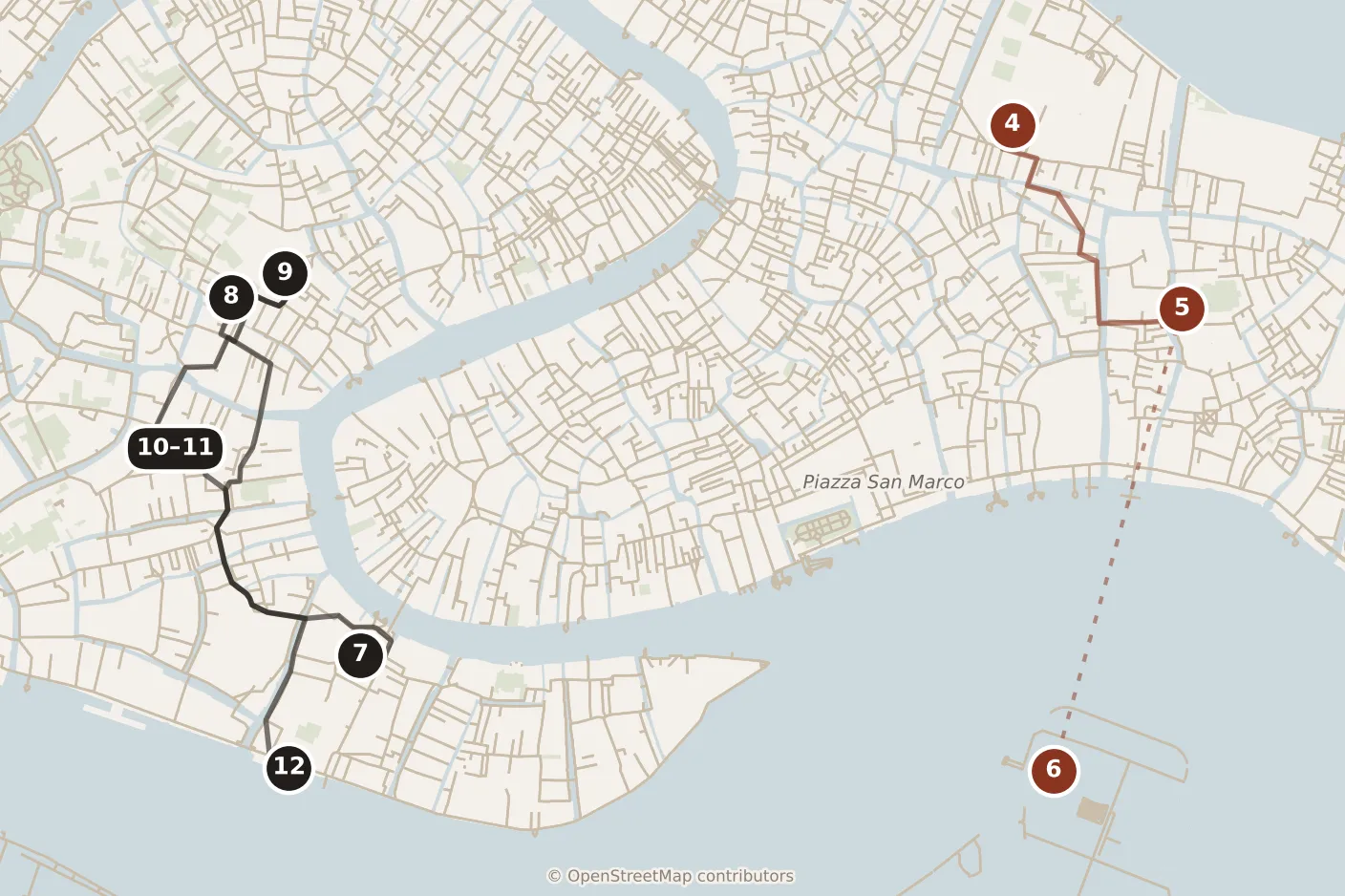
- Day one
- 4Santi Giovanni e Paolo
- 5Scuola di San Giorgio degli Schiavoni
- 6Church of San Giorgio Maggiore
- Day two
- 7Gallerie dell'Accademia
- 8Scuola Grande di San Rocco
- 9Santa Maria Gloriosa dei Frari
- 10campo Santa Margherita
- 11Ca' Rezzonico
- 12Zattere
Day one

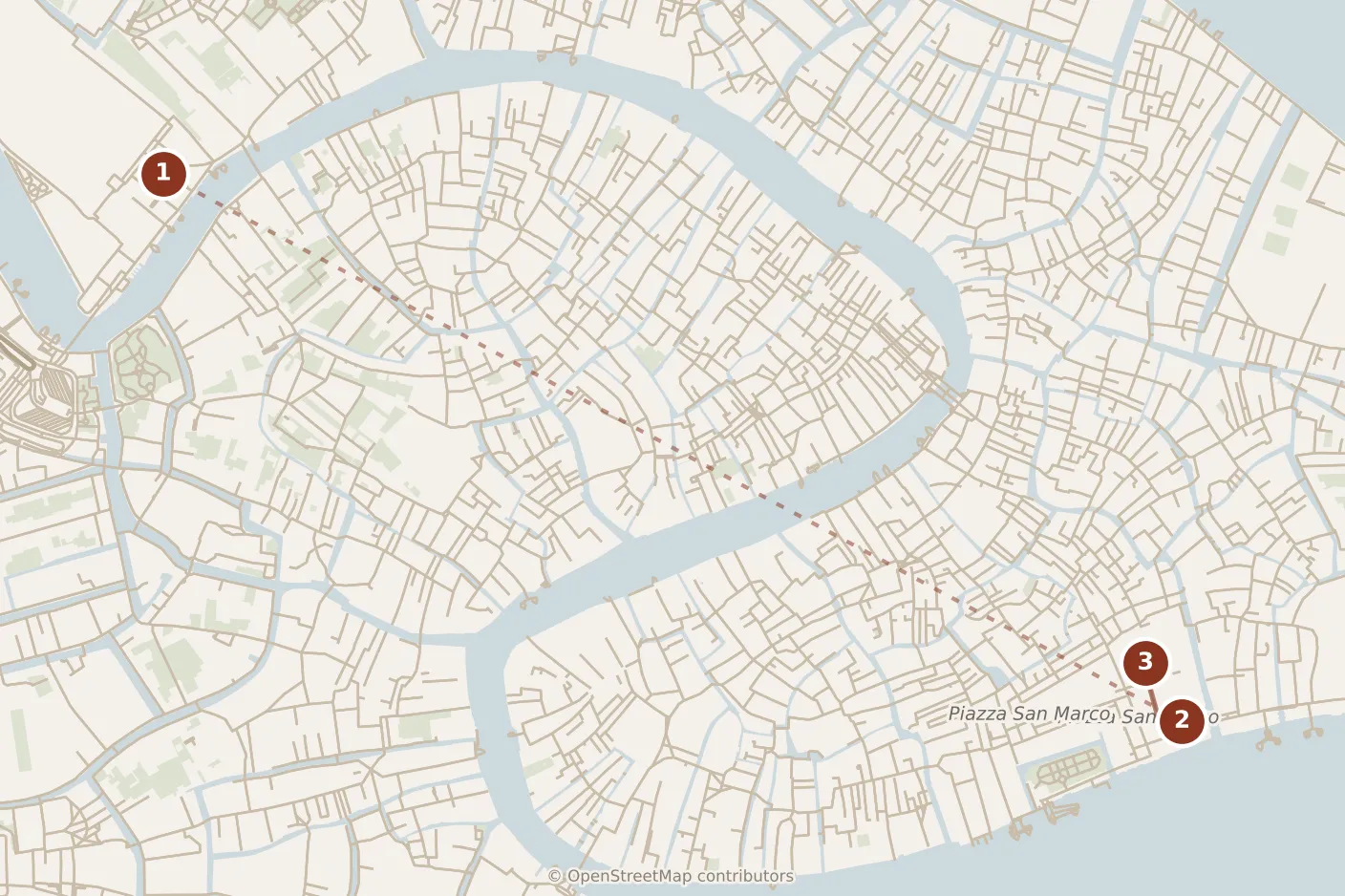
- Morning
- 1Venezia Santa Lucia
- 2Doge's Palace
- 3St Mark's Basilica
Today is the state and the church, in that order, and then two smaller interiors in Castello. Everything until the last hour is within seven hundred meters of the same square, and the last hour is a five-minute crossing.
Morning
The palace door is on the Piazzetta, the short arm of the square that opens to the water, and it admitted visitors from nine in 2026. Take the earliest hour you can get and build the day forwards from it; if the hour has moved, build it forwards from the new one, because everything below is a chain and only the front of it is fixed.
Give the Doge’s Palace two hours. It was the residence, the parliament, the civil service and the gaol of a republic that lasted a thousand years, and the visit runs through all four in one one-way route. What you come out into first is the courtyard and the Scala dei Giganti, the ceremonial stair with Sansovino’s two colossal Mars and Neptune standing at the top of it, where a doge was crowned; then the Scala d’Oro, gilded and stuccoed, which was the route to the rooms where things were decided. The room to slow down in is the Sala del Maggior Consiglio, fifty-three meters by twenty-five, one of the largest rooms in Europe and built to seat every patrician in the city at once. The whole end wall is Tintoretto’s Paradiso, painted between 1588 and 1592 and said to be the widest canvas painting in the world; the frieze above the walls is a row of portraits of doges, with one space painted out in black because its occupant was beheaded for treason in the fourteenth century. Almost none of what you see is older than the 1570s — two fires, in 1574 and 1577, burned out the state rooms and most of the paintings in them, and the Republic rebuilt it in the Gothic style it had already grown out of rather than in the Renaissance one Palladio offered.
Then the route drops. It crosses the Bridge of Sighs, put up after 1600, and comes out in the New Prisons on the far side; the older cells are in the building itself, the Pozzi on the water line and the Piombi under the lead of the roof, and Casanova escaped from the second in 1756.
Local tip. The route through the palace is one-way and the prisons come at the end of it, which is a trap if you spend your two hours in the first rooms. The state apartments and the armoury are the part to take at a walk. Give the council chamber a proper twenty minutes and keep twenty for the bridge and the cells, because there is no going back for them.
Two minutes across the square is St Mark’s Basilica, on the slot you booked, and give it an hour. The church itself is a marked one-way route with no stopping, so the hour is not an hour in the nave: it is twenty minutes moving through a dark building full of gold, ten in front of the Pala d’Oro behind the high altar, and the rest upstairs in the museum and out on the Loggia dei Cavalli, which is the part a shorter trip cuts and the reason to buy the larger ticket. The four gilded bronze horses on the loggia are the originals, indoors since 1974; the ones on the front of the building are copies. There is a security check at the door with a bag scan, large bags are not admitted, and there is a dress rule enforced without argument: shoulders and knees covered, nothing on a man’s head. Leave anything sizeable somewhere before you join the line rather than at the head of it — check the basilica’s own access page for where — because a timed slot turned back at the door leaves you minutes, not options. In 2026 the basilica admitted nobody before half past nine from Monday to Saturday, and nobody at all until two in the afternoon on a Sunday. The second of those is the one that can break this morning; what to do about it is in the Practicalities, and the method survives the hour moving.
Afternoon
Lunch happens in the lanes running north-east out of the square, towards campo Santa Maria Formosa, which is on the way to this afternoon’s first stop, and it happens standing up. This is cicchetti — small things on bread or on sticks taken at a counter with a small glass of wine — and baccalà mantecato, whipped salt cod, is the one to ask for by name. Three quarters of an hour. Do not take it outside and sit down with it on the paving or on a bridge step: eating seated on the ground in the square, on the bridges and along the monumental quays is fined here, and the rule is enforced. The campi have benches and wellheads and nobody minds at all; the distinction is between a square and a monument, and Venetians make it without thinking.
Eleven minutes north of the basilica is Santi Giovanni e Paolo, the great Dominican barn of a church that the city calls San Zanipolo, and it is the burial place of the doges — around twenty-five of them, in tombs stacked up the walls like a filing system. Give it three quarters of an hour, and give ten minutes of that to Bellini’s polyptych of Saint Vincent Ferrer, nine painted panels in a towering gilt Gothic frame, which is early and strange and hardly ever has anyone in front of it. Outside in the campo, Verrocchio’s bronze condottiere Colleoni sits his horse on a high plinth, unveiled in 1496 and one of the two great equestrian bronzes of the Renaissance; and the marble front standing against the church, all trompe-l’oeil perspective panels that pretend the flat wall has depth in it, is the Scuola Grande di San Marco, which is the city hospital now and has been for two centuries. You can walk into its entrance hall.
Eight minutes back down towards the water is the Scuola di San Giorgio degli Schiavoni, and it is the smallest thing on these three days and one of the best. A confraternity of Slav and Dalmatian sailors was approved in 1451 and built this in 1507, and between 1502 and 1507 Carpaccio filled its single ground-floor room with nine canvases of their patron saints out of the Golden Legend: Saint George riding down the dragon across a floor of half-eaten corpses, Saint Jerome bringing the lion into the monastery and the monks fleeing in every direction, Saint Tryphon and the basilisk, and Saint Augustine in his study at the moment he learns Jerome has died, with the light coming in and the little dog looking up. It is one room, it takes forty minutes, and nothing in it has moved since it was painted.
Evening
Six minutes south-west, coming out onto the Riva degli Schiavoni, is San Zaccaria, and from there line 2 crosses to San Giorgio in about five minutes — one stop, and the shortest ride in this article does the most work in it, because it is the only moment on day one when you see the whole waterfront you have spent the day inside.
The Church of San Giorgio Maggiore is Palladio’s, begun in 1566: a white classical temple front on the water facing a Gothic city, which is the whole argument of the sixteenth century in one view. Inside, past a nave of gray stone and white plaster with almost no color in it, two very late Tintorettos face each other across the chancel — a Last Supper set at a slant in a smoky kitchen with the servants going about their work, and a Gathering of the Manna opposite — painted at the very end of his life and quite unlike the Paradiso you stood in front of this morning. Give the church three quarters of an hour, and take ten of it standing on the quay outside rather than in. In 2026 the church here was open every day and shut at six, which is the back wall of this day: start later than about half past eleven and the island is the piece that goes. The bell tower, which is the reason many people come, was closed for maintenance in 2026 with no announced reopening — check whether it is back, and plan the evening so that the answer does not change it, because the quay at the foot of it is free, is never shut, and holds the same view at a lower angle. The rest of the island belongs to a foundation and is not a walk-in.
Take line 2 back to San Zaccaria and eat in Castello, in the lanes between the water and campo Santa Maria Formosa rather than on the Riva itself. This is the night for fegato alla veneziana — calf’s liver under a great mound of onions cooked down until they are sweet — which is a sit-down dinner and not a counter dish.
From the palace door to stepping back off the boat, this day comes to about six and three quarter hours: five hours and fifty-five minutes inside the places, not quite half an hour of walking between them, and twenty minutes of water including the wait at the pontoon. What that count does not hold is the basilica’s entrance. A timed slot puts you in the shorter line and not past the scan behind it, so add a quarter of an hour there, and add it to the front of the day rather than the end.
Day two

Today is four interiors and a square inside a triangle eight hundred meters on its longest side, and it is the day the trip is really for. Everything is walked. Start from the Accademia landing, which lines 1 and 2 both serve and which sits at the foot of the wooden bridge of the same name; from most of the center it is under twenty minutes on foot.
Morning
The Gallerie dell’Accademia opened at nine in 2026 and this day is built on being there for it. Two hours. It is Venetian painting and almost nothing else, five centuries of it in the order it happened, in a building that was a church, a monastery and a confraternity house before it was a gallery. What it gives that no other collection does is the sequence: the gold-ground panels, then the moment color and weather arrive, then the vast narrative canvases painted for rooms this size — processions and miracles with the city itself in the background, painted from life, so you can stand in front of a square you have walked through as it was in 1500. What to give up is the eighteenth century at the far end, which is good and is the one part of this gallery that this day sees better elsewhere, later this afternoon, in the palace it was painted for.
Thirteen minutes north-west, through the lanes rather than along any canal you could name, is the Scuola Grande di San Rocco, and it is the reason this day is arranged the way it is. A lay confraternity commissioned Tintoretto in 1564; he and his son Domenico kept working here until 1587, and everything on the walls and ceilings of all three rooms is theirs. The Sala Terrena on the ground floor is the life of the Virgin. Upstairs the Sala Superiore has the Old Testament overhead and the New Testament round the walls, and off it the small Sala dell’Albergo holds the Crucifixion, which fills an entire wall and puts the whole hill in one continuous scene with the crosses still being raised at the edges of it. Give the building an hour and a quarter. The ceiling is what defeats people here: take the walls first, then sit down on a bench and take the ceiling in three goes rather than standing in the middle of the room with your head back. In 2026 it opened at half past nine and, on a Sunday, not until half past one.
Two minutes on is Santa Maria Gloriosa dei Frari, begun in 1250, its front finished in 1440 and the church consecrated in 1492. An hour. It holds three things nothing else does. Titian’s Assunta of 1516–18 is on the high altar and is framed by the choir screen so that it appears at the end of the nave like something at the end of a tunnel — walk to the back of the church and look at it from there before you go up to it. His Pesaro Madonna of 1519–26 hangs on the aisle wall on your left as you walk up and moves the Virgin off the center of the picture, which nobody had done. In one of the chapels flanking the high altar is Donatello’s wooden John the Baptist, gaunt and gilded, his first documented work in the city. Titian is buried here; Canova is not, but his heart is, inside a white marble pyramid with a half-open door and a procession of mourners walking into it, which his pupils built for him. The sacristy’s Bellini triptych was in restoration through 2026 — the Frari publishes the state of the work itself, so read that before you come and let the rest of the hour go to the nave if it has not returned. The bell tower outside, finished in 1396, is the second tallest in the city and you cannot go up it.
Afternoon
Seven minutes south-west is campo Santa Margherita, and lunch is here and it is an hour, sitting down. It is not the largest square in this half of the city — campo San Polo, a little to the north-east, is that — but it is wide and irregular, it has a university on one side of it, and it is busy in a way nothing on day one is. Sarde in saor — fried sardines under a cold tangle of onions, vinegar, pine nuts and raisins — is the dish to look for, and this is a square where sitting outside with it is entirely ordinary, which the square day one eats beside is not.
A minute away, on the Grand Canal, is Ca’ Rezzonico, and an hour and a quarter. Longhena began it in 1649 and died with two floors built; Massari finished it a century later, in the 1750s, and what that accident produced is a palace whose interior is all one moment — the eighteenth century, the last of the Republic, which is the century Venice is least often shown in. It is the Museo del Settecento Veneziano now. The ballroom is fourteen meters by twenty-four with a painted sky over it; there are Tiepolo ceilings upstairs; and the rooms that stay with people are the small ones, Longhi’s little paintings of Venetians doing nothing in particular — a rhinoceros on show, a dressmaker, a card game — which are the only honest pictures of ordinary life the city produced. Robert Browning died in an apartment on the mezzanine in 1889. This palace closes on Tuesdays and the churches on this day close on nothing — so a Tuesday costs you the afternoon, and if that is your day, walk the nine minutes to the quay early and take the Gesuati, the church of Santa Maria del Rosario standing on it, which is half an hour, has a Tiepolo ceiling of its own and is on the Chorus pass that covers sixteen Venetian churches for the price of four of them.
Evening
Nine minutes south the lanes end at the Zattere, and this is the last stop and the reason the day runs the way it does. It is a kilometer and a half of open stone quay facing the Giudecca across its own wide channel, and it is the only place in the old city where you get sky, distance and a horizon at once — everywhere else you have been for two days is a corridor. The channel runs away west on your right, and that is where the sun goes.
Counting backwards, in the short half of the year. Two hours in the gallery, an hour and a quarter in the Scuola, an hour in the Frari, an hour over lunch and an hour and a quarter in Ca’ Rezzonico come to six and a half; half an hour of walking between them makes a little over seven. Take your month’s sunset from the Overview and count back that much. In the second week of December the sun goes just before half past four, which puts the start at the gallery’s own opening and puts you on the quay a bit under half an hour before the light goes — and that is the whole of the margin, which is why nothing can be added to a December version of this day.
In the long half it does not close, and the honest thing is to say so rather than to pretend. A June sunset is five hours after this day ends, and you cannot simply start five hours later: the Scuola Grande di San Rocco shut at half past five in 2026 and the Frari beside it not long after. A two o’clock start reaches the Scuola at about a quarter past four, which leaves it exactly the hour and a quarter it takes and not a minute over, and reaches the Frari after it has closed. So this day runs forwards in summer and the spare hours are spent rather than saved. Four of the five have somewhere to go. An extra hour in the gallery at the start, which slides everything an hour later and still puts you into the Scuola before half past twelve. Half an hour at the Gesuati on the way down to the quay. An hour and a half over a sit-down dinner in the lanes behind it. And an hour on the last move, which is line 2 from the Zattere landing across to Palanca on the Giudecca, three minutes on the water, and then a kilometer of its fondamenta walked slowly with the whole waterfront of Venice opposite you and the low sun on it rather than behind it. The fifth hour is the point and you spend it standing still.
Dinner comes after the day rather than inside it, in either half of the year, and it is not in the seven hours counted above. The lanes immediately behind the quay, on the way back up towards the Accademia landing, are a sit-down quarter five minutes off the water and are not the ones you had lunch in. In December you are at a table not long after the light has gone; in June it is the hour and a half the paragraph above has already put there.
With a third day

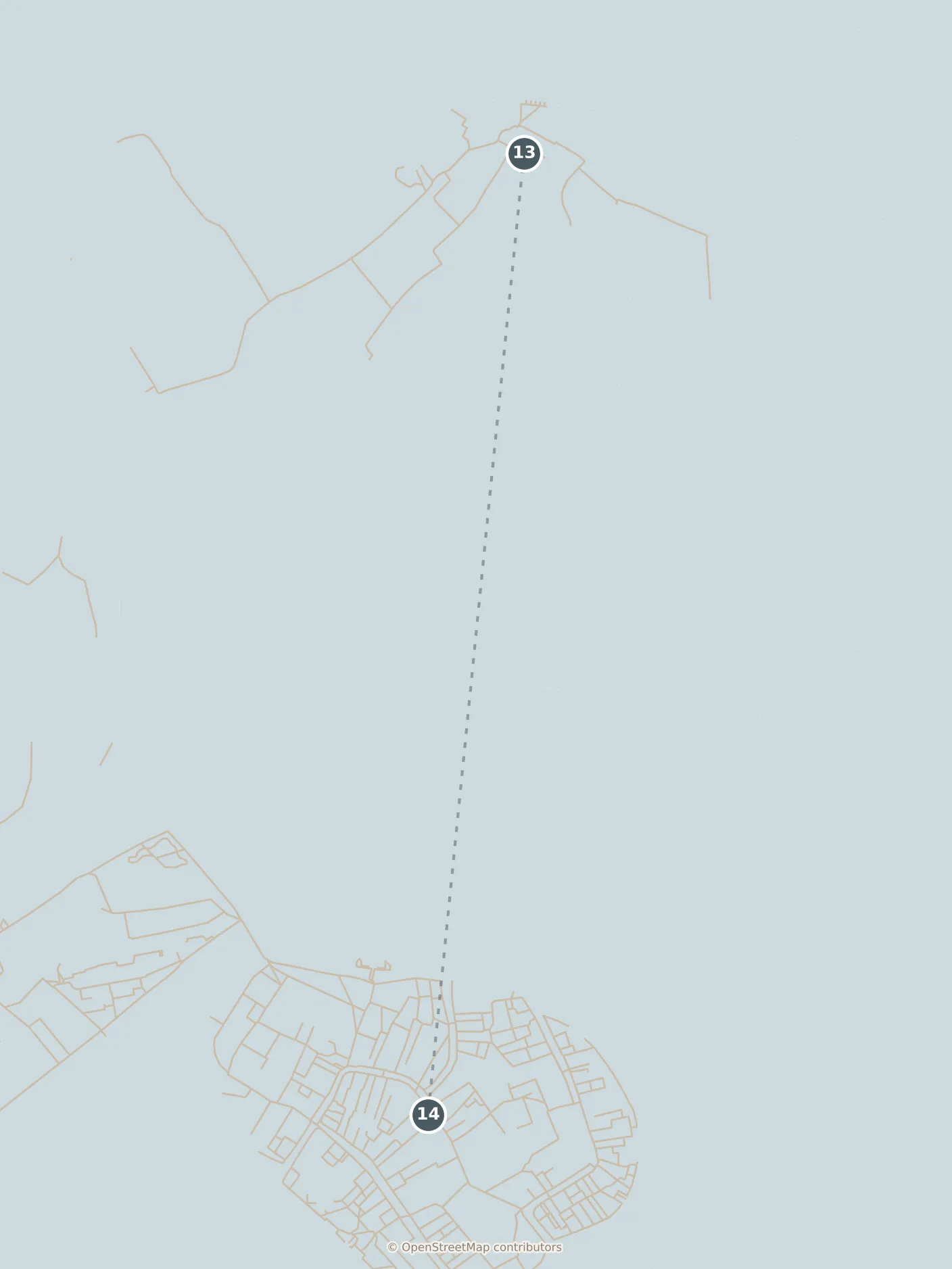
- With a third day · stops 13–14
- Fondamente Nove — in the prose, not on the map
- 13Torcello Cathedral
- 14Burano
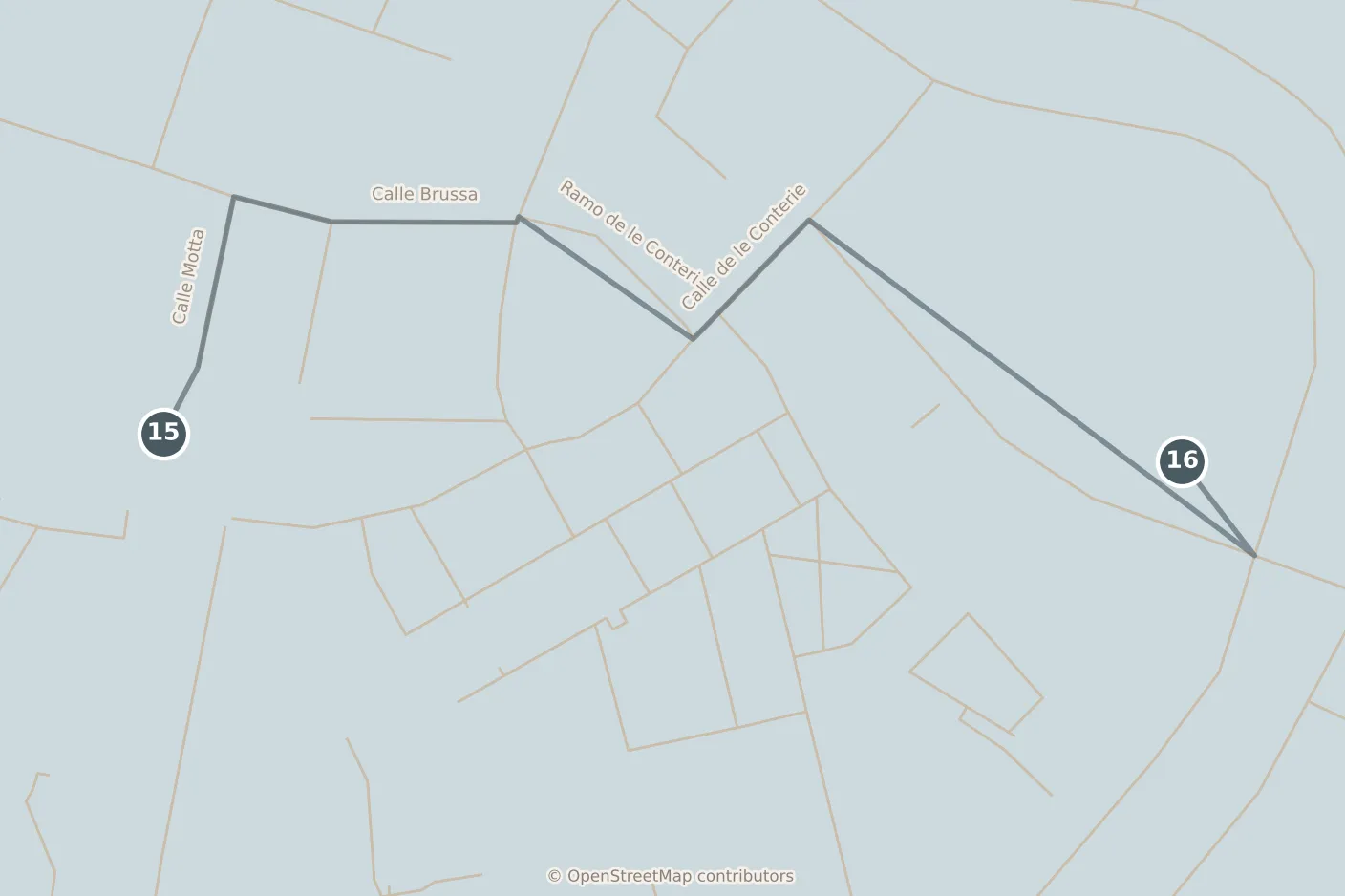
- With a third day · stops 15–16
- 15Murano
- 16Church of Santa Maria e San Donato
The third day leaves the city, and it is the thing every short trip in Venice gives up. It goes out into the northern lagoon to Torcello, Burano and Murano, and the order matters more than any other order in this article: go to the furthest first and come back through the others. Torcello is fifty minutes away and its one great interior opens at ten, so the only way to be at that door when it opens is to make it the first thing; and coming back through the other two puts the island with the lunch on it at lunchtime and the island with the shops on it in the afternoon. Done in the other direction the day has you eating on Murano at eleven and arriving at Torcello when the boats out have been arriving all day.
It is appended rather than inserted, unless one of your dates is a Monday. Days one and two are a sequence — the state and the church, then the painting the state and the church paid for — and a day at sea in the middle of them breaks it. But this is also the only one of the three days that no weekday touches at all, so if a Monday falls inside your dates it belongs here, and the city day it displaces moves to the third date. Nothing else changes when it does: day one and day two hold together in either order, with the one caveat in the Practicalities.
Leave from Fondamente Nove, the long north quay, which is about a quarter of an hour on foot from the Rialto and half an hour from the station. Line 12 runs from there out to Burano in about three quarters of an hour, calling at Murano Faro on the way, and some of its departures run through to Torcello itself; where they do not, line 9 shuttles the five minutes between Burano and Torcello. Take a through boat if the schedule offers one, because the change at Burano is onto a separate half-hourly service and one missed connection costs you the door the whole day is built on. The count the day is built from is a nine o’clock boat: three quarters of an hour out, five minutes across, ten minutes’ walk from the Torcello landing along the single path beside the canal, and the cathedral opens at about ten. That hour is the kind that differs between summer and winter rather than only between years, so read the current one and set the boat from it — everything below stays as it is.
Torcello is an hour and a quarter and it is why the third day exists. This was the city before Venice was: settled from the mainland in the fifth century, thirty thousand people at its height, finished off by malaria and silt, and now about a dozen residents and a field. Torcello Cathedral was founded in 639 and is the oldest church in the lagoon, a bare Byzantine hall with a stone floor and no decoration whatsoever except at its two ends, which is what makes them work: over the door as you leave, a Last Judgment in mosaic covering that whole wall in registers, with the damned being sorted into fire; and at the far end, in the apse, the Virgin standing alone on a plain gold ground with a single tear on her cheek and nothing else in the field at all. Santa Fosca beside it is a Greek cross church of the eleventh century with an octagonal colonnade round it, five minutes and free. In the grass between them sits a stone chair the island calls Attila’s throne, which has nothing to do with Attila and was probably a magistrate’s seat. The rest of the island is a path, a canal and a bridge with no parapet.
Back across to Burano and give it two hours, one of them lunch. It is a fishing island of about two thousand people whose houses are painted in flat, saturated, uncoordinated colors — the usual explanation is that fishermen wanted to pick out their own house from the water, and the useful fact is that the colors are regulated now, so you apply to the council for permission to repaint. The campanile of the parish church leans visibly and alarmingly. Lace was the industry before tourism and there is a small museum of it on the main square. Lunch is the reason to give this island two hours rather than one: risotto de gò, made with the lagoon goby, is a Burano dish and is genuinely local; the almond-ring cookies called bussolai buranelli come with the coffee after it.
Half an hour back down the line is Murano, and an hour and a half. Glass has been made here since 1291, when the furnaces were moved off the main islands because they kept setting the city on fire, and the working furnaces that admit visitors do so on their own terms — some sell a demonstration, some do not want you there, and the shops along the fondamenta are the ordinary face of it. What separates glass made here from imported stock is a registered mark, Vetro Artistico Murano, held under a Veneto regional law of 1994 and applied to the piece itself; look for it rather than for a shopfront’s word. What is worth the walk regardless is the Church of Santa Maria e San Donato at the far end of the island, a little over ten minutes from the landing. It was rebuilt around 1140 and it has a mosaic floor of that date covering more than five hundred square meters — peacocks, eagles, geometry, all in cut stone, buckled where the ground has moved — under an apse holding a single standing Virgin on gold in the same manner as Torcello’s. Behind the altar, hanging on wires, are three rib bones over a meter long and a vertebra, which the church has always said are the dragon Saint Donatus killed and which are more probably a whale’s. Getting back is the one leg of this day to settle before you walk it: line 12, the boat you came out on, calls at Murano Faro and not at Museo, the landing under this church, so it is either ten minutes back along the fondamenta to Faro and ten more across the water, or lines 4.1 and 4.2 from Museo itself, which take rather longer and call all the way round the island. If the bag is at the station and the train is tonight, take line 3 from Museo instead and go straight to Ferrovia.
The day comes to about six and a half hours, of which more than an hour and a half is spent sitting on boats and the rest is the three islands, walking on them included. What the count leaves out is the waiting, and on this day that is not a rounding error: line 12 is roughly half-hourly, you use it three times and line 9 up to twice, out to Torcello and back, and you should budget up to an hour of standing on pontoons across the day. Call it seven and a half hours door to door, and start it at nine. Fondamente Nove comes out in Cannaregio, and the canal-sides five minutes west of the landing are where that evening’s dinner is: a sit-down quarter, and the third of the city’s quarters these three evenings eat in.
Local tip. If the day has to be shortened, Murano is the piece to drop and not Torcello, which is the opposite of what most people do. Coming straight back from Burano on line 12 is about three quarters of an hour and saves you an hour and a half; and Murano is ten minutes from Fondamente Nove on its own, so it is the one of the three that fits into a spare afternoon on any other day. Torcello does not, and Torcello is what you came out here for.
Practicalities
Booking. Two things, both before you travel: the Doge’s Palace timed entry and the basilica’s timed slot, both on Venezia Unica and both on day one — and if day one is a Sunday, the basilica’s is the two o’clock slot rather than a morning one, for the reason in the weekday rules below. The palace also sells guided routes of its own through the chancery, the interrogation rooms and the cells under the roof, in small numbers and on a fixed schedule; the palace publishes them itself under its special routes, and if you want one it is an optional third booking made at the same time as the ordinary ticket rather than on the day. Nothing on day two takes a reservation — the gallery, the Scuola, the Frari and the palace on the canal all sell at the door — and nothing on the lagoon day takes one either.
What to read in the week before you go, collected here because the article scatters it. The gallery’s opening calendar and Ca’ Rezzonico’s — a Monday and a Tuesday, and the two that shape day two; the Scuola di San Giorgio degli Schiavoni’s week; whether the Frari’s Bellini triptych is back from restoration and whether the bell tower on San Giorgio has reopened; Torcello’s current opening hour, which is the pin the third day hangs from; the tide forecast, three days out rather than now; and whether one of the six dates in the Overview lands inside yours. Every hour and closing day named in this article is what was published in 2026 and is given so you can recognize the shape of the thing — the current one is on the door’s own page, and every count here is built to slide when it moves.
The weekday rules, which is what you need rather than a start day, because your train arrives when it arrives.
- Day two must miss Monday. The Gallerie dell’Accademia closed on Mondays in 2026 and it is the first two hours of the day; the Scuola and the Frari behind it are open on a Monday and cannot carry a morning on their own. There is no reordering that saves this one — and since it is the line in this article carrying the most weight, confirm it on the gallery’s own calendar before you book anything around it.
- Ca’ Rezzonico closes on Tuesday. It is day two’s afternoon, so day two has two forbidden weekdays rather than one — and because days one and two trade places freely, a Monday and a Tuesday inside your dates are absorbed rather than fatal: the lagoon day takes the Monday, day one takes the Tuesday, day two takes whichever date is left. If you do end up there on a closed Tuesday, the Gesuati on the Zattere is the replacement and the day is three quarters of an hour shorter, which in the long half of the year it can afford.
- The lagoon day takes any weekday there is, and it is the only one of the three that does. The cathedral on Torcello, the church at the end of Murano and the two islands themselves keep no weekly closure between them, which is what makes this the day to put on a Monday.
- Day one has one stop with a weekly closure I would not swear to, and it is the Scuola di San Giorgio degli Schiavoni, a small institution that keeps its own week. Check it before you set out. If it is shut on your day, it is also the stop this article nominates to cut, so what a bad weekday costs day one is forty minutes and nothing structural — the palace, the basilica, the Dominican church and the island church were all open every day in 2026.
- Sunday closes nothing and reorders two mornings. The basilica admitted nobody until two in the afternoon on Sundays in 2026, and the Scuola Grande di San Rocco not until half past one; the Frari gives its Sunday morning to worship as well and publishes its own hour. Both days survive by turning inside out rather than by moving. A Sunday day one is the palace at nine, then the Dominican church and the Schiavoni, then lunch, then the basilica on a two o’clock slot and the island after it: that costs about a quarter of an hour more walking, because you cross back to the square in the middle, and it costs nothing else — the island church shuts at six and this order reaches it well before four. A Sunday day two is the gallery at nine, then the palace on the canal and lunch on the square brought forward into the hole, then the Scuola at half past one and the Frari after it, and the quay at about a quarter past four. The walking comes out the same and the December light still works, on ten minutes of margin rather than half an hour.
- The arrival that quietly breaks this is an afternoon one. Day one is pinned at nine, day two at nine, and the lagoon day at nine; none of the three absorbs a late start. The honest answer is that the afternoon you land is not one of the three days at all, and what to spend it on is the one stretch none of the three walks: line 1 down the Grand Canal from the station, off at the Rialto, and the lanes behind it until dinner. Not the Zattere — that is day two’s ending and doing it first spends it. And not the Rialto market either, which keeps a fishmonger’s hours and is finished by the middle of the day; it is the reason the one-day version of this trip opens where it does, and it cannot share a morning with a door that opens at nine.
- Days one and two will otherwise trade places. The only thing lost by swapping is that day one is the easier arrival day, because it begins on a square you can walk to from the platforms in half an hour.
If something has to go, this is what goes and what it buys. On day one it is the Scuola di San Giorgio degli Schiavoni: forty minutes, near enough all of it the visit, because the walk down to the landing from the Dominican church is fourteen minutes whether you stop there or not. On day two it is Ca’ Rezzonico: an hour and a quarter, on the same day, and it is the one that can go because the two rooms before it are the day’s whole argument. On the lagoon day it is Murano, as above. What should not go on any of them is the Scuola Grande di San Rocco, which is the single room on these three days with no substitute anywhere.
Local conduct, which the city enforces rather than requests. Shoulders and knees covered in the basilica and checked at its door, and the same is expected in the working churches on day two. Eating while sitting on the ground in Piazza San Marco, on the bridges or along the monumental quays carries a fine; the campi do not, and campo Santa Margherita on day two is the demonstration of the difference. And the day-visitor access charge the city ran on selected spring days from 2024 is not in force: the trial ended on 27 July 2026, and whether it comes back is a decision the city has not taken. If you find it running again, an overnight stay exempted you while it ran — but the exemption was registered rather than assumed, and the place it was settled was wherever you were sleeping, so ask them rather than the city.
Getting between the stops. Day one is about two kilometers on foot inside the city, the longest single stretch being the eleven minutes from the basilica to the Dominican church, plus one crossing on line 2 from San Zaccaria to San Giorgio and back. Day two is about two kilometers as well, the longest stretch the thirteen minutes from the gallery to the Scuola, and no water at all until the optional summer hop to Palanca at the end. The lagoon day is almost all water: line 12 from Fondamente Nove and line 9 across to Torcello, with about forty minutes of walking on the islands themselves, all of it flat and all of it counted inside the hours above. Everything else in this article is walked, and none of it is step-free — the crossings between the sestieri are stepped bridges, which is the whole argument for leaving the bag at Venezia Santa Lucia rather than pulling it behind you, and which also means this route as written will not work for a wheelchair or a pram. Each of the three big interiors publishes its own access arrangements, and each of them is easier to get into than the lanes are to cross: the doors are not the obstacle here, the ground between them is.


_-_Portal.jpg)

.jpg)