Venice in one day: the market first, the basilica in the middle, the point at dusk

Last updated 4 August 2026
Overview
Venice is unusually generous to a single day, for a reason that has nothing to do with its size and everything to do with where the trains stop. Venezia Santa Lucia stands on the Grand Canal: you come out of the doors and the city is already in front of you, with no ride in from an outskirt and no transfer. The route below is about four and a half kilometers of walking spread over a whole day. It runs east from the station to the Rialto, crosses to Piazza San Marco, then bends away to the far tip of Dorsoduro. It never doubles back, and it comes home on the water.
What one day costs you is the lagoon and two great interiors. Murano and Burano are each half a day of boat before you have looked at anything, and a day that goes out to them is a day about the lagoon rather than about Venice. The Doge’s Palace and the Gallerie dell’Accademia are a different sort of loss, because they are not a detour at all: the first stands on the square you cross in the middle of the afternoon, the second at the foot of the bridge you cross an hour later. Leaving them out is not a decision about geography. It is a decision about hours, and how many you have depends on the month.
The fixed point at the beginning is the Rialto market. It is a working retail market rather than a display, which means it is a morning, and there is no version of this day that puts it later. The fixed point at the other end is Santa Maria della Salute, for the opposite reason: it is a working church rather than a monument, it shuts for a couple of hours around the middle of the day like Venetian churches generally, and it does not stay open into the evening. So it belongs to the second half of the afternoon in every month of the year, and the wedge of land beyond it — which has no door and never shuts — is the last stop of all.
Those two facts leave a hole in the early afternoon, and that hole is why the two interiors this route skips are worth knowing about. Walked straight through, the day comes to about five and a half hours: the time spent inside the places, plus a little over an hour of walking between them, and nothing else. Start in the middle of the morning at the latest, for the market’s sake, and five and a half hours puts you at the Salute’s door in the early afternoon, which is exactly when it is shut. Something has to fill that gap, and the Gallerie dell’Accademia stands at the foot of the bridge you cross on the way there — so on a short day it is not an extravagance, it is the thing that makes the order work. On a long day take the Doge’s Palace as well, in the middle of the afternoon on the square where it stands. The order to watch then is the last one: two interiors in an afternoon can push you to the Salute after it has closed for the evening, and if something has to go it is the gallery and not the church, because the church is what the end of this day is built out of.
The light is the last variable and it is a wide one. Venice loses the sun in the middle of the afternoon in December and keeps it until late in the evening at the end of June. In December the route as arranged above puts you out on the point in the last of the light, which is the best version of this day. In June it will have gone dark long after you got there, and the honest advice is not to stand on a quayside for three hours waiting: go when you have seen it, and let the light find you on the boat home instead, which runs the whole Grand Canal and is no worse a place to watch it from.
What the five and a half hours does not count is the basilica’s front door. A timed slot puts you in the shorter of two lines rather than past the check at the entrance, so allow a quarter of an hour there, and do not take it out of the morning. The check is a metal detector and a bag search, and it enforces a dress rule as well: shoulders and knees covered, no bare feet, nothing on a man’s head, verified at the door without exceptions.
The bag, finally, and here it decides more than comfort. Venezia Santa Lucia has a staffed left-luggage office; this day begins on its platforms and ends at its landing stage, so leaving it there costs no detour at either end. Insist on it, because the one door this whole day is built around will not take it: the basilica’s access rules refuse a rucksack or a bag larger than 40 by 30 by 20 centimeters, and a wheeled case in no case at all, and there is no cloakroom at the door to leave either in. The steps are the second argument. This route crosses the Grand Canal three times, every one of those crossings is a flight of steps, and there are a few dozen smaller ones in between.
If you arrive still holding it — the office shut, the line longer than the morning will bear — the day is still worth walking, but it is a different day and it is better to choose it than to meet it at the security check. Take the same line in the same order and leave out the inside of the basilica, which is the one thing the bag costs you and the reason to settle it before you buy a slot: the Ponte degli Scalzi, campo San Polo, the market and San Giacomo, cicchetti in the lanes, the Rialto bridge, then Piazza San Marco from the outside, where the square, the arcades and the front of the church refuse nothing. Then the Accademia bridge, the Salute, which publishes no rule about bags, its sacristy, and the point. That is about four and a half hours rather than five and a half, it ends in the same place and on the same boat, and every step of it is carried.
The day

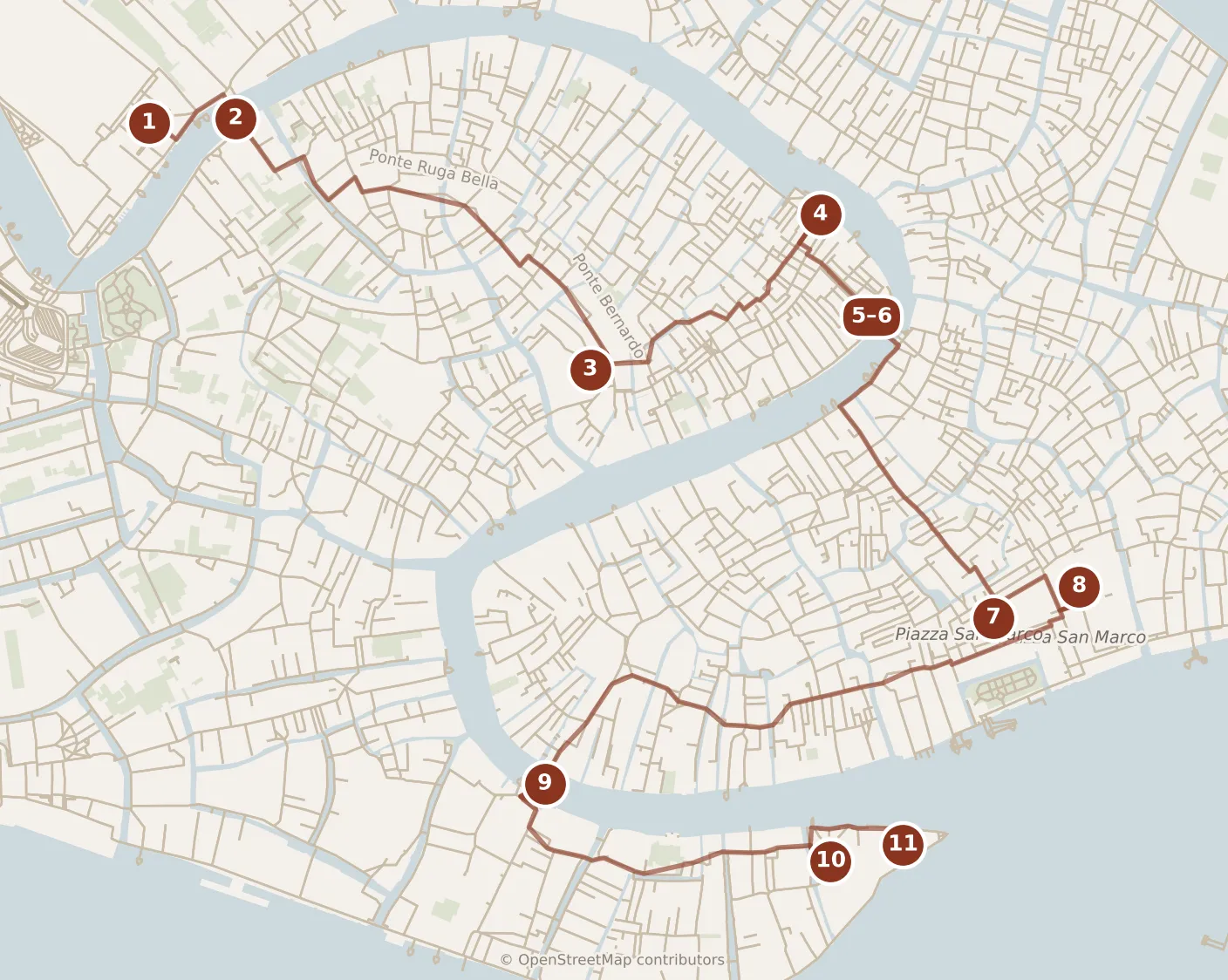
- The day
- 1Venezia Santa Lucia
- 2Ponte degli Scalzi
- 3campo San Polo
- 4Mercato di Rialto
- 5San Giacomo di Rialto
- 6Rialto Bridge
- 7Piazza San Marco
- 8St Mark's Basilica
- 9Ponte dell'Accademia
- 10Santa Maria della Salute
- 11Punta della Dogana
Morning
Come out of Venezia Santa Lucia onto the water, and the first thing to do is cross it. The Ponte degli Scalzi is three minutes from the platforms: a single stone arch built by Eugenio Miozzi in 1934 to replace an Austrian iron bridge, and one of only four crossings of the Grand Canal in the entire city. Go over it. Almost everyone leaving the station walks the other way, along the main thoroughfare on the near bank; you are heading for the same place by the quieter side, through Santa Croce, and it is no further.
Thirteen minutes of that brings you into campo San Polo, the largest campo in Venice and the second largest open space in the city after Piazza San Marco. It was grazing land until it was paved in 1493, and after that it was where Venice held its bullfights, its open-air sermons and its masked balls; Lorenzino de’ Medici was murdered on it in 1548. Carnival still happens here. There is nothing to go inside, and that is the reason to stop: a wide empty square with a wellhead in the middle and children on it, ten minutes and a coffee, and the last quiet thing before the market.
Nine minutes east is the Mercato di Rialto, which has been the city’s market since 1097 and is the oldest continuously working thing on this route. Fish is sold under the loggia of the Pescheria, fruit and vegetables in the arcades of the sixteenth-century Fabbriche beside it. What to look for is what comes out of the lagoon and out of nowhere else: soft-shell crabs when they are in season, mantis shrimp, small cuttlefish sold with the ink sac still in them. Give it half an hour. Do not plan on it for the afternoon — it keeps a fishmonger’s hours, not a monument’s, and by the middle of the day the stalls are hoses and empty crates.
Three minutes on, at the foot of the bridge, is San Giacomo di Rialto, and it goes here rather than after lunch for a reason: it is a small church, it keeps a small church’s hours, and the middle of the day is when it will be shut. Tradition makes it the oldest church in the city and the documents do not go back nearly far enough to support that, but it is certainly one of only two buildings on this square to survive the fire that destroyed Rialto early in the sixteenth century. Over the door is a large fifteenth-century clock which has been a local joke for its unreliability for as long as anyone has written about the place. Inside is a Latin cross the size of a large room, on six columns of ancient Greek marble under eleventh-century capitals; the floor was raised from 1601 to keep the acqua alta out of it. Ten minutes.
Then lunch, back in the lanes you have just walked through, and it happens early, which is the right order rather than a compromise. Those lanes are where the bàcari are, and the Venetian lunch is cicchetti — small things on bread or on sticks, taken standing at a counter with an ombra, a small glass of wine — rather than a plate. Take sarde in saor, sardines soused with onions, pine nuts and raisins, and baccalà mantecato, whipped salt cod on bread. Three quarters of an hour, on your feet. Eating this early feels wrong and is exactly what buys the basilica the middle of the day.
Afternoon
A minute from that door is the Rialto Bridge, begun in 1588 and finished in 1591 to Antonio da Ponte’s design: one stone span carrying two ranks of shops up to a portico at the summit. Vincenzo Scamozzi, who had submitted a design of his own and lost, predicted it would collapse. Cross it and stand in the middle of it for a quarter of an hour, which is what it is for — the shops on it sell what the shops on every other bridge in Venice sell.
From the far end, ten minutes through the Mercerie, the silk and cloth road that has joined the market to the square since the days of the Republic and is still the shopping street. It delivers you under the arch of the Torre dell’Orologio, finished in 1499, straight into Piazza San Marco.
Give the square half an hour and spend it outside. This is the only piazza in Venice — every other open space in the city, including the one you stood in this morning, is a campo, and the distinction is not pedantry but a statement about what this one was for. The long arcade down one side is the Procuratie Vecchie, built in the early sixteenth century as the homes and offices of the procurators of the basilica, who ranked immediately below the doge. The bell tower is a reconstruction: the original fell down in 1902 and this one opened in 1912 on the same footprint. Skip the climb. It costs a ticket and a line, and it puts you on top of the one tall thing in the view, whereas this day ends on the water at dusk for the price of a single boat fare.
Then the basilica, three minutes across the square, and give it an hour — but not an hour inside the church. The visit route through the basilica itself is capped at twenty minutes, one-way and marked, with no stopping and nowhere to sit; the Pala d’Oro is ten minutes more, and the rest of the hour is upstairs in the museum and the loggia. Which is why you go in knowing what you are looking for: it is a dark building full of gold, and twenty minutes is ample time to walk through it seeing nothing. Look up first: the domes and vaults carry gold-ground mosaic laid down over eight hundred years, of which only about a third still keeps its original composition — the rest was remade as tastes changed, some of it from drawings by Titian and Tintoretto, so the ceiling is an argument between centuries rather than a single work. Then look down, which hardly anyone does. The floor is eleventh- and twelfth-century inlaid marble, geometric and full of animals — lions, griffons, peacocks, deer — and it rolls underfoot, because the ground beneath it has moved. At the altar, the Pala d’Oro is not one object but four centuries of them: begun in 976, enlarged with enamels ordered from Constantinople and set on the high altar in 1105, given its Gothic frame in 1342. Panel after panel of Byzantine enamel on gilded silver, behind glass, and it carries a separate ticket to stand in front of. And upstairs are the four gilded bronze horses, brought back from Constantinople after the Fourth Crusade and the only team of horses to survive from the ancient world. The ones on the front of the building are copies, and have been since 1974, when the originals came indoors.
This is the one door on this route that keeps a schedule the day has to obey, so it is worth stating plainly. In 2026 the basilica admitted visitors from half past nine on Monday to Saturday, and on a Sunday admitted none of them until two in the afternoon; on every day of the year the last of them went in during the late afternoon, whatever the sky was doing. The hours are the basilica’s own and it publishes them, with the timed slots, on its ticket site. Two things follow, and they survive the hours being changed: the basilica cannot be the last thing you do, and on a Sunday it cannot be the first. If you find different hours from these, the method is the same — put the basilica in the middle of the day, build the morning back from the market, and leave the light to the end.
Local tip. If you are taking only one of the two interiors this route skips, take the Accademia and not the palace, and it is a question of position rather than of pictures. The palace is here, on this square, where the day has hours in hand; the gallery is at the foot of the next bridge, which is where the day runs out of things to do while the Salute is shut. The one you insert costs no walking either way. Only one of them fills the hole. And in neither case spend the spare time at the start instead: begin later and the market has gone, and the market is the only part of this day that cannot be moved.
Evening
From the basilica to the Ponte dell’Accademia is seventeen minutes and it is the longest single stretch of this itinerary. Leave the square at the end away from the church and the crowd falls off within two turnings, into lanes and wide campi where nobody is selling anything to you. The Accademia bridge is made of wood, and the reason to stand on it for ten minutes is the view along the canal to the dome you are about to walk to: this is the composition that put the Salute into several hundred paintings, and it is better from up here than from anywhere at water level.
Nine minutes on the Dorsoduro side brings you to Santa Maria della Salute itself, which the Senate vowed in October 1630 while a plague was killing something close to a third of the city. Baldassare Longhena laid the first stone in 1631 and it was consecrated in 1687, five years after his death: an octagon under a great dome, standing on a platform of roughly a million wooden piles driven into the mud. Longhena built the arithmetic of the dedication into the shape — the dome for the Virgin’s crown, the eight sides for the eight points of her star. Over the high altar the Flemish sculptor Josse de Corte carved the Virgin driving the plague out of Venice as a piece of theater in stone, with the plague itself an old woman being driven off the edge of it. Look at it from the main rotunda: the smaller one around the high altar is kept for people praying rather than for visitors. This is the church whose closed middle sets the order of the whole afternoon, as above; read its hours for the date you are going and let them, rather than the sky, decide when you leave San Marco. Twenty minutes.
The great sacristy is a separate door and it is worth twenty minutes more. Tintoretto’s Marriage at Cana of 1561 hangs there, with the painter’s own face among the guests, and Titian’s ceiling holds three Old Testament killings — Cain over Abel, Abraham with the knife over Isaac, David over Goliath — painted to be read from below and violent in a way nothing downstairs is. In 2026 the ticket you had already bought for the basilica covered this sacristy as well, for up to six months from the day of purchase; check whether it still does before you buy a second one.
Two minutes past the church the land runs out. The Punta della Dogana is the wedge where the Grand Canal meets the Giudecca canal, and the low arcaded building on it is the Republic’s old sea customs house, put up between 1678 and 1682. Two stone figures on its corner hold up a golden globe with a figure of Fortune balanced on top, and she turns with the wind, which is precisely what a customs house wanted to know. San Marco lies across the open water, the channel runs away to the west toward the lagoon mouth, and the light goes down it. There is a contemporary art museum inside the building now, on a long lease; it is a serious one and it is a different day. Stand outside. In the short months you will arrive with the sun already low and the thing to do is stay through it and for twenty minutes after, when the lamps come on around the basin and the sky behind them has not gone black yet. In the long ones you will arrive hours early, and the thing to do is look, and go, and take the light on the water.
Then walk the two minutes back to the Salute landing and take line 1 towards Piazzale Roma. It calls at every stop on the Grand Canal and reaches Ferrovia, which is Venezia Santa Lucia’s own landing stage, in about twenty-five minutes. You are on it because the last thing this day gives you is the whole double bend of the Grand Canal after dark, with the palace fronts lit from the inside, and because it puts you down at the station where the bag is.
Practicalities
One thing on this route is booked before you travel and it is the only one: the timed slot at the basilica, which admits you in your slot and not at your convenience. Buy it as far ahead as you reasonably can, and take an early-afternoon slot — the shape above depends on it. The plain basilica ticket was in the eight-to-ten-euro range in 2026, and the full one, which adds the Pala d’Oro and the upstairs museum with the horses in it, was about three times that. Everything else here is free or paid at the door: the campo, the market, all three bridges, the square, the point. The Salute’s own nave is free and its sacristy is not.
This route uses the water exactly once, at the very end, so what it needs is a single fare and not a pass. How the boats are paid for, and when a timed pass is worth buying instead, belongs to the city guide — worth reading before you arrive holding nothing.
Between the middle of September and the end of April, read the tide before you set out. The city’s own tide office forecasts the level for the day and for the two days after it, and on a high one the low ground around Piazza San Marco is crossed on raised walkways laid along fixed routes rather than on the line you would otherwise walk. December, the best version of this day, is inside that season.
Sunday is the one date to know before you fix the day, because it moves two things at once: the basilica does not admit visitors until the afternoon, and the fish market does not trade at all. Neither breaks the route. Take the morning as lanes and squares instead of stalls, eat early all the same, and let the basilica open the afternoon; the order is unchanged and only the first two hours are thinner. What a Sunday does change is the far end of the day: everything after the basilica shifts back by roughly an hour, so a Sunday is the one date on which to read the Salute’s closing time before you set out rather than after, and to drop the inserted gallery if the two will not fit. The market keeps a fishmonger’s week, which has a second closed day in it that is not a Sunday — check which one before you build a morning on it, and if it falls on yours, the produce stalls, the Pescheria’s loggia and San Giacomo are all still standing and the morning survives at half strength.
If your one day happens to fall on 21 November you get the feast of the Madonna della Salute, when a temporary bridge of boats is laid across the Grand Canal and the city walks over it to the church this route ends at. That changes the day rather than breaking it: the Salute will be full of Venetians instead of visitors, which is worth more than the quiet.
The day-visitor access charge deserves a line here rather than in the city guide, because the reader of a one-day itinerary is exactly the person it was designed for. Venice has run it as a trial on a set of busy spring days since 2024; the 2026 trial ended on 27 July and the charge lapsed with it. Whether it runs again, and on which dates, is settled year by year, so check for your own date rather than for this year’s answer.
Local tip. A Monday, which in most cities is the day that ruins an itinerary, costs this one less than most, but it is not free. From April to the end of October the Salute’s sacristy is shut on Mondays, which takes the Tintoretto and the Titian ceiling out of the end of the day. A Monday may also be the fish half of the market, the second closed day worth checking above. The produce arcades, the church beside them, the basilica and the whole of the walking line are unaffected.
Getting between the stops is walking, all of it, and about four and a half kilometers over the day. The longest single stretch is the seventeen minutes from the basilica to the Accademia bridge; the next longest is the thirteen minutes from the Scalzi bridge to campo San Polo. Nothing else on the route is over ten minutes. All three of the Grand Canal crossings are flights of steps, which is the whole argument for leaving the bag at the station rather than pulling it behind you. And said plainly, apart from the luggage: this route is not step-free, and as written it will not work for a wheelchair, a walking frame or a pram. The doors are not the obstacle — the basilica has a ramped entrance at the Porta dei Fiori and an elevator up to the museum, and admits a disabled visitor and a companion free — the walking line between them is.


