Valencia in two or three days: the old town's interiors, the riverbed to the sea, and the lagoon the rice comes from

Last updated 15 August 2026
Overview
One day in Valencia is a straight line from the old town to the sea, and it is a good day. What a second one buys is not more places. It is doors. A single day walks past the silk exchange’s upper floor, past a church whose Gothic vault was painted over end to end, past a Roman forum lying under a glass floor, past a palace with a doorway carved out of alabaster, and past an aquarium you could give a whole afternoon to — and it is right to walk past them, because there is one day. With two you go in, and going in is what this city turns out to be unexpectedly good at: the interiors here are better than the outsides, which is the reverse of the reputation this city travels on. What it is known for at a distance is a set of white shells four kilometers from the old town; what it is actually good at is behind doors you would walk past.
So day one stays inside the ring the vanished walls left, and it is the day with all the tickets on it: six paid interiors before the evening, none of them more than eight minutes’ walk from the last, and then a seventeen-minute walk to a seventh at the gate. Day two leaves the old town at its northern gate, crosses the empty riverbed to the city’s painting collection, and then walks the channel south until it reaches the water, where the one ticket worth planning around is spent. A third day, if you have it, leaves the city altogether for the lagoon and the rice fields, which is where the food on the first two days actually comes from.
Both days end on the light, so the band matters. The sun goes down here as early as about twenty to six in the second week of December and as late as about half past nine on the longest day in June. Both are late for how far south this is, because Spain keeps central European time rather than the one its longitude asks for, and the practical effect is that the evenings run long: in June there is daylight after almost any dinner you can plan, and in December the afternoon closes on you an hour before you expect it to. Take your own month’s hour and count back through the durations each day gives you.
Two things about those counts before you use them. They add up the time spent standing still and the time spent walking between stops, and nothing else: no ticket desks, no bag checks, and — the largest omission on this route by a distance — none of the walking inside the Oceanogràfic, which covers eleven hectares and is mostly open air between its buildings. And a duration here is a recommendation about what to give a place, never a measurement of what it demands; the difference shows up on day two, which is the long one.
Nothing on the two days below has to be bought before you travel except one ticket, and there is one card to buy on the day you land. The ticket is the Oceanogràfic: a little over thirty euros for an adult, bought direct from the Oceanogràfic itself, in 2026, with a few euros more adding the Hemisfèric and the Museu de les Ciències. Resellers were asking up to a third above that for the identical entry, so buy it from the aquarium and not from whoever comes up first in a search. The card is a SUMA, which is the word to use at the machine and the thing the whole network runs on: you buy the blank card and load journeys onto it at any Metrovalencia ticket machine, and the Metrovalencia app tops it up afterwards. That is the only app this route asks you to install. A third day adds two reservations of its own, both made once you are here rather than before you travel; they are in that section.
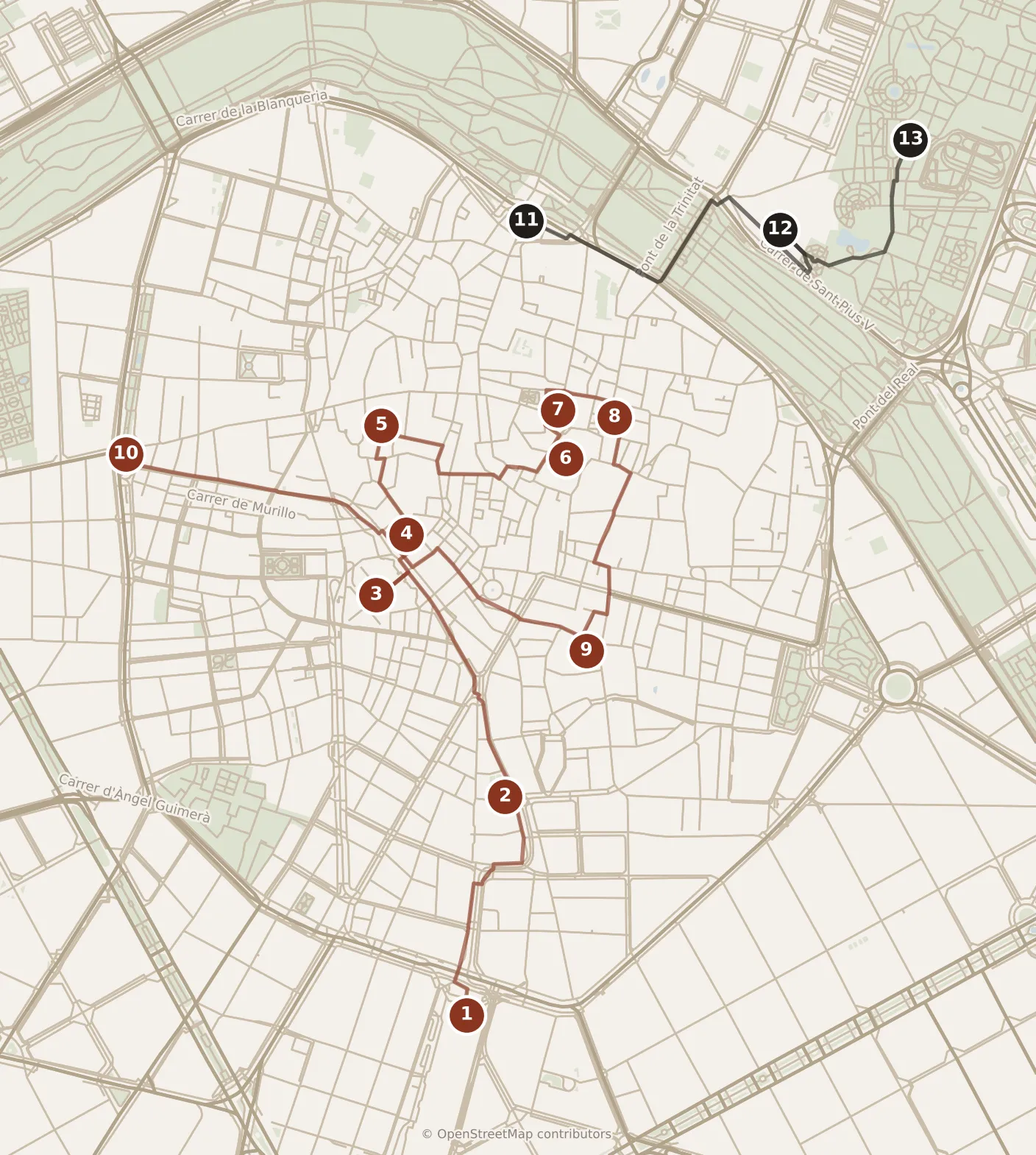
- Day one
- 1Estació del Nord
- 2Plaça de l'Ajuntament
- 3Mercat Central
- 4Llotja de la Seda
- 5Sant Nicolau
- 6Catedral de València
- 7Plaça de la Mare de Déu
- 8Almoina
- 9Palau del Marqués de Dos Aigües
- 10Torres de Quart
- Day two
- 11Torres dels Serrans
- 12Museu de Belles Arts de València
- 13Jardins del Real
Day one

Everything today sits inside the old walls, and the day is arranged so that you never walk the same lane twice.
This day’s hard deadline is at the beginning — and from November to January it has a second one at the end. The market trades from first thing, but the Llotja de la Seda did not open until ten in 2026 and the cathedral not until half past — so the morning is counted forward from ten rather than backwards from anything, and the market goes first because it is the only stop that will take you before then. If those hours have moved, put the market ahead of whichever pair opens later and the shape holds. The one at the end is the light on the Quart gate, and in those three months it decides your start rather than your finish: the arithmetic at the foot of this day works it back for you.
Morning
If you are starting from Estació del Nord — or from Xàtiva, the metro station beside it, if you have come in from the airport on lines 3 or 5 — it is seven or eight minutes north to Plaça de l’Ajuntament, the wide triangle the city treats as its front room, with the flower stalls ringing the flat open esplanade in the middle of it and the town hall closing the southern end. Ten minutes is enough for it. One thing here is not a matter of taste: from the first of March to the nineteenth this square holds the mascletà at two in the afternoon, a daylight barrage of gunpowder fired at ground level. It is not a firework display: the charges are laid on the ground in the middle of that esplanade and fired in sequence, behind a wide security cordon that holds the public off them, and the crowd presses against the cordon for exactly that reason. It is loud enough to be felt in the chest. If your day falls in those two and a half weeks, bring ear protection or stand well back, and do not bring a dog.
Eight minutes north-west is the Mercat Central, and three quarters of an hour is the right amount for it. It took from 1914 to 1928 to build, covers more than eight thousand square meters under domes and colored glass, and the part that repays a slower visit is the fish hall — a city that eats rice at midday buys what goes into it here at nine in the morning, and the lines at the good counters are three deep while the first aisle photographs itself.
Across the square, two minutes, is the Llotja de la Seda, and a second day lets you do the half of it that a single day skips. Three quarters of an hour. The Sala de Contractació, Pere Compte’s hall of twisted stone columns, is what everyone comes for and takes twenty minutes of that. Spend the rest upstairs in the pavilion beside it, which housed the Consolat del Mar — the first maritime merchants’ court in Spain, a standing body for settling arguments about cargo and shipwreck. It is the room that explains why the hall next door exists at all. Then the walled orange garden between the two.
Four minutes north through the lanes is Sant Nicolau, and this stop justifies the second day on its own. Behind a plain Gothic shell, Juan Bautista Pérez Castiel’s remodelling of the 1690s left the ribbed vault standing and had it painted over its entire length: Antonio Palomino designed the scheme, his pupil Dionís Vidal executed it between 1697 and 1700, and Baroque painting stretched across Gothic geometry produces something you will not see anywhere else in the city. A restoration that ran from 2014 to February 2016 cleaned it, after which an Italian restorer who had worked on the real one called this a Valencian Sistine Chapel, and the nickname stuck. Three quarters of an hour with the audioguide, most of it spent looking up. It is a working parish church, as the cathedral six minutes on is a working cathedral: shoulders and knees covered in both. And in 2026 it admitted visitors from Tuesday to Sunday and kept Mondays entirely for worship — that single fact decides which of your days is which, so read Practicalities before you fix the order.
Six minutes east is the Catedral de València, for an hour. A one-day visit goes in for the chalice chapel and the frescoes uncovered above the high altar in 2004, and both deserve your hour; what a slower one adds is the building’s argument with itself. Come in at the Puerta de los Hierros, the curved Baroque front of 1703 facing Plaça de la Reina, and then notice that almost nothing inside agrees with it — a restoration completed in 1972 stripped out the eighteenth-century neoclassical skin to recover the Gothic, so you are walking through a church edited to remove the era its main door belongs to. Add half an hour for El Micalet, the bell tower, which has its own ticket and its own steps, and which in 2026 was open every day of the year — the cathedral published it in two seasons, the first of March to the end of November and the first of December to the end of February, both running to a quarter to seven, which is a change of the row on the page and not of the tower. On this itinerary you get both climbs: the other one is on day two.
Afternoon
Lunch is Valencian lunch — two o’clock, in the lanes east of the cathedral — and on this day it is an hour, not more. Those lanes are the most heavily walked few hundred meters in the city, and rice is the thing most reliably faked in them: a paella cooked to order from raw takes an hour and a half, and this is the least likely ground in Valencia to be given one. So eat in the hour here, and give the long rice to the lagoon on a third day, or to a tram ride out of the old town on any day — not to the street behind the cathedral because it happens to be two minutes away.
Two minutes from the cathedral flank is Plaça de la Mare de Déu: a quarter of an hour, all of it sitting down.
On a Thursday, spend that quarter of an hour at noon rather than at three. The Tribunal de les Aigües, the court that has settled arguments about irrigation water in this plain for a thousand years, sits in the open at the cathedral’s Apostles door on this square every Thursday at twelve — free, no arrangement, no ticket, and over in minutes — and moves to the Wednesday when the Thursday is a public holiday. The morning absorbs it if you start at nine: the market keeps you until about a quarter past ten, the exchange and the church follow as written, and they put you at this square a few minutes before twelve. Then take the cathedral after the session and pick the afternoon up at the Almoina.
Two minutes further east, beneath the square next to it, is the Almoina — the Roman forum and the streets running off it, the baths, the Visigothic cathedral that replaced them and the Islamic city built over that, all dug out in one pit, roofed in glass and covered at street level by a shallow sheet of standing water. Three quarters of an hour, and it is the one place in Valencia where the cities under this one read as a stack rather than as a list.
Eight minutes south is the Palau del Marqués de Dos Aigües, and it wants an hour and a quarter. The doorway alone would earn the walk: alabaster, designed by Hipólito Rovira and carved by Ignacio Vergara in 1745, with two reclining river gods pouring water from jars — the Turia and the Júcar, the two waters of the family’s title — under a Rococo pile-up of crocodiles, a lion, and the Virgin in a niche above them. Inside, the palace holds the national ceramics collection, and the rooms to give your time to are the ones that are themselves ceramic: the reconstructed Valencian kitchen, tiled floor to ceiling in eighteenth and nineteenth-century work, and the coach house with the nymph-carved carriage of 1753. When the tiled panels upstairs stop registering as anything but pattern, which they will, go down to the kitchen and the carriages.
Local tip. The doorway is on the street and costs nothing. You can stand under it, read the two rivers and the crocodiles, and walk on. The ticket buys the rooms behind it. If the afternoon has gone short, the free half is the half that photographs and the paid half is the one you came for — so make that choice deliberately, rather than by running out of time in the entrance hall.
Evening
Seventeen minutes west, across the width of the old town and out through El Carme, are the Torres de Quart: the western gate of the medieval wall, begun in the 1440s and finished in 1493, with Pere Compte among the hands on it — the same man as this morning’s exchange hall. Its outer face is pocked all over with holes. Those are French cannon and musket from the twenty-eighth of June 1808, left unrepaired on purpose, with a second set added by artillery in 1873. The gate outlived the demolition of the walls because it had been turned into a prison, first for women and later for soldiers. Twenty minutes, and they want daylight: the holes are the whole point, and floodlighting flattens them.
Then stay in El Carme, which begins at the foot of the gate and is where the evening is: lanes rather than a strip, so you walk until something looks right.
Dinner is the one clock worth moving onto local time. Kitchens fill from nine, half past nine is ordinary, and a table asked for at seven puts you alone in a room laid for later. If nine is too late to wait out, the answer is not an earlier dinner but the thing the city does in between: something small, standing up, at about eight, and dinner after it. And if El Carme is not your evening — it is loud, and it is the one everybody has heard of — the other one is Russafa, just south of Estació del Nord and ten minutes from where day one began, which is a neighborhood rather than a night out.
The arithmetic, and the months it bites. The stops above come to about six and a half hours and the walking between them to just under an hour: call it seven and a half hours, and lunch is on top. On a half-past-nine start with an hour for lunch, that puts you at the gate at about half past five — the middle of the afternoon in June, and in December two minutes before the sun is gone. Two levers fix it, both on this day rather than borrowed from another, and each is worth exactly half an hour. Start at nine instead of half past — the market is the only stop that will take you before ten, so the extra half hour is spent in the fish hall and costs nothing — and you are at the gate a little after five with real light on it. Or drop the climb up El Micalet, which buys the same half hour. Pull both and you are at the gate before five, which is the only version of this day that works in the shortest weeks. Pull neither and the gate is a floodlit gate, which is not the same object.
This bites from November to January, and nothing takes the half hour off the day for you: the tower is open in winter too, so the climb is a lever you have to pull rather than one the calendar pulls for you. November is where it starts — the sun is already going at twenty to six — and December is the worst of it. In those weeks start at nine without thinking about it and keep lunch to its hour: that puts you at the gate a little after five, with the last half hour of December’s light on the holes, and dropping the climb as well buys you an hour of it instead. Keep the half-past-nine start and you arrive at about half past five, which in December is sunset, which is the same as not arriving. Read the tower’s own hours when you read the cathedral’s, and if the two seasons have become one, the climb is still the half hour this day has spare.
Day two

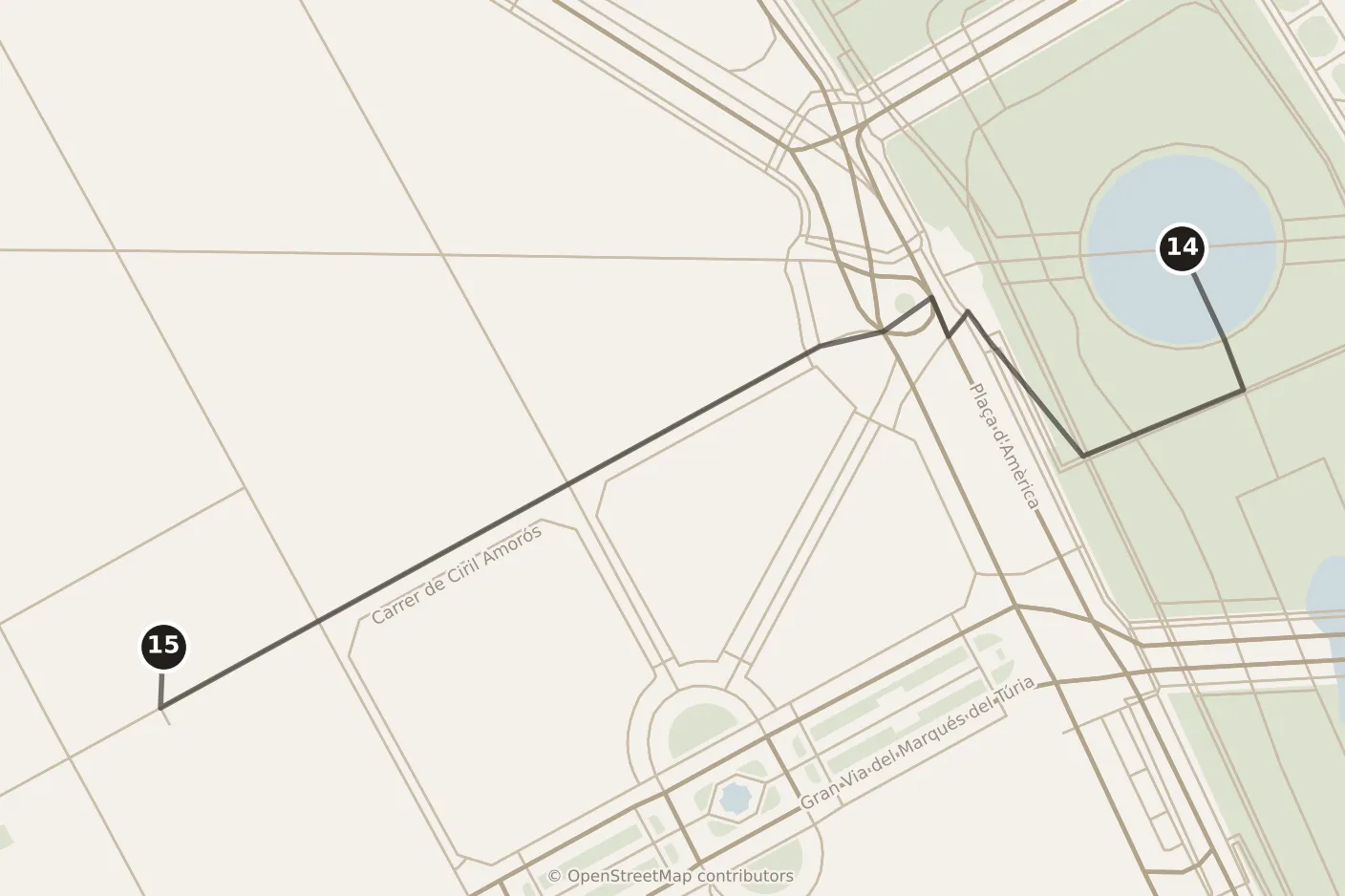
- Afternoon
- 14Pont de la Mar
- 15Mercat de Colón
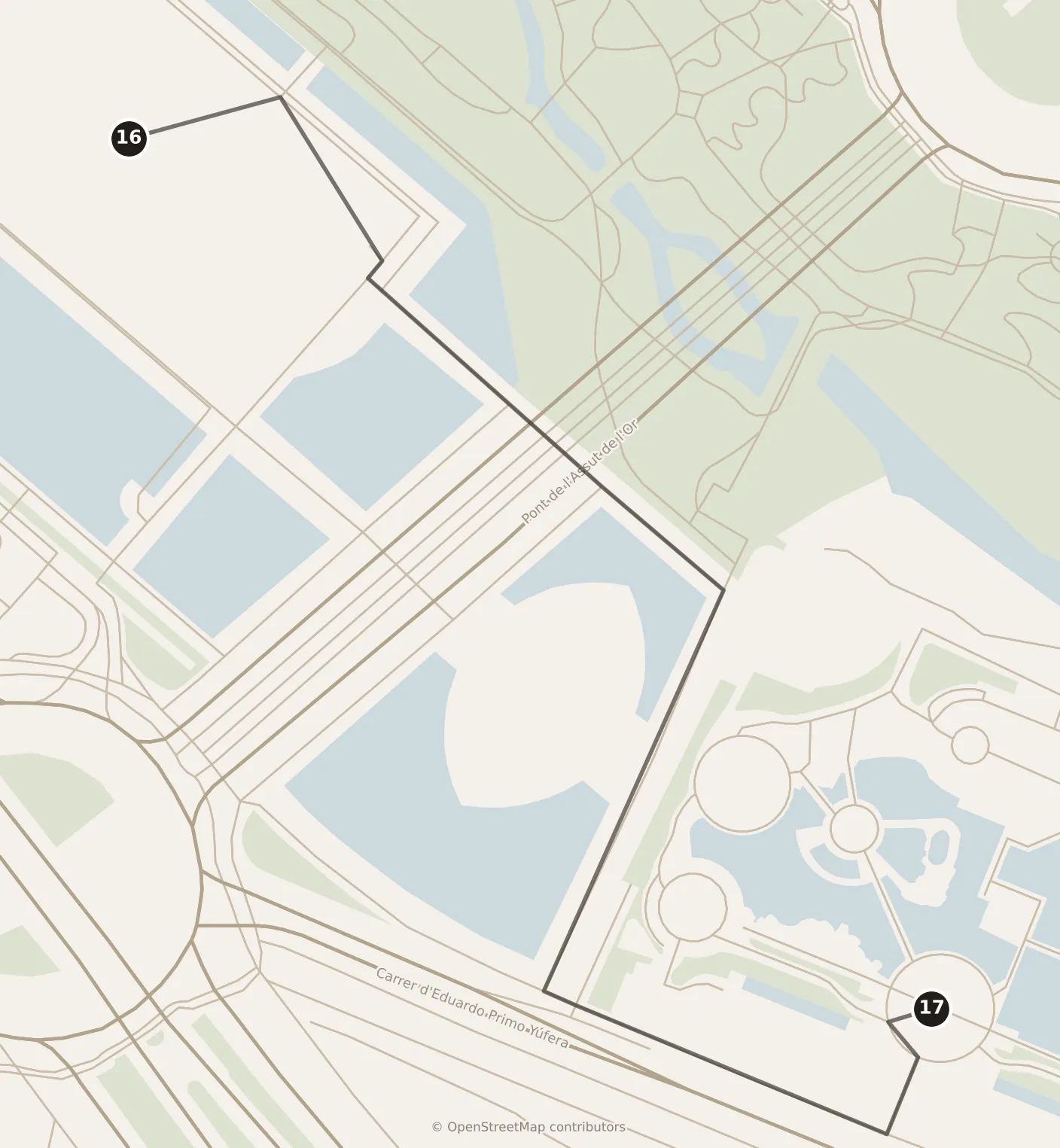
- Evening
- 16Museu de les Ciències Príncep Felip
- 17Oceanogràfic
Today runs north out of the old town, crosses the riverbed once, and then goes down it to the sea end. It is the longer day by a wide margin and it has a genuine deadline at the end, so the cuts are named as they arrive.
Morning
Start at the Torres dels Serrans, the northern gate: half an hour, most of it on the parapet. This is the second of the two climbs, and from the top the whole of today is laid out in the green channel below you.
Down, and over the bridge on the far side. Eight or nine minutes brings you to the Museu de Belles Arts de València, in the old college of San Pío V under its blue-tiled dome. It charges nothing, on any day it opens. Give it two hours, and take the instruction to skip things seriously, because two thousand works will otherwise beat you. The rooms that justify crossing the river are the Valencian primitives — the gold-ground panels of the fourteenth and fifteenth centuries, which are what this museum is known for, with Bermejo’s nursing Virgin of 1465 as the one to stand in front of — and then a small room holding Velázquez’s self-portrait. After those, El Greco’s Baptist and the Sorolla rooms, and then stop. The archaeology, the sculpture and the Piranesi engravings are all good, and none of them is what you came over the bridge for.
Five minutes on are the Jardins del Real, which nobody here calls that — ask for els Vivers and you will be pointed the right way: seventeen hectares of orange trees, roses and cactus where the kings of Aragon kept a palace until 1810, when it was pulled down so that the French could not fortify it. That is the same war as the cannonball holes on day one, the Peninsular War, seen from the losing side of a decision rather than the receiving end of one; the rubble was heaped into two mounds in 1814 and the mounds are still there. Half an hour, walking through rather than sitting down.
Afternoon
Drop into the riverbed here and turn south. It is empty because the river was taken out of it: on the fourteenth of October 1957 the Turia came over its banks into the city and killed at least eighty-one people, and rather than let the water back through, the city diverted it around the south. What it left became this park in the 1980s. That is the reason the modern map looks the way it does — everything on today either crosses or follows a river that is not there. Twenty-five minutes down the channel, under bridges built for water and now crossing football pitches, is the Pont de la Mar — a quarter of an hour on it. Then climb out on the south bank, eight minutes, to the Mercat de Colón, and lunch, an hour. Francisco Mora Berenguer built it between 1914 and 1916 after training in Barcelona, and the training shows: the Jorge Juan end is brick and ceramic panelled with the produce, meat and fish that used to be sold inside, and the other end is one enormous parabolic arch filled with glass. It stopped being a food market as its traders retired, was rebuilt between 2003 and 2009 with four floors dug in underneath, and what stands under the ironwork now is counters and kitchens rather than stalls, including a horchata counter of the old kind. Horchata is the city’s own drink rather than something that market happens to sell: pressed from tiger nuts grown in the villages immediately north of here, served cold, and taken in the middle of the afternoon with a long soft fartó to dip in it. It is the one thoroughly Valencian thing on these two days that takes a quarter of an hour, and it goes inside the hour you are already sitting here rather than on top of it — take it at the end of lunch. Three of the original food traders are still in there, which is what keeps it from being a shopping center with a roof.
Evening
Back into the riverbed for the longest walk of these two days: forty minutes south, with the white frame of the Museu de les Ciències Príncep Felip rising out of the channel ahead of you long before you reach it. An hour and a half inside if you want it. It is a hands-on science museum aimed squarely at children, which is either the reason to go or the reason not to, and there is no third reading of it.
Nine minutes further is the Oceanogràfic, the ticket this day was arranged around. Félix Candela designed the thin concrete shells over it at the age of eighty-seven, and it opened in February 2003: forty-two million liters of water, forty-five thousand animals, and ten habitats laid out as a walk from the Mediterranean out to the Arctic. Give it two and a half hours, and spend them on the tunnel under the ocean tank and on the cold end. The dolphin presentation runs several times a day and takes half an hour; if you are not going to it, that is the half hour to use on the tanks that are otherwise busiest. Then come outside for the water there: the shells stand in shallow pools that double them, and the half hour when the sun is low enough to be inside the pools is the reason this day finishes here rather than anywhere else.
The arithmetic, and the two cuts. The stops come to eight and a quarter hours and the walking to an hour and a half — close to ten hours in all, which is long, and which is why the cuts are written down rather than implied. Without the science museum it is a little over eight. Count backwards from your own month’s sunset. In June there is room for every part of it and you will still leave the complex in daylight. In December the science museum is the first thing to go, and the working is short: count back from a twenty-to-six sunset through two and a half hours of aquarium, about fifty minutes of walking up from the market, an hour of lunch and the whole morning above that, and its ninety minutes put your start at ten to eight — before sunrise here, and before any door on the route opens. Without it the day starts at twenty past nine and wants the painting museum’s door open a couple of minutes before ten; if it opens on the hour, the second cut is the painting museum coming down to one hour and the two rooms named above, which moves the start to twenty past ten and lets the whole day fit with room to spare. One assumption underneath both winter starts is worth checking before you lean on it: this day opens on the Serrans parapet, and the arithmetic assumes the gate is open when you arrive. If it admits nobody before ten, take the gardens first and the museum when it opens, and climb the gate on your way back into the riverbed: it is the only stop on this day the route can reach twice, and the doubling back is about a quarter of an hour each way. If that will not fit either, this is the stop to give up, because it is the only one whose loss changes nothing after it.
Local tip. The combined ticket costs only a few euros more than the aquarium alone, which makes it look like the obvious buy. It is obvious only if you will use the other two, and the science museum is the first thing this day gives up when the light gets short. So settle the December question at home, where the ticket is bought, rather than at the gate where it cannot be unbought.
The summer version of this day is a different problem, and the cut above does nothing for it. In July and August what breaks the day is the heat rather than the light, and the exposure is the forty minutes of open channel between the Mercat de Colón and the science museum — which the day as written walks between half past two and a quarter past three, the worst hour of the afternoon. Dropping the science museum removes none of it, because the museum sits at the far end of that walk rather than on it. Two things do work: ride the leg instead of walking it, on the line 10 below, which runs from beside the two stations to both ends of the complex; or keep the walk and move it, breaking for three hours after lunch somewhere with a roof and picking the channel up at five. Both keep the low sun on the pools, which is the point of finishing here.
Getting back is one ride: Metrovalencia line 10 has a station at each end of the complex — Ciutat Arts i Ciències and Oceanogràfic, so board at whichever you finished nearest — and it runs to Alacant, which is joined to Estació del Nord by a footbridge. Walking back up the channel instead is just under an hour. Take the ride and dinner solves itself: nothing at the sea end of the riverbed is arranged to feed you at nine, and Alacant puts you back within walking distance of both the quarters day one ends in.
With a third day

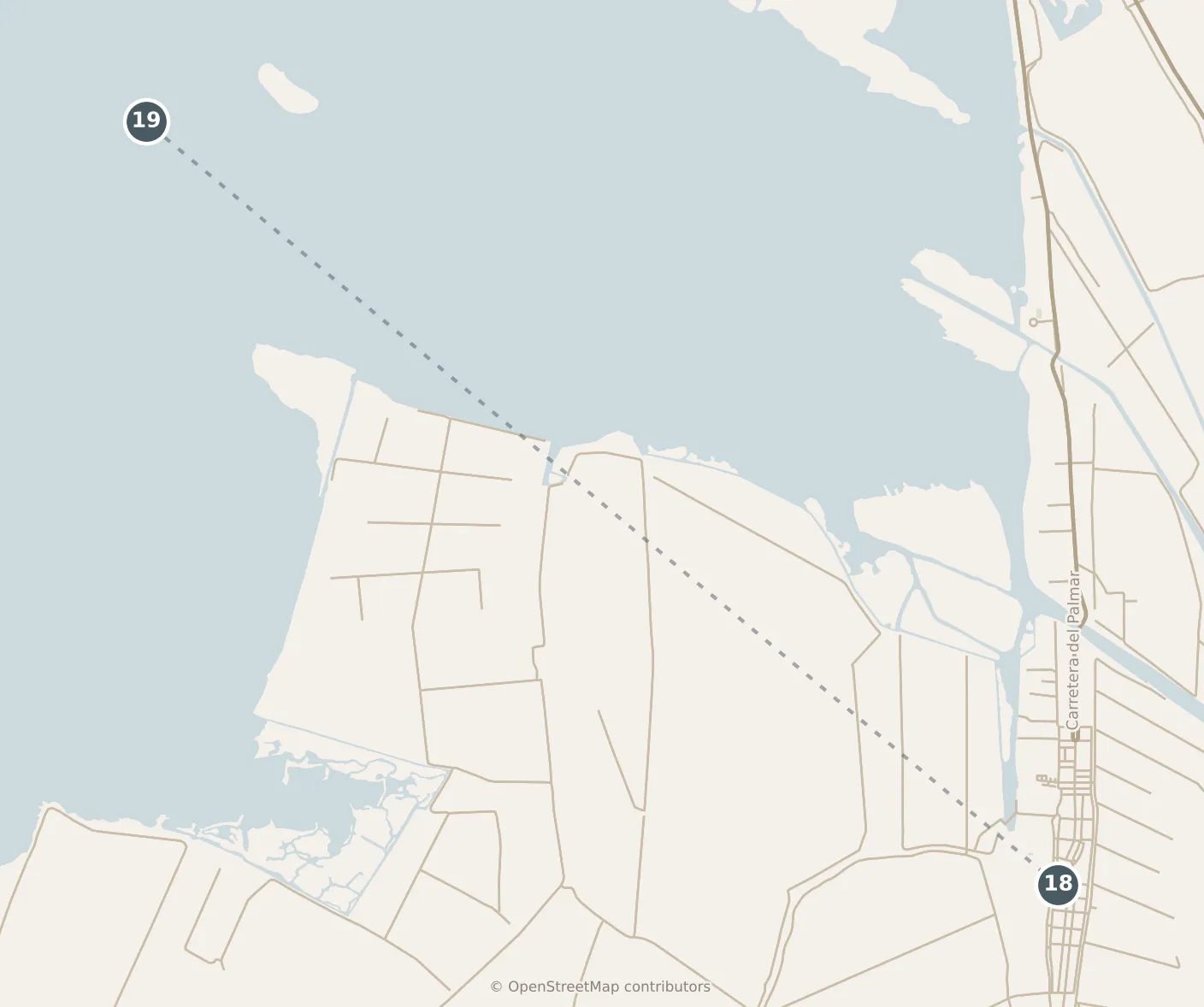
- With a third day
- 18El Palmar
- 19Albufera
A third day goes to the water this city is actually built on: the Albufera, the freshwater lagoon fifteen kilometers south, and the rice paddies around it. This is where paella comes from in the literal sense, and it is the one thing on this page that a shorter trip genuinely cannot have.
The running order for three days, stated once: old town, lagoon, City of Arts. Day one as written, then this day in the middle, then day two — and the long rice lunch goes here, on the day it belongs to. Two things follow, and both are improvements. The long rice lunch that day one sends you away from finally has a day it fits on, which is the only place on this page you can have it. Day one’s light is not part of the bargain: the two levers that buy it are the nine o’clock start and the Micalet climb, and both sit on day one whether or not you have a third. And the City of Arts and its dusk move to your last evening, which is where that stop sits best — unless the weekday rules in Practicalities push it elsewhere, which they may, and the light is the one thing on this route available every day of the year. Nothing else changes: the two city days keep their internal order exactly as written. The single rule above that this rewrites is the Monday rule, and Practicalities restates it for three days.
Getting there is a city bus, not an excursion. EMT lines 24 and 25 both run south into the park and only one of them ends where you want to be: the 24 is signed for El Palmar, the 25 for El Perellonet, they share most of their route, and reading the destination board before you board is the whole trick. EMT publishes its own route map and that is where to find the stop nearest you; the southbound stops along the Gran Via de les Germanies are a few minutes’ walk from both railway stations. Under an hour each way, and your SUMA card pays for it.
El Palmar is a village on an island in the lagoon, one long street of rice kitchens with a fishing harbor at the end of it. Give the village and the harbor three quarters of an hour before lunch. The boats are flat wooden albuferencs, and a trip out onto the water and back is about forty minutes — that one is a published length, not a recommendation. They go from the harbor here and from the Gola de Pujol jetty out on the main road, and the jetty is the busier of the two. Sunset is when everyone wants to be on the lagoon, and this is the one thing on these three days you reserve on the spot rather than buy in advance: ask at the harbor the moment you arrive, before lunch rather than after it.
Lunch is the reason to come and it takes as long as it takes. Rice is cooked to order here from raw, and an hour and a half is not slow, it is correct — this is the version the city’s own kitchens are measured against. The village also does eel, all i pebre, which is the local dish that never traveled. Then an hour on foot before the boat and the light — on a marked route rather than wherever the map suggests. The paddies are working farmland crossed by irrigation tracks and not a path network, and the Devesa, the sand bar between the lagoon and the open sea, is a protected dune system inside the natural park, where the walking is on signed boardwalks and the rest is closed for a reason. Take the boardwalks, or the road south out of the village between the fields, and if nothing is signed when you get there, give the hour back to the lunch. That comes to a little under four hours on the ground, and the buses add the best part of two more: call it six hours door to door, none of them hurried, which is the argument for giving this a day rather than an afternoon.
One kind of wrong weather is not a change of plan but a stop, and it belongs to autumn. From September to November this coast gets the gota freda: a day or two of extraordinarily concentrated rain falling on the plain south of the city — the plain this third day is on. The one on the twenty-ninth of October 2024 killed 224 people in this province, and the city center was spared largely because the river had already been moved out of it. When the national weather service has an orange or a red warning out for Valencia, the answer is neither the lagoon nor the coast: stay out of the low ground and off the riverbed, keep the day to the old town, and treat the alert that arrives on the phone here as the instruction rather than the sky. Read the warnings the evening before rather than the morning of — they are issued ahead, and the trains and the southern bus routes go down with them.
If the weather is merely wrong, or the day is short, here is the replacement rather than a gesture at one. Take the sea instead. Metrovalencia tram line 4 is the one to take, and get off at Platja les Arenes or Platja Malva-rosa, which is how the two stops are written on the platform and read out on board. Line 6 reaches the same two stops on the way out to Marítim but comes back along a different street, so the 4 is the one that works in both directions. Either is a few minutes from the Malvarrosa beach, and which of them you want depends on your side of the city, which Metrovalencia’s own map answers at a glance. Walk the promenade south into El Cabanyal, the old fishermen’s quarter behind the beach — low tiled houses on a grid of narrow streets, about half an hour end to end — eat rice by the sea rather than beside the paddies, and come back on the same tram. It is half the traveling, it works in anything short of a storm because the quarter is a town rather than a beach, and it costs you the lagoon, the boats and the fields, which is a real loss and worth naming. What it does not cost you is the food: the same rices are cooked on both shores.
And if the third day is only half a day — a late flight, an early train — do not attempt the lagoon at all. The bus alone eats two hours of it. Take the tram to the sand, or give the morning to the one thing days one and two leave out entirely, which is the riverbed north and west of the Serrans gate: the half of the channel this itinerary never enters.
Practicalities
Arriving. From the airport, Metrovalencia lines 3 and 5 both start at Aeroport and run into the center; get off at Xàtiva, which is the station beside Estació del Nord and the corner day one begins from. Buy the card at the machine in the airport station and buy that first ride on it there too, taking the airport journey the machine offers rather than a plain city one — the airport sits at the outer end of the network, and what covers a ride in the center may not cover it. If you come in on a high-speed train you arrive at Joaquín Sorolla instead, about eight hundred meters from Estació del Nord on a signed walk.
What must be booked, and when. The Oceanogràfic, from the Oceanogràfic, before you travel: that is the only advance purchase on these days, and its price band is in the Overview. The third day adds two reservations and neither is a website: the lagoon boat, asked for at the harbor on the day and genuinely needed only for the sunset trip, and — if your lagoon day falls on a Sunday — a table, which is a phone call the evening before — and if none of the village’s kitchens appears on the booking site you normally use, that is normal rather than a sign they are shut, so have the desk where you are staying make the call. Everything else here, the market, the exchange, the church, the cathedral and its tower, both gates, the Almoina and the palace, is bought at the door. The painting museum is not bought at all: the Museu de Belles Arts charges nothing, all year. Nor, for part of the week, does the ceramics palace — in 2026 it was free from four in the afternoon on Saturdays and all day on Sundays, which is exactly where day one’s afternoon puts you, so read its free hours before you wait in line at the desk.
The day of the week decides the order, and one rule does most of the work: never make a Monday your day one. Three of day one’s interiors keep the Spanish museum week. Sant Nicolau admitted visitors from Tuesday to Sunday in 2026 and kept Monday for worship; the Almoina and the ceramics palace are a municipal and a national institution respectively, each publishing its own closing day, and those are the two to read the week before you travel. A Monday day one is three shut doors spread over a kilometer and a bit of the old town — by this article’s own walking times they are eighteen minutes apart end to end, which is not one corner you can step around. Read the Quart gate’s Monday with them: it is a municipal monument too, and it closes the day. Day two survives a Monday far better: the stop at risk is the painting museum, which is free, so a Monday there costs you the art and not the ticket; the Oceanogràfic is open every day of the year, Christmas included, so a Monday day two starts later, gives the museum’s two hours to the aquarium instead, and loses nothing that cannot be lost.
Sunday costs the market and moves the cathedral, and the second of those reshapes the whole day. The Mercat Central did not trade on a Sunday in 2026, and the cathedral admitted no visitor before two in the afternoon on any Sunday of that year — it published two to half past five from October to June and two to half past six from July to September, with the last entry an hour before the close. Sant Nicolau opened at eleven on a Sunday rather than at half past ten. So a Sunday day one is not a reordering of the morning, it is a different shape: the exchange at ten, the church at eleven, lunch, the cathedral at two, and the Almoina, the palace and the gate behind it. That puts you at the Quart gate at about six, which is daylight from February to October and gone from November to January — where the gate, and not the market, is what a Sunday really costs you in those three months. Read the cathedral’s Sunday row before anything else on this page: it is the one closure on this route that moves a day rather than a stop.
Which days may trade places, and the arrival that breaks the week. Days one and two swap freely in every case except the two above. The trap is arriving on a Sunday with only two days, because Sunday and Monday are between them the two worst days this itinerary has. Take them in that order — Sunday for day one, Monday for day two — and you lose the market, you eat before the cathedral rather than after it, and on the Monday you lose the painting museum, which is free and can be dropped without paying for it. Take them the other way round and you keep the market but lose three of day one’s interiors to the Monday, including the painted vault that is the reason a second day exists at all — which is not a trade. With three days the trap dissolves, and the middle-day default gives way to the weekdays: the Monday goes to the City of Arts day, the Sunday goes to the lagoon — where it is in any case the traditional day for a rice, and therefore the day to reserve a table rather than walk in — and the old town takes whichever day is left over.
The calendar here is not only a week, and for nineteen days a year it is not a week at all. From the first of March to the nineteenth the city runs on Fallas rather than on weekdays: the mascletà fires in Plaça de l’Ajuntament every afternoon of it, and from the morning of the sixteenth the sculptures stand in the streets themselves, closing them, until they burn on the night of the nineteenth. Day one’s morning is the part that stops working on every day of that stretch, because it opens in the square the mascletà fires in and then threads the lanes the monuments are standing in, and no reordering repairs it — the crowd is the city rather than a line. On the seventeenth and the eighteenth the afternoon goes too: the Ofrenda, the flower offering, carries its delegations to the Virgin’s pedestal in Plaça de la Mare de Déu through the afternoon and into the night of both days, which is the square day one’s afternoon opens in, with the Almoina under the square beside it. On those two dates do not attempt day one at all — take day two, or the lagoon. Come for those days deliberately, and read the city guide on what they are actually like, or take the trip from the twentieth onward, when the streets are simply back. The other seasonal fact runs the opposite way to a closure: the rice kitchens on the lagoon and the small family places in town are the ones that take August off, so a third day in August wants a phone call the day before rather than a plan.
The bag, and where this route puts it. Estació del Nord has a left-luggage counter among its ticket desks, and day one starts at that station’s front door, so an early arrival costs you nothing but the walk back. Day two is the one to think about if you are leaving that night: it ends at the sea end of the riverbed, just under four kilometers on foot from the stations, and line 10 from Ciutat Arts i Ciències or Oceanogràfic to Alacant is what closes that gap — that ride is the plan, not a convenience. On the lagoon day there is nowhere at all to leave anything. El Palmar is a village with a bus stop, no station and no lockers, and a flat wooden boat is a poor place to be holding a suitcase, so the bag stays in the city. Getting it back is not the problem: the buses set down on the Gran Via de les Germanies, minutes from both stations, so the case never leaves the block you collect it from. The problem is the hour. A lagoon day that ends with the sunset boat gets you back to a left-luggage counter whose closing time nobody publishes reliably, with a train to catch — the one combination on these three days that can leave you at a shut door. So if your last day is the lagoon day, choose one of the two things it is for: take an early boat and eat afterwards, or give the day to the lunch and skip the boat. Or take the tram to the sand instead, where the same trams run you back into the center all evening.
How much walking, and where it lands. Day one is under four kilometers, flat, with nothing longer in it than the seventeen minutes out to the Quart gate at the end. Day two is six and a quarter kilometers, also flat, and it is front-loaded — two hours standing still in a museum, followed by an hour and a half of walking, an hour of that down the open channel. The forty minutes from the Mercat de Colón to the science museum is the longest unbroken stretch on either day, and its southern end has almost no shade on it. If one of the two days is going to be too much, day two is the one that bends, and it bends by dropping the science museum before it drops anything else.


