Valencia in one day: the old town in the morning, the riverbed walk, and the City of Arts at dusk

Last updated 4 August 2026
Overview
The shape of one day in Valencia is decided by a river that was taken away. After the flood of 1957 the Turia was diverted round the south of the city, and the empty channel it left behind was planted rather than built on, so there is now a green trench curving through the middle of everything from the north-west round to the sea. Almost all of what a single day can hold sits at one end of that trench or the other: the old town at the top, and the white complex at the bottom where the channel reaches the port. The walk between them is not a transfer. It is the best hour of the day, and it is the reason this route is a straight line rather than a tour.
So: the old town in the morning, the riverbed after lunch, and the City of Arts and Sciences as the light goes. Close to seven kilometers of walking, none of it uphill, and exactly one train on the whole day — the one that brings you back at the end.
What one day costs you here is unusually easy to name, because it is two whole things rather than a scatter of small ones. The first is the sea. Valencia has a proper city beach with a tram to it, and it is not on this route at any point; if you have come to swim, or if your day falls in July or August when the center empties towards the shore, the honest swap is the entire afternoon — the riverbed and the white buildings go, you take the tram out to the Malvarrosa sand, and the morning below stands unchanged. The second is everything with a ticket at the City of Arts: the aquarium, which was the largest in Europe when it opened in 2003, and the science museum beside it. Each is a half-day on its own. This route goes there to walk between the buildings and look at them, which is free, and it says so plainly because the alternative is a day that has seen one aquarium and no city. The Albufera rice fields south of town, which is where the food actually comes from, are a different day again.
The one moment that does not wait is the last one. The complex is a set of white shells standing in shallow water, and what it is for is the half hour when the sun is low enough to be in the pools and the buildings are lit from underneath. The sun goes down here at around twenty to six in the middle of December and not until about half past nine at midsummer, so take your own month’s hour and count backwards. Everything above the City of Arts — the walk in from the station, the market, the silk exchange, the cathedral with its tower, the square, the towers on the riverbed, lunch, and the riverbed walk itself — comes to about six and a half hours. With the quick version of lunch and the bell tower left unclimbed, a little over five.
Two things about that number, because a number is the thing readers act on. It is the time spent at the stops plus the walking between them, and nothing else: it does not include the two separate ticket desks in the cathedral precinct, and it does not include a single minute inside anything at the City of Arts, which is the largest thing it leaves out. And in the long half of the year the count stops being useful, because six and a half hours back from a nine o’clock sunset is a start in the middle of the afternoon, by which time the first stop of the day has shut. In summer you simply start in the morning as you would anyway, and the surplus goes into a slower riverbed, or into the sea.
One hour decides the order of this day and it is worth stating outright. The Mercat Central shut at three in 2026 and did not open at all on a Sunday. That is why the old town has to be the morning half: you cannot rescue a late start by running the day backwards and taking the riverbed first, because the thing you would be saving would be shut before you reached it. If the hour has moved, build the morning back from the new one.
Nothing on this route is booked in advance — every ticket on it is bought at the door on the day, and that includes the fare for the single ride at the end, on Metrovalencia line 10: a single ticket comes out of the vending machine at the station you board at, so there is nothing here to arrange before you travel. How fares work here, and everything else that is true of the city rather than of this walk, is in the city guide.
The day

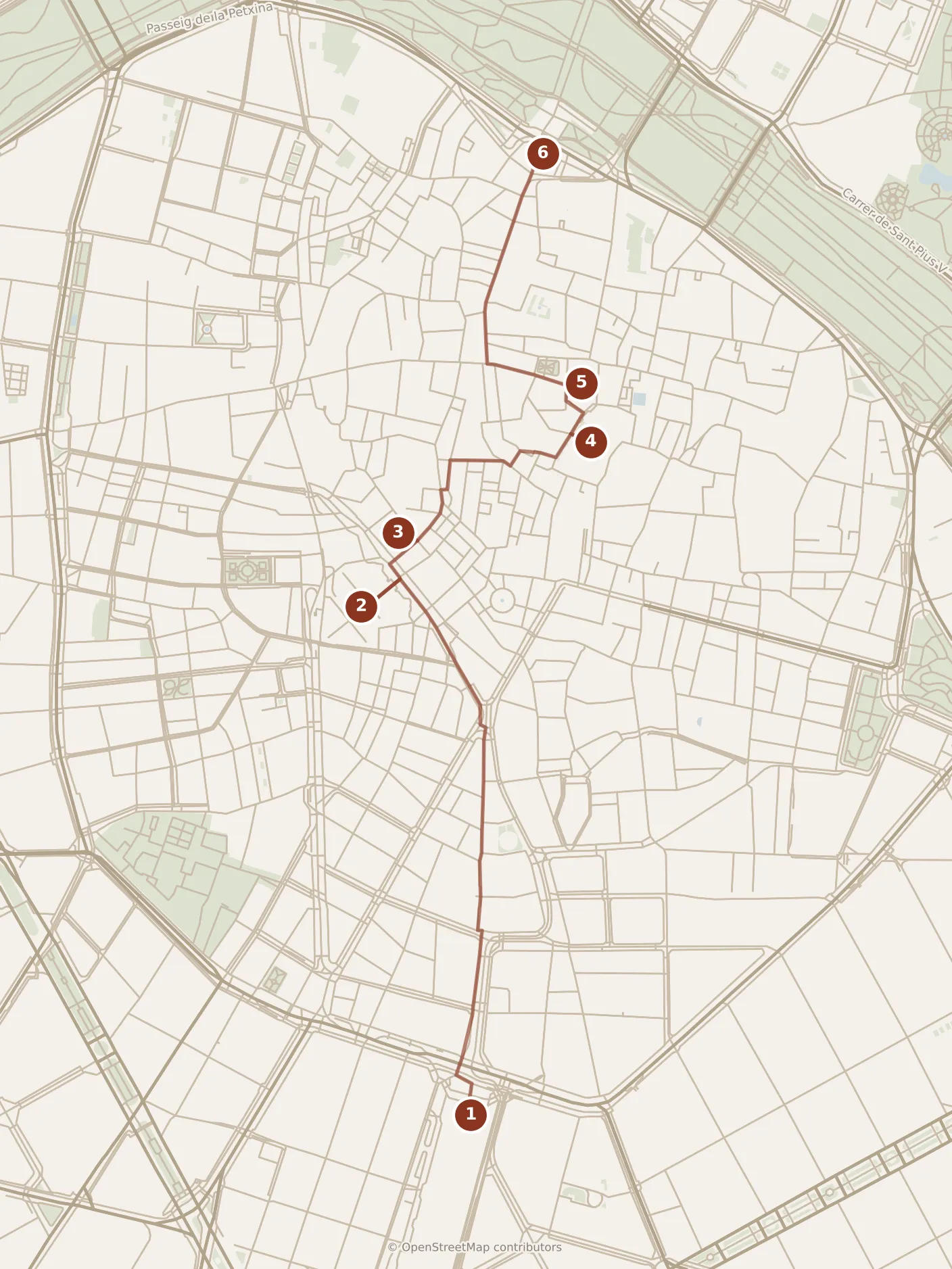
- Morning
- 1Estació del Nord
- 2Mercat Central
- 3Llotja de la Seda
- 4Catedral de València
- 5Plaça de la Mare de Déu
- 6Torres dels Serrans
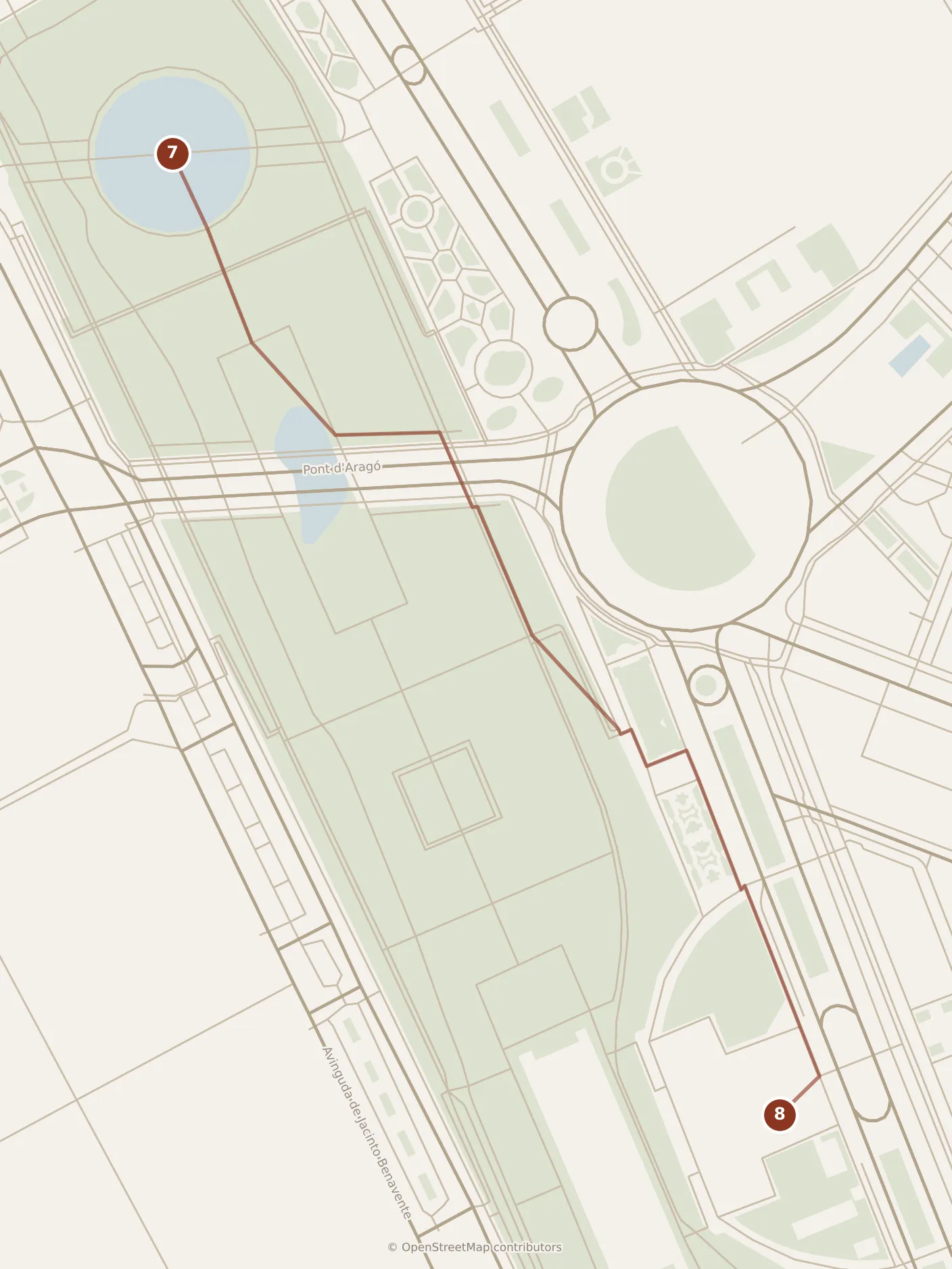
- Afternoon
- 7Pont de la Mar
- 8Palau de la Música
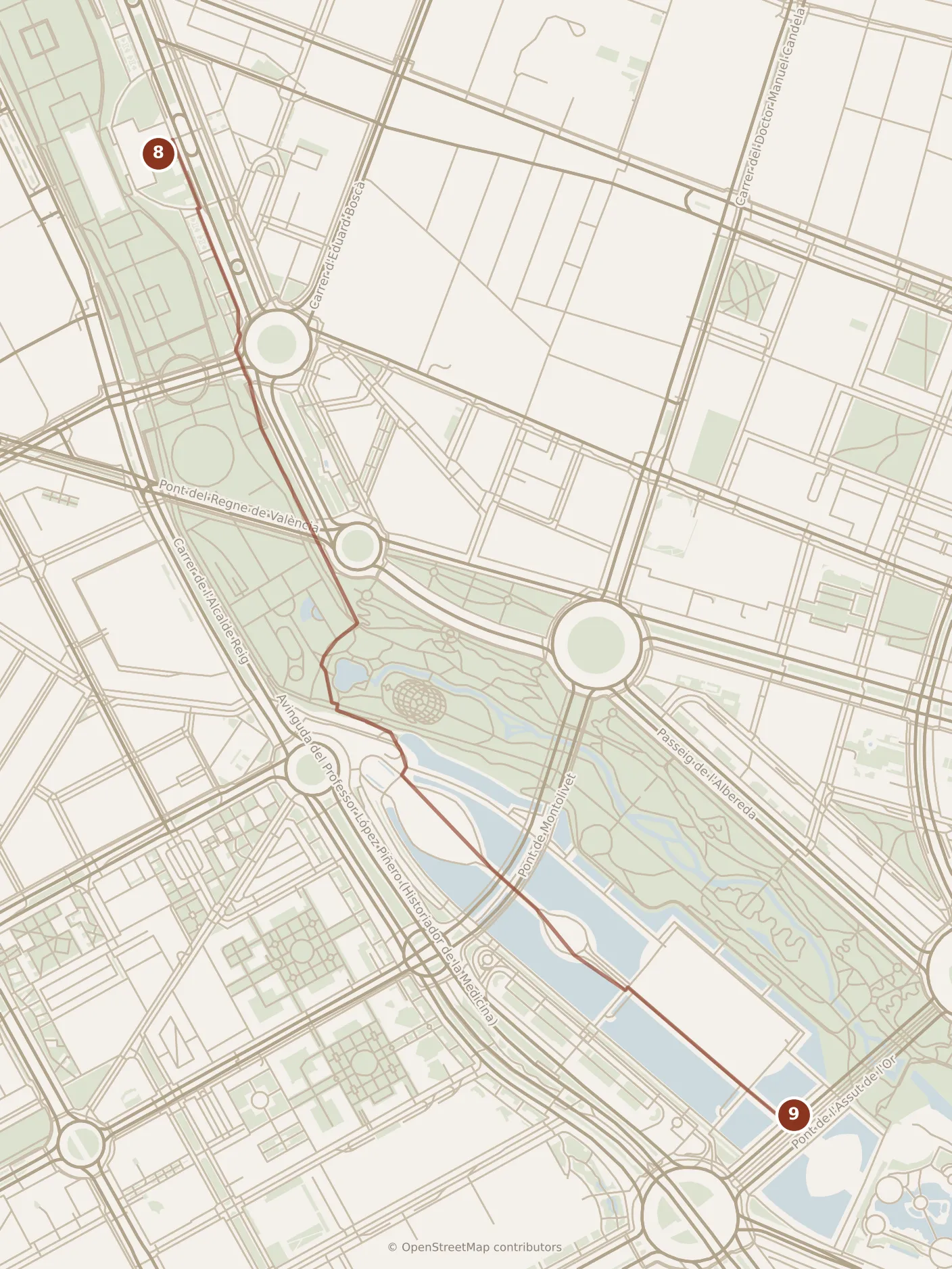
- Evening
- 9City of Arts and Sciences
Morning
Start at Estació del Nord, which is a stop rather than a formality. It opened in 1917 to a design by Demetrio Ribes and it is a modernista building still doing the job it was built for: the front is carved with oranges and orange blossom, and inside the booking hall the wooden panels above the doors carry “good journey” written out in several languages. Five minutes to look at it, and then out of the front and north.
It is a quarter of an hour on foot to the Mercat Central, past the town hall square two hundred meters from the station door. The market took from 1914 to January 1928 to build and it is the reason the morning starts early — though early here means around nine rather than at the market’s own door, because the market trades from first thing and the two stops after it, the silk exchange and the cathedral, did not open until ten and half past ten in 2026. Count the morning forward from the later pair, whatever the two of them say when you go. More than two hundred and fifty stalls under iron and colored glass, a dome with a weathervane on it, and — this is the part worth the walk — an entire wing of fish and shellfish laid out on ice, because a city that eats rice for lunch buys what goes in it in the morning. Forty-five minutes. Go past the first aisle, which sells to people photographing it, and get to where the lines are three deep and nobody is looking up.
Directly across the Plaça del Mercat, two minutes, is the Llotja de la Seda: the silk exchange, put up between 1483 and 1548, and on the UNESCO list since 1996. Give it forty minutes and give nearly all of them to one room. The Sala de Contractació was designed by Pere Compte, who oversaw the building of it and finished it in fifteen years, and it is a single hall with eight helical stone columns eleven meters tall that open into rib vaults seventeen meters up — the columns are palm trunks and the vaults were once painted blue with gold stars, because the room is a deliberate picture of paradise built for the trading of money. Running round the top of all four walls, in gold Latin on a dark ground, is an inscription reminding the merchants below not to lend at interest if they wanted eternal life. The tower beside the hall held the cells where dishonest traders and silk thieves were kept. Out through the far door is a small courtyard of orange trees with satirical gargoyles round it; sit in it for five of your forty minutes.
Six minutes east through the lanes brings you to the Catedral de València, which is built on the main mosque, which was built on a Visigothic cathedral, with the Roman city under the square next door — demolition of the mosque was ordered in June 1262 and the church grew as it came down. Three quarters of an hour inside. Two things to aim at. The chapel of the Holy Chalice is the old chapter house of the 1360s, a room with a star vault and five Gothic tombs in the passage to it, and the agate cup it is named for has been claimed as the Grail since it arrived in 1437. And above the high altar, look up: in June 2004 workmen found Renaissance frescoes of angels playing instruments hidden behind a baroque vault Juan Pérez Castiel had thrown over them, painted around 1474 by Paolo da San Leocadio and Francesco Pagano and among the first Renaissance painting done in Spain. They had been out of sight for three hundred years.
Half an hour more, if you want it, for El Micalet, the bell tower, entered separately from the cathedral and open every day of the year: in 2026 the cathedral published its hours in two seasons, the first of March to the end of November and the first of December to the end of February, both closing at a quarter to seven — a change of the row on the page rather than of the tower, which is worth saying because the two-season layout reads as a closure and is not one. It is an octagonal prism just under fifty-one meters tall and exactly the same measure round its base, which is the fact everyone in Valencia knows about it, and a little over two hundred stone steps of a narrow spiral get you to the bells.
Round the flank of the cathedral, a minute or two, and you are in Plaça de la Mare de Déu, which is where the Roman forum stood and now reads as the city’s living room: the basilica of the city’s patroness on one side, the cathedral on another, a fountain in the middle with the Turia lying back as a bearded river god and women pouring water from jars around him, one for each of the irrigation channels of the market gardens. Fifteen minutes, sitting down.
If your one day happens to be a Thursday, put this square before the cathedral rather than after it. At noon — in 2026 as for a very long time before it — the Tribunal de les Aigües constitutes itself in the open air at the foot of the Porta dels Apòstols, the Gothic doorway on this square, the one crowded with statues of apostles. The elected representatives of the irrigation channels sit in a ring of chairs in black smocks, farmers bring disputes about water, and the whole hearing is spoken start to finish. It takes a few minutes, it is free, it has been happening on this spot since before the cathedral was here, and it moves to the Wednesday when the Thursday is a public holiday. If the hour has moved, build the morning around the new one; it will still be a Thursday.
Seven minutes north are the Torres dels Serrans, and they are the end of the old town in the literal sense — one of the two gates left standing from the medieval wall. Pere Balaguer built them between April 1392 and March 1398. They survived the demolition of the rest of the wall in the nineteenth century only because they had been turned into a prison for nobles and knights in 1586, and stayed one until 1887; in the Civil War the paintings evacuated from the Prado were stored inside them. The inner face is open, so from the square you are looking at bare staircases running up the back of a gatehouse. Half an hour, most of it on the parapet, where you get the old town on one side and, on the other, the green channel you are about to spend the afternoon in.
Local tip. Two climbs are on offer within a few hundred meters of each other and one day genuinely only pays for one. The bell tower is the higher view and it costs a separate ticket and the two hundred steps of narrow spiral described above; the gate is a short climb at the end of the morning and it shows you the riverbed walk laid out before you do it. If you are walking the garden, take the gate. If you are swapping the afternoon for the beach and will not be walking the channel at all, take the tower instead: it is the higher of the two, and the view from it is the only part of the afternoon you would still be getting. In the short days of December and January, check the closing time before you commit to it — both climbs shut well before dinner.
Afternoon
Lunch happens here, at the top of the old town, and it is the long kind. A rice is ordered before anything else and cooked from raw, so reckon on an hour and a quarter from sitting down; the quick version of this lunch is three quarters of an hour of small plates and does not cost you anything except the rice. Be warned about one thing and it is not a warning about the food: a paella eaten within sight of a monument in any city is a lottery, and the ones worth crossing a region for are out in the villages by the rice fields. If a great rice matters more to you than the riverbed does, that is a legitimate day and it is not this one. The other Valencian thing worth twenty minutes before a long walk is a glass of cold horchata on the way out of the old town.
Then go down. Steps and ramps drop into the riverbed beside the Serranos gate, and from that moment until the end of the day you are below street level, out of traffic, and cannot get lost: the channel has one direction and the sea is at the end of it. It is a little under half an hour of walking to the Pont de la Mar, under a run of old bridges that used to cross water and now cross football pitches, running tracks, rose beds and lines of palms. The Pont de la Mar itself is the one to stop on rather than under: a stone bridge of the 1590s, closed to cars, a medieval river crossing carrying nothing over a park.
Ten minutes further down is the Palau de la Música, a long glass barrel vault set into the bank with palms and a pond and fountains in front of it. It is a concert hall, it is not a stop with a door on this day, and the reason to walk to it is that it marks roughly the halfway point of the channel and it is a good place to sit and fill up with water before the final stretch. Ten minutes.
Evening
The last stretch is the longest single walk of the day, half an hour from the Palau de la Música to the City of Arts and Sciences, and the buildings come at you slowly, which is the correct way to arrive at them. A few minutes into it the channel holds a reclining Gulliver the size of a building, with staircases and slides worked into the ropes that pin him down and children swarming over the whole thing; it went in in 1990, it is free, and it is the best argument in the city that the riverbed was given back to the people who live here rather than to visitors.
The complex sits in the last stretch of the old riverbed, on the way down to the port. Santiago Calatrava designed most of it and Félix Candela the aquarium; it opened in stages from 1998, starting with the Hemisfèric, the eye-shaped cinema that sits in a pool of water and reflects into a complete eyeball, and finished with the opera house in October 2005 and the covered arena after that. The science museum, the Príncep Felip, is a long white ribcage that reads as the hull of a ship turned over.
Give it an hour and a half and spend it outside. All of the walking between the buildings, the lawns, the promenades and the length of the pools is public and free, which is not obvious from the outside and is the thing most one-day visitors get wrong. Walk the whole complex end to end once at ground level, then go up onto the Umbracle, the raised garden deck along one side — palms and rosemary and bougainvillea planted under white arches, laid out as a viewing platform over the rest, and the best place to be standing when the light goes if you find it open — nobody publishes a closing time for that deck and the complex’s own site is the only place that would, so make it the first choice rather than the plan. The walkways at ground level are free, and the pools reflect just as well from the path beside them. This is the half hour the whole day was ordered around: the water goes still, the shells turn from white to orange and then to lit white again, and the reflections double everything.
Then home, and it is one train. Metrovalencia line 10 has two stations on the complex — Ciutat Arts i Ciències at the near end, Oceanogràfic at the far one — and it runs to Alacant, which is joined to Estació del Nord by a footbridge. It is a short ride and it is the only transport on this itinerary — and most of the line runs in the open, both of the stations at the complex included, so the ride back is the city rather than a tunnel. The alternative is to walk back the way you came, a little over an hour with the buildings behind you; how well that stretch of the garden is lit after dark is not something anyone publishes, so it is a decision to make standing there rather than one to plan on.
Practicalities
Nothing on this route has to be booked before you travel. The cathedral, the bell tower, the silk exchange and the gate towers are each bought at the door on the day. The fare for the one ride at the end comes out of a machine inside the station you board at, so it is not an exception either, and how the network is paid for is the city guide’s business, not this route’s.
The day of the week matters more here than the season, and it matters in an unexpected direction. A Monday costs this route nothing — the market trades, the exchange opens, the cathedral opens, the gate towers open, and the museums that take Mondays off in this city are the ones this day has already given up. A Sunday costs it a great deal. Four of the six morning stops change on a Sunday in a way that breaks the day as written: the market does not trade at all, the silk exchange closes in the early afternoon instead of the evening, the cathedral opens to visitors for only a few hours and which few hours depends on the season, and the Serranos towers close early. Check all four before you set out, because the fix is not a reordering but a reshaping: take the old town from the outside on a Sunday — the squares, the fountain, the doorway the water court sits in, the gate from the street — and go down into the riverbed earlier. The whole afternoon and evening of this day are unaffected, because none of it has a door. The one thing worth checking on a Sunday rather than assuming is the Roman city under the Almoina, on the square east of the cathedral: it is the indoor hour this route otherwise gives up, and a Sunday is the day you would suddenly have room for it. Its hours are the city’s rather than the cathedral’s — it is a municipal museum, so the city’s own listing is the one that governs it — and an early Sunday closing is the thing to confirm there before you build the rest of the day around it.
The other date to know about is March, and its two halves are not the same thing. From the first of the month to the nineteenth the city builds towards Fallas, and for the first two weeks what is in the streets is not the monuments but the noise: a mascletà every afternoon in the town hall square, a daylight barrage of firecrackers rather than fireworks, two hundred meters from the station door. The sculptures the size of houses go up on the fifteenth and the sixteenth and burn on the night of the nineteenth. The festival is a reason to come, and those five days are not a reason to come for one day: whole streets close, and the morning half of this route stops being a walk and becomes a crowd. The city guide describes what those days are actually like.
If this day is happening between trains — and a lot of them will be, because Valencia is a place people change at — decide the bag first. The two stations, Estació del Nord and Joaquín Sorolla where the high-speed trains come in, are eight hundred meters apart at the southern edge of the old town and joined by a signed walk, and this route returns to them by design: line 10 finishes at Alacant, a footbridge from Estació del Nord, so nothing here asks you to make a special journey back for a case. What the day does ask is that your hands are empty, and two stops are the reason. The spiral up the bell tower is not a thing to do holding luggage, and the riverbed is worse: over an hour below street level with nowhere to sit down that is not a bench, and no short way back up to a taxi once you have started. Estació del Nord has a left-luggage counter of its own, in among the ticket desks and the machines, so the bag does not have to cross to the other station or go into a private office. What nobody publishes reliably is the hour that counter keeps, so ask as you come off the platform rather than find out when you come back for the train.
If it is shut, this stops being the same day with a bag in it and becomes a shorter one, which is still a good day. Walk in to the Mercat Central, cross the square to the Llotja de la Seda, take the lanes east to the cathedral, and finish sitting down in Plaça de la Mare de Déu: those four, in that order, are close to three hours from the station door, and neither of the two towers is in them, which is the part a case genuinely rules out. Then the long lunch at the top of the old town, and back down the way you came — the quarter of an hour you walked out, plus the few minutes the square adds to it. What you lose is the riverbed and the white buildings, which is the whole afternoon; what you keep is the dense half of the day, and you keep it with your hands free.
The walking is close to seven kilometers and the ground is flat throughout. The morning is the compact half: the market, the exchange, the cathedral and the square are within a few minutes of each other, and the longest walk in it is the quarter of an hour in from the station. The afternoon and evening are one continuous line down the riverbed, a little over an hour of walking in total, of which the half hour from the Palau de la Música to the City of Arts is the longest unbroken stretch on the day. The garden has tree cover along most of its length and the last stretch, out among the concrete and the pools, has almost none — apart from the Umbracle, which is the one shaded thing standing on it and one more reason to end the day up there.


.jpg)
