Toronto in two or three days: the museum, the islands, and the tower at dusk

Last updated 14 August 2026
Overview
One day in Toronto can only be spent downtown, and it always costs the same three things: the neighborhoods, the big museum at the top of Queen’s Park, and the boat across to the islands. Two days buys back all three. That is the whole argument for the second day, and it is why the two days below do not simply cut the center in half. Day one runs north to south down the middle of the city and then turns west into the market streets, ending on a strip that a single day cannot afford the hour it costs to reach and come back from. Day two goes to the water in the morning and stays out on it until the evening.
The trip is on foot and the numbers are small. Day one is about five and a half kilometers of walking, day two closer to eight — more than half of that out on the island, where there are no cars at all. As written the two days contain one subway ride, the one that gets day one started, and two ferry crossings, and no other fare between their stops; day one ends on Ossington Avenue rather than back where it began, so add whatever takes you home from there. A third day adds one streetcar out and one subway home.
Two hours decide everything, one per day, and both are doors. The museum’s own hours calendar gave ten o’clock, seven days a week, through 2026: it is the one large interior in this article that never takes a day off, which is why it holds whichever day your Monday falls on. The market’s south hall is the other — nine on a weekday, seven on a Saturday, ten on a Sunday, and shut all day Monday, as its own hours page had it in 2026. Count each day forward from whichever of those is yours, and if an hour has moved, count forward from the new one.
Day one has no hinge in it. Nothing on it depends on the light, which is a real kind of day rather than a defect, so it is anchored at the start instead: everything from the museum doors to the bottom of Ossington Avenue comes to about seven hours and twenty minutes, of which an hour and twenty is walking. Ten in the morning is therefore the hour that makes the evening land where it should.
Day two does have a hinge and it is the sky. The last stop is a window three hundred and forty-six meters up, and what it is for is the half hour on either side of sunset, when the grid has come on below and the water has not yet gone black. The sun goes down here just before a quarter to five in the first week of December, and a few minutes past nine in the third week of June, so take your own month’s hour and count back. From the market’s door to the foot of the tower, day two as written comes to a little over six hours — and about half an hour more between mid-October and mid-April, when the far island dock is shut and you walk back the way you came. That half hour is the reason the winter version of this day lands almost exactly on a December sunset while the summer version arrives nearly six hours early. What to do with six spare hours is in day two itself, and it is not padding.
Those sums count the time inside the places and the walking between them, and nothing else. Two omissions on day two are big enough to name. The first is the ferry line: the city warns that waits at the terminal can pass thirty to sixty minutes on summer weekends and public holidays, roughly between ten and three going out and between five and nine coming back. The second is the tower’s ticket check and elevator, which on a summer evening is the longest single wait in this article. Neither is inside the six hours.
Which weekday gets which day is the only real planning this trip needs, and it comes out of two closures rather than a preference. Day two cannot be a Monday: the market is shut, and it is both the first stop and where the island’s lunch comes from. A third day cannot be a Monday either, because the gallery is shut. Day one takes any day of the week. So the rule is short — if your stay contains a Monday, that Monday is day one, wherever it falls in the trip, and the remaining days will take any date in either order. The arrival that quietly breaks a two-day trip is the one that leaves you with a Monday and a Tuesday, because day one is then pinned to the Monday, day two must be the Tuesday, and if the Tuesday is also the day you travel, the two rules below cannot both hold.
Weather is the second sort of constraint and it falls on one day only. Day two is a boat, a boardwalk and a beach with nothing worth sheltering in at the far end. If one of your days has a bad forecast, that day is not day two. If all of them do, the honest answer is that the island is not worth the crossing wet: run day one, run the third day if you have it, and give the tower an evening of its own.
Last, the bag. Union Station keeps no public lockers and offers no baggage storage — its own list of common questions says so plainly, and the single exception is a checked-baggage service one intercity operator runs for its own ticketed passengers, which is a service of the train rather than of the building. On a two- or three-day trip you have a room and that is where the bag goes, which is a real answer here in a way it is not for someone changing trains. What matters is narrower: day two is the day you cannot carry one. There is nowhere on the island to leave anything, the walking is four kilometers of boardwalk, sand and grass, and the boat back is not something to hurry. So if you are checking out and traveling on the same day, do not put day two last. And where that collides with the Monday rule — a two-day trip of Monday and Tuesday, leaving Tuesday night — the two cannot both be satisfied, so here is the trade. The island is the thing worth protecting: keep day two on the Tuesday, leave the bag where you slept, and build the return for it into the evening. From the tower you are eleven minutes from Union Station, so if you slept anywhere near that line the detour is small. If you did not, the island has cost you an hour you may not have, and the better answer is to drop it — do the market, the walk west along the water and the tower, and give the island up rather than miss a train for it.
Day one

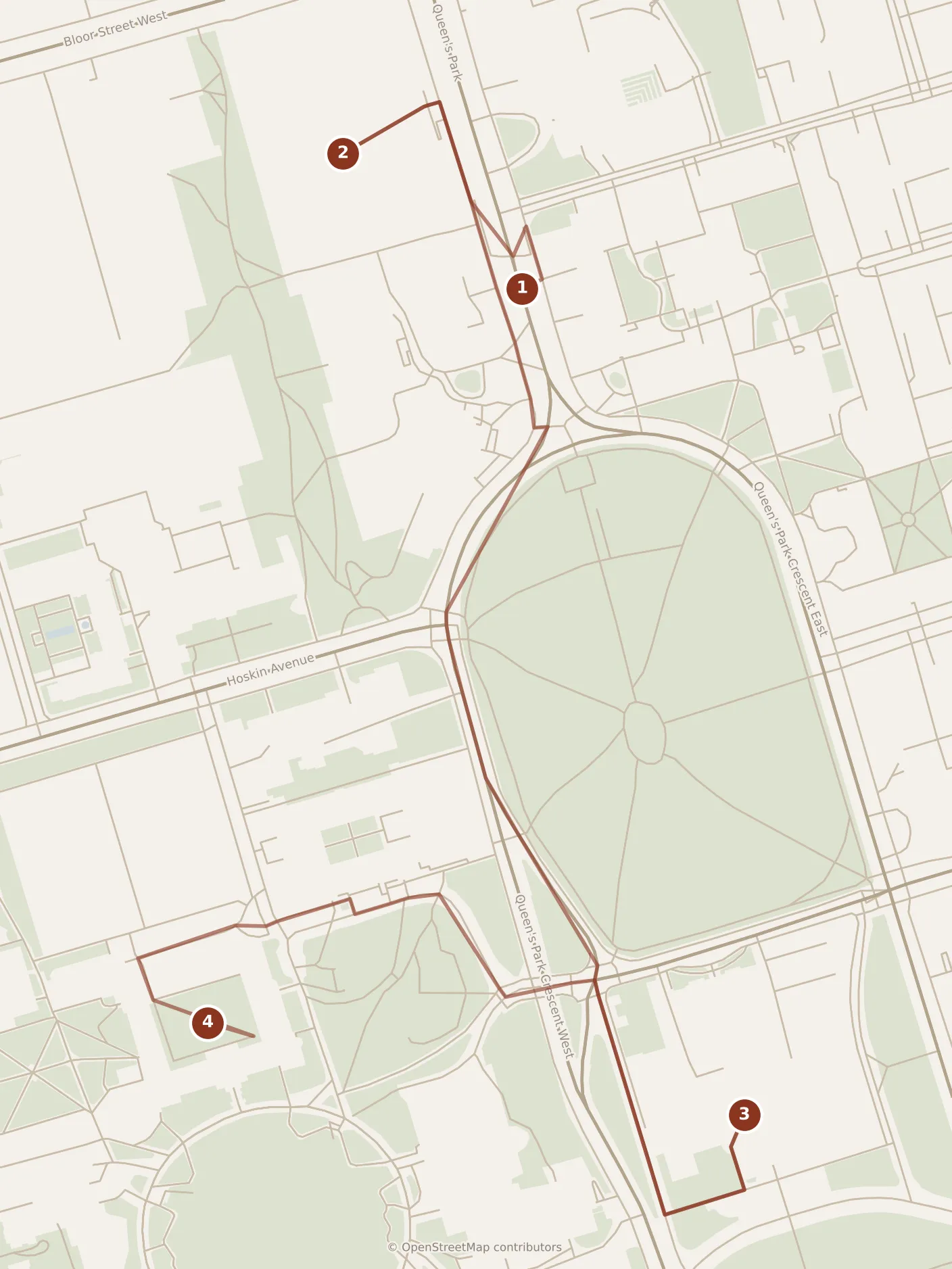
- Morning
- 1Museum station
- 2Royal Ontario Museum
- 3Ontario Legislative Building
- 4University College
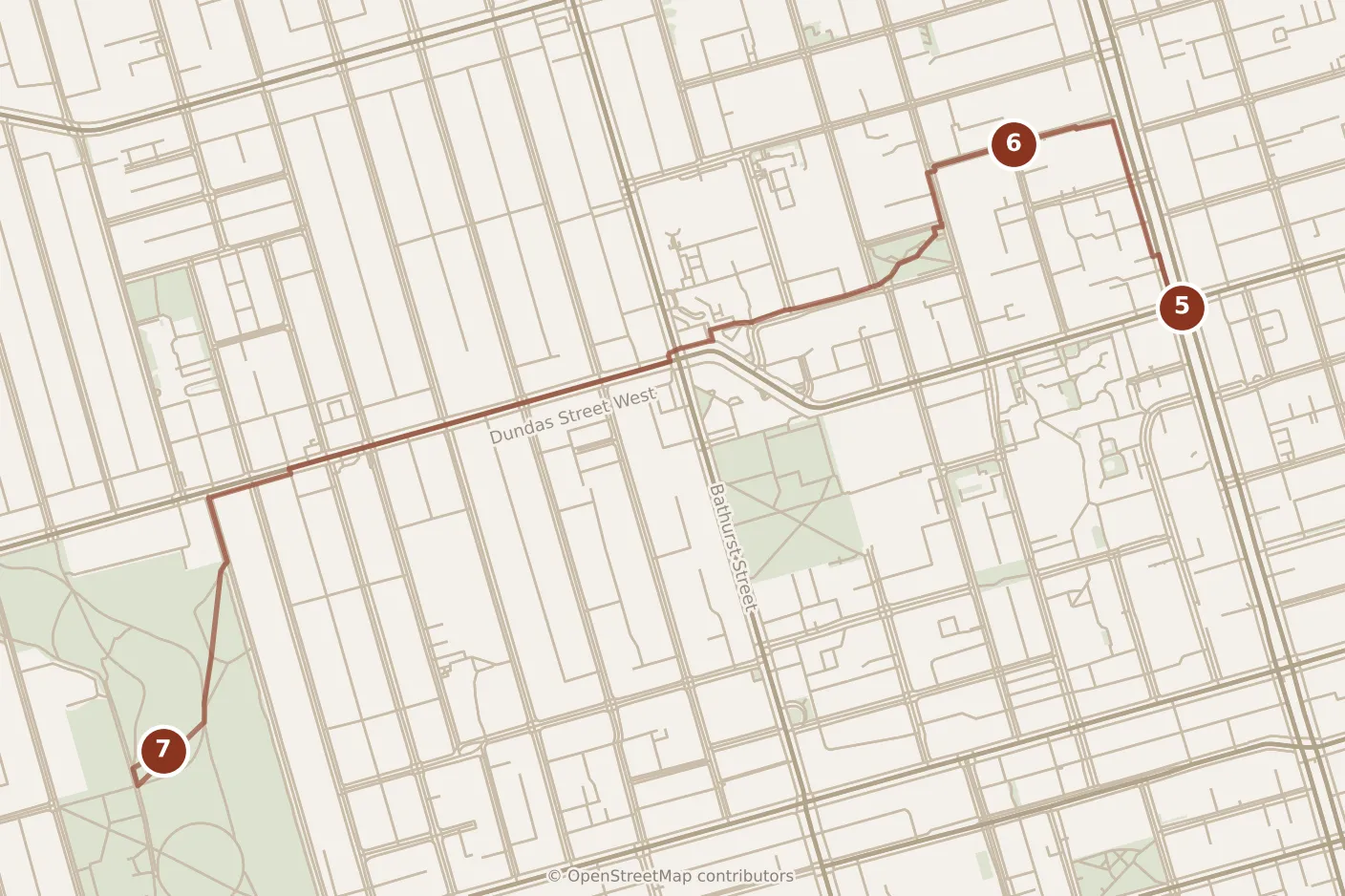
- Afternoon
- 5Chinatown
- 6Kensington Market
- 7Trinity Bellwoods Park
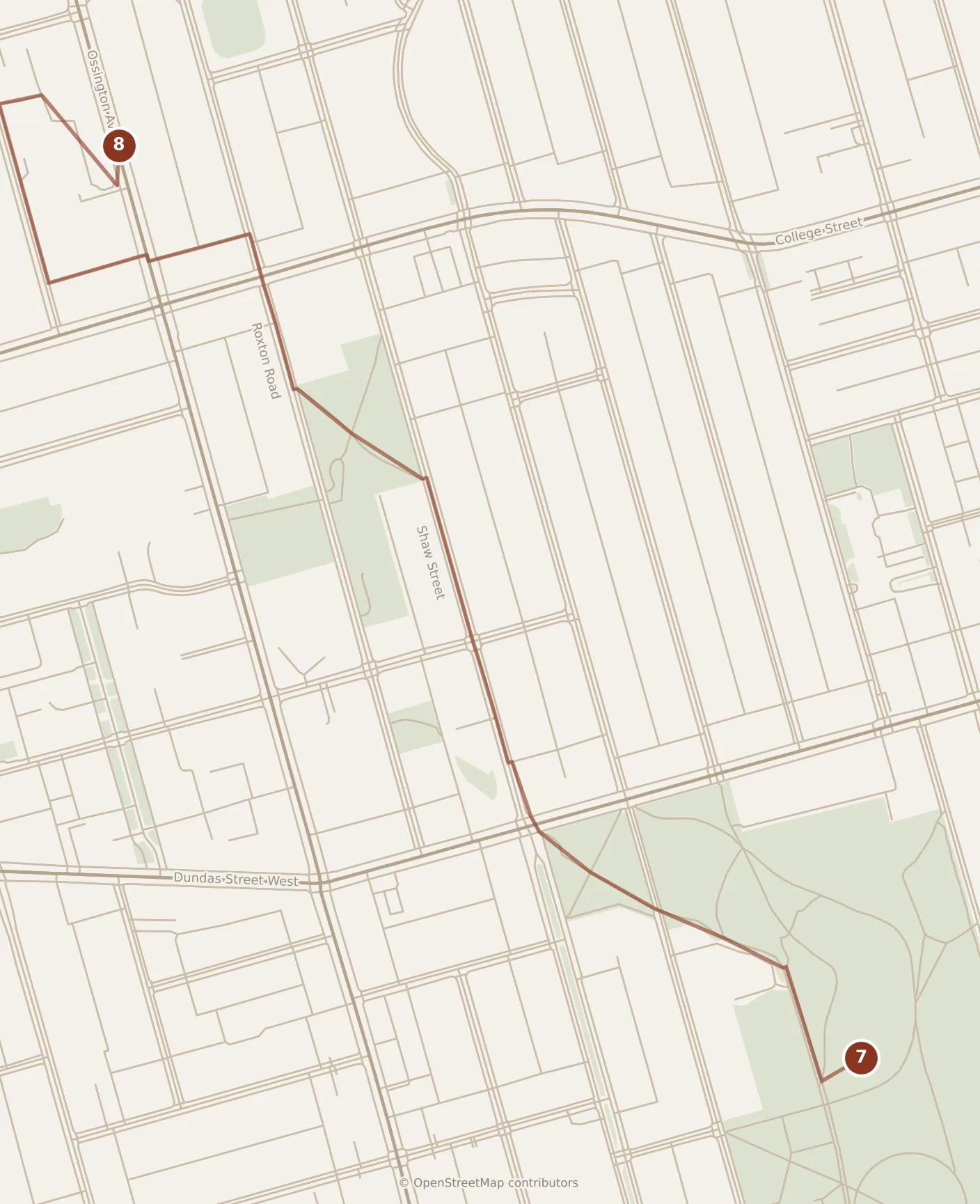
- Evening
- 8Ossington Avenue
Everything today happens along one line drawn from the top of Queen’s Park down to Queen Street West. You never double back, and by the evening you have crossed from the most formal ground in the city to the least.
Morning
Get to Union Station however you arrive — the airport train ends there and so does everything else — and take Line 1 north. One thing to settle before you go down the stairs: the line runs as a horseshoe with Union at the bottom of it, so both platforms are Line 1 and only one of them is yours. You want the train signed Vaughan Metropolitan Centre, which climbs the University Avenue side; the one signed Finch goes up Yonge Street and will not bring you anywhere near the museum. Five stops — St Andrew, Osgoode, St Patrick, Queen’s Park, Museum — and under ten minutes. Museum station surfaces on the museum’s own block.
Give the Royal Ontario Museum two hours, and accept at the door that two hours is one visit to a building holding eighteen million objects in forty galleries. The outside makes the first argument: a stack of leaning aluminum-and-glass prisms called the Michael Lee-Chin Crystal, put up in 2007 to Daniel Libeskind’s design and driven into the old stone museum so that the two read less as joined than as collided. Inside, the decision is halves. On the natural-history side there is Gordo, a Barosaurus, and the Bat Cave, a dark walk-through built around some eight hundred models. On the world-culture side there is the Bishop White Gallery, where three Yuan-dynasty temple wall paintings have wooden bodhisattvas standing in front of them, plus a Ming tomb complex and a rebuilt structure from Beijing’s Forbidden City. Take one side and leave the other. Whichever you take you will pass the crest poles, because they stand in the museum’s own stairwell: they arrived in the 1920s, they were too tall for any room in the building, and when the place was extended in 1933 the extension was built around them instead. The tallest is a Nisga’a pole of twenty-five meters, the tallest ever carved on the Nass River, and there are Haida poles beside it.
Local tip. One side of the museum, not both. The failure here is an hour of dinosaurs followed by an hour of Chinese galleries, which puts you back on the street at noon having half-seen two things and remembering neither — and it costs the hour the rest of this day has no slack for.
Out of the doors and twelve minutes south through Queen’s Park is the Ontario Legislative Building, which stands in the middle of the park and is the reason people here say “Queen’s Park” when they mean the provincial government. It is Richardsonian Romanesque, built between 1886 and 1892 and opened in 1893, faced in a pink sandstone quarried in the Credit River valley that earned it the nickname the Pink Palace. Twenty minutes outside it is what this day has for it. The Legislative Assembly of Ontario runs free guided tours of about an hour and publishes its own times; taking one costs you the campus below and about half an hour besides, and on a first trip that is the wrong trade.
Seven minutes west, the park runs into the university’s oldest ground: King’s College Circle, a lawn ringed by the buildings the place started with. University College is the one to walk round — built between 1856 and 1859, Norman and Romanesque Revival with fragments of several other things in it, and a National Historic Site since 1968. Convocation Hall, the round domed building on the same circle, is still where the university graduates its students. Twenty-five minutes, and it is a walk rather than a visit.
Afternoon
Seventeen minutes south-west and the city changes entirely. Chinatown runs along Spadina Avenue between Dundas Street West and College Street. Lunch is here and it should be sitting down: the district is a working one rather than a restaurant row, and this is the day’s one sit-down lunch — what Kensington offers an hour later is not a second. Forty-five minutes. Give the avenue itself a minute of attention on the way through — it is absurdly wide for a downtown street, with the streetcars running in a reservation down the middle, and it is the one central street built for something larger than what stands on it.
Six minutes north-west is Kensington Market, and this is where the second day pays for itself. A single day can only walk this place; two days lets you stop at the counters — one thing at a time rather than another meal — so give it an hour and a half instead of the three quarters you would otherwise afford. It is not a market hall. It is four narrow streets — Augusta Avenue, Baldwin Street, Nassau Street and Kensington Avenue — where houses became shopfronts and stayed that way, and what it amounts to now is a long run of small counters each selling one thing properly. The bakeries have a butter tart, which is a Canadian thing rather than a Kensington one. On the last Sunday of the month from May to October in 2026 the streets closed to cars from midday for Pedestrian Sundays, which makes the place better and twice as full at once. It is a seasonal arrangement rather than a fixture, so check it is running before you build an afternoon on it; if it is, and that is your Sunday, come at noon rather than at four.
Twenty-six minutes south-west, down out of the market and across Bathurst, brings you to Trinity Bellwoods Park and the run of Queen Street West beside it. The park is thirty-eight acres and it used to be a college: Trinity College stood on this ground from 1852 until most of it came down in the early 1950s. The iron gates at the Queen Street West entrance look original and are replicas — the originals went to a school in Port Hope — which is the kind of thing worth knowing before you photograph them. The deep bowl in the southern half is not landscaping either. It is the ravine of Garrison Creek, buried and backfilled in the 1950s, and it now does duty as the off-leash dog park and the tobogganing hill. An hour covers the park and the shops along Queen Street West together.
Evening
Thirteen minutes south-west and you are at the bottom of Ossington Avenue. The strip is the four or five blocks running north from Queen Street West towards Dundas Street West, ten minutes to walk end to end, and almost every first floor along it is a kitchen or a bar. This is what the whole day has been walking towards, and it is precisely what a single day in this city cannot have: getting out here and back costs an hour that one day does not own. It is loud on weekends and it starts late. When you have finished, the streetcars along Queen Street West run east from the bottom of the strip, and that is the near way out; Ossington station on Line 2 is at the top of the avenue, which is a good deal further north than the top of the strip and a walk of its own at the end of this day.
Day two

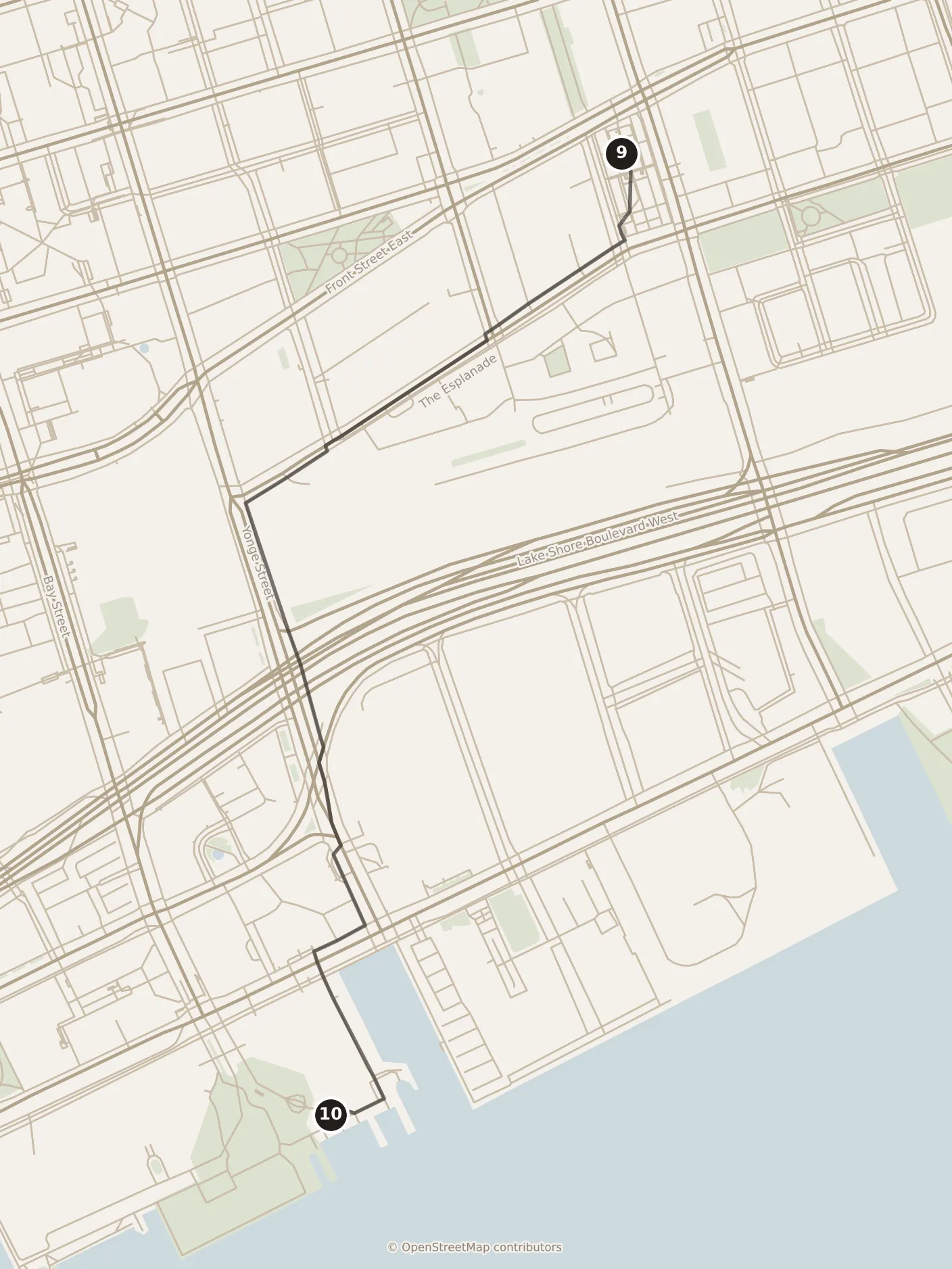
- Morning
- 9St. Lawrence Market
- 10Jack Layton Ferry Terminal
- Afternoon
- 11Toronto Islands
- 12Hanlan's Point Beach
- 13Harbourfront Centre
- Evening
- 14CN Tower
- 15Union Station
Today is a boat, a long walk and a window, in that order, and the whole thing is built backwards from the last of the three.
Morning
Start at the St. Lawrence Market, seventeen minutes east along Front Street from Union Station, or one stop on Line 1 to King and nine minutes east from there — the walk is what the day’s count assumes. Give the market an hour and do two separate things in it. The first is breakfast: the south hall is a working food market rather than a display one, and the counter version of the peameal bacon sandwich is what it is known for. The second is why the hour is an hour rather than half of one. Buy your lunch here. What is open on the island is seasonal, sparse, and in the cold months largely not open at all, and one o’clock will find you a long way from any of it.
Local tip. Lunch today is a decision you make at nine in the morning or not at all. The market is the last thing you pass before the boat, and once you are across, whatever you did not buy is a forty-minute walk and a ferry crossing behind you.
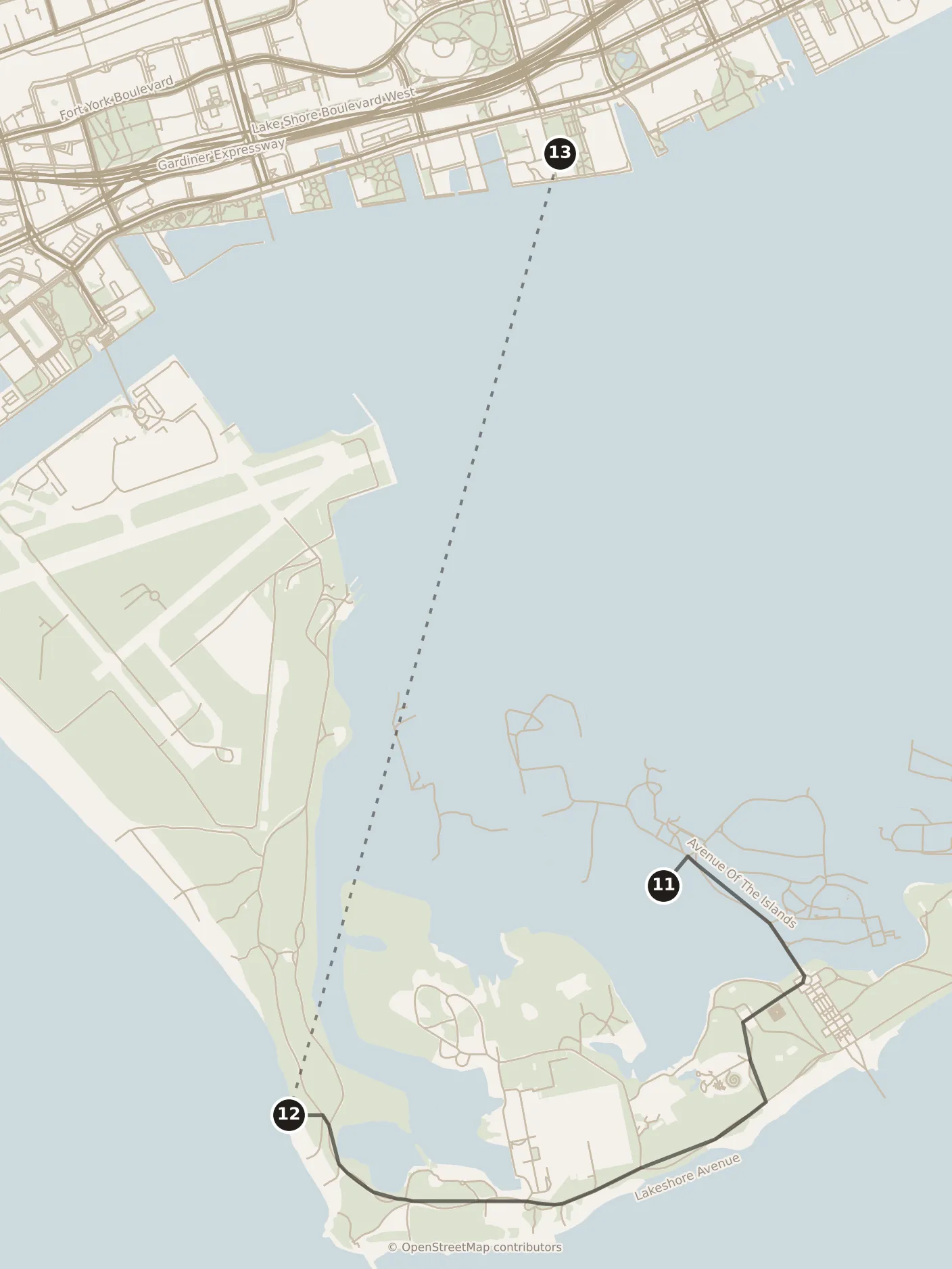
Twenty minutes on foot south-west is the Jack Layton Ferry Terminal, at the foot of Bay Street where it meets Queens Quay, set back from the intersection behind the hotel block on the corner. Allow a further fifteen minutes here for the ticket gate and boarding, and considerably more on a summer weekend. Three island docks are served — Ward’s Island, Centre Island and Hanlan’s Point — and only Ward’s runs through the winter; the other two operate from about mid-April to mid-October. Go out to Ward’s whatever the season. It is the quiet end, it is where the walk starts, and the crossing takes about a quarter of an hour.
Afternoon
You land at the eastern tip of the Toronto Islands and the plan is simply to walk west. There are no cars on them. The route is the boardwalk and then the lakeside path, with the open water of Lake Ontario on your left the whole way and the city standing up behind you every time you turn round, and it is about four kilometers from the Ward’s dock to the far end — call it an hour and a quarter of actual walking. Spend three hours on it altogether: half an hour at the Ward’s end among the island houses, forty minutes of boardwalk, three quarters of an hour at Centre Island where the pier runs out into the lake and the bridge and the formal gardens are, then twenty-five minutes west again, and ten at the end to reach the dock.
That last stretch ends at Hanlan’s Point Beach, which is where the day turns round: a wide, quiet, west-facing beach worth the last half hour of the afternoon. One thing to know before you walk down onto the sand, because nothing warns you — part of this beach has been an officially clothing-optional beach since 1999, made permanent in 2002, and it is the only one in the city. It is simply not what you expect at the end of a boardwalk.
Take a boat back from the Hanlan’s Point dock — another quarter of an hour on the water. Between mid-October and mid-April that dock is closed, so the winter version of this afternoon turns round earlier and walks back to Ward’s, which is what makes it three and a half hours rather than three. Either way you land at the terminal again, and eleven minutes west along the water is Harbourfront Centre, and in it the contemporary gallery called The Power Plant, free to walk into since 2012. Forty-five minutes there is the buffer this day is built with: in December it is what stops you standing at the foot of the tower a full hour before the light is worth anything. It hangs exhibitions rather than a permanent collection, so between shows there is nothing in it — Harbourfront Centre publishes what is up — and if the answer is nothing, the promenade west takes the same forty-five minutes and costs the day nothing.
And in the long half of the year, none of the above is the plan. From late spring the count above puts you at the tower’s foot in the middle of the afternoon with the sunset five or six hours away, and the answer is not to slow the mainland down; it is to stay where you are. The island is the one place on these three days that absorbs six hours without padding, because it is a beach, four kilometers of boardwalk, a bicycle if you want one, and a lake to swim in. So in June and July, take a boat back at about half past seven rather than at two. That puts you at the terminal at a quarter to eight and, walking nineteen minutes straight west rather than by way of the gallery, at the tower’s foot a little after eight — an hour in hand for the ticket check and the elevator before a nine o’clock sunset. Two things follow. The city’s own warning about return waits covers five until nine on summer weekends, so join the line at the island dock earlier than that hour suggests. And The Power Plant drops out of the day entirely on that plan, not as a cut but because you come back past it in the evening.
Evening
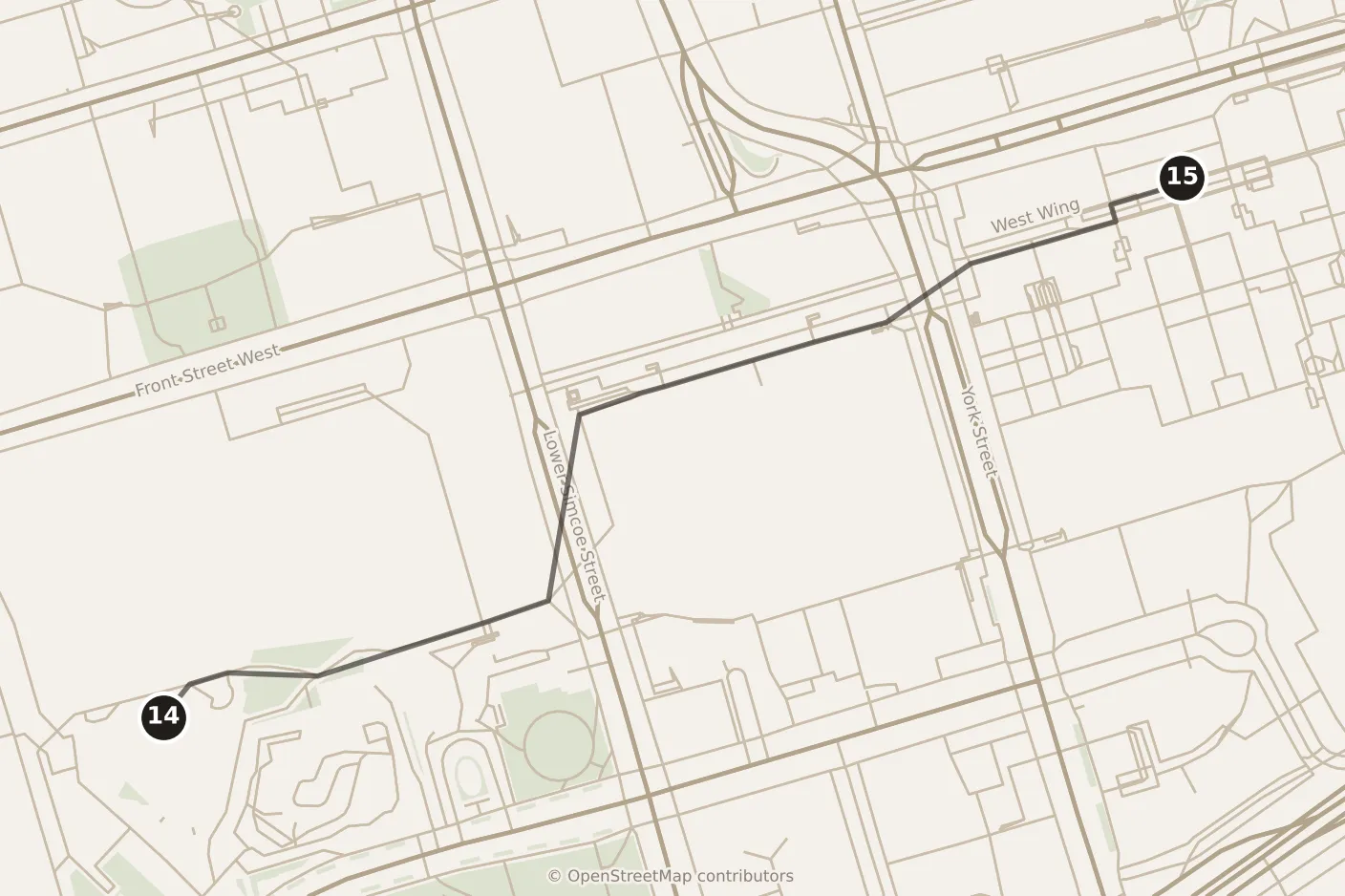
Twelve minutes north-west along the water and you are at the foot of the CN Tower: five hundred and fifty-three meters to the tip, finished in 1976, with the elevator running to the main observation level at three hundred and forty-six meters and a glass floor and an open terrace one level below it. There is a higher level sold as an extra and it is not what makes this stop work. Give the whole thing an hour and a quarter — the tower itself suggests two, and the difference between the two figures is waiting in line and wandering rather than looking.
This is the stop the day is built around, and the reason it comes last is that it completes a circle. You have spent the entire afternoon looking at this city from a boardwalk two kilometers out in the lake; now you stand where you were looking at, and the low bar of trees on the horizon is the walk you did. You can follow it with a finger: the houses at the eastern tip where you landed, the long dark middle, the western end where the beach is. Nothing else up there does that. The rest of what you see is a grid running north until it runs out of light, which is impressive and could be almost any large city on this continent — the islands are the half hour that is specifically this one, and they are only legible for about that long, between the lights coming on and the water disappearing.
Then down and back. Union Station is eleven minutes east along Bremner Boulevard, or the same distance under cover on the SkyWalk, the enclosed bridge between the two, which is the difference between a pleasant walk and a miserable one from December to March. Eleven minutes is the whole distance between the last thing you look at and the departure board, which is worth knowing at the one point in the day when it is the only thing you need.
With a third day

- With a third day
- 16Art Gallery of Ontario
- 17Distillery District
- 18Corktown Common
- 19Riverdale Park
- 20Greektown
A third day goes on the end rather than in the middle, and it takes the half of the city the first two never touch: the east. Nothing in days one and two moves to make room for it. The one thing a third day changes is what you are allowed to want, and that is at the end of this section. It is about five and a half kilometers of walking, the same as day one.
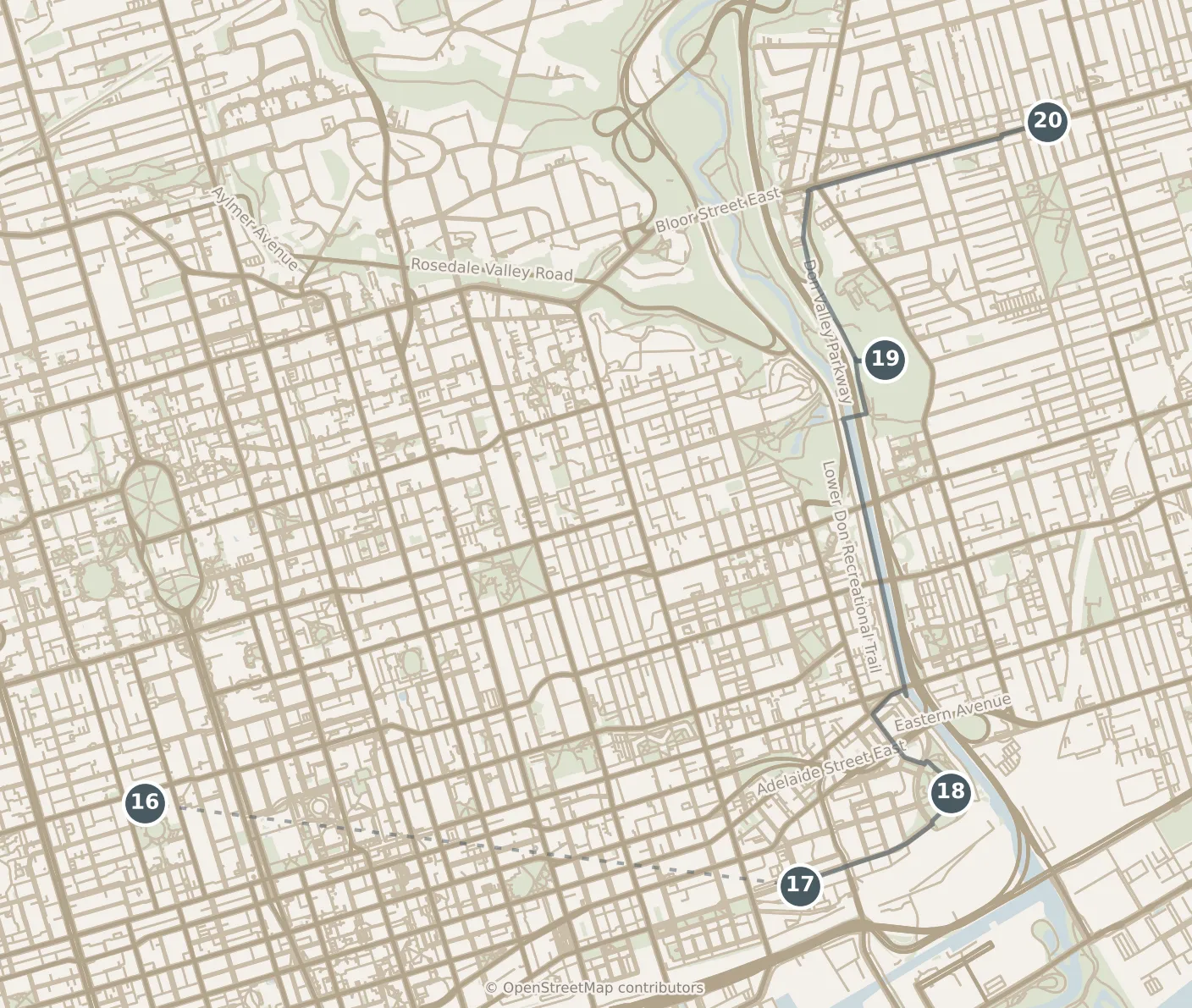
Start at the Art Gallery of Ontario, which opened at half past ten in 2026 and is shut on Mondays. Two hours. It sits eight minutes east of where day one had lunch, and it is deliberately not on day one: two large collections in one day is how you come to resent the second. What Frank Gehry did to it between 2004 and 2008 is the reason to spend a minute outside before going in — he was born in this city and this was his first building in the country, and the two-hundred-meter glass-and-timber front he hung on the Dundas Street West side reads from the sidewalk like a greenhouse laid on its side. Then, inside, the same discipline the museum wanted. Either the Canadian rooms, with the Group of Seven and the Thomson Collection behind them, or the European ones, which hold Rubens’ Massacre of the Innocents in a dark red room of its own and a collection of Gothic boxwood miniatures — carvings you could close a hand around, with whole crucifixion scenes worked into the inside of them. One or the other, not a bit of each.
Then east, on the article’s one ride that is neither a subway nor a boat. Walk seventeen minutes south-east to King Street West at University Avenue and take a 504 King streetcar eastbound — and read the front of it, because the route splits: the branch you want is signed for Distillery Loop and turns down Cherry Street, and the other is signed Broadview and goes nowhere near. About twenty minutes.
The Distillery District is thirteen acres of Victorian industrial brick, cobbled and closed to cars — the old Gooderham and Worts works, kept whole instead of knocked down, and now galleries, studios and places to eat. Give it an hour and three quarters with lunch inside it. One thing to check first: from mid-November to early January the whole district is handed over to a winter market, and in the 2025–26 season that market charged admission after four in the afternoon on Fridays, Saturdays and Sundays and daily through the second half of December, and was free at every other hour. A late morning or an early afternoon in that season is both free and half as crowded, which is a second reason this is not an evening stop.
Now the longest walk between two stops in this article, the island itself aside, and it is a walk rather than a transfer. Fourteen minutes north-east brings you to Corktown Common, a park made out of old industrial ground with a marsh in the middle of it and a good backward view of the towers; fifteen minutes. Then thirty-five minutes north on the trail that runs beside the Don River to Riverdale Park — the eastern of the two parks of that name, the one below Broadview — a steep west-facing slope and one of the two or three places in the city where the whole downtown stands up in front of you with nothing in the way. Half an hour, and in the long months make it longer — the slope faces the sunset and the skyline together, which is the one thing this day has that day two’s tower cannot give you, since up there you are inside the view. If your legs have gone by the time you leave the distillery, the alternative is a plan and not a shrug: walk back up to King Street West, take a 504 west to King station, Line 1 north to Bloor–Yonge and Line 2 east to Broadview, and you arrive at the top of the park rather than the bottom in about forty minutes and one fare, having given up the common and the river walk.
Sixteen minutes up Broadview Avenue is Greektown, the long stretch of Danforth Avenue that runs east from the top of the hill for well over a kilometer, and the evening this day exists for. Broadview station on Line 2 stands at the corner where you arrive, so the way home is settled before you sit down. Door to door, the gallery to Greektown comes to about six hours and a quarter, an hour and twenty of it walking, so the gallery’s half past ten is what decides where the evening lands. The only moment on this day that answers to the light is the optional one already described at the park, and it is optional in both directions: take it and dinner is late, skip it and nothing else on the day notices.
And the one thing a third day changes about the two below. On a two-day trip the gallery is what you give up, and some people would rather have it than the island. That swap is available on most trips and it is not free: put the gallery into day one after lunch, cut the campus and cut Trinity Bellwoods to pay for it, and day one still comes out about forty minutes longer than it is written. And on a stay that contains a Monday it is not available at all, which is worth saying plainly because that is the case most likely to want it: the Monday rule has already pinned that day as day one, the gallery is shut on Mondays, and the swap would put it behind a locked door. A two-day trip with a Monday in it keeps the island, and the choice is made for you. With three days you do not have to make that choice at all, which is most of what the third day is for.
Practicalities
Three things want booking before you travel on a two-day trip, four if you have three days. The museum sells dated tickets on its own site and is cheaper the further ahead you buy, so booking is a reason rather than a formality. The ferry is sold on the City of Toronto’s own ferry ticket page and at the booths in the terminal; buying online is worth it for the line rather than the money, since online holders go through a separate express line at peak times, which is the city conceding a wait without ever publishing its length. An adult round-trip crossing was under ten Canadian dollars in 2026. The tower sells timed general admission a limited number of days ahead, and the slots either side of sunset are the first to go from June to September; adult general admission was in the forty-to-fifty-dollar range in 2026. The gallery, on a third day, is the fourth, sold as dated general admission on its own site.
Everything else across these three days is free to walk into or walk past: the legislature, the campus, Chinatown, Kensington Market, Trinity Bellwoods Park, The Power Plant, Corktown Common and Riverdale Park. The island is free once you are on it; the crossing is the ticket above.
The closures are two and both are Mondays. The market’s south hall was shut on Mondays in 2026, which removes the sandwich and the island’s lunch in one go; the gallery is shut on Mondays too, stated on its own visitor page, so that one is a fact rather than a risk. The museum was open seven days a week. Hence the rule: the Monday is day one. The other days take any date in either order, and the arrangement people get wrong is a Sunday arrival treated as day one, which lands day two on the Monday and sends you to a locked market at nine in the morning.
The weekend moves day two, and only in one direction. On a Sunday the south hall opened at ten rather than nine in 2026, which pushes the whole day back an hour. That costs nothing between April and September and matters in the short weeks around midwinter, when an hour is the difference between reaching the tower before the light goes and after it — so on a winter Sunday the forty-five minutes at The Power Plant is the thing to drop: go straight from the terminal to the tower, nineteen minutes on foot, and the day lands where it should. That cut belongs to a winter Sunday and to no other day. Saturday looks like the opposite case and is not: the south hall opened at seven, but starting earlier buys nothing on a day anchored at its far end by the light rather than at its near end by the door. What a Saturday actually adds is the north building, which holds a farmers’ market that morning and is gone by mid-afternoon — worth spending half of the market’s hour on.
The two general cuts, for a reader with less time rather than a difficult weekday, and they are one per day. On day one, cut the museum’s second hour rather than a stop — one side of it instead of one side and a piece of the other — and drop the twenty minutes at the legislature: that gives back an hour and twenty minutes, and gives it back before lunch, which is where day one’s slack is needed. On day two the cut is the island’s western half: turn round at Centre Island rather than walking on to Hanlan’s Point, and take the boat from the Centre Island dock. That is an hour and a half and it leaves the shape of the day intact. It is available from mid-April to mid-October only, because that dock is otherwise closed — in the winter months the equivalent is simply to turn back sooner on the way to Ward’s. What not to do is cut the island to a short crossing there and back while keeping everything else, which is the day with its reason removed.
The one hour worth reading off a website rather than off this page is the tower’s last elevator ride, and only because it is the single published hour that could break these three days as they are written rather than merely change their comfort: if the last elevator ever left before sunset, the tower would stop being an evening stop and day two would have to be built backwards from the boat instead. The tower publishes its own hours. Look once, the week before. Two other things on these days are worth confirming in the same week — the market’s Pedestrian Sundays and the museum’s free third-Tuesday evening — but neither is an hour the trip stands on: they are offers, and if one of them has stopped running you lose an alternative rather than a day, and everything above holds as written.
Two useful things that are neither bookings nor closures. Through 2026 the museum was free from four in the afternoon until half past eight on the third Tuesday of every month, pre-booked only, tickets released about two weeks ahead and no walk-ins; confirm it is still on before you rebuild a day around it. If your day one is a third Tuesday the inversion is genuine and so is its price: run the campus, Chinatown and Kensington Market first and the museum from four, and you save the ticket and lose the Ossington evening, because you come out of a museum three kilometers away from it at half past eight. And on fares: Line 1, Line 2 and the streetcars all take a Presto card or a contactless bank card, which is the only word you need at the gate — the city guide has how it actually works. Nothing on these three days needs an app installed, including the ferry, whose ticket is a file you show at the gate.
Getting to and from the days themselves. Day one starts at Union Station and ends on Ossington Avenue, with the Queen Street West streetcars at the bottom of the strip and Ossington station on Line 2 well north of the top of it. Day two starts seventeen minutes’ walk from Union Station and ends eleven minutes from it. A third day starts at the gallery, eight minutes west of St Patrick station on Line 1, and ends at Broadview station on Line 2.


.jpg)
