Toronto in one day: west from Union Station, and the tower at dusk

Last updated 4 August 2026
Overview
Toronto is an enormous city with a small walkable middle, and one day works here because of the second fact rather than in spite of the first. Everything below sits within two kilometers of Union Station. The route is about seven and a half kilometers on foot, a little under two hours of actual walking, and it goes one way — a short stretch east of the station, then steadily west, then south to the water — so it never sends you back over ground you have already covered.
What a single day costs you is the neighborhoods, and it costs you every one of them. The strips people here actually spend their evenings on are a streetcar ride out in each direction, and a day that goes to fetch one spends an hour on the ride and comes back with nothing. It also costs you the Royal Ontario Museum, which is a good museum in the wrong place for this route, and the ferry to the Toronto Islands, which is half a day and not half an hour. Give all three up at nine in the morning rather than at four in the afternoon.
What you get in exchange is an order that means something. Union Station is 1927. The market hall you eat in was Toronto’s city hall from 1845 to 1899. Old City Hall, twenty minutes north-west, took the council over in 1899 and held it until 1966. The city hall beside it opened in 1965 — and the square it stands on was cleared, in the late 1950s, of Toronto’s first Chinatown, whose businesses moved west to Spadina Avenue, which is where you have lunch. The tower at the end went up in 1976 on the railway land behind the station you started in. A century and a half of a city moving west and then straight up, walked in sequence in a single day.
Two hours decide the shape of it. The first is the market’s: the south hall admitted nobody before nine on a weekday in 2026, opened later than that on a Sunday, and on a Monday did not open at all. The morning is counted forward from that hour. Nothing before it on this route has a door that is shut at nine in the morning — the station does close overnight, but it opens hours before that, and the flatiron is a street corner — so the market is the first thing here that can turn you away, and a nine o’clock start reaches it at about a quarter to ten. If the hour has moved, count forward from the new one.
The second is the tower’s: in 2026 the last visitors went up at half past nine at night, and that is the fact which lets the tower stay the last stop all year round rather than only in the months when it gets dark early. It is the one hour on this page worth reading off the tower’s own site before you go, because it is the only one that can move the order: if the last elevator ever falls ahead of sunset, the tower stops being the last stop.
The third thing that decides the day is not an hour and nobody can revise it. The last stop is a window three hundred and forty-six meters up, and what it wants is the half hour either side of sunset, when the grid below has come on and the water has not yet gone invisible. The sun goes down here at about twenty to five in early December and just after nine at midsummer, so take your own month’s hour and count backwards. Everything above the tower comes to roughly seven hours from a nine o’clock start, walking included, which puts you at the foot of it at about a quarter to four — in December, an hour before the light goes, which is exactly right.
Those seven hours count the time you spend inside places and the time you spend walking between them, and they count nothing else. Here the omission has a name: the ticket check and the elevator line at the tower, which on a summer evening is the longest single wait of the day and belongs beside the total rather than inside it. And from late spring the arithmetic overshoots the light badly — at midsummer you reach the tower five hours early. Do not pad the middle to close that gap. Spend the surplus on the thing this day otherwise gives up: the ferry to the Toronto Islands goes from the Jack Layton Ferry Terminal at the foot of Bay Street, twenty minutes east of the tower along the water, and looking back at the skyline from out there is the counter-shot to looking down at it. Buy the ticket online before you walk down there: the city’s own ferry page tells you to, and it puts online ticket holders in a separate line at peak times, which is the city conceding a line without ever publishing how long it runs. Then come back and go up.
Last, the bag, because on a one-day itinerary you are carrying one. Union Station answers this question itself and the answer is no: no public lockers, no baggage storage, and checked luggage only for the intercity operator’s own ticketed passengers. That is not a footnote, it changes the day. Neither the gallery nor the tower is a place to spend two hours holding a suitcase, and they are also the day’s two paid stops — so a reader between trains who has nothing to check should make the decision at the start rather than discover it at three in the afternoon. Here is what to do instead, and it is a whole day rather than a gesture. The morning below is all street level and outdoors and needs no changing: the station, the flatiron, the market, both city halls, in that order, about two and a half hours of it with the walking. Then keep going west to the gallery and stop on the sidewalk — the glass-and-timber canopy on the Dundas Street front is the half of it you can see with a bag in your hand — and carry on to Spadina Avenue for lunch sitting down, three quarters of an hour, then six minutes north-west into Kensington Market for another three quarters. From there back to Union Station is the walk the evening below makes, plus the twelve minutes from the tower’s foot to the station — or the 510 streetcar down the same avenue, whose Union Station branch is the one that matters here: the evening says the ride saves you nothing, and that stops being true the moment you are carrying something. It comes to a little over five hours from a nine o’clock start, it ends at the departure board where the bag has to be anyway, and what it gives up is exactly the two stops the bag ruins. It is a good Toronto day. It is not the one below.
The day

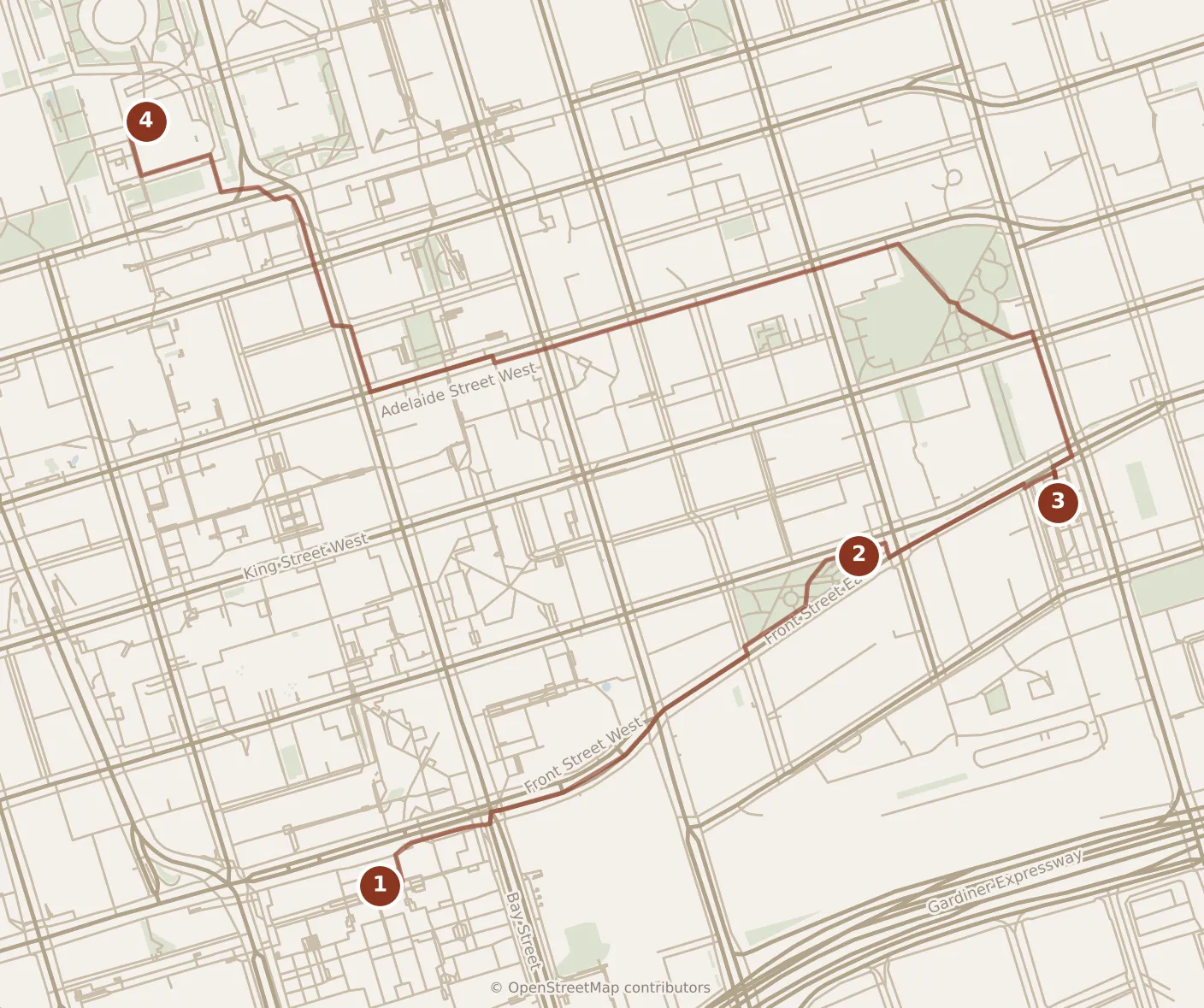
- Morning
- 1Union Station
- 2Gooderham Building
- 3St. Lawrence Market
- 4Nathan Phillips Square
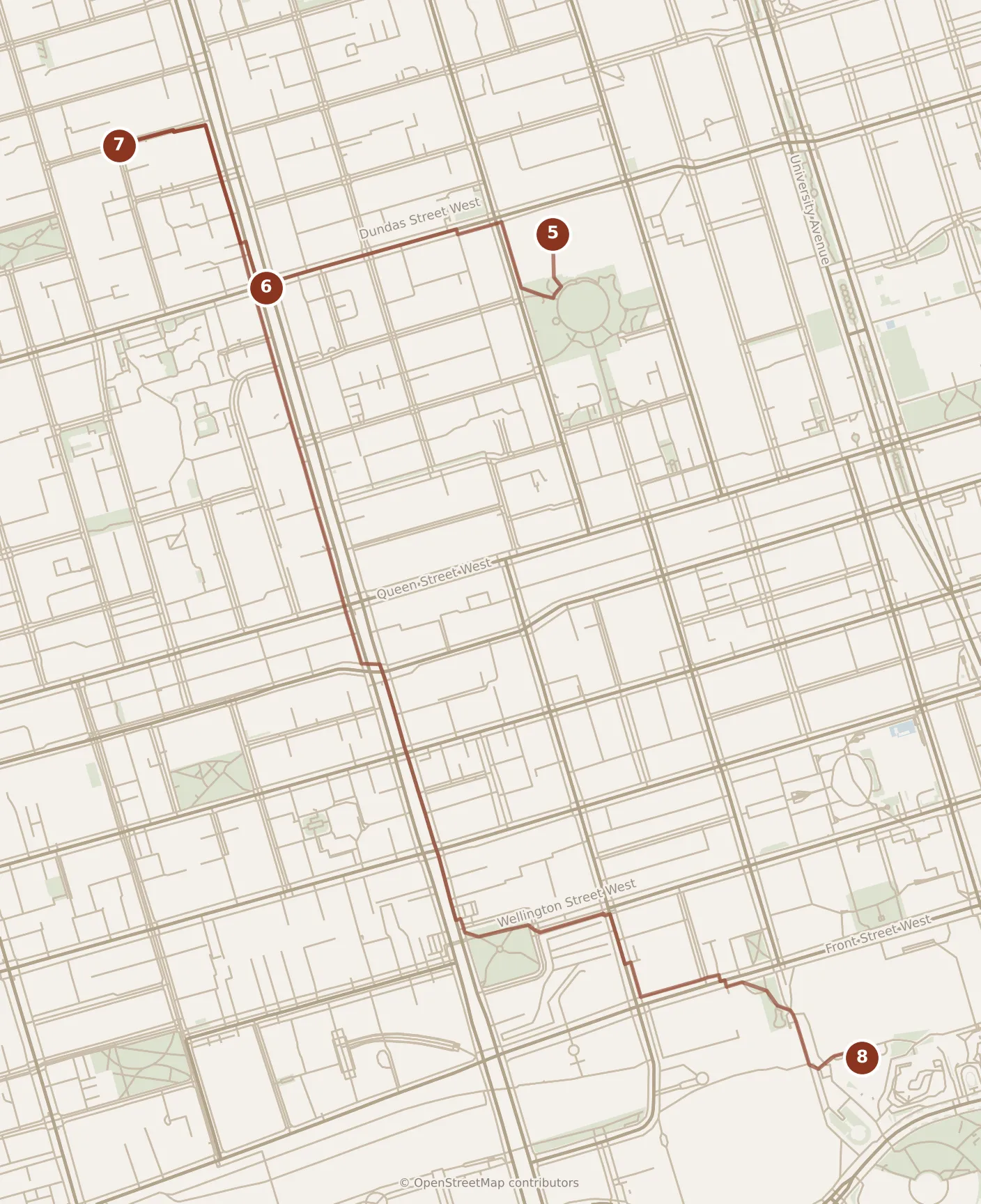
- Afternoon and evening
- 5Art Gallery of Ontario
- 6Chinatown
- 7Kensington Market
- 8CN Tower
Morning
Start inside Union Station rather than walking out of it. It was built in 1927, and the room behind the colonnade — the ticket lobby, known to everyone as the Great Hall — is seventy-six meters long and twenty-seven meters to the top of its vault, faced in limestone and marble under a coffered tile ceiling of the kind that is engineered rather than plastered. The thing to look for is written round the room in a band under the cornice: the names of the places the railways reached in 1927, carved from the east coast to Vancouver. It is a map of the country as it was the year the building opened, and a good many of those names are still on the departure board a hundred meters away. On the way out, count the colonnade along Front Street — twenty-two columns, each twelve meters high and seventy-five tons of limestone. Twenty minutes, and you have not left the station.
Then twelve minutes east along Front Street to the Gooderham Building, the red-brick flatiron of 1892 driven into the triangle where Front Street and Wellington Street run together. Do not stand at the point of it. Walk past and look back west along Front Street: the rounded corner in the foreground, low nineteenth-century blocks either side, the financial towers stacked up behind. That composition is the one that turns up on other people’s postcards of this city, and it takes ten minutes to find it and see why.
Five minutes further east is the St. Lawrence Market, where the building is half the point. The south hall was Toronto’s city hall from 1845 to 1899; when the council moved out to the building you will reach in an hour, the market moved into the shell, reopening with the old civic front built into it. Inside it is a working food market rather than a display one — butchers, fishmongers, cheese counters, bakers — and it is where the peameal bacon sandwich is made: cured pork loin rolled in cornmeal, griddled, served in a soft bun with nothing on it unless you ask. Eat it standing up. Give the market three quarters of an hour, which is a second breakfast and a look at what the building used to be, not a shopping trip.
Then the longest walk of the morning, twenty minutes north-west through the financial blocks to Nathan Phillips Square, where two city halls face each other across Bay Street sixty-six years apart. Old City Hall is 1899 and Romanesque, with a clock tower planted so that it closes the view up Bay Street from the water; the council sat in it until 1966, the provincial courts used it until 2023, and it has been a National Historic Site since 1984. Opposite, the present city hall opened in 1965 out of an international competition — two curved towers of unequal height wrapped round a low domed council chamber, by a Finnish architect, Viljo Revell, who died the year before it opened. Walk into the middle of the square, past the letters spelling the city’s name, and take in what is under it: this ground was cleared in the late 1950s of Toronto’s first Chinatown, which is the reason the Chinatown you eat lunch in is a kilometer to the west. Twenty-five minutes for the pair of them.
Afternoon
Fifteen minutes west and north brings you to the Art Gallery of Ontario on Dundas Street West. Spend a minute on the building before the collection: Frank Gehry rebuilt it between 2004 and 2008, his first work in the country he was born in, and what he hung on the Dundas Street front is a canopy of glass and laminated timber two hundred meters long that reads from the sidewalk like a greenhouse laid on its side.
Give it two hours and give up on completeness at the door — there are more than a hundred and twenty thousand works here, and two hours is one collection. Two are worth choosing between. The Canadian rooms hold the Thomson Collection, some six hundred and fifty Canadian paintings given to the gallery in 2004, two hundred and fifty of them by Tom Thomson, together with the Group of Seven whose landscapes are as close as this country comes to a national image. The European rooms hold the other half of the same gift: nine hundred objects, a hundred and thirty ship models, the world’s largest holding of Gothic boxwood miniatures — carvings the size of a walnut with entire crucifixions inside them — and Rubens’ Massacre of the Innocents, bought at auction in 2002 and hung in a low-lit, blood-red room. Whichever you take, pass through the Henry Moore Sculpture Centre on the way. It opened in 1974 and Moore chose its proportions, the color of its floor and walls, and the skylight over them: a room built around its sculptures rather than filled with them.
Local tip. Two hours buys one of those two collections, not both. Choose the one you would rather have seen and skip the other outright. The failure here is doing half of each, leaving at half past three having seen neither properly, and arriving at Kensington Market with no appetite left for it.
Eight minutes west along Dundas Street West and you are at Spadina Avenue, in the Chinatown that moved here when the square you were standing in was cleared. This is lunch, and it should be eaten sitting down: dim sum, Cantonese roast meats hanging in the windows, Vietnamese soup, and most of it costing a fraction of what the towers behind you charge. Three quarters of an hour.
Six minutes north-west, across Spadina Avenue, is Kensington Market, a National Historic Site since 2006 and not a market building at all. It is four or five residential streets whose Victorian houses had their first floors turned into shops a century ago and never turned back — produce crates out on the sidewalk, vintage clothes, fishmongers and cheese shops. Walk Augusta Avenue first, then Baldwin Street, Nassau Street and Kensington Avenue, and sit for ten minutes in Bellevue Square in the middle of it. Three quarters of an hour is enough to have seen it and not enough to start shopping.
Evening
From Kensington Market the tower is a little over half an hour on foot, and there is no faster way, which is worth saying because there appears to be one. Go south down Spadina Avenue to Queen Street West, four blocks east, then south down John Street, which crosses the rail corridor on its own bridge and comes out on Bremner Boulevard at the tower’s entrance. The 510 Spadina streetcar runs down the middle of that same avenue and looks like the shortcut. It is not: you walk six minutes to reach it, its branches end in three different places and only one of them is Union Station, and whichever one arrives leaves you a walk at the far end. What you save is the difference between waiting and walking, which is nothing. The exception is the weather. The last stretch of that walk crosses open railway land on a bridge with nothing on either side of it, and between December and March that is the part of the day people regret — so in winter the streetcar earns its fare for a different reason. Ride it to Union Station and cross to the tower on the SkyWalk, the enclosed bridge between the two, without going outside at all. One thing to check before you fix the evening, whichever way you come to it: the stadium stands at the foot of the tower and the SkyWalk is its own way to and from the trains, so on a home date or a concert night that bridge is carrying tens of thousands of people at about the hour you want to be crossing it. The fixture list is published; look at it once.
The CN Tower is five hundred and fifty-three meters to the tip, finished in 1976 on the railway land behind the station you started in, and it held the record for the tallest free-standing structure in the world for thirty-two years, until the Burj Khalifa passed it in 2007. The elevator goes to the main observation level at three hundred and forty-six meters; one floor below, at three hundred and forty-two, are the glass floor you can stand on and the open-air terrace where you can hear the city instead of only looking at it. There is a higher level again, The Top, thirty-three stories up from there and sold as an extra, and it is not what makes this stop work. Give the whole thing an hour and a quarter.
This is the stop the day is built around, and what makes it worth the whole walk is directly underneath rather than out on the horizon. Straight down, between your feet and the station you began in, the rail corridor spreads out of Union Station in a dozen tracks: the tower was put up by a railway company, on railway land, which is the only reason a structure of this height stands on this particular patch of ground. Out over the water the islands lie as a dark bar, and the lake behind them stops being visible before the sky does. Inland the city goes flat and gridded until it runs out of light. Those three things are true together for about half an hour, and that half hour is the entire reason the tower goes at the end of the day rather than the start.
Then down, and back. The SkyWalk runs from the tower into Union Station under cover; on the street, along Bremner Boulevard, it is twelve minutes. Twelve minutes is the whole distance between the last view of the day and the departure board, which is a good thing to know at the point in the evening when it is the only thing you need.
Practicalities
One thing on this route has to be arranged before you travel and it is the tower. It sells timed general-admission slots; in 2026 they went on sale thirty days ahead and no further, and the slots either side of sunset are the first to go from June to September. Adult general admission was in the forty-five-to-fifty-dollar range in 2026, before the tax that is added at the till. The gallery is the only other ticket and it is a softer one: separately ticketed from everything else here, sold as dated general admission through the calendar on the gallery’s own site, and silent either way on whether you can also buy it at the door — so buy it there rather than find out at the entrance. The station, the flatiron, the market, both city halls, Chinatown and Kensington Market cost nothing at all.
Monday breaks this day twice, and the market is only the first of them: its south hall was shut on Mondays in 2026, which removes the sandwich and the best three quarters of an hour of the morning. The gallery is shut on Mondays as well — that is on the gallery’s own visit page, so it is a fact and not a risk — and it is the afternoon’s two-hour anchor, which means a Monday needs two substitutions rather than one, and that rejoining the route as written would walk you to a locked door. In the morning, do not look for a stand-in at the market’s address — walk twenty-five minutes east from the flatiron to the Distillery District instead, a pedestrianized block of Victorian industrial buildings, and then forty minutes back west along Front Street to rejoin the route at Nathan Phillips Square. In the afternoon take the answer set out below that needs no second interior: look at the Dundas Street canopy from the sidewalk, walk on, and give the two hours to Chinatown and Kensington Market. That hour and a half of extra walking is the whole cost of a Monday, and it is why the substitution is a Monday one and not an improvement. A Sunday costs less and costs it at the same stop: the south hall opened later that day in 2026, which pushes the whole route back by about an hour. That matters only in the short weeks around December, when an hour is the difference between reaching the tower before the light goes and after it — so on a December Sunday give the gallery ninety minutes rather than two hours and take the hour back there. Saturday runs the other way: the south hall opened earlier on a Saturday in 2026 than on any weekday, so it is the one day of the week the market’s hour does not hold the morning back, and the slack it hands you lands at the end of the day, in front of the tower.
The gallery’s closure is the Monday above, and it is published rather than guessed: the gallery’s own visit page gives it as closed on Mondays and open Tuesday to Sunday. That same page is where its hours live, and hours move more often than closing days do, so it is still the one page to look at before you set out. If your day is a Monday, or the closure has moved onto whichever day is yours, there are two answers and they are not equal. The like-for-like swap is the Royal Ontario Museum, two stops north on Line 1 from St. Patrick station — eight minutes east of the gallery on Dundas Street West — to Museum; but it sits a kilometer and a half north of everything else here, so taking it means giving up Chinatown and Kensington Market, and the day becomes two interiors and a tower. The other answer, and the better one, is to keep walking: Chinatown and Kensington Market will absorb two unhurried hours between them, and you arrive at the tower with time to spare rather than time to kill.
Otherwise the route asks very little of you. It is walked end to end and there is no fare to pay at all unless you take the streetcar or the subway in the two places above; if you do, the city guide has the fare card and how it works, and this page assumes you have not read it.
About the bag once more, because it is the thing a reader most often arrives assuming the opposite of: Union Station has no public lockers and no baggage storage, and the station’s own FAQ answers it in those words rather than leaving it to be discovered. The one exception it names is the intercity rail operator’s baggage check, which takes bags only from that operator’s own ticketed passengers — a service of the train rather than of the building, no use at all to a reader who arrived on anything else, and the FAQ does not say where in the station its counter stands. The day beginning and ending there is the shape that matters — you are never walking away from your luggage in one direction and back for it in another — but the two stops a suitcase ruins are the gallery and the tower, which are also the two that cost money. If you are carrying one, do not improvise around that: take the replacement day at the end of the Overview, which drops both of them, keeps everything else below in the order it is written, and still ends at this station in the middle of the afternoon.
If you are flying in rather than arriving by train, nothing needs rewriting. The airport train ends at Union Station, so the day starts where you get off it.


.jpg)