Tianjin in one day: the concession city on foot, ending in the Italian quarter after dark

Last updated 4 August 2026
Overview
Tianjin is thirty minutes from Beijing South on the intercity railway, which is the single fact that decides who reads this. Most people who spend one day here are not staying in the city: they come out for the day and go back in the evening, and both ends of that day are Tianjin Railway Station. The route below is built for exactly that shape — it starts at the station, it ends twenty minutes’ walk from it, and it never asks you to cross town for anything.
What Tianjin has, in a quantity very few cities anywhere can match, is concessions. Nine foreign powers held ground here at the same time; the first was granted in 1860 and the last was handed back in 1947, and the streets they laid out were not one riverfront but a set of small countries pressed against each other inland. You can walk out of one and into the next in ten minutes, and the difference between them is legible from the sidewalk. That walk is the day.
What a single day costs you is the Chinese city and the river north-west of it: the Ancient Culture Street, rebuilt in the 1980s in Qing style, and the observation wheel that was built into a road bridge in 2007. They are not across town, and it is worth being exact about that: the Ancient Culture Street is a little over a kilometer from Tianjin Railway Station and under a kilometer from the Italian quarter where this day ends, with the wheel a further kilometer and a half up the same water. It is the Five Great Avenues, at the far end of the afternoon, that sit three to four kilometers from both. What rules the two of them out is the clock rather than the crossing: they are a half-day of their own, bolted onto a route that already fills six hours. Give them up — or, if you are here in the long half of the year, take them before the day rather than instead of it, which the last two paragraphs set out.
This day is timed backwards from sunset rather than forwards from an opening time, because its last stop is the former Italian quarter, which is now where people eat and which fills as the offices empty. Everything above it comes to about six hours, walking included, so take your own month’s sunset and count back from that. The sun goes down in Tianjin between about ten to five at the start of December and about twenty to eight in the last week of June — nearly three hours of swing, which is why one hour quoted here would be useless to you. In December that count starts you a little before eleven in the morning. At midsummer it hands you a start in the middle of the afternoon, which you should ignore: treat it as the latest you can leave rather than the hour to set off, and put the spare morning into the two things this article has just told you to skip. The last two paragraphs say how.
Six hours is time spent standing in places and walking between them, and it is not the length of your day. It counts the Porcelain House from the outside only; go in, and the ticket line and the rooms are half an hour more, which is the largest single thing left out of the sum. It also counts nothing for the shops on Binjiang Dao, and nothing for the bag scanner at the metro entrance, which here as everywhere in the country costs a couple of minutes.
You are almost certainly carrying a bag. Left luggage lives at the main station, and what matters about this route is its shape rather than its lockers: it begins at Tianjin Railway Station and the metro puts you back on the same square at the end, with one twenty-minute walk after that. Nothing here asks you to fetch the bag in the middle or to carry it at all — which is worth the trouble, because the afternoon in the avenues is an hour and a half on foot with nowhere to put one down. One warning about the station itself: not every fast train to Tianjin uses it. Tianjin West and Tianjin South also take intercity and high-speed services and neither is on this walk, so read which station is on your ticket before you plan a day around the left luggage at this one. If it says Tianjin South you are already on the line this day ends with — it is the south-western terminus of Line 3 — so ride it north to Tianjin Railway Station and start as written. If it says Tianjin West, take Line 1 to Yingkoudao, the station this route leaves the avenues at in the afternoon, and change there onto Line 3 for the same station. Neither costs you a stop on the walk below; both cost you time, which in December is the one thing the count has none of.
The day

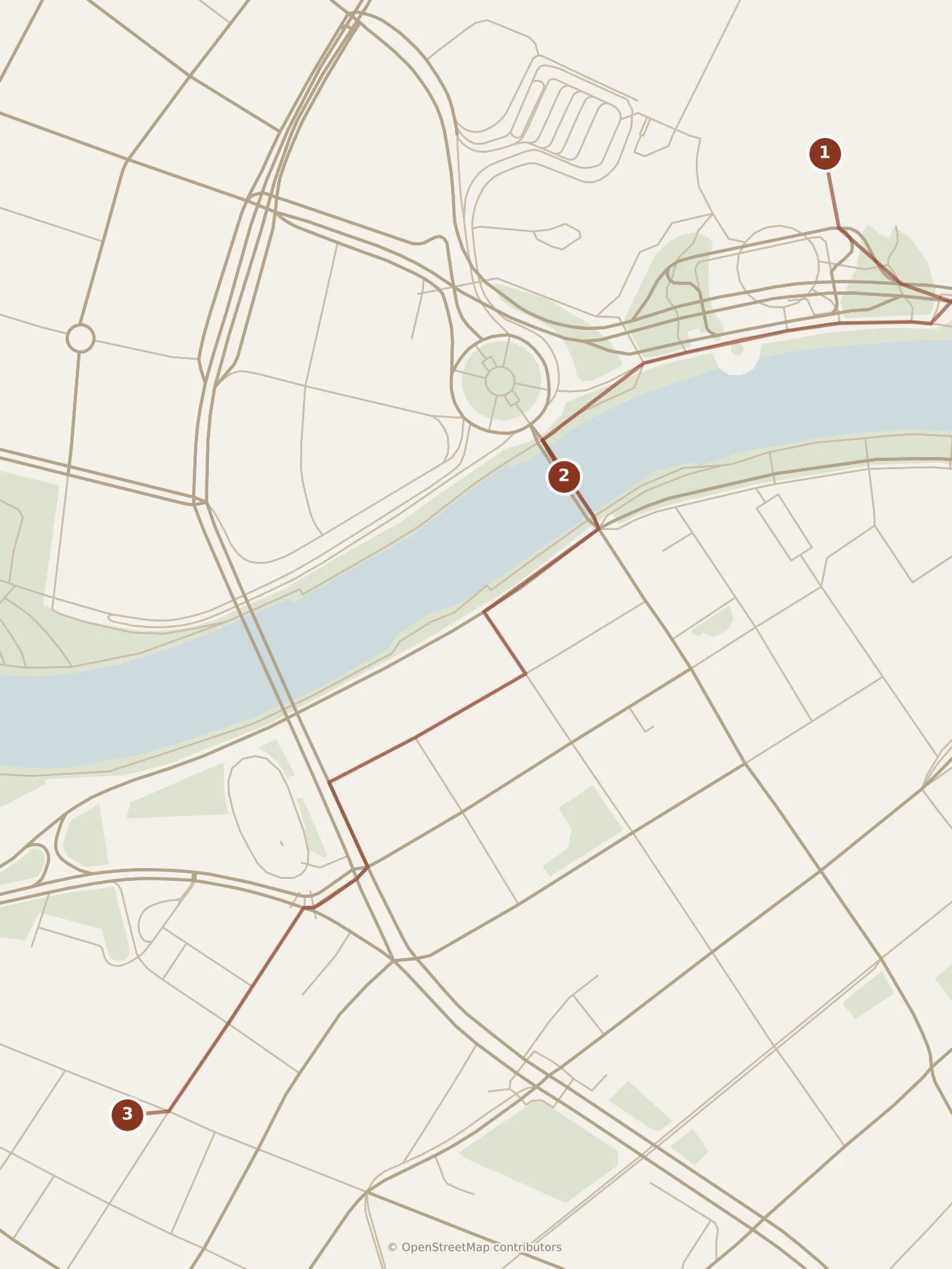
- Morning
- 1Tianjin railway station
- 2Jiefang Bridge
- Jiefang North Road — in the prose, not on the map
- Porcelain House — in the prose, not on the map
- 3Quanyechang department store
- Binjiang Dao — in the prose, not on the map
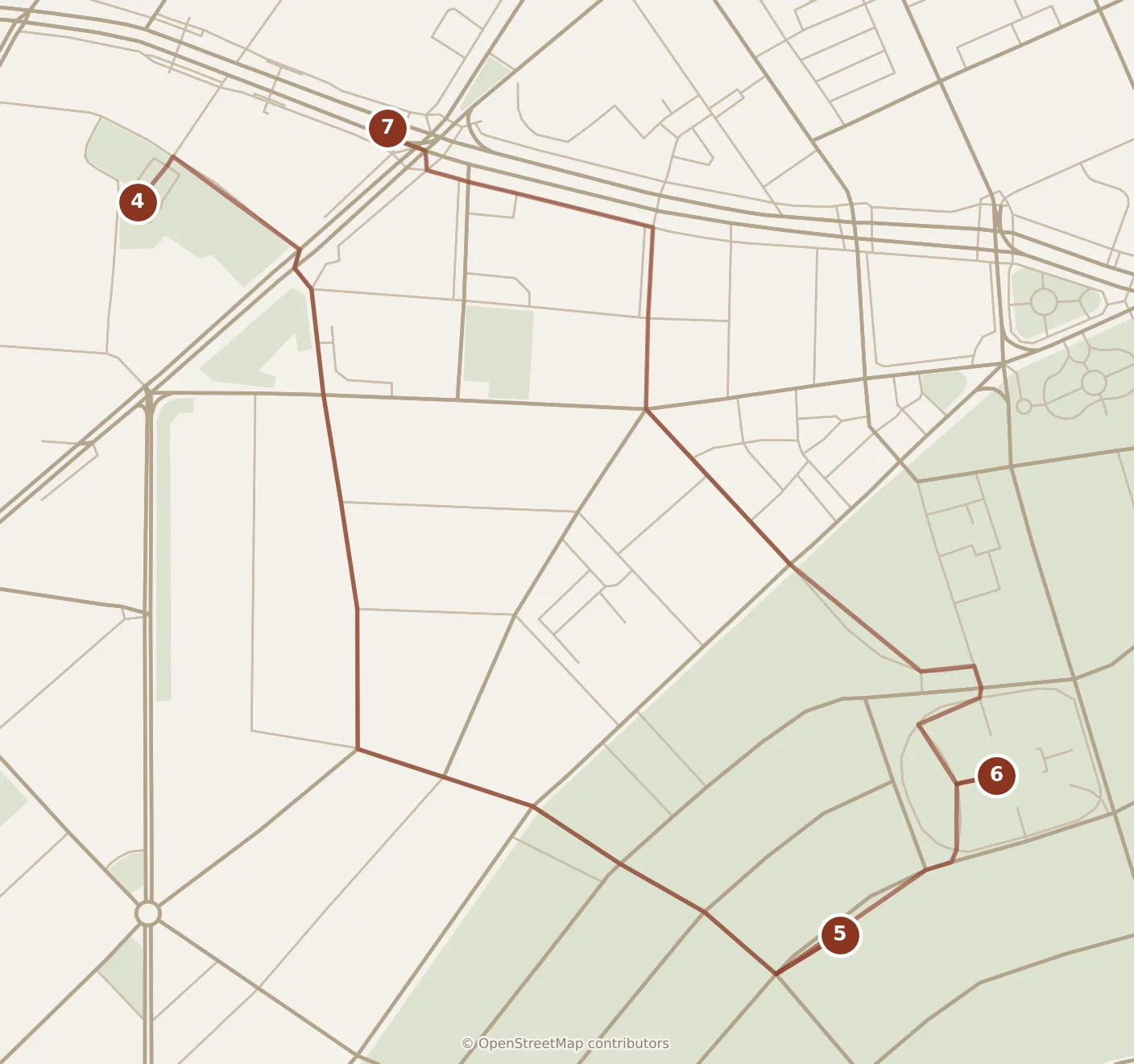
- Afternoon
- 4St Joseph Cathedral
- 5Five Great Avenues
- 6Minyuan Stadium
- 7Yingkoudao station
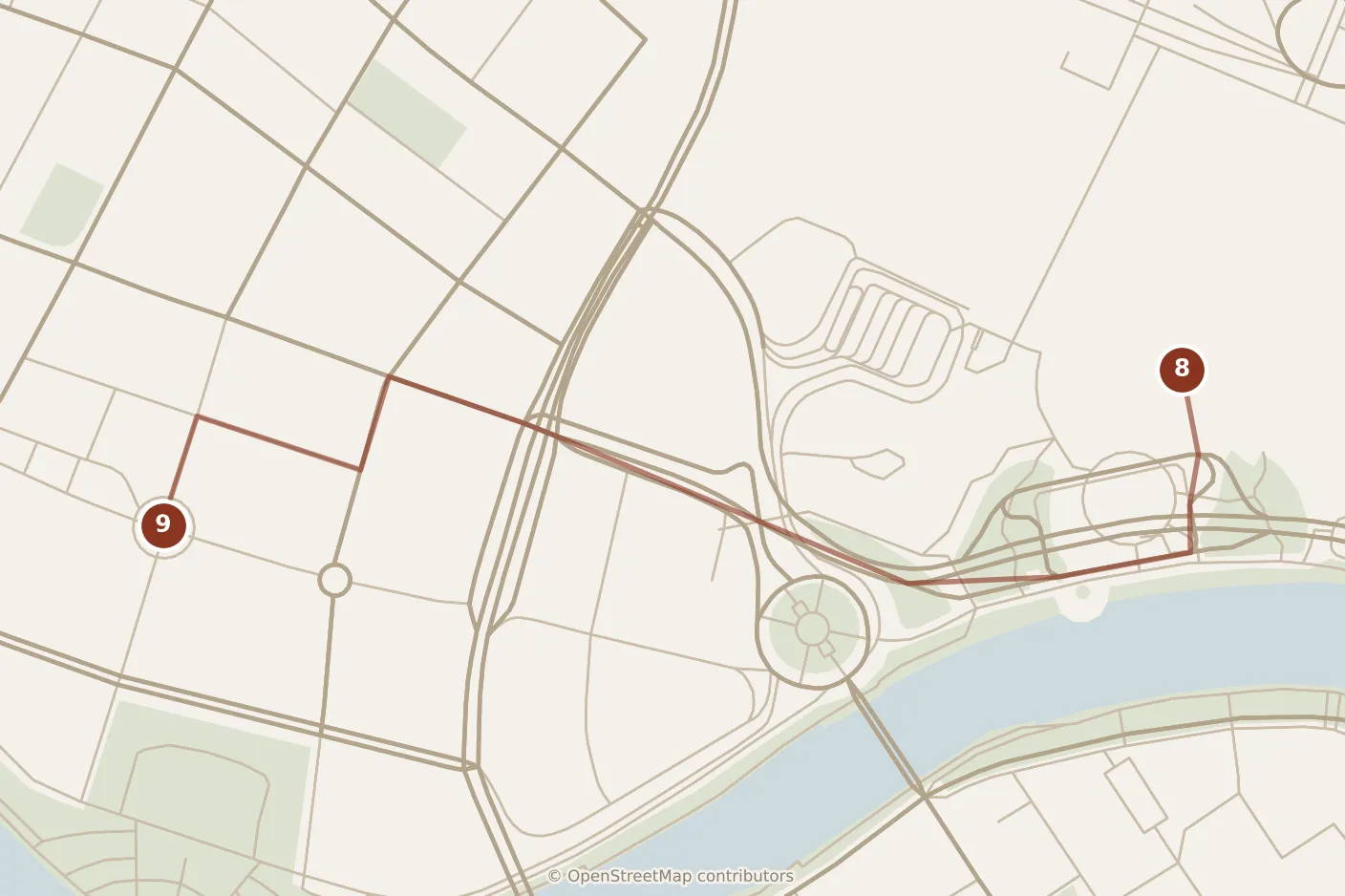
- Evening
- 8Tianjin railway station
- 9Marco Polo Square
Morning
Come out of Tianjin Railway Station on the river side and walk ten minutes up the Hai River to the Jiefang Bridge. It is a double-leaf bascule bridge of 1926 and 1927, ninety-seven meters of riveted steel drawn by a French engineer, tendered to an American firm and built by French contractors, and it was raised four times a day while the port below it was working. It was the International Bridge then; it has had two names since, and the current one dates from 1949. It was put back into working order in 2008 and is raised on the big public holidays rather than for shipping, so do not plan around seeing it move — plan on standing on it. Ten minutes, and take them in the middle: the water is the reason every one of these countries wanted this particular mud.
Off the far end runs Jiefang North Road, which is the reason to have crossed. For about a kilometer it is a wall of banks — head offices, customs houses and trading firms in granite, columns and domes, built by half a dozen administrations that each wanted to look permanent. Give it half an hour and walk south-east down it as far as Chifeng Road, reading the doorways rather than the whole facades; the buildings are shoulder to shoulder and there is no distance to see them from. Nothing here is a museum and almost nothing is open, and that is the point: this is a financial district that stopped, and it has been left standing.
Turn right into Chifeng Road, and fifteen minutes of low houses from the French decades later you arrive at the Porcelain House. It is a 1920s mansion whose owner, a collector named Zhang Lianzhi, covered it — walls, roof, railings, the lions at the door — in broken porcelain, old plates and shards and whole vases, until the building disappeared under its own decoration. It is not tasteful and it is not restrained, and it is the only thing on this route that has to be looked at twice, once from three feet away and once from across the street. Half an hour outside is the honest visit; there is a ticket for the inside, bought at the door, and what is in there is more of what is on the outside.
Five minutes north brings you to the Quanyechang department store, a great slab of a building at the head of Binjiang Dao, finished in 1928 and the largest department store in the north of the country when it opened. Look at it from the sidewalk, then start down Binjiang Dao itself, which is pedestrian, loud and about a kilometer long. Lunch goes here, sitting down, and the hour you give it is the last comfortable hour of the day. What trades along a kilometer of pedestrian street changes faster than a page like this can honestly track, so take it as it comes; what is worth knowing instead is that this city’s real reputation is its street breakfast, which a day counted backwards from sunset is too late to catch. If that matters to you, come on an earlier train and eat before the bridge.
Afternoon
Binjiang Dao ends at St Joseph Cathedral, which everyone in Tianjin calls Xikai. It was begun in 1913, finished in 1916, holds fifteen hundred people, and is Romanesque in the heavy, round-arched way that reads as much older than it is. The dome is copper and has gone green; Red Guards took down three of its towers in 1966 and they were not rebuilt until the 1980s, which is why the brickwork of the front does not quite agree with itself. Twenty minutes. It is a working parish church before it is a monument, and it keeps church hours: open from five in the morning until half past four on weekdays and until eight on Sundays, with the masses early. Walked as written this day reaches it in the early afternoon and none of that binds; the only version that arrives at a shut door is the one that starts in the middle of the afternoon, which the last two paragraphs deal with. The outside is what you came the length of the street for, and the day does not depend on the door.
Ten minutes south of the cathedral the grid changes character completely and you are in the Five Great Avenues: five parallel streets in the former British concession, named after Chongqing, Changde, Dali, Munan and Machang, holding more than two hundred houses in British, French, Italian, German and Spanish styles, built for the people who worked in the buildings you saw this morning. Give it an hour. It is the only part of today that is genuinely quiet, and after a morning of institutions the shift into brick, gardens and gateposts is the thing you will remember. There are horse-drawn carriage tours, with a ticket office inside the district; they cover more ground than you will, and they take away the only thing this hour is good for, which is stopping.
Local tip. Five parallel avenues is more than an afternoon holds, and the useful decision is which two. Walk out along one and come back along another. You come in past the cathedral and you leave from a station a few streets from it, so a there-and-back through the grid costs you nothing and shows you twice as many streets as walking one avenue to its end and turning round.
The far end of that loop is Minyuan Stadium, which is a stadium in name only now. It opened on 6 October 1926 as the concession’s athletics ground, laid out with the help of Eric Liddell — the runner, who was a missionary here — and modeled on Stamford Bridge in London, his favorite athletics ground. It was closed in 2012, rebuilt over two years, and reopened in 2014 as a public square: the oval and the terraces are still there, with shops and eating places built in under them and people walking laps on the inside. Half an hour, and it is the right last thing, because it is where the district actually gathers.
Then out. Yingkoudao station is twenty minutes north-west on foot, back through the avenues, and it stands a few streets from the cathedral you came in past. Take Line 3 north: Yingkoudao, Hepinglu, Jinwan Square, Tianjin Railway Station, where Lines 2, 3 and 9 all meet. Three stops, about ten minutes, and it is the only ride in the whole day.
Evening
Come up at Tianjin Railway Station and walk west along the north bank — ten minutes to the first of its streets, twenty to the middle — into the former Italian quarter. Italy was granted forty-six hectares here in 1901 and took possession the following year, and it was the only concession in the country that it administered outright; the whole of it went back to China in 1947. What survives is a grid of a few short streets of low plastered houses with shutters and iron balconies, restored hard, and Marco Polo Square at the center of them — a small piazza that was named after an Italian queen before it was named after a traveler.
Be clear about what it is now: a restaurant and bar quarter, busy, lit, and playing its own history back at you. That is not a complaint. It is the only part of the concession city that is used in the evening rather than commuted out of, so it is the one place where the day ends among people instead of among facades, and it is twenty minutes from your train. Give it an hour and a half — an hour if you eat quickly, longer if you do not.
Walking back east along the river you get the other thing this quarter is for: the Jiefang Bridge again, from a kilometer off and at the other end of the day, which is the one thing on this route you see twice and from opposite banks. The station is straight ahead of you the whole way, the left luggage is inside it, and the intercity trains for Beijing South go from here — which is the one booking this day makes on your behalf, so make it deliberately. The route is counted backwards from sunset, and in the long months that puts you on this concourse late; hold a return late enough to survive the hour and a half the Italian quarter is worth, and hold it before you leave. How a ticket on this line is bought, and why turning up for one is not an option, is the parent guide’s.
Practicalities
Nothing on this route has to be booked; the return train is the exception, and it is dealt with at the end of the evening above. Exactly one thing here rests on an opening hour. Every stop above is a bridge, a street, a shopfront, a square or a district; the single interior is the cathedral, which shuts at half past four on a weekday, and the day as written reaches it in the early afternoon with hours in hand. A shut door there costs you twenty minutes rather than the plan. That is worth saying plainly because it is what makes this particular day robust: it survives a Monday, when museums in this country commonly shut, and it survives a public holiday, when they are open and full. What it does not survive is the dark, and that is the whole of the planning problem here — see the last two paragraphs. If you want an interior on top of the route, the Porcelain House is the one to add, and it is the one whose hours you should check rather than assume, because it is a private house rather than a public institution and nothing else on the day gives you a reason to be standing outside it early.
One thing this route needs, and exactly one: a single metro ride. Three stops on Line 3, from Yingkoudao to Tianjin Railway Station by way of Hepinglu and Jinwan Square, bought as a single journey at the machine or the window before you go down. Everything else about paying, arriving and getting about this city is the parent city guide’s, and this page assumes you have read it or will.
The walking comes to roughly two and a half hours in total, in three unequal pieces. The morning is easy — the stops come every ten or fifteen minutes and the longest gap is the quarter of an hour along Chifeng Road. The afternoon is the hard half: the walk down Binjiang Dao to the cathedral, the ten minutes on to the avenues and the twenty back out to Yingkoudao come to about an hour on foot between them, and that is the part of the day to shorten if the weather is against you, by cutting the loop through the avenues to a single street. Those twenty minutes back out are the longest stretch on this itinerary with nothing to stop for; the walk down Binjiang Dao is longer on a map and you will be stopping the whole way. The evening walk out to Marco Polo Square and back is forty minutes, and it is the one stretch you do twice, which is the price of ending beside the station.
Two ways this day goes wrong while every instruction in it has been followed, and both of them are about the count. In December there is no slack in it at all, and every half hour you are late comes off the far end of the afternoon, which is where the avenues are — and the avenues are gardens and gateposts, which is to say nothing whatsoever after dark. So if you are behind, cut the avenues, and cut them before anything else: they are the one stop here that is worth nothing without light, while every other stop is a street, a bridge or a lit square. The cut is a single turn, and it is made at the cathedral door. Instead of the ten minutes south into the grid, walk the few streets to Yingkoudao station, take Line 3 north as above, and you are back at Tianjin Railway Station. That returns the avenues, Minyuan and the twenty-minute walk back out — close to two hours — and the honest thing to do with them is to reach the Italian quarter while it is still filling, not to add a stop.
In June the count is arithmetically right and still bad advice, because six hours back from a sunset at twenty to eight starts you in the middle of the afternoon. One thing does break: the cathedral shuts at half past four on a weekday, and a two o’clock start reaches it well after that. The rest of the route is outdoors and keeps no hours, but you will have thrown away a morning as well as the only interior on the day. So treat the count as a floor rather than a schedule, start by mid-morning whatever the month, and give the spare hours at the front to the two things this article told you to skip. Concretely: leave Tianjin Railway Station and walk up the river instead of straight to the bridge — twenty minutes north-west brings you to the Ancient Culture Street, and another half hour on the same water to the wheel. Give the two of them an hour and a half between them, then walk back down to the Jiefang Bridge, about fifty minutes, and begin the morning below there rather than at the station. That is a little over three hours, it displaces nothing at all, and it is the only shape in which those two are free. The wheel is a ride and its hours are not this page’s to promise, so check them, or make the street the whole of it.
One last thing, and it is about the season rather than the clock. Tianjin is a northern coastal city, this route is outdoors from end to end, and its two most exposed stretches — the bridge and the bank street — are beside the water and in the wind. There is no version of this day that is mostly indoors, which is the one place where the parent guide’s month-by-month paragraph stops being background and becomes part of the plan: read what a January here actually is before you commit to walking one. So in the depths of winter the honest advice is the same as for a late start, and it is the same cut — keep the bridge, the bank street, the cathedral and the Italian quarter, leave from Yingkoudao at the cathedral door, and give the avenues to another visit.


.jpg)