Tashkent in two or three days: the old city, the center indoors, and the view from the north

Last updated 8 August 2026
Overview
A day is what Tashkent usually gets, and a day is defensible. What a second day buys is not more sights: it is the inside of things, and the hours a single day has to spend crossing between them.
So these two days each stay put. Day one is the old city and nothing else, from the market at the bottom of it to the museum that opened above it in 2026, with the lanes between them walked rather than skipped. Day two is the rebuilt center, and it is deliberately a day of interiors — a diplomat’s house finished by Uzbek plasterers, a museum under a blue dome, an opera house — because the center’s outsides are squares and avenues you can read in twenty minutes, and its insides are the reason to stay a second night. The numbering below is the order the days are written in and not necessarily the order you walk them: if you take the third day it goes second, and the center day becomes your last — except after a Saturday arrival, where the last section trades those two over.
Three metro lines do all the work and it is worth learning their names before you start. The Oʻzbekiston line runs north-west to south-east and strings the old city, the center and the main railway station on one thread. The Chilonzor line crosses it at Alisher Navoiy and Paxtakor, which are two halves of a single interchange. The Yunusobod line heads due north from Mingoʻrik, next door to Oybek, and it is the one the third day uses. Nothing below needs a bus.
The first leg is the one that never gets described, so: day one opens at Chorsu Bazaar, and Chorsu is a metro station. Toshkent station sits directly under the railway terminus, and Chorsu is six stops from it on the Oʻzbekiston line. Coming from the middle of the city instead, it is one stop on the Chilonzor line from Mustaqillik Maydoni to Paxtakor, a walk through the interchange passage to Alisher Navoiy, then two stops on the Oʻzbekiston line by way of Gʻafur Gʻulom. From the airport the parent city guide covers the ride in, and you will need it: there is no metro at the terminal.
Light does not in the end decide anything on these three days, and it is worth saying so rather than leaving you to check. The sun sets here as early as a few minutes before five in the first days of December and as late as a minute past eight around the summer solstice, but nothing on these days runs late enough for that to matter: the long outdoor stretches — the half hour north on day one, and the canal, the mosque and the garden on the third — are morning work, and what closes on these days closes on a clock rather than at dusk. What a December date costs is the last walk back to the metro in the dark. The exception is a Sunday third day, which runs backwards for the reason the section below gives, and so walks the canal, the garden and the mosque in the late afternoon rather than the morning: in the first days of December that half of it is in the dark.
One published hour decides the order of day two, and it is the only one those two days rest on. In 2026 the museum under the blue dome rested on Mondays and shut its doors at five, which is why it comes before lunch rather than after; build the morning forward from that, and if the hour has moved, build it forward from the new one. Everything else on days one and two publishes its own hours and keeps them.
Add up what is recommended below and day one comes to a little over eight hours, day two to about seven. Neither total carries a ticket desk, and day one’s does not carry the fact that the Center for Islamic Civilization is a hundred and forty-five meters from one end to the other, so the walk from its door to the case you came for is part of the visit and not part of the hour.
The bag is a last-morning problem here rather than a first-morning one, because you have a room for the nights in between. On the day you leave, the answer is the main railway station: it keeps a left-luggage room, it is the only one this article can point you at, and it is two short rides and a walk from where the last day starts. Toshkent to Oybek on the Oʻzbekiston line, across to Mingoʻrik, one stop on the Yunusobod line to Yunus Rajabiy, and you are eleven minutes on foot from the morning’s first stop. If the trade in the last section has left the northern day last instead, ride on to Minor on the same line, and the walk is the twenty minutes that day opens with. Do not take a case round any of these days: the walk through the old city and the market at the start of it are both bad with one, and there is nowhere on either to set it down.
What two days deliberately leave out: the residential districts where most of Tashkent actually lives, the reservoirs and ridges of the Chatkal foothills two hours north-east, and the fast train south. Each of those is a separate trip rather than a spare afternoon, and pretending otherwise is how a short stay turns into a day spent in transport.
Day one

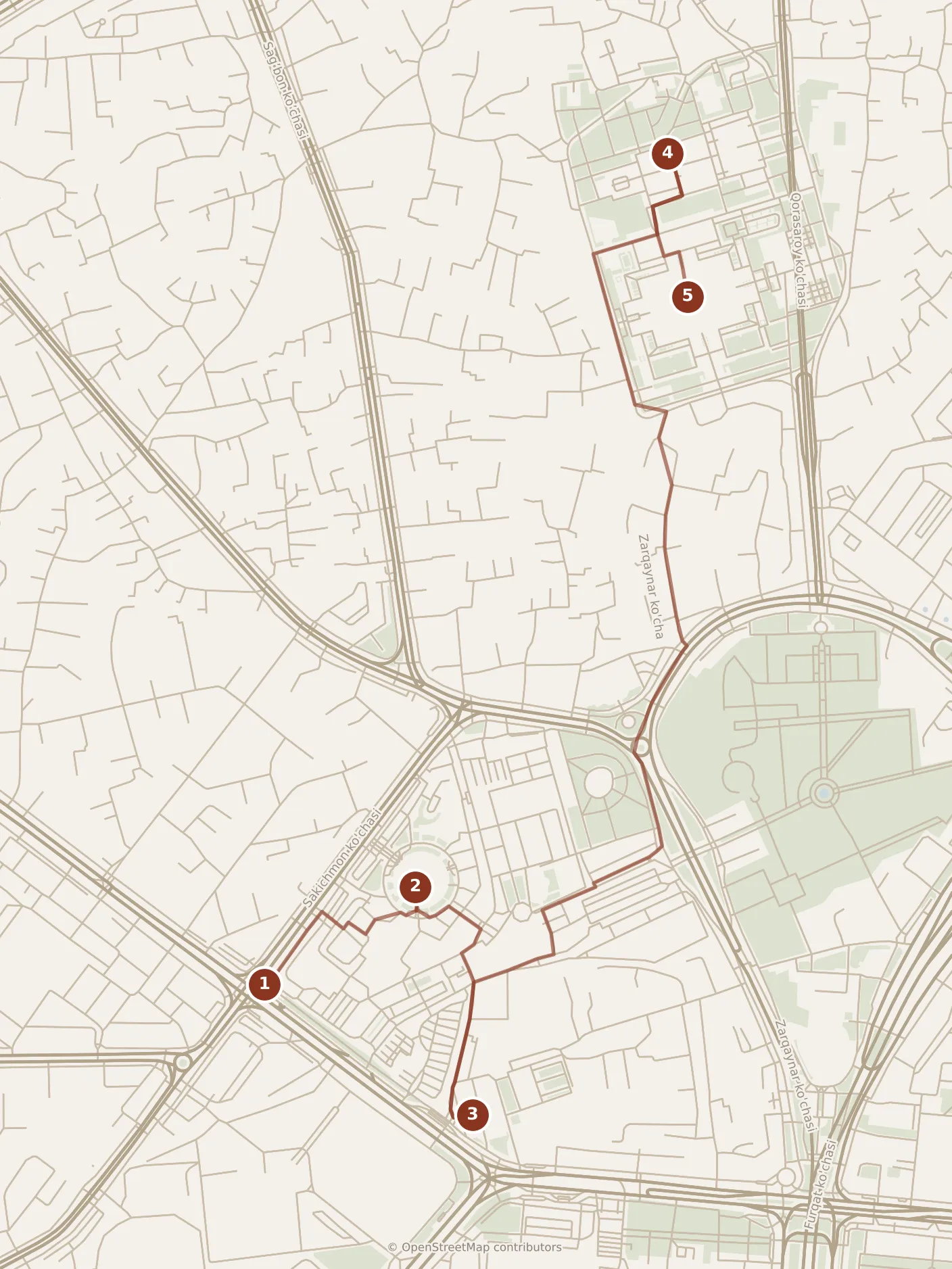
- Morning and afternoon
- 1Chorsu metro station
- 2Chorsu Bazaar
- 3Kukeldash Madrasah
- 4Hazrati Imam complex
- 5Center for Islamic Civilization
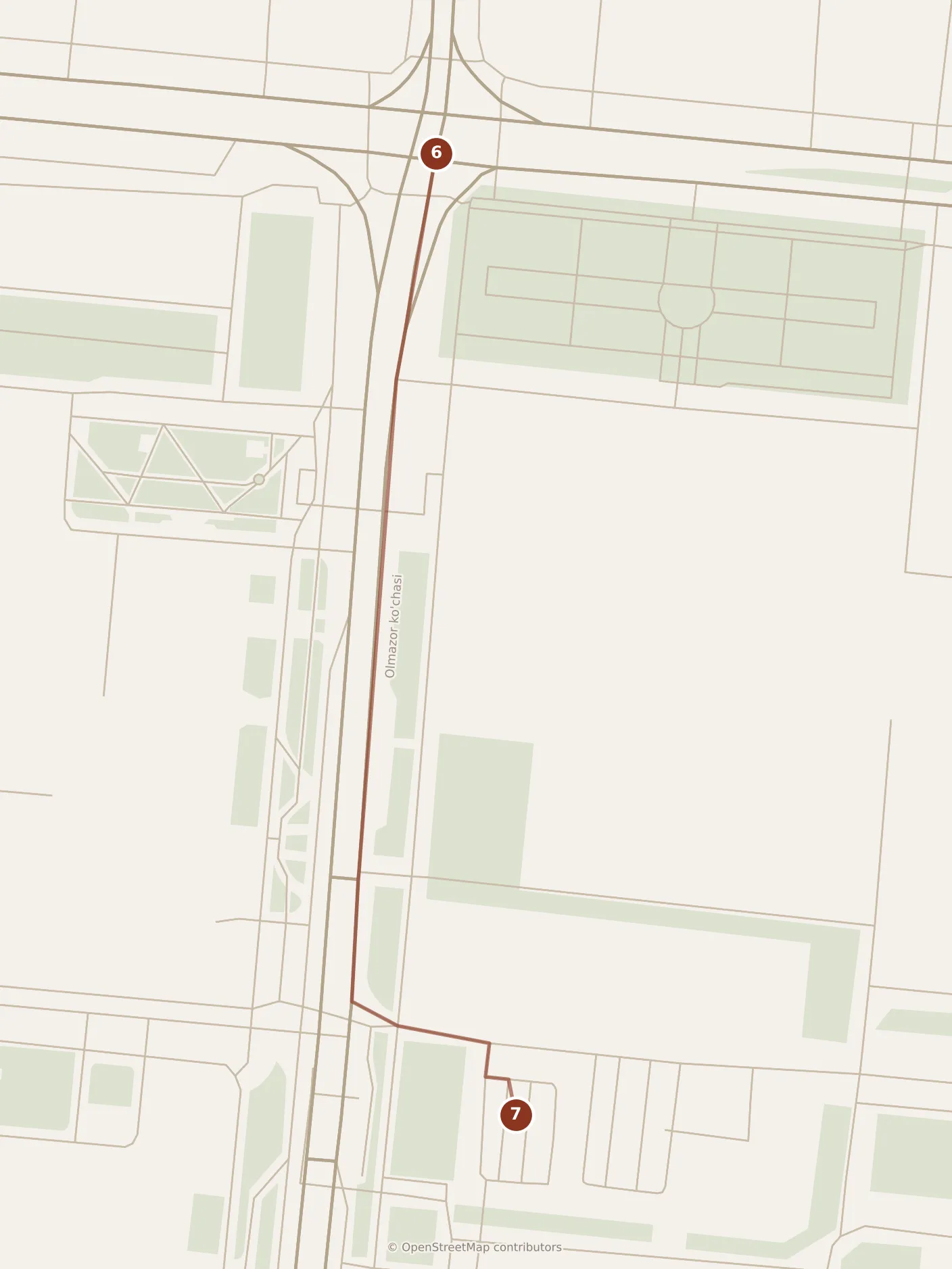
- Evening
- 6Alisher Navoiy metro station
- 7Paxtakor metro station
The old city is the one part of Tashkent that was not laid out on a drawing board after 1966, and it is small enough to cross on foot. Today climbs through it from the bazaar at the bottom to the museum that opened at the top of it in 2026, and comes back down underground.
Morning
Five minutes from the exit at Chorsu station the bazaar’s turquoise dome stands over the road, and you can see it from the top of the escalators. Get here at the beginning of the day. This market is trading hours before any museum in Tashkent unlocks a door, and the early part is when it is a market rather than a sight: bread being slapped onto the inside of the tandirs, a whole arc of dairy, apricots and green raisins in banked heaps, the ring of the hall sorted by trade so that one circuit tells you what the country grows. Breakfast is non straight off the oven wall and a samsa out of the same clay, eaten upright. An hour and a half, and do not have lunch here — today’s lunch is at the far end of the climb.
Eight minutes up from the dome, the Kukeldash Madrasah sits on the rise looking down at it: a sixteenth-century teaching college in yellow brick with an enormous portal and a quiet courtyard, put to four or five other uses since and back to its original one now. Twenty minutes covers it honestly, and it is the smallest thing on this day.
Then half an hour north on foot, and this stretch is the part of the morning with nothing to photograph. The streets between the college and the complex belong to the mahalla — the walled residential quarter, where the houses turn their backs on the lane and everything happens through a gate — and they are what survived, in patches, of the low city the earthquake took. There is almost nothing to see, and that is the point: it is the only ground in Tashkent that has a texture rather than a plan. Eat at the top of it if the lane offers you somewhere, and eat plov, which is a midday meal here and runs out rather than waiting for the evening; if it offers nothing, eat by the complex instead. An hour, sitting down.
Local tip. If the morning has run late, the stop to drop is the college, not the walk. The college is twenty minutes and a courtyard, and the complex an hour ahead has better brickwork and better tile of exactly the same period; the walk is the only part of this day that is not a building, and there is nowhere else in the city to take it.
Afternoon
Six buildings stand round the open paving at the Hazrati Imam complex, and the useful way to spend an hour and a half here is to treat them as three things rather than six. The mausoleum first: Qaffol Shoshiy, over the grave of the tenth-century scholar Kaffal Shashi, whom the city remembers as its first imam, and the reason everything else was built where it is. Then the two teaching buildings, the Barak Khan and the Moʻyi Muborak madrasahs, for the portals and the tile — the Barak Khan’s is the one to stand in front of for a while. Then the mosques, Tillya Sheikh and Hazrati Imam, which are large, carpeted and busy, and which are the half most visitors photograph from the doorway and never enter. Enter them. The sixth building is a working college for imams and is not a sight.
That means conduct, and nobody at the gate will tell you. Shoes come off at the carpeted threshold, women cover their hair before going in, and shoulders and knees stay covered on everyone; if a row of people is praying you go behind them or you stay outside. In the middle of Friday the congregational prayer fills both mosques, and that is the one thing that changes the order of this day — the fix is in the last section below.
Five minutes away is the building that emptied the complex of its most famous object. The Center for Islamic Civilization opened in March 2026 after eight years of construction, and its scale is the first fact about it: a hundred and forty-five meters by a hundred and fifteen, a dome sixty-five meters overhead, fifteen thousand square meters of museum under it. The manuscript everyone comes for is the Quran attributed to the caliph Uthman, which arrived here in November 2025 after thirty-six years on show in the madrasah two hundred meters back down the road. Its age is genuinely unsettled — the tradition puts it in the 650s, the radiocarbon result lands two centuries later — and the room does not pretend to resolve it.
Give the building two and a half hours, and this is precisely what a second day buys. The manuscript is ten minutes. The rest — a hundred and fourteen other Qurans, the calligraphy, a manuscript library counted in six figures, the dome seen from beneath — is the two hours and twenty that a visitor with one day has to walk past. It is a new institution; it publishes its own hours and closing days, so read them the week before, and if it turns out shut on your date the complex next door is open every day of the week and takes the afternoon instead.
Evening
Walk twenty-five minutes back down to Chorsu station and ride two stops on the Oʻzbekiston line to Alisher Navoiy, and get out there on purpose rather than passing through. It opened in 1984 and it was built to read as a madrasah rather than as a corridor: a file of tall domes down the platform hall, blue majolica set into the ribs, medallions taken from the poems of the man the station is named after. Ten minutes. Then cross the passage to Paxtakor, come up into the center, and have lagman — hand-pulled — in the streets above the station.
If the center day comes next and ends at the opera, settle the ticket tonight: one further stop on the Chilonzor line to Mustaqillik Maydoni and thirteen minutes on foot puts you at the theater’s own box office, which is inside the building, and the same seats are sold online. The start time is printed on the ticket, and that is the only reliable answer to the question of when it begins. If you are inserting the northern day instead, this evening is your only pass by the box office, because that day goes nowhere near it: make the walk now, or buy online.
Day two

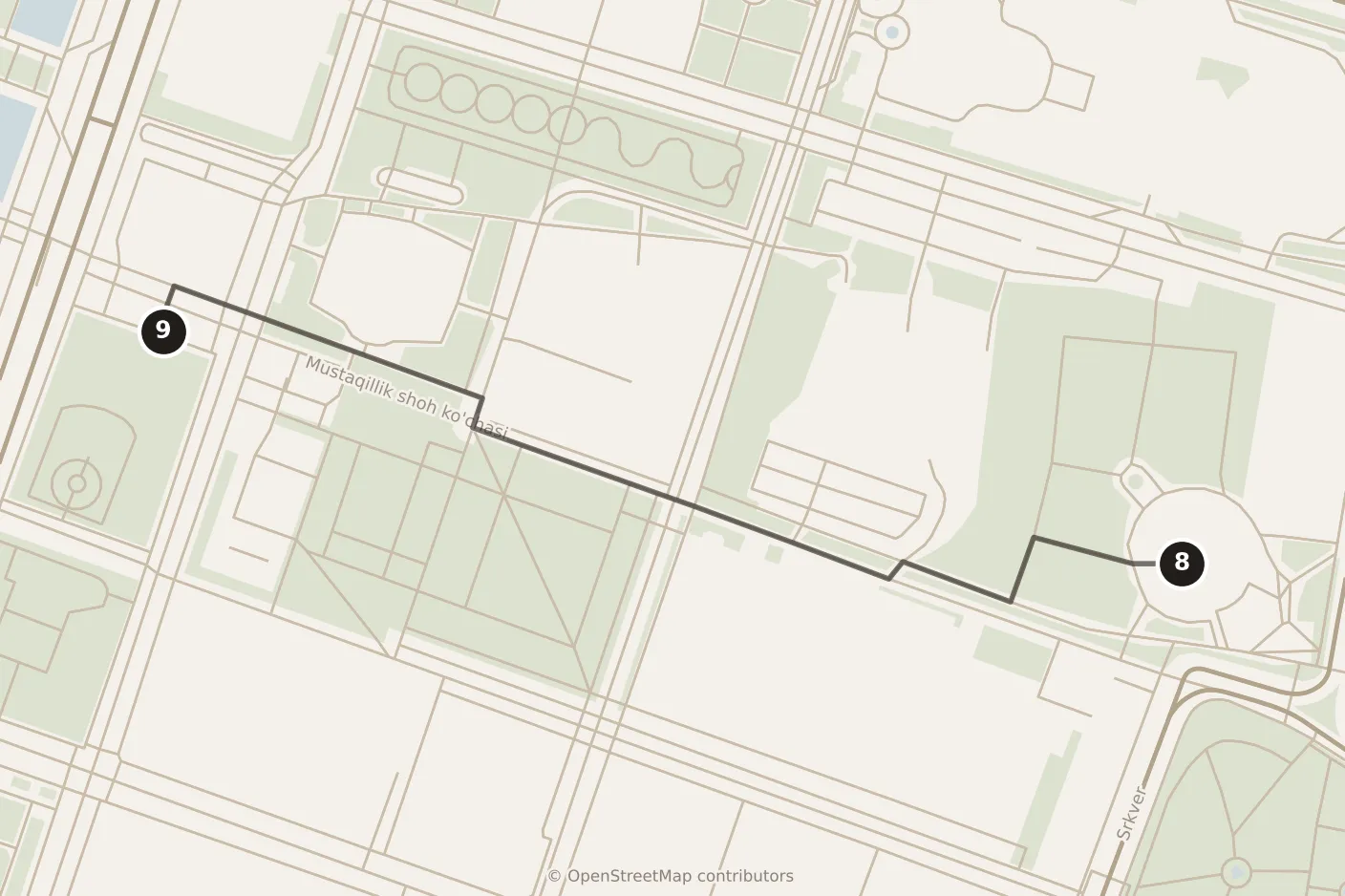
- Morning
- Oloy Bozori — in the prose, not on the map
- 8Amir Timur Museum
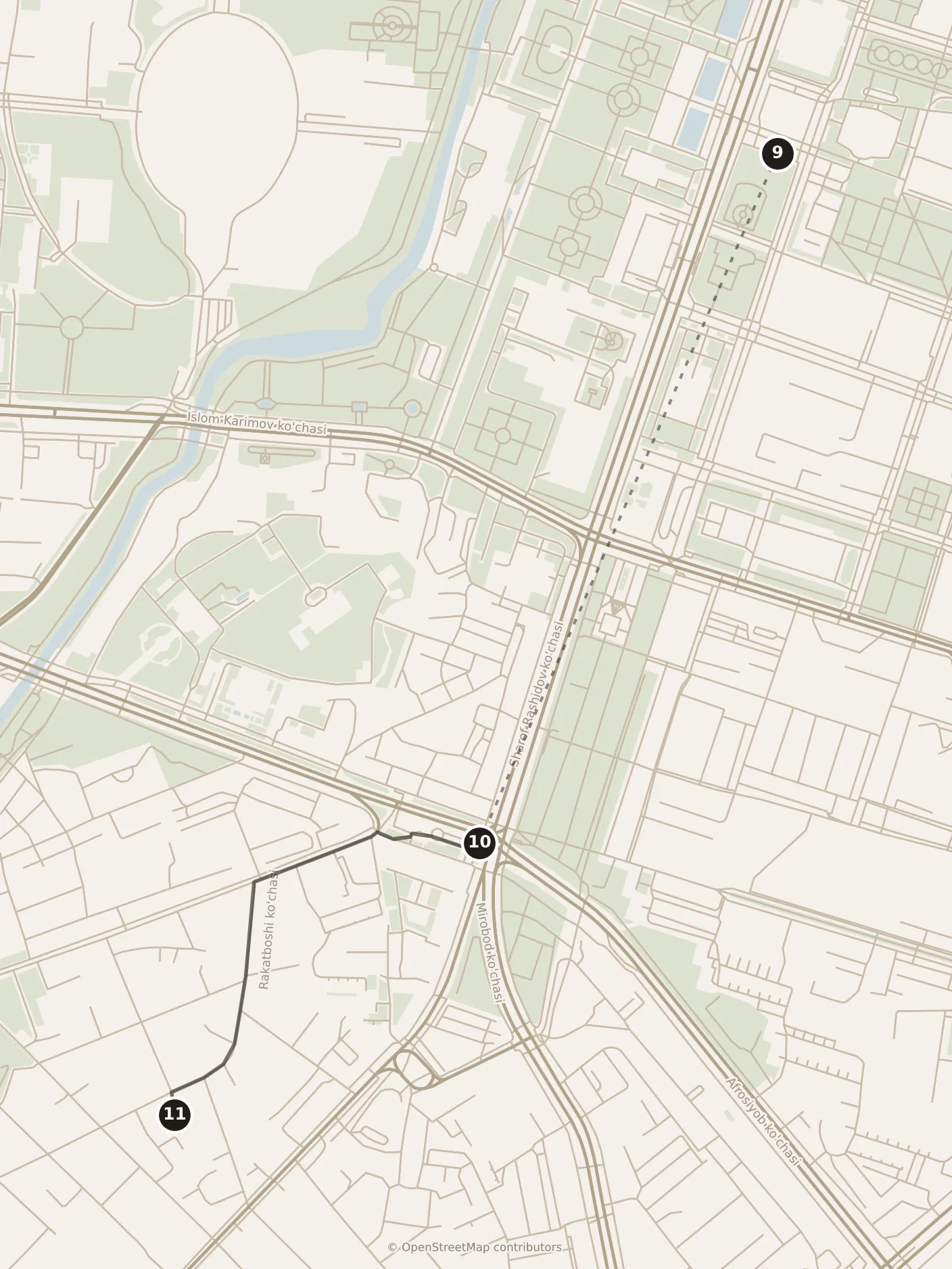
- Afternoon
- 9Mustaqillik Maydoni metro station
- 10Kosmonavtlar metro station
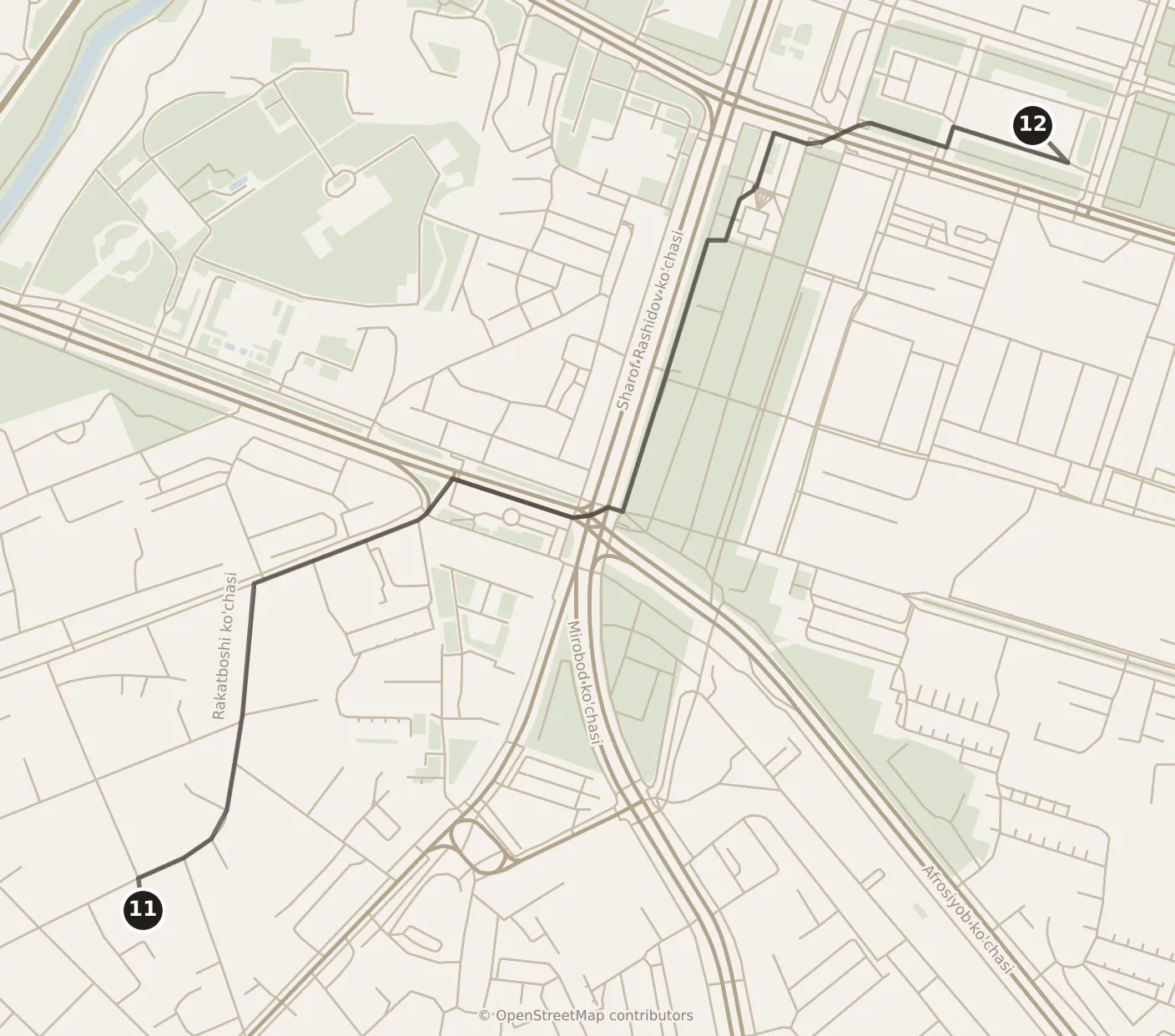
- 11State Museum of Applied Arts of Uzbekistan
- Evening
- 12Alisher Navoi Opera and Ballet Theatre
Today runs east to west across the center so that it finishes at the theater instead of doubling back to it. Three interiors and one market, and it is the shorter of the two days on purpose, because it ends with an evening that runs long. Start at ten: the day below adds to about seven hours, which puts you on the theater’s square a little before five, with the museum under the blue dome long finished inside its own five o’clock and the meal still ahead of whatever hour the ticket says.
Morning
Start at Oloy Bozori, eleven minutes north of the interchange where the Chilonzor and Yunusobod lines meet — Amir Temur Xiyoboni on one, Yunus Rajabiy on the other, one passage between them. This is the center’s own market and it is the opposite of yesterday’s in every way that matters: smaller, tidier, dearer, stacked with dried fruit and nuts built into pyramids for people buying presents rather than dinner, and full of Russian as much as Uzbek. What to do here is taste, which is the expected thing at a dried-fruit counter rather than a liberty: the difference worth learning is between the dark, shrunken, sun-dried apricot and the bright orange one, and it is a difference of sulphur rather than of variety: sulphur is what keeps the color bright, so the dark one is the untreated fruit. Three quarters of an hour, and the stall to leave with something from is a nut counter rather than a sweet one. It earns its place precisely because you did Chorsu first: the contrast between a market where the city buys dinner and one where it buys presents is most of what there is to learn about how Tashkent divides itself.
A quarter of an hour south-west stands the Amir Timur Museum, a round building under a ribbed blue dome copied from the Gur-e-Amir in Samarkand, opened in 1996. It holds over five thousand objects and shows about two thousand: manuscripts, copper and silver coinage, weapons, miniatures, and the maps of an empire administered from Samarkand rather than from here. Give it an hour and a half, and take the objects rather than the narrative — the campaigns are told in wall text you will not finish, and the cases are what you came for. Two things earn a stop: the coinage, because a currency is the plainest evidence there is of how far a state actually reached, and the manuscript pages, which come out of the same tradition of book-making that day one gave its whole afternoon to, and are worth a second look for exactly that reason. The circular hall under the dome is where everyone stops to photograph, and it is the least interesting part of the visit. This is also the stop that times the day: in 2026 it rested on Mondays and shut at five, which is why it goes before lunch and not after.
Lunch in the streets between the museum and the avenue below it, an hour, and eat properly: there is no meal in the afternoon and the evening’s comes early.
Afternoon
Thirteen minutes west is Mustaqillik Maydoni station, and from there the crossing is underground: one stop on the Chilonzor line to Paxtakor, the passage to Alisher Navoiy, then two stops on the Oʻzbekiston line, through Oʻzbekiston, to Kosmonavtlar. Twenty-five minutes platform to sidewalk. Twelve minutes on foot from that exit is the State Museum of Applied Arts of Uzbekistan, which is the one interior in the center worth two hours rather than the ninety minutes most people give it.
The building went up at the end of the nineteenth century as a private house for Alexander Polovtsov, a Russian diplomat who left Russia in 1918 and never returned. He had it reworked by an architect named Burmeister and then had the interiors carried out by Uzbek master craftsmen — Usta Shirin Muradov among the names recorded — in carved and painted ganch, the local gypsum plaster, so that a European floor plan is finished throughout in a wholly Central Asian surface. That is the exhibit. The four thousand objects the house has held since it became a museum of handicraft in 1937 — suzani embroidery, ceramics, jewelry, carved doors — are shown in rooms that are themselves examples of the crafts on display. Spend a third of your two hours looking up.
Every metro version of the next leg is slower than walking it, because the theater’s nearest station is on the other line and the change costs more than the ride saves. Walk.
Evening
Twenty-five minutes north-east on foot is the Alisher Navoi Opera and Ballet Theatre, and you arrive with time in hand, which is deliberate: eat before the performance rather than after, since it finishes late and the blocks behind the theater empty out.
Alexey Shchusev designed it — the architect of Lenin’s mausoleum — and it was built between 1942 and 1947 and opened that November for the five-hundredth anniversary of the poet it is named for. Part of the labor was forced: Japanese prisoners of war held by the Soviet Union worked on the building between 1945 and 1947, and a plaque recording that was put up in 1996. It seats fourteen hundred, and the fountain on the open square in front is where the city sits out summer evenings. Opera and ballet need no language, the seats cost a fraction of the equivalent anywhere in Europe, and this is the one thing on these two days that a single day cannot have.
If the board has nothing on the night you are there, the evening does not collapse and it does not move: stay on this square, eat here, and give the hours to the fountain and the streets behind the theater, which is where the center goes after work. It is a smaller evening, it is in the right place, and it costs the day nothing, because the walk that brought you here was going to happen anyway. What it is not is a reason to go looking for a second theater across town; that is a half-hour ride at the end of a day with a museum in the middle of it, and you would arrive tired for a performance in a language you do not have.
Then close the loop, which is the thing this paragraph is for. Mustaqillik Maydoni is thirteen minutes on foot and is the theater’s station; the Chilonzor line runs one stop from there to Paxtakor, the passage crosses to Alisher Navoiy, and the Oʻzbekiston line takes you four more — Oʻzbekiston, Kosmonavtlar, Oybek — to Toshkent, underneath the railway terminus. If the curtain comes down after the last trains, a taxi the length of this city is cheap, and a booked seat on the Afrosiyob is not something to test.
With a third day

- With a third day
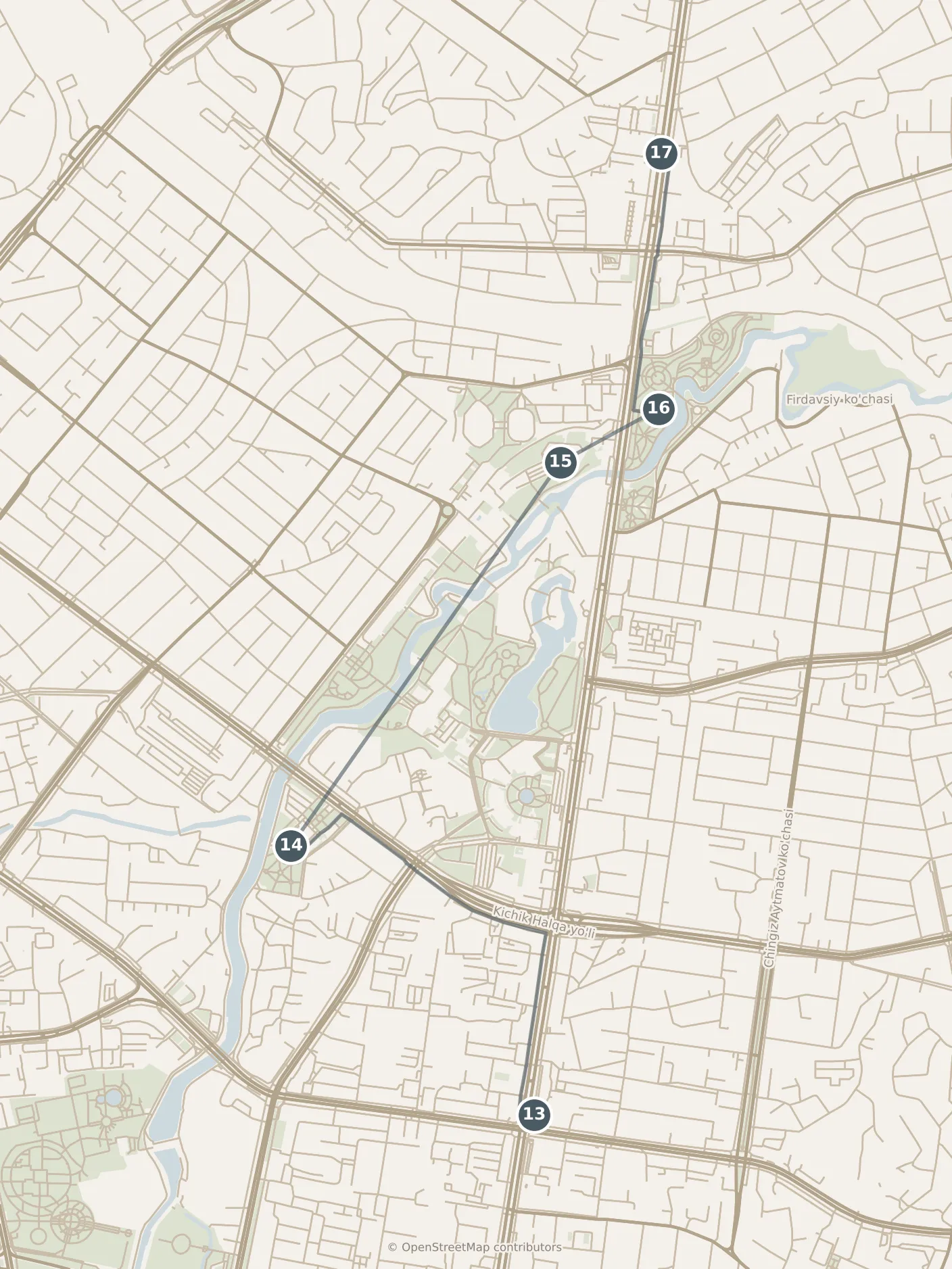
- 13Minor metro station
- 14Minor Mosque
- Japanese Garden — in the prose, not on the map
- 15Tashkent Tower
- 16State Museum of Victims of Repression
- 17Shahriston metro station
The third day goes north, up the Anhor canal, and it is the only one of the three that is mostly outdoors. It adds three things the other two cannot: a working mosque built in this century rather than the sixteenth, a public viewpoint in a flat city, and the museum that says out loud what the Soviet century cost here.
Put it second, between the two days above. Day one finishes in the far north-west and this day begins on the same latitude, so the ground is continuous rather than a fresh crossing; and days one and two hold five interiors between them, which is too much museum to run back to back. What moves is the center day, which becomes your last — and the Monday rule moves with it, which is the trap. The last section works it out.
Take the Yunusobod line to Minor and start at half past ten. The mosque is a little over twenty minutes north-west of the station, and it is worth knowing that the station named after it is not the closest one — Bodomzor, the next stop north, is nearer — but Minor puts you on the canal, and the walk in along the water is the better twenty minutes. The Minor Mosque opened in October 2014, faced throughout in white marble, with a turquoise dome and a pair of minarets on the canal bank. After day one’s fired brick and worn glaze it reads as almost shockingly plain, which is the interest of it. The conduct is the same as at the complex — shoes, hair, shoulders, and prayer before you — and this order already has you out well before midday, which is what a Friday needs. Forty minutes.
Fifteen minutes east along the water is the Japanese Garden, a stroll garden with a lake, bridges and pavilions, and the one stop on these three days with nothing at all to read. An hour, and it is the day’s luxury rather than its substance.
Fifteen minutes north is the Tashkent Tower, and here is the hour this day rests on. In 2026 both the tower and the museum beside it closed for the hour after one in the afternoon, and the museum then shut for the day well before the tower did — earlier still on a Sunday. That settles the order: eat in the dead hour, the museum after it, the tower last. The museum is the one with the earlier door, and the tower is the one stop here whose line can run long, so a wait there costs you the view and nothing else. A Sunday is not a swap inside that order but a reversal of the whole day: come up at Shahriston rather than Minor, take the museum from its opening hour, be at the cauldrons at one, and give the afternoon to the tower, the garden and the mosque, in that order back down the canal. If the hours have moved, find the new dead hour and put the meal in it. Two hundred meters north of the tower, plov is cooked in the open in cauldrons the size of a bath, and one o’clock is exactly when to be standing there. Give it the hour.
Seven minutes east, inside the memorial park called Shahidlar Xotirasi, is the State Museum of Victims of Repression, opened in 2002 on ground where graves came up while it was being built. It runs from the Russian conquest of the 1860s to the end of the Soviet period: photographs, documents and the belongings of people who did not come back, the purges under Stalin, models of the camps, a prison van in the yard, and over eight hundred case files from the cotton prosecutions of the late 1980s. An hour and a half. It is the only building in these three days that will make you quiet.
Seven minutes back west, the tower is 375 meters, built between 1978 and 1984 and in service from January 1985, with an observation deck at ninety-seven meters reached by three fast elevators and, above it, a restaurant that turns a full circle in forty minutes. Bring your passport: it is asked for at the entrance, and nothing on the way there warns you. The slot is sold online as well as at the door, and on a weekend the line for the elevators is the one thing on this day long enough to matter. An hour and a quarter, more if you eat up in the turn.
Local tip. Of the two paid stops at the top of this day, the museum is the one to protect, and taking it first is what protects it: you are out of it before you ever join an elevator line. If that line has then gone long, give up the deck without argument — the view is the thing you can come back for on a clear morning, and it is also the only stop here that weather can cancel on its own.
Seven minutes back east past the museum and fifteen north brings you to Shahriston and the Yunusobod line home. The day comes to a little under seven hours with lunch inside it, which is where half past ten comes from: it puts you at the cauldrons at one and inside the museum straight after, well clear of the hour its door shuts. The total does not carry the elevator line, which is the one thing here that can run long.
If the day is short, the garden is what goes — an hour of pleasant nothing, where the other three stops are each unrepeatable. If the sky is thick, which in high summer it often is, the deck is a hundred-meter view of haze: skip the tower rather than the day. Taking the museum first is what makes that cheap — the decision then costs you the view and nothing else. Decide it in the morning, while you are still ahead of the museum, and the freed hour and a quarter goes to the museum in its own slot, which is worth more than the ninety minutes it is allowed.
Practicalities
Nothing here has to be booked before you travel. Two things want arranging a day ahead: the theater ticket, from the opera house’s own box office inside the building or online, and — only if you take the third day — the tower slot, sold online and at the door. The tower is the one price this article can put a figure on, and it was in the fifty-thousand-som range in 2026. Everything else is walk-up, which means unbooked rather than free: most of the interiors on these days have a ticket desk, and you pay at it. Carry cash for the markets, the plov and the taxis, and have some way of paying for the metro; both of those belong to the city rather than to this route, and the parent guide covers them.
Days of the week, and the rules the answer comes from. Day one takes any day, with one adjustment. On a Friday the two mosques at the Hazrati Imam complex fill for the congregational prayer through the middle of the day, so swap the afternoon round: the Center for Islamic Civilization first, the complex after it, which puts you inside the mosques in the early afternoon once the prayer has cleared. Nothing else on day one turns on a weekday: the bazaar and the complex are open every day. The new museum beside the complex is the one unknown, and the fix for it is in the afternoon above.
Day two must miss Monday. The Amir Timur Museum rested on Mondays in 2026; the applied-arts house did not. If the Monday is unavoidable, invert the day rather than abandoning it: take Kosmonavtlar first thing and give the applied-arts house the morning, run the underground crossing backwards and one stop further on the Chilonzor line to Amir Temur Xiyoboni, give Oloy Bozori the afternoon, then walk the half hour west from the market to the theater in the evening. That walk replaces the twenty-five minutes the ordinary day ends with, so a Monday costs you five minutes on foot and the blue dome.
The northern day must miss Monday as well — the museum beside the tower rested on the same day — and it also reads differently on a Sunday, when that museum closes earlier than in the week and the whole day therefore runs backwards, as the section above sets out. Its Friday is easy: the order above reaches the mosque well before noon anyway.
So the rule is: put any Monday you cannot avoid onto the old-city day, which does not care. With two days, the trap is a Sunday arrival, which lands the center day precisely on the Monday. With three days and the northern day inserted second, the center day slides to last — and the trap moves with it, to a Saturday arrival, which puts the center day on the Monday and the northern day on the Sunday, so that one arrival meets both complications at once. Trade the two days over: the center day on the Sunday, which it does not mind, and the northern day on the Monday, which costs one museum out of its four stops rather than a whole morning. A Sunday arrival with three days already falls that way and needs nothing done to it. Those two days trade places freely; the old-city day will not move, because it is the one that orients you and everything after it is easier for having been done.
One further consequence of inserting the third day: you no longer pass the opera house on any evening before the one you need it, because the northern day’s route is nowhere near it. Buy that ticket online, or buy it on day one’s evening as described above.
What to cut when short. Day one: the Kukeldash Madrasah goes first. Day two: Oloy Bozori goes first, because you did the better market the day before. The northern day: the Japanese Garden. The first two go because their subject turns up again elsewhere on the same trip; the garden goes for the other reason, which is that it is the one hour of the three days that is pleasure rather than substance.
Moving between the stops. Everything above runs on three metro lines and a pair of feet: day one is about five kilometers on foot, day two about six counting the walk back to the station after the theater, the third day a little under six. The single longest stretch anywhere in the three is the half hour north through the mahalla, and it is put in the morning deliberately, before the heat and while you still want to walk. The one leg where the metro loses to walking is day two’s last, and it is flagged where it comes up.
July and August need this rewritten. Tashkent runs past forty degrees, and two stretches suffer for it: the half hour north on day one, which has no shade and no door to duck into, and the first half of the third day, which is outdoors from the station to the cauldrons. Day one can simply start at eight and do that walk before the heat arrives. The third day cannot, because its clock is set by the cauldrons at one and the dead hour behind them rather than by a door — so on that one keep the half past ten and the one o’clock, and take a car for the two long legs, from the station to the mosque and from the mosque to the garden. What you lose is the canal, which is the pleasant part; what you keep is the day.


