Tashkent in one day: the old city, the Quran that moved, and one metro line

Last updated 4 August 2026
Overview
Almost nobody plans to spend time in Tashkent. It is where the flight lands and where the fast train to Samarkand and Bukhara leaves from, and a day wedged between the two is the commonest amount of time anyone gives it. A day is enough — but only if you stop trying to see the city and see two parts of it instead, because the ground between them is what eats the time.
The two parts are the old city around Chorsu in the north-west and the rebuilt center in the middle. They are three or four kilometers apart, the railway station is a couple of kilometers south-east of the center and six from the old city, and one metro line strings all three together. The Oʻzbekiston line runs from Toshkent, the station underneath the main railway terminus, out to the old city, so both halves of this day and the place you start and finish it sit on the same line. The route below uses that line three times and uses nothing else underground.
What a single day costs you is the sprawl, which is most of Tashkent: the television tower, the residential districts where the city actually lives, the applied-arts museum, the Timurid museum on Amir Temur Square. Give them up cleanly. None of them is the reason to come, and each one is a ride out and a ride back on top of whatever you spend inside.
Two things have changed recently enough that most accounts of this city now describe a day that no longer exists. In November 2025 the Quran attributed to the caliph Uthman — the most famous object in the country — left the Hazrati Imam complex, where it had been shown since March 1989, and moved a couple of hundred meters into the new Center for Islamic Civilization, which opened in March 2026. And in 2026 UNESCO inscribed ten of the city’s modernist buildings as World Heritage, under the name Tashkent Modernist Architecture: Modernity and Tradition in Central Asia. Three of the ten are on this route. The Soviet rebuild that every account of Tashkent tells you to skip is now the listed half of it.
No door on this route decides the order, and that is worth saying plainly, because it is unusual. There is no ticket to time the day around, nothing that shuts before everything else, nothing that has to come first because it closes first. What decides the order is the market: Chorsu is a market in the morning, and plov is a midday dish whose counters run out. So the old city goes first and the museums go second. If you find a museum’s hours disagreeing with the shape below, move the museum and leave the bazaar where it is.
The only clock that matters is the light, and it matters at one seam. Everything before the middle metro ride wants daylight — a market, a walk through low streets, tiled courtyards. Everything after it does not: the squares are floodlit and Broadway is an evening street. The sun goes down here as early as just before five in the first days of December and as late as just after eight at the end of June, so take your month’s hour and see which side of the seam it falls. In the short months the last third of this day happens in the dark, which is the third that improves for it.
Add up what is recommended below — an hour at the complex, an hour in the new museum, half an hour walking down into the old city, twenty minutes at the madrasah, an hour and a half at the bazaar with lunch inside it, half an hour crossing the city underground, an hour in the history museum, half an hour on the square, an hour and a half for the evening, and the short walks between them — and it comes to about eight and a half hours from the moment you get out of the taxi, plus three quarters of an hour to reach it from the station. Nine o’clock at the station puts you at the top of Broadway just before five and finished by half past six. Two things that total does not carry: the ticket desks of two institutions that opened or reopened inside the last year, and the fact that the Center for Islamic Civilization is a hundred and forty-five meters long, so the walk from its door to the room you came for is part of the visit and not part of the hour.
One last shape. This day begins and ends at Tashkent’s main railway station, the only point on it you touch twice, so whatever you are carrying is best left there — confirm on arrival that it can be, because the route is built on the assumption that your hands are empty. If it cannot be, change the day now rather than at the bazaar gate. A bag rules out two things and no others: the half-hour walk down from the complex into the old city, which becomes a ride in both directions, and the hour and a half at Chorsu, which becomes a walk through — a ringed hall at midday is the worst place on this route to be carrying anything, and the plov is the part of it you sit down for. The rest of the day survives with a strap on your shoulder, and what is left is shorter and thinner but the same shape.
The day

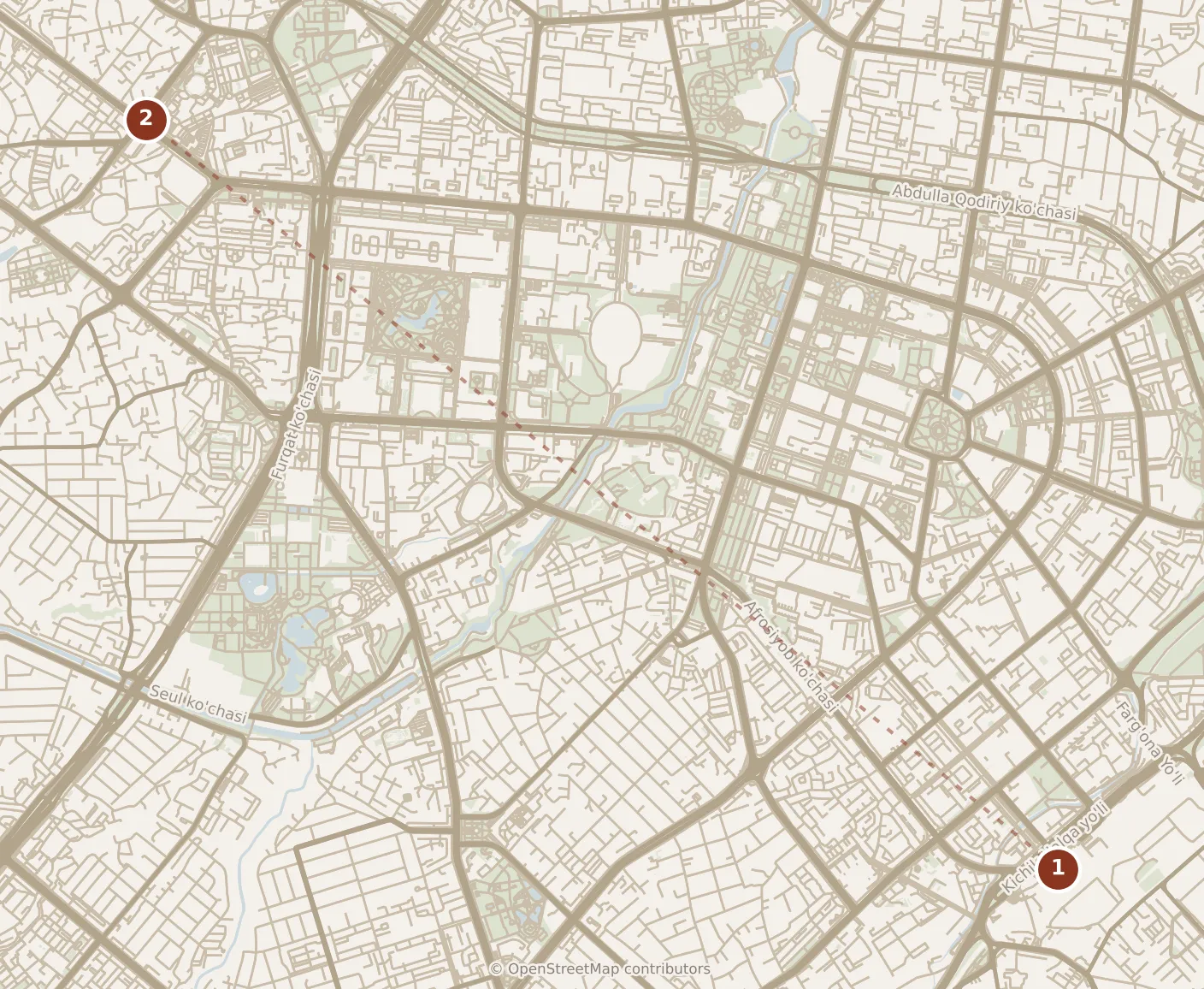
The ride on to stop 2, by metro, not on foot.
- Morning
- 1Tashkent railway station
- Morning
- 2Chorsu metro station
- 3Hazrati Imam complex
- 4Center for Islamic Civilization
- 5Kukeldash Madrasah
- 6Chorsu Bazaar
- Afternoon and evening
- 7Kosmonavtlar
- 8State Museum of History of Uzbekistan
- 9Mustaqillik Maydoni
- Sayilgoh Street — in the prose, not on the map
- 10Amir Timur Square
Morning
Six stops on the Oʻzbekiston line take you from Toshkent to Chorsu, out from under the railway lines and into the old city. Come up the escalators, note where the bazaar’s blue dome is, because you are coming back to it in three hours, and find a taxi on the road outside.
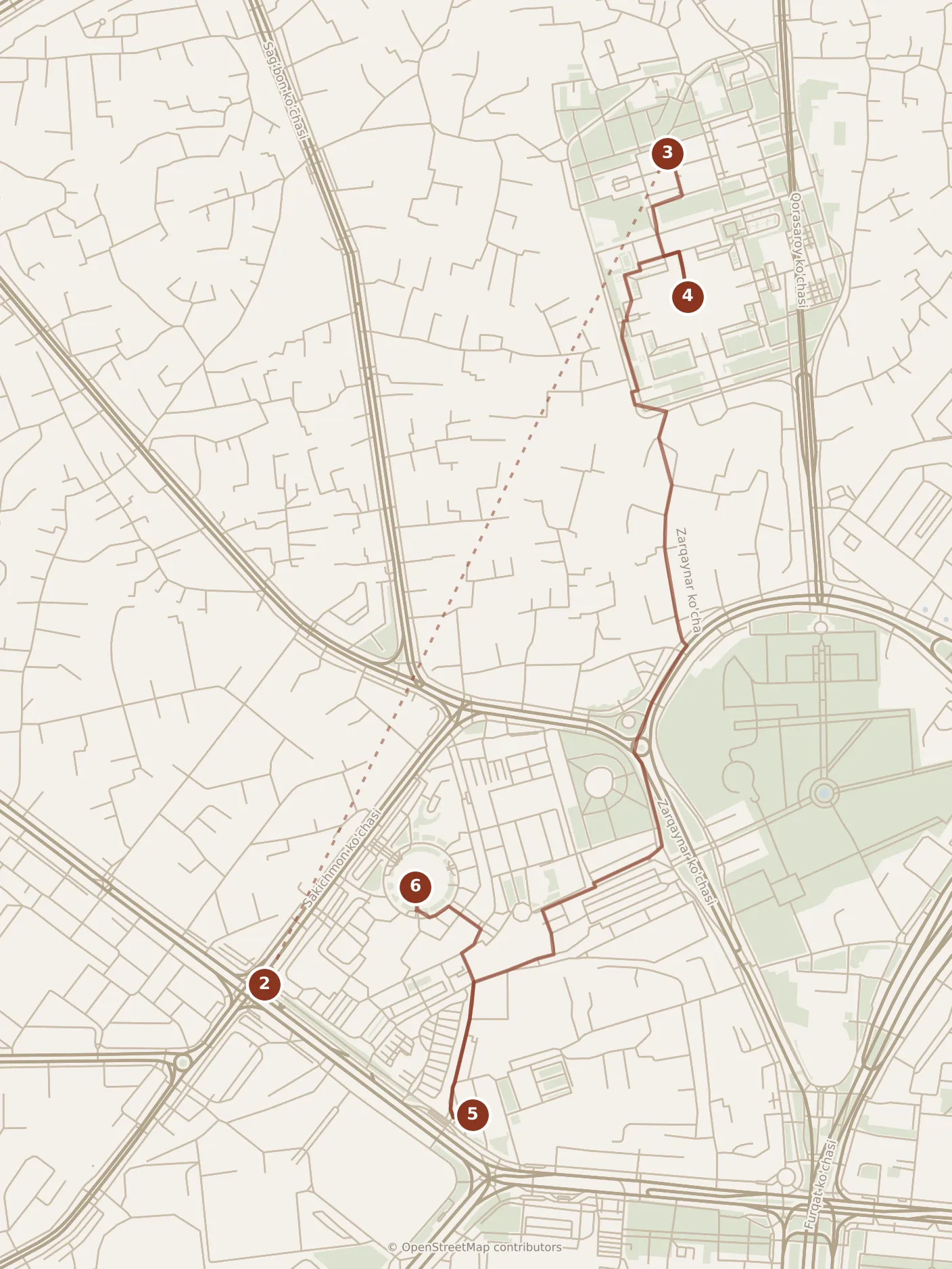
The Hazrati Imam complex is a kilometer and a half north of the station as the crow flies and a short ride by road, and the ride is worth taking in one direction only — you will walk the return. The complex grew up around the grave of Kaffal Shashi, a tenth-century scholar remembered as the first imam of Tashkent, and it is now six buildings set around open paved ground: the Barak Khan and Moʻyi Muborak madrasahs, the Qaffol Shoshiy mausoleum, the Tillya Sheikh and Hazrati Imam mosques, and an Islamic institute that is a working college rather than a sight. What is worth your hour is the older masonry — the portal and tilework of the Barak Khan madrasah, and the mausoleum at the heart of it, which is the grave the rest was built around. The two mosques are large, carpeted and in daily use, and a quarter of an hour in each is plenty. If you would rather walk in than ride, get off one stop earlier at Gafur Gulom and it is twenty-five minutes on foot.
A little over two hundred meters away stands the reason the complex is quieter than it used to be. The Center for Islamic Civilization laid its cornerstone in June 2018 and opened in March 2026: three stories, a hundred and forty-five meters by a hundred and fifteen, a dome sixty-five meters up, fifteen thousand square meters of museum on the second floor. In November 2025 the Quran came here from the madrasah next door. Tradition holds that it is one of six copies made for the caliph Uthman around 651 and the one he was killed reading; radiocarbon dating puts it between 775 and 995 with ninety-five per cent confidence, and the hand suggests the eighth or ninth century. So it is either the relic the tradition describes or a very early Quran that is not it, and nothing in the room settles which. A Russian general took it out of a Samarkand madrasah in 1868 for the imperial library in St Petersburg, and it came back to Tashkent on 9 August 1923. Give the building an hour and accept that you are skipping most of it: the manuscript is what you came for, and the library of a hundred thousand manuscripts and the hundred and fourteen Qurans around it are a second visit.
Then walk back down, about half an hour, and this is the part of the morning that is not a monument. The lanes between the complex and the bazaar are the mahalla quarter — single-story houses behind blank walls, courtyard gates, bread ovens, children — and they are what the earthquake of 1966 and the rebuild after it left of the low mud-brick city. There is nothing to look at, and it is the only place in Tashkent where the question “where is the old town” gets an answer instead of a shrug.
Local tip. If the morning has run long, cut the upper floors of the new museum rather than this walk. The manuscript itself takes ten minutes, and the calligraphy galleries are the kind of thing that will still be there on a longer trip — whereas the walk down is not available anywhere else in the city, and it is free.
The walk delivers you at the Kukeldash Madrasah, on the rise above the bazaar: yellow brick, a portal twenty meters high with a tower at each side, and a courtyard of student cells. It was built around 1570 under the Shaybanids and has since been a caravanserai, a fortress, a Soviet museum of atheism, a museum of folk music, and, since the 1990s, a madrasah again. It was damaged by the earthquake of 1868 and rebuilt twice, and it was one of the very few religious buildings left standing after 1966. Twenty minutes.
Eight minutes downhill is Chorsu Bazaar, and it is the best hour of this day. The dome was designed in 1980 by Vladimir Azimov and Sabir Adylov and is one of the ten buildings UNESCO listed in 2026 — a turquoise disc from outside, and inside a single ringed hall where the rows are sorted by trade and the noise never drops. Chorsu is Persian for crossroads, and there has been a market here a great deal longer than there has been a dome over it. Work the spice and dried-fruit rows, take a samsa straight out of a tandoor at one of the bread counters, look for the Korean carrot salad that the city’s Korean community turned into an ordinary Uzbek market item, and then sit down for plov. Sitting down is the point. Plov is the midday meal here and the counters run out, and something eaten walking is the wrong economy in the one city in Central Asia where the rice is a sight in its own right. Give the whole thing an hour and a half and expect to overrun.
Afternoon
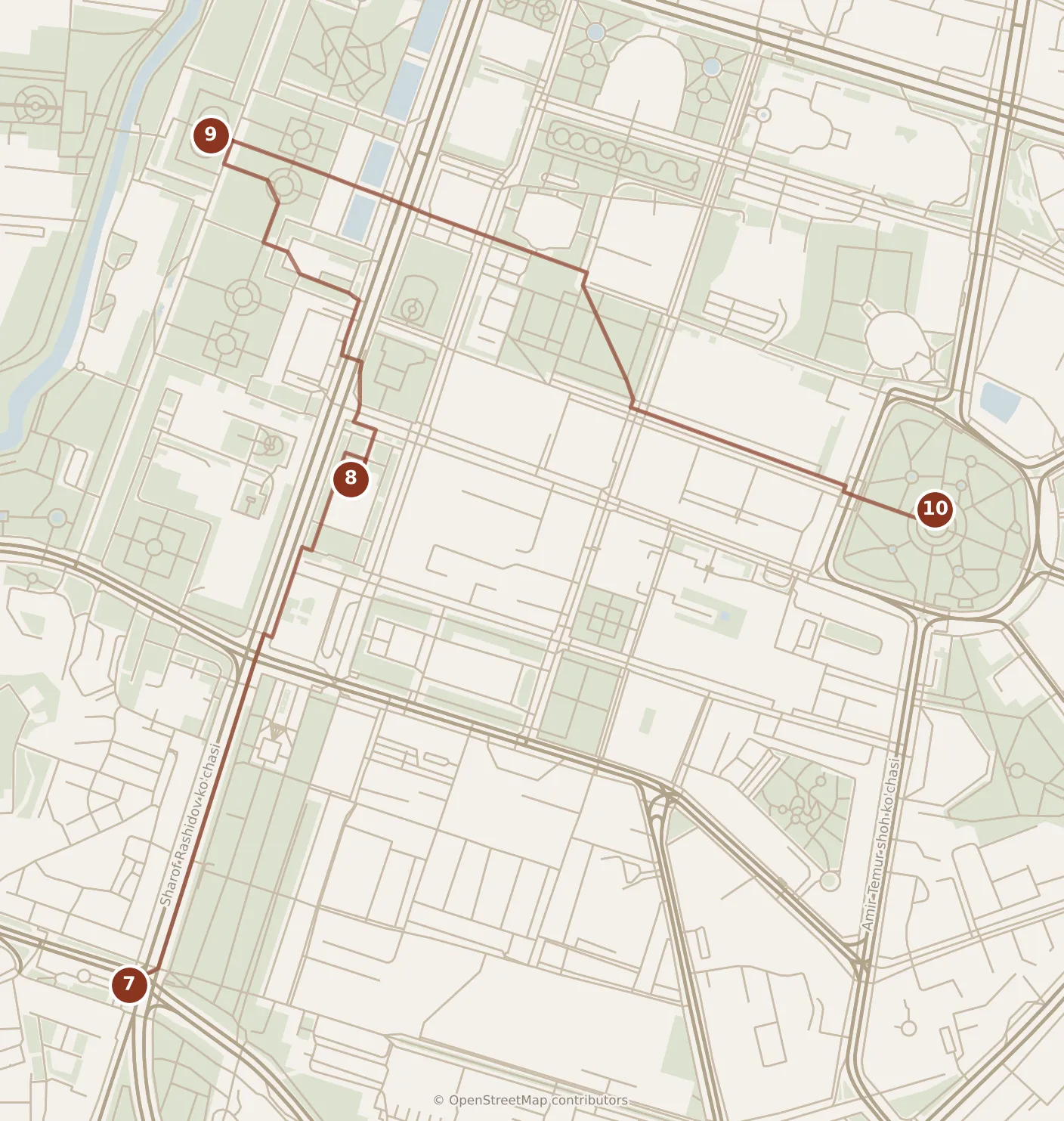
Six minutes back to Chorsu station and four stops to Kosmonavtlar, and get off there deliberately rather than passing through it. The station opened on 8 December 1984 and was listed by UNESCO in 2026 alongside the bazaar: blue anodised aluminum, columns clad in lit glass, and along the platform walls twelve ceramic medallions of people who looked up — Ulugh Beg, Galileo, Icarus, Gagarin, Tereshkova, two more cosmonauts — with Sputnik among them and a ceiling of inset glass stars standing in for the Milky Way. A Soviet space program rendered as a Central Asian tiled interior. Ten minutes.
A quarter of an hour on foot to the north-east is the State Museum of History of Uzbekistan, the third listed building of the day and the one you go inside. The institution dates from 1876, the building it occupies was finished in 1970, and it shut in June 2024 for a rebuild and reopened in July 2026 — so what you walk into is both fifty years old and brand new. Go for the Buddhist rooms. The alabaster Buddha relief from Fayaz-Tepa, a monastery near Termez in the far south of the country, is the object worth crossing the city for, and the heads and fragments from the same desert sites stand around it: a reminder that this was a Buddhist country for centuries before it was a Muslim one, which is not what the rest of the day tells you. An hour, and do not try to walk the whole chronology on top of it.
Eleven minutes to the north-west is Mustaqillik Maydoni, which is Independence Square, and which was a parade ground before that and, from 1865, the fortress of the Russian governors of Turkestan. Where Lenin stood until 1992 there is now a globe with Uzbekistan picked out on it and a seated mother and child beneath. The entrance arch, the Ezgulik, carries silver storks over a fountain. The half to walk is the memorial one: the Tomb of the Unknown Soldier, and the Memory Lane, a long covered walk whose panels carry the names of the men this country sent to the Second World War and did not get back. Half an hour, and it is the one place on this route where nobody is talking.
Evening
Eight minutes east of the square, Sayilgoh Street — Broadway to everyone who lives here — runs the best part of a kilometer to Amir Timur Square, and it is where the day stops being a list of buildings. It is pedestrian end to end, tree-lined, full of portrait painters and stalls and cheap cafés, and it fills as the offices empty. Eat here. Lagman, hand-pulled, is the dish that suits an evening rather than a midday, and the counters along and just off the street do it properly.
Broadway ends at Amir Timur Square, which holds the best plinth in the country for what it has carried. The square was laid out in 1882 under the Russian administration, and the middle of it has held a statue of the imperial governor-general from 1913, Stalin from the late 1940s until 1961, Marx from 1968, and, since 1994, Amir Timur on a horse. Four regimes, one pedestal. Twenty minutes and a last look is the right amount; the museum with the blue dome beside it is the one this day gave up at the outset.
Then close the loop. Kosmonavtlar is a little under half an hour back on foot, and two stops from there — Oybek, then Toshkent — put you underneath the railway station with your bag. With a train to catch, take a taxi to the station instead and do not feel clever about walking; this is a city where that ride costs very little, and the Afrosiyob does not wait.
Practicalities
Nothing on this route has to be booked before you travel, and there is no pass or ticket to arrange in advance. What it does need is cash for the two museum tickets, the taxi and everything at the bazaar, and some way of paying for the metro. Both are the city’s business rather than this route’s, and the parent city guide covers them; two minutes with it before you start is worth more than anything in this paragraph.
The two museums are the only stops here that can be shut for a day of the week, and both opened or reopened within the last year, which is exactly when such arrangements are still settling. Check the day before you set out rather than assuming one. If one of them falls badly, do not rearrange the morning to compensate: spend the hour underground instead, on the older stations of the Oʻzbekiston line, which is a gallery nobody can close and which holds one of the day’s three World Heritage buildings anyway.
Friday changes the morning rather than breaking it. The mosques at Hazrati Imam fill for prayers around the middle of the day, and the complex is a place of worship before it is a monument; this route reaches it in the first half of the morning, which is the reason it is arranged that way. Arrive at lunchtime on a Friday and you will be looking at the outsides.
July and August are the months to rewrite this day for. Tashkent goes past forty degrees, and the half-hour walk down from the complex is the one long stretch of the route that is outdoors from end to end, with nowhere to step inside. In high summer take the ride in both directions, or start at eight and do the walk before the heat arrives; everything else here is underground, indoors or under trees.
On foot the whole day comes to about six and a half kilometers, plus a last half-hour back to the metro if you walk that rather than taking a taxi. It falls in two clusters four kilometers apart, which is why the metro leg in the middle is not optional and the taxi at the top of the morning is not laziness. The longest single stretch is the half-hour down from the complex into the old city, taken in the morning for that reason; the only other walks over a quarter of an hour are the one from Kosmonavtlar up to the history museum and the last one back down to it.


