Taipei in one day: west to east across the basin, ending on Elephant Mountain at dusk

Last updated 4 August 2026
Overview
Taipei filled up from west to east, and one day here is best spent going the same way. The oldest lanes sit by the river on the western edge of the basin; the newest towers stand under the hills about eight kilometers east of them. Walk that line and the day gives you something no list of sights can: a temple founded in 1738, a merchant street laid out in the 1850s, a monument opened in 1980, and a skyline that did not exist when your parents were young — in that order, each a short metro ride from the last.
The order also suits the light, because the day ends on a hill and the hill is the one part of this route that cannot be moved. The sun goes down here between just after five in late November and a little before seven at midsummer — an hour and three quarters between the two extremes, which is the whole swing the subtropics allow. Everything above the hill (two temples, a market street, a memorial, two sit-down meals and four rides on the MRT) comes to about six hours, the climb is another half hour on top, and the Taiwanese hiking guides tell you to be on the platforms a full hour before sunset rather than at it, because the front row fills. Call it seven and a half: take your month’s sunset, count back that much, and you leave the station about half past nine in the morning at the darkest end of the year and a little after eleven in June.
Two things that count does not contain. It has the metro legs in it but not the line for a bowl of noodles, which is what a mealtime costs you on Yongkang Street — this route reaches the street in the middle of the afternoon, between services, and the shops there trade straight through. And it treats the last kilometer as a walk when most of it is stairs. There is also one published hour the count has to bend around, and it bites hardest in the months when the light lasts longest: the main hall of the Chiang Kai-shek Memorial Hall shut at six in 2026, and this route reaches it about five hours in, so a departure much after noon leaves you minutes rather than an hour inside that door. Noon is the backstop, not the plan. Start mid-morning whatever the month and spend the surplus daylight on the hill, which is the only stop that improves the longer you sit on it. If that closing hour has moved, work the same way from the new one, and take it from the hall’s own listing rather than from here: the hall is the piece with a door, and it goes before the hill, never after.
What a single day costs you is the National Palace Museum. It holds the best of what left the mainland in 1949, and it is also forty minutes north of the center by metro and bus and a half day once you are inside. Taking it would delete the whole west of Taipei, which is where the city is oldest, densest and most itself. The museum is the honest sacrifice here, and it is better made deliberately in the morning than discovered at four in the afternoon.
The day

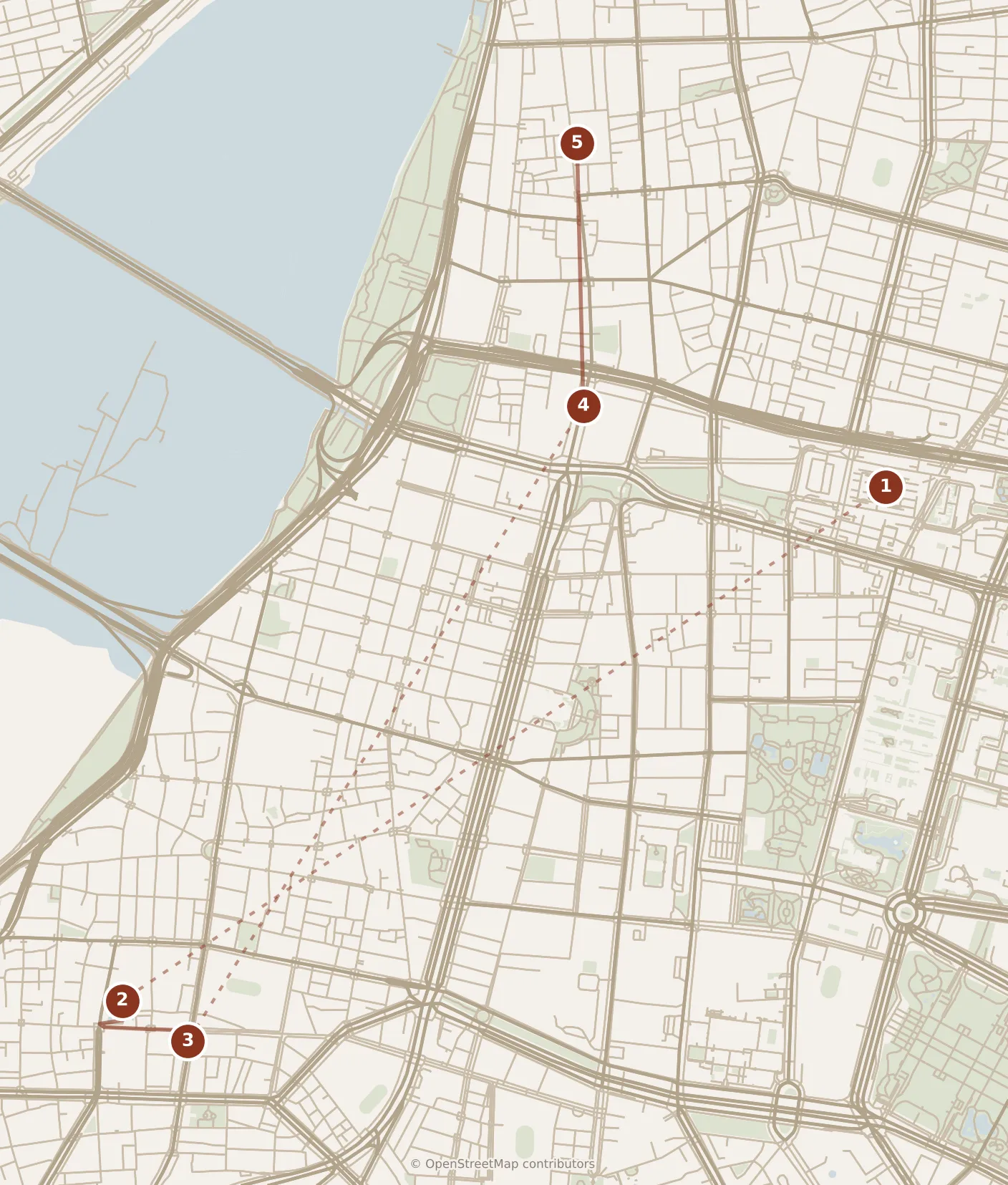
- Morning
- 1Taipei Main Station
- 2Longshan Temple
- 3Bopiliao
- 4Beimen Station
- 5Yongle Market
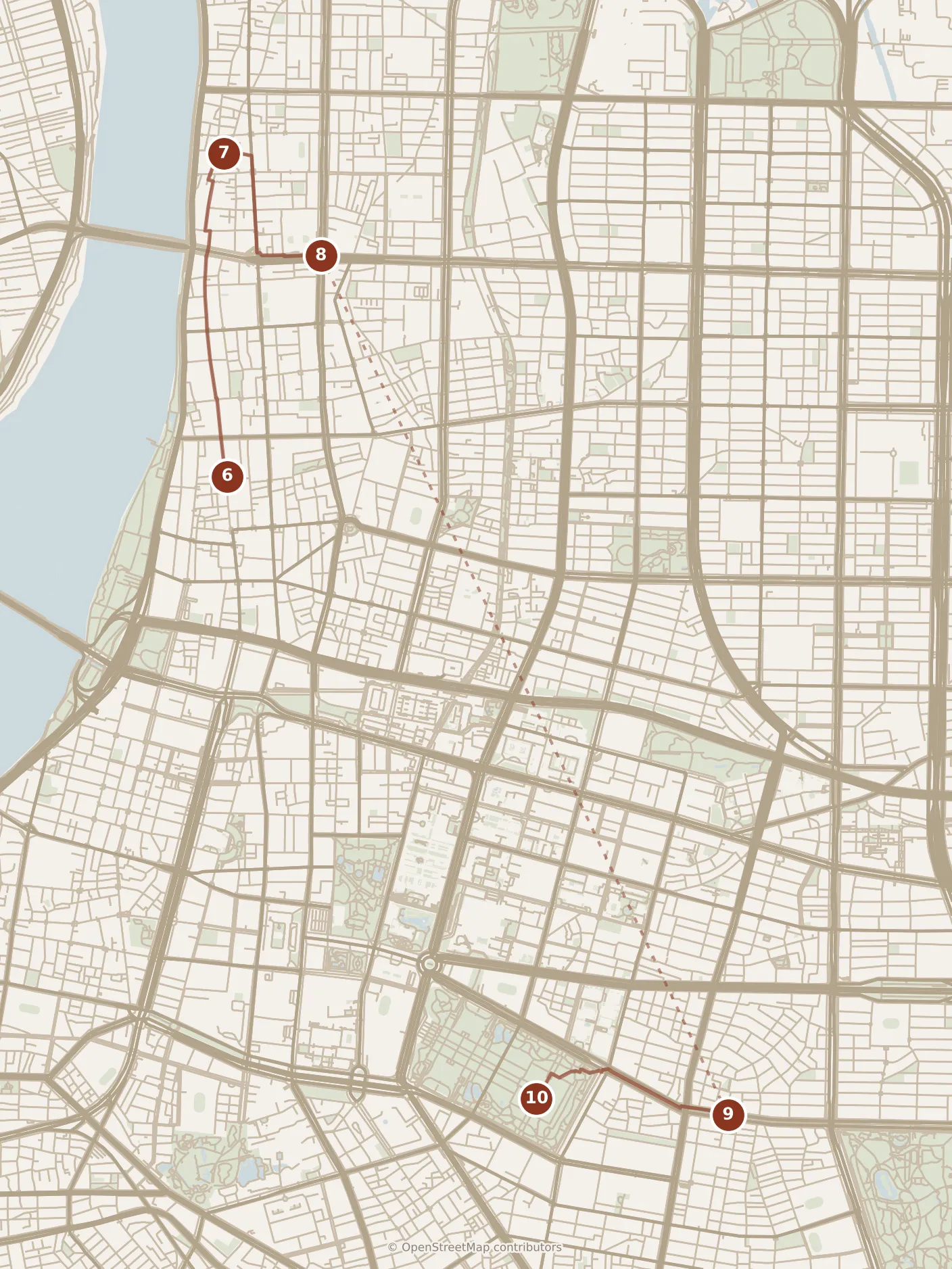
- Afternoon
- 6Xiahai City God Temple
- 7Dihua Street
- 8Daqiaotou Station
- 9Dongmen Station
- Yongkang Street — in the prose, not on the map
- 10Chiang Kai-shek Memorial Hall
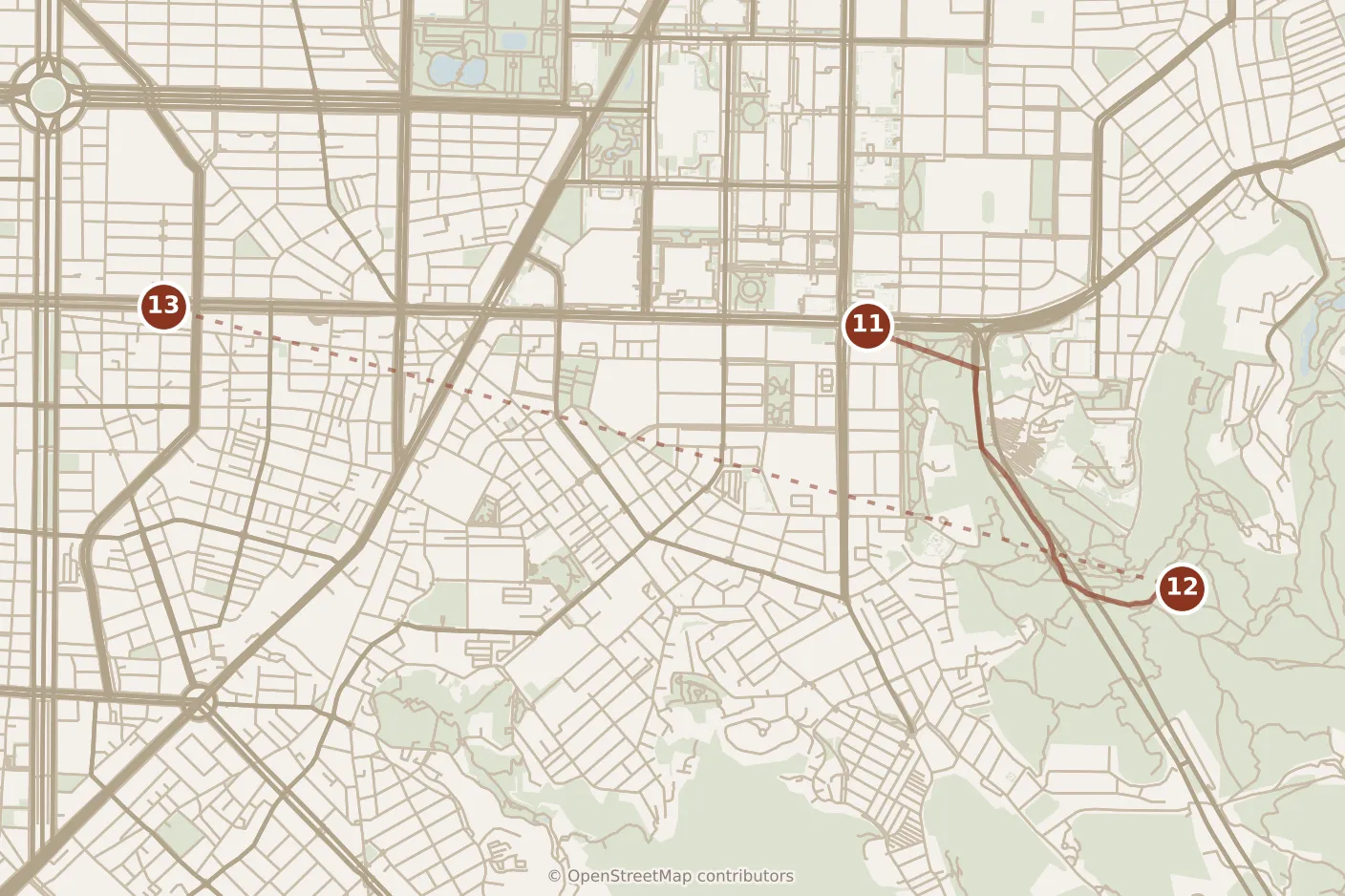
- Evening
- 11Xiangshan Station
- 12Elephant Mountain
- 13Xinyi Anhe Station
- Linjiang Street Night Market — in the prose, not on the map
Morning
Leave the bag at Taipei Main Station and take the blue line two stops west to Longshan Temple. The station is named after what you have come to see and the temple is five minutes from it, past Mengjia Park, which has been a fenced building site since July 2025 rather than the small park full of chess players it was; the rebuild is due to finish in 2026.
Longshan Temple was founded in 1738 by settlers from Quanzhou in Fujian, in the riverside quarter they called Bangka and the maps now call Wanhua — the first Han settlement in the basin, though not the first thing here: Bangka is the Ketagalan word for a dugout canoe, and the canoes were working that landing before the settlers came. It was bombed on the last day of May 1945 and rebuilt after the war, which is why a temple this old has such crisp carving. Enter by the dragon gate and leave by the tiger gate: both are labeled, everyone does it, and going against the flow in a courtyard this busy is the one way to look foreign here. Do not treat it as a museum. The front hall and the main hall belong to Guanyin, but the row of small shrines behind is where the place is actually working: Hua Tuo for illness, Wenchang for examinations, Mazu for anyone who goes to sea, Guan Yu for business and Yue Lao for marriage, each with its own line and its own offerings. Watch how the divination blocks are thrown before you leave. Give it three quarters of an hour, which is longer than it looks and less than it deserves.
Four minutes east is Bopiliao, a single block of shophouses that the city spent a decade restoring and finished in 2009. What makes it worth the detour is that it was not tidied into one period: Qing shopfronts, Japanese-era arcades and post-war concrete stand in the same short lane, so you can read three governments off one wall. Twenty minutes — and it is the one stop of this morning with a closing day: the whole block shuts on Mondays, the open lanes with it, and it is the site’s own listing that says so.
Now the awkward hop of the day, and it is genuinely short: back to Longshan Temple station, one stop on the blue line to Ximen, change there to the green line and one stop north to Beimen. From Beimen it is a quarter of an hour on foot to Yongle Market, and lunch goes there. The first floor is a food market and the lanes around it are full of small kitchens; upstairs is three floors of fabric, which is worth five minutes even if you are not buying, because the bolts stacked to the ceiling explain what this district was for. The two halves keep different closing days — the food floor shuts on Mondays, the fabric floors on Sundays — so on a Monday lunch is the small kitchens in the lanes rather than the hall, and on a Sunday the five minutes upstairs is not on offer.
Afternoon
Two minutes from the market is the Xiahai City God Temple, and the arithmetic is what everyone quotes about it: over six hundred deities inside a hundred and fifty square meters, the densest concentration of statues in Taiwan. It was founded in 1859 by Tongan merchants who had come up from Bangka — not the people whose temple you stood in this morning but the ones they drove out. In the feud of 1853 the Quanzhou three-counties families who had built Longshan burnt the Tongan quarter, and the losers went upriver to Dadaocheng carrying their City God with them and built this for him. Its Yue Lao shrine is the famous one in the city for anyone looking for a spouse; the red threads tied everywhere are the reason. Fifteen minutes.
The temple stands on Dihua Street, and the street is the stop. It runs about a kilometer and a quarter north from here, a quarter of an hour if you walk it without stopping and the longest stretch of level walking on this itinerary. Do it slowly instead — except in the two weeks before Lunar New Year, when the whole street turns into the city’s new-year goods market and an unhurried walk is not on offer: in 2026 that ran from the last day of January to the middle of February. The shophouses are nineteenth-century merchant fronts, some with Japanese-era brickwork grafted on top, and the trade they were built for is still working inside them: dried scallops and mushrooms in open sacks, medicinal herbs weighed on a hand balance, tea, incense, cloth. It shares the street with the cafés and design shops that have been moving into the restored shophouses since 2011; nobody publishes the proportion, and both are there. From the top of the street it is ten minutes on foot to Daqiaotou station, and the orange line runs six stops from there to Dongmen.
Yongkang Street begins four minutes from Dongmen station, off Xinyi Road, and it is where the afternoon eats. This is beef noodle soup territory — the lines outside the good places are obvious and worth joining — and it is also where you get mango shaved ice and a bubble tea. If you had a real lunch at the market, take the ice and nothing else and keep moving; half an hour here is plenty.
Then west along Xinyi Road for a quarter of an hour, with the railings of the park coming up on your right, to the Chiang Kai-shek Memorial Hall. It is seventy-six meters of white marble under a blue octagonal roof, opened on 5 April 1980, with two flights of eighty-nine steps — one for each year of the man’s life — climbing to the statue hall. The square in front of it is the more interesting half. It was renamed Liberty Square in 2007 after the demonstrations that took place on it, and the National Theater and the National Concert Hall face each other across it in full imperial dress, which is a strange thing to build in the 1980s and a stranger thing to walk between. One warning about what you may not see: in July 2024 the honor guard was withdrawn from the statue hall and its drill moved outside onto Democracy Boulevard, so check the hall’s own listing for what now happens where before you plan an afternoon around watching it. Forty-five minutes for the hall and the square together.
Local tip. The square, the gate and the two concert buildings are free, open air and open late; the only part of this monument with a door and an hour is the statue hall at the top of the steps. On a short winter afternoon that is the piece to drop rather than rush — crossing the square costs you nothing but the walk, and the daylight you save belongs on the hill.
Evening
The metro station sits at the far corner of the park from where you came in, ten minutes across it, and the red line runs six stops from Chiang Kai-shek Memorial Hall to Xiangshan, the end of the line. That is the whole logistics of the evening.
Elephant Mountain rises straight out of the streets behind the station — one of the Four Beasts hills, a hundred and eighty-three meters, and close enough to the city that the steps start at the edge of an ordinary residential block. From the station to the viewing platforms is a kilometer, which works out at twenty minutes on the flat, and it is not flat: most of it is stone steps. Give it half an hour, and considerably more patience in August, when the humidity turns a small hill into a serious one. The platforms partway up are the point rather than the summit. Taipei 101 stands a kilometer and a half away across the valley, close enough that you look slightly up at it, with the whole basin and the mountains behind it — and this is the stop the day was built around. The half hour is the climb and nothing else: the local hiking guides say to be up there a full hour before sunset, because the front of the platform fills long before the light goes. Arrive with it still on the towers and stay while it comes off them. If the weather has closed in, the honest substitute is the tower’s own observatory, which is indoors, open late and costs money.
Come back down to Xiangshan station and ride two stops on the red line to Xinyi Anhe. Under ten minutes’ walk from there is the Linjiang Street Night Market, which half the city still calls Tonghua: a few hundred meters of stalls between apartment blocks, wedged into a residential grid rather than laid out for coaches. Graze rather than sit — gua bao, grilled squid, oyster omelette, fruit — and treat it as dinner. The two famous markets, Shilin and Raohe, are each a long detour in the wrong direction from here, and on a one-day trip that detour costs more than the difference in the food.
From the market it is back to Xinyi Anhe and six stops on the red line to Taipei Main Station, about twenty-five minutes door to door, which is where the bag is and where the trains are.
Practicalities
The one thing this route needs that you may not have is a stored-value travel card — an EasyCard, sold at any station — because the day uses the MRT six times and buying a single token each time is a small tax on the whole itinerary. Carry notes as well: two of the three meals here are stalls. Everything else about arriving, paying and getting around is in the Taipei city guide, and this route asks nothing unusual of it.
Nothing on this day has to be booked, and almost nothing has to be paid for: both temples, Bopiliao, Dihua Street, the memorial hall and the hill are free. The single figure worth knowing is the one that decides the ending. The standard 89th-floor observatory ticket at Taipei 101 was in the six-hundred New Taiwan dollar range in 2026, and the hill opposite is free and gives you the tower in the view instead of putting you inside it — which is why this itinerary sends you up the hill and treats the observatory as the wet-weather substitute, not the other way round.
Monday is the one day this route does not survive whole. Bopiliao shuts completely, the open lanes included, and Yongle Market’s ground floor — the lunch — shuts with it, so a Monday costs you a morning stop and a meal. The fabric floors upstairs keep Sunday instead. Both places publish their own closing day, and those are the two things worth checking before you set out; everything else here is indifferent to the day, since the memorial hall keeps no weekly closing day and temples, streets and a night market do not either. If you are stuck with a Monday the morning still works, shortened: the temple, then the metro hop to Beimen and straight on to Dihua Street, with lunch in the small kitchens in the lanes around the closed market hall, which puts you at the memorial hall an hour early and the extra hour on the hill.
The bag rules the shape of the day rather than a line of it. Taipei Main Station is where left luggage lives, in two forms — the railway’s staffed baggage counter, and the metro’s coin lockers, which the metro publishes as keeping the station’s own hours and charging by the hour — and it is also where this route begins and ends, so the sensible move is to drop it before the first metro leg and collect it after the night market; the day is a loop and the last leg is a single red-line ride back. That matters more here than it usually does, because Elephant Mountain is half an hour of stone steps in subtropical humidity and is the one stop on this itinerary you should not attempt holding a case. Neither operator publishes how many lockers are free at any moment, so treat the drop as the thing that can fail rather than as a given.
If it does fail — every locker taken, or a gap between trains too short to come back for a bag — the hill goes and the rest of the day does not. Walk the morning and the afternoon exactly as written, as far as the memorial hall. Then take the red line from Chiang Kai-shek Memorial Hall to Taipei 101, one stop short of Xiangshan, and give the tower’s own observatory the half hour the climb would have taken: an elevator rather than stone steps, it takes a case, and it puts you inside the building you would otherwise have spent the evening looking at. Come down, ride the single stop to Xinyi Anhe and do the night market exactly as above, and you are back at Taipei Main Station about twenty-five minutes after that. It costs the six hundred dollars the hill is free of, and it is a whole day rather than a truncated one.


