Sydney in two or three days: the western harbor, the coast walk to Coogee, and a museum day

Last updated 8 August 2026
Overview
Sydney’s difficulty on a short visit is not its size. It is that the two things people come for — the harbor and the ocean beaches — sit seven kilometers apart with the whole eastern half of the city between them, and neither improves for being hurried. One day makes you choose. Two days is where the choosing stops, and that is the entire argument for the second one: day one stays on the harbor and is walked from end to end once you are on it, day two stays on the coast and is walked from end to end, and a ride at each end of day two is the only thing in this article that joins them.
Day one is the western half of the harbor, which is the half a single day never reaches: a headland rebuilt out of a container wharf, a row of timber cargo wharves now full of theaters, the hill the colony put its telescope on, the oldest streets in the country, and then the Opera House from the inside rather than from the podium. It ends on the deck of the bridge with the light going. Day two is the six kilometers of clifftop path from Bondi south to Coogee, with ocean pools and a cemetery on it, which is the walk this city is actually organized around. A third day goes in the middle and is spent indoors.
The one stop the light decides is the last one of day one. The sun goes down here at just before five in the first week of June and not until a little past eight in the first week of January — the seasons run the other way round from Europe and North America, and a June evening in Sydney is a great deal shorter than most visitors expect. What you want is to be standing on the span for the last hour of it. Everything above that point comes to a little over seven hours, and here it is: six minutes from the station, three quarters of an hour on the headland, eight minutes east, twenty minutes along the wharves, eight minutes uphill, three quarters of an hour on the hill, ten minutes down, three quarters of an hour in the old streets, eight minutes to the gallery, an hour and a quarter inside it, five minutes to the water, an hour for lunch, a quarter of an hour round the cove, an hour on the tour, and a quarter of an hour back to the foot of the stairs. In the first week of June that puts your start at a quarter to nine in the morning. In the first week of January the same sum says just after midday, and those three-and-a-quarter hours between the two answers are the whole difference between visiting this city in winter and in summer. Do not read the summer answer as permission to lie in: start at nine anyway and give the surplus to the two stops that can absorb it — the contemporary art gallery, where an hour and a quarter is a compromise, and the old streets, where three quarters of an hour is.
That sum counts the time you spend in the places and walking between them, and nothing else. The largest thing it leaves out is the one thing on the day you do not control: the tour is a timed slot booked weeks earlier, and if the only one left is at eleven or at three, the day rearranges itself around that rather than the other way round. Day two carries a count of its own and it runs in the opposite direction, giving a latest start rather than a start; it is inside that day.
Exactly one thing in this article has to be booked before you arrive, and a third day adds nothing to it: the guided hour inside the Opera House, which was in the fifty-dollar range in 2026 and a few dollars more bought at the door than bought ahead. It is sold on the Opera House’s own website and at the welcome center on the lower level of the podium, and the line at that desk is the whole reason to do it before you travel. Three other things may take a ticket you buy on the spot and cannot usefully book — the contemporary art gallery on the quay, the observatory on the hill, and the ocean pool at the south end of Bondi — and every other stop in these three days is free.
Four rides, five if the road sends you out to Bondi by train instead, and everything else is walking: a few minutes of metro to the start of day one, a bus out to Bondi, a bus back from Coogee, and one train out for the third evening. Neither of day two’s end rides is inside that day’s count, and on Oxford Street at five o’clock that is not a small omission: they are long enough to matter and variable enough on the road that a figure here would be a fiction, so allow for them on top of the count rather than inside it. If you arrive holding nothing, the one thing to sort out before you walk anywhere is the tap — a contactless bank card or phone, or an Opal card — which covers the metro, the buses and the trains alike; how the fares and the caps work is the parent city guide’s business rather than this page’s.
Two or three days means a room, so the bag is a problem on exactly two of them, the day you arrive and the day you leave, and here that is a routing question rather than a locker question. Day one and the museum day both start in the middle of the city, within a quarter of an hour on foot of Circular Quay, where the T8 runs from the platforms above the ferry wharves to both airport terminals. Day two does not: it ends at Coogee, which has no railway station of any kind, and the six kilometers before it are a clifftop path with long flights of steps, almost no shade in the second half and nowhere at either end to leave anything. So do not make the coast your arrival day, whatever the forecast says. Departure is the half of that rule the orders below cannot honor, because every one of them ends on the coast: it is the second day of two and the third of three. So if you fly out on your last day, take that trade knowingly — walk the coast with nothing on your back and collect the bag on the way through, since the 374 from Coogee runs to Central, and the airport line runs from there. If you arrive in the morning and want to start at once, day one is the day to start with, and it matters little which way you came in: the T8 brings you to Central from either airport terminal, and the intercity trains come into Central too. From Central it is three stops north on the M1 metro — Gadigal, Martin Place, Barangaroo — to the platform the day opens on.
Day one

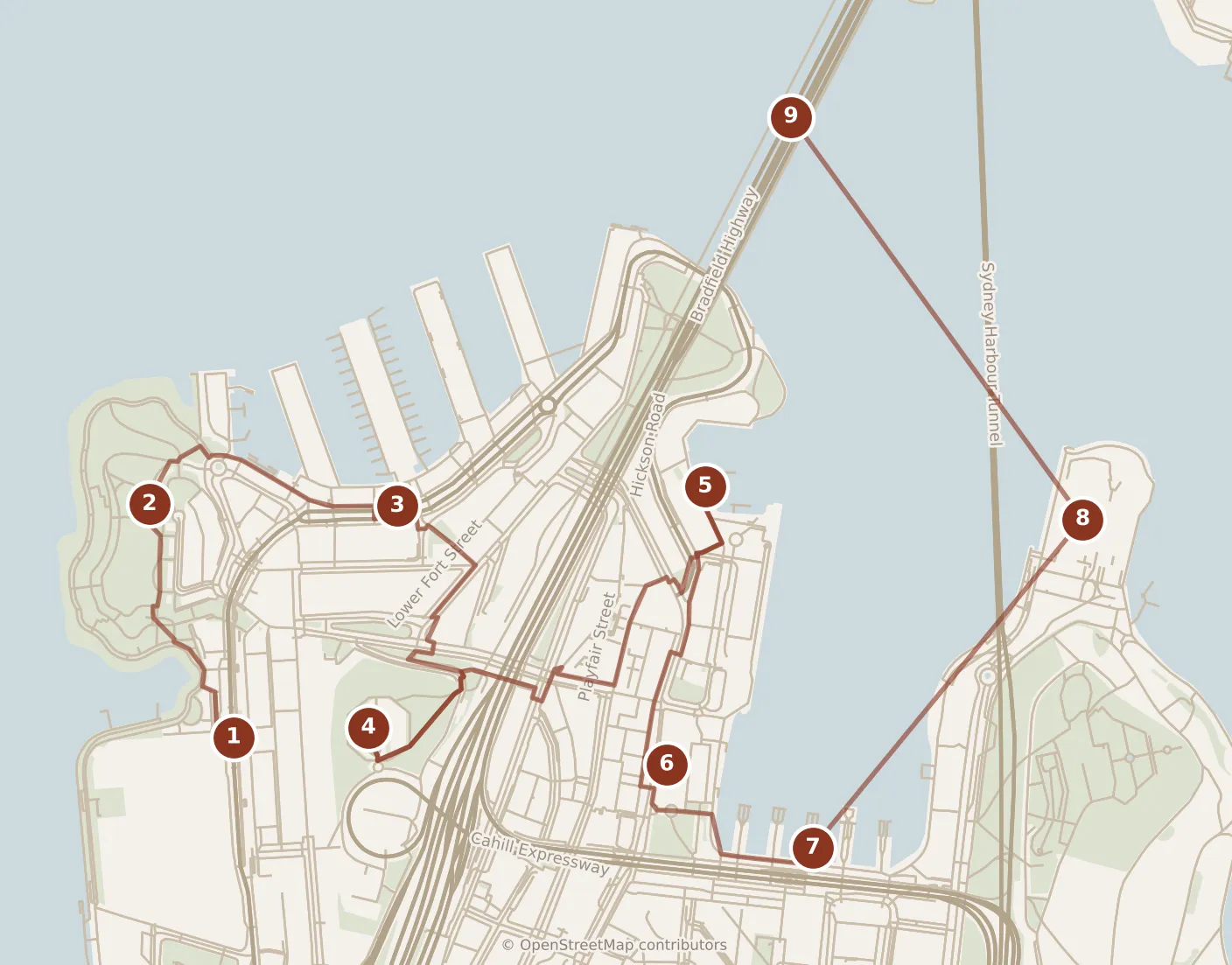
- Day one
- 1Barangaroo station
- 2Barangaroo Reserve
- 3Walsh Bay
- 4Sydney Observatory
- 5The Rocks
- 6Museum of Contemporary Art
- 7Circular Quay
- 8Sydney Opera House
- 9Sydney Harbour Bridge
Today runs west to east along the harbor and then doubles back once, which is deliberate and is explained where it happens. After the metro it is entirely on foot, it stays within about a kilometer and a half of water throughout, and it is the only day of the three with a booking in it.
Morning
Start at Barangaroo station, which is on the M1 metro and has only existed since August 2024, so it is missing from a good deal of older advice about this city. From Wynyard it is a quarter of an hour on foot and downhill the whole way, which is the better option if you are sleeping in the center. Six minutes from the barriers the ground opens out into Barangaroo Reserve.
This is a headland that was not here in 2014. The original one was quarried away from 1836 onwards to make wharves, the site finished its working life as a container wharf, and the park that opened on 22 August 2015 is a reconstruction: six hectares, faced with sandstone cut out of the ground on the spot — about ten thousand blocks came out and some six and a half thousand went into the new shoreline — and planted with roughly seventy-five thousand native trees and shrubs. Walk the Wulugul Walk round the water’s edge rather than over the top. At that level you are on rock ledges a meter above the harbor with the bridge opening up ahead of you, and the illusion that this is old coastline holds until you notice how regular the blocks are. Barangaroo herself was a Cammeraygal woman and the second wife of Bennelong, whose name is on the point the Opera House stands on and who is the better remembered of the two, for reasons that say more about the record than about either of them. Three quarters of an hour.
Eight minutes east along Hickson Road brings you to Walsh Bay. These are the finger wharves built between 1912 and 1921, when the harbor trust rebuilt this whole shore for steamships: enormous timber sheds on piles, running out into the water at right angles to the road, with the shore buildings and a bond store behind them. They stopped being a port and became a theater and rehearsal quarter, and the point of walking out along one is that almost nothing has been prettified — the decking, the trusses and the sliding cargo doors are the working fabric, and the water moves under the boards. Twenty minutes, unless something is on.
Then climb: eight minutes up from the road, all of it steps, onto the hill where Sydney Observatory sits under its Moreton Bay figs. It is a sandstone building of 1857 to 1859 with a time-ball tower on it, and the ball was the city’s clock before the telegraph — hoisted and dropped at a fixed hour each day so that ships in the harbor below could set their chronometers. The original mechanism still drops it. The hill is the real stop and it is a public park with no gate: the view back over the wharves you have just walked, and on to the bridge, is the best free one on this side of the water, and it is why the day comes up here rather than staying at sea level. Three quarters of an hour. The building itself opened only Thursday to Sunday in 2026. That is the one weekly closure on today and it decides nothing about the order — if your day one is a Monday, give the same three quarters of an hour to the park, the figs and the view and walk down into the old town a little earlier. The museum service that runs it publishes its own days; read them the week before, and if they have moved, the rule that survives is that the hill carries this stop and the building is a bonus.
Afternoon
Ten minutes downhill and east brings you into The Rocks, the oldest continuously built-up ground in the country and very nearly not: the government resumed the whole district after the bubonic plague of 1900 and pulled hundreds of buildings down, then planned to finish the job with towers in the early 1970s, and what stopped that was the residents persuading a building workers’ union to impose a ban on the site in 1973. Walk the lanes and the stairs rather than George Street, which is the one part tidied into a shopping street. Two things to find: Cadmans Cottage on George Street, a small stone house of the 1810s and the oldest surviving one here, which stood on the waterfront when it was built and is now a street back from it because the harbor was filled in front of it; and Susannah Place, a terrace of four houses put up in 1844 and lived in until 1990, kept as they were left rather than restored, now a house museum with its own short opening days — worth looking up if you want to go in, and worth looking at from the street either way. On a Saturday or a Sunday a market fills the northern lanes, which is either the reason to come on the weekend or the reason not to. Three quarters of an hour.
Seven or eight minutes south down George Street, where the sandstone runs out, the Museum of Contemporary Art occupies a stripped-classical government office of 1952 built for the harbor authority, converted in 1991 and extended in 2012. Go for the Australian work, and in particular for the Aboriginal and Torres Strait Islander holdings, which are one of the building’s main strengths rather than a side gallery. Check the gallery’s own site for whether general entry carries a charge before you go, rather than arriving with an assumption either way. An hour and a quarter taking two floors properly is better than two hours taking all of them. Then five minutes to Circular Quay for lunch. Give it an hour but keep it loose — a meat pie eaten on the seawall rather than a table you have to wait for — because the tour is a timed slot and this is the part of the day with the least give in it.
A quarter of an hour round the eastern side of the cove is the Sydney Opera House, and today you go inside it, because the outside is the part everybody already has. The hour on the tour is built round the concert hall, reworked and reopened in 2022 to fix an acoustic fault the building was born with — the roof is so high that the sound leaving the stage had almost nothing to come straight back off — and the theater below it. Which rooms you are actually shown depends on what is rehearsing or loading in that day, so read the concert hall as the likely center of the hour rather than as something you have paid to be guaranteed. The story it tells is a scandal: Jørn Utzon designed the shells, resigned in 1966 with the interiors unbuilt, left the country and never came back to see it finished, and Peter Hall designed the rooms you are standing in, which is why they do not look like the outside. One room, opened in 2004, was rebuilt to an Utzon design after a reconciliation of sorts.
Local tip. If today is running short, the stop that goes is the contemporary art gallery, and it buys back an hour and a quarter, which is the entire margin on this day. Do not take it out of the hill instead. You have already done the climb by the time you get the view, so cutting the hill saves you eight minutes of walking and removes the one stop that explains the shape of the harbor before you walk along it.
Evening
From the Opera House, walk back west along the quay and up the Argyle Stairs to Cumberland Street — a quarter of an hour, the last of it climbing — and out onto the bridge. This is the one doubling-back in the article and it is unavoidable: the only pedestrian way onto the span from this side is that staircase, in the district you were standing in at two o’clock. It costs fifteen minutes and it buys the same water in different light, which is a fair exchange.
Ten minutes out from the top of the stairs puts you at the middle of the span, and the middle is the whole of it. Go out, stand there, come back the same way. From the center the city is laid out on one side and the harbor opens northward on the other, and over about twenty minutes the towers come on — not together, in ones and twos — while the sky is still blue enough to show the water. The deck is free, there is no gate and no ticket, and it is a working footway rather than an attraction, so the traffic is beside you the whole time and it is loud. One of the pylons holds a lookout with its own ticket and its own hours; that is a daytime visit and it is not what this evening is for.
Dinner is back down the stairs in the old streets, or out at the wharves, and by now you know which lane is which, which is the small reward for a day that finishes where it started.
Day two

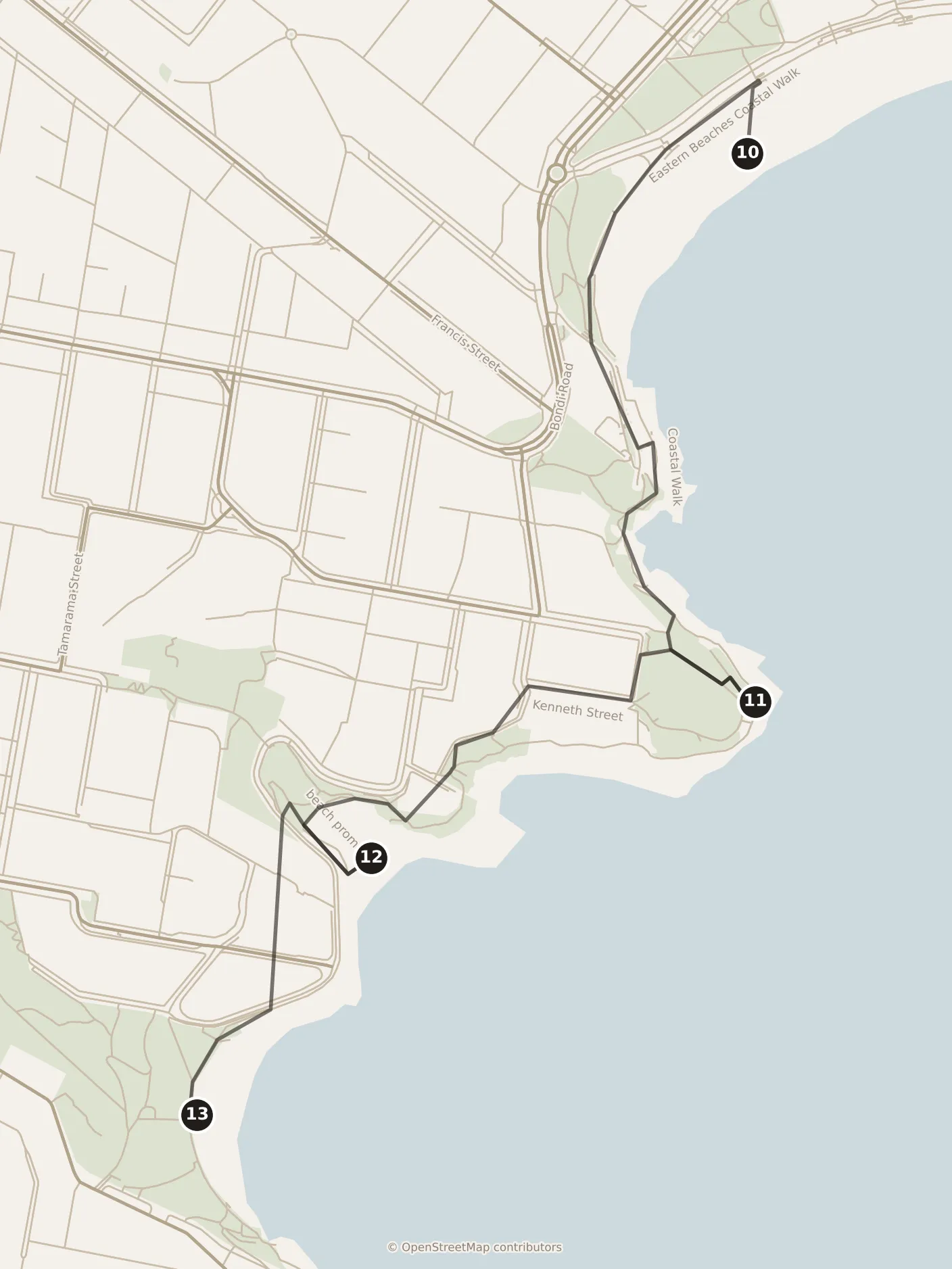
- Morning
- 10Bondi Beach
- 11Marks Park
- 12Tamarama Beach
- 13Bronte Beach
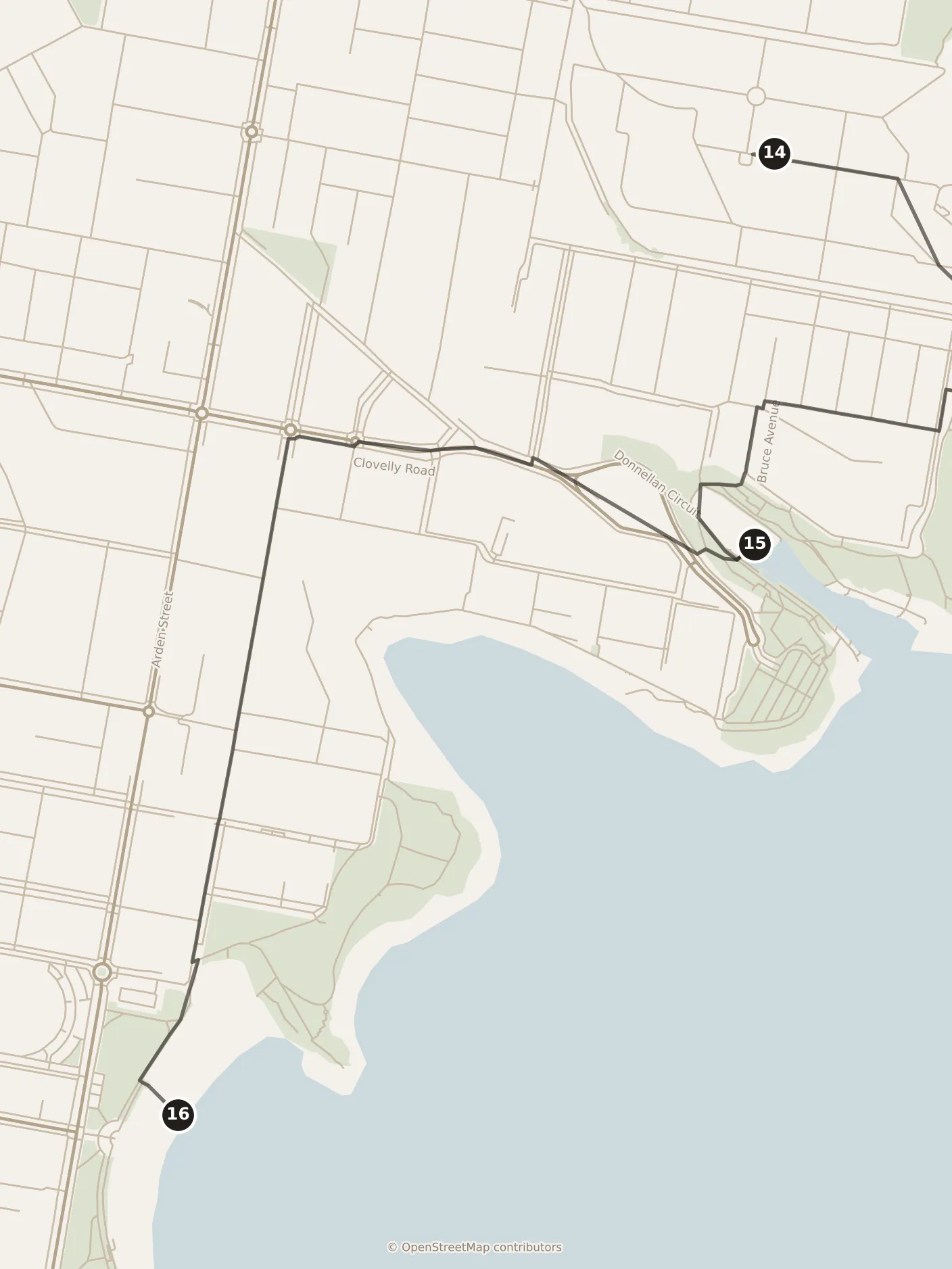
- Afternoon
- 14Waverley Cemetery
- 15Clovelly Beach
- 16Coogee Beach
Today is one path: the coastal walk from Bondi to Coogee, six kilometers of it, published as two to three hours depending on how often you stop. The leg times below come to about an hour and a half of actual walking, and everything else is the stopping, which is the point.
Two ways out, and the hour you leave decides between them. The 333 starts at Circular Quay and runs up Elizabeth Street, out along Oxford Street and down Bondi Road to the beach, one vehicle from end to end, and it is the better of the two early. The alternative is the T4 to Bondi Junction, which is the end of that line, then one of the buses down the hill from the interchange above the station. The train wins whenever Oxford Street is solid, which is most of the middle of the day, so if the morning is well under way when you leave, take the train and change.
This day’s count runs backwards and it gives a latest start rather than a start, because what matters is finishing in daylight — the path between the beaches is a clifftop with steps and no lighting at all, and the last two headlands are the worst of it in the dark. From standing on Bondi’s sand to standing on Coogee’s is about five and a half hours as written. In the first week of June that means being on the sand by twenty past eleven; drop the two swims, as June does anyway, and it comes down to a little over four and a quarter hours and about half past twelve. In the first week of January the same sum gives a latest start of twenty to three, which is not advice — it is the margin that lets you get into the water three times instead of once.
Morning
Bondi is a wide crescent with a serious break on it and a promenade behind, and the first thing worth doing is nothing: three quarters of an hour on the sand before you walk anywhere. Which end you sit at is a matter of taste; which water you get into is not. Swim between the red and yellow flags, and if there are no flags up, do not swim. They mark the stretch the lifesavers are actually watching, they are moved during the day as the conditions move, and they come down when the patrol ends. On an open ocean beach this is not a formality. It is one of two things on today that are about safety rather than manners, and the other is the sun: a hat and sunscreen belong in the bag before you leave the room, because the second half of this walk has almost no shade and the ultraviolet here is not the ultraviolet of a European summer. The parent city guide carries the same warning; this page repeats it once, here, because here is where it starts to matter.
Ten minutes along the sand and up the steps at the southern end is the Bondi Icebergs pool, cut into the rock shelf, where the club has swum through the winter since 1929. It is open to anyone for a small charge at the door, the water is the sea and is not heated, and the waves break over the end of it, which is most of the appeal. Three quarters of an hour, counting getting changed. It closed on Thursdays for cleaning in 2026, with an exception in the summer season when the tides allow, so if your coast day is a Thursday check the club’s own published pool hours before you build a swim into the morning — and if it is shut, take the swim at Bronte instead, a third of the way along this same path, where the pool is free.
Ten minutes more, climbing onto the headland, is Marks Park at Mackenzies Point. There are Aboriginal engravings cut into the flat sandstone up here, reckoned at around two thousand years old, and they are not laid out for you: people walk over them. Keep off the engraved surfaces and go round them — the same thing the cemetery boardwalk asks of you later today, and for the same reason. Spend a few minutes looking at the rock rather than at the view. Fifteen minutes, and the view back north over the whole of Bondi is the best one of the day.
Twelve minutes on is Tamarama, one of the smallest strips of sand in the state, wedged between two headlands, known locally as Glamarama and with a hard reputation on this coast: the bottom shelves away fast and the rips run strong. The rule from Bondi holds here and holds harder — if the flags are up, swim between them and nowhere else; if they are not, do not swim at all. Ten minutes. For three weeks in late spring the stretch between Bondi and Bronte carries an outdoor sculpture exhibition, free, as it has every year since 1997; when it is on, this part of the path is a crowd rather than a walk. Two honest options and no third: accept it, because the sculptures are why most of those people are there and they are good, or reverse the whole day — the 373 or 374 out to Coogee in the morning, walk north, and the 333 home from Bondi — which takes the crowded two kilometers late in the afternoon when it thins. The count and the light work identically in that direction.
Ten minutes further the path drops into Bronte, which has a park of big old pines behind the sand and a row of places to eat along the back of it. Lunch here, an hour, and you are a third of the way along the path and almost exactly halfway through the day.
Afternoon
Bronte has two swims and they are different things. There is a proper swimming pool cut into the rock at the southern end of the beach, where the overarm stroke that became the Australian crawl was first seen in 1899; and the Bogey Hole, further along the same shelf, a shallow scoop the sea washes through, its name from an Aboriginal word for a swimming place, the present one cut artificially in the early twentieth century after the natural one was destroyed. Half an hour covers whichever you choose. Both are free.
Local tip. If you are only getting into the water once today, take it here rather than at Bondi. The pool at Bondi costs something and closes one day a week; this one costs nothing, it is a third of the way into the walk rather than at the start of it, and you have earned it by the time you reach it. Bondi’s is the better photograph and this is the better swim.
If the day is short, the cut is the first swim and then the second — three quarters of an hour at Bondi and half an hour at Bronte, which is exactly the seventy-five minutes the arithmetic above already prices. What cannot be cut is the cemetery, because the boardwalk through it is the path: stopping in it costs twenty minutes and skipping it saves only those twenty.
A quarter of an hour south, and it climbs, the path runs into Waverley Cemetery, on a clifftop above the Pacific, opened on 1 August 1877 and one of the strangest pieces of ground in the city — white marble, Celtic crosses, iron railings, and nothing beyond the last row but the ocean. Henry Lawson is buried here. The way through is a raised boardwalk, built after coastal erosion in 2016 closed the old cliff-edge line, and it exists precisely so that the walk does not run over the graves; stay on it. This is a working cemetery with funerals in it. Twenty minutes.
Twelve minutes on is Clovelly, which is not really a beach: a narrow inlet with concrete terraces built down both sides to the water, so people lie on the concrete and swim up the middle of the channel. It is the calmest water on the whole route and it is where you would take somebody who does not like surf. A quarter of an hour. Twelve minutes further is Gordons Bay, a rocky cove with boats pulled up on it and an underwater trail six hundred meters long laid out on the seabed for divers, which is why there are always more people here in wetsuits than in swimming costumes; you pass above it rather than stopping.
Twelve minutes more and the path comes down into Coogee, a proper bay with a low island offshore called Wedding Cake Island that breaks the swell, which is why this water is gentler than Bondi’s. There are ocean baths cut into the rocks at the southern end, one of them reserved for women and children and run that way for well over a century; they take a small charge and they are not on the route as written. Fish and fries on the grass above the sand is the right end to this day.
Evening
The bus stand is on Arden Street beside the beach, and there are two useful answers from it. The 373 runs to Museum station by way of Taylor Square: get off at the square and you are at the top of the Darlinghurst and Surry Hills streets, which is where this day should end — small restaurants and bars on a grid of terraced streets, and as far from a beach as this city’s center gets. The 374 goes to Central instead, which is the answer if you are sleeping near it. If both are away, the 313 runs to Bondi Junction station and the T4 runs from there.
With a third day

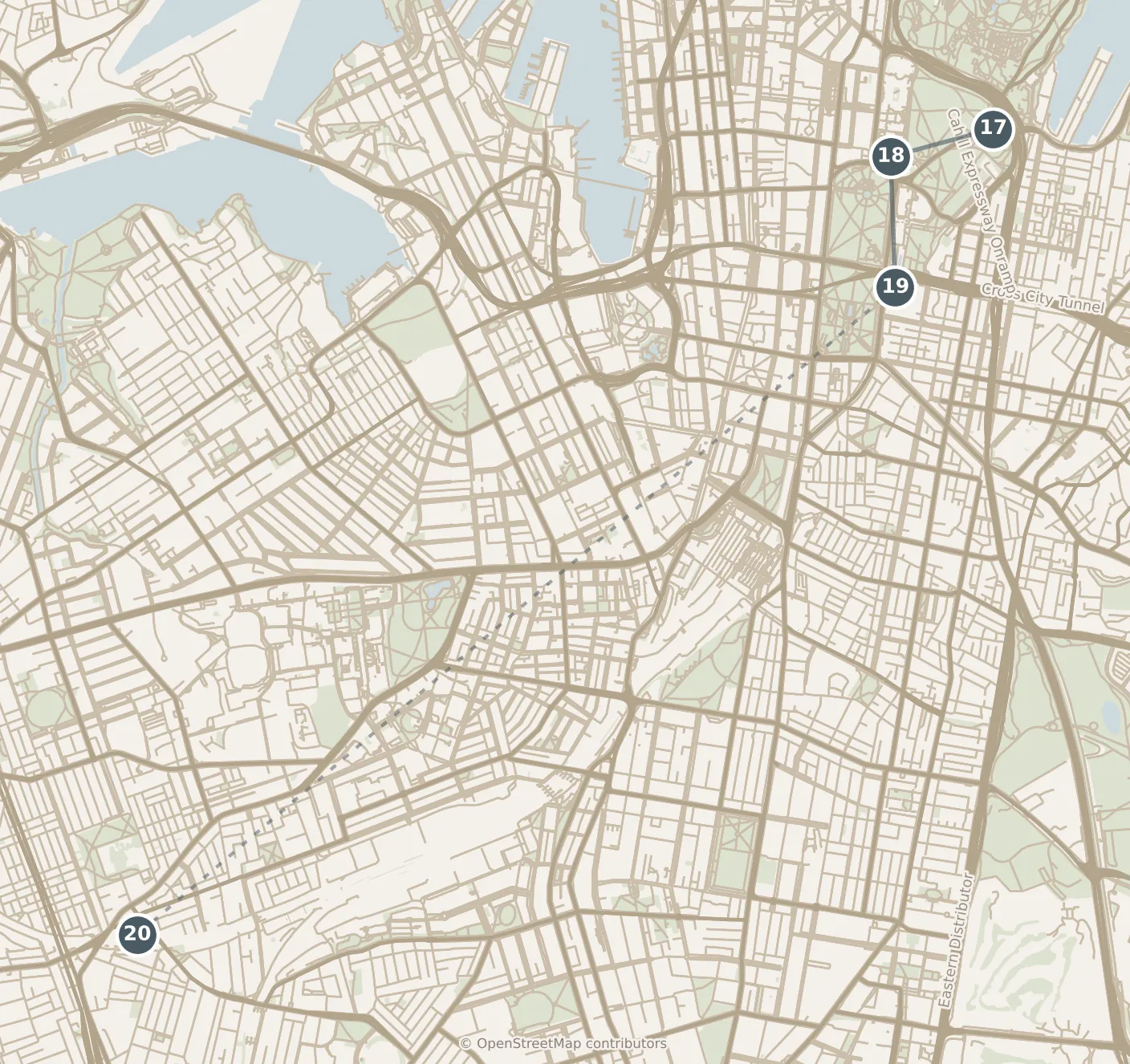
- With a third day
- 17Art Gallery of New South Wales
- 18Hyde Park Barracks
- 19Australian Museum
- 20Newtown
A third day goes in the middle, as a new day two, and the coast moves to day three. Nothing on day one changes at all.
It goes in the middle rather than on the end because it is the only one of the three with no weather in it: everything on it is indoors apart from about three quarters of an hour of walking between the doors and half an hour sitting in a park, so it is the day to put on the worst forecast you have, and second is the position from which it can trade places with either of the others. Two things do not move with it. Day one holds the only booking in the article, so once the tour is booked day one is pinned to a date and it is the museum day that shifts around it. And the two evenings are written to be different places on purpose — the coast day ends in Darlinghurst and Surry Hills, the museum day ends in Newtown — so swapping those two would give you the same three streets twice.
What the day buys is the half of this city neither of the others touches: what happened here before the harbor was pretty, and what has been made of it since. It has no hinge in it, no view that wants an hour of the day and no boat to catch, so the count runs forwards from the opening rather than backwards from anything. The gallery, the barracks and the museum all opened at ten in 2026, and all three shut at five, which makes this the one day of the three with a hard frame round it: start at ten, because nothing lets you in earlier, and build forward. One exception is worth knowing because it changes the order — the gallery stayed open until ten on Wednesdays in 2026. If your museum day is a Wednesday, invert it: barracks first, museum second, gallery last and unhurried, and the two hours the gallery is held to below can be three or four, out of a day that otherwise ends at five. If the hours have moved, the method holds — whichever of the three keeps the longest day goes last.
Walk out from Circular Quay through the Domain, twenty minutes, to the Art Gallery of New South Wales. General entry is free. It is two buildings now: the 1890s sandstone one, renamed Naala Nura, whose Grand Courts hold the Australian and European painting; and Naala Badu, a set of glass-walled pavilions stepping down the slope, opened on 2 December 2022 to a design by a Japanese practice, holding the contemporary and First Nations collections. Underneath Naala Badu is the reason to come: the Tank, a decommissioned naval oil bunker of the Second World War, a wide low room of bare concrete on a forest of round columns, dark except for whatever is put in it. There is nothing else like it in the country and it is easy to miss, because you have to go down to reach it. Two hours for the whole site, which means choosing: take Naala Badu and the Tank and one of the Grand Courts, rather than a lap of everything.
Nine minutes west across the Domain is Hyde Park Barracks, and this is the stop that justifies the day. A plain three-story brick building of 1817 to 1819, designed by Francis Greenway, who was himself a transported convict, to hold six hundred convict men, and at its worst holding fourteen hundred. Then a depot for immigrant women, then an asylum for destitute ones, then government offices and courts. It has been on the World Heritage list since July 2010 as one of eleven Australian convict sites, entry is free, and what it does well is refuse to be a display of objects: the rooms are largely empty, the hammocks are strung as they were, and the sound is doing most of the work. An hour, and it is the hour of the three days that stays with you. Lunch after it, an hour, in the streets immediately west.
Ten minutes south down College Street is the Australian Museum, founded in 1827, the oldest museum in Australia and free since a rebuild finished in 2020. Skip most of the temporary exhibitions and give the time to two things: the long gallery upstairs, two hundred objects chosen as the collection’s treasures and shown in a nineteenth-century room that is itself one of them, and the sea-country gallery of Aboriginal and Torres Strait Islander material, which is organized around a coastline rather than around a museum category. The dinosaurs are genuinely good and the children in front of them will tell you so. An hour and a half. If today has run short this is the stop that goes, and it buys back that hour and a half exactly where you need it: it is a natural history museum, and there is a version of one where you live, whereas there is not another convict barracks anywhere.
Then cross into Hyde Park, sit under the fig avenue for half an hour with a coffee and a lamington, and walk on to Museum station at the park’s southern corner — eight minutes for the two together. A T2 train from there runs out to Newtown, and King Street is the evening: a long straight run of second-hand bookshops, pub bands, Thai and Vietnamese kitchens and very little arranged for visitors. It is the least harbor-like place in this article, which after two days of water is exactly why it is here.
The whole of it, walks and a sitting lunch included, comes to about six and a half hours from the gallery door, so a ten o’clock start has you inside the last museum well before it closes. That count leaves out the twenty minutes it takes to walk out from the quay in the first place, and it leaves out lines at two free doors that do not usually have them.
The other third day, and why it is not this one. Everybody asks about the Blue Mountains, and the answer is that it is a real plan and it is not this trip’s. The Blue Mountains Line runs from Central out to Lithgow; Katoomba is a hundred and ten kilometers along it, about two hours each way, with a local bus from the station out to Echo Point and the cliff walks. That is four hours of train and a whole day gone, it cannot be combined with anything else, and it replaces this museum day outright rather than adding to it. With three days in a city you have not seen, it is the wrong trade. With a week, or on a second visit, it is the right one.
Practicalities
Book one thing and only one, and book it as soon as you have dates: the guided hour inside the Opera House, on the house’s own site. Everything else across all three days is either free or bought at the door on the day.
The closures, and the method rather than the answer. Two stops here keep a day a week and they pull in opposite directions, so read this before you assign your days. The observatory building on the hill opened Thursday to Sunday in 2026, which wants day one late in the week; the ocean pool at the south end of Bondi closed on Thursdays for cleaning in 2026, which wants the coast day on any other day. Both publish their own hours, and both are worth two minutes the week before. Neither is load-bearing, which is the useful part: if the observatory is shut, the hill it stands on is a public park with the same view and no gate, and day one loses an interior and nothing else; if the pool is shut, the Bronte baths a third of the way along the same path cost nothing, and their own weekly clean falls on a Wednesday rather than a Thursday, so the two closures never land on the same day. The museum day takes any weekday, and Wednesday is its best because of the late opening — a bonus, not a requirement.
So the shorthand, with three days, is the harbor on a Thursday, the museums on the Friday, the coast on the Saturday: that satisfies the observatory’s window, keeps the coast off a Thursday, and puts the arrival day on the one that starts and ends in the middle of town. It also puts the coast on a Saturday, which is the day that path carries the whole city rather than only its visitors: if a crowd costs you more than a closed observatory does, walk the coast in reverse — out to Coogee first, north to Bondi — which is the trick the sculpture weeks already ask for, and it works here for the same reason. If your dates hand you a Wednesday, the better arrangement is museums on the Wednesday, harbor on the Thursday, coast on the Friday, which adds the gallery’s late evening. But the shorthand is not the point, because it compresses a trap: a Monday-to-Wednesday visit never gets inside the observatory at all, in any order. That is not a reason to rearrange anything — the hill is the stop and the building is the bonus — and it is one of two places where the rules above genuinely cannot both hold. The other is the bag against the day order: every arrangement here ends on the coast, so a visit that flies out on its last day takes the coast as its departure day, and the trade for that one is at the top of this page. If you land on a Monday and want to start straight away, the bag rule wins over the observatory’s window: take the harbor on your arrival day and accept a closed door on the hill.
Rain. Day one survives it badly and day two does not survive it at all — the coast path is exposed for its whole length and the reason to be on it is the water. With three days this is what the middle day is for: move it onto the wet one. With two days and a wet second, bring the third day forward wholesale rather than improvising. It is written to be done indoors, it starts twenty minutes’ walk from Circular Quay through the Domain, and it costs nothing, so a lost coast day costs you the walk rather than the money. Save the coast for the next visit; a gray Bondi is worse than no Bondi.
Getting between the stops. Day one is walked in full after the metro, and its longest stretches are the two quarter-hours either side of the Opera House — out round the cove and back to the foot of the Argyle Stairs. Day two is one continuous path, and its longest leg is the quarter of an hour from Bronte up to the cemetery, which also climbs the most; the whole six kilometers has steps at every headland and is no route for wheels or for a case. The third day’s longest walk is the twenty minutes out from the quay at the start of it. The only rides on the route as written are the metro to Barangaroo, the 333 out to Bondi — or the T4 and a bus down the hill, if you leave late enough for Oxford Street to be solid — the 373 or 374 back from Coogee, and the T2 out to Newtown, and every one of them takes the same tap.


