Sydney in one day: the bridge on foot, the harbor walk, and the ferry to Manly

Last updated 4 August 2026
Overview
Sydney is a hard city to do in a day and an easy one to do in a day badly, and the reason is the same in both cases: the things people come for are genuinely far apart. The beaches are half an hour east of the center, the inner suburbs are a train ride south, and a day spent joining them up is a day spent on buses. The way out is to refuse the whole problem. Every stop below is within sight of salt water, the longest walk on the route is the bridge itself, and two of the moves between stops are made sitting on a boat with the harbor going past — which is not a compromise, because on this particular harbor the transport is one of the sights.
What one day costs you here is Bondi and the coastal walk, and the museums and galleries along with them. Bondi is the harder loss to accept and the easier one to justify: there is no train to it, so it is a bus at each end of a beach afternoon, and it does not sit on anything else you would want to do. Manly gives you the same ocean and the same surf and puts a half-hour ferry ride in front of it, and that ride is the best thing on this list. Take Manly, and come back for Bondi another year.
The day is built around the light, and specifically around the crossing back from Manly, when the city comes up out of the water in front of the boat. The sun sets here at just before five in the depths of June and not until a little after eight around the turn of the year, so take your own month’s hour and count back. Everything above that crossing — the lanes of The Rocks, the bridge, lunch, the garden walk, the ferry out and an hour and a half of Manly — comes to about seven and a half hours. In June that means being at Circular Quay by half past nine in the morning; at the height of summer the same sum says you could start at half past twelve, which is not permission to lie in but permission to give the extra hours to the beach. The count models the time you spend in the places and on the water and nothing else: you are waiting for a timetabled boat twice on this route, and neither wait is in it.
This day begins and ends within a hundred meters of the same spot, so whatever you decide to do with a bag, you do it once and collect it where you left it. Circular Quay is a wharf and a small elevated station; the interchange where luggage questions get answered is Central, three stops away either way round the City Circle. Two parts of the route are genuinely poor with luggage — the bridge, which has a long flight of stairs at each end and two hundred more if you go up inside the pylon, and Manly, which is a beach at the far end of a boat ride.
The day

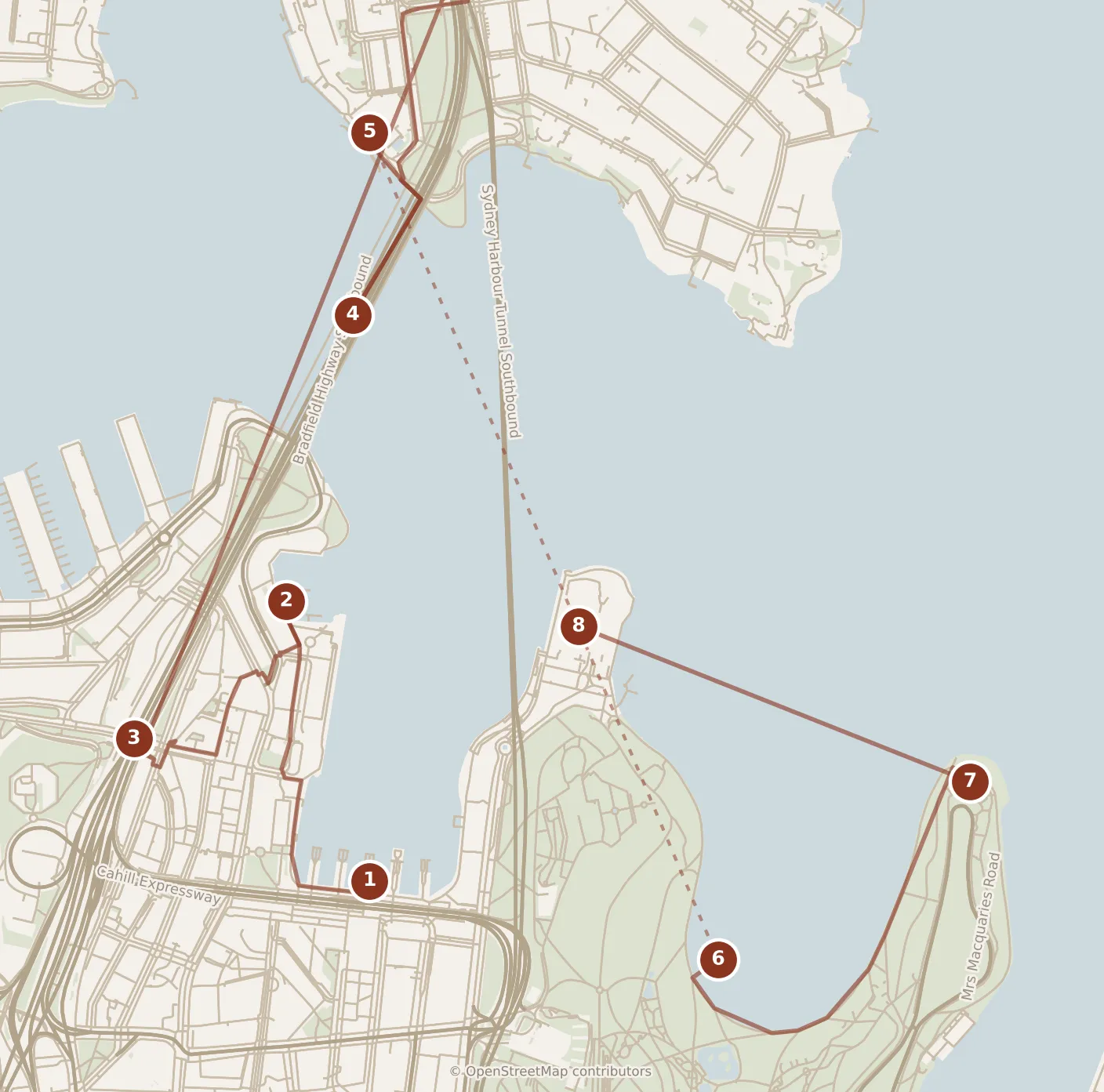
- Morning and afternoon
- 1Circular Quay
- 2The Rocks
- 3Argyle Cut
- 4Sydney Harbour Bridge
- 5Milsons Point ferry wharf
- 6Royal Botanic Garden
- 7Mrs Macquarie's Chair
- 8Sydney Opera House
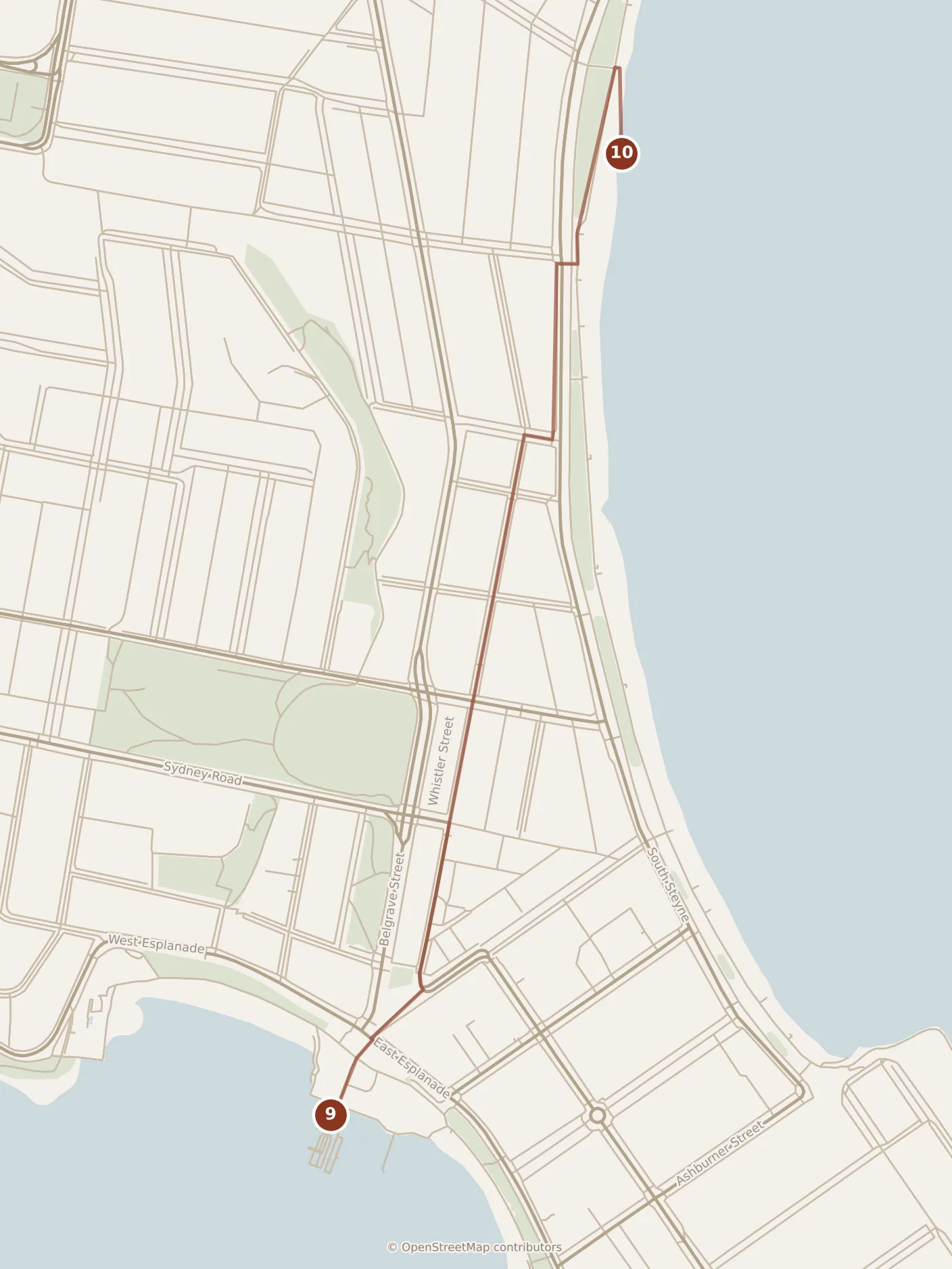
- Evening
- 9Manly ferry wharf
- 10Manly Beach
- Shelly Beach — in the prose, not on the map
Morning
Start at Circular Quay, which is where every version of this day has to start: the ferry wharves are numbered along the water, the trains run on a viaduct directly above them, and the airport line, the T8, calls here, so if you have come straight from a morning flight you can be standing on this quay without changing platforms. Walk north-west along the water with the wharves on your right and in five minutes the glass stops and the sandstone begins.
The Rocks is the oldest built-up ground in the city and the one part of the center that still reads as a nineteenth-century port — stepped lanes, cut-stone warehouses, terraces on a slope steep enough that some streets are stairs. Give it three quarters of an hour and walk it rather than read it: up off George Street into the lanes, then west along Argyle Street to the Argyle Cut, a canyon hacked straight through the sandstone ridge by convict gangs with hand tools from the 1840s, abandoned half-finished, and completed with explosives by the city council in 1859. You walk through it under the bridges that carry the streets above, and the tool marks are still on the walls.
From the Cut, climb back east to the stairs at Cumberland Street and Gloucester Street, which are the way up onto the bridge. The footway is on the eastern side, it is free, there is no ticket and no gate, and the crossing takes a little over twenty minutes from the stairs at this end to the far side. It is worth knowing what you are standing on: a single steel arch opened in 1932, and the four granite-faced pylons at the corners hold nothing up at all — they were added because a bare steel arch was thought to need reassuring. One of them, the south-eastern, has a lookout inside it, about two hundred steps up from the walkway you are already on; it has a ticket desk, and it belongs in this half of the day, because the second half is spent on the water. The guided climb over the arch itself is a separate, booked and expensive thing, and it is not on this route.
The footway comes down at Kirribilli, and Milsons Point ferry wharf is six or seven minutes west of the bottom of the stairs, under the grinning painted face of the old funfair. The F4 calls there all day on its way to Circular Quay and the F3 only in peak hours, so mid-morning there is one boat rather than two; Milsons Point station is the same distance away and one stop from Wynyard on the T1, and Wynyard is then one more stop on a City Circle train to the Quay, or a thirteen-minute walk down to it, so the boat is the tidier of the two.
Local tip. Cross the bridge once, not twice. Both the wharf and the station at the northern end will bring you back to the Quay, and the walk back is the same view seen over the other railing. The twenty minutes or so it saves is the difference between eating lunch sitting down and eating it standing up, which in this city is not a small difference.
Afternoon
Eat at the Quay or just behind it, and eat seafood: Sydney rock oysters are the thing to order here, small and hard-shelled and sold by the dozen, and they are grown in the estuaries up and down this coast rather than shipped in. Allow an hour, because the afternoon that follows has no seats in it.
Then walk east past the Opera House — past it, not into it; it will still be there — and keep going along the water into the Royal Botanic Garden. It is free, it is open every day, and it was laid out in 1816 on the ground where the colony had already tried and failed to farm, which is why the bay it curls around is called Farm Cove. Give it three quarters of an hour and stay on the harbor-edge path rather than working through the collections: the point of this garden, for a visitor with one day, is that it puts the water, the trees and the absence of traffic in the same place. Ten minutes further round the cove the lawns run out onto a rock platform at Mrs Macquarie’s Chair, a bench cut into the sandstone by convicts early in the 1810s for Elizabeth Macquarie, the governor’s wife, who is supposed to have sat there watching for ships. From the rock the Opera House and the bridge stack up behind one another in a single view, and that is the whole reason for walking out to a dead end. Twenty minutes is enough. The chair sits in the Domain, which is open ground rather than fenced garden, so it can be reached even when the garden gates are shut.
Walk back the way you came — a quarter of an hour along the same waterfront, which is not a penance, because a point is a dead end and this is the price of going out to it — and this time stop at the Sydney Opera House. Half an hour on the podium is the right amount. Get close enough to touch: what looks white from across the harbor is more than a million tiles in two finishes, glossy and matt, laid in chevrons, and the whole thing is a duller cream in the flesh than in any photograph of it. Walk right round the building at water level; the podium is public, free and open, and Jørn Utzon’s shells make more sense from underneath than from the famous angle. The promontory it stands on, Bennelong Point, held a tram depot until the 1950s. Then back along the water to the ferry wharves, ten minutes.
Evening
The F1 to Manly leaves Circular Quay from Wharf 3, takes twenty-five to thirty minutes, and is paid for with the same tap as a bus. Sit outside and at the back on the way out, so that the bridge and the Opera House stay in front of you as they shrink. The last stretch, where the boat crosses the open water inside the harbor mouth with the heads off to starboard, is the only unsheltered part of this route and it meets whatever the ocean is pushing in that afternoon; if you are a poor sailor, that is the ten minutes to know about in advance.
Manly ferry wharf lands you on a harbor beach — calm, shallow, no surf at all — and the ocean is on the other side of the peninsula. The Corso runs straight across from one to the other, a pedestrian street of about ten minutes with the water visible at the end of it, and Manly Beach is what you came for: a long open ocean beach with a proper break on it, Norfolk Island pines in a row along the promenade, and none of the cliff-top staginess of the eastern beaches. Swim between the red and yellow flags, and if there are no flags up, do not swim. They mark the patrolled stretch, they move during the day with the conditions, and they come down when the patrol ends — which on an ocean beach in the last of the light is exactly when this route gets you here. An hour and a half is the honest allowance — enough to swim, dry off and walk. If the light is still holding, take the footpath south from the end of the beach, which runs round the rocks above the water for twenty minutes to Shelly Beach, a small cove tucked in behind a headland and out of the swell, which is why people snorkel there and not at Manly. In June, when the day is short, skip it; the crossing back matters more.
Then walk back down the Corso and get on the boat. This is the stop the whole day is built around and the reason the arithmetic in the overview is worth doing: the run in from Manly with the light going takes you down the length of the harbor towards a skyline that is switching itself on, with the bridge growing across the middle of it — and it costs the same tap as a bus. Stand outside, at the front. You land back at Circular Quay, where you started, with the trains overhead: the T8 runs from the platform above the wharves back to the airport terminals — though not every T8 does, because many services run via Sydenham instead, so check the indicator says via the Airport. Central, for anything longer distance, is three stops away round the City Circle in either direction, about six minutes.
Practicalities
Nothing on this route has to be booked, and that is worth stating plainly, because it is unusual: the day’s entire content — The Rocks, the Argyle Cut, the bridge deck, the garden, the point, the Opera House podium and both beaches — is free. What you do need is one thing, and it is the same thing all day: a contactless bank card or phone, or an Opal card, tapped on and off at the station gates and at the ferry wharves. The two ferry legs, and any train you take, all run on that single tap. How the fares and caps work is the parent city guide’s business, not this page’s, but if you arrive holding nothing, that tap is the one thing to sort out before you walk anywhere. The only paid option on the route is the lookout inside the bridge pylon, where tickets are sold at the door subject to availability, though booking online guarantees a slot.
This route has no weekly closure to plan around, which is the quiet reason it works as a single day: streets, a public deck, a garden open every day of the year, a podium and two beaches close for nobody. The one gate on the whole day belongs to the Royal Botanic Garden, and it is the reason the harbor walk sits in the middle of the day rather than at the end of it — in 2026 the garden was shutting at five in June and July and not until eight at the height of summer, so an evening version of this walk arrives at a locked gate for half the year. Build the day the way it is written above; if you find the hours have moved, the rule that survives the change is simply that the garden goes on whichever side of the day it is open, and the Opera House podium, which has no gate at all, is the part that can be left for the dark.
Distances, since this is a route you walk: the longest single stretch is the bridge, a little over twenty minutes of deck plus the stairs at each end, and after that the optional path round the rocks to Shelly Beach, which is twenty. In the center nothing is more than a quarter of an hour from the last thing — the longest is the walk back from Mrs Macquarie’s Chair to the Opera House, fifteen minutes — and at Manly the Corso is ten. If you are doing this in summer, bring swimming things and something to carry a wet towel in, because the last three hours of the day are a beach and there is nowhere on this route to go back for them.


