Strasbourg in two or three days: the cathedral, the island and the German town

Last updated 7 October 2026
Overview
Strasbourg’s old center is an island. The Ill divides around the Grande Île, and most of what a first visit wants sits on it or a few minutes from its banks, so two days here are spent almost entirely on foot. The island was listed by UNESCO in 1988; in 2017 the listing was extended across the water to the Neustadt, the town the German administration built after 1871. That extension is the shape of this trip. Day one is the cathedral and the eastern half of the island. Day two crosses into the Neustadt in the morning and comes back through Petite France in the afternoon, finishing a quarter of an hour’s walk from the station. A third day goes out to the European institutions and the park opposite them, and then sees the city from the river.
Day one is the day built around an hour: the cathedral’s astronomical clock performs once a day, and everything in the morning is arranged backwards from it. Day two has no hour it must hit. The third day rests on a boat departure you book yourself, so you choose its hinge.
One thing decides which day is which. The city-run museums on this route do not share a closing day: the Musée de l’Œuvre Notre-Dame closes on Mondays, and the three museums in Palais Rohan close on Tuesdays. Day one carries both, so it wants a day that is neither; if your first day is a Monday or a Tuesday, swap days one and two. The swap is not free: day one is arranged to show you the island before you walk off it, and day two assumes you already know where the cathedral is. It is still the trade to make. A Sunday morning raises the same question for the cathedral, which is a working church and gives the morning to its services; read the cathedral’s own published visiting times for that day, and if the clock does not fit, swap the days for that reason too.
In December the island holds the Christkindelsmärik, a Christmas market the city dates to 1570. It is spread across the squares of the Grande Île, and in recent years the bridges onto the island have had security checks while it runs. Everything below still works, but give every walk on the island more time than it says, book the boat well before you arrive, and buy the clock ticket first thing on the morning itself.
Day one

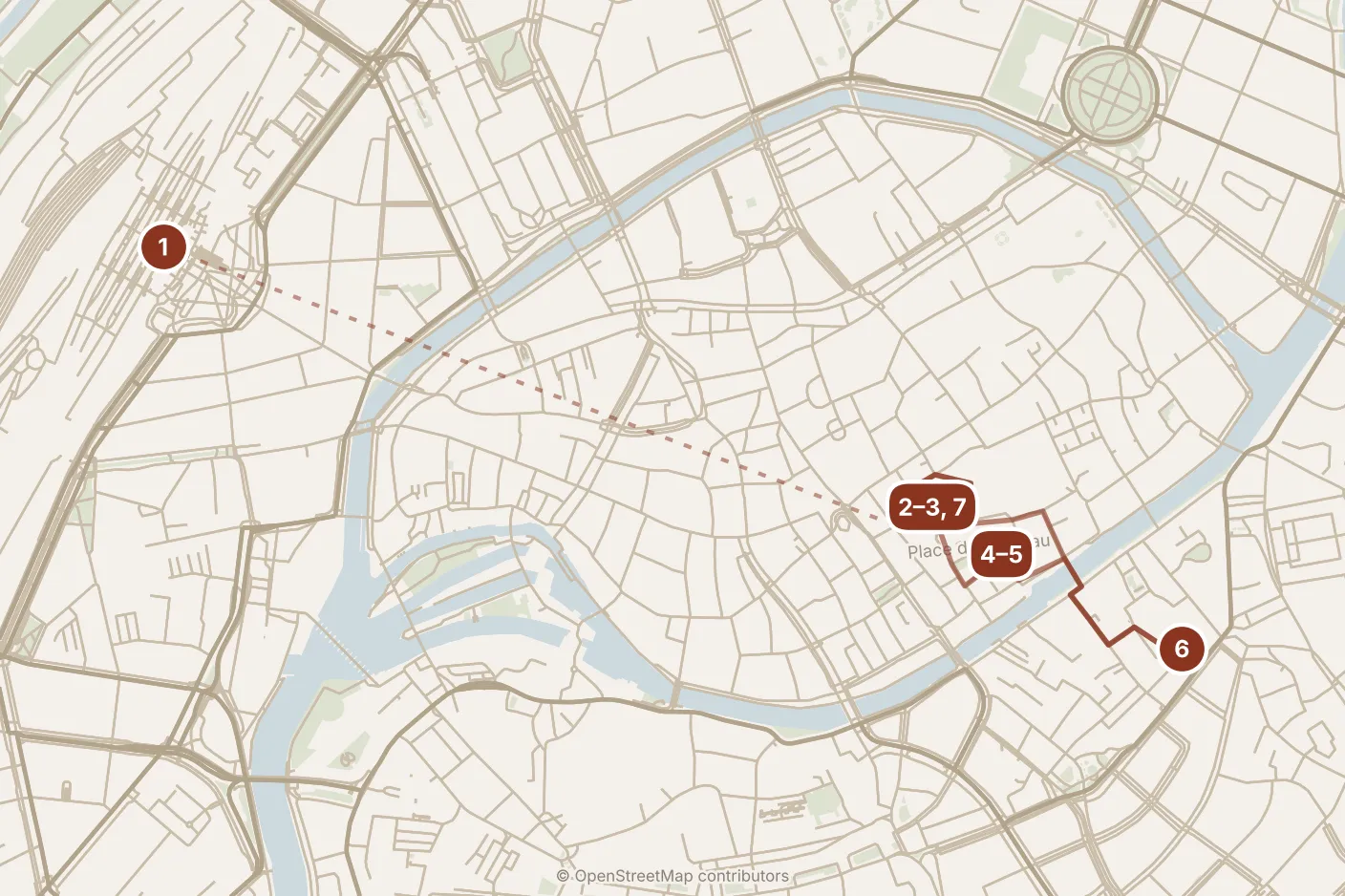
- Day one
- 1Strasbourg-Ville station
- 2Rue Mercière
- 3Cathédrale Notre-Dame
- 4Musée de l'Œuvre Notre-Dame
- 5Palais Rohan
- 6Krutenau
- 7Place de la Cathédrale
Everything today is within a few hundred meters of the cathedral, and that is the point of doing it first: by the evening you will know the island well enough to stop looking at the map.
Morning
Trains arrive at Strasbourg-Ville, the main station, a nineteenth-century front now wrapped in a glass shell. Beneath the forecourt is the underground tram stop, Gare Centrale. Lines A and D both run from there three stops to Langstross-Grand’Rue, and from that stop it is about eight minutes on foot, through Place Gutenberg and up Rue Mercière, to the cathedral. Walking the whole way from the station takes about twenty-five minutes. If you are carrying luggage, leave it where you are staying before you start: the first thing this morning is a stair of some 330 steps.
Rue Mercière is the approach to take, because it is narrow and straight and it frames the west front of the Cathédrale Notre-Dame so that it fills the end of the street. The building is pink sandstone from the Vosges, and the front is covered in a screen of free-standing stone rods set proud of the wall, like the strings of a harp. There is only one spire; the second was never built. At 142 meters that spire made this the tallest building in the world from 1647 until 1874.
Climb first. The platform at 66 meters, reached by those steps, has its own door outside the church and its own ticket, and from it the roofs of the island lie flat beneath you with, on a clear day, the Vosges on one horizon and the Black Forest in Germany on the other. Give the climb and the view forty-five minutes.
Before you climb, though, buy the ticket for the clock. It is sold at the cathedral itself, the places are limited, and in summer and December they go: ask for it the moment you arrive.
Then a minute across Place du Château to the Musée de l’Œuvre Notre-Dame, in the houses of the Œuvre Notre-Dame, the foundation that has looked after the cathedral since the Middle Ages. This is where the originals of the cathedral’s sculpture ended up, and the pair to find is Ecclesia and Synagoga, the two women — the church triumphant and the synagogue blindfolded — that stand at the cathedral’s south door as copies. The museum also holds medieval drawings for the façade on parchment, among the oldest architectural drawings to survive anywhere. Give it an hour and a quarter. If the morning is running late, the sculpture rooms and the drawings are the reason to come, and the rest can go.
The clock is the stop this day is built around. In 2026 its show opened with a film at noon and the procession ran at half past twelve, and from Monday to Saturday the nave is kept for ticket-holders around it. So work backwards. You want to be at the south door on Place du Château with your ticket by half past eleven; above that sit forty-five minutes for the platform and an hour and a quarter for the museum, two hours together, which puts you at the foot of the west front by half past nine at the latest. If the hour has moved, count back the same two hours from the new one. The count does not include the line for the platform stair, which in summer can be the longest single wait of the trip, and nobody can tell you how long it will be on your day — if it is long, do the museum first and climb after lunch.
The astronomical clock itself is a mechanism of the 1840s by Jean-Baptiste Schwilgué, built inside a much older painted case. At the procession the apostles file past Christ and a gilded cock flaps and crows; the rest of the day, figures of the ages of life strike the quarters and Death strikes the hours. Beside it stands the Pillar of Angels, a thirteenth-century column carved with figures of the Last Judgment in tiers, and it is worth more of your time than the clock is. When the procession ends, give the nave half an hour: the stone pulpit Hans Hammer carved in 1485, the medieval glass, and the great rose seen from inside.
Local tip. Buy the clock ticket before you climb, not after. The climb and the museum can move around each other; the clock is the one thing this morning that happens once, and the ticket is the only part of the day that can run out.
Afternoon
Lunch first, and not on the cathedral square, where the terraces cost the most and look at the same thing as the ones a street away. Keep it light; the tarte flambée is for this evening, when more of the ovens are fired.
Then cross Place du Château to Palais Rohan, the bishops’ palace built in the 1730s for the Cardinal de Rohan to designs by Robert de Cotte, standing between the cathedral and the river. It holds three museums, and two days do not have room for all of them. Take the state apartments of the Arts décoratifs on the first floor first: the rooms are the palace as it was furnished, and the same museum keeps the faience of the Hannong workshops, the painted ceramics this city made in the eighteenth century. Give that an hour. Upstairs, the Beaux-Arts is a broad collection of European painting whose most local picture is Largillière’s portrait known as the Belle Strasbourgeoise, a woman in an enormous black hat; give it another hour if you still have the appetite. Skip the archaeology in the basement on a trip this short.
Evening
Leave the palace by the river side and follow the quay east for about eight minutes into Krutenau, the old quarter across the water from the island, once boatmen and market gardeners, now students. Its restaurants and bars are where students and residents eat and drink, and it is not built for visitors, which is the reason to go. This is the evening for tarte flambée, the thin Alsatian bread spread with cream, onion and bacon and baked fast.
After dinner, walk back to Place de la Cathédrale, about eleven minutes. With the light gone and the groups gone the west front is lit and the square is close to empty, and it is the same façade you saw this morning made into a different object.
Day two

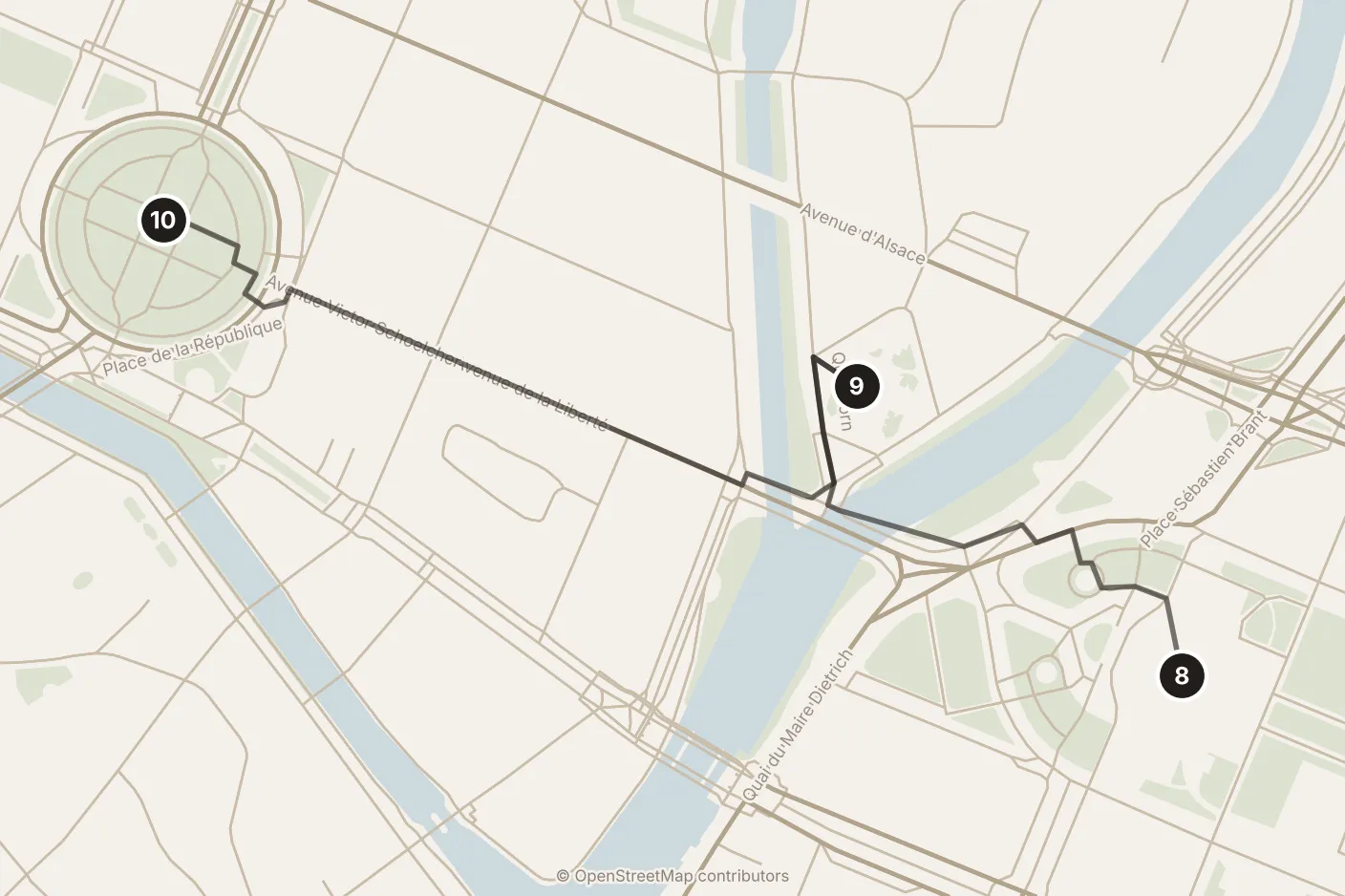
- Morning
- 8Palais Universitaire
- 9Église Saint-Paul
- 10Place de la République
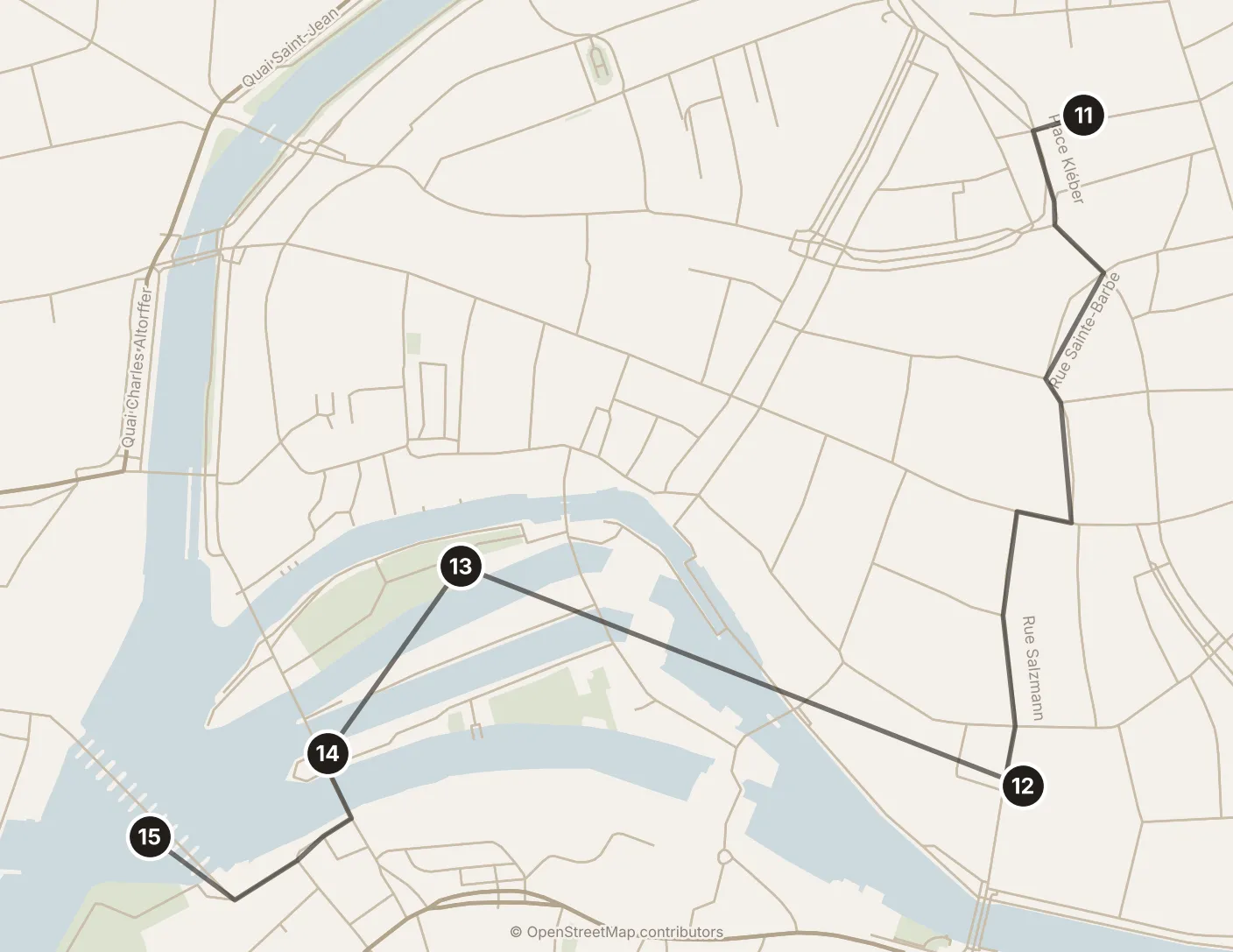
- Afternoon
- 11Place Kléber
- 12Église Saint-Thomas
- 13Petite France
- 14Ponts Couverts
- 15Barrage Vauban
Today crosses the river twice: north-east into the German town in the morning, back onto the island for lunch, and west through Petite France in the afternoon, so that the day ends a quarter of an hour from the station. Nothing on it depends on an hour. The one argument about time is that Petite France is at its most crowded in the middle of the day, which is why it comes second; start the morning whenever suits you, but before ten gives the Neustadt the unhurried pace it rewards.
Morning
From Place de la Cathédrale it is about seventeen minutes on foot east across the Ill to the Palais Universitaire, the university building the German administration raised in the 1880s as a statement of what the new town was for. The front is a long sandstone palace lined with statues of scholars; in front of it, Goethe, who studied here as a young man, stands in bronze. Give the outside twenty minutes; it is a working university and the building is the point, not a visit.
Four or five minutes north is the Église Saint-Paul, a Protestant church built for the German garrison, its two spires standing on the tip of an island where the rivers meet. It is one of the most photographed views of the Neustadt, and from the quays around it you see why: the church sits on the water at the point of its island. Go in if the door is open; if not, the outside is the reason you came.
Then about ten minutes west to Place de la République, the round garden square at the center of the imperial town. Around it stand the Palais du Rhin, built as the emperor’s palace, the Théâtre National de Strasbourg in what was the regional parliament, and the national and university library. In the garden in the middle is the war memorial: a mother holding her two dead sons, one who died for France and one for Germany, which in a city that changed hands four times in seventy-five years is not a metaphor. Give the square half an hour and walk all the way round it.
Afternoon
From the square it is about fifteen minutes back onto the island to Place Kléber, the largest square on it, named after Jean-Baptiste Kléber, the Revolutionary general born here, whose statue stands in the middle. The streets off it are where to have lunch; in winter this is choucroute weather.
Then about eight minutes south to the Église Saint-Thomas, the city’s great Protestant church. It holds two things to come for. One is the organ built by Silbermann, which Mozart played in 1778. The other is the tomb of Maurice de Saxe by Pigalle, finished in 1777: the marshal walking down to the coffin that Death holds open for him, while a weeping figure of France tries to hold him back. It is theater in marble, and it takes ten minutes to see and longer to stop looking at. Give the church half an hour.
From there it is about seven minutes west into Petite France, the old quarter of tanners, millers and fishermen, where the Ill splits into channels and locks. The name has nothing to do with a small France: it comes from a hospice once here for sufferers of syphilis, which the German-speaking city called the French disease. This is the timber-framed Strasbourg of every photograph — steep roofs with open lofts where hides were once hung to dry, houses leaning over the water, a lock and a swing bridge that still turn for boats. Give it an hour, and get off the main lanes: the quieter streets one row back from the water are where it feels like a neighborhood rather than a set.
Five minutes on are the Ponts Couverts, three bridges and four square towers that were part of the thirteenth-century defenses. The roofs that gave the bridges their name went in the eighteenth century and the name stayed. Two minutes beyond them is the Barrage Vauban, a covered dam built in the 1680s to Vauban’s plan so that the south of the city could be flooded against an attacker. Walk along its roof terrace, which is free: it is the view back over the towers to Petite France, with the cathedral spire above it, and it is the classic view of the island from ground level. From November to February the terrace closes at four in the afternoon.
Directly across the water is the Musée d’Art Moderne et Contemporain. It is the one alternative this afternoon offers, and it is for rain: if the weather turns, give Petite France its hour from the dry side of a window and spend the rest of the afternoon here instead of the terrace, on the rooms of Gustave Doré, who was born in this city, and of Jean Arp, who was too. It closes on Mondays.
If the afternoon runs short, cut the Palais Universitaire from the morning rather than anything in Petite France: it is the one stop on this day that is only an exterior.
Evening
Eat a street back from the water in Petite France, or on the Grand’Rue side just north of it. If this is your last evening and you have a train, the station is about fourteen minutes on foot from the Barrage Vauban, the shortest leg to Strasbourg-Ville anywhere on this route — which is why the day ends here.
With a third day

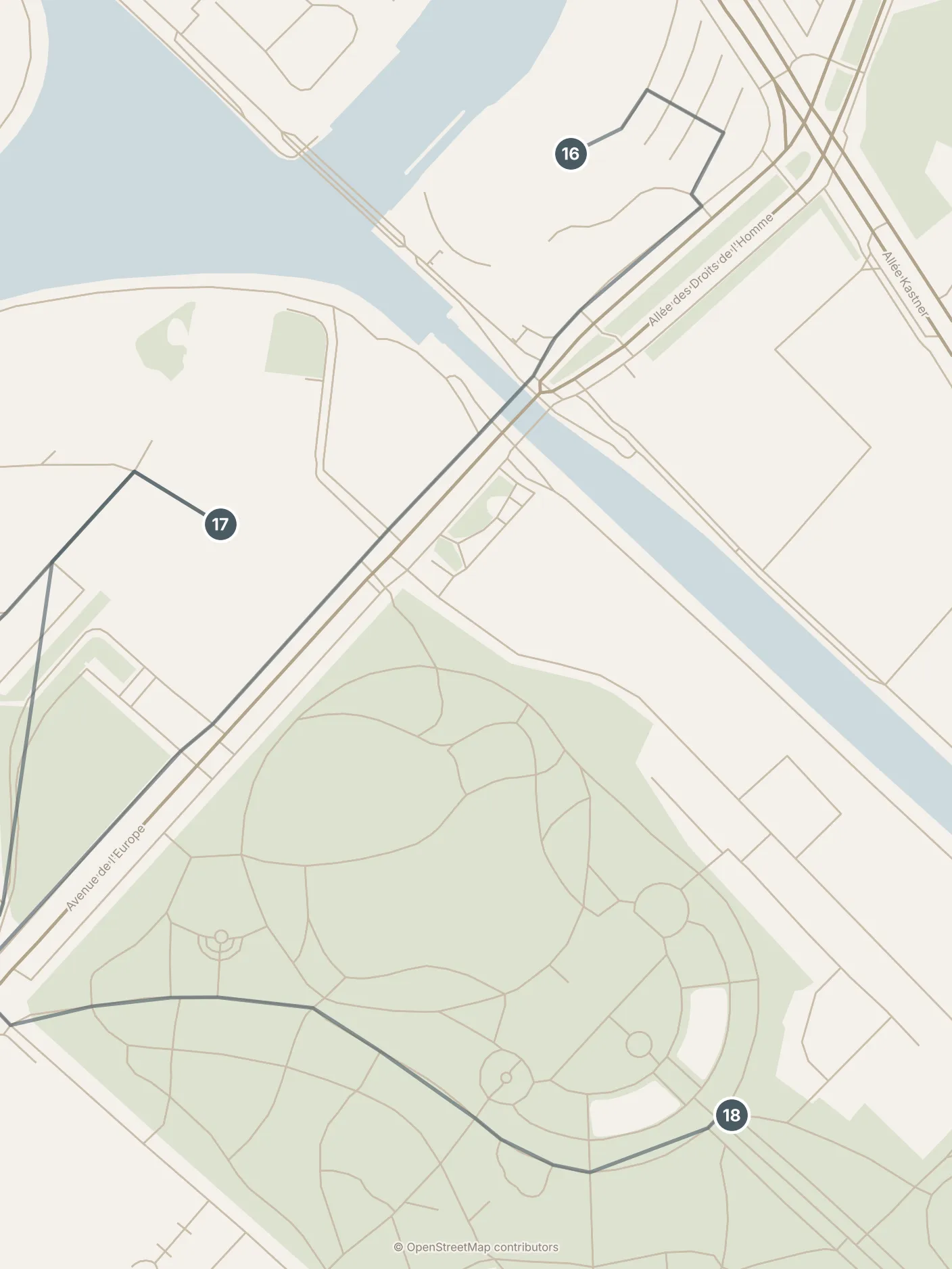
- With a third day · stops 16–18
- 16European Court of Human Rights
- 17Palais de l'Europe
- 18Parc de l'Orangerie
- With a third day · stops 19–20
- 19Palais Rohan landing
- 20Musée Historique
Give it to the European Quarter in the morning and to the river in the afternoon.
Tram line E, which also stops at Place de la République, runs out to the stop called Droits de l’Homme. You get off beside the European Court of Human Rights, the building Richard Rogers designed in the 1990s, two steel drums beside the water. From the bank by it you look across at the European Parliament, the glass ring built around an unfinished courtyard, and further on stands the Palais de l’Europe, the Council of Europe’s building. These are working institutions rather than sights; the Parliament publishes its own visiting arrangements, and if you want to go inside, read them before you come, because they depend on whether the chamber is sitting. Without a visit, give the three buildings an hour on foot; it is about a quarter of an hour from the court to the Palais de l’Europe.
Opposite the Palais de l’Europe is the Parc de l’Orangerie, the city’s oldest park, laid out formally around a lake. The storks are the reason to come: they nest in its trees, and they are the bird Alsace put on everything. Give it an hour, and have lunch out here.
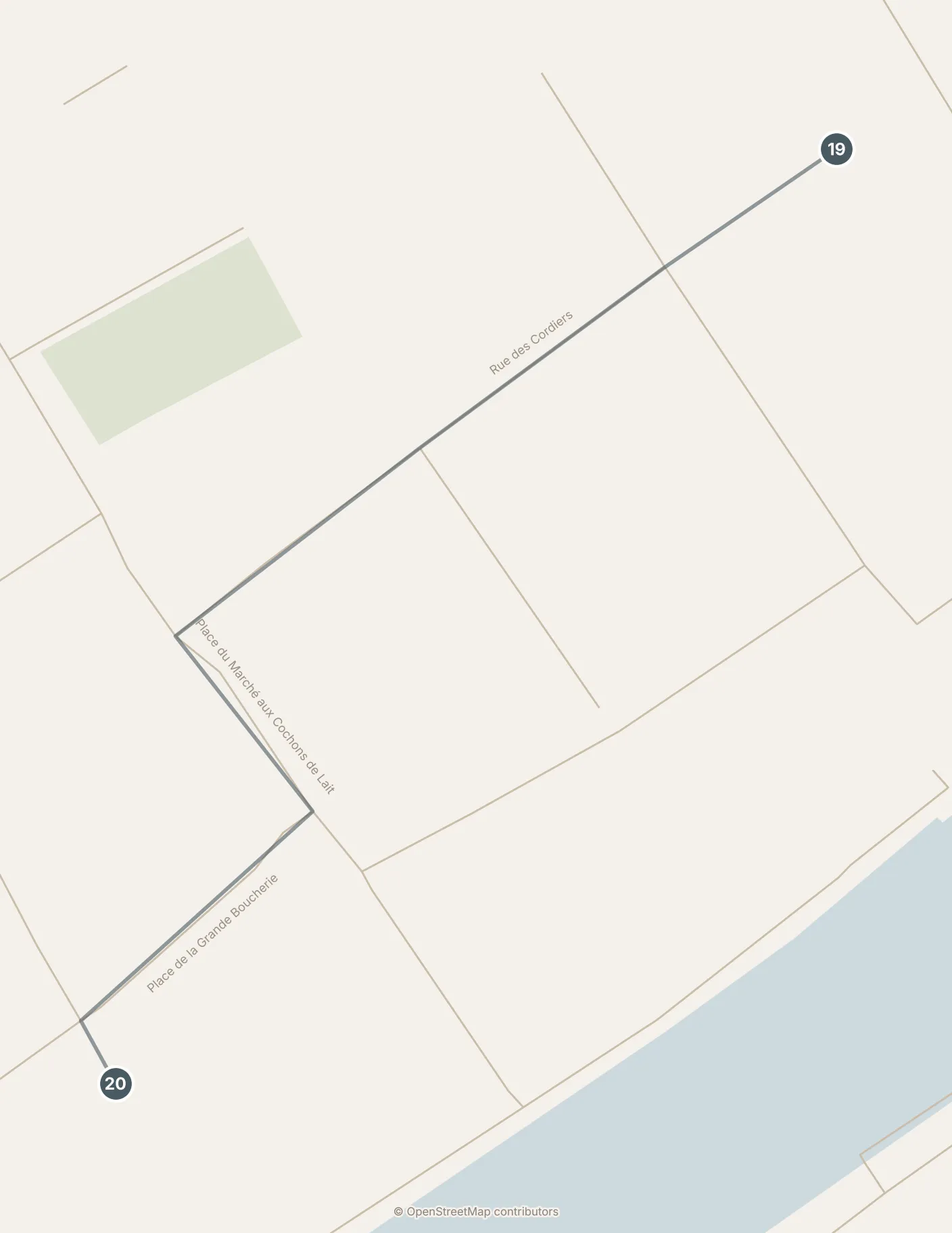
The afternoon hinges on the boat. The tour, run by Batorama, leaves from the landing beside Palais Rohan and runs a little over an hour, through the locks of Petite France, past the Neustadt and out towards the quarter you have just walked. It is the one way to see the locks working and the Neustadt from below, and in 2026 the ticket was in the fifteen-to-twenty-euro range. In summer and December the departures fill: book the slot online before you travel, and choose it by counting back. From the Orangerie to the landing is about forty minutes on foot, or line E from Droits de l’Homme back to Place de la République and fourteen minutes’ walk from there, so with lunch an afternoon departure of about two hours after you leave the park is the one to take.
When the boat lands, the Musée Historique is a couple of minutes away on the same side of the river, in the old butchers’ hall by the Pont du Corbeau: the city’s own history, from the medieval free city to the twentieth century. It closes on Mondays. Give it an hour. The Musée alsacien across the water, the museum of Alsatian country life, is closed for works until the summer of 2028.
If you would rather leave the boat out, the afternoon stands on the museum alone, and the time is better spent in the Musée d’Art Moderne et Contemporain if day two’s rain kept you from it.
Practicalities
One thing to book before you arrive, and only in summer and December: the boat tour, for the third day, sold online by Batorama. One thing to buy first on the day: the clock ticket, which cannot be booked ahead and is sold at the cathedral that morning in limited numbers, which is why day one starts there.
The trams are run by the CTS, the city’s network; you buy the ticket at the machine on the platform before boarding. This route uses them twice: lines A and D from Gare Centrale under the station to Langstross-Grand’Rue on the first morning, and line E between Place de la République and Droits de l’Homme on the third day. The parent guide covers the passes and everything else about getting around.
The closing days that can break the trip are the museums’. The Musée de l’Œuvre Notre-Dame, the Musée d’Art Moderne et Contemporain and the Musée Historique close on Mondays; the three museums in Palais Rohan close on Tuesdays. Day one carries the Œuvre Notre-Dame and Palais Rohan, so it must avoid both days — swap days one and two if it would fall on either. Day two only needs a museum if it rains, and the third day’s museum is the last hour of the afternoon; on a Monday the boat and the European Quarter still stand without it.
Everything on the first two days is walkable, and the longest stretches are the seventeen minutes from the cathedral to the Palais Universitaire and the fifteen from Place de la République back to Place Kléber.


