Strasbourg in one day: the island on foot, from the station and back

Last updated 7 October 2026
Overview
Strasbourg’s old town is an island. The Ill splits around it, and almost everything a single day wants is on it or on its banks: the tanners’ quarter at its western tip, the cathedral near its middle, the bishops’ palace on its southern edge. End to end it is about twenty minutes on foot, and the main station sits just off its western end, so this day is walked from the train and back to it, with one ride on the water in the afternoon that is a sight in itself rather than a way of getting anywhere.
What a single day costs you is most of the city’s museums, and the German-built quarter to the north-east, the Neustadt, which UNESCO added to the island’s listing in 2017. Both are worth a second day; neither is worth a third of this one. One museum stays in, because it holds the cathedral’s own statues and medieval drawings and stands a minute from its door.
The day has one hinge, and it is not the light. It is the cathedral’s astronomical clock, whose figures move once a day: in 2026 the show began with a film at noon and the procession ran at half past twelve, and the clock has kept that hour for a very long time — but if the cathedral has moved it, move the morning with it. The show is ticketed, and the tickets are sold at the cathedral that morning, in limited numbers, with no booking ahead. Everything before it is arranged to put you at the cathedral by half past eleven, ticket in hand before the film. Work backwards: thirteen minutes’ walk from the station to the river, twenty minutes on the dam’s roof, an hour in Petite France, a quarter of an hour across to the cathedral. That is about two hours, so leave the station at half past nine. The count models the time you spend looking and walking, and nothing else: not the bag check at the cathedral door, and not the line for the clock tickets. In summer and in December, when they go, reverse the first steps: go straight from the station to the cathedral, about twenty-five minutes on foot or a few stops by tram, buy the ticket, and then walk out through Place Gutenberg to Petite France and the dam and back, which costs about twenty minutes more than the morning below.
The bag is the other thing that shapes the day, and Practicalities says how.
The day

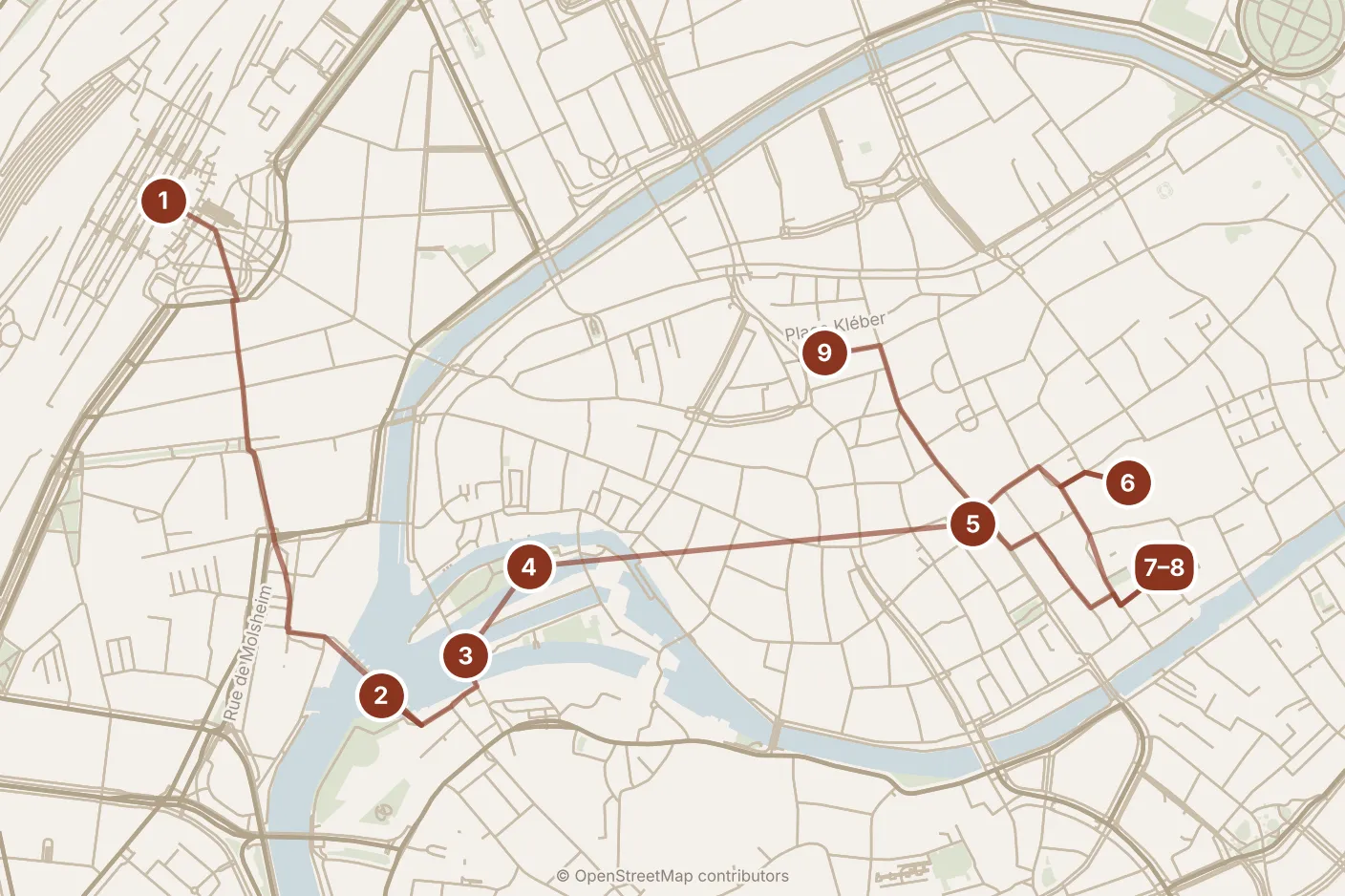
- The day
- 1Gare de Strasbourg
- 2Barrage Vauban
- 3Ponts Couverts
- 4Petite France
- 5Place Gutenberg
- 6Strasbourg Cathedral
- 7Musée de l'Œuvre Notre-Dame
- 8Palais Rohan
- 9Place Kléber
Morning
You arrive at Gare de Strasbourg, a nineteenth-century station front that has been wrapped since 2007 in a glass shell, so the old building now sits inside a modern one like something under a cloche. Leave the bag if you can, then walk out across the square in front of the station and south to the river, about thirteen minutes, to the Barrage Vauban.
This is a seventeenth-century dam built as part of the city’s defenses: a long, low stone building across the Ill whose sluices could flood the land upstream against an attacker. The arcaded gallery inside holds stone sculpture and can be walked through in passing; what you came for is the roof terrace, which is free. From it the whole western end of the island lines up in front of you — the square medieval towers of the Ponts Couverts in the foreground, the roofs of Petite France behind them, and the cathedral’s single spire over everything. Give it twenty minutes; it is the view that explains the rest of the morning, and it is the best one of the day that costs no stairs.
Cross the water by the Ponts Couverts, a run of bridges between towers left from the old walls. The covered roofs that gave them their name are long gone; the towers are what remains, and the channels of the Ill run fast between them. On the far side you are in Petite France, the quarter where tanners, millers and fishermen worked on the river. The half-timbered houses still have open lofts under their steep roofs, where hides were hung to dry, and the lanes follow the channels rather than any plan. Give it an hour, mostly walking rather than stopping. If a tour boat is coming through the lock, wait for it: the footbridge over the channel swings aside to let it pass, and you will go through the same lock yourself in the afternoon.
Leave the quarter eastwards along the main street that runs from its edge towards the center, about a quarter of an hour, to Place Gutenberg. The statue in the middle is Gutenberg, who lived and worked in Strasbourg in the 1430s and 1440s, years before he printed his Bible in Mainz. Do not linger: the cathedral is two minutes north-east, and you want to be at its door by half past eleven.
Afternoon
Strasbourg Cathedral is built of the pink sandstone of the Vosges, and its spire, at 142 meters, made it the tallest building in the world from the seventeenth century until the nineteenth. It has only one; the second tower was never built, which is why the front looks lopsided from the square and right from everywhere else in the city. The nave is free, but from Monday to Saturday it is kept for clock ticket-holders from late morning until about a quarter to one, so the rest of the interior waits until the show is over. The cathedral publishes its visiting arrangements itself, Sundays and holidays included, and they are worth reading before you come rather than at the door.
The clock is the nineteenth-century mechanism in a much older case, and at half past twelve its figures move: the apostles file past, and a gilded cockerel on top flaps and crows. Stand where you can also see the carved Pillar of Angels beside it, which is the finest thing in that part of the building and is easy to miss while you wait. The show runs from noon to about a quarter to one; give the rest of the interior a quarter of an hour after it.
Local tip. If you can only manage one of the clock and the climb, take the clock: it happens once a day and is the reason the morning was built backwards, while the platform’s view is the same at three as it is at one.
Lunch next, in the streets around the cathedral square, for about an hour and sitting down. This is where to eat choucroute, if you have the afternoon for it, or something lighter; tarte flambée is kept for the evening, when more ovens are fired. The side streets off the square have cheaper places with shorter menus.
Then the platform: some 330 steps up a stone spiral to a terrace about 66 meters up, with its own ticketed entrance outside the building. From the top the island lies flat below you and you can trace the morning’s walk back to the towers of the Ponts Couverts. Give it three-quarters of an hour, climb included, and leave the bag out of it.
The Musée de l’Œuvre Notre-Dame is a minute away on the little square beside the cathedral, in the old houses of the workshop that has looked after the building for centuries. It holds the originals of the cathedral’s sculpture — among them Ecclesia and Synagoga, the crowned Church and the blindfolded Synagogue from the south portal, a medieval allegory of the Church’s triumph over Judaism, whose copies you have just walked past outside — and the medieval drawings of the facade on parchment, the plans the masons actually built from. Give it an hour and give most of it to the sculpture; the later paintings can go.
Next door is the Palais Rohan, the bishops’ palace of the eighteenth century, with three museums inside that this day leaves alone. Its riverbank is the reason you are here: the tour boats leave from the landing beside it. The commented tour runs a little over an hour, round the island and through the lock in Petite France you watched in the morning, then out past the Neustadt to the European Parliament and back. It is the only way to see that half of Strasbourg on a single day, and in bad weather the operator runs covered boats, so it survives rain.
Evening
From the landing it is about ten minutes on foot north-west, across the island, to Place Kléber, the city’s main square, with the general’s statue in the middle. Dinner goes in the streets between here and the cathedral; a winstub, the Alsatian wine room, is the local form, and the tarte flambée belongs here.
If you have a train, Homme de Fer is the tram stop at the corner of the square: lines A or D, two stops, to Gare Centrale, which is underground beneath the square in front of the station. On foot it is about seventeen minutes west. Either way, you finish where you started, at the station where the bag is.
Practicalities
The one thing on this route to book ahead is the boat, from Batorama, the operator at the Palais Rohan landing, either online or at its ticket office there; in summer and in December the afternoon departures are the ones that fill. The commented tour was in the fifteen-to-twenty-euro range in 2026. The clock ticket and the platform are bought on the day at the cathedral.
The Musée de l’Œuvre Notre-Dame is the one stop here that closes a day a week, on Mondays. On a Monday, give its hour to the afternoon instead: a longer lunch, or more time on the platform and the quays before the boat. The morning stays as it is, because the clock does not move. On a Sunday morning the cathedral is a working church and visits give way to services, so read what the cathedral publishes before planning a Sunday around the clock. In December, during the Christmas market, the island’s bridges have been ringed with security checks in recent years, and that adds time to every crossing on this route.
If the day is shorter than this, cut the Musée de l’Œuvre Notre-Dame first: it is the stop the rest of the day does not depend on. Then the platform. The clock, Petite France and the boat are the day; keep those three and it is still Strasbourg. If it rains, the dam’s roof and the platform lose their point; give their time to the boat, which runs covered in bad weather, and to the Palais Rohan’s state rooms, one of the three museums inside, a few steps from the landing (closed on Tuesdays).
The bag decides the afternoon. The main station is the only place on this route to look for left luggage (consigne on French signs), and whether a service is running there when you arrive is the one thing on this page to check before you travel. If it is, the day starts and ends at the same building and you never carry anything. If there is none, take the consequence rather than the fact: the platform is the stop you cannot do holding a case, the cathedral door has a bag check that a case makes slower, and the narrow lanes of Petite France are hard work with wheels. So cut the platform, keep the clock, and give the hour to the Musée de l’Œuvre Notre-Dame, which you can walk round with a bag at your side. The boat and the walk back to the station are no harder with one.


