Stockholm in two to three days: inside the palace, the whole of Djurgården, and a third day at Drottningholm

Last updated 8 August 2026
Overview
A single day in Stockholm is spent crossing water and looking at the outsides of things. What two days buy is doors: the state rooms of a palace you would otherwise photograph from a courtyard, a hall hung with the arms of every noble family in the country that is open for one hour a day, and a whole island of museums instead of the one you had time for. The walking barely changes — the center is small and flat until you reach the cliffs — so the second day is not more ground. It is more inside.
Day one stays on the old town’s island and the two bridges off its northern end, and apart from an hour in the lanes, the guard change and the walk out to Skeppsholmen that ends it, it is indoors. Day two is a single green island east of the center, reached by tram and left by boat, and it is three collections and a hill. They share no stop: day one goes west to the hall, back through the old town, and out over the bridges to the north-east; day two goes east across the water and comes back by a different crossing.
The sun sets here at a little before three in the middle of December and a few minutes past ten at midsummer. That is a swing of seven and a quarter hours, and in December the usable light runs to about six — shorter than either day below. So both days are written for the light half of the year and both carry their own dark-months version, in the paragraph where a reader in December would otherwise be standing in the wrong place. Day one’s outdoor ending drops out altogether; day two runs backwards.
Three tickets across the three days are worth having before you reach a desk: the palace on day one, Drottningholm if you take the third, and Skansen on day two. The same body sells the first two, and the palace ran between 220 and 240 kronor for an adult in 2026 according to the season; Skansen is the odd one out, bought ahead because it is cheaper that way rather than because it sells out. Nothing here sells out. Everything that moves you — the metro, tram 7, ferry 82, and the bus out to Drottningholm — is on one regional travelcard; how you buy and load it is the city guide’s business and not this article’s, and it is the only ticket the three days themselves ask you to think about. The airport train is not on it: it is a separate commercial service with a fare of its own, and it is the one to settle before you land.
Left luggage at Stockholm Central Station is a locker bank rather than a counter you hand a bag across, and the shape that matters is this: day one begins one metro stop away, and day three leaves from the same station, but day two ends on a cliff on the far side of the water and does not come back past it — except from November to February, when day two is run backwards and ends at Kungsträdgården, a stop from the station. So deal with the bag on the morning you arrive and do not plan to collect it between stops. Three places on this route are genuinely bad with a case — the stair up to the hall on day one, the hill inside Skansen, and the climb to Fjällgatan at the end of day two.
Day one

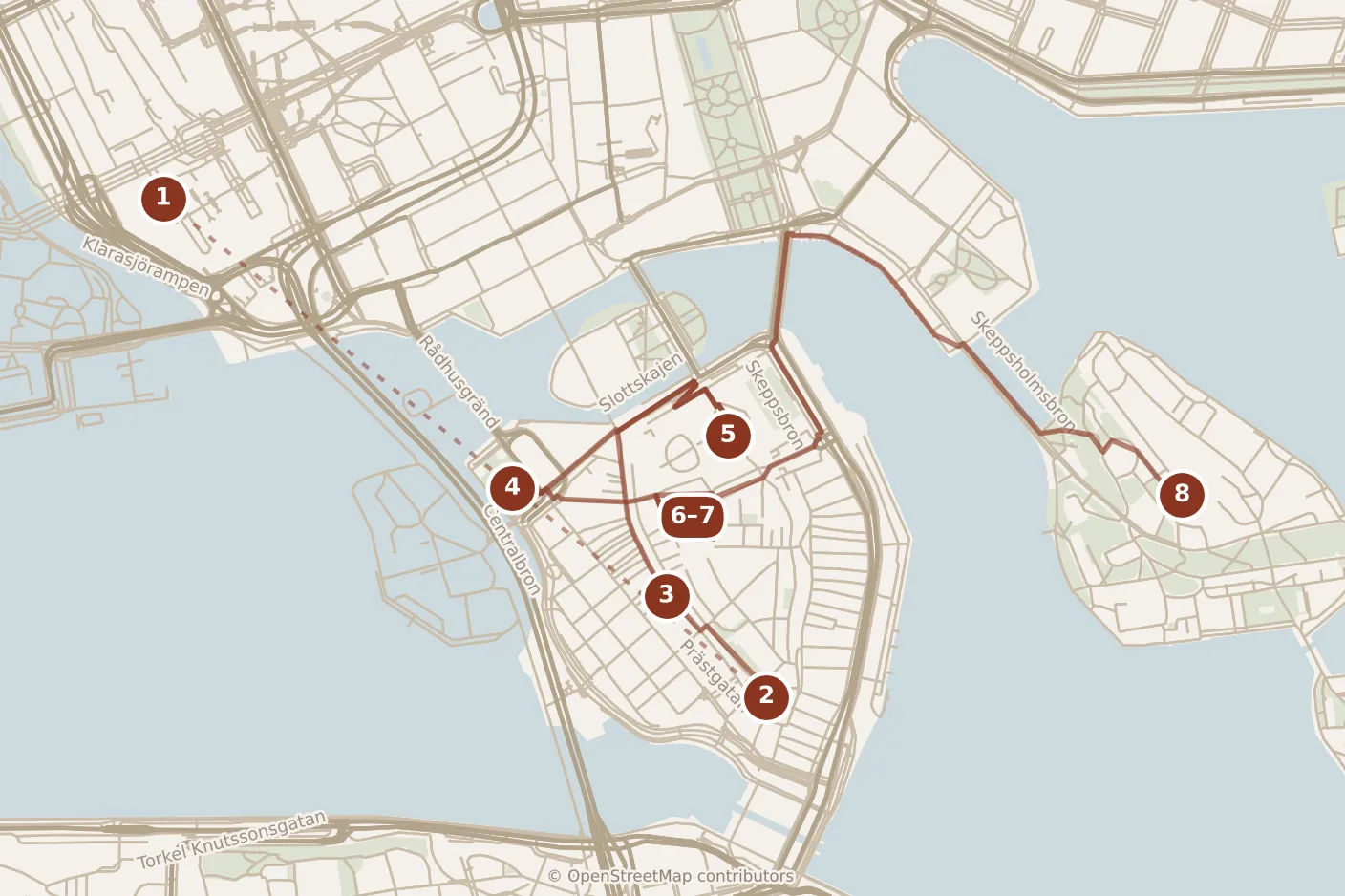
- Day one
- 1Stockholm Central Station
- 2Mårten Trotzigs gränd
- 3Västerlånggatan
- 4Riddarhuset
- 5Stockholm Palace
- 6Storkyrkan
- 7Nobel Prize Museum
- 8Skeppsholmen
Everything today is within seven hundred meters of the same square, and then the day walks out of the old town over two bridges at the end of it. The whole of it turns on one hour.
Morning
Most readers arrive at Stockholm Central Station, either off a long-distance train or off the Arlanda Express, which takes about twenty minutes from the airport. T-Centralen, the metro station, is joined to it by an underground passage; from there it is one stop south on the red or green line to Gamla stan, or about twenty minutes on foot over Vasabron if the weather is kind. Come up at the island’s southern end.
The hour the whole day rests on is eleven o’clock, and it is the reason to start early rather than to hurry later: Riddarhuset admits visitors from eleven until noon on weekdays and not at all on the weekend, nor on a weekday that is a public holiday, and in high summer opens earlier and stays open until one. Everything before that hour is streets, which have no doors — an hour in the lanes, plus the metro leg and the walk across the island, comes to about an hour and a quarter, so leave the station at half past nine.
Give that hour to the lanes, which are a different place before the middle of the day than after it. Mårten Trotzigs gränd is the narrowest of them, ninety centimeters across at the top of its steps and named for a German merchant who bought property here in the 1590s. From there work north up Västerlånggatan, the old town’s spine, and then step one street east onto Prästgatan and walk the same distance back — it runs parallel, it is the same age, and it has none of the shops. That contrast is the whole lesson of the morning and it costs nothing.
Then six minutes west to Riddarhustorget for Riddarhuset. It was begun in 1641 on land bought by Axel Oxenstierna, the facade is Justus Vingboons’ and Jean de la Vallée finished the building in 1660, and what you come for is upstairs: one great hall hung with something over two thousand small copper coats of arms, one for each noble family, ranked in tiers up the walls under a painted ceiling of the 1670s. It is a single room, it takes forty minutes, and it costs less than any other interior on these three days. Nothing else in the city is quite so plainly a picture of how a country was once organized.
Afternoon
Seven minutes east is Stockholm Palace, and the outer courtyard is where the Royal Guards mount the guard — around midday, an hour later on Sundays and public holidays. Twenty-five minutes, standing at the back, and then eat: the lanes behind the palace are full of places, and the one to order is gravlax, cured rather than smoked, with dill and a mustard sauce.
The palace is the afternoon. The medieval castle that stood here, Tre Kronor, burned on a May day in 1697; what replaced it is Nicodemus Tessin the Younger’s, finished in the 1750s, and it is still the working address of the monarchy. One ticket covers four things and the mistake is to try to do them evenly. The Royal Apartments are the long enfilade of state rooms and take half of your time. The Treasury, down in the cellars, holds the regalia — Erik XIV’s crown of 1561 among them — and is twenty minutes and the densest twenty minutes in the building. The Hall of State holds Kristina’s silver throne, made in Augsburg and given to her at her coronation in 1650. The fourth, the museum of antiquities, is marble busts a king brought back from Italy, and it is the one to skip without regret unless that is your subject. Two and a half hours.
Local tip. If the palace has to be cut, cut the state rooms and not the cellars. The enfilade is the half that resembles every other palace in Europe; the regalia and the burnt castle’s foundations are the half that is only here. That is also the order to do them in, because it puts the part you would not give up in front of the part you would.
One warning that is earned rather than offered: the Royal Apartments close, wholly or in part, for the household’s official receptions, and the dates are published on the palace’s own calendar by the royal court that runs it. Look the week before. If yours is one of them the ticket still takes you into the cellars, and the hour you get back goes to the two stops below.
Two minutes away, Storkyrkan is the cathedral, and a second day is what lets you look past the two objects everybody finds in five minutes — the carved dragon group, and the painting of the city under a sky of false suns. What is worth the twenty minutes after that is the church’s argument with the palace next door. The building is a brick hall of the fifteenth century; the plaster shell around it was put on between 1736 and 1745 to Johan Eberhard Carlberg’s design, for no reason except that the palace going up beside it was baroque and the cathedral could not be allowed to look medieval. The argument carries on inside: the royal pews are Tessin’s, with canopies carved as outsize gilded crowns, and they are the one thing at that end of the church worth walking to. Coronations happened here, and so did the wedding of Crown Princess Victoria in 2010.
A minute further, on Stortorget, the Nobel Prize Museum occupies Erik Palmstedt’s stock exchange of 1776, whose upper floor is the Swedish Academy’s own. The museum is small, and it is better than the subject sounds: laureates’ objects travel round the ceiling on a cable system, and the chairs in the café are signed underneath by the people who sat in them. An hour and a quarter. It was open into the evening every day in 2026, later than anything else on this island, which is why it is last; if you find it closing earlier in midwinter, put it before the cathedral and give the cathedral the final twenty minutes instead.
Evening
Walk out of the old town the way the day has been pointing: fifteen minutes north-east past the palace, over Strömbron, along Blasieholmen and across Skeppsholmsbron, whose ironwork carries a gilded crown. Skeppsholmen was the navy’s island from the seventeenth century until the 1960s and is now yellow barracks, a domed former garrison church, a park and two museums. Forty minutes is enough to walk the shore round it. The reason to come is the water on the south-west side: the whole of the old town you have spent the day inside, seen end-on across Strömmen with the palace closing it, and — the other way — the low green island with the museums on it, which is a whole day of its own.
From November to February this last stop simply does not happen; the light is gone before you leave the palace, and a dark island with a closed church on it is not worth the walk. Day one then loses its outdoor ending, and what stays outside is the hour in the lanes and the twenty-five minutes standing for the guard — about ninety minutes of cold, so dress for standing still in it. Eat instead in the streets behind Blasieholmen, or ten minutes north on Östermalm.
Day one’s stops come to a little under seven hours and the walking between them to a little over half an hour. That counts the time inside the places and nothing else — not lunch, and not the walking inside the palace, which is four collections at opposite ends of one very large building and is the largest single thing the figure leaves out. Add the meal and the day runs about eight and a half hours, from the metro at half past nine to the last bridge in the early evening.
If the day is running short, the stop that goes is the Nobel Prize Museum. It is an hour and a quarter, it is the only stop here whose subject is an idea rather than the city, and it keeps the longest hours of anything on the island — which means it is also the one you can pick up on another evening without moving anything else. Unless you are taking day one last, as the winter arrangement below has you do: then there is no later evening, and it simply goes.
Day two

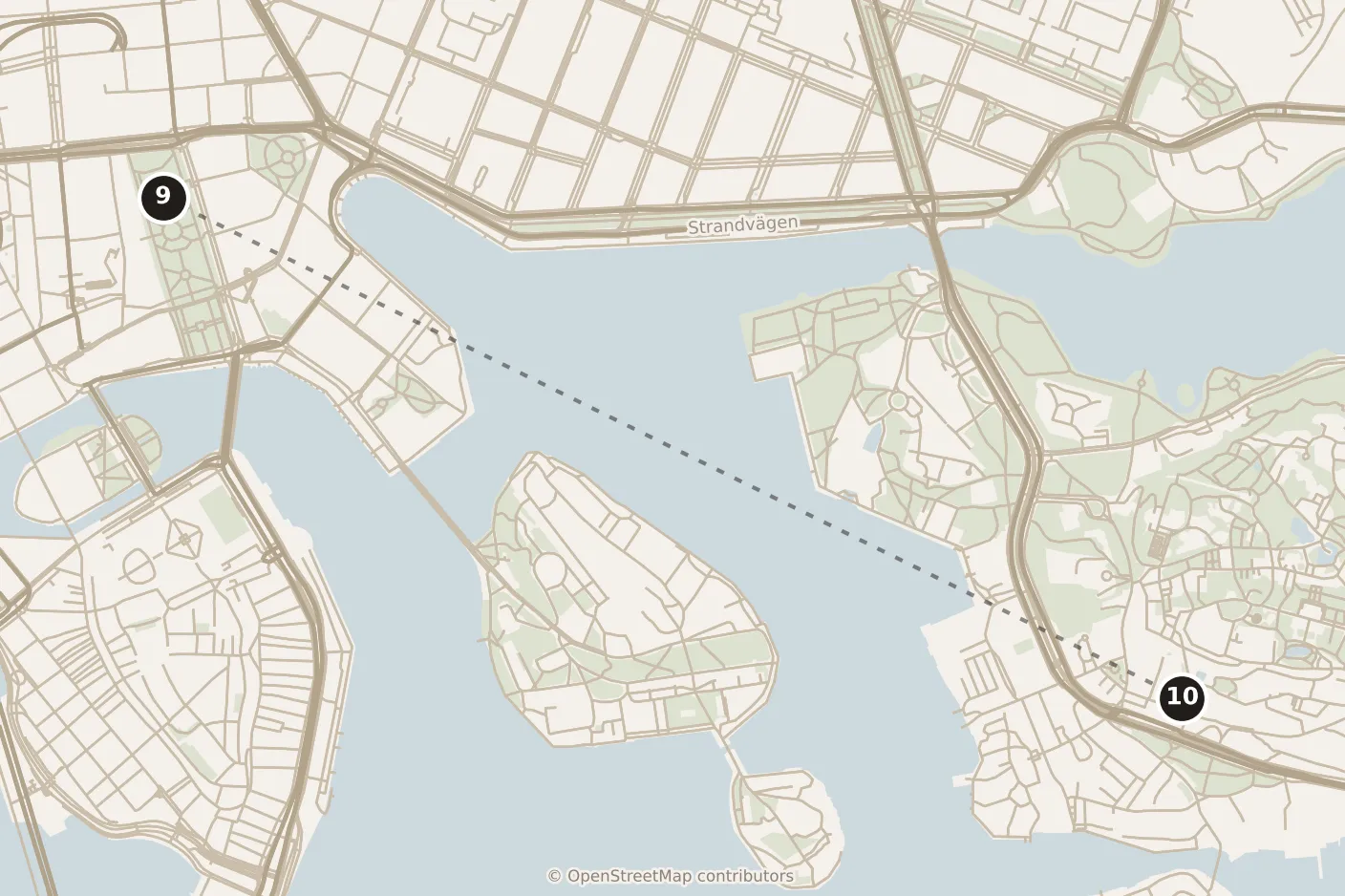
- Morning
- 9Kungsträdgården
- 10Skansen
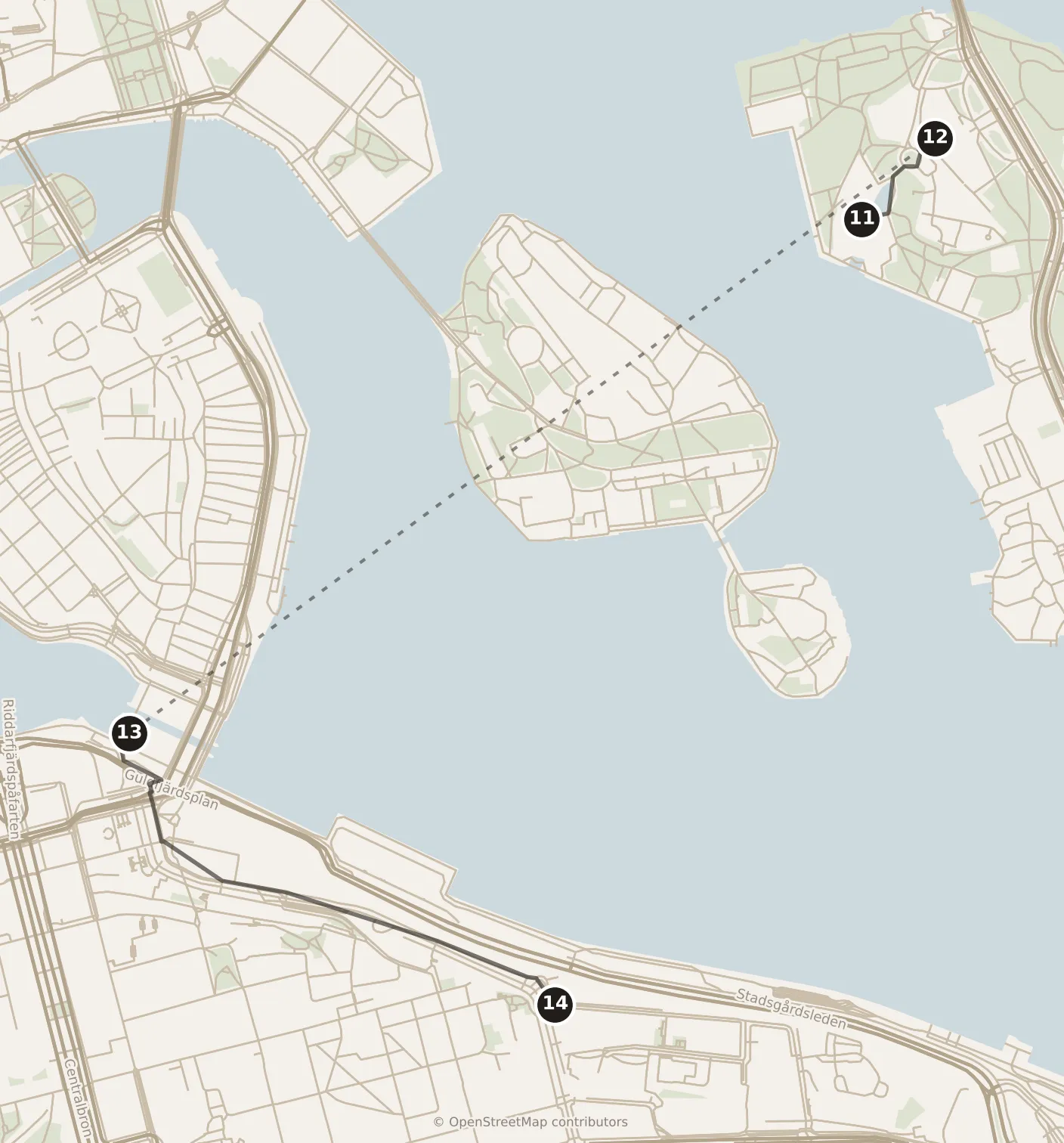
- Afternoon and evening
- 11Vasa Museum
- 12Nordiska museet
- 13Slussen
- 14Fjällgatan
Today is one island: a green one east of the center, largely parkland, with three of the country’s biggest collections standing on it. You go out by tram and come back by boat, so the day is a loop and not a there-and-back.
Morning
Start at Kungsträdgården, the long park in Norrmalm just across the water from the old town — about ten minutes’ walk from T-Centralen, or one stop on the blue line. Tram 7 leaves from the top of it and is on Djurgården in about ten minutes. It is an ordinary line on the city network and takes the same travelcard as the metro. Stay on it past the Nordiska museet stop, which is where the afternoon is, as far as the Skansen stop, which sets you down by the main gate.
Artur Hazelius opened Skansen in 1891 and it was the first open-air museum anywhere: about a hundred and fifty buildings taken down where they stood across Sweden and rebuilt on this hill, from a farmstead of the 1600s to a whole town quarter of workshops. There is a zoo along the top with the northern animals in it — bear, wolf, lynx, wolverine, elk — and it is a real one rather than a petting corner.
Three hours, and the way to spend them is to walk the hill upwards in one direction rather than crossing it repeatedly; the map you are given at the gate invites the second, and the second is how people leave exhausted having seen a third of it. Skansen goes first for a reason that only bites in winter: from late September to early January it shut at three on weekdays and four at weekends in 2026, earlier than either museum below it, so it has to stay ahead of both. The reversed winter version below keeps it there — from first light the cliff and the crossing come to about ninety minutes, which still has you inside the gate by half past ten and out well before three. If those hours have shifted, the method is the same — put the earliest-closing thing at the front of the day and let the others fall in behind it. What Skansen publishes is its hours and not which of its houses are manned month by month, so on a winter date ask them what is open before you give it three of them.
Local tip. Decide at the gate to walk the hill one way. The plan the map suggests crosses its own middle repeatedly, and the difference between a good three hours here and an exhausting one is going up one side and coming down the other instead.
Afternoon
Ten minutes downhill, the Vasa Museum is the building put up around a warship that sank in the harbor in 1628 and came up whole in 1961. Two hours. A reader with one day is told to give the hull an hour and leave the side exhibitions alone; a second day is exactly what buys those exhibitions, and two of them are worth the extra hour. One is the rigging and the sail — one of the oldest sails preserved anywhere, laid flat in a low-light room. The other is the conservation story: the polyethylene glycol sprayed into the oak for seventeen years from 1962, why the hull has been settling under its own weight ever since it was raised, and the new supporting structure designed to take it. It is the rare museum that explains its own failure.
Three minutes’ walk north, Nordiska museet is Hazelius’s other creation and the larger idea: everything Swedish people have owned, worn, eaten off and slept in since 1520, in a granite and brick hall of 1907 by Isak Gustaf Clason that looks like a cathedral and was meant to. Carl Milles’s seated Gustav Vasa in painted oak sits at the end of the great hall. An hour does the hall, the table settings and the Sami collections, which are the strongest thing in it.
Evening
Walk ten minutes back south to the quay at Allmänna gränd and take ferry 82 across to Slussen, ten minutes on the water, which hands you the old town’s whole eastern front on the way. Slussen has been a building site since 2016; the walk through it is signposted and the way up the cliff works.
From there it is fifteen minutes east and uphill — Katarinavägen, then Stigbergsgatan — to Fjällgatan, on Södermalm: a short cobbled street along the top of the cliff, wooden houses on one side and nothing but air on the other. It looks out over Saltsjön, the ships coming in, and the whole of the island you have just spent the day on, which is the point of ending here rather than anywhere else. Half an hour. Dinner is in the streets around Nytorget, ten minutes inland and downhill, and köttbullar is the obvious order.
This is the stop whose worth depends on the hour, and between November and February the day has to be run backwards to have it at all. Take ferry 82 out from Slussen first thing instead of the tram, do Fjällgatan in the first hour of light before you board, then Skansen, the ship and the hall in that order, and come home on tram 7 from the Nordiska museet stop to Kungsträdgården. Check the first crossing the night before, though: if the boat starts later than the light, climb to Fjällgatan anyway and come back through Slussen to Kungsträdgården for the tram, which costs twenty minutes and nothing else. Otherwise nothing is lost: the same stops, the same island, the light spent on the only part of the day that needs it.
Day two comes to six and a half hours inside the places, about an hour moving between them, and lunch on top — about eight and a quarter hours. What that does not count is the walking inside Skansen, which is a hillside and not a building, and is easily the largest thing these sums leave out. If the day is running short, Nordiska is the stop that goes: it is the newest of the three to a visitor’s list, it is an hour, and it is thirty meters from the tram stop you would leave from anyway.
If the forecast is bad, the substitute is decided at the tram stop and not later. Skansen is open air from end to end and a wet three hours there is a wasted three hours. Get off tram 7 at the Nordiska museet stop instead of riding on to the gate, go into the ship first and give it the full three hours the side exhibitions can absorb, then Nordiska for two rather than one. That fills the day indoors within four hundred meters, and it displaces Skansen rather than shortening it — which means Skansen is what you owe the third day, or what you lose.
With a third day

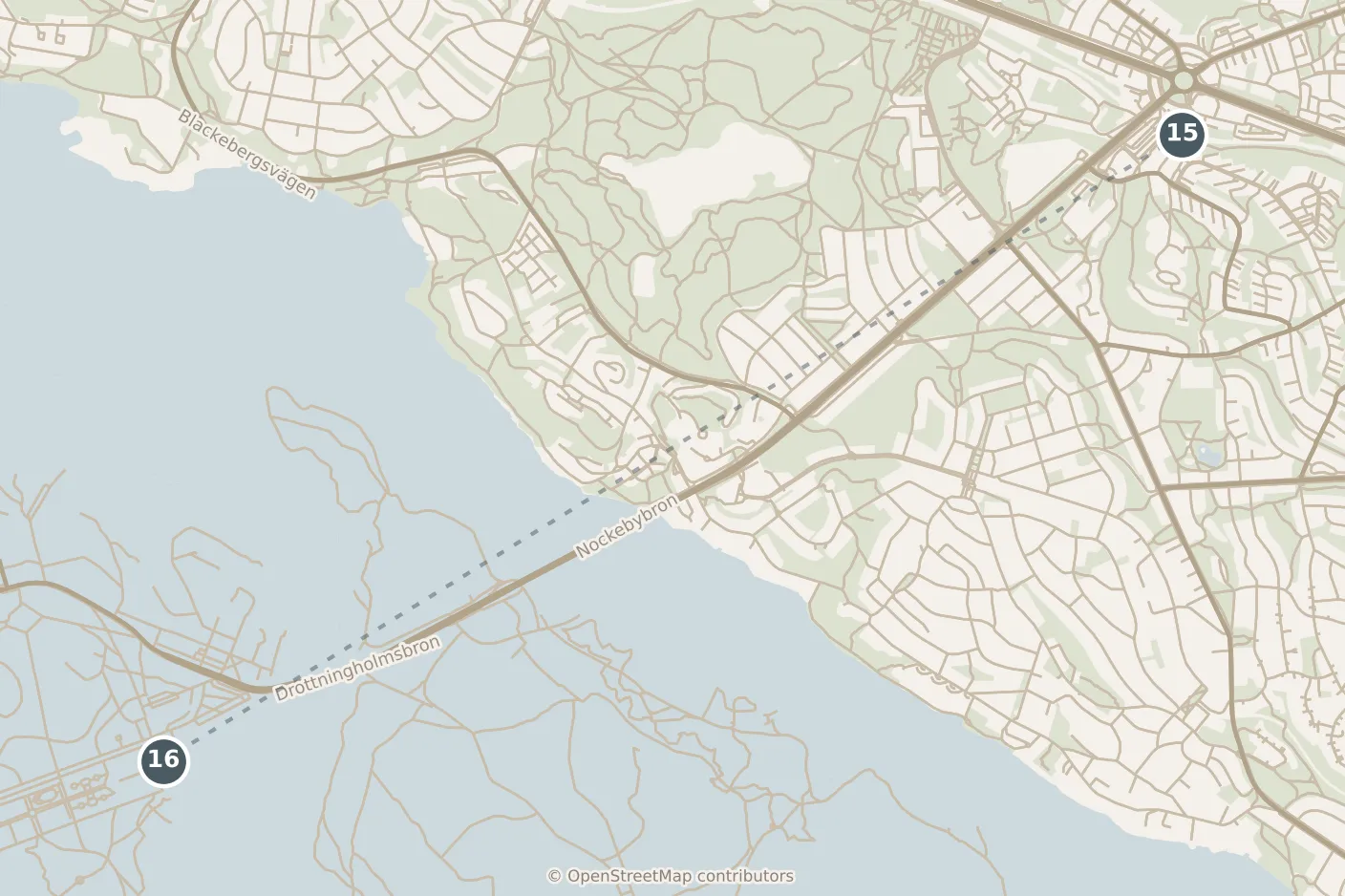
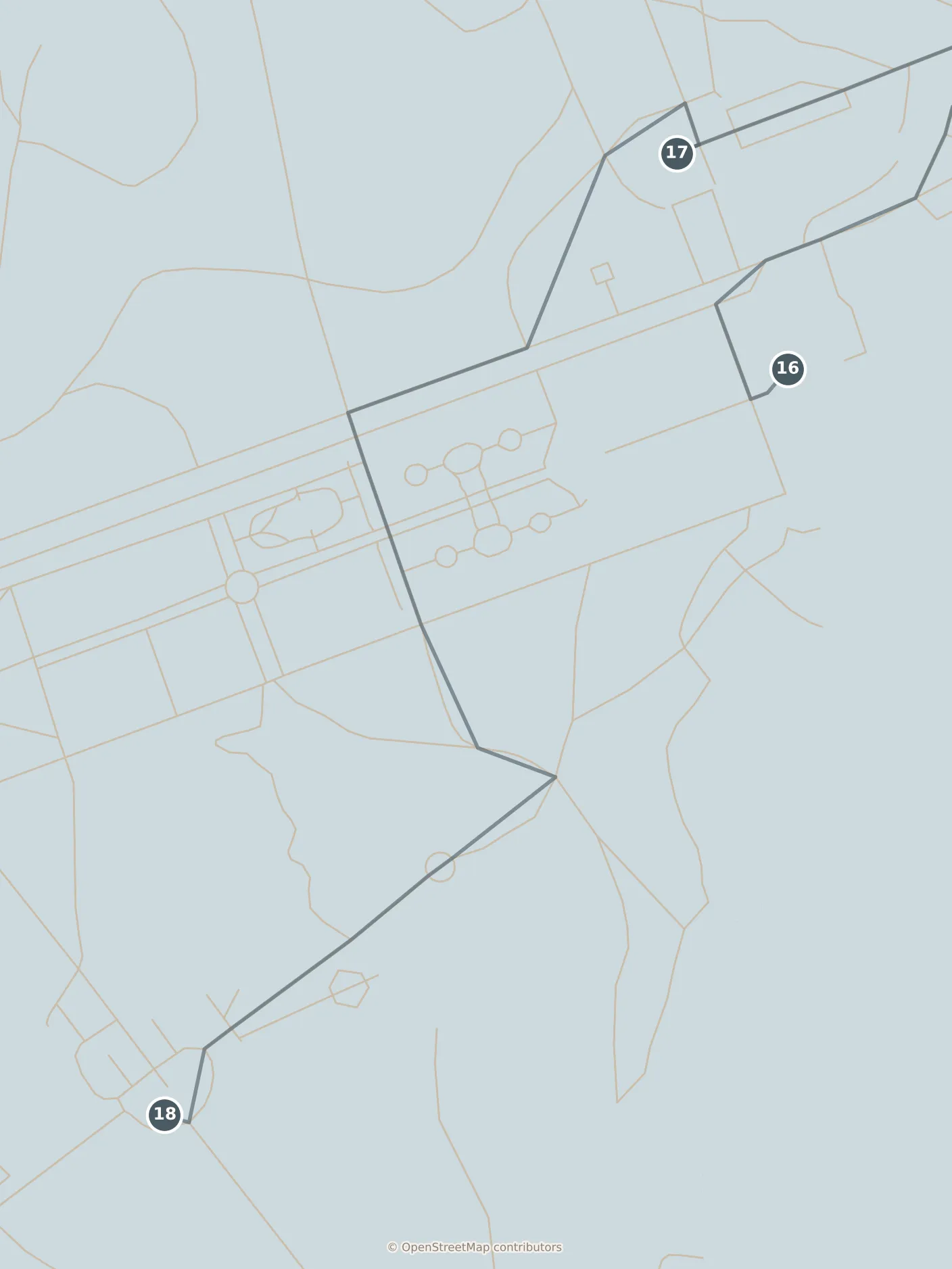
The ride on to stop 16, by bus, not on foot.
- With a third day · stop 15
- 15Brommaplan metro station
- With a third day · stops 16–18
- 16Drottningholm Palace
- 17Drottningholm Palace Theatre
- 18Chinese Pavilion at Drottningholm
The third day leaves the city, and it is appended rather than inserted: days one and two run west then east through the same small center and read as one movement, and putting a boat trip between them breaks it for no gain. It goes out to Drottningholm, on Lovön in Ekerö, ten kilometers west up Mälaren — the royal family’s actual home since 1981, a UNESCO site since 1991, and the one thing near Stockholm that two days genuinely cannot hold.
There is one case for inserting it, and it is a calendar case rather than a taste one. Through October and November Drottningholm opened only on weekends in 2026, and over December and January only on a handful of named dates around the turn of the year — so in that stretch the date is chosen for you, and there may be no day in your three that works at all. Riddarhuset on day one opens only on weekdays. If your three days contain exactly one day Drottningholm is open, the Drottningholm day has to take it, wherever it falls. Insert it there and day two is what moves, not day one. From November to February that costs nothing: day two is being run backwards anyway, which finishes Skansen in the early afternoon and never comes near either closing time, so the weekday hour it gives up is an hour it was not using. In October it does cost an hour, because the day is still running forwards and Skansen shut at three on a winter weekday against four on the weekend, and no order of the three avoids it: Riddarhuset has taken a weekday and Drottningholm has taken the weekend. Give Skansen its three hours at the start of the day as written, and if the day still runs short, Nordiska is the stop that goes.
From T-Centralen take the green line west — lines 17 and 19 both call — to Brommaplan, about fifteen minutes, and from the bus terminal above the station any bus signed for Ekerö stops at Drottningholm in about a quarter of an hour. It is all on the same travelcard. In summer there is also a boat up Mälaren from Stadshusbron, the quay beside the city hall: it is a private service and not on the card, and it takes far longer than the bus, which is the entire point of taking it.
The palace is Nicodemus Tessin the Elder’s, begun in 1662 for the dowager queen Hedvig Eleonora after the earlier house burned, and finished inside by his son. An hour and a half does the staterooms and the staircase properly. Then three quarters of an hour in the baroque garden below the terrace and the looser English park Gustav III laid out beyond it. The south wing is the royal family’s home and is not part of the visit; the soldier on the gate is on duty and not a costumed one, which is worth knowing before treating him as scenery.
Three minutes along the terrace is the Drottningholm Palace Theatre of 1766, and it is the reason to make this a whole day rather than a morning. It is one of very few eighteenth-century theaters in Europe still worked with its original stage machinery: wooden drums and ropes under the boards that change a full set of painted flats in seconds, wave rollers, a thunder run. Going in means a guided tour and the tour is the only way to see any of it move. Give it three quarters of an hour. The theater keeps its own season and its own hours, quite separate from the palace’s, and it publishes them itself — that is the one thing on this day to read the week before, because it is the stop that decides whether the day is worth the journey.
Fifteen minutes further through the park stands the Chinese Pavilion, put up between 1763 and 1770 to replace a wooden one given as a birthday surprise a decade earlier: rococo with chinoiserie laid over it, a summer house that a court took seriously enough to build twice. Half an hour, and it is open in summer only — from October it is shut, so on a winter third day it is not one of the stops at all. In the months it does open it is also the one to cut if the day is running late: it is the furthest from the bus and the least of the three.
That is three and a half hours inside the four things in summer, or three from October, when the pavilion has shut — less again if the theater’s own season has closed by your date — about half an hour walking between them, and three quarters of an hour each way to get there: a six-hour day with lunch in it, which is why it needs no early start except from October to January, when the palace shuts at four and the whole thing has to be done between ten and then.
If Drottningholm is shut on your date — over December and January that is most days, and from October on any weekday — the replacement is a full day and not a consolation, and you decide it at breakfast rather than at a bus stop. From T-Centralen walk fifteen minutes east, or take the blue line one stop to Kungsträdgården and walk eight, to Nationalmuseum on Blasieholmen: four centuries of the country’s own painting and its design collections, and two and a half hours. Then ten minutes over Skeppsholmsbron — the bridge day one crossed at dusk, now in daylight — to Moderna Museet on Skeppsholmen, which holds a twentieth-century collection out of proportion to the country’s size, and another two hours. Nationalmuseum was closed on Mondays in 2026, and its neighbor keeps a closing day of its own, so this substitute has a weekday problem of exactly the kind it is replacing: it will not do a Monday. A trip whose only spare day is a winter Monday gets neither, and should give that day to the old town’s lanes and the food halls instead.
Practicalities
Book three things — two of them from the same body. The palace ticket for day one and, if you take it, Drottningholm’s for the third; each is sold at the door and online, and online is what saves you the desk rather than the day, since neither sells out. The palace ran between 220 and 240 kronor for an adult in 2026 according to the season. The third is Skansen, and it is there for the other reason: it is the one stop on this route sold cheaper in advance than on the door, so booking ahead changes what you pay rather than only what you wait in line for. Everything else on all three days is a street, a church, a walk-up ticket or a tram.
The days that are load-bearing, and the ones that are not. Day one must miss Saturday and Sunday, because Riddarhuset admits visitors on weekdays only — and not on a weekday that is a public holiday, which is the same rule with the case that catches people. That is the single weekly rule on these three days that removes a stop outright. A public holiday moves the guard too: it mounts an hour later on Sundays and public holidays, so on a holiday weekday you had thought safe it pushes lunch and the palace back an hour into a shorter winter afternoon. Day two takes any day of the week; in October, while the day still runs forwards, prefer a weekend, because Skansen shut at four on winter weekends against three on winter weekdays — once the day is being run backwards that hour stops binding, since Skansen is finished by the early afternoon either way. The third day takes any day from spring to September; from October it has to take a day Drottningholm is open, which through October and November means a weekend and over December and January means one of a handful of named dates. Its substitute for a date when the palace is shut, the two art museums, must itself miss a Monday.
Two closures on this route are not weekly at all and are missed by any rule about weekdays. The palace’s are by date, for the household’s receptions, and the royal court publishes them on the palace’s own calendar. The theater and the pavilion at Drottningholm each keep a season shorter than the palace’s and publish their own. Read all three the week before, and read the theater’s first, because it is the one that decides whether the third day is worth the journey.
The trap is a winter trip of Saturday, Sunday and Monday, which looks generous and satisfies nothing if the days are taken in the order written: Riddarhuset needs the Monday, Drottningholm needs one of the two weekend days, and the art-museum substitute is shut on the Monday. The arrangement that clears all of it is Drottningholm on the Saturday, Djurgården on the Sunday and the old town on the Monday. Check two things against a calendar before you commit to it: that your Saturday is one of the dates Drottningholm actually opens, which over December and January it usually is not, and that your Monday is not a public holiday, which shuts Riddarhuset and leaves day one with nothing to anchor it. Otherwise this is the one arrangement in which day one comes last rather than first, and it costs one thing only: nothing on that day depends on the two days below it, but its fallback stop stops being deferrable, so a day one that runs short loses the Nobel Prize Museum outright instead of picking it up on a later evening.
Getting between the stops. Everything inside each day is on foot except three rides, all of them ordinary network services on one travelcard: tram 7 from Kungsträdgården out to the Skansen stop at the start of day two, ferry 82 from Allmänna gränd to Slussen at the end of it, and the green line to Brommaplan plus an Ekerö bus on the third day. The longest single walk on day one is the fifteen minutes from Stortorget out to Skeppsholmen; on day two it is the fifteen minutes up from Slussen to Fjällgatan, which is also the only real climb on the route. Nothing else on either day is more than ten minutes from the last thing.
Numbered counters. Swedish counters run on numbered paper tickets. At a bakery, a pharmacy or a museum desk you take a number from the dispenser by the door and wait to be called, and the people apparently standing in a line are not the line.
The end of the trip. Day one and the third day both finish within half an hour of Stockholm Central Station — Skeppsholmen is a ten-minute walk back to Kungsträdgården and one stop on the blue line, and the Ekerö bus and the green line put you back under the station itself. Day two does not: from Fjällgatan it is fifteen minutes down to Slussen and two stops on the red or green line to T-Centralen, so a reader with an evening train should allow forty minutes from the cliff and not twenty. From November to February that reverses with the day — it ends on tram 7 at Kungsträdgården, one stop from the station, and is then the easiest of the three to leave from.
The bag. Left luggage at Stockholm Central Station is lockers rather than a staffed office, and it is inside the station rather than out on the platforms. The route is shaped so that this mostly does not matter: day one starts one metro stop away and the third day starts at the station, so the awkward day is the second, which ends across the water and never passes it — except in the reversed winter version, which ends a stop from the station and has no bag problem at all. If you arrive on a morning when no room is ready, take day one as written: the lanes, the hall and the palace all sit within seven hundred meters of each other, so the locker is a five-minute detour rather than a decision. Keep the hill inside Skansen and the climb to Fjällgatan for a day when you are carrying nothing at all.


