Stockholm in one day: the City Hall, Gamla Stan, a warship, and the cliff over the water

Last updated 4 August 2026
Overview
Stockholm is built across fourteen islands, so a one-day route here is mostly a question of which water you cross and in what order. This one crosses three channels using a bridge, a ferry and two stops on the metro, and it never doubles back: west to east along the shore in the morning, out by boat in the afternoon, and up onto a cliff at the end to look back at all of it.
What a single day costs you is the rest of Djurgården. That one green island holds the open-air museum, the funfair, the design collections and several more besides, and you will walk past two of them to reach the one that matters. Naming a fourth museum is easy and useless; the Vasa is not a fourth museum.
The one thing that genuinely changes the shape of this day is the light. The sun goes down at a quarter to three in the middle of December and a little after ten at the end of June — a swing of seven and a half hours between the two ends of the year, which is longer than the day below takes to walk. The same route is therefore two different days, and the paragraph on the cliff path explains how they differ.
The stops here come to a little over six hours between them, walks included and meals not. That figure counts the time you spend inside the places and nothing else: in particular it does not count the ticket line at the Vasa Museum, which in high summer is far and away the longest wait on this route. Add two meals and you have a day of eight to nine hours. From March to September that sits comfortably inside the daylight, so nothing here is a race and the day is anchored at its start rather than its end. In the dark half of the year it does not, and the fix is to swap two stops rather than to hurry.
Left luggage is at Stockholm Central Station, which is where this starts, and the day ends two metro stops from it — so you leave the bag once and collect it on the way to your train. Do not carry it. The last stretch is a climb up a cliff onto a narrow path, and a wheeled case there is a nuisance to everyone else on it.
The day

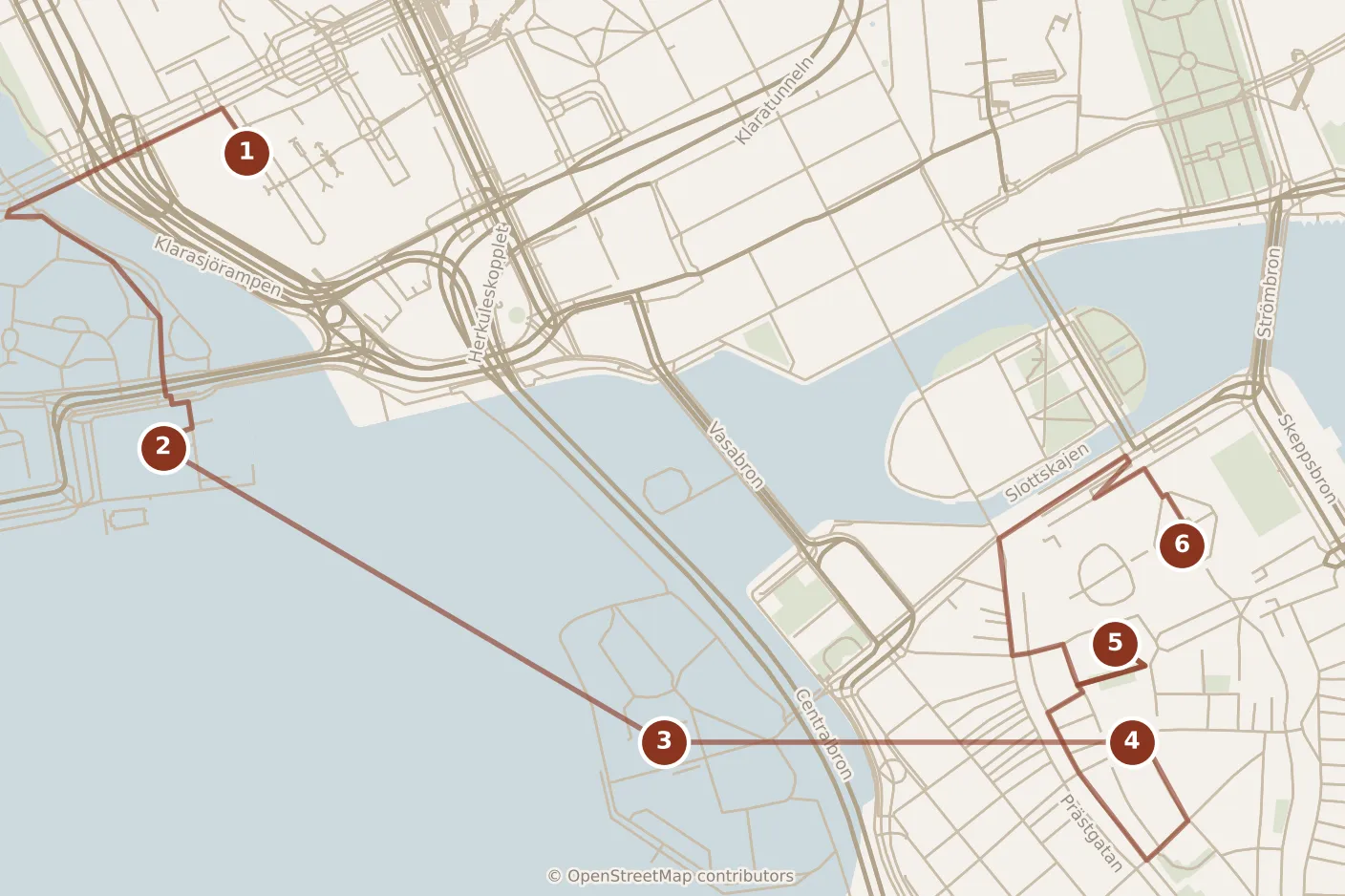
- Morning
- 1Stockholm Central Station
- 2Stockholm City Hall
- 3Riddarholmen
- 4Stortorget
- 5Storkyrkan
- 6Stockholm Palace
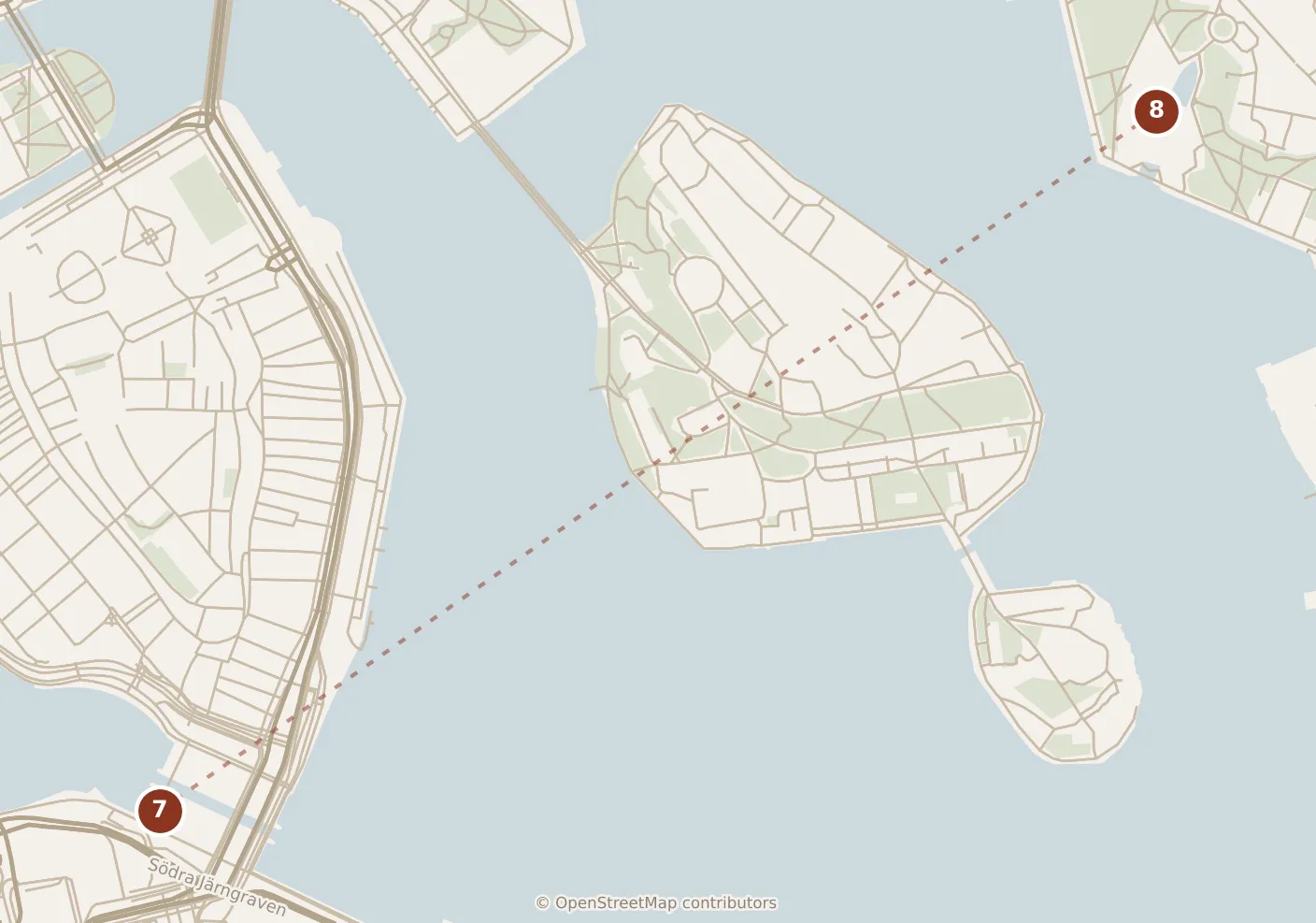
- Afternoon
- 7Slussen
- 8Vasa Museum
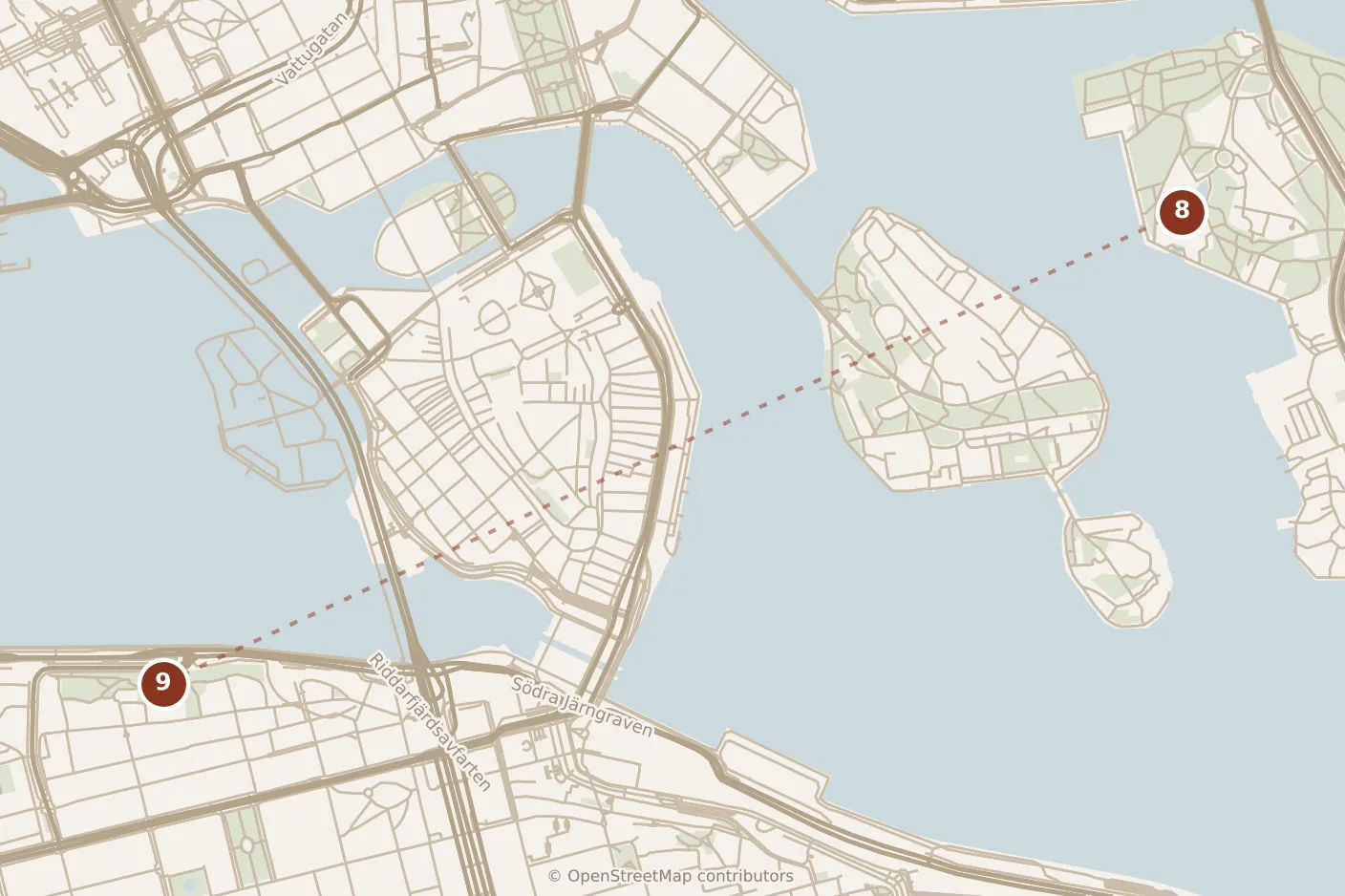
The leg out of the center: from stop 8 by boat, not on foot.
- Evening
- 9Monteliusvägen
Morning
Walk south from Stockholm Central Station and over the water — ten minutes at the outside — to Stockholm City Hall: the dark red brick block with the square tower and three gilded crowns on top, built between 1911 and 1923 to Ragnar Östberg’s design. You cannot simply walk into it. A guided tour is the only way in and it runs about forty-five minutes. The first English tour of the day left at half past nine in 2026, and how many follow it varies through the year — so build the morning back from the first one listed on your date, and if the hour has moved, build it back from the new one.
Two rooms carry the tour. The Blue Hall is not blue and never has been: Östberg drew it that way, then watched the bare red brick go up and left it alone, and the name outlived the plan. It is where the Nobel banquet is eaten each December. The staircase out of it climbs to the Golden Hall, eighteen million glass and gold-leaf tiles over every surface, with an enthroned queen holding the city small in her lap at the center of the scheme. Give the building an hour and a quarter including the wait, and walk out through the courtyard and along the waterfront terrace, both free and open, which look across Riddarfjärden to the cliff you will finish on. The tower is a separate ticket and 365 steps.
Local tip. Skip the tower. The view it sells you is the one this day gives you free at the end, from the cliff — and with the tower itself in the picture, which is the version worth having. A paid climb in the morning is an hour taken off the ship in the afternoon.
Twelve minutes east along the water is Riddarholmen, an island a few blocks across that held the nobility’s town palaces and now holds courts and archives, which makes it oddly empty for the middle of Stockholm. Riddarholmskyrkan at its center is the burial church of the Swedish monarchy; its openwork cast-iron spire replaced the original after lightning burnt it off in 1835. Walk through to the quay on the far side for the view back over Riddarfjärden. Fifteen minutes; the island, the spire and the quay cost nothing, and the church interior is ticketed and open only in the summer months.
Cross the bridge east into Gamla Stan and the ground changes under you: cobbles, ochre and oxblood render, lanes narrow enough to touch both walls. Stortorget is the square at the top of them, ringed with tall gabled houses and heavy with what happened in it — in November 1520 the newly crowned Christian II had some eighty of the Swedish nobility and clergy beheaded here over two days, the Stockholm Bloodbath. The old stock exchange on the square holds the Nobel Prize Museum, and one day is not the day for it.
A minute uphill is Storkyrkan, a brick Gothic hall inside a plain baroque shell, with two things in it worth the stop. Sankt Göran och draken is a carved group the size of a small room — knight, horse and dragon, cut by Bernt Notke in 1489, with real elk antlers used for the dragon’s spines. The other is Vädersolstavlan, a painting of Stockholm under a sky of false suns: the panel here is a copy made in 1636 of a lost original of 1535, which makes the image the oldest one of Stockholm in color. Twenty minutes.
Next door is Stockholm Palace, and for one day the honest advice is to look and not enter: there are several ticketed museums inside it, and none of them will beat what you are seeing after lunch. The guard changes in the outer courtyard and draws a crowd, but not on every day of the year — it is the one fixed hour on this route that is not yours to choose, so check whether it runs on your date and, if it does, put lunch after it rather than before. Eat in Gamla Stan knowing what it is: the busiest few hundred meters of the city, where the restaurants on the through-lanes trade on the address. Go one street off it, and order toast Skagen — prawns, dill and mayonnaise piled on fried bread — which is what a Swedish lunch looks like when it is not trying.
Afternoon
From the palace walk twelve minutes south down Skeppsbron, the quay along the whole eastern edge of the old town, with the harbor on one side and the back wall of the merchant houses on the other, to Slussen. Slussen has been a building site since 2016 while the entire interchange is rebuilt: the quay, the metro and the way up the cliff all work, the walk through is signposted, and it is simply not pretty yet.
Ferry 82 leaves from here for Allmänna gränd on Djurgården, several times an hour, about ten minutes across. It is part of the ordinary transport network rather than a tour boat, and it hands you the whole waterfront of the old town from the water, which is how this city was meant to be looked at. From the quay it is ten minutes on foot to the Vasa Museum, past the funfair and the edge of Skansen — two of the things this day gives up, and it gives them up in plain sight.
The Vasa is not really a museum; it is a building put up around a ship. She was a sixty-four gun warship, sixty-nine meters from beakhead to stern, and she went down on 10 August 1628 about thirteen hundred meters into her maiden voyage, inside the harbor, in front of the crowd that had come to watch her leave. She lay on the bottom for three hundred and thirty-three years and came up in 1961 with the hull whole, which is why you are looking at seventeenth-century oak rather than a reconstruction.
Six levels of gallery run round the hull and the way to see her is to walk them all, low to high, so that the ship rises past you. Give the hull itself an hour, and do not spend it on the bottom floor: close to five hundred carved figures are concentrated on the stern and the beakhead, and they are only readable from the upper galleries. The side exhibitions would take another two hours and mostly should not. The one worth half an hour is the one about the people who went down with her, because the skeletons came up too, and they have names and faces now. Two hours in the building; three if you read everything.
Evening
Take the ferry back to Slussen and climb. Monteliusvägen is a walkway of gravel and planking along the top of the Mariaberget cliff on Södermalm, some five hundred meters long, thirteen minutes up from the quay and the steepest thing on this route. It has benches and a railing, it costs nothing and it has no door to close, and it looks north over Riddarfjärden at the entire day you have just had: the spire on Riddarholmen, the City Hall tower, the roofline of Gamla Stan, the water between them.
This is the stop whose worth depends on the hour, and it is where the light band above stops being trivia. In summer there is no deadline at all — the sun is still up long after dinner, and the path is as good at ten as at six, so the count runs forwards from your tour and you arrive whenever you arrive. In the dark months it inverts: the light has gone by mid afternoon, so the climb moves ahead of the boat and the ship becomes the end of the day instead of its middle. That swap costs nothing, because the path and the ferry quay are the same place — you come down off the cliff and walk onto the boat. It does cost time, though, so a December day wants an earlier start, a shorter lunch, and ninety minutes with the ship rather than two hours.
Dinner is on Södermalm, in the streets a few blocks behind the cliff rather than on it. Köttbullar with lingonberry and cream sauce is the obvious order and it is obvious for good reason. Afterwards, Slussen is your station: two stops to T-Centralen, which is Stockholm Central Station and your bag, on either the green or the red line — both run there, and both call at Gamla Stan on the way.
Practicalities
Everything this route needs beyond a ticket to the three paid stops is a single SL travelcard, which covers the metro and ferry 82 alike; how to buy and load it is in the city guide, and there is nothing else to arrange.
Book the City Hall tour before you travel. It is the only way into the building, the tours are timed, and the English ones are a subset of the day’s list rather than all of it, so a summer walk-up can mean a two-hour wait or nothing at all. The Vasa is less strict, but a timed slot is what saves you the line in July; the adult ticket ran between 195 and 240 kronor in 2026, the higher figure in the summer months. Storkyrkan is the third ticket and needs no booking at all: adult admission ran at 120 kronor in 2026, audio guide included.
The hour this day genuinely rests on is the Vasa’s closing, because it decides the order rather than merely the pace. In 2026 the museum shut at five from September to May — eight on Wednesdays — and at six in June, July and August. Five is more than two hours later than a mid-December sunset, and that gap is what makes the winter swap above work: you can be on the cliff in daylight at two and still have the ship afterwards. If the hour has moved, do the same sum with the new one — compare the closing time against your date’s sunset, and put the outdoor stop on whichever side of the museum still has light in it.
This route survives a Monday, which is worth knowing if your one day falls on one: all three ticketed stops here run every day of the week. The interior most likely to be shut is Riddarholmskyrkan, which does not keep the same season as everything around it — and losing it costs you nothing this day was built on, since the island, the spire and the quay are all outdoors. Storkyrkan keeps plain daily hours and publishes no closure beyond funerals and other unforeseen events, so there is nothing there to plan the order around; if you do find it shut on the day, the square and the lanes absorb the half hour and you lose an object rather than a morning.
If you would rather not wait for a boat, tram 7 reaches the museum door from Kungsträdgården, getting off at the Nordiska museet stop. From where this route puts you it saves nothing: Kungsträdgården is thirteen minutes north of the palace, against twelve minutes south to the ferry at Slussen, and the boat is the better ride. The longest single walk on the whole itinerary is the thirteen-minute climb from Slussen up to Monteliusvägen, which is also the one real climb; nothing else here is more than a quarter of an hour from the last thing.


