Singapore in two or three days: Chinatown and the ridge, Kampong Glam and the bay, and a day in the east

Last updated 8 August 2026
Overview
A second day in Singapore does not add to the first one; it changes the subject. A single day here is a tour of the quarters — you cross from one immigrant community to the next, eat twice, and finish under the lit steel trees at the bay. Two days lets you stop touring and ask a question instead, and the question this article answers on its first day is how the people who arrived here with nothing actually lived, and what the state built to get them out of it. That runs from a rented cubicle inside a shophouse in Chinatown, through a clan hall on the old shoreline where a man could send money home and have his letters written for him, to a curved concrete balcony of 1936 in Tiong Bahru — and it ends on a wooded ridge above the port that brought every one of them. Day two is the half of the city a single day never reaches at all: the Malay quarter, the two big museums, and the bay taken slowly rather than at a jog. Little India is the quarter all three of these days leave out, and it is the first thing a fourth day in the center should take — the third day below goes east instead, and that is a choice rather than an oversight.
The days do not overlap and neither doubles back on the other. Day one runs steadily west, from Chinatown to Tiong Bahru out to the coastal hills, and then turns back east along a ridge to finish above the harbor. Day two runs the other way, from Kampong Glam south-west through the civic center and then out to the water. They share no stop and no station: the only thing carried from one to the other is the fare card.
Five things across the two days have a ticket: the museum of shophouse life in Chinatown, the palace museum in Kampong Glam, the two museums in the civic center, and the glasshouses at the gardens. Only the last of those is worth buying before you travel, because it is the only one with a line in front of it rather than a counter. A combined non-resident adult ticket to both glasshouses was in the forty-to-fifty Singapore dollar range in 2026; single-glasshouse tickets cost considerably less and the gardens sell both on their own site and at the desk. The third day, described at the end, adds no ticket at all — everything on it is a street, a temple, a park or an airport.
The one thing this route needs that you may not be holding when you land is a way to tap through an MRT gate: there are seven rides below, on four lines named in the days themselves — the East-West, the North East, the Circle and the Thomson-East Coast — plus whichever one takes you home from the bay at the end of day two. How fares are paid here is the parent guide’s subject rather than this one’s, and it is two minutes’ reading before you arrive.
Almost all of the first day rests on the light, and this is the one city on this site where the light is not a planning problem at all. A degree north of the equator the sun sets between about ten to seven at the end of October and about twenty past seven in the first half of February, and between those two dates it never leaves that band: half an hour of variation across a whole year, against five hours in a northern European city. There is no season in which the evening runs out early and none in which it lingers. What can wreck an afternoon here is not darkness, it is rain — an hour of it most days, and a stretch of days of it during the northeast monsoon — and the ridge at the end of day one is the only thing on these three days that a storm cancels outright. The shore on the third day is the other one it spoils.
So the first day is counted twice, from both ends, because it has two hinges pulling in opposite directions. The market it starts in is only a market in the morning, and the ridge it finishes on wants the last of the light, and those two facts are nine hours apart. From the market to standing on top of Mount Faber, everything below comes to about nine hours: four and a half in Chinatown including lunch, an hour and a half in Tiong Bahru, fifty minutes of trains and platforms, and a little over two hours on the ridge itself. The heritage center three minutes from the market admitted from ten in the morning in 2026, and an hour in the hall before it opens is what puts you at its door as it does — so start an hour before whatever that opening hour has become, and if it has moved, the market hour moves with it. Nine hours from a nine o’clock start puts you on top of the hill a little after six, which is three quarters of an hour before the sun goes at the October end of the band and an hour and twenty minutes before it at the February end — so give the top an hour if you are there in the autumn and closer to an hour and a half if you are not, and the day closes somewhere between seven and half past either way. That sum counts the time you spend inside places and walking between them and it counts nothing else: not the line at the glasshouse desk on day two, and not the three or four halts you will make for a cold drink and ten minutes of air conditioning. Here those are not slack in the plan, they are the plan.
Two days means a room, so the bag is only a problem on the day you arrive and the day you leave. The MRT stations have no lockers, which is the thing most people assume and get wrong here, but the city has three other answers and the nearest is usually the desk of the room you have booked, which will normally take a case before check-in and after checkout. Failing that, paid bag-drop points operate out of shops and hotel lobbies in the tourist quarters — several around Chinatown and several around Bugis, which is where day one and day two begin — at a few Singapore dollars for the day in 2026; and the airport terminals have baggage storage of their own for anyone arriving or leaving by air. Drop the bag rather than plan the days around it: day one’s evening is a wooded hill with steps in it, and there is nothing on it you would want to do holding a case. What is left is a preference and not a constraint — day two spends most of itself indoors and is the gentler of the two on the day you land — and it is the first of the two to give way, because the only thing that genuinely dictates an order is the date: day two cannot be a Monday or a Friday. The weekday paragraph at the end runs day one first and swaps only where the date makes it, and where that order and this preference disagree the date wins.
The first leg of all of it: from Changi Airport station the East-West Line runs into town with a change at Tanah Merah, and at Outram Park you change again onto the North East Line for one stop to Chinatown, coming up on Pagoda Street. Reckon on the better part of an hour, and on rather more if you have landed at seven in the morning and the trains are full of people going to work.
Day one

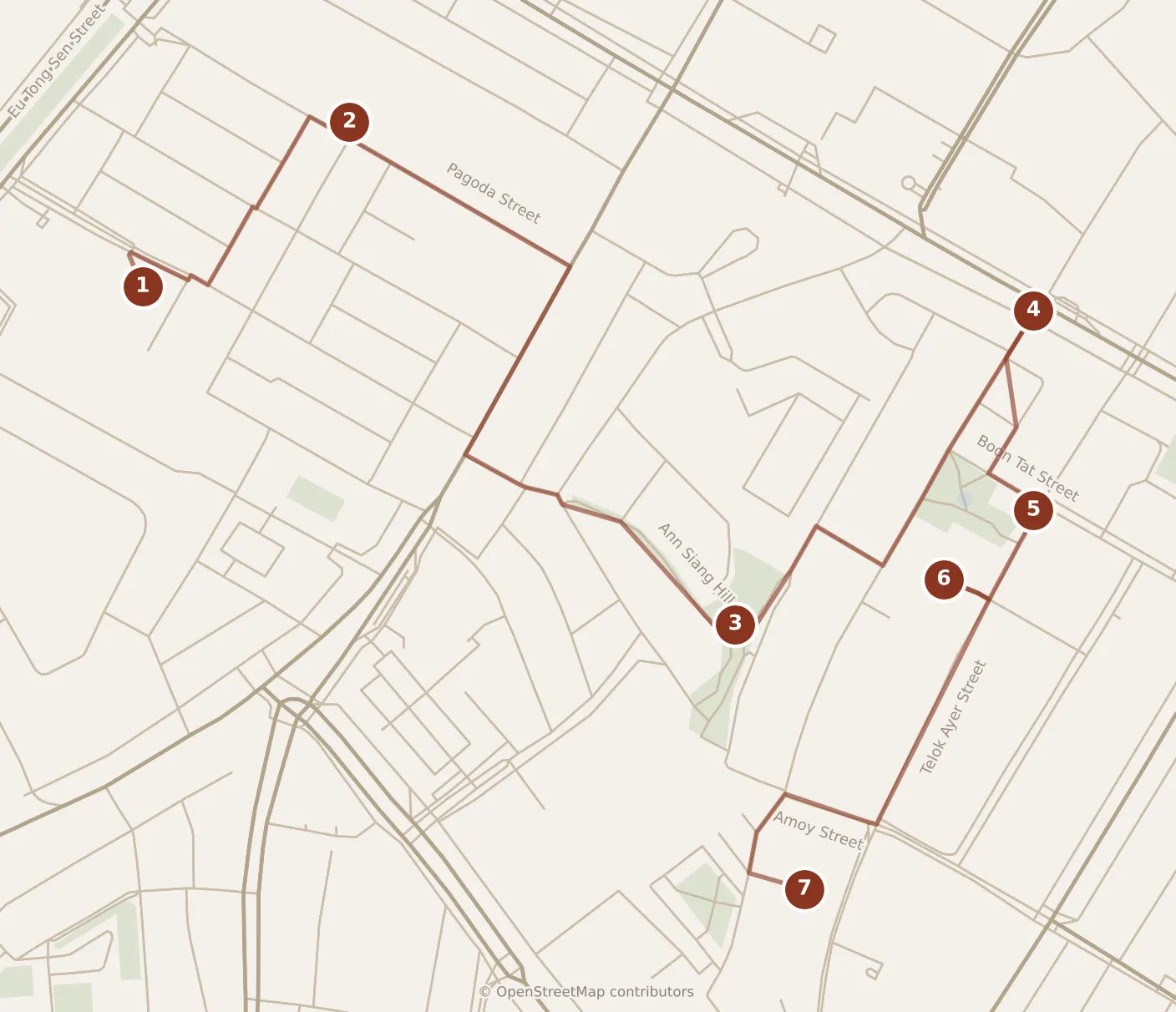
- Morning
- 1Chinatown Complex Market and Food Centre
- 2Chinatown Heritage Centre
- 3Ann Siang Hill Park
- 4Ying Fo Fui Kun
- 5Nagore Durgha
- 6Thian Hock Keng
- 7Amoy Street Food Centre
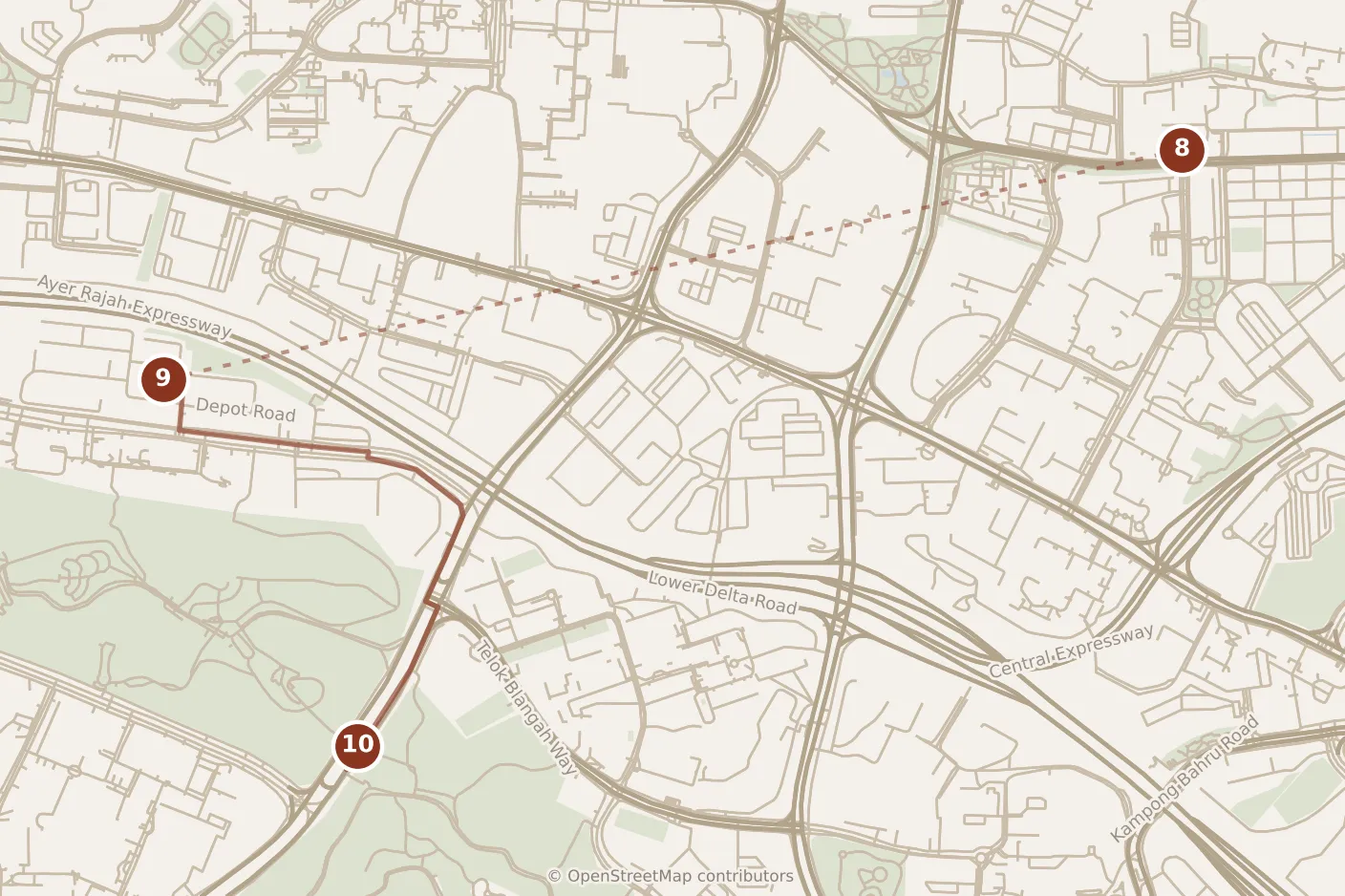
- Afternoon
- 8Tiong Bahru
- 9Telok Blangah Hill Park
- 10Henderson Waves
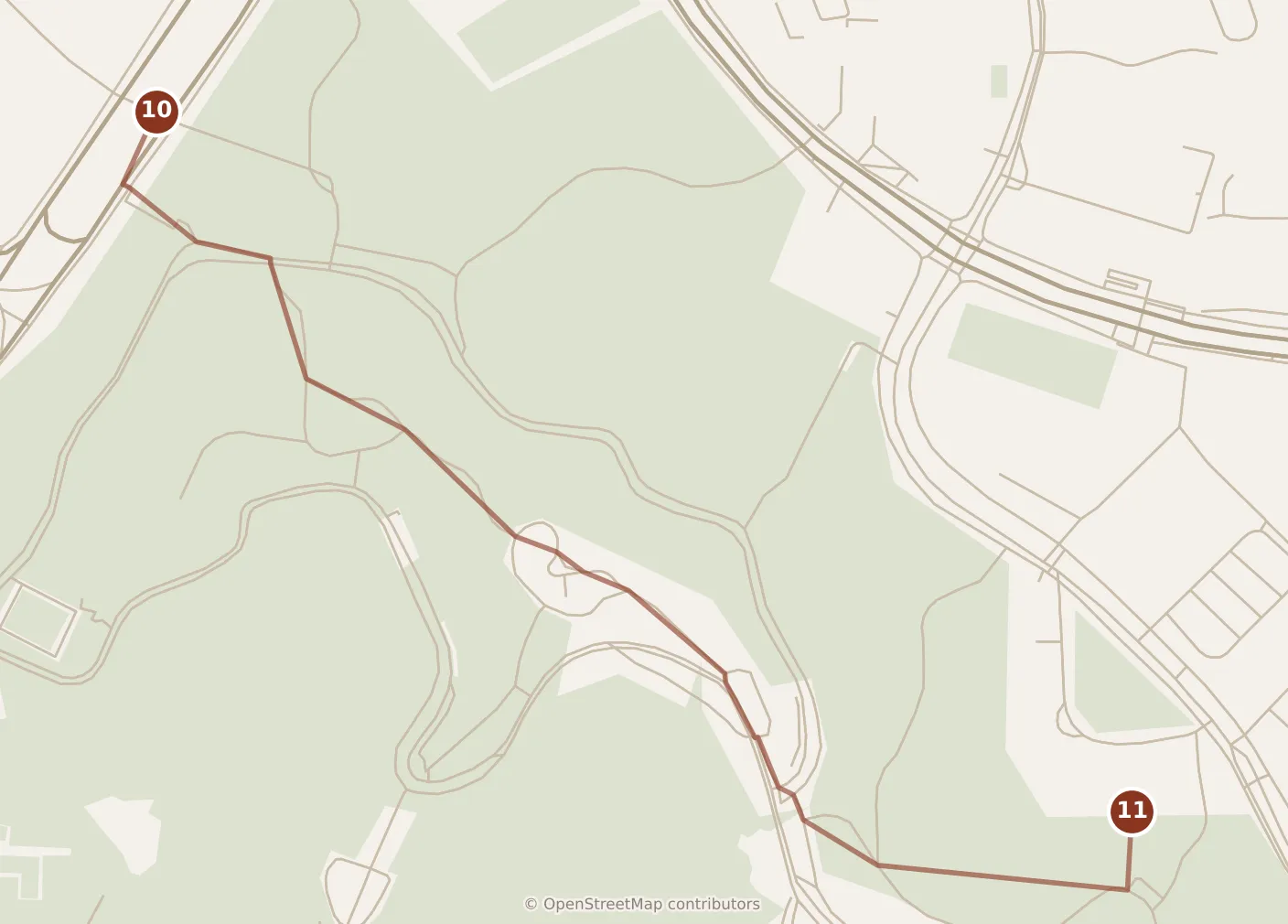
- Evening
- 11Mount Faber
Today is one street’s worth of argument stretched across four kilometers: where the people who built this city slept, where they ate, where they banked, where they prayed, and where the state finally rehoused them. It moves west across the city, then turns back east along the ridge, and it finishes above the port.
Morning
Start at the Chinatown Complex Market and Food Centre, on Smith Street, and start before the rest of this route is awake — the city itself has been at work for two hours by then, but the shophouse streets below have not opened. The ground floor is a wet market and the floor above it is the largest hawker center in the country — a low ceiling, several hundred numbered stalls, and a great deal of noise. The wet market is the reason to be here early rather than late: it is a market for two or three hours and a set of shuttered stalls for the rest of the day, and it is one of the few of this size left in the middle of the city. Eat upstairs while you are at it — there will be a breakfast stall or two open at that hour, and kaya toast with soft-boiled eggs is the thing to look for — and give the two floors an hour together. Individual stalls take their own rest days here, so a hall this size is never entirely open and never entirely shut, which is the argument for going to the hall rather than for a stall.
Two things nobody tells you before your first hall, and there are five of them on these three days. You claim a table before you get in line rather than after — a packet of tissues left on the seat is how it is done and it is understood — and you carry your own tray back to the return racks when you have finished. The second is a rule here rather than a courtesy: tray return has carried a penalty since 2021, and the racks are signed.
Three minutes away, on Pagoda Street, is the Chinatown Heritage Centre, and it is the single most useful hour on these three days. It occupies three restored shophouses over three floors, and what it has rebuilt inside them is what a shophouse was actually used for after the merchants moved out: a warren of plywood cubicles, each let to a family, sharing one kitchen and one tap. There are galleries on arrival and settlement and on the trades that grew out of the street, but the cubicles are the thing — you walk down a corridor past bedding, a sewing machine, a shrine and a suitcase, at the scale the people who lived there had. Give it an hour. Everything else today is a gloss on it.
Eight minutes east and slightly uphill, Ann Siang Road and Club Street run round the little park at the top of Ann Siang Hill Park. The hill was a nutmeg and clove plantation under two European owners before a timber merchant called Chia Ann Siang bought it in 1873 and gave it his name. What matters is what went on in the shophouses that went up here between 1903 and 1941: this was where remittance houses sent money back to China for men who could not write, and where letter writers and calligraphers sat under the covered five-foot ways and wrote home for them by the page. Club Street was the clubs and the clan associations. Half an hour of walking it is enough; the shophouses are restored to an inch of their lives and the interest is entirely in what they were for.
Five minutes down onto Telok Ayer Street, and the next five hundred meters carry three buildings put up by three communities who all came off the same boats. Ying Fo Fui Kun is a Hakka clan association that has occupied this plot since the middle of the nineteenth century and still does — a low courtyard house with an ancestral hall at the back, wedged between office towers that arrived a century later. A quarter of an hour, and understand what you are looking at: for a man with no family here this building was his bank, his post office, his hostel, his employment agency and his burial society, all of which were run by people from his own county because nobody else was going to run them.
Two minutes on is the Nagore Durgha, built between 1828 and 1830 by the Chulias, South Indian Muslims who worked this quarter, and gazetted a national monument in 1974. It is worth knowing before you go in that it is not a mosque any more and has not been for years: it reopened in 2011 as an Indian Muslim heritage center, so it receives you as a heritage center rather than as a mosque, which is the reverse of what its front leads you to expect; take your cue from whatever is asked at the door rather than from this paragraph. And the front is why it is here — four minarets, each built up in fourteen shallow layers under an onion dome, over an entrance with European columns on it, the whole thing white and narrow and squeezed between shophouses. A quarter of an hour, and note that it keeps a small institution’s hours rather than a mosque’s, so it can be shut when the street is busy. The façade is on the street either way.
Two minutes further is Thian Hock Keng, the Hokkien temple to Mazu, goddess of the sea. Give it twenty-five minutes and look for the thing the tour does not point out: the association that built it, the Hokkien Huay Kuan, is the same kind of institution as the Hakka hall you were standing in ten minutes ago, and it ran schools and cemeteries out of these courtyards for a century. People are burning incense in here rather than visiting: walk behind anybody bowing rather than across them, and do not put a camera into a shrine somebody is using.
Four minutes south is the Amoy Street Food Centre, and this is lunch. It is the office lunch of the financial district rather than a visitors’ hall, which means it fills from noon and thins after one. The route above reaches it in the middle of that, so budget three quarters of an hour and expect a fair part of it to be spent waiting in line — that is the price of a hall this good, and moving lunch earlier only moves you into the same crowd from the other side. The thing to eat is bak chor mee — minced pork, liver, vinegar, dry noodles, chili — which is a breakfast dish here and served all day. If you would rather eat the dish this city is most identified with, a hall this size will have chicken rice in it and probably several, and this is the lunch with room for it — the other two each name a dish of their own.
Afternoon
Now the second half of the argument. From Tanjong Pagar station, eight minutes’ walk from the food center, the East-West Line runs two stops west to Tiong Bahru; call the whole move twenty minutes.
Tiong Bahru is the first public housing the state ever built here, and it is why the cubicles you saw this morning are a museum. The Singapore Improvement Trust bought seventy acres in 1927 and finished its first block in December 1936, and the pre-war part of the estate is art deco of a very particular kind: long horizontal balconies wrapped round the corners of the blocks, curved stair towers, flat roofs. Residents called them airplane flats, and once you have been told that you cannot see them as anything else. Twenty of those pre-war blocks were placed under conservation in 2003 and they are still lived in, which is the point — this is not a heritage site, it is a neighborhood with laundry poles out. Walk the horseshoe streets rather than any single building, look into the ground-floor units, and find the civil air-raid shelter built into the base of one of the blocks around 1940, the only one of its kind left on the island; whether you can get inside it depends on whether a tour is running, and the estate is the sight either way. Finish at the market on the corner of Seng Poh Road, rebuilt in concrete in the mid-2000s on a site that has held a market since the 1940s: wet market below, which will have finished for the day by the time you get there, hawker stalls above, which will not have, and a line for a second breakfast at four in the afternoon. An hour and a half for all of it.
Then out to the ridge, and this is the awkward move of the day: one stop back on the East-West Line to Outram Park, one on the North East Line to HarbourFront, one on the Circle Line to Telok Blangah. Two changes and about half an hour, and there is no cleverer way to do it.
Telok Blangah Hill Park is up a slope from the station and it sits in the middle of the Southern Ridges, a ten-kilometer chain of hill parks joined by walkways; the chain carries on west past it, which is why the walk below goes out and back before turning east. A quarter of an hour up — it is a climb, and the first of two today, the path to the summit at the end being the other — and twenty minutes on the terrace garden at the top, which is the first place today you can see where you have been. Then the Forest Walk: 1.3 kilometers of steel walkway carried three to eighteen meters above secondary forest, so you are level with the canopy rather than under it, and out and back is three quarters of an hour. These hills have long-tailed macaques on them and the parks board’s own advice is the whole of what you need — nothing edible visible, no eye contact, and never try to take back something one has taken.
Fifteen minutes east along the ridge is Henderson Waves, and it earns the fifteen minutes you should spend standing on it. It is a footbridge of seven undulating steel ribs carrying a deck of yellow hardwood thirty-six meters above the road below, the highest pedestrian bridge in the country, opened in 2008. The ribs curl over the deck into alcoves you can sit inside, which is what the shape is for as well as what it looks like.
Local tip. The Forest Walk is the only elastic in this day and the only part of it you can lengthen or drop without moving anything else. From the station to standing on the summit is two hours and ten minutes with the walk out and back, and an hour and twenty-five without; the hour on top comes after that, and it straddles the sunset rather than ending at it. So reach Telok Blangah with three hours of light left — which is what the count above delivers at the October end of the band, and half an hour more at the February end — and take the walk; reach it with two and a quarter and go straight across to the bridge instead; reach it with less than two and the ridge itself has to go, and the answer is the cable car up from HarbourFront, which buys the hour on top and gives up everything before it. It is the same decision every time: how much ridge, not which ridge, and never how long you get on top.
Evening
Twenty minutes on from the bridge the path climbs to the top of Mount Faber, a hundred and six meters up and the last thing today. This is the stop the whole day was ordered around, and what it gives you is the working half of the island rather than the photographed one: the container terminals and their cranes, the ships lying at anchor in the roads beyond them, the cable car going out over the water to Sentosa, and the towers of the center small in the same view. A day that began in a wet market ends looking at the reason the wet market was ever there. An hour is enough in October and an hour and a half in February, for the reason the Overview gives: you arrive well before the sun goes and the whole value of the stop is being on top when it does.
Getting down is either Mount Faber Road on foot or the steps of the Marang Trail, eight hundred meters and seventy meters of descent; both come out at HarbourFront station, on the North East and Circle Lines, in about twenty minutes. There is a cable car station at the top too, running down to HarbourFront and on across to Sentosa; it is a paid ride at attraction prices, and it is the right answer if you would rather not take steps in the dark.
If the sky has gone black and stayed black, the ridge is off — an exposed steel bridge and a canopy walkway in a thunderstorm are not a wet version of themselves. The first fix costs nothing but has to be taken at breakfast rather than up here: if the morning’s forecast is a whole wet day, swap the days — take day two today and come back to the hill tomorrow, since day two’s middle is two museums and its end is two glasshouses. Standing on the ridge at four in the afternoon that swap has already gone, and it is not available at all onto a Monday or a Friday, for the reasons given at the end. What follows works from where you are actually standing. If you have only one evening and it is wet, then from Tiong Bahru take the East-West Line one stop to Outram Park and the North East Line one stop back to Chinatown, and give the evening to Ann Siang Road and Club Street with the shutters up. You walked that street at eleven in the morning when it was five hundred meters of restored joinery; at eight at night it is where the district drinks, and it is the same five hundred meters — though in the rain the drinking happens inside the shophouses rather than out on the sidewalk, and they are small and they fill early. That is a substitution rather than a repetition, and it is the only one on this day that costs you nothing to reach.
And if the day is simply too long — nine hours is long, and this is the longest of the three — cut the Forest Walk first, which is three quarters of an hour; then take Ying Fo Fui Kun and the Nagore Durgha as façades from the sidewalk rather than half an hour of stopping; then halve the hour in the market hall. That is an hour and three quarters gone, the day comes down to about seven and a quarter, and every stop is still on it. What must not be cut is the hour in the heritage center, because everything else today is a footnote to it, and not the hour on top of the hill, because losing that loses the reason the other eight were ordered the way they were.
Day two

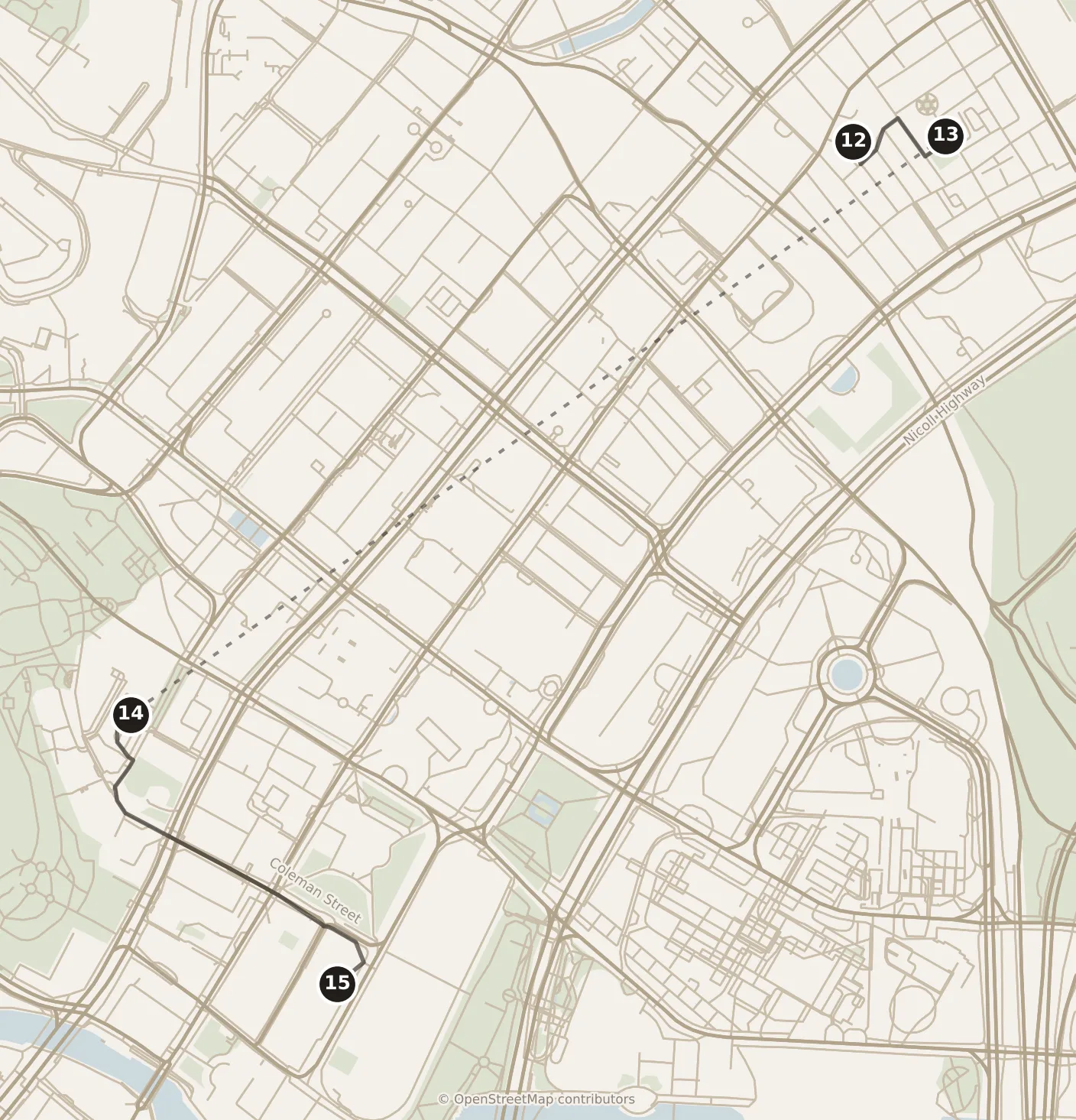
- Morning and afternoon
- 12Masjid Sultan
- 13Malay Heritage Centre
- 14Peranakan Museum
- 15National Gallery Singapore
- Evening
- Cloud Forest — in the prose, not on the map
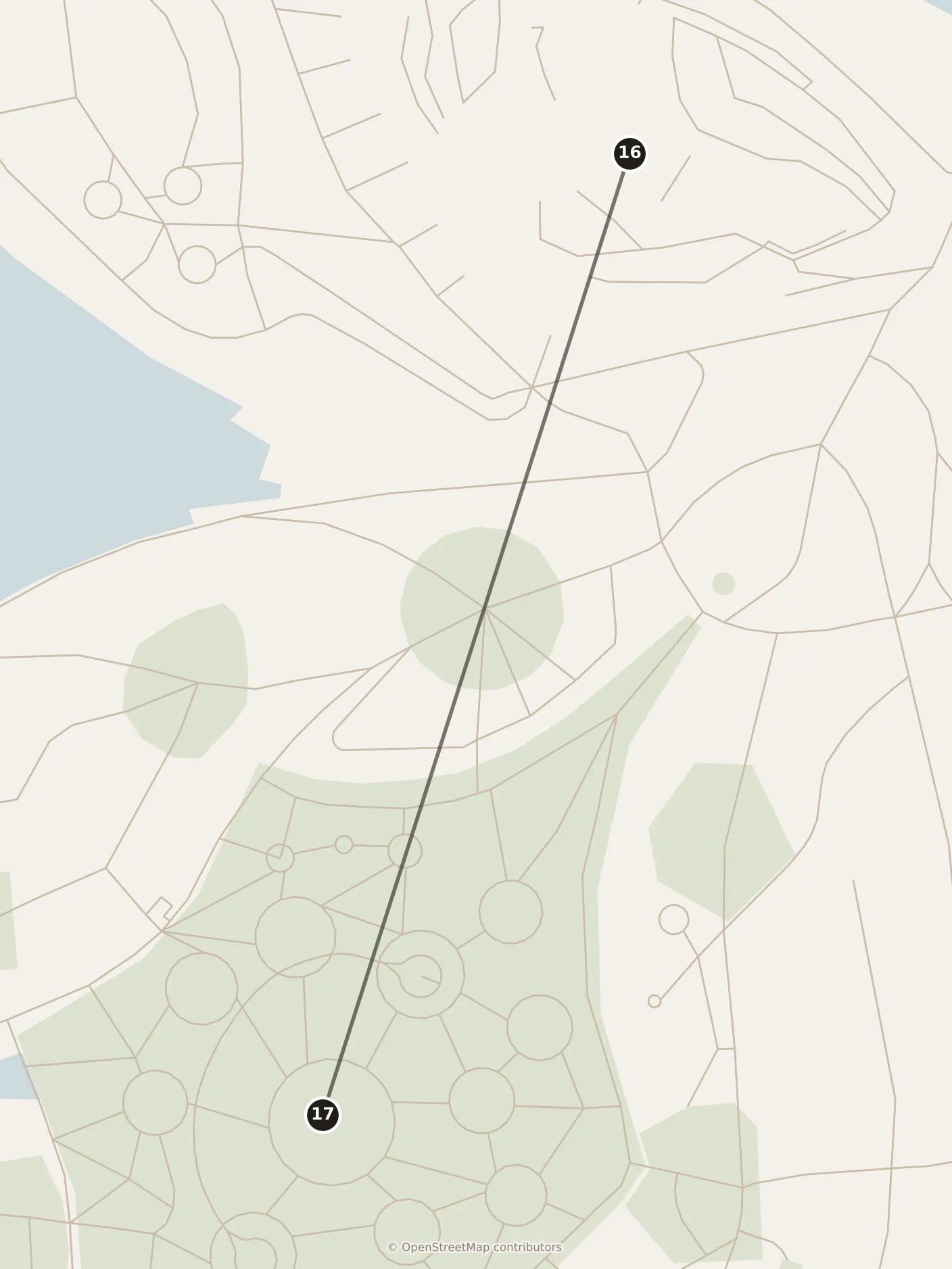
- 16Flower Dome
- 17Supertree Grove
Today is the quarter a single day in this city always loses, then the two buildings that hold what the country says about itself, then the bay. It runs south-west and then east and it never crosses its own path.
Morning
Start in Kampong Glam at Masjid Sultan, whose two golden onion domes are visible from three streets away. The first mosque here was a wooden building put up in the mid-1820s for Sultan Hussein Shah; what stands now was built between 1924 and 1932 in a heavy Indian-Islamic manner, and it has been a national monument since 1975. The detail worth walking round for is the dark band at the base of each dome, which is made of donated glass — the contribution of Muslims too poor to give money, so that everybody in the community had a piece of the building. Half an hour.
This is a working mosque and the conduct is not optional: shoes come off, and anyone with bare arms or legs is given a robe at the door to put on before going further. Visitors are received in the lobby and see the prayer hall from a marked area at the back of it rather than walking across it, and nobody is received at all during prayers. The mosque admits visitors in two short windows a day and none at all on a Friday, when the congregational prayer takes the middle of the day. In 2026 those windows ran from ten to twelve and from two to four, Saturday to Thursday — check them the week before rather than on the morning, and note that the half past ten start this day is counted from falls inside the first of them, which is all the day needs of it. If you cannot be at the door inside it, take the mosque from the street rather than folding it into the afternoon window: two o’clock is when the day below walks into the Peranakan Museum, and coming back here for half an hour costs you the National Gallery. The order inside this quarter is otherwise free; only the quarter’s place in the day is fixed. And on a Friday the mosque is two domes and a façade and nothing more, which is the second half of the reason day two is the one day of the three that needs a date chosen for it.
Spend twenty minutes on Bussorah Street and the lanes off it — palm trees down the middle, two stories of shophouse either side, and the mosque closing the end of it, which is the one deliberately composed view in this part of town. Then the Malay Heritage Centre, two minutes on, in the sultan’s own compound: a low colonial-looking palace of the 1840s, built for the family that signed the island away, reopened after a long restoration and now telling the story of the Malay community here through the objects it kept. An hour. This is one of the two doors that give day two the only date on these three days that is not free — it opened Tuesday to Sunday in 2026 and not on Mondays, the mosque you have just left being the other — and apart from those two, everything in Kampong Glam is a street.
Half an hour on Arab Street and Haji Lane before lunch. Arab Street is bolts of cloth stacked to the ceiling, rattan, and prayer rugs, and it is a textile street that survived; Haji Lane is a single alley two doors wide, painted end to end, and it is the most photographed and the least interesting fifty meters in the quarter — walk it once and do not linger. Lunch is here: nasi padang, chosen by pointing at a window full of dishes, or a murtabak, which is a folded pancake of minced mutton and egg the size of a dinner plate. Three quarters of an hour.
Afternoon
From Bugis it is one stop on the East-West Line to City Hall and eight minutes’ walk from there to Armenian Street; call it twenty-five minutes with the platforms. You can also walk the whole distance in about half an hour, and in this climate that is a choice rather than an obvious saving.
The Peranakan Museum occupies the old Tao Nan School, a 1912 building of tall shuttered windows, and it reopened in February 2023 after nearly four years shut. Ten galleries over three floors set out what the Straits Chinese made of themselves: a community descended from Chinese men who married locally over generations and produced something that is neither one thing nor the other and knew it. The two rooms that justify the ticket are the wedding gallery, built around a carved and gilded wedding bed brought over from a family in Penang and hung about with the objects of a twelve-day ceremony, and the Nonya gallery of beadwork and embroidered blouses, which is where the community’s women appear as makers rather than as subjects. There is a whole gallery of porcelain in implausible pinks and greens made in China to Straits taste. An hour and a quarter, and give the top floor less than the two below it.
Ten minutes south is the National Gallery Singapore, which is two buildings under one glass roof: the former Supreme Court of 1939, with its dome, and the former City Hall of 1929 beside it, joined and reopened as a gallery in 2015. It holds the largest public collection of modern art from this country and from the region around it, and the reason to give it ninety minutes rather than a whole afternoon is that its own two floors of Singapore painting are the part nowhere else has. Take those, take one gallery of the regional collection, and let the rest go without regret. Then go and find the fabric of the buildings, which is half the visit, free of charge inside the ticket, and inside the ninety minutes rather than added to them: the Supreme Court’s rotunda library, the holding cells below it, and the steps outside on the Padang, where the Japanese surrender in this region was taken in September 1945 and where a great deal of what followed was announced to crowds standing on the grass.
Evening
Esplanade station on the Circle Line is about ten minutes from the gallery and Bayfront is two stops — Promenade, then Bayfront — with signs from the platform to the gardens; twenty-five minutes all in. You can also walk it round the water in a little over half an hour, which is the better way to arrive and the worse way to arrive tired.
Two glasshouses stand side by side here, and a single day in this city forces you to pick one. This is the evening you do not have to. Take the Cloud Forest first: you go up inside it and come down through it, a false mountain in the wet with a waterfall dropping down the inside of the shell and montane planting — tree ferns, mosses, pitcher plants — hung on the rock as you descend. It is held cold and damp, which after a day of this climate is a physical relief and not only a horticultural one. An hour, and take the walkways rather than the exhibits at the bottom.
Five minutes across is the Flower Dome, which is the larger of the two, and dry and cool instead of cold and wet: olives, baobabs, succulents, and a changing bed of flowers in the middle that is the part locals come back for. Three quarters of an hour is honest. It is on this day because you have two days, not because it is the equal of its neighbor.
Local tip. Take the Cloud Forest before the Flower Dome. Not because it is the better of the two — it is, and the paragraphs above say so — but because the Flower Dome is the one you can walk out of half-finished without feeling you missed anything, and the show under the trees does not wait. Whichever glasshouse you are standing in when the clock runs out should be the one you mind leaving least.
Five minutes on is the Supertree Grove, and half an hour under it closes the day. They are steel towers between twenty-five and fifty meters high, and they are not decoration: they are planted up their flanks with ferns and bromeliads, some of them carry photovoltaic cells, and some are part of the ventilation of the two glasshouses you have just walked through. In 2026 a free light-and-sound show ran under them at a quarter to eight and again at a quarter to nine — the day above is built back from the first of those, and if the times have moved the method has not.
From the mosque door to standing under the trees, everything above comes to about eight and three-quarter hours, of which two and three quarters are the two museums, an hour and three quarters the two glasshouses, and fifty minutes trains and platforms. Start at half past ten, and the count lands you under the trees about half an hour before the earlier show. What it leaves out is the desk at the glasshouses, which is the one real line on these three days and the reason to have bought that ticket at home — that half hour is the margin it comes out of. This close to the equator the show is after dark in every month of the year, which is worth saying because in most cities it would not be.
If the day has to be shortened, drop the Flower Dome, then the Peranakan Museum — the second is a real loss and the first is not, and dropping both takes the day to under seven hours. Both ends of this day are pinned, though, so the two hours come off the start rather than the shape: begin at half past twelve instead, take the mosque from the street as the morning paragraph allows, since its first window has shut by then, and the evening still lands under the trees before the show. Dinner is after the show rather than before it: the gardens have their own open-air hawker center a few minutes east along the waterfront, and it keeps later hours than anything else out here. Bayfront station sits on the Circle and Downtown Lines, so wherever you are sleeping, one of the two starts you off.
With a third day

- With a third day
- 18Sri Senpaga Vinayagar Temple
- 19Koon Seng Road
- East Coast Park — in the prose, not on the map
- 20Jewel Changi Airport
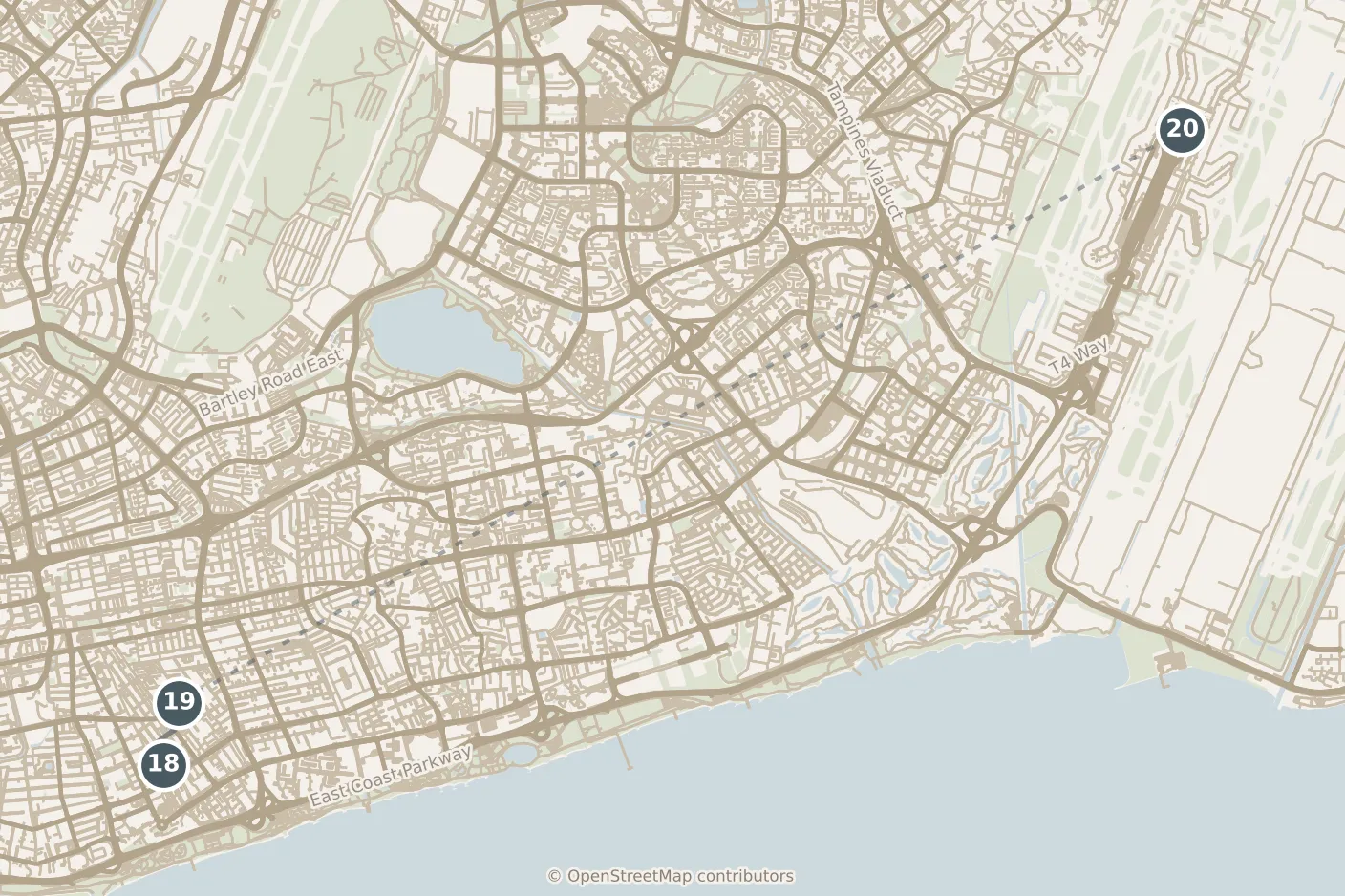
The third day goes east to Katong and Joo Chiat, and it is appended rather than inserted. Days one and two are the ones that have to happen; this is the one you would give up to a wet morning without much regret, because most of it is out of doors. What it adds is the community day two showed you in a museum, seen on the street it actually lived on — and, at the end, the sea and the ships that are the other half of day one’s argument.
Append it, and it is the day you fly out on, which is the real reason it goes last: Katong sits between the center and the airport, a taxi east along the East Coast Parkway takes a quarter of an hour, and by train you would go back into the city and out again, which is the long way round. Insert it between days one and two, and that advantage goes — your last day now ends at Bayfront at eight in the evening, which is fine for a night flight and no use at all for an early one. What also moves is day two, one day later, and day two is the only one of the three whose date is not free. That is the whole of the calculation and the weekday paragraph below does it for you.
Marine Parade, on the Thomson-East Coast Line, is the station: since 2024 that line has run out under the east coast, and it is about twenty minutes direct from Outram Park. Start at nine, the way day one starts — that puts you at the temple well inside its morning, and the only other clock on this day is your flight. Ten minutes’ walk brings you to the Sri Senpaga Vinayagar Temple on Ceylon Road, and this is the first stop rather than the last because, like the island’s other Hindu temples, it closes for the middle of the day and reopens in the evening. A Ceylonese Tamil settler found a statue of Vinayagar by a pond here in the 1850s, beside a chempaka tree — senpaga in Tamil, which is where the name comes from — and put a shelter over it. By 1909 there were three hundred Ceylonese Tamil families in the district and their association took the temple over in 1923; the building was bombed in the war, restored from 1949, and rebuilt from the ground in the late 1990s. What stands now is Dravidian, with a twenty-one-meter tower over the entrance and a musical pillar inside it, the first of its kind in this part of the world. Twenty-five minutes. Shoes off at the door, shoulders and knees covered, and do not photograph people at prayer.
Twelve minutes north is Koon Seng Road, which is the terrace everybody has seen: two stories of Peranakan shophouses in pistachio, rose and pale blue, with moulded plaster birds and flowers over the windows, glazed tiles set into the façades, and the low swing gates called pintu pagar in front of the doors. Half an hour, and cross the road to look at both sides, because the two terraces face each other and only one of them is ever photographed. Then walk back south down Joo Chiat Road for forty minutes. It is named after Chew Joo Chiat, a Hokkien landowner who was called the king of Katong and who handed a private road of his over to the municipality in 1917; the street now is bakeries, a wet market, textile shops and a great many places to eat, and it is the ordinary working version of what Koon Seng Road is the postcard of.
Lunch in Katong, and there is only one right answer to it: laksa, which in this district means a coconut and prawn broth with the noodles cut short so that it is eaten with a spoon alone. Three quarters of an hour.
Then the sea. East Coast Park is on the far side of the expressway from the neighborhood and you reach it through one of the pedestrian underpasses beneath it, about twenty minutes from where you have eaten. This is fifteen kilometers of reclaimed shore — every meter of the ground you are standing on was sea until the 1970s — and what makes it worth an hour and a half is not the beach, which is decent and gray, but what is on the water: a standing line of ships at anchor, dozens of them at a time, waiting their turn at the port you were looking down on from the ridge two days ago. There are bicycle-rental counters along the park and riding east is far better than walking it. Do that and you reach the open-air food village on the lagoon partway along, which is where satay is eaten here, over charcoal, at plastic tables, with the water in front of you.
To the end of the park the day comes to about four and a half hours, which is deliberately shorter than the other two, because it has a flight in it. If you are flying out, a taxi from the park is another quarter of an hour east along the same expressway, and Jewel Changi Airport is worth an hour and a half at the end of it, which brings the day to a little over six hours. It is a glass doughnut wrapped round a forty-meter indoor waterfall that drops through a hole in the roof into a basin below ground, opened in 2019, and it is on the public side of the airport, so you walk into it before you check in rather than after. Allow for the fact that it is genuinely large and that you will lose ten minutes finding your terminal afterwards. If you are not flying out, then stay on the coast instead and eat chili crab at one of the seafood halls along this shore in the evening, which is where the dish belongs and where people here come for it when there is something to mark.
Practicalities
Buy one thing before you travel and no more: the combined ticket to the two glasshouses on day two. The other four tickets on this route — the heritage center in Chinatown, the Malay Heritage Centre in Kampong Glam, and the two museums in the civic center — are sold at their own doors and at their own sites and have no line worth avoiding. Everything else across the three days is free to walk into: every temple, the mosque, the clan hall, the shrine, the market halls, both hill parks, the bridge, the top of the hill, the shophouse streets, the beach and the waterfall at the airport.
The weekday arithmetic is short, and only one of the three days is load-bearing. Day two must miss both Monday and Friday, and for two different doors: the Malay Heritage Centre closed on Mondays in 2026 and it is the only ticketed interior in Kampong Glam, so a Monday there leaves you with three streets and a mosque; the mosque admitted no walk-in visitors at all on a Friday, so a Friday there leaves you with three streets and a palace. Neither is a broken day and both are a poorer one, and of the two the Monday costs the longer hour. Day one and the third day take almost any date. The one exception is small enough to plan around rather than plan for: the shrine on Telok Ayer Street closed on Sundays in 2026, so a Sunday day one takes that front from the sidewalk — which is exactly what the day-one paragraph above already suggests doing when the day runs long. Nothing else on those two days has a closing day. The heritage center in Chinatown opened daily in 2026, and so did the gallery on day two; the clan hall and the temple on Telok Ayer Street keep the hours of the institutions that still use them rather than a museum’s; and a hill park has no door. Individual hawker stalls take a rest day each and the halls they stand in do not, so no market hall on this route is ever shut and none is ever entirely open. On the third day the temple’s closure is a daily midday one rather than a weekly one, which is why it goes first.
So the whole rule is one line — day two on anything but a Monday or a Friday — and the consequences are worth spelling out rather than leaving to be worked out. With two days, look at the date after the one you land on: if it is a Monday or a Friday, swap the days, because day one does not care and day two does. That makes a Sunday arrival the one that quietly breaks the trip if you do not swap — day one on the Sunday, day two on the Monday, and nothing warns you until you are standing outside a shut palace — and a Thursday arrival the same thing one door further on. With three days there is always an arrangement that loses nothing and still ends on the third day, and the proof of it is one line as well: Monday and Friday are never consecutive, so at least one of your first two dates is always free for day two. A Saturday arrival needs no thought at all — day one Saturday, day two Sunday, the third day Monday. A Sunday arrival wants the same swap the two-day case wanted: day two Sunday, day one Monday, the third day Tuesday, appended where it belongs and the fly-out ending intact. Whatever order you end up in, there is one test and it is the date day two falls on.
One other closure is worth checking yourself rather than taking from here: the gardens publish their own scheduled maintenance closures for each glasshouse separately, and that is the thing to look at the week before you travel, because it is the only ticket you will have bought in advance.
The rides are seven and all named above: the East-West Line from the airport with the change at Tanah Merah, the North East Line into Chinatown, the East-West Line again from Tanjong Pagar out to Tiong Bahru, the three-line hop from Tiong Bahru to Telok Blangah by way of Outram Park and HarbourFront, the East-West Line from Bugis to City Hall, the Circle Line from Esplanade to Bayfront, and the Thomson-East Coast Line out to Marine Parade on the third day. Everything else is walked, and the longest single stretch on foot is the Forest Walk out and back on day one at 2.6 kilometers, followed by the ridge from Telok Blangah Hill Park to the top of Mount Faber at about a kilometer and three quarters. Neither is the one that tells on your legs, though: the forty minutes down Joo Chiat Road on the third day is shorter than both and is walked on open sidewalk rather than under a canopy, which is what actually decides how a walk feels here. On the route as written, no walk on day two exceeds fifteen minutes; the two walks offered there in place of a train are half an hour each, and that is the whole of the difference between them.
Which leaves the heat, which is what these days actually cost you rather than the distance. It is hot and humid here every day of the year, and the three days above are built around that rather than in spite of it: day one puts its two hardest hours at the end, when the sun is off the ridge; day two puts its middle inside two museums and its end inside two glasshouses; the third day offers you a bicycle for the only part of it that is genuinely exposed. What none of that solves is the walking between stops, and the answer is the one everybody here uses — stop more often than you think you need to, drink more than you think you need to, and treat a spare hour as a reason to sit down in the cold rather than as room for another stop. Carry a small umbrella rather than a raincoat, which in this humidity is a sweatbox with a hood. An afternoon downpour is normal and usually brief; a monsoon surge that puts rain over a whole day is not, and the only thing on these three days it genuinely cancels is the ridge.


_-_img_02.jpg)
