Singapore in one day: two quarters, the old river mouth, and the bay after dark

Last updated 3 August 2026
Overview
One day goes further in Singapore than it does in most cities, and the reason is not especially flattering to the place: the island is small, the trains are quick, and the handful of things here that exist nowhere else sit within four kilometers of each other. The day below runs in one direction — Little India, then Chinatown, then the old river mouth, then the bay — and the only ground it covers twice is the five minutes back down Serangoon Road to the station. It takes the train twice; the ride in the middle of the day is three stops on one line.
What a single day costs you is the rest of the island. Kampong Glam, the old quarter of the Malay and Muslim community, is what most people would add if they had a second morning, and it is close enough that swapping it in for Little India is a legitimate way to write this day differently. Katong’s Peranakan shophouses are an afternoon on their own and they are on the wrong side of the city from everything below. Orchard Road is shopping, and that is not what one day is for. Naming a fifth temple is easy and useless.
The constraint that actually shapes a Singapore day is not distance, it is heat. It is hot and wet here every day of the year, and the instinct to walk between everything, which serves you well in a temperate city, will end the day early here. So the route walks under six kilometers in total, but it walks them in three short stretches — just over a kilometer before lunch, two kilometers in the afternoon, and 2.7 kilometers round the water in the evening — and it puts the worst of the afternoon inside a museum and a glasshouse, which are the two cold rooms on it. Anyone who says they walked Singapore all day spent part of it in a shopping center.
The stop this day is built around is the last one: a grove of steel trees that is worth little in daylight and remarkable once it is lit. This close to the equator the sun sets within about twenty minutes of seven o’clock every day of the year, which is the great planning convenience of the place — there is no season in which the light runs out early. Count backwards through everything above the grove and the day comes to about seven and a half hours: close to six inside the stops and over two meals, an hour and twenty minutes of walking, and a quarter of an hour on the train. That is the latest the light allows, but it is not the latest that works: both Hindu temples shut at midday and do not reopen until the evening, which pulls the real ceiling back to about half past ten. Nor is it the earliest — the market at the top of the route is a morning market, and the Chinatown streets are far more bearable before the middle of the day than after it. What the seven and a half hours does not cover is the line at the glasshouse ticket desk and the three or four halts you will make for a cold drink and ten minutes of air conditioning. In this climate those are not slack in the plan; they are the plan.
The day

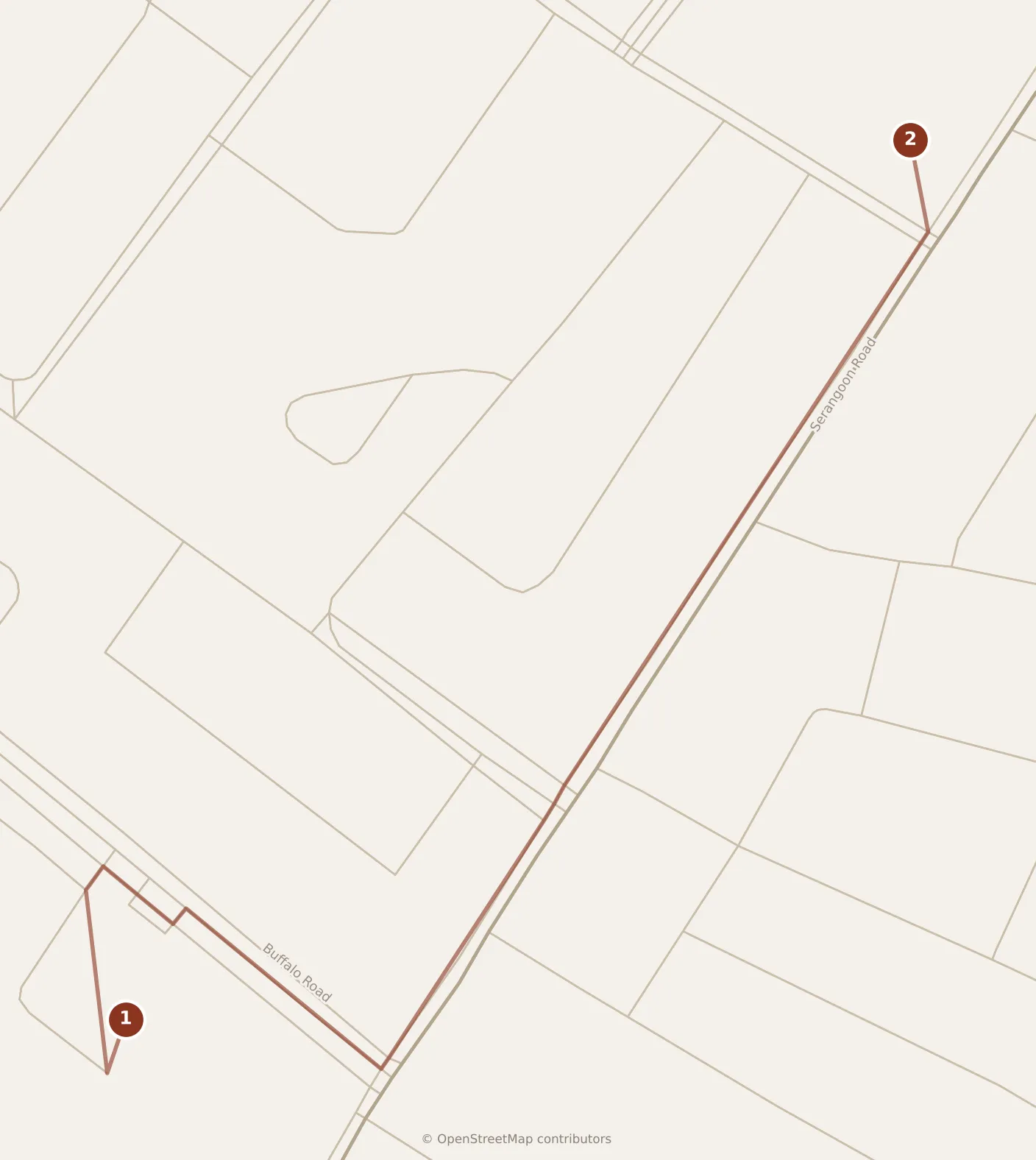
- Morning
- 1Tekka Centre
- Serangoon Road — in the prose, not on the map
- 2Sri Veeramakaliamman Temple
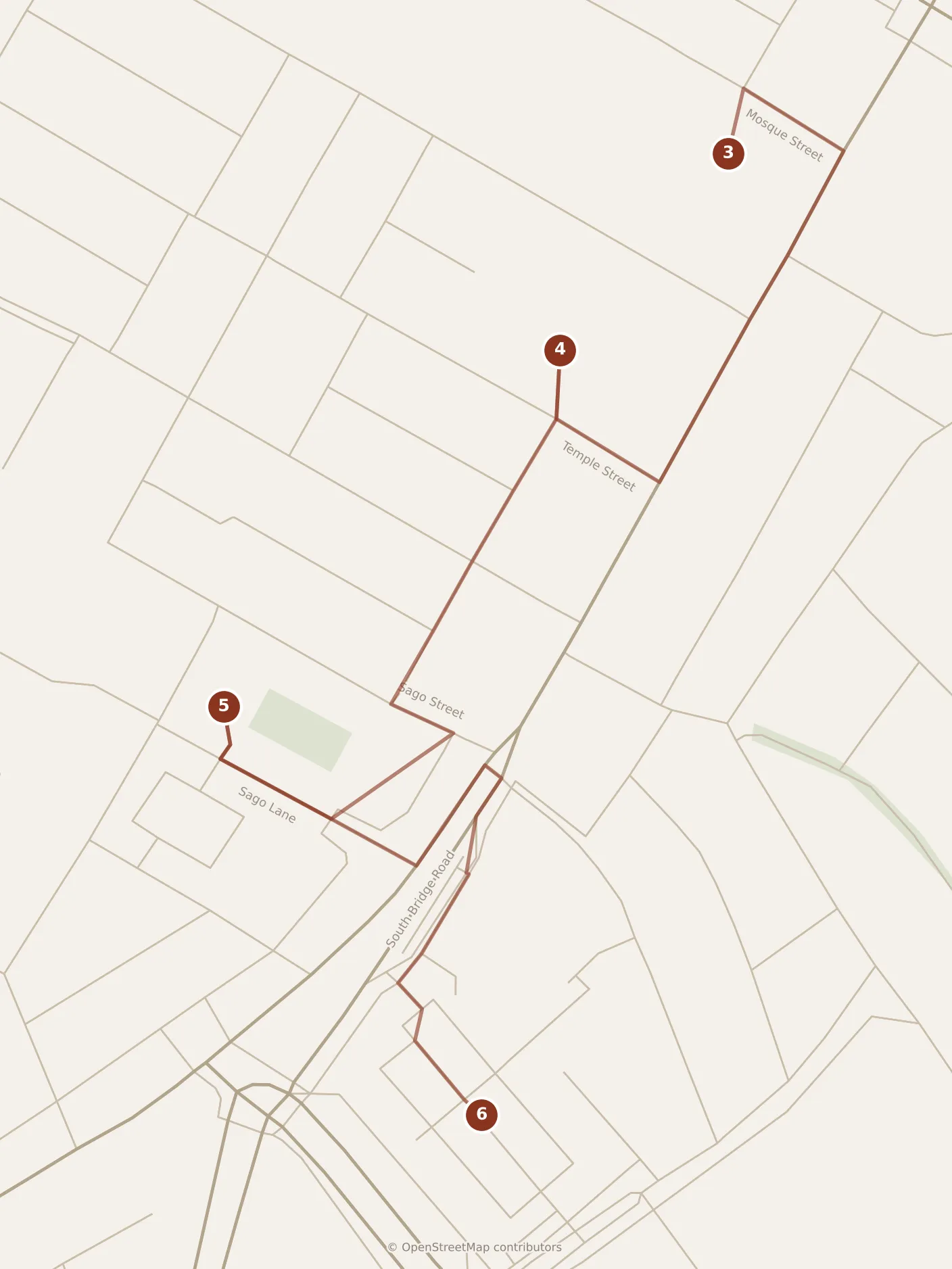
- Morning
- 3Masjid Jamae
- 4Sri Mariamman Temple
- 5Buddha Tooth Relic Temple and Museum
- 6Maxwell Food Centre
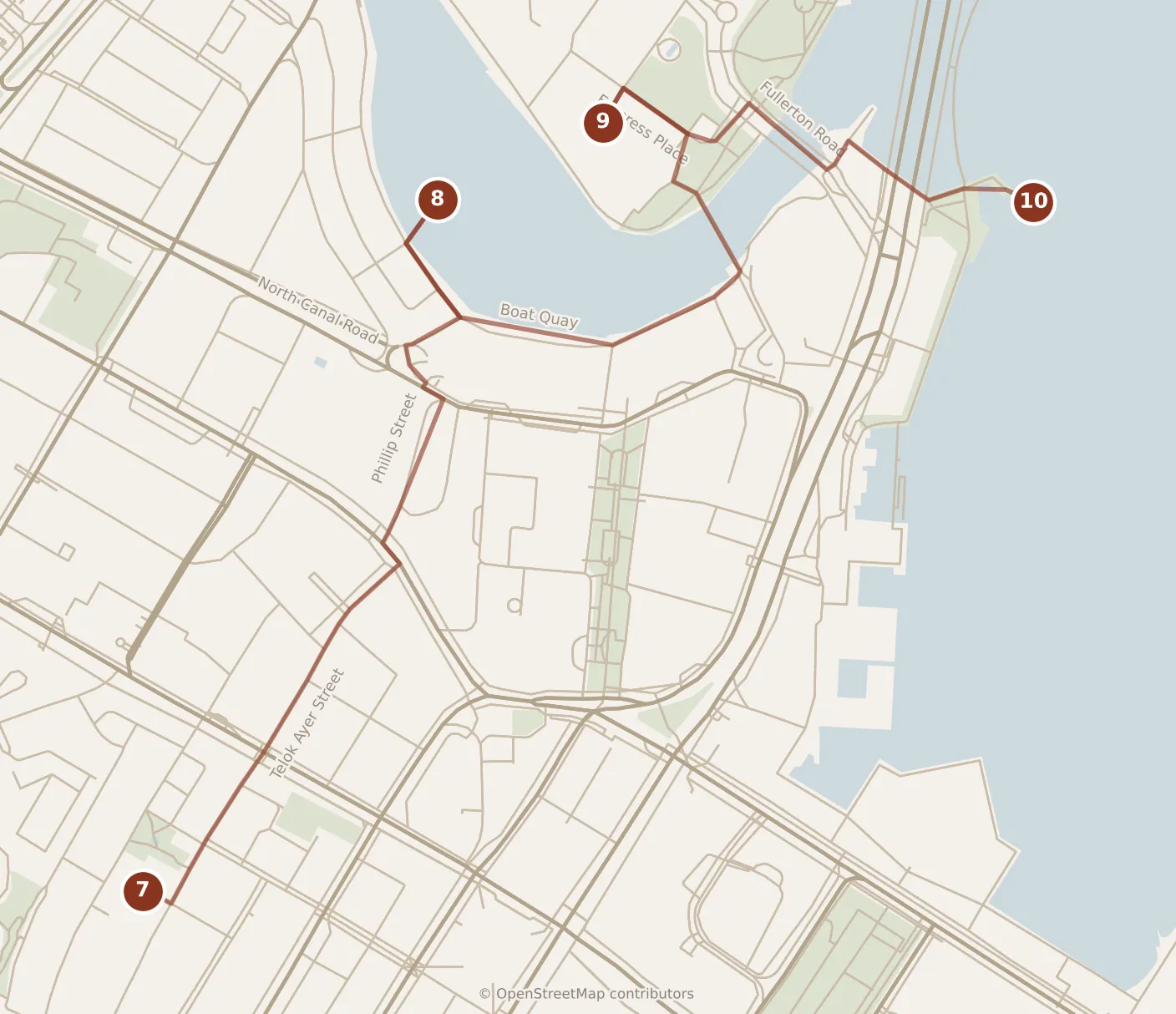
- Afternoon
- 7Thian Hock Keng
- 8Boat Quay
- 9Asian Civilisations Museum
- 10Merlion Park
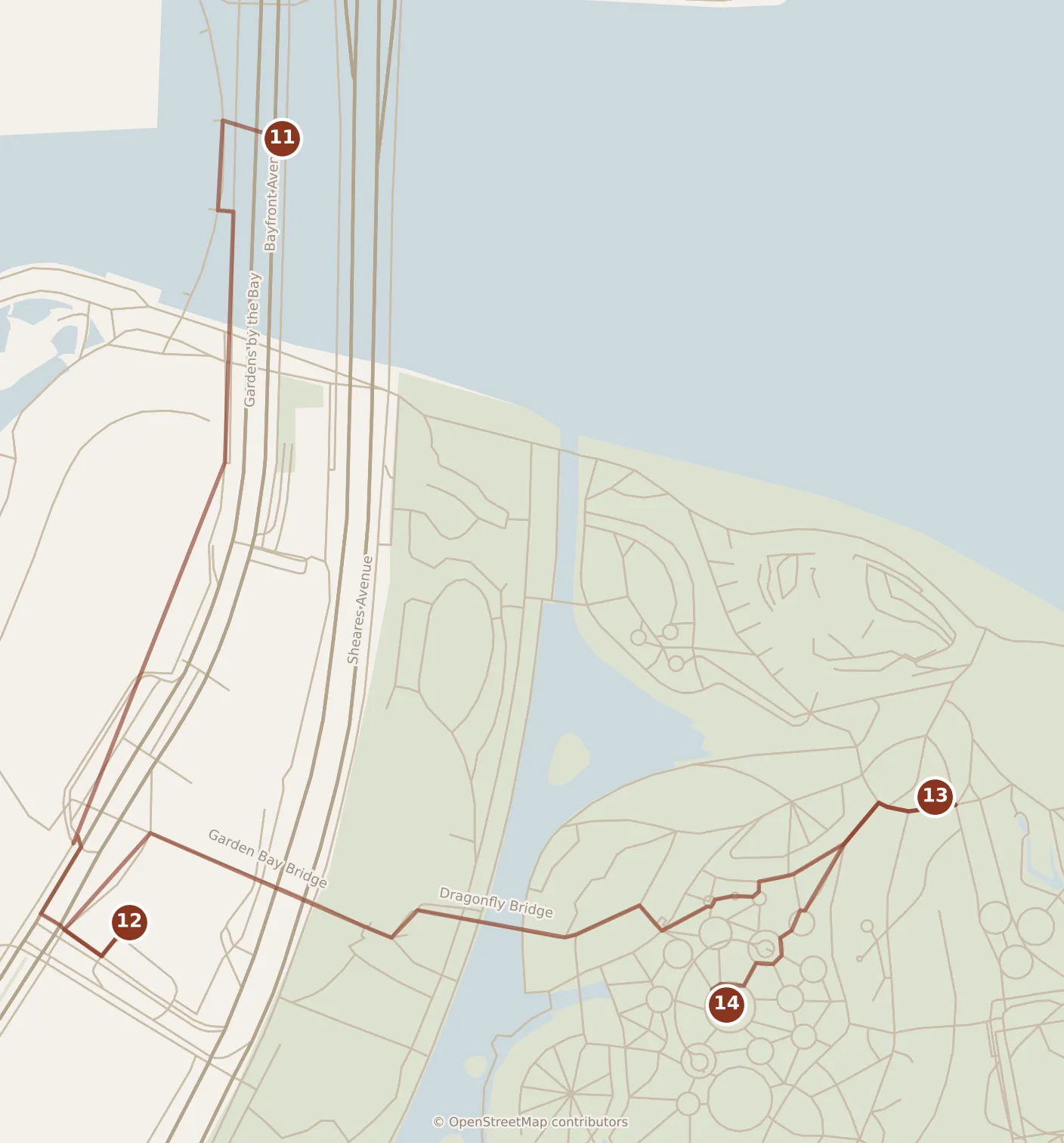
- Evening
- 11The Helix Bridge
- 12Marina Bay Sands
- 13Gardens by the Bay
- 14Supertree Grove
Morning
Start at Tekka Centre, the market hall at the bottom end of Little India, and start hungry. The first floor is a wet market — fish on ice, goat on the block, cilantro and curry leaves by the armful — wrapped around a hawker center where the South Indian cooking is as cheap as good food gets here: a dosa the size of a rolled newspaper, or roti prata torn into curry. Give it half an hour, eat standing or sitting, and go up to the second floor for two minutes to see the textile stalls, which is what the building looked like before the food took over.
Then walk up Serangoon Road, the spine of the quarter, for five minutes. This is the least sanded-down street on this route: garland-makers threading jasmine and marigold on the sidewalk, gold shops with their windows full, sacks of rice, and the smell changing every twenty meters. It is worth doing slowly, because the walking is the sight.
At the top of that stretch is the Sri Veeramakaliamman Temple, which belongs to Kali in her fierce aspect — the roof and the gate tower are a stacked crowd of painted figures, and inside she stands on the demon with a severed head in her hand. Shoes come off at the door and shoulders and knees stay covered, here and at everything else before lunch. Give it twenty minutes, and go in even if you think you have seen enough temples; this one is a working neighborhood shrine and there will be people in it.
Walk back down Serangoon Road — five minutes, the only stretch this day repeats — and from Little India station take the North East Line three stops to Chinatown: one ride, no change, and a few minutes underground.
You come up on South Bridge Road, and the next two hundred meters are the point of the whole morning. Masjid Jamae was built in 1826 by Tamil Muslim traders, and its street front is a pair of squat green-and-white gate towers in a south Indian idiom with a plain neoclassical prayer hall hidden behind them. Ten minutes is enough, and it is a working mosque: visitors are received outside the prayer times, which on a Friday take the middle of the day. Eighty meters further along the same sidewalk is the Sri Mariamman Temple, founded in 1827 and the oldest Hindu temple in the country, its gate tower six tiers of brightly painted gods and cows, and its courtyard full of people who have come to pray rather than to look. Twenty minutes. A mosque and a Hindu temple on one Chinatown street, with a Chinese temple ten minutes away, is not a coincidence arranged for visitors — it is what an immigrant port town looked like before anyone planned it.
Three minutes south is the Buddha Tooth Relic Temple and Museum, and it is worth knowing before you walk in that it was finished in 2007. It is red and gold and enormous and built in a ninth-century Chinese manner that is entirely deliberate; the tooth itself is upstairs in a chamber you view from a distance, there is a museum floor of Buddhist objects, and on the roof a garden with a prayer wheel the size of a small car. Give it half an hour.
Local tip. Wear shoes you can step out of standing up, and carry a thin scarf. The morning has four doors in it that want bare feet and covered shoulders, and the choice you are really making at the first of those doors is between walking into all four of them and standing in the street outside two.
Three minutes on from the temple is Maxwell Food Centre, and this is lunch. It is a plain covered hall of numbered stalls, most of them cooking one thing each, and the thing to have is Hainanese chicken rice — poached chicken, rice cooked in the stock, chili and ginger on the side, a plate that costs a fraction of lunch in the office towers two streets away. Give it an hour, and expect part of it to be spent in line. Yes, this is the second meal of the morning; you have been up a while, and eating twice before the afternoon is how the city works.
Afternoon
Six minutes east, on Telok Ayer Street, is Thian Hock Keng, built between 1839 and 1842 by Hokkien merchants and sailors and dedicated to Mazu, the sea goddess. The carpentry is the reason to go in — a timber frame assembled without nails, dragons along the ridge, granite columns shipped in as ballast — but the reason it is on this route is the address. Telok Ayer Street was the beach. Sailors came ashore here and thanked her within a hundred meters of the water, and everything between this door and the bay you finish the day on — the whole financial district, the reclaimed promontory, the gardens — is land that did not exist. Give it twenty minutes and then stand outside and look at where the sea used to be.
Fourteen minutes north brings you to Boat Quay, the first bend of the river, where the godowns that once unloaded the lighters are now a curved terrace of places to eat with the office towers standing straight up behind them. Do not stop; it is a five-minute walk along the water, it is prettier than it is interesting, and every door on it has someone outside with a menu.
Three minutes on, in Empress Place — an 1867 block of colonial government offices standing with its back to the river — is the Asian Civilisations Museum, and this is the one place on the route worth an hour indoors. The first floor holds the cargo of a ninth-century Arab dhow that sank off Belitung: more than sixty thousand pieces of Chinese ceramic, stacked inside storage jars for a market four thousand miles to the west and raised more or less intact. It is the single best object-lesson in why this coast has always been a place people sailed through. Give the whole museum an hour and a half; give it an hour if you go to the shipwreck and the export ceramics and let the upper floors go, which with one day is the right trade.
Eight minutes further and the river ends at Merlion Park. Ten minutes here and no more, and go with your expectations down: the creature was drawn in the 1960s as a tourism emblem, put up at the river mouth in 1972, and shifted a hundred and twenty meters in 2002 when a new bridge blocked the view of it. It is a mascot with a plaque. It is on this route because of where it stands — this is the seam between the river and the bay, and the view across the water to the towers and the hotel with the boat on its roof is the picture everyone has seen of this city, taken from here.
Evening
The last stretch is the longest: 2.7 kilometers round the bay, about forty minutes on the flat, and it is last precisely because it is the one walk you would not want at midday. Keep the water on your right and follow the promenade past the concert halls under their spiked shells.
You cross to the far side on The Helix Bridge, opened in 2010, whose structure is two steel helixes wound around the walkway so that you are inside a double spiral the whole way over. It has viewing platforms hung off it over the water, and they cost nothing to stand on.
The bridge lands you at Marina Bay Sands, and you walk under and through it rather than up it. The observation deck on the roof has its own ticket and its own line, and the view from it is the one view of this skyline that leaves out the building most people came here to look at. It is eleven minutes from the end of the bridge to the far side of it, and walking through is the correct amount of it to have.
Twelve minutes more and you are in Gardens by the Bay. Go into the Cloud Forest and give it an hour: a glass mountain wrapped in cloud with a thirty-five-meter waterfall falling down the inside of it, and — the honest reason it is on the route — a cool, wet, highland climate held in the mid-twenties, which is the best hour out of the heat on the route. The Flower Dome next door is larger and duller, and with one day you pick one.
Finish four minutes away, under the Supertree Grove. They are steel towers between twenty-five and fifty meters high, planted up their flanks with ferns and orchids, and they do nothing for you in the afternoon and a great deal once the light has gone and they are lit. Standing underneath them is free. There is a walkway strung between two of the trees twenty-two meters up which has a ticket, and the trees are better from beneath than from on top of, so save it. The lights come on around sunset, and there is a free fifteen-minute light-and-sound show, Garden Rhapsody, at a quarter to eight and again at a quarter to nine; half an hour at the grove takes you to the first of them. Bayfront station is ten minutes from where you are standing.
Practicalities
This route needs one thing you do not already have in your hand: a way to pay a train fare, because there are two rides on it — Little India to Chinatown on the North East Line, three stops, and whatever takes you home from Bayfront at the end. The first is direct; Bayfront is on two lines, the Circle and the Downtown, so wherever you go next one of them starts you off. How fares are paid here is in the city guide rather than repeated in this one.
Two stops have a ticket: the museum on the river and the conservatories at the Gardens. Neither needs booking weeks in advance, but the conservatories are the one desk on this route with a line at it, and buying before you arrive removes the only genuine wait in the day. Everything else — every temple, the mosque, the market, the hawker center, the grove itself — is free.
The museum is also the single stop that could be shut on the day you come: it closes on Mondays. Check that one thing before you set out, and if your day is a Monday the afternoon simply loses an hour and a half and you arrive at the bay in daylight with time to walk further round it, which is no hardship. Singapore’s Hindu temples generally close for a few hours in the middle of the day, which is why both of them sit in the morning here rather than after lunch; if you invert the order of the day for any reason, that is the second thing to check.
Five buildings on this route are places of worship and want covered shoulders and knees. The four before lunch also want bare feet — at the door in the two Hindu temples and the mosque, and upstairs at the relic chamber in the fourth. There is nothing to buy or rent for this: a shirt with sleeves, trousers or a long skirt, and shoes that come off without a struggle.
An afternoon downpour is normal here and usually brief, though a monsoon surge between December and early January can put continuous rain over a whole day. The route has three indoor stops — the temple with the museum floor, the museum on the river, the glasshouse — and if the sky goes black, moving one of them earlier costs nothing, because no single walk on this day is longer than fifteen minutes — it is only the last stretch that strings four of them together.


