Shanghai in two or three days: the east bank, the Bund from the inside, and Hongkou

Last updated 8 August 2026
Overview
Two days in Shanghai is not one day with more of the same in it. A single day here is spent almost entirely on the west bank and almost entirely in the open: concession lanes, the old city, the waterfront at dusk. It is a good day, and it leaves out two whole categories. The first is the far bank — the towers you spend that evening looking at from a distance, and the part of the museum collection that moved across the river to sit underneath them. The second is interiors. The Bund is a mile of banking houses, and a short trip walks past every one of them without going into any.
So these two days go where the short one cannot. Day one crosses to the east bank, spends the morning in a museum and the evening five hundred meters up, and comes back under the river. Day two goes inside the Bund — one hall, and it is the one worth going in for — and then north into Hongkou, which has the strangest twentieth century of any district in the city and nothing on this route that asks you to look at a skyline.
These two days also assume something you may not have had: the short day itself. If Shanghai is a single stop and you have three days in it, run the one-day route on this site first and take these two after it — the third day below goes up Suzhou Creek, and it does not stand in for the old city and the concession lanes that the short day is made of.
One decision comes before the rest and it is a weekday. The east building of the museum was taking its weekly closure on a Tuesday in 2026 — not a Monday, which is what most state museums in China take, and which is exactly why this one is worth checking rather than assuming. If your first day lands on the day it is shut, run the two days in the other order; why that works is at the end.
Day one is built around the light, so it needs the hour the sun goes down. The earliest sunset of the year here falls about ten minutes before five, in the last days of November; the latest is three minutes past seven, in the last week of June. China keeps one clock all year and never moves it, so that is the whole of the variation, and your month sits somewhere between the two. From the museum door to standing on the observation deck comes to about five and three quarter hours on the recommendations below — three hours in the galleries, half an hour of metro and walking, an hour for lunch, three quarters of an hour on the promenade, and half an hour to walk over to the tower and get up it. Count that back from your own month’s sunset and you have the latest hour you can start.
The count works at both ends of the band, so nothing about the light forces you out early: in late November it starts you soon after the galleries open, in June it starts you after lunch. What binds is the light rather than the door. The galleries stopped admitting at five in 2026 and the building shut at six, so three hours inside means being through the door by three — and in every month of the year your own sunset has already sent you in earlier than that. In the long months take the morning anyway rather than the lie-in the count permits, and give the three spare hours back to the galleries and to the promenade; the river light before the deck is the best free thing on this itinerary. And note what the five-and-three-quarter-hour sum leaves out: it measures time spent inside places and on your feet, and the line for the elevator — which is where this day’s waiting is concentrated, and which nobody can predict — is not in it. That line is the whole argument for holding a timed slot rather than turning up.
Two things want booking before you arrive and both are on day one. The gallery slot at the east building was free in 2026 and still had to be reserved; the observation deck’s ticket was in the hundred-and-fifty to two-hundred-yuan band that year, and the slots for the hour before sunset are the ones that go first. Both are held against your passport number and the passport is what you show at the door, so a booking made in somebody else’s name is not a ticket. A third day, if you take one, adds no advance ticket at all. The one capability this route needs that a wander round the old city does not is being able to make those two bookings from abroad — the parent guide covers the payment apps and the blocked-app problem that stand behind that, and it is worth reading before you fly rather than after.
The first leg is the easiest arrival in the city, because day one is on the same side of the river as the international airport. From Pudong airport take the Maglev to Longyang Road — eight minutes — and then two stops west on Line 2, Century Park and then Shanghai Science and Technology Museum. If you come in to Hongqiao, at either the airport or the railway station beside it, Line 2 runs the whole way east without a change; it takes the better part of an hour, and it is the same line you will use tomorrow.
The bag is a day-one problem rather than a first-morning one, because you sleep on the west bank and day one is on the east. Left luggage in this city lives at the railway stations and in the airport terminals, not at the sights, so the counter you want is the one where you land: a terminal at Pudong if you fly in there, or the one at Hongqiao Railway Station if you arrive at Hongqiao, since it sits on the same Line 2 as everything else here. Whichever you use, the bag stays there until you go back for it, and day one ends across the river on the west bank — so unless your hotel will hold it before check-in, weigh that return trip against simply carrying it. The museum puts your bag through a scanner and then round six floors with you, and the elevator line at the tower is not a place to stand with a case.
Sihang Warehouse, M50 — not on the walking map.
- With a third day
- 14Sihang Warehouse
- M50 — in the prose, not on the map
Day one

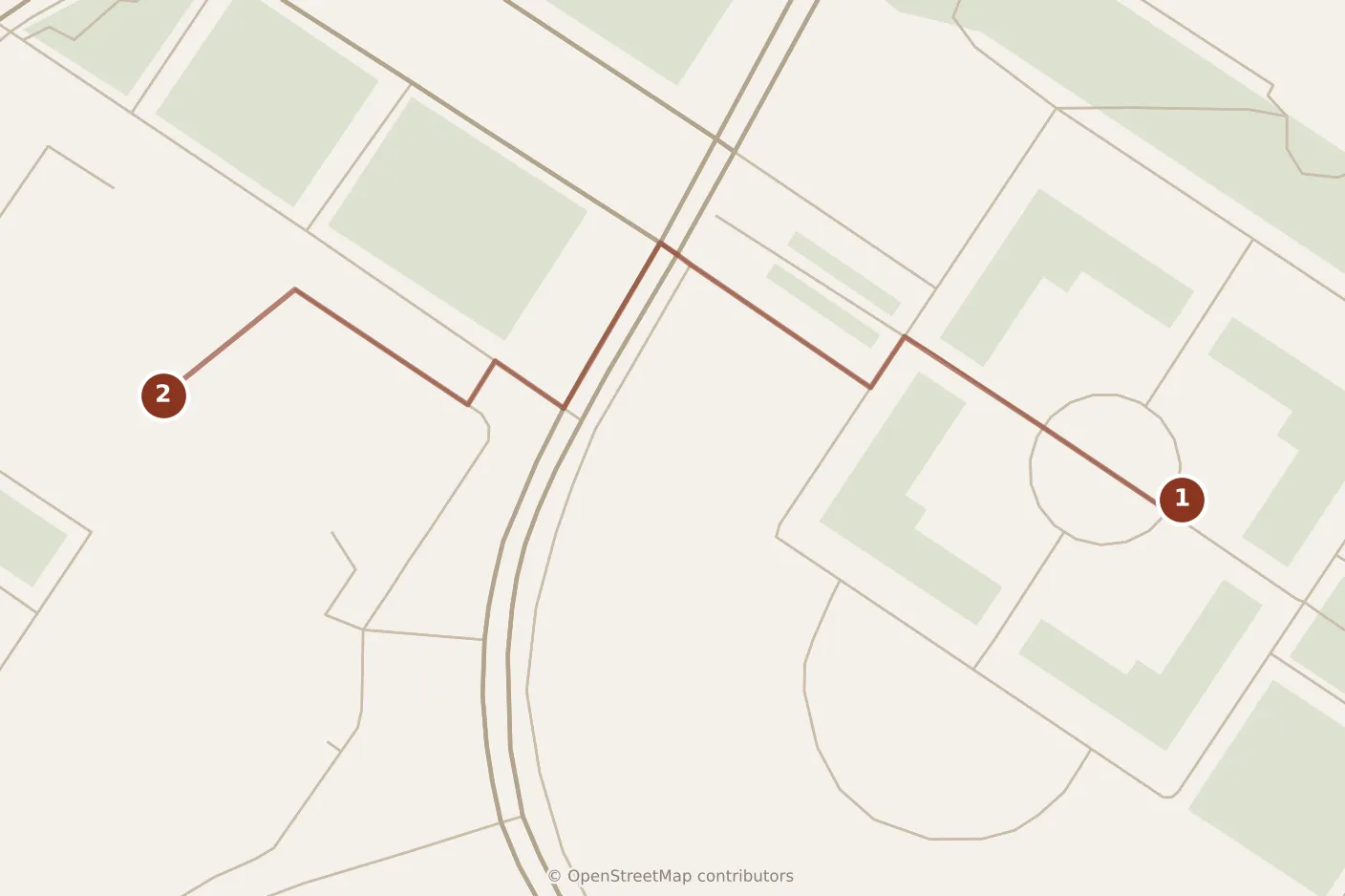
- Morning
- 1Shanghai Science and Technology Museum station
- 2Shanghai Museum East
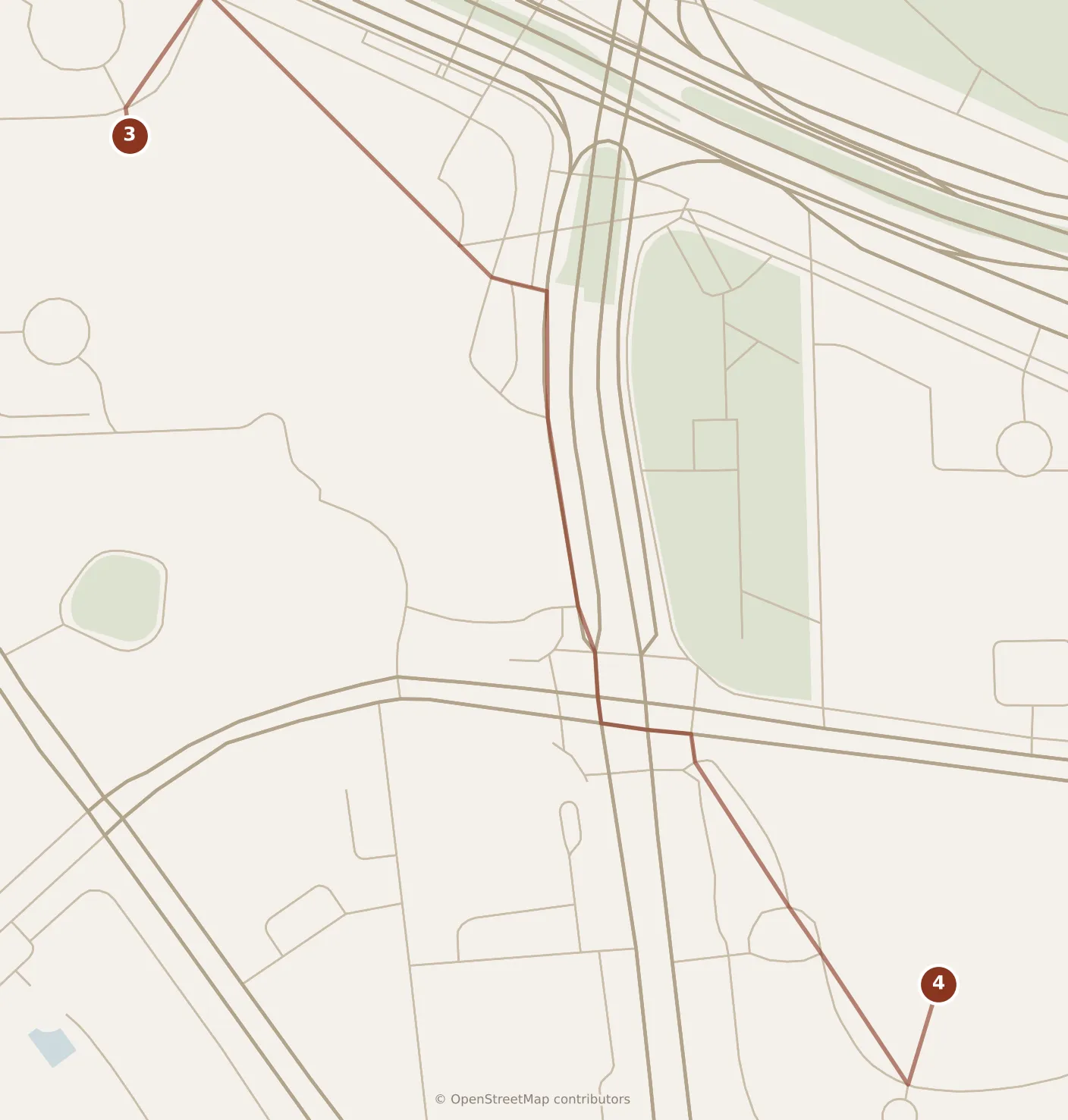
- Afternoon and evening
- 3Lujiazui
- 4Shanghai Tower
Everything today is on the east bank, and the day is really two places with a metro ride between them: a museum four kilometers inland, and the tower district on the river.
Morning
Come up at Shanghai Science and Technology Museum station, on Line 2, and walk under ten minutes west to Shanghai Museum East. This is the second home of a collection that used to sit entirely on the other side of the river, and it is the reason a two-day trip can contain a museum at all. The bronze gallery opened here in February 2024, the sculpture a month after it, the calligraphy in November, and the building was declared complete that December; it has roughly twice the floor area of the original.
Give it three hours and be ruthless about which three. The bronzes are why this collection is famous, and they are the first hour: ritual vessels of the Shang and the Zhou, cast in assembled clay moulds rather than beaten out, carrying a dense animal ornament that resolves into eyes and jaws once you know to look for it, and inscribed on the inside of the bowl where nobody was ever meant to read them. Then pick two more galleries and walk past the rest. The mistake here is the one every very large museum invites — trying to see all six floors, and arriving at the best of them with no attention left. Skipping is not a compromise on this day, it is the plan.
Bags go through a scanner at the door, as they do at every metro entrance in this city, so what you are carrying decides how pleasant the first twenty minutes are.
Afternoon
Back to the station and three stops west on Line 2 — Century Avenue, then Dongchang Road, then Lujiazui, which is the stop for the tower district. Lunch is easier in the malls at the foot of the towers than the street outside suggests: this is a district built for offices, and it feeds office workers well and fast. It is also the meal to spend on the city’s own two dumplings — xiaolongbao, the soup ones, and shengjianbao, pan-fried and heavier — because neither of these two days goes near the old city, which is where a single day in Shanghai eats them.
Then walk about five minutes down to the riverside promenade and turn along it. This is the view a single day in Shanghai gives you from the opposite direction, and it is worth taking as the reverse of it — from here the mile of granite banking houses across the water reads as one continuous wall rather than as a street, which is what it was built to look like from a ship coming up the river. Give the promenade three quarters of an hour, north and then back. Somewhere behind you the Oriental Pearl Tower stands on its concrete legs; you are not going up that one, and the reason is the next paragraph.
Evening
A quarter of an hour east and inland brings you to Shanghai Tower: 632 meters to the top, finished in 2014, and rotated a hundred and twenty degrees between its base and its crown — a shape chosen to spill the wind rather than to be admired, and the reason it has looked like a different building from every angle you have seen it at today. The deck is on the hundred and eighteenth floor, at 546 meters. It stopped admitting at half past eight in the evening in 2026, which is what makes the midsummer version of this day possible at all, since a sunset three minutes past seven sits comfortably inside that. If the last admission has moved, the method survives: all it has to be is later than your month’s sunset, and if it is not, the promenade below gives you the same hour of light for nothing.
Local tip. The deck’s slot is timed and the promenade is not, so take them in that order — promenade first, deck second. If the slot turns out later than you wanted you have spent the wait on the better free view instead of in an elevator lobby, and if the tops of the towers are in cloud you discover it at river level, before you have waited in line for anything.
Come down and cross back under the river rather than over it: Lujiazui station is one stop on Line 2 to East Nanjing Road. There is a commuter ferry across this reach — a working boat with scooters wheeled on at the bow, not an excursion, and slightly cheaper than the metro — but the crossing stops running in the early evening, before you are down from the deck in any month of the year, so it belongs to a day that ends earlier than this one.
You come up a few minutes back from the water, at the station where day two starts. Dinner is in the streets one block back from it. Winter is the season for hongshao rou, red-braised pork belly, and it is the dish that most repays a cold evening here.
Day two

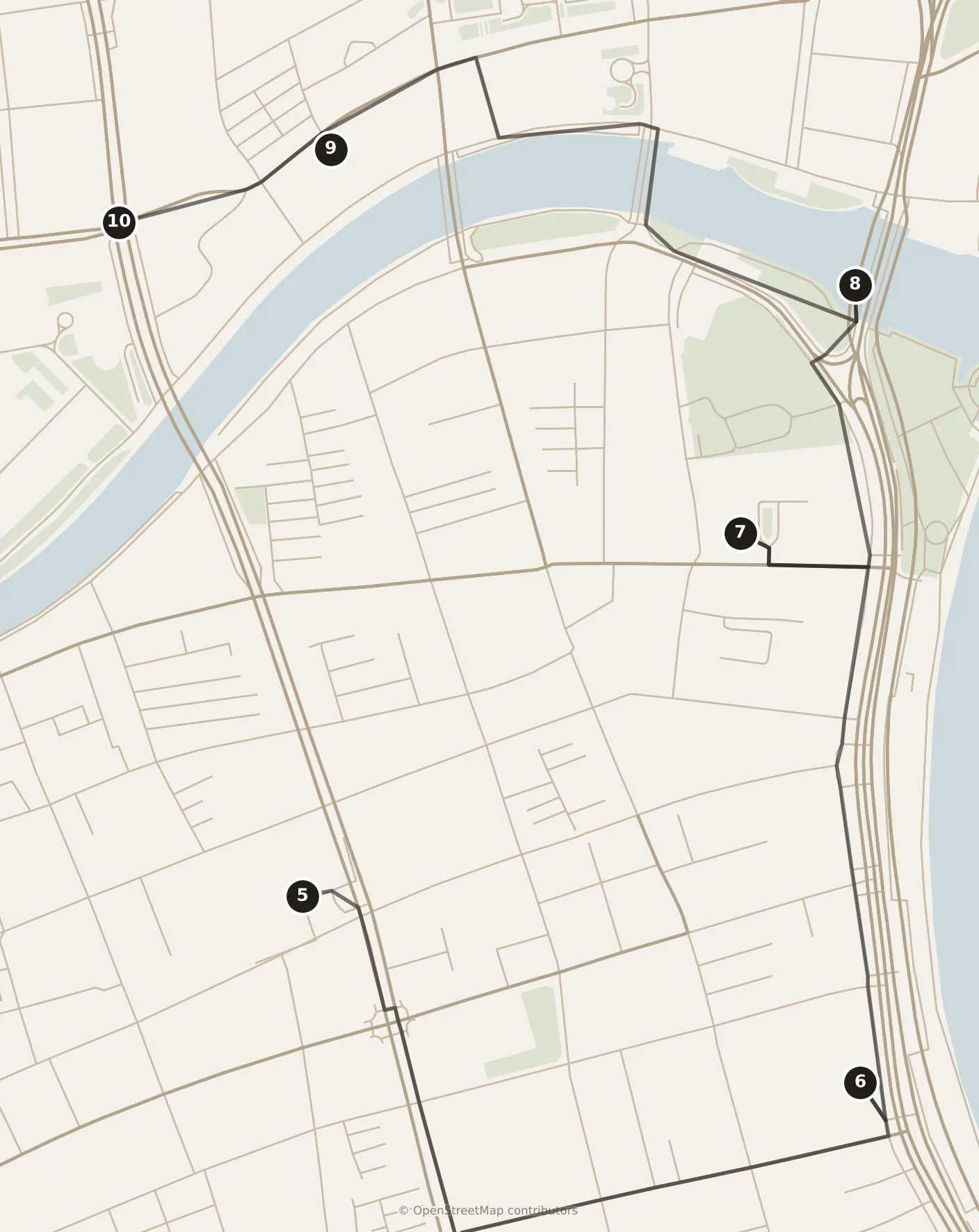
- Morning
- 5East Nanjing Road station
- 6HSBC Building
- 7Rockbund Art Museum
- 8Waibaidu Bridge
- 9Shanghai Postal Museum
- 10Tiantong Road station
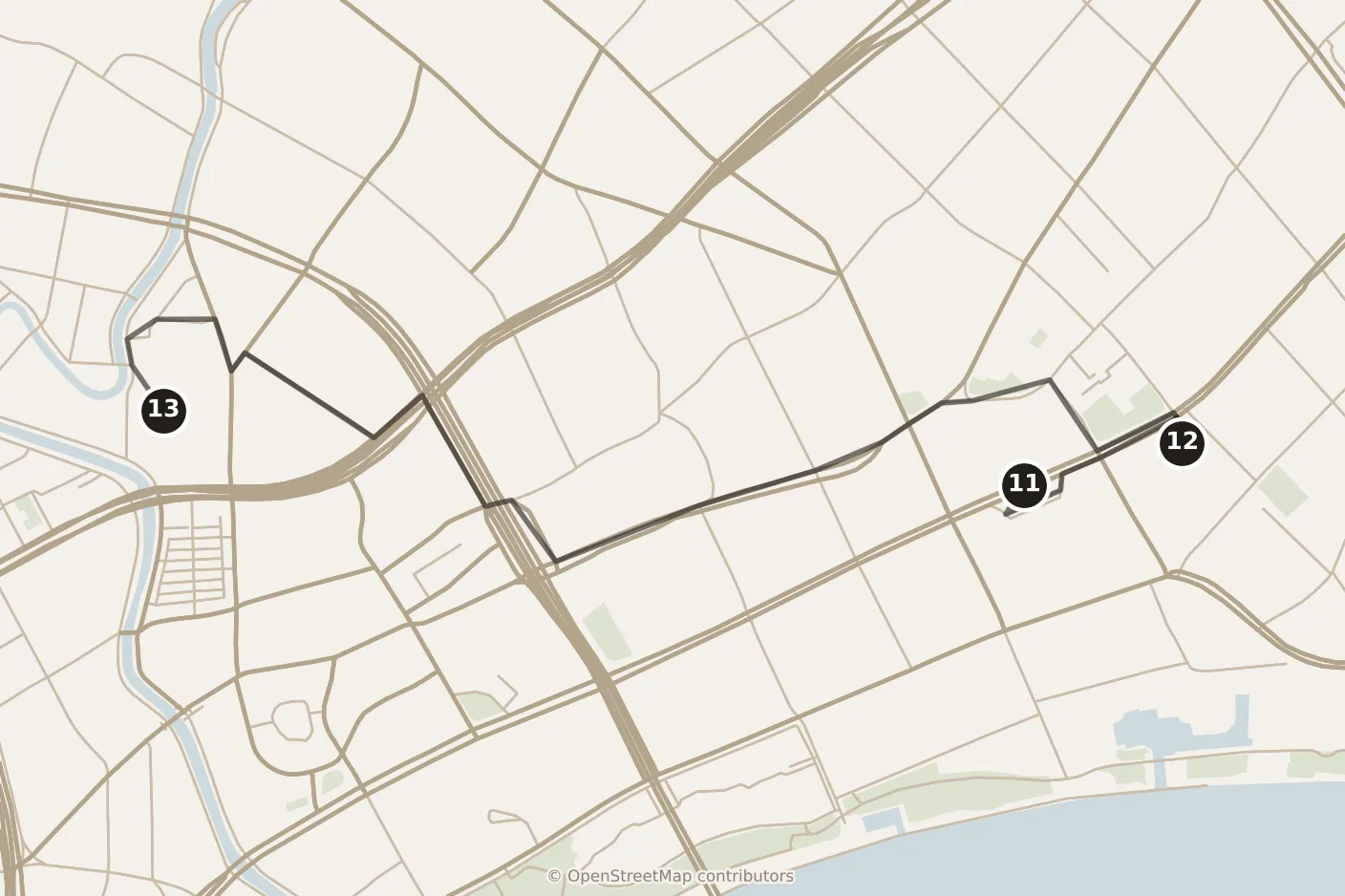
- Afternoon and evening
- 11Tilanqiao station
- 12Shanghai Jewish Refugees Museum
- Huoshan Park — in the prose, not on the map
- 131933 Old Millfun
Today is the day the Bund is entered rather than walked past — one hall, and it is the one worth the twenty minutes — and the day of a quarter almost nobody puts on a two-day trip. It has no moment that depends on the light, so nothing here is counted backwards from the sky. What it has instead is a door with a deadline: the museum at the far end of it stopped admitting at five in 2026. From the first stop to that door is about four hours on the recommendations below, lunch and the metro ride included, so a start by ten leaves the museum an unhurried hour and a half and the streets after it; start after noon and the museum is what you lose.
Morning
Begin at East Nanjing Road station, on Lines 2 and 10, and walk twelve minutes east down to the waterfront and the HSBC Building, at number 12. It went up between 1921 and 1923 and it is the grandest thing on the Bund, but the reason to come is inside the front door: an octagonal entrance hall under a dome carrying eight mosaic panels, one for each city the bank ran a branch in — this one and seven others, scattered from London to Bangkok — each with its river personified as a figure and its own skyline behind. They were hidden under paint for decades and brought back in the 1990s. Give it twenty minutes.
Understand what you are walking into. This is a working bank branch, not a museum: no ticket, no guide, no gift shop, and a security desk. The bank that has occupied the building since 1995, Shanghai Pudong Development Bank, publishes its own branch hours, and they are banking hours rather than museum ones — which makes this the one stop on these two days that is surer on a weekday than at a weekend. Treat the hall as something to look at rather than something to set up a camera in.
Immediately north is the Customs House of 1927, whose clock tower is the landmark you have been navigating by without knowing it; that tower is the point and it is seen from the sidewalk. Then ten minutes north, one street back from the water, to the Rockbund Art Museum, in an art-deco building of 1932 put up for a learned society. What is inside changes — that is the nature of the place, and it is also why it is the first thing to cut if the day compresses. An hour if the exhibition holds you.
Five minutes further north the Bund runs out at Waibaidu Bridge, a gray steel truss of 1907 thrown across the mouth of Suzhou Creek, and the single best place to understand this city’s geography: the creek on one side, the big river on the other, the towers east, the banking houses behind you. Then ten minutes west along the creek to the Shanghai Postal Museum, in the general post office building of 1922–24 — Corinthian columns three stories high, and a Baroque clock tower carrying statuary groups, one of them Hermes with Eros and Aphrodite, which is a great deal of mythology for a sorting office. Admission is free. The museum inside does not open every day of the week; the postal authority publishes which days it does, and if it is shut then the building, the tower and the creek in front of them are most of what you came for. Half an hour either way.
Afternoon
Tiantong Road station is four or five minutes west of the post office, on Lines 10 and 12. Take Line 12 two stops — International Cruise Terminal, then Tilanqiao.
Five minutes from that station is the Shanghai Jewish Refugees Museum, on Changyang Road, built around the Ohel Moishe Synagogue, which Russian Jews put up here in the 1920s. Between 1938 and 1941 Shanghai took in something over twenty thousand people fleeing Nazi Europe, largely because it was the one major port on earth that required no visa to land. In 1943 the Japanese authorities confined most of them to a Restricted Sector for Stateless Refugees of about a square mile — this square mile. A copper wall in the courtyard carries 13,732 names. Give it an hour and a half. The ticket is small, and this stop is what the whole afternoon is arranged around.
Then walk the streets, which are the other half of it. Zhoushan Road and the lanes off it were nicknamed Little Vienna, because that is where the coffee houses and the delicatessens went when their owners did; a few shop fronts still carry the shape of an arcade with nothing European left in it. Three minutes south is Huoshan Park, a small square of trees with a memorial tablet, and the park the refugees actually used, their rooms being too small to sit down in.
One thing about conduct here, because no map says it: these lanes are not a heritage site, they are housing. People live in them, cook in the entries and dry washing across them, and a lane courtyard is somebody’s hallway rather than a photograph. Walk the streets, stay out of the courtyards unless you are asked in, and the afternoon is a pleasure for everyone in it.
Local tip. The two doors that shut are the frame of this day — the bank hall in the morning, the museum here at five — and everything between them is streets, which keep no hours at all. So if you are running late, lose the streets and not the doors. The lanes are as good at seven in the evening as at three; the museum is open at neither.
Evening
Half an hour west on foot, along Changyang Road and then Haining Road, is 1933 Old Millfun: a municipal abattoir of 1933, built as a concrete cage of ramps, spiral stairs and narrow bridges, the whole thing arranged so that cattle could be walked up to the killing floor without ever having to turn round. It was converted in the late 2000s, it is free to walk into, and in 2026 it stayed open until ten at night, which is why it is the evening rather than the afternoon. The shops and studios in it are beside the point; the building is the point, and it takes an hour to walk properly.
If half an hour on foot is more than you have left, a taxi does it in a few minutes, and this is the one leg of these two days where that is the sensible answer. Coming away, Hailun Road station is ten minutes north of the building, on Lines 4 and 10, and Line 10 runs from there to Hongqiao Railway Station and to Hongqiao airport with no change at all — worth knowing if this is your last day.
With a third day

A third day usually goes in the middle rather than on the end, and it takes something with it — though the weekday rules at the foot of this page come first, and on two arrivals out of three they push it to one end anyway.
The new day is Suzhou Creek, and it opens with the morning day two would otherwise have had: the bank hall, the Customs House, the Rockbund Art Museum, the bridge and the post office, in that order and at those durations. Then, instead of turning north to the metro, you turn west and follow the creek. Shanghai opened a continuous public walkway along long stretches of both banks from 2020, and where it is interrupted the street beside it does the same job.
Twenty-five minutes upstream is Sihang Warehouse, a plain gray block that is the most consequential building on this itinerary. For four days at the end of October 1937 a battalion of the Chinese army — a little over four hundred men, publicly reported as eight hundred and remembered ever since as the Eight Hundred Heroes — held it against the Japanese assault on the city. What made it matter is the geography you are standing in: the far bank of the creek was the foreign-run International Settlement, and the creek is narrow enough to shout across, so tens of thousands of civilians and every foreign correspondent in Shanghai watched the battle from the other side of it. A memorial hall opened inside the building in 2015, and the wall on the square side was rebuilt with its shell damage showing. Give the hall an hour, and give the wall five minutes from across the square first, because that is where it was meant to be seen from. Like the museums on the other two days it may keep a weekly closure; check it with the rest.
From there the day has two endings and it is a real choice. Qufu Road station is five minutes north of the warehouse, on Lines 8 and 12, and taking it makes this a half day. Or carry on west along the creek for another three quarters of an hour to M50, a cotton mill on Moganshan Road given over to galleries around the turn of the century — a couple of dozen of them in the old sheds, most free to walk into, and the walk that reaches them is half the point: warehouses, cranes, and the backs of buildings that never expected an audience. From M50 it is twenty minutes east on foot to Shanghai Railway Station, on Lines 1, 3 and 4.
If contemporary art is not what you want at the end of a day like that, the substitution is the Jade Buddha Temple, a working monastery twenty minutes’ walk south-west of M50, whose two figures were carried here from Burma in the 1880s. It has a ticket and it keeps daylight hours rather than gallery ones, so it replaces M50 rather than following it, and Jiangning Road station on Line 13 is about ten minutes away when you leave — and photography is not allowed in the halls holding the two jade figures, which is the sort of thing you would rather read here than be told at the door.
Now what moves. The Bund morning leaves day two altogether, which frees the Hongkou day to start at nine at Tilanqiao instead of two — a tight afternoon becomes a proper day, and the recovered morning is enough for Duolun Road, a short street of 1920s villas and bookshops half a mile north-west of the abattoir, and Lu Xun Park beyond it, with Hongkou Football Stadium station on Lines 3 and 8 at the park’s corner to leave from. The weekday rules move with the stops, and they come apart pleasantly; that is worked out below.
Practicalities
What to book, and how far ahead. Two things, both on day one, both timed, both held against your passport number: the free gallery slot at the east building, and the paid slot on the observation deck. A few days is normally enough for the museum; the deck’s sunset slots go first, so treat that one as the fixed point of the trip and hang the rest off it. Everything else on these days is walk-up, and a third day adds no advance ticket — though a state memorial hall may want you to register at the door, so the passport travels on that day as on the others.
Which day is which, in two days. Four doors on this route keep a weekly closure and they do not agree with one another, so here are the rules rather than a single answer.
Day one must miss the day the east building shuts, which was a Tuesday in 2026. That is the one hard rule of the two-day version and it is the one most likely to catch you, precisely because the general habit in China is a Monday and this is not it. Check it before you fix anything else.
Day two wants a weekday, for one reason only: the bank hall keeps banking hours. It also holds three doors whose closing day I would not guess at — the Rockbund Art Museum, the postal museum inside the post office, and the museum at Tilanqiao. Check all three. The Tilanqiao one is the load-bearing one: if it is shut on your day, day two does not work as written.
Which gives the arrangement. Any weekday pair works so long as day one is not the Tuesday; if it is, run the two days in the other order, because a Tuesday is a perfectly good day for the bank hall and Hongkou, and the east building will be open the following morning. Reversing them does change the first morning: you come in from the airport to the west bank rather than starting beside it, and the longer of the two days is now the one you arrive on and it ends at the abattoir late in the evening — so the bag wants a left-luggage counter rather than your shoulder. If one of your two days is a Saturday or a Sunday, put day two on the weekday and day one on the weekend day — that costs nothing at all, and it is the reason to read this paragraph before you arrive rather than on the first morning. Only if both your days fall on the weekend is the bank hall a casualty, and then give its twenty minutes to the Rockbund and the post office and accept that you have seen the Bund from the outside only. That is the one Bund interior on these two days, so it is the loss this whole paragraph exists to avoid — worth a weekday if either of your days can move.
And what changes when the third day goes in. Re-derive it rather than assuming the two-day rules carry over, because they do not: the bank hall moves onto the new creek day, and so do the Rockbund and the postal museum, which now sit alongside the warehouse’s own weekly closure — three doors to check on the creek day, with the bank’s weekday on top of them. So the creek day is the one that must be a weekday, the Hongkou day is left holding only the Tilanqiao closure and will take a Saturday or a Sunday happily, and day one still must not be the Tuesday. The order in which you run the three is otherwise free. A Thursday arrival is the easy case — east bank, creek, Hongkou, in that order, and nothing collides; it is also the only one of the three that keeps the creek day in the middle. A Friday or a Saturday arrival is the trap, because the natural order puts the creek day on a weekend and shuts the bank hall, and the only way round that is to send the creek day to one end of the trip: with a Friday arrival do the creek day first, then the east bank on the Saturday and Hongkou on the Sunday; with a Saturday arrival do the east bank, then Hongkou, and leave the creek for the Monday.
What to cut when short. If you have a day and a half rather than two, the first stop to go is the Rockbund Art Museum. It is a good building with changing contents, and unlike everything else on that morning it is not about Shanghai in particular, so losing it costs an hour and no thread. The second is 1933 Old Millfun, because it is the only stop on either day separated from its neighbors by a real distance. Do not cut the museum at Tilanqiao to save the time: without it the afternoon in Hongkou is a walk round some ordinary streets and you will not know what you are looking at.
If the weather takes the view. The deck sells you a white wall when the tops of the towers are in cloud, which is a real prospect in the drizzling weeks of June. You find that out from the promenade, an hour before your slot, which is the practical argument for the order in the tip above — a slot you do not use is one you have already paid for. In July and August the problem is not the cloud but the heat: the promenade has no shade at all, and its three quarters of an hour is the part of this day to shorten or to push later, not the deck.
If the forecast is bad before you set out, the clean answer is to swap the whole days: run day two on the cloudy one and keep day one for the clearer one, since nothing on day two depends on seeing anything at a distance. The swap has to pass the weekday rules again, though, and it can fail them — the clear day must not be the Tuesday the east building shuts, and the cloudy one had better be a weekday or the bank hall goes with it. Day one’s two bookings are also timed and held against your passport, so the swap is only free if you can move them; find that out before you commit to it. If it closes in while you are already on the east bank, keep the promenade, skip the deck, cross back as planned and walk the Bund at ground level in the floodlights — that is an evening in its own right, and it is the only time these two days ever see those facades lit. Buying the deck back then costs you day two’s evening: leave Tilanqiao after the museum instead of walking west to the abattoir, and it is Line 12 to Tiantong Road, Line 10 to East Nanjing Road and Line 2 one stop under the river — three trains, two changes — which puts you at the foot of the tower well inside the half-past-eight cut-off. The abattoir is the one stop on these two days that can be traded for something, and this is the trade.
On day two the wet-weather move is smaller: bring 1933 Old Millfun forward out of the evening, since it is the only fully covered stop of that afternoon, and give up the Zhoushan Road streets, which are the part rain genuinely ruins.
The walking. Day one is about six kilometers in total, in short pieces either side of the one metro ride, and half of it is the promenade. Day two is about the same, and the longest single stretch is the half hour from Huoshan Park west to the abattoir, which is also the only one with nothing to stop for. The third day is the walking day — getting on for nine kilometers if you go as far as M50, nearly all of it flat and beside water, and the leg from the warehouse to the mill is the three quarters of an hour that decides whether you want it. Nothing here is hilly, and every leg described above has a named station within about ten minutes of it.


