Shanghai in one day: the concession lanes, the old city, and the Bund at dusk

Last updated 4 August 2026
Overview
Shanghai is not a city you walk across, and one day here is really the business of choosing which few kilometers you walk. The metro does everything else, and this route leans on a single line for almost all of it: Line 10 runs from the concession lanes through the old city to the river, which is the direction the day travels and the reason it never doubles back on itself.
What a single day costs you is the east bank. Pudong stays across the water — the towers, the observation decks, the line for the elevator. That is not a sacrifice made to save time. The skyline is a thing to look at rather than a place to stand in, and the parent guide is blunt about Lujiazui being built for offices rather than for loitering; the hour you would spend going up a tower is the hour that buys you the old city. A day here also costs you the museums, the Shanghai Museum first among them. Give them up without arguing. One day in this city is streets.
The moment the whole thing is built around is the Bund at dusk, when the floodlights come up on the banking houses behind you and the towers opposite go on across the river. Everything above it comes to about five and a half hours, walking included, so take your own month’s sunset and count back from it. The sun goes down here from just before five at the end of November to a few minutes past seven at midsummer — a swing of more than two hours, which is why a single hour would be useless to you. In the short months that count starts you late in the morning. In the long ones it hands you an afternoon start that you should ignore, for a reason set out at the end of this article.
Five and a half hours is time spent inside places and on your feet, and it is not the length of your day. It does not include the bag scanner at every metro entrance, which is universal here and costs a couple of minutes a time, and it does not include the line at the dumpling window in the old city, which is the longest standing-still on the route.
You are probably carrying a bag. Left luggage lives at the main railway stations, and the useful thing about this route is its shape rather than its lockers: Line 10 runs from Hongqiao Railway Station to South Shaanxi Road, where the day starts, and back from East Nanjing Road, where it ends. Nothing here asks you to fetch it in the middle or to carry it at all.
The day

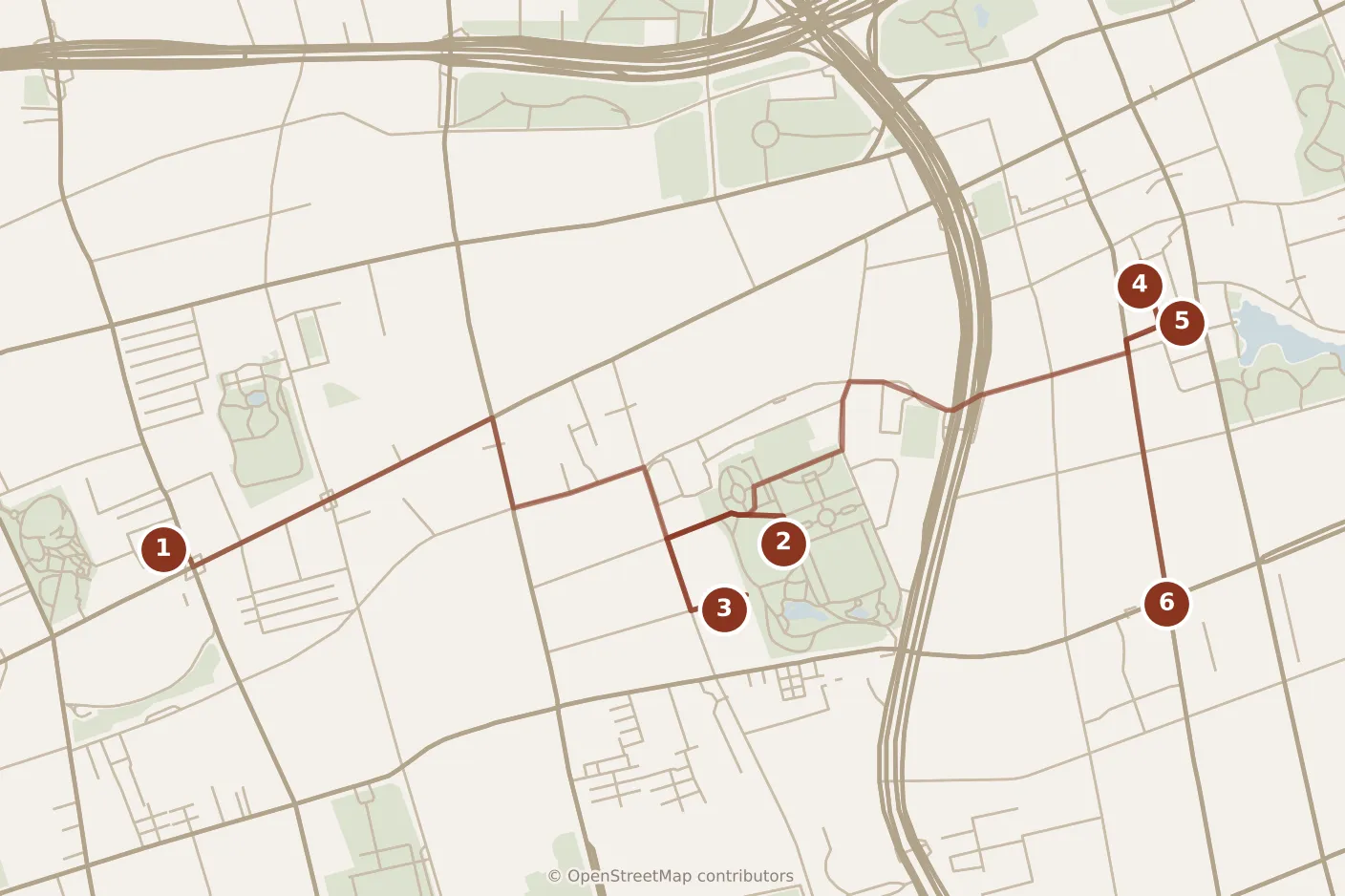
- Morning
- 1South Shaanxi Road station
- 2Fuxing Park
- 3Former Residence of Sun Yat-sen
- 4Xintiandi
- 5Site of the First Congress of the Chinese Communist Party
- 6Xintiandi station
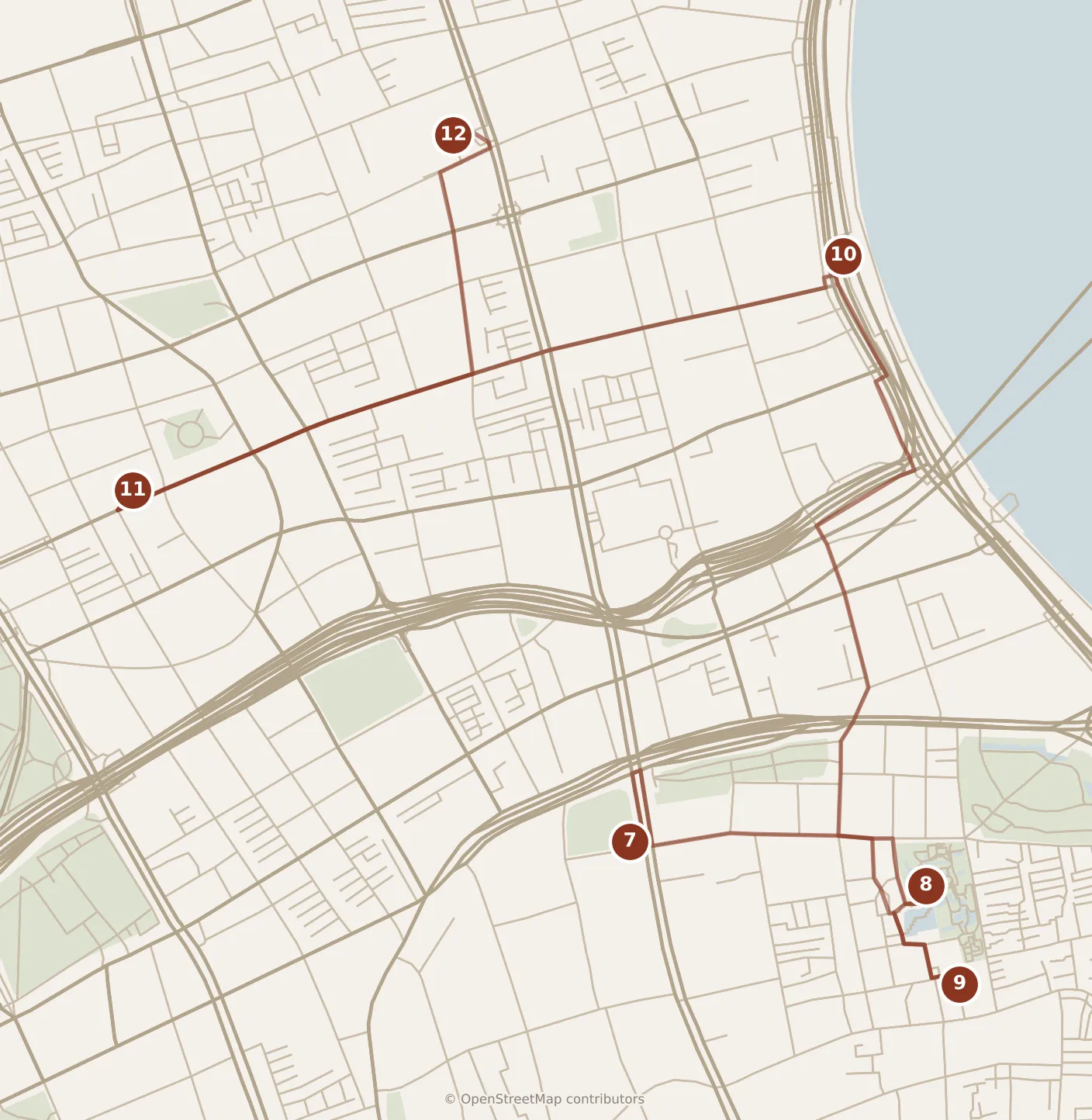
- Afternoon and evening
- 7Yuyuan Garden station
- 8Yu Garden
- 9City God Temple
- 10The Bund
- 11Nanjing Road East
- 12East Nanjing Road station
Morning
Come up at South Shaanxi Road station — Lines 1, 10 and 12 meet there — and walk twenty minutes east into Fuxing Park. It is a French municipal garden of 1909, ten hectares of lake, fountains, pavilions and formal beds laid out inside China and never redesigned into anything else, with a heavy stone Marx and Engels sitting side by side on one of its lawns. Early in the morning it stops being a park and becomes a schedule: dancers, tai chi in groups and alone, card players, mahjong tables. None of it is arranged for you. Twenty minutes is enough, and it is the only stop today where the thing to look at is the people rather than the building.
Two minutes away on Xiangshan Road is the Former Residence of Sun Yat-sen, the gray two-story house he was given in 1918 and lived in until the last year of his life, kept as a museum of those years. Give it half an hour. It is small, and it explains the concession better than any plaque: the man who ended the empire lived on a street the French administered, because it was the one piece of Shanghai where the Chinese authorities could not touch him.
Then a quarter of an hour north-east through the lanes to Xintiandi, where two blocks of shikumen — the stone-gate lane houses this city was largely built out of — were gutted and rebuilt between 1996 and 2001 as a car-free shopping quarter with the brick shells kept. Be honest about what that is: the shops are the shops of any rich city and twenty minutes covers it. What earns the walk is one of those houses, kept as it was and now standing in front of a much larger exhibition hall built behind it, where thirteen delegates opened the founding congress of the Chinese Communist Party on 23 July 1921 — and where the French Concession police raided them a week later, so that the business was finished on a rented boat on South Lake at Jiaxing. It is free and it is worth three quarters of an hour. Bring your passport: state museums here ask for identity at the door, and you are supposed to be carrying it in China anyway.
From there it is ten minutes south to Xintiandi station and two stops on Line 10 to Yuyuan Garden.
Afternoon
Yuyuan Garden station leaves you ten minutes short of the garden, and those ten minutes run through the bazaar, which is where lunch goes. The quarter was rebuilt in the 1990s as a pastiche of Ming and Qing architecture and is frankly a machine for selling things, but it is also the best argument for being here: xiaolongbao, the soup dumplings, and shengjianbao, their thicker-skinned pan-fried cousins, both made in quantity within a hundred meters of the pond. The window with the longest line sells them in a paper box to carry; the same kitchens have floors above with tables and a shorter wait, and eating soup dumplings standing up is how people burn their mouths. Give lunch an hour and sit down for it.
Yu Garden itself is two hectares behind a wall, begun in 1559 by a Ming official named Pan Yunduan for his father and rebuilt after four centuries of fires and wars. An hour walks all of it, which is the whole point of coming: it is small enough to finish. What it is not is photographable in one frame. Dragon-crested walls chop those two hectares into separate courts and the doorways are cut so that each one frames the next rather than opening onto it, so the garden is designed to be walked and is disappointing on a screen. Two things to look for rather than photograph: the Grand Rockery, twelve meters of piled yellow stone with caves and a path climbing through it, and the Exquisite Jade Rock, a perforated boulder over three meters tall and holed all the way through. Do not rush this hour; the garden is small and the crowd in it is not.
Come out and give the City God Temple and the lanes around it half an hour. It is a working Taoist temple, incense and all, and the pond outside with the zigzag bridge across it is the photograph everyone in the quarter is taking. Then leave. The shopping here is the worst you will pass all day, and the reason to have come was on the plate.
A word on the order, because it only bites if you are running late. In 2026 the City God Temple shut at half past four, and the four o’clock garden deadline at the end of this article puts you back outside an hour after that. So on a late arrival the temple’s half hour goes before the garden rather than after it: the door that shuts first is the one you take first, whatever hours the two of them keep when you come.
Evening
Walk north out of the old city — twenty minutes, the longest uninterrupted stretch on this itinerary — and the streets go from lane-width to granite as you reach the Bund. This is what the day has been aimed at, and it wants the half hour before the light goes rather than the hour after.
The Bund is two things facing away from each other along a mile of riverbank. On one side, across the road, stand some fifty banks, customs houses and trading offices in granite and marble, put up in the decades when the foreign business of China was run from this sidewalk: neoclassical, baroque and art deco within a few doors of each other. On the other side, across the Huangpu, is Lujiazui — the Oriental Pearl Tower on its concrete legs, and behind it the Shanghai Tower, which twists as it rises and is the tallest building in China. The promenade you are standing on was raised well above the road in the 1990s as a flood levee after a run of typhoons, and that accident of engineering is what lets one spot hold both views. The road running between the two of them is Zhongshan Road, named after Sun Yat-sen — the man whose house you stood in this morning.
Local tip. The promenade is up on the levee and the banking houses are on the far side of the road below it, not on the water. So walk out along the top for the towers and come back along the sidewalk underneath for the facades — the same stretch twice, and the only part of this day worth doing in both directions.
The floodlights come up at dusk, first on the buildings behind you and then across the water, and they do not all come on together, which is the reason to be there before rather than after. Give it forty minutes and do not spend them all looking one way.
Then turn inland. Nanjing Road East starts a few hundred meters west of the promenade and runs pedestrianized for a bit over a kilometer to People’s Square, all neon and department stores and a small road train you should let go past. It is not good shopping and it is not good food, and both improve the moment you step one block off it into the side streets, which is what to do about dinner. There is a station at either end — East Nanjing Road, on Lines 2 and 10, at the end you arrive from, and People’s Square at the far one. Line 2 runs to both airports from either of them, and Line 10 from East Nanjing Road goes back to Hongqiao Railway Station and your bag without a change.
Practicalities
Two doors on this route charge to enter. Yu Garden’s ticket was in the thirty-to-forty-yuan range in 2026, at the higher end in the spring and autumn seasons, and the house on Xiangshan Road was twenty yuan. Nothing here needs booking weeks ahead. What it does need is a way to pay at all: the ticket window and most of the food in the bazaar want a code scanned from one of the two Chinese payment apps, and setting that up is a job for before you land rather than for a line in the old city. The metro is the exception, and it is the gate you meet first: the machines take notes and give change, the stations sell and recharge a transport card, and a foreign contactless card taps through on every line. The apps are the fast way through that gate, not the way in. The parent city guide covers how, along with the transit card, the airports and the blocked-apps problem in general — this article assumes you have read it or will.
Yu Garden is also the hinge of the day, and it is the one hour here worth carrying. It shuts in the late afternoon; the published hours moved with the season in 2026 and the last admission ran earlier still, so treat four o’clock as the time you need to be through the gate already and no version of them will catch you out. Build the afternoon backwards from that. If the hours have moved since, build it backwards from the new ones — the part that does not change is that the garden is the last door on this day you can be locked out of, so it goes before the river and never after.
That closing is also what breaks the backward count in summer, and it is worth being explicit about. Counting five and a half hours back from a midsummer sunset gives you a start in the middle of the afternoon, which would put you at the garden gate after it has shut. So treat the count as a floor rather than an instruction, and start by ten in the morning whatever the month. In the short half of the year that leaves you an hour or so spare before the light goes, which is about right for a first look at the promenade. At midsummer it leaves you more than three, and all of it belongs at the front of the day rather than the back — another hour in the concession lanes, or the arts alleys of Tianzifang, twenty minutes south of Fuxing Park. Arriving at the river three hours before anything lights up is the one way this route goes wrong while every individual instruction in it has been followed. The other thing a ten o’clock start costs you is the earliest hour in Fuxing Park, when the dancers and the card tables are thickest; if that is what you came for, start earlier still — the order does not change.
State museums in China commonly close one day a week and it is usually a Monday. In 2026 three doors here kept it: Yu Garden, the house on Xiangshan Road, and the congress site at Xintiandi. Check all three before you fix which day you come, and let the third decide it — the three quarters of an hour at Xintiandi are what earn that first walk at all, so a Monday is a day to move off rather than to work around. If it cannot be moved the route still stands — the park, the lanes, the bazaar, the temple, the promenade and the street are all open — but you are giving up three interiors and the best of them, not trading two.
The walking comes to about two hours in total, in three separate pieces with a metro ride between them, which is modest for this city. The longest continuous stretch with nothing to stop for is the twenty minutes north out of the old city to the Bund, and it is worth doing on foot rather than underground, because it is the stretch where the scale of the streets changes under you. The evening’s walk along the promenade and up Nanjing Road East is further than that on a map, but you are stopping the whole way.


