Seville in two or three days: the Alcázar unhurried, Triana at dusk, and Roman Itálica on a third morning

Last updated 8 August 2026
Overview
One day in Seville is a real visit rather than a consolation, because three of the things you came for stand around a single square. What a second day buys is not more ground — the old town is small, and you can walk from the cathedral to the top of it in under half an hour — but two things a single day cannot have.
The first is the inside of the buildings a hurried day walks past. The floor of the Alcázar that is still lived in. The oval chapter house inside the cathedral, which most visitors never find. A charity hospital on a back street by the river whose walls hold one of the best rooms of seventeenth-century painting in the city, and it is not a museum, and almost nobody with one day has ever heard of it.
The second is the hour, and in this city that matters more. One day forces every outdoor stop into the middle of the afternoon: the Barrio de Santa Cruz when it is at its most crowded, the Plaza de España when it is fullest and hottest. Two days let you take the outdoor half early and late and put the indoor half in between, which is not a scheduling trick — it is how the city itself is organized, and it is why the city does not really eat before two. A third day buys the one thing Seville cannot give you at all: the town that stood here before it, eleven kilometers upriver, where two Roman emperors were born.
The shape is three days that barely touch transport. Day one is the World Heritage core and then straight north through the old town, on foot end to end, about two and a half kilometers. Day two starts in the lanes beside the cathedral at nine, runs south to the exposition grounds, turns north-west to the river and crosses it into Triana for the last of the light — five kilometers, again all walked. The only ride between stops in the whole three days is the bus out to Itálica on the third morning and the same bus back; days one and two contain none at all. Getting in from the station and out to it again are the other two rides, and they are described where they happen, at the start of day one and at the end of Practicalities.
Day two starts at nine whatever the month; the rest of this paragraph is the reasoning behind that, and it is worth having before you plan around the light. The sun goes down here anywhere from about ten past six, in the first days of December, to a few minutes short of ten at midsummer. Spain keeps central European time although Seville sits a long way west of Greenwich, which is why the evening starts so late in summer, why dinner does too, and why the range across the year is so wide. Day two comes to about eight and a quarter hours, so counting back from your month’s sunset gives the latest start the light allows. In early December that is a few minutes before ten, but the day opens in a street rather than at a door, so beginning at nine instead costs nothing and buys an hour of margin, and in the short months that is the right thing to do. At midsummer the same count lands after half past one in the afternoon, which is not a start time but a signal: four and a half hours have to go somewhere. In Seville in June they go into the middle of the day, and Practicalities says where.
Days one and three are not built around the light; each rests on one hour instead, and both are given where the route reaches them.
Two things want booking before you arrive, and both of them sit on day one: a timed slot for the Real Alcázar, and the cathedral’s combined ticket, which covers the church, the climb up the Giralda and the Iglesia del Divino Salvador on one entry. Buy both from the institutions themselves rather than from the resellers a search puts above them, and let the price be the test. The cathedral’s ticket was in the thirteen-to-fifteen-euro range in 2026 and the Alcázar’s general admission a little above it, in the fifteen-to-twenty; the Alcázar’s upper apartments are a single-figure supplement added to that same order, and day one takes them. A checkout asking a multiple of those numbers is a reseller’s bundle, whatever the page calls itself. Nothing on days two and three needs booking at all: they are walk-up or free. Everything true of Seville rather than of this route — when to walk instead of riding, when the city eats, what to do about August — is in the city guide.
The bag is a smaller problem here than on a single day, because you have somewhere to sleep, but it bites twice. Sevilla-Santa Justa is the main station and the one with a left-luggage office; it is a little over half an hour on foot from where day one starts, and the Alcázar’s timed slot is the one thing in three days that cannot be moved. So if you arrive on the morning of day one, leave the bag at the station before you go anywhere, and book the slot against your train rather than against a blank date. The other bite is at the end: day three finishes at Plaza del Museo, three quarters of an hour’s walk from Santa Justa, which is not the walk to make with a train to catch. Twelve minutes south-east to Plaza Nueva and the T1 Metrocentro tram is one answer; Practicalities gives the stops, and says when to take a taxi instead.
Day one

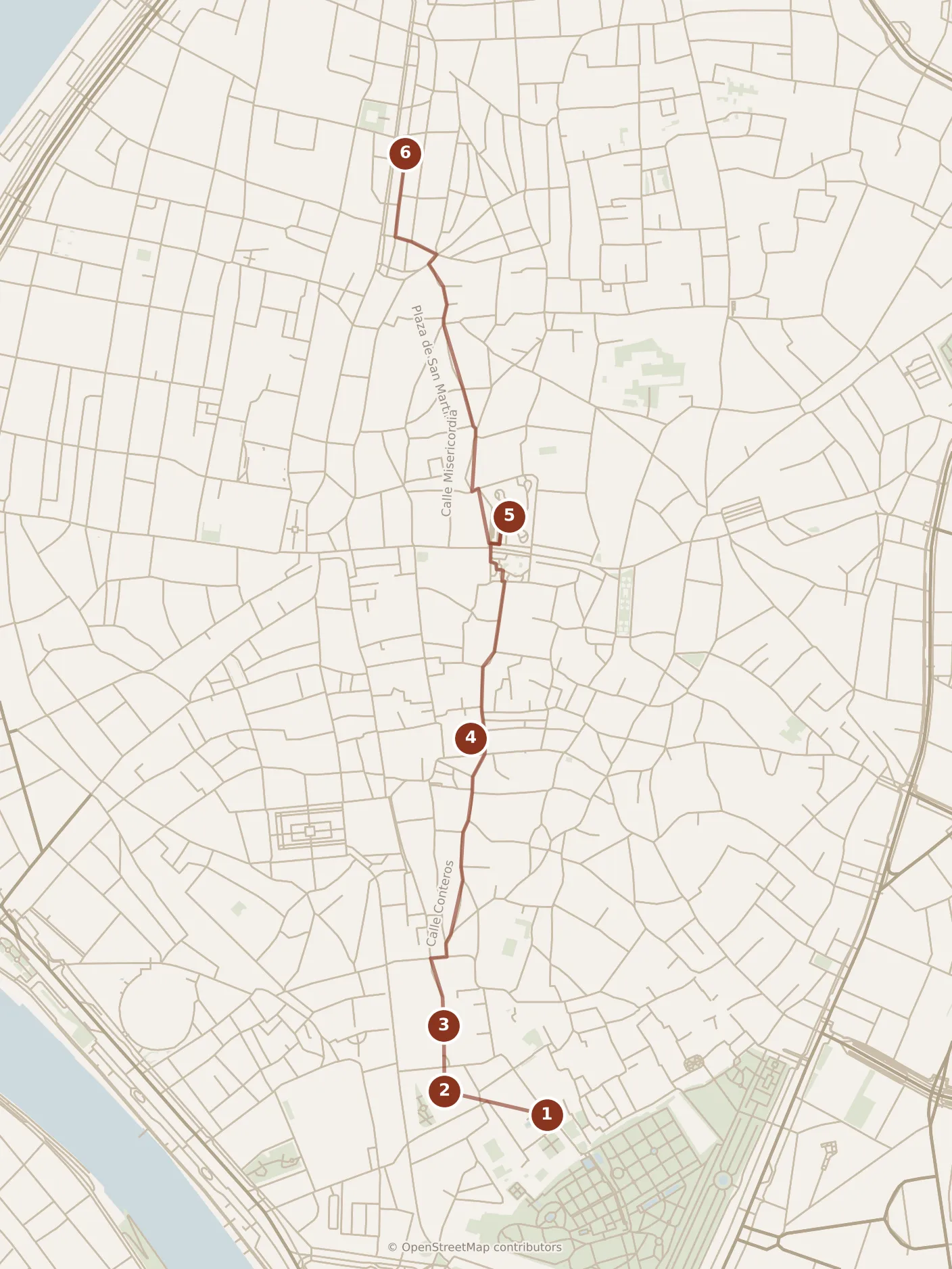
- Day one
- 1Real Alcázar
- 2Archivo General de Indias
- 3Catedral de Sevilla
- 4Iglesia del Divino Salvador
- 5Setas de Sevilla
- 6Alameda de Hércules
Everything today is one line running north. You start at the southern edge of the old town, at the square where the cathedral, the palace and the archive face each other, and you finish two and a half kilometers later on a boulevard where the day stops being about buildings. Nothing doubles back, and the whole day is under forty minutes of walking. The stops and those walks come to about eight and three quarter hours, so from a half-past-nine start the day is done by a little after six.
Morning
First, the leg that usually goes undescribed. Arriving by train you are at Sevilla-Santa Justa, a little over half an hour on foot from the Alcázar gate — the version that does not depend on a schedule, and the one to take if you have a slot to make. Otherwise the Cercanías C-1 runs one stop to San Bernardo, and the T1 Metrocentro tram takes it from there through Prado de San Sebastián and Puerta Jerez to the Archivo de Indias stop on the Avenida de la Constitución, three minutes from the gate. From the airport it is the airport bus into the center; the city guide has that.
Be at the Real Alcázar for opening, and give it three hours rather than the two a single day can afford. In 2026 it admitted its first visitors at half past nine, and that gate time is what this whole day counts forward from; if the hour has moved, count forward from the new one. It is not one palace but several stacked on one site, and the sequence most people walk is the famous one: the Patio de las Doncellas, with its sunken garden and its arcades of interlaced plasterwork, and next to it the Salón de Embajadores under a wooden dome of interlocking stars, both rebuilt for Pedro I in the 1360s by craftsmen working in an Islamic idiom for a Christian king, with a Renaissance upper story added for Charles V two centuries later and plainly visible as a join.
What the third hour buys is the rest of it. Take the Cuarto Real Alto, the upper floor, which has its own timed slot and its own supplement and which a one-day visit is right to skip: it is a guided route through furnished rooms that are still used, and the thing to look for in it is the small oratory with its altar of painted tiles, made by Niculoso Pisano in 1504, who brought the Italian way of running one picture straight across a wall of tiles instead of penning each color into a cell of its own. Half an hour. Then go down and find the Baños de Doña María de Padilla, the long vaulted rainwater tanks under the raised courtyard, which are included in the ordinary ticket and which most people leave without seeing. And give the gardens a full hour, walking out along the Galería del Grutesco, the raised gallery built into the line of the old Almohad wall, which is the only place you understand that the gardens are outside the fortress rather than inside it.
Out through the Patio de Banderas and three or four minutes north-west is the Archivo General de Indias. Twenty-five minutes, and it costs nothing. Juan de Herrera drew it for Philip II in 1572 as a merchants’ exchange, and Charles III turned it into an archive in 1785 to hold the paperwork of the Spanish empire in the Americas; the building is severe and beautiful and the great marble staircase is the point, with a room of documents on rotating display at the top. It is also the one stop on day one that closes a day a week, which Practicalities deals with.
Two minutes further is the Catedral de Sevilla, and this is the hour that decides the order of the whole day. In 2026 it admitted nobody before eleven from Monday to Saturday, and not until half past two on a Sunday — in July and August it opened at half past nine, and at half past twelve on a Sunday — but the Giralda and the accesses stopped admitting at five whatever time the building itself shut, on every day of the week, and the Alcázar across the square shut at five too through the winter half of the year. So the church cannot be taken at the end of the day and the palace cannot be taken in the middle of it, and that is the entire argument for the order above; if any of those hours has moved, keep the rule and rebuild from the new ones. Give it an hour and three quarters. Climb the Giralda first — the Almohad minaret with a Renaissance belfry set on top of it by Hernán Ruiz in the 1560s, and 35 shallow ramps instead of stairs, because it was built to be ridden up. The weathervane at the summit, a bronze figure of Faith set there in 1568, is called the Giraldillo, and the tower is named after it rather than the other way round. Inside, an unhurried visit means two rooms a hurried one loses: the Sacristía Mayor, a domed chamber that is a building in its own right, and beyond it the Sala Capitular, the chapter house, an oval room in stone under a painted vault, and for a building this size astonishingly quiet. Leave through the Patio de los Naranjos, the old mosque’s courtyard, still planted round its fountain.
This is a working cathedral, and the reason it opens so late on a Sunday is that Sunday mornings belong to services rather than to visitors. Shoulders and knees covered is the expectation at the door, here and at the church you go to next.
Local tip. If today runs short, the stop that goes is the Alcázar’s upper floor. It is the only piece of the day you can drop without dropping a whole building — thirty minutes back, and you still walk the palace, the gardens and the baths on the ordinary ticket. The archive is the next twenty-five minutes to go and the only one after that, because everything else here is either the thing you booked or half an hour long already. Do not buy the same half hour twice by shortening the gardens as well: that is where this day slips without anyone deciding to.
Afternoon
Nine or ten minutes north up the shopping streets, and the Iglesia del Divino Salvador is on your combined ticket already — most people who buy that ticket never use this half of it. Half an hour. There was a mosque here from 829, the city’s main one until the Almohads built the larger one under the cathedral in 1182, and the courtyard you walk through is that mosque’s ablutions courtyard, still there and still planted. The church around it is the other thing entirely: begun in 1679 and finished by Leonardo de Figueroa in 1712, with a wall of carved and gilded altarpieces that is Baroque at the point where it stops being decoration and becomes weather. The processional sculpture in the side chapels, some of it by Juan de Mesa, is what a working parish keeps rather than what a museum displays, and if you have only fifteen minutes of the thirty, spend them on that rather than on the high altar. The chapels belong to the parish before they belong to a ticket, so some of them may be shut when you are there.
Then lunch, in the streets between the Salvador and Alfalfa, and by now it is the hour Seville actually eats. An hour and a half sitting down. This page names no restaurants anywhere, so take the one tell instead, and it holds for all three of this trip’s lunches: the places these streets use themselves have a short menu and no photographs of it outside. This is the neighborhood for espinacas con garbanzos — spinach with chickpeas, cumin, a little vinegar — which is the dish that tells you this is a city of vegetables and pulses as much as of ham, and is on almost every counter in these streets.
Evening
Seven minutes north and the Setas de Sevilla stands over the old market square: a timber canopy on six columns, opened in 2011, with a walkway looping across the top of it. Give it an hour. What makes it worth the ticket rather than the photograph is the walkway itself, which is a long slow curve rather than a viewing platform, so the old town turns round you and you see the shape of it — the cathedral and the tower, and the roofs going on flat in every other direction. This is the stop that makes day one a day with no deadline in it: the walkway stays open until one in the morning, so it cannot be missed and nothing above it has to be hurried. In the short months you will arrive with the light still going, which is the best of it; from about April onwards the day delivers you here three or four hours early, and the answer is not to start later — it is to go up when you arrive, walk on to the Alameda, eat, and come back afterwards if you want the same view black and lit — ask at the counter whether one ticket covers the return before you plan on it. Underneath the building, where the excavation for a parking garage ran into a Roman street, there is a small museum of what they found; it keeps its own hours and its own ticket, and it is a separate thirty minutes rather than part of this one.
Then twelve minutes north-west to the Alameda de Hércules, and this is the correction the day needs. It is a long tree-lined rectangle laid out in 1574 on a drained arm of the river, and at the southern end two Roman columns carry statues put up in the same year. Nobody comes here for that. It is where the city drinks, on terraces, late and outdoors, and it is a square rather than a sight. After a day of gilded interiors it is the right last hour.
Day two

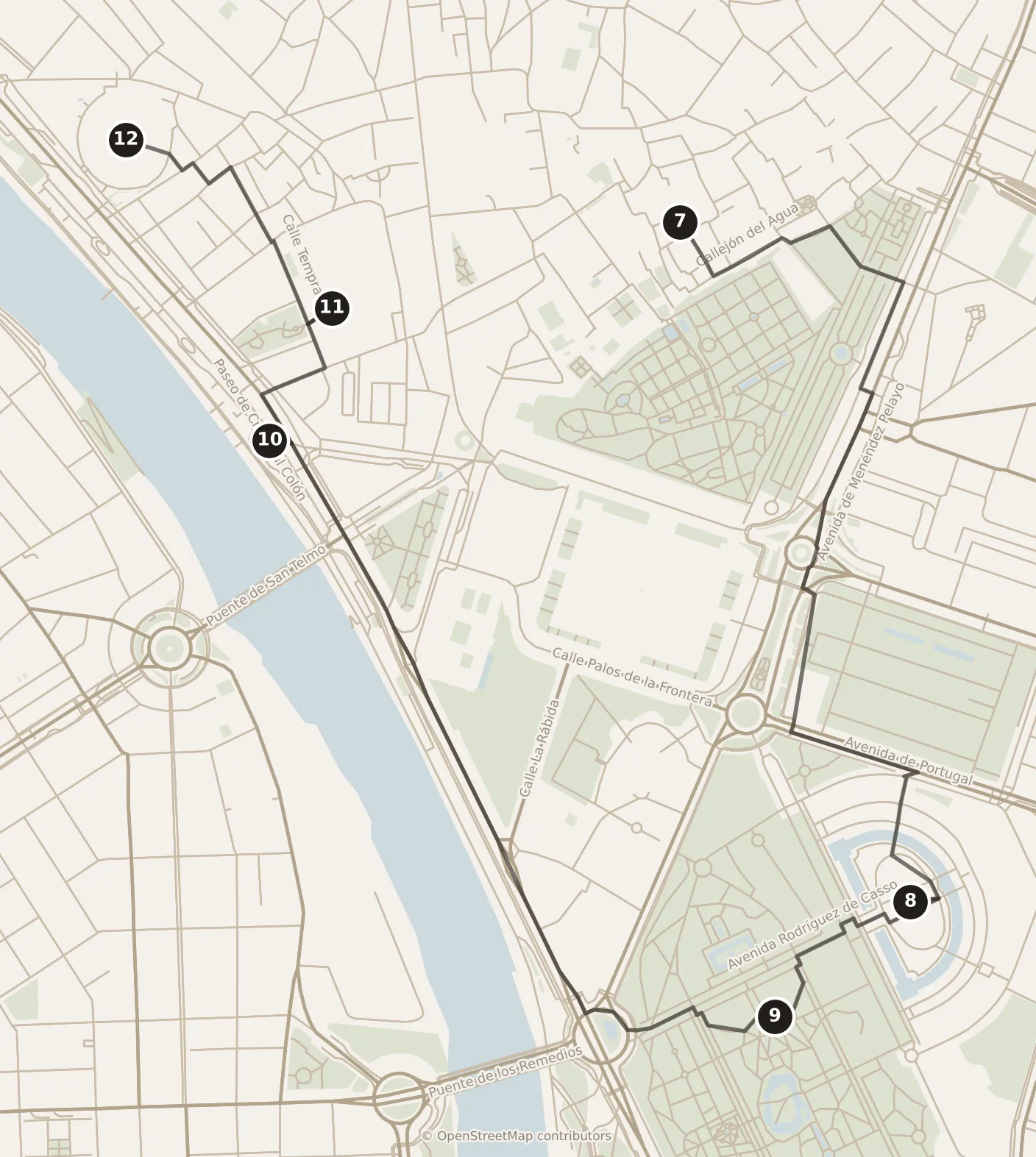
- Morning and afternoon
- 7Barrio de Santa Cruz
- 8Plaza de España
- 9Parque de María Luisa
- 10Torre del Oro
- 11Hospital de la Santa Caridad
- 12Plaza de toros de la Real Maestranza
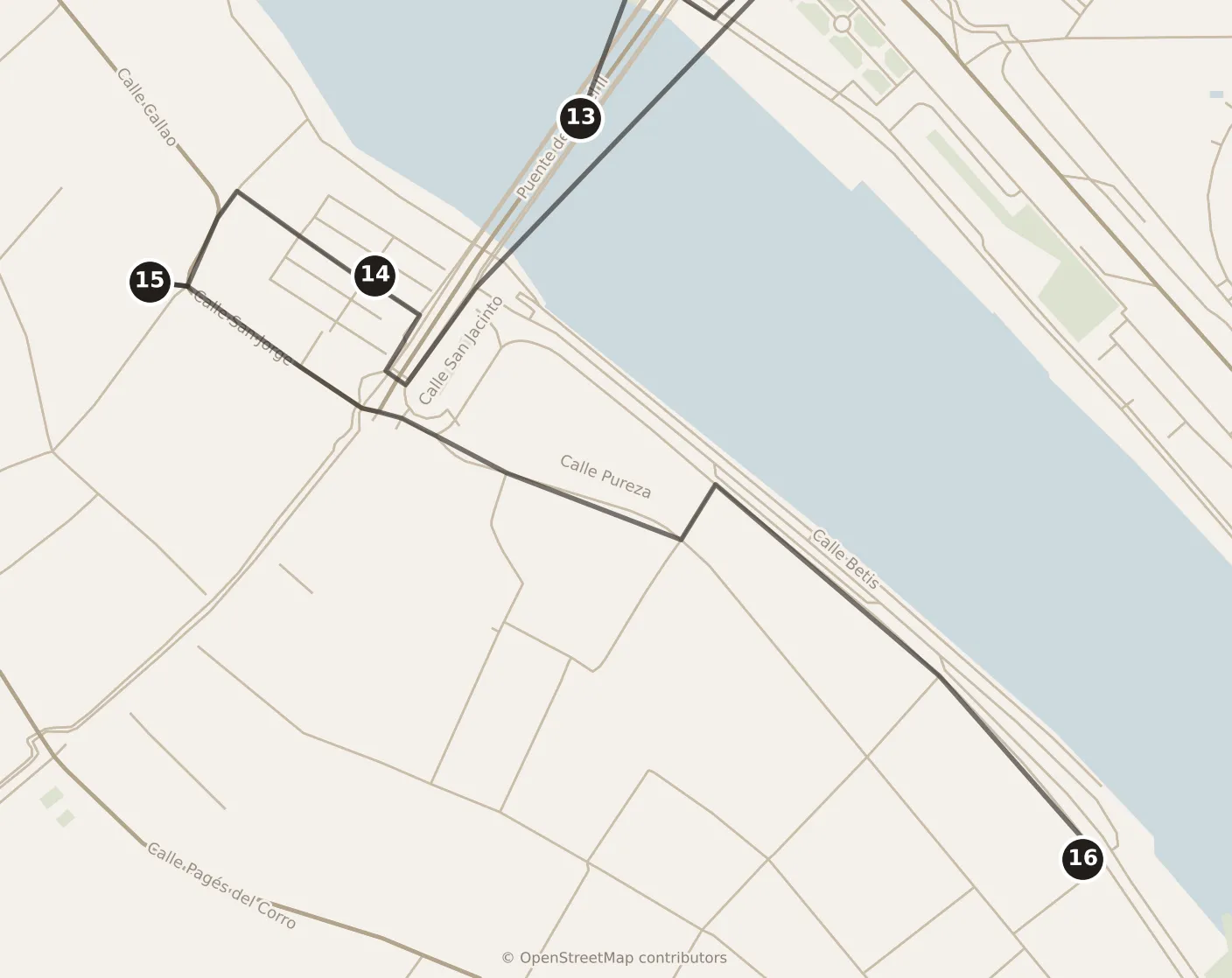
- Evening
- 13Puente de Isabel II
- 14Mercado de Triana
- 15Centro Cerámica Triana
- 16Calle Betis
Today runs south, then north-west to the river, then across it, and it never turns back on itself. It is about five kilometers and an hour and a quarter of walking, and it is arranged around the one thing on the whole trip that no institution can reschedule, which is where the sun goes.
Morning
Start in the Barrio de Santa Cruz at nine, and the hour is the whole point. No part of Seville takes more visitors per square meter, and by midday its lanes are barely passable where they are wide enough for two people at a time; at nine they are empty and you have them. Forty-five minutes, and do not try to navigate. It was the Jewish quarter until a massacre in 1391 ended it, the lanes were narrow before anyone thought them picturesque, and what you are there for is the small squares you arrive at without meaning to, and the whitewash with the light coming down into it. Come out along the eastern edge, where the Jardines de Murillo run in a strip under the line of the old city wall, and turn south.
Eighteen minutes down past the old tobacco factory that is now the university and the Plaza de España opens in front of you. An hour, and again the hour of the day is doing work: at nine in the morning the half-circle is nearly empty and the canal is flat, and by late afternoon the arcade is shoulder to shoulder from one tower to the other. Aníbal González built it for the Ibero-American Exposition of 1929, with a canal curving in front of it, four bridges across the water, and a tiled alcove set into the base of the building for each Spanish province, each with a painted scene and a ceramic map. Walk the curve rather than photographing the towers. The buildings have held government offices almost since the exposition packed up, which is why the arcades are open and the interiors are not — this is a working administration with a moat, and standing in for a British headquarters in Egypt in Lawrence of Arabia in 1962 has never stopped anyone filing paperwork in it.
Five minutes on you are inside the Parque de María Luisa, which the plaza was cut out of. Give it forty-five minutes and walk north-west through it rather than round it. It was given to the city in 1893 and replanted for the same 1929 exposition, and it is a designed park rather than a green space — fig, orange, palm and cedar, tiled benches, ponds with ducks, and exposition pavilions still standing among the trees at the Plaza de América end. One of those pavilions is the Museo Arqueológico, which holds the Roman sculpture dug out of Itálica, and it has been shut since January 2020 for a rebuild. Check whether it has reopened before you come; if it has not, then nothing on any of these three days shows you what came out of the ground on day three, and it is worth knowing that in advance rather than finding a locked door.
Afternoon
Twenty minutes north-west out of the park brings you to the river and the Torre del Oro. This is the longest single stretch of the three days and it is worth it for what is at the end: a twelve-sided Almohad watchtower of 1220 that anchored a chain drawn across the Guadalquivir to stop ships, with a fourteenth-century second stage and a round eighteenth-century cap on top of it. Fifteen minutes, outside. There is a naval museum inside and it is not what you came for. If you want the rest of the story, its twin the Torre de la Plata survives a few streets inland, swallowed by later buildings — the same wall, the same century, and no ticket.
Four minutes north and off the riverfront is the stop that justifies the second day on its own: the Hospital de la Santa Caridad. Forty-five minutes. It is a charitable brotherhood, and Miguel Mañara, who took it over in 1663, rebuilt its church and commissioned the paintings on the theme that obsessed him, which was death and what your possessions are worth against it. Two Murillo canvases are still on the walls they were painted for; four more were taken by Marshal Soult in 1810 and are now in London, Ottawa, Washington and Saint Petersburg, which is a fact about this room rather than about those cities. Facing them are the two Valdés Leal pictures of 1672 that Seville calls the hieroglyphs of the last things — In Ictu Oculi, death snuffing the candle with a coffin under his arm, and Finis Gloriae Mundi, a bishop and a knight rotting in their vaults under a set of scales. Nothing else in this city says it as plainly. This is also the reason this stop comes before lunch rather than after: in 2026 it shut at five, every day except Friday, and a Seville lunch does not reliably end before four. It is still a working charity with a residence in the same building, so what you visit is the church and the courtyards and not the rest of it, and you go through them at the volume you would use in any church that is being used.
Seven minutes north the Plaza de toros de la Real Maestranza is a white and ochre oval with an arcaded gallery above the ring. Give it forty-five minutes, which is what a single day never has. It was begun in 1749 and finished more than a century later, which is why it is an oval rather than a circle — it was built in sections by people who kept changing their minds. The visit takes you round the ring, the stalls under it and the collection upstairs, with an audioguide. In 2026 it opened every day, and closed at three instead of the evening on days when there is a fight. Whatever you think of what happens in it, this is one of the two or three buildings the city has arranged itself around.
Lunch after that, in El Arenal, an hour and a half. It is the quietest of the three districts you eat in on this trip.
Local tip. Something today will run late, because half of it has no doors to keep you to time. When it does, the two stops that go are the bullring and the tower, in that order. That is an hour bought back on this day, and it is the hour that gets you across the bridge while there is still light on the far bank, which is the only thing today that cannot be rearranged. Do not buy the same hour twice by also shortening lunch: you will want it, because the second half of this day is entirely on your feet.
Evening
Seven minutes takes you onto the Puente de Isabel II and over the river. It was built between 1845 and 1852 on the model of a Paris bridge of the same generation, it replaced a crossing of moored boats that had served for six hundred years, and there is a small tiled chapel of 1927 at the far end where the bridge lands on the Altozano.
Two minutes on, the Mercado de Triana sits on the foundations of the Castillo de San Jorge, which was the seat of the Inquisition’s tribunal here from 1481 until 1785 — the excavated castle is in the basement, and access to the underground route has been closed to visitors; the market lobby is also a tourist information desk in the mornings, and that is where to ask whether it has reopened rather than reading about it anywhere else. Say twenty-five minutes for the building itself. Be honest with yourself about what you are getting: this is a working market, so its fish and vegetable counters are a morning thing and this day reaches them in the late afternoon. You get the hall, the castle under it and the bars round its edge, not the trade. That is a real trade-off and the alternative is a real plan, so it is set out at the end of this section.
Two minutes further, on Calle Callao behind the market, the Centro Cerámica Triana occupies an old tile works with its kilns left standing in place. Forty-five minutes, and it is better than it sounds, because it explains a technical problem rather than showing you plates: glazes of different colors run into each other in the kiln, and the two solutions Seville worked out — drawing the outlines in a greasy manganese line that fires black, and pressing the design into the clay so each color sits in its own hollow — are the reason the tiles you have been looking at for two days look the way they do. The ceramics streets are still here; Calle Alfarería, two streets back, is named after the trade.
Then ten minutes down to Calle Betis, and this is what the day was walked in this direction for. Betis is the street on the Triana bank, and Triana is west of the old town, so with the sun dropping behind you the whole east bank goes the color of the brick it is built from while you stand in shade with the water in front of you. Nobody can reschedule that. Stay for the half hour either side of it. Then eat here rather than crossing back — pescaíto frito, the mixed fry of small fish, is a river dish and this is the bank for it. Betis is the view, and the tables on it are priced for the view; a street or two back from the water is the same fry without it. In the short months the light goes well before the sit-down kitchens start, and that gap belongs to a bar rather than a table.
Flamenco is genuinely rooted on this bank, and if you go it goes after the light rather than instead of it. The ones worth going to seat very few people, so ask about a table earlier in the day rather than turning up after dinner. One thing a visitor cannot guess and gets told off for: at the small places built around the singing rather than around dinner, you do not clap along and you do not talk during a cante. The silence is the performance as much as the sound is.
And the alternative, if the market matters to you more than the light does. Run today backwards: Triana first thing — the market, then the ceramics center when it opens — then back over the bridge for the bullring, the hospital and the tower, lunch in El Arenal, and Santa Cruz, the plaza and the park in the late afternoon. It costs you two things and they are worth naming. The plaza and the lanes are then at their fullest and hottest, which is exactly what putting them at nine avoids. And the light lands wrong: from the east bank at sunset you are looking into the sun rather than watching it fall on something, so the best hour of the day becomes an ordinary one. Take that swap if the market is why you came to Triana. Otherwise do not.
With a third day

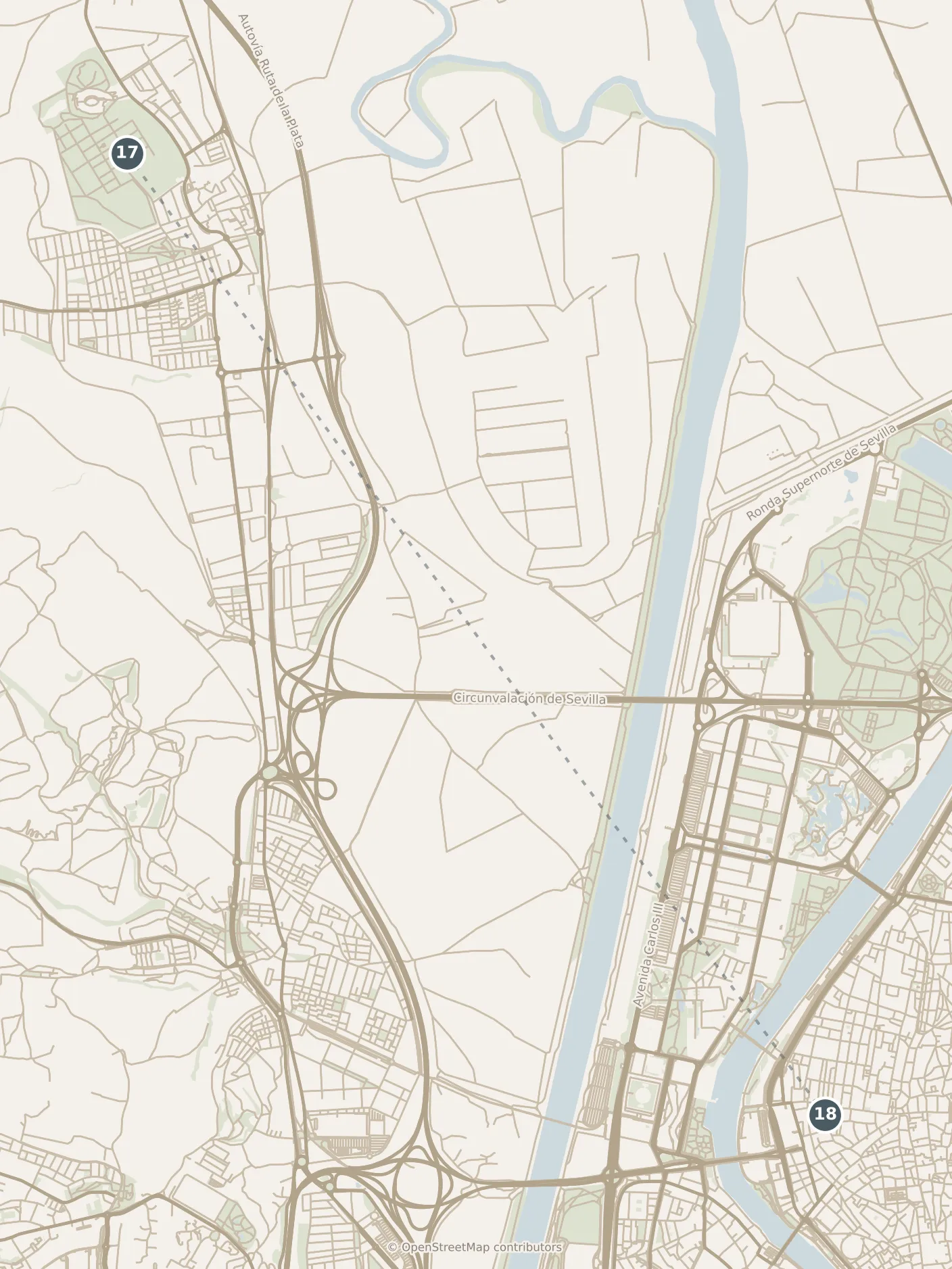
- With a third day
- 17Itálica
- 18Museo de Bellas Artes
Append it rather than insert it: it goes third by default, and nothing on days one and two moves to make room, because those two days are independent of each other and of this one. Two things move it, and both are named below — a Monday, and a departure. What it adds is not another quarter of Seville. It is Itálica, a Roman town eleven kilometers upriver at Santiponce, and then the city’s picture gallery on the way back in, which together make a day about the two things neither of the first two days has time to be: much older, and indoors.
Both halves of it also keep the same unusual calendar, which is the first thing to check. Itálica and the Museo de Bellas Artes both close on Mondays, and both stop admitting at three on a Sunday and, at the museum, right through August — where the rest of these three days barely notices the weekday at all.
The hour this day rests on is at the far end of it. Itálica keeps shorter hours in the hot half of the year than in the cool half, and in 2026 it shut at three from mid-June to mid-September, with last admission half an hour before closing; the Junta de Andalucía publishes the season’s times and they are worth reading the week before. Whatever they say, the conclusion does not move: Itálica is a morning. Take the first bus you reasonably can.
The 170A leaves from the Plaza de Armas bus station and runs to Santiponce in about half an hour; the 170B covers the same route less often. On an ordinary weekday it is frequent enough to turn up for; on a Sunday, a public holiday or in August it thins, and since the whole day rests on catching an early one, read the day’s first departures before you fix the day. Get off in the village and the site is signposted. Give Itálica two and a half hours. Scipio settled his wounded veterans here in 206 BC, which makes it the first Roman town in Spain, and Trajan was born in it and Hadrian’s family came from it — which is why Hadrian then built a second town beside the first, on a grid, with a temple to his deified predecessor at the center of it. That second town is what you walk: paved streets you can follow for a kilometer at a time, the platform of the Traianeum, and the floors of the big houses with their mosaics still where they were laid — the Casa de los Pájaros with its birds, the Casa del Planetario with the seven deities of the week, the Casa de Neptuno. The amphitheatre held twenty-five thousand people and is the largest thing here by a distance; walk down into the arena itself rather than only round the seating. The old town underneath the modern village is not excavated and not visitable, so what you see is the newer half only. It is an open site with almost no shade, the walking is on stone and grit, and there is nowhere to leave anything, so this is the day to carry water and not a bag.
Back on the 170A to Plaza de Armas, and then eat somewhere between the station and the museum rather than at the station, which is a bus concourse with a road round it — in heat this is the meal for cold gazpacho before anything else, and by now you will understand why the whole city drinks it.
Seven minutes east is the Museo de Bellas Artes, on Plaza del Museo. Two hours. It is in the Convento de la Merced Calzada, handed over as a gallery after the religious houses were dissolved in the 1830s, and the collection is largely what came off the walls of the monasteries that closed — so this is not a survey of European painting, it is Seville’s own century, gathered from ten minutes’ walk away. The room to give the time to is the old convent church, which has been left as a single tall space and hung with Zurbarán’s monks and Murillo’s altarpieces at the scale they were painted for. Elsewhere there is Valdés Leal again, polychrome sculpture by Juan de Mesa, and El Greco’s portrait of his son Jorge Manuel, holding a brush. If the day is short, do not drop the museum — halve it, and spend the hour in the church room alone. That is the room, and dropping the museum to keep the rest would be dropping the reason the third day comes back into town at all.
And the third day has an alternative of its own, if you did not run day two backwards and the market is the thing you regret. In the cool half of the year, take the Mercado de Triana first thing while it is actually trading, walk back over the river, pick up the 170A late morning, and let the museum go rather than Itálica. That contradicts the paragraph above and it is meant to: the advice there is for a day that has run short, this is for a reader who came for a market and got a hall. It costs you the convent church, which is the reason this day comes back into town at all, and it breaks the first-bus rule above rather than bending it: a late-morning 170A reaches an unshaded site around midday, so it only works while Itálica is not shutting at three — in the hot half of the year there is no room for both, and the market stays lost.
Local tip. Because of the calendar above, this is the only one of the three days that has to be placed rather than simply taken: give it a Tuesday to a Saturday. On a Sunday take Itálica and keep the museum for another morning. On a Monday do not take it at all — run day one or day two on the Monday instead, and this day moves into the slot that frees. Nothing inside days one and two changes when it does, which is why it can move without costing anything.
Today comes to a little over seven hours from the first bus, of which an hour is on the bus — and it does not count the waiting for one, which on a thin day can be another half hour at each end. It ends earlier than the other two days, and deliberately: this is the day you are most likely to have a train to catch, and it is why a departure is the second thing that moves it. If you do not have one, the third evening belongs to whichever of the first two you preferred, and the difference between them is simple — the Alameda is late, young and loud, El Arenal is early and quiet.
Practicalities
Book two things before you travel: the Alcázar’s timed slot and the cathedral’s combined ticket, both on day one, both from the institution that owns them rather than from a reseller. Take the earliest Alcázar slot offered and a cathedral slot for the early afternoon. Add the Alcázar’s upper-floor supplement at the same time, because it has its own timed sessions and a limited number of them. How far ahead either of them goes on sale is not something this page can tell you, and it moves; the rule that survives that is to book the moment your dates are fixed, and to fix the dates around the slot if the day you wanted has gone. Nothing on day two or day three is booked: the hospital, the bullring, the ceramics center, Itálica and the picture gallery are all walk-up, and the archive is free. The Setas walkway on day one is ticketed as well, and it is sold at the door; whether the hour can also be held in advance is worth checking when you buy the other two, but nothing on day one turns on it — the walkway stays open until one in the morning, so there is no hour to catch. The other ticketed stops on this route are not priced on this page, because the two above are the only ones checked this year.
The weekday rules are short, and the reason to write them out rather than name a start day is that you will arrive when your train arrives. Day three cannot be a Monday: Itálica and the Museo de Bellas Artes both close, and there is nothing left of it. Day three also wants to avoid a Sunday and, if you can, August, because both halves stop at three on those and cannot both be done. Days one and two will take any date at all, in either order, and lose only small change on a Monday — day one loses the Archivo General de Indias, which is twenty-five free minutes and can be admired from the Plaza del Triunfo instead, and day two loses the Centro Cerámica Triana, forty-five minutes and a real subtraction from that evening but not a broken day. Nothing else on day two takes a weekday off — the hospital, the bullring and the market hall are open on a Monday like any other. The one weekday that reorders rather than removes is a Sunday on day one: the cathedral and the Salvador do not open until half past two, so take the Alcázar and the archive as written, eat at one, and put the church and the tower where the afternoon would otherwise have been — the Giralda still stops admitting at five, so that is the constraint to fit around. In July and August that Sunday runs differently again: the cathedral opens at half past twelve, so take it straight after the archive and eat afterwards, and the Salvador does not open on a Sunday at all. Each of these institutions publishes its own closing days and reading them the week before costs a minute.
The walking, day by day: under forty minutes on day one, over about two and a half kilometers, with no climb in it but the tower’s ramps, and the longest single leg is the twelve minutes from the Setas to the Alameda; an hour and a quarter on day two, over about five kilometers, of which the longest single leg is the twenty minutes out of the park to the river; and on day three seven minutes in the city plus however far you walk inside Itálica, which is the real distance of that day. All three days are flat.
The sums above are the time you spend inside places and walking between them, and they model nothing else. Day one’s eight and three quarter hours does not include the line at the Alcázar’s gate, which is the same gate for everyone however they bought the ticket, and it does not include the walking inside the Alcázar, which is not a rounding error — the gardens are several times the footprint of the palace and are where this day most often slips. Day two’s eight and a quarter does not include sitting on the river wall at the end, which is the point of it. Add those back before you decide any of it is comfortable.
Heat rewrites all three days rather than inconveniencing them, and it is structural rather than a caution: day two is outdoors at both ends with only a run of interiors in the middle of it, and day three is an unshaded ruin. From late June to early September, take day two’s morning exactly as written and keep the nine o’clock start, putting the surplus into the middle of the day rather than into a later start, because nine is when the plaza and the lanes are bearable and eleven is not. Do the arithmetic once: at midsummer there are four and a half hours more daylight than the day needs, and they go as ninety minutes added to lunch, making it three hours, and two more spent indoors or in shade before you walk again — which is what the city itself does — with the last hour spent slowly in the ceramics streets rather than standing on the riverbank waiting for the sun. You will still reach the far bank with the light, because it does not go until nearly ten in late June; by early September it has come back the better part of an hour, so take the month’s hour rather than the season’s.
Two weeks in the year replace this itinerary rather than bending it. During Semana Santa the processions close large parts of the old town at hours nobody can predict, and the walk between the cathedral and the river becomes impassable; the local rule that catches visitors out is that you do not cross a procession — you wait, or you go the long way round, and the stewards will stop you doing otherwise. During the Feria de Abril the city’s center of gravity moves across the river to the fairground and the ordinary rhythm of the afternoon goes with it — the fairground is built of casetas, and how many of them a visitor without an invitation can get into is the thing to find out before planning a day around it. Both are worth seeing for themselves. Neither is a week to follow these three days in.
Leaving. All three days end a long way from Sevilla-Santa Justa on foot: three quarters of an hour from Plaza del Museo where day three finishes, three quarters from Calle Betis where day two does, and a little over half an hour from the Alameda de Hércules where day one does. The route back is the same from all three — reach Plaza Nueva and take the T1 Metrocentro tram to San Bernardo, which is one Cercanías C-1 stop short of the station. Plaza Nueva is twelve minutes from Plaza del Museo, fifteen back across the bridge from Calle Betis, and twenty from the Alameda. That is a walk, a tram, a change and a suburban train, and this page cannot tell you what any of those waits will be on your day; with a bag and a train to catch it is the wrong chain, and a taxi from wherever the day ends is the right one.
Left luggage is at Santa Justa and nowhere on this route, which matters on the last morning rather than the first: a morning carrying the bag is a morning of streets rather than buildings. That is the second reason the third day can move. If your train goes at midday on the last day, run day three second and finish on day two, whose closing hour is a riverbank you can leave when you like — and if you finish on day three instead, know that its last stop is the one furthest from the platform.


.jpg)