Seville in one day: the Alcázar at opening, the cathedral, and Triana for the last light

Last updated 4 August 2026
Overview
Seville hands a one-day visitor an unusual piece of luck: three of the things you came for stand around one small square. The cathedral, the Real Alcázar and the Archivo General de Indias were inscribed together as a single World Heritage site by UNESCO in 1987, and they face each other across the Plaza del Triunfo, close enough that you can turn on the spot and see all three. That is the morning, and it is the reason one day here is a real visit rather than a consolation.
The rest is a single line running south and then west, and it never doubles back. Out of the cathedral into the lanes of Santa Cruz for lunch; eighteen minutes down to the grounds built for the Ibero-American Exposition of 1929; then across to the river, north along the water, and over the bridge into Triana for the end of the light. About five kilometers of walking across the whole day, all of it flat, and the longest single stretch is the twenty minutes from the park back up to the river.
What one day costs you is the rest of the indoor city, and it is worth naming the losses so you stop weighing them halfway through the morning. The Museo de Bellas Artes is one of the two or three best picture galleries in the country and it is not a stop you fit between two others; take it and you lose the river. The Casa de Pilatos is a genuinely fine sixteenth-century palace with a tiled courtyard, and it is also the one thing on any Seville list that duplicates what you will have spent the morning looking at. The Setas de Sevilla, the timber canopy over the market square fifteen minutes north of the cathedral, has a rooftop walkway that is worth doing at dusk — at exactly the hour this day spends on the far bank, which is the better view and costs nothing. And Itálica, the Roman town outside the city, is a half-day excursion and simply the wrong shape for a single day. None of these are mistakes. They are what a second day is for.
The day has one moment that will not wait, and it is the last one. From the Triana bank the old town stands directly across the water, so the low sun comes over your shoulder and puts the last of the light on the far side — the tower, the bridge, the whole east bank — while you stand in shade with the river in front of you. Nothing about that is in anyone’s gift to change, which is why it is the fixed point of the day and everything else is arranged behind it. The sun goes down here anywhere from just after six in the first days of December to nearly ten at midsummer, so take your month’s hour and count backwards. The stops above come to about seven and a half hours at the places themselves, and the walking between them adds an hour and a quarter: call it eight and a half hours with lunch sitting down, and a little under eight if you eat standing at a counter.
Two things about that number, because it is the sentence readers act on. It counts the time you spend at the stops and walking between them, and nothing else — so it does not include the lines at the entrances, and this route has three of them rather than two, because the tower inside the cathedral has an access check of its own. Nor does it include the walking inside the Alcázar, which is not a rounding error: the gardens are several times the footprint of the palace and people routinely spend longer in them than they meant to. Add both back before you decide the day is comfortable.
And two hours, in 2026, decided the order everything else follows. The Alcázar admitted its first visitors at half past nine; the cathedral admitted nobody before eleven from Monday to Saturday, and not until half past two on a Sunday. That is why the palace comes first and the church second, and it is not a preference — the palace also shuts noticeably earlier in the short months than it does in summer, so there is no version of this day in which it goes at the end. If the hours have moved, the method has not: find the later of the two opening times, put that building second, and count the day backwards from the light as above. The arithmetic is tight enough to be worth doing. In December, eight and a half hours before the sun goes down is half past nine — the Alcázar’s own gate time, with nothing spare in the day at all. In June you have four hours of slack, and the right place to spend them is a long lunch and a slow afternoon rather than an earlier start.
One thing to have in your hand before you arrive, since you may not have read anything else about the city: two timed tickets, one for the Alcázar and one for the cathedral, bought from the two institutions themselves rather than from the resellers a search puts above them. Each was in the thirteen-to-sixteen-euro range in 2026. Nothing else on this route is ticketed. Everything that is true of Seville rather than of this particular walk — how the transport is paid for, when the city eats, what to do about the summer — is in the city guide.
Last, the bag, because this day has an awkward shape for it. Sevilla-Santa Justa is the main station and it has a left-luggage office; it is also a little over half an hour on foot from where this day starts and about three quarters of an hour from where it ends, on the wrong side of the river. So the day does not come back for the bag, and you should not plan as though it will: leave it at the station in the morning — check on arrival that the office is open, before you commit the day to it — and budget a taxi at the end. Two stops here are genuinely bad with luggage in hand: the tower, which is a long spiral climb, and the twenty-minute walk up the riverside, which has nowhere to stop.
If the bag cannot go anywhere — you arrive and leave the same day, or the office is shut when you get there — then this day as written is not yours, and the one that is runs the same line with two pieces taken out of it. The Alcázar at opening for two hours and the archive for twenty minutes exactly as below; then the cathedral for an hour rather than an hour and a half, skipping the Giralda, which is the climb the bag rules out; then Santa Cruz, and lunch standing at a counter in forty-five minutes rather than ninety at a table. That is an hour and a quarter bought back, and it is what pays for the two legs the bag makes long — the eighteen minutes down to the plaza and the twenty up the riverside — with the park in between them, which is where you sit down. The end does not move, because it is the part that cannot: the bridge, Calle Betis, the light coming over your shoulder onto the far bank, and then a taxi across to Santa Justa, which was the plan with a bag from the start.
The day

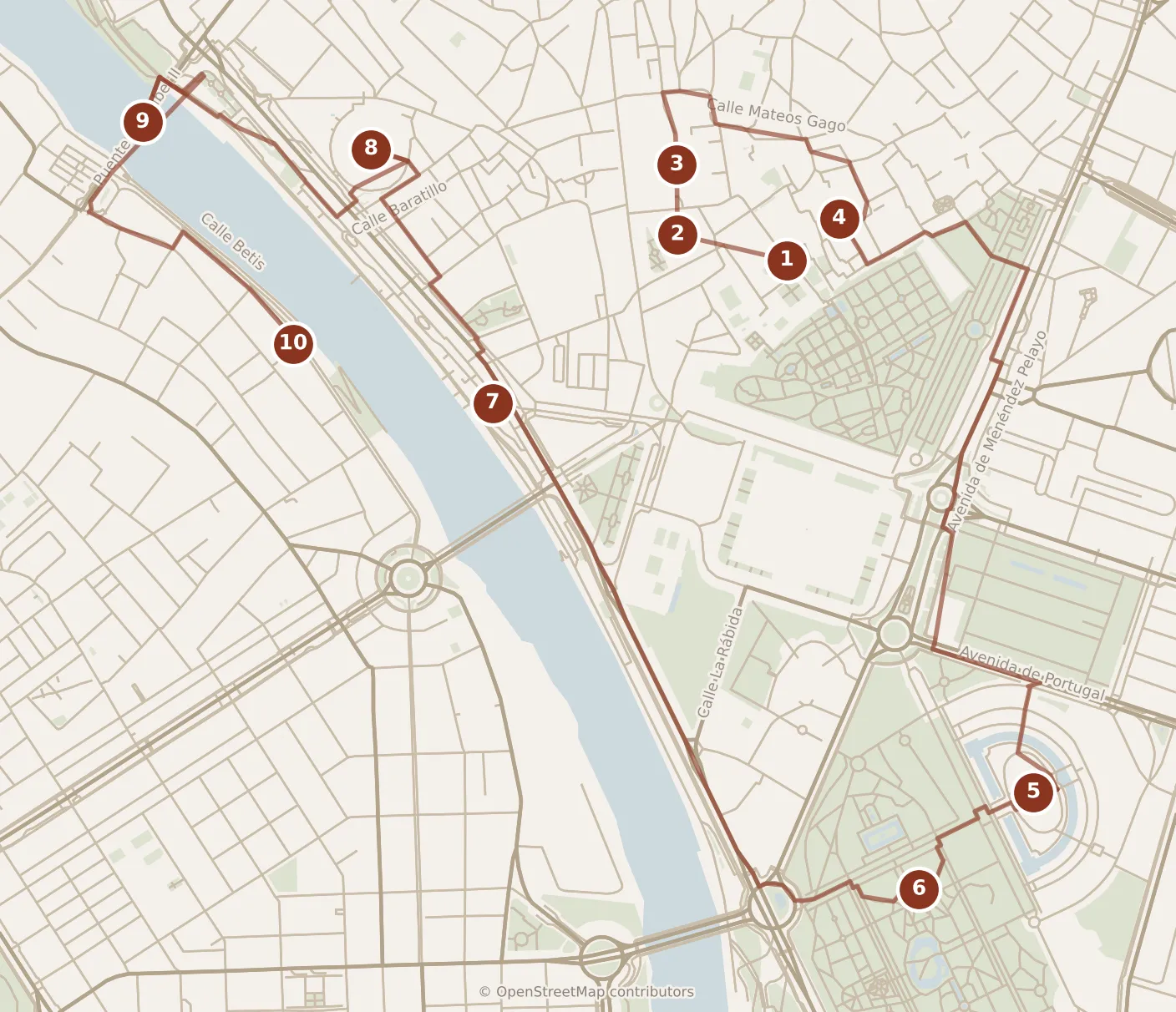
- The day
- 1Real Alcázar
- 2Archivo General de Indias
- 3Catedral de Sevilla
- 4Barrio de Santa Cruz
- 5Plaza de España
- 6Parque de María Luisa
- 7Torre del Oro
- 8Plaza de toros de la Real Maestranza
- 9Puente de Isabel II
- 10Calle Betis
Morning
Get to the Real Alcázar for opening, and if you can only be early once today, be early here. On foot from Sevilla-Santa Justa it is a little over half an hour, and that is the version that does not depend on a schedule. If a Cercanías C-1 is due it is one stop to San Bernardo and then three on the T1 Metrocentro tram — Prado de San Sebastián, Puerta Jerez, Archivo de Indias — which sets you down on the Avenida de la Constitución three minutes from the gate; but the C-1 runs at about a thirty-minute headway even at peak, so with a timed slot to make, walk rather than wait for one. Give the Alcázar two hours.
It is not one palace but a stack of them on one site, and knowing that is what makes the two hours legible. There was an Umayyad fort here in the tenth century and a much larger Almohad palace complex by the twelfth; Alfonso X put a Gothic hall on part of it after the city changed hands in 1248; and in the 1360s Pedro I rebuilt the heart of it in Mudéjar style, with craftsmen working in an Islamic idiom for a Christian king. The Patio de las Doncellas is the room that explains the whole building: a sunken garden with a long pool, arcades of interlaced plasterwork, and around the lower level an Arabic inscription that calls Pedro I sultan. The upper story above it is Renaissance, added for Charles V two centuries later, and the join is plainly visible. Next to it the Salón de Embajadores, finished in 1366, is a square hall under a wooden dome of interlocking stars. Off to one side are the rooms of the Casa de Contratación, the crown office set up in 1503 to license and tax everything that crossed to the Americas — which is the thread that ties this building to the archive you will see in twenty minutes.
Then the gardens, and give them at least half of your two hours. They descend in terraces from the palace wall, they were reshaped in the Italian manner in the early seventeenth century, and they are large enough that people lose track of time in them, which is the single most common way this day slips. They also stood in for a desert palace in a season of Game of Thrones, so expect company.
Local tip. The Cuarto Real Alto, the upper apartments still used by the royal family, is a separate ticket and a separate timed slot inside the same building. With one day, skip it. It is a guided route through furnished rooms, it fixes you to a clock on a morning that is already counted to the minute, and the half hour it costs is the half hour the gardens want.
Out through the Patio de Banderas and three minutes north-west is the Archivo General de Indias. Juan de Herrera drew it for Philip II in 1572 as a merchants’ exchange, to get the traders out of the cathedral where they had been doing business; Charles III turned it into an archive in 1785 and had the paperwork of the Spanish empire in the Americas and the Philippines brought here. It now holds something like nine kilometers of shelving. What you actually see is a severe, beautiful stone building, a great marble staircase, and a room of documents on display. Twenty minutes, and it is the cheapest twenty minutes of the day.
Two minutes further and you are at the cathedral. Give it an hour and a half. It stands on the footprint of the Almohad mosque of 1172, it was begun in 1402, it was finished around 1506, and it is the largest Gothic cathedral there is. The visit starts by going up the Giralda, which has its own access control: the tower is the mosque’s minaret of 1184 to 1198 with a Renaissance belfry set on top of it by Hernán Ruiz in the 1560s, and you climb it by 35 shallow ramps rather than stairs, because it was built to be ridden up. At the top is the view that tells you what shape the old town is. Inside, three things earn the time. The main altarpiece, begun by Pieter Dancart in 1482 and not finished for more than a century, is a wall of carved and gilded scenes that takes a while to resolve into anything. The monument to Christopher Columbus, here since 1899, is a coffin carried on the shoulders of four crowned bronze bearers; whether the bones in it were his was argued over between Seville and the Caribbean for a century, and a study reported in 2024 came down on Seville’s side. And you leave through the Patio de los Naranjos, the mosque’s old courtyard, still planted with orange trees around its fountain — the calmest thing in the building and the part most people walk past.
Afternoon
Five minutes east of the cathedral the streets narrow and you are in the Barrio de Santa Cruz. Give it half an hour and do not try to navigate it: the lanes were laid out as a medieval quarter and are in places barely wide enough for two people, and the pleasure is in the small squares you arrive at without meaning to. It is also the most tourist-saturated quarter of the city, so the eating immediately around the cathedral is aimed at people who will only eat there once.
Lunch goes here, and the city’s own lunch hour is late enough that the count above arrives at it without any adjusting. Walk five or ten minutes out of the tightest lanes — west towards El Arenal, or north — before you sit down; nothing published ranks the two directions against each other, and the rule that does hold is only that the further you get from the cathedral, the less the menu is written for someone who will eat here once. Pescaíto frito, the mixed fry of small fish, is the Andalusian lunch and it is better than its reputation abroad; espinacas con garbanzos, spinach with chickpeas, is the dish that proves the point about this being a city of vegetables as much as of ham; and in heat, cold gazpacho first. Ninety minutes at a table. The alternative is three or four small plates standing at a counter in forty-five minutes, which buys you back most of an hour — and at the December end of the band above, that hour is the difference between arriving at the river in time and arriving after it.
From Santa Cruz walk south, eighteen minutes, past the old tobacco factory that is now the university, and the Plaza de España opens in front of you. Give it forty-five minutes. Aníbal González built it as the centrepiece of the Ibero-American Exposition of 1929: a half-circle of building with a canal 500 meters long curving in front of it, crossed by four bridges named for Aragón, Castilla, León and Navarra, and boats rowed on the water. The thing to do here is walk the curve. Set into the base of the building are 48 tiled alcoves in alphabetical order, one for each Spanish province except Seville itself, which as the host city of the exposition was given none, each with a painted scene from that province’s history and a map in ceramic — so you can walk most of the alphabet of the country in twenty minutes, which is a better use of the time than photographing the towers. It has been filmed a great deal, most famously as an alien capital in a Star Wars film, and it is the single most crowded outdoor place in the city in the late afternoon.
Five minutes on and you are inside the Parque de María Luisa, which the plaza was carved out of. It was given to the city in 1893 by the infanta it is named after and replanted for the same 1929 exposition, and it is the shaded half of this afternoon: fig and orange and palm, tiled benches, ponds, and small pavilions from the exposition still standing among the trees. Half an hour, walking north-west through it rather than round it. This is the one stretch of the day where a bench is a legitimate use of your time, and in summer it is not optional.
Evening
Come out of the park north-west, twenty minutes, to the river and the Torre del Oro. This is the longest single leg of the day and it is worth it for the arrival: the tower is a twelve-sided Almohad watchtower of 1220, built to control the river, and it was one anchor of a chain that could be drawn across the Guadalquivir to stop ships. The upper stories are later — a fourteenth-century second level and a round eighteenth-century top. There is a small naval museum inside; skip it. At this hour the tower is an object on a riverbank, and that is what you came for. Fifteen minutes.
Walk north along the Paseo de Cristóbal Colón, eight minutes, past the Plaza de toros de la Real Maestranza — the bullring, an eighteenth-century oval in white and ochre with an arcaded gallery above the ring. Whatever you think of what goes on inside it, it is one of the buildings this city has arranged itself around. It runs guided visits; this day does not have the hour. Seven minutes further and you reach the Puente de Isabel II, which everyone calls the Triana bridge: finished in 1852, the first permanent crossing here, replacing a bridge of moored boats that had served since the twelfth century.
Cross it — the square at the far end is the Altozano — then turn left and walk down Calle Betis with the water beside you. This is the reason the day was walked in this direction. Betis is the street along the Triana bank, the district of potters and sailors on the far side — the ceramics workshops are still on the streets behind you, and the old Santa Ana factory two minutes from the bridgehead is a ceramics museum now, with its kilns restored in place — and it faces the old town across the river. As the sun drops behind you the east bank turns the color of the brick it is built from, the tower catches it last, and the river holds both. Eight minutes gets you the length of it. Stay for the twenty minutes either side and then eat here rather than back across the bridge — though in the short months the light goes well before the sit-down kitchens start serving, and that gap belongs to a bar on the same street rather than to a table. Triana is the less expensive, less performed half of Seville’s evening, and it is also where flamenco is genuinely rooted. If you want to see some, it goes after the light and not instead of it.
When it is time to leave, know that you are on the far bank and Santa Justa is three kilometers away. On foot it is three quarters of an hour, which is not the walk to make with a train to catch. Back over the bridge to Plaza Nueva is fifteen minutes, and from there the T1 tram retraces the morning to San Bernardo, one Cercanías stop short of the station. With a deadline, take a taxi from Triana and stop doing arithmetic.
Practicalities
Book two things and nothing else: the Alcázar and the cathedral, both timed, both from the institution that owns them. Take the earliest Alcázar slot you can and a cathedral slot for around midday, and buy them before you travel rather than on the morning: the Alcázar took over two million visitors in 2019 and it admits them in timed slots. Each ticket was in the thirteen-to-sixteen-euro range in 2026. There is a further charge inside the Alcázar for the upper royal apartments, which this route skips, and there is nothing else to pay for on the whole day.
A Sunday changes the morning rather than breaking it. With the cathedral not admitting anyone until the afternoon, the order inverts: take the Alcázar at opening as written, then the archive, then Santa Cruz and lunch, and put the cathedral and the tower where the plaza would have been. The plaza and the park then move to the late afternoon, which is where they are best anyway, and the river still gets the last of the light. What a Sunday costs is slack, and it costs it in one place. The cathedral publishes a last admission as well as a closing time, and in 2026 the accesses and the Giralda shut at five whatever hour the building itself closed at, Sunday included — so the afternoon has to fit between the half past two opening and that. Read the last-admission hour off the cathedral’s own pages before you go and fit the lunch to it, rather than the other way round.
The archive is the one stop here that takes a day a week off, and it is the one thing worth checking before you set out. If it falls on your day you lose twenty minutes and no more — walk the Plaza del Triunfo, look at the outside of it, and go on to the cathedral. The two ticketed buildings are steadier: the Alcázar closes on a very small number of national and religious holidays across the year, four of them in 2026, and the cathedral says plainly on its own pages that its visiting hours can move for services and ceremonies. Everything after lunch is a street, a square, a park or a bridge, so none of it is ticketed — though the park can be closed at short notice, as it was preventively in September 2025 under the regional avian-flu protocol and as it is in high winds, and the Navarra and Aragón ceilings of the plaza are under a nine-month restoration that began in mid-2026.
Two dates rewrite this day rather than inconveniencing it. During Semana Santa the processions close large parts of the old town for much of the day and the route between the cathedral and the river becomes impassable at unpredictable hours; during the Feria de Abril the city’s center of gravity moves across the river to the fairground and the ordinary rhythm of the afternoon goes with it. Both are worth seeing on their own terms. Neither is a day to follow this itinerary in.
Heat is the other thing that rewrites it, and it is not a caution but a structural fact about the shape above: the morning is three interiors and the afternoon and evening are entirely outdoors, with real shade only inside the park. From late June to early September, take the morning exactly as written, then let lunch run long and stay off the streets until the worst of the afternoon has passed, and start the walk south late. You will still make the river, because the sun does not go down until nearly ten in late June — though by early September it is back to a little before nine, so take the month’s hour and not the season’s.
The walking is about five kilometers and there is no climb in it except the tower’s ramps. Two legs account for most of it: eighteen minutes from Santa Cruz down to the plaza, and twenty minutes from the park back up to the Torre del Oro. Both are in the open, both are best walked with something cold in hand, and both are why the bag belongs in the station locker rather than on your shoulder.


