Seoul in two or three days: a day of palaces, a day along the wall, a third for the museum

Last updated 8 August 2026
Overview
One day in Seoul makes you choose between the old walled city and everything else, and that is an honest choice honestly made: the center is small and legible and the rest of the place is a hundred times its size. Two days does not simply give you twice as much of it. It buys two specific things. The first is that the palaces stop being one item on a list — there are five of them inside the old walls, they are walled towns rather than buildings, and the best thing in any of them is a garden you cannot walk into without an appointment made before you travel. The second is that the second day is freed to be about something other than sights.
So day one is the Joseon city as it meant to be seen: the ceremonial palace at the head of the main avenue, the hill village behind it, and then the palace the kings actually preferred to live in, with its garden at the back. Day two is what the twentieth century did to all of that. A palace that was made into a zoo. A shrine that a road cut off from its palaces in 1932 and that was joined back to them in 2022. A market founded in 1905 by Korean merchants for the specific purpose of getting out from under Japanese control. A city gate left standing alone in the traffic because the wall on either side of it was taken down. And then the wall itself, over the ridge east of the center, walked in the last of the light. The two days share a district and share nothing else, and they can be taken in either order.
Neither of them contains a single ride once it has begun. Day one is walked from Gwanghwamun Station to Ikseon-dong — about four and a half kilometers between the stops, and a great deal more than that inside the palace walls — and no stop on it is more than a quarter of an hour from the next. Day two is a loop of about six and a half kilometers that starts and ends at Hyehwa Station. A third day is the opposite: one ride you cannot avoid and one you can.
One thing on these days is certainly bought before you arrive, and a third day adds nothing to that count: the timed tour of the garden behind Changdeokgung. Everything else is free or is a ticket sold at the gate on the day — though the shrine on day two admits by timed tour too, and how that tour is obtained is worth finding out before you go rather than at its gate.
Day one is built backwards from the garden appointment, and day two from the light. The palace at the top of day one admitted nobody before nine in the morning in 2026, and from the moment it lets you in, everything before the garden gate comes to about five and a half hours — so the slot to book is one in the early afternoon, and if you find the opening hour has moved, move the slot with it. On day two the last stop is a ridge, and what it wants is the hour on either side of sunset. The sun goes down here between about ten past five in the first days of December and two minutes short of eight at the summer solstice, a band a shade over two and a half hours wide; the country keeps no summer time, so the clock on your phone is the clock of the sky in every month of the year. Day two is counted back from that sunset, and because in June the sum comes out at a start nobody would make, the long half of the year is dealt with inside the day itself rather than here.
The hour counts on this page measure the time you spend inside places and the time you spend walking between them, and they measure nothing else. On day one they do not include the ticket window at the largest palace on a spring weekend, which is the one genuine line on these two days, and they do not include the fact that a palace here is a walled town of several courtyards, so the walk from one building to the next happens far more often than a plan suggests. On day two they do not include the twenty minutes you will lose in a market you meant to pass through.
What you need in your hand that you may not have is two things, and both belong to the parent guide rather than to this route. The first is a way of paying small metro fares by tapping: the rechargeable card is the T-money card, sold and topped up at the machines in the stations and over the counter in convenience shops, so it is an errand for your first hour in the city rather than something to arrange from home. The second is a mapping application that gives walking directions in this country, because the one on your phone at home does not — Naver Map and KakaoMap are the two, and either is a download before you fly.
Last, the bag, because the shape of these days settles it. Seoul’s metro stations carry coin lockers, and the one to use is at the end of day one rather than at its start: Jongno 3-ga Station, on lines 1, 3 and 5, is where day one finishes and is one stop east of where it begins. Day two needs no such thinking, because it comes back to the station it left. There are two stretches on these days that a case genuinely ruins, and they are worth naming here rather than in the paragraph where you would otherwise find out: the stepped lanes of the hill village on day one, which are somebody’s front door, and the last half hour of day two, which is a climb up a hillside of stairs with nowhere to set anything down.
Day one

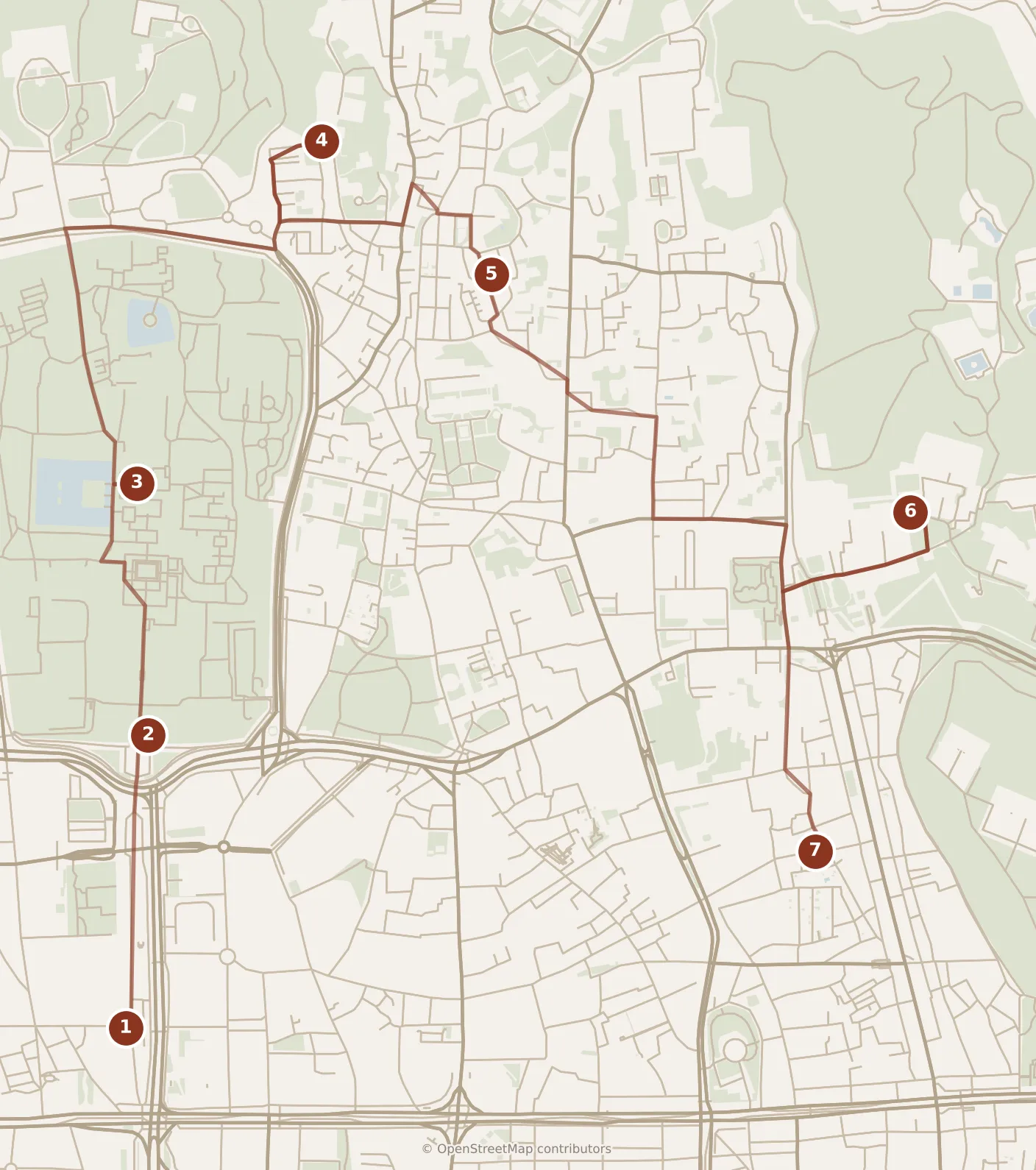
- Day one
- 1Gwanghwamun Station
- 2Gwanghwamun
- 3Gyeongbokgung
- 4Samcheong-dong
- 5Bukchon Hanok Village
- 6Changdeokgung
- 7Ikseon-dong
Everything today lies on a single line running east along the foot of the mountains, and nothing on it is a ride. What makes the day sit still rather than sprawl is that its middle is an appointment: a tour of a garden that leaves at a fixed time whether you are standing at the gate or not.
Morning
Come up at Gwanghwamun Station on line 5. Most people reach the old city through Seoul Station, the main railway terminus, where the airport railway from Incheon International Airport ends and the trains from the rest of the country come in: from there line 1 goes up to Jongno 3-ga and line 5 takes you one stop west. That is a route read off a network map rather than the shortest way across town with a case, so look for a nearer interchange with line 5 before you set off. If you have flown into Seoul Gimpo International Airport it is simpler — line 5 runs from the airport station to Gwanghwamun with no change at all. Either way you surface at the bottom of Gwanghwamun Square, and the walk to the gate is under ten minutes, straight up a paved axis with the mountains closing the view at the top.
Spend a quarter of an hour on the square before the palace opens, because it costs nothing and keeps no hours. It has been rebuilt twice in twenty years — laid out in 2009, dug up again and reopened in 2022 with most of the traffic taken off it — and it carries two bronzes that tell you what this country commemorates. Yi Sun-sin, the admiral, has stood at the southern end since 1968. Sejong, the king who had the alphabet made, sits further north and was unveiled in 2009 on the ninth of October, which is the day the alphabet is celebrated here. Then Gwanghwamun itself, the palace’s front gate: three stone arches under a double wooden roof, with the guard changed in the space in front of it more than once during the day, in reconstructed costume. That one is worth looking up the night before, because it runs about twenty minutes and you either walk into it or you do not.
Then Gyeongbokgung, and give it two hours. This is the part a single day cannot afford, and the extra half hour is not spent on more of the same. The three set pieces are at the front and in the middle — Geunjeongjeon, the throne hall on its double terrace; Gyeonghoeru, the banquet pavilion standing on forty-eight stone pillars in a lake; Hyangwonjeong, the small hexagonal pavilion on its island — and a day trip takes those three and is right to. Take them at a walk today and go to the back and the sides instead. Jagyeongjeon, the dowager queen’s quarters, burnt in 1873 and again in 1876 and was rebuilt both times; the thing to find there is the chimney wall behind it, a screen of moulded and fired brick worked with the ten symbols of long life, which is a designated treasure in its own right and is a chimney. Amisan, the queen’s garden, is a raised terrace made out of the earth dug from the pond under the banquet pavilion, and it carries four more brick chimneys of the same kind — a garden built from a hole, heated from underneath, and decorated at the point where the smoke comes out. At the very back is Geoncheonggung, a small compound put up in the 1870s in a domestic rather than a palatial style, and it is where the king’s queen was killed by Japanese agents in 1895, in the building on its western side, Gonnyeonghap. Nothing about the place announces it. That is the reason to walk to the back of a palace on a second day: the front of it is architecture and the back of it is what happened.
Leave by the east side. A dozen minutes takes you into Samcheong-dong, the street that runs north along the palace’s outer wall and then climbs into the hillside — galleries, small shops, coffee, and a gradient. Half an hour, and do not start shopping; the point is that after two hours of walled courtyards it is a street rather than a compound. It is not the quiet one — it is walked as hard as anything here — but nothing on it is behind a gate. Seven minutes further up and you are in Bukchon, the hill of restored hanok, the tiled single-story courtyard houses, packed onto lanes steep enough to look down over the roofs of the row below. Three quarters of an hour, and walk it downhill rather than up: what you have come for is the roofline below you, so the direction matters more than the route. Several thousand people live here and the lanes are their street. There are quiet-hours signs, there are wardens, and there are lanes with visiting hours enforced on them; check what is open before you climb and plan on the assumption that a lane may be shut, because there are others. Speak quietly and do not photograph into a doorway. That is the whole of the local code here and it is not a suggestion.
Afternoon
Come down out of the hill towards Anguk, a quarter of an hour, and eat in the lanes on the way. This is the right meal on these two days for bibimbap, which is a bowl to sit down over rather than a thing to carry. Three quarters of an hour, and the rule for choosing here is the one that works in the market on day two: go a lane in off the main street, and prefer the room with the menu on the wall to the one with the photographs outside it.
Then Changdeokgung. Give the palace itself an hour before the garden, because you cannot reach the garden gate without crossing it, and because it is the more likeable of the two palaces on this day. Where Gyeongbokgung was laid out on a grid against the mountain, Changdeokgung was fitted into the ground it found: the courts step and swerve, Injeongjeon sits at an angle to what comes before it, and the kings preferred living here for four hundred years, which is the only review that matters. It was founded in 1405, burnt in the invasions of the 1590s, burnt again in a coup in 1623 and rebuilt in 1648; a fire in 1917 took the inner quarters.
The garden behind it is the Huwon, and it is why this day exists. It is not a garden in the sense of a planting scheme — it is a wooded valley with pavilions dropped into it at the points where somebody once decided the water and the slope were right, and it was shut altogether from 1979 until 2004 to let it recover. You go round it in a group, at a set time, on a ticket bought in advance, and it takes about an hour. Tours run through the day in Korean and only a couple of times a day in English, which is the real constraint on which slot you get. There are over a hundred and sixty species of tree in it and seventy-odd individual trees over three hundred years old, and the effect of walking through it after a morning of courtyards is that the architecture stops being the subject.
Local tip. If the only slot you could get is the first of the morning, run this day backwards rather than abandoning it: the garden and Changdeokgung first, then the hill village, then the street below it, then Gyeongbokgung last. It is the same line walked the other way, so nothing is further from anything and the total is unchanged. What you lose is that the largest palace no longer teaches you the scale that makes the second one readable. What you gain is a slot you could actually get, which is worth more.
Evening
A dozen minutes south-west from the palace gate brings you into Ikseon-dong, and you will arrive there in the middle of the afternoon rather than at dinner time. That is the right time to arrive. It is a block of very narrow alleys of small 1920s and 1930s hanok, built as cheap urban housing and turned over the last decade into tiny shops, tea rooms and bars, one to a house. In the middle of the afternoon you can still see the roofs and the width of the lanes, which after dark you cannot, because after dark you can see the lines. Have coffee, walk the whole grid before you choose a door, and stay for dinner once the light has gone.
Be honest about what it is: not a survival but a conversion, and the interest is in how completely a lane of one-room houses can be turned into something else without a single house being knocked down. Insadong is ten minutes west if you want a craft street as well, but it is the busier and the more obviously aimed of the two and it is on every one-day route in the city. Jongno 3-ga Station is ten minutes south when you have finished, and it is on lines 1, 3 and 5 — check which of the three serves the part of the city you are sleeping in.
Day two

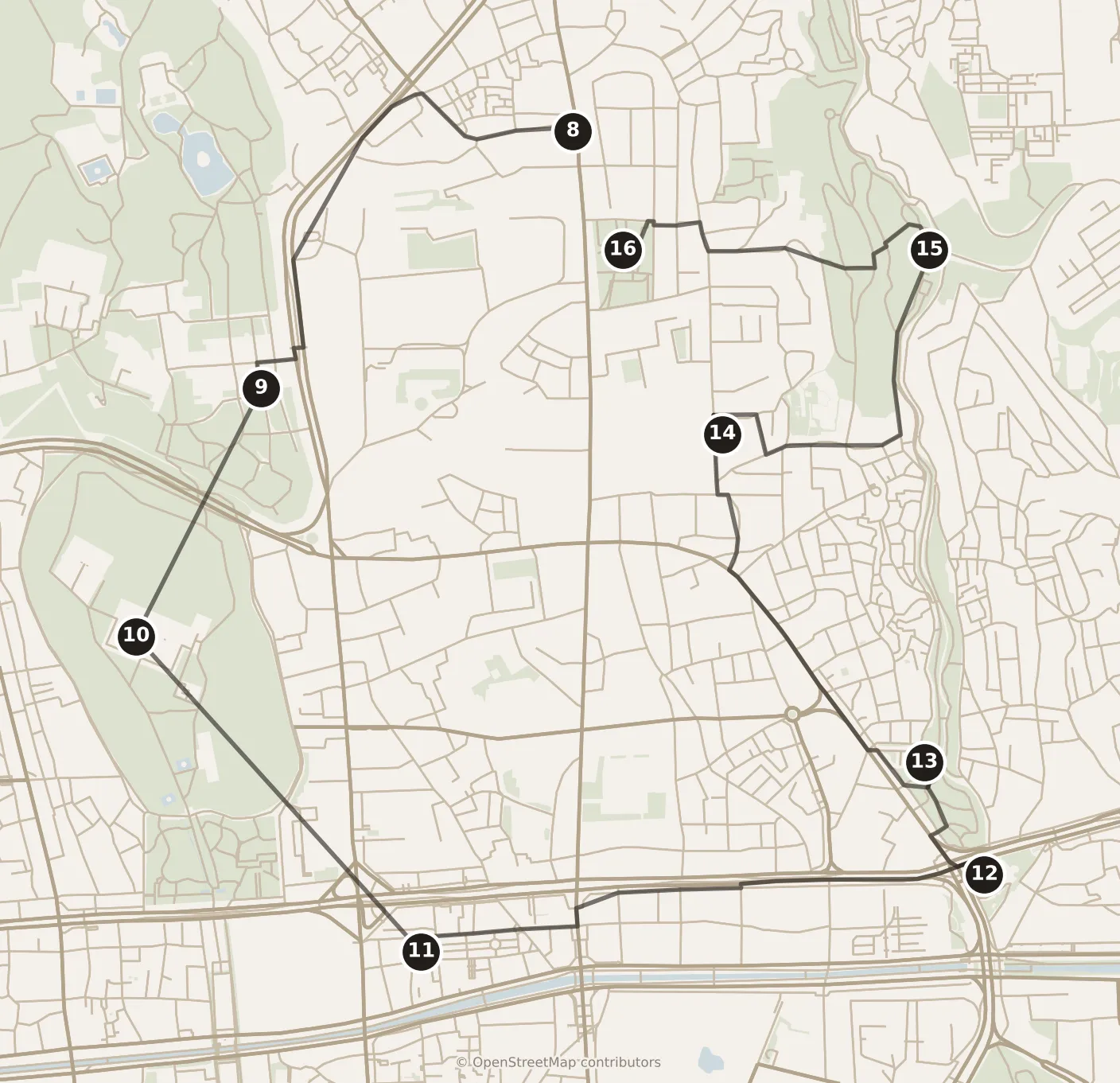
- Day two
- 8Hyehwa Station
- 9Changgyeonggung
- 10Jongmyo
- 11Gwangjang Market
- 12Heunginjimun
- 13Seoul City Wall Museum
- 14Ihwa Mural Village
- 15Naksan
- 16Marronnier Park
Today is the twentieth century, and it goes anticlockwise: south through two royal compounds, south-east to a market, east to a gate, then north and up onto the ridge for the light. About six and a half kilometers, an hour and a half of actual walking, and no ride from start to finish — the day ends four minutes from the station it started at.
The stop this day is built around is the ridge, and it wants the hour on either side of sunset. Everything from the first palace gate to the top comes to about five and three quarter hours, so take your own month’s hour and count back that far: about half past eleven in December, a quarter past two at midsummer. A quarter past two is no way to begin, and starting later is not the answer, because the shrine below the ridge is a morning appointment and the palace before it opens in the morning too. So in the long half of the year two of the rules on this page cannot both hold, and here is the trade. Keep the morning as written and start at the palace’s opening; from a nine o’clock start in late June you will reach the ridge with about five hours of daylight in hand. Three of those have obvious homes on this route — the shrine’s wood and the market each take an extra hour without complaint, and the wall north of the ridge to Hyehwamun and back is about another — and the last two are the reason to take the final two things in the other order, eating in the theater quarter at the bottom first and climbing afterwards. That costs ten minutes uphill instead of ten minutes down and nothing else, and the wall is lit after dark, so what you give up is the dusk rather than the view.
Morning
Start at Hyehwa Station on line 4 and walk a quarter of an hour south-west to Honghwamun, the gate of Changgyeonggung. This is the palace nobody puts on a list, and it is the one with the worst century. It was built as a set of apartments for dowager queens in 1484; Honghwamun and the main hall behind it, Myeongjeongjeon, were destroyed in the invasion of 1592 and rebuilt in 1616, which makes Myeongjeongjeon the oldest main hall of any palace in Seoul. Between them lies Okcheongyo, a twin-arched stone bridge of 1483 with goblin faces carved on it to stop bad things crossing. Then, under Japanese rule, a zoo, a botanical garden and a museum were put up inside these walls and the place was renamed Changgyeongwon — the ending meaning garden rather than palace. The zoo stayed until 1983, when the animals went out to Seoul Grand Park and the palace was put back. What survives from that period, and the reason to come, is the Daeonsil at the top of the grounds: a glasshouse designed by a Japanese horticulturalist, built by a French firm, begun in 1907 and finished in 1909, and the first of its kind in the country. It is a Victorian-looking greenhouse standing in a Joseon palace because a colonial administration decided a palace should be a park. An hour and a quarter for the whole compound, and give a real part of that to the glasshouse and the pond in front of it.
Leave by the south. Ten minutes takes you across ground that did not exist in this form until 2022: Yulgok-ro, the road driven between the palace and the shrine in 1932, which split them for ninety years, has been put into a tunnel and the ridge over the top of it planted and walked on again. You now go from Changgyeonggung into Jongmyo the way the kings did, on the ground. The work took eleven years.
Jongmyo is the royal ancestral shrine and it is the least like anything else in this city. It is not a temple and there is nothing to look at in the ornamental sense: it is a walled wood with two long, low, almost undecorated halls in it, and the tablets of the Joseon kings and queens are kept in the rooms behind their doors. Jeongjeon, the main hall, is a hundred and one meters long with nineteen chambers along it, added one at a time as kings died, and it is the longest single building of traditional design in the country. Its roof was taken apart and re-laid with hand-made tiles between 2020 and 2025, so what stands there now has only just been finished. An hour and a quarter.
Two things about being there. Entry is by timed guided tour on most days, in a group that walks together, and on certain days the shrine is opened for free walking instead; it publishes which days and which times itself, and whether the tour you want is reserved in advance or joined at the gate is on the same page. Read all of it before you fix the order of your trip, because the two visits are not the same thing — the tour tells you what you are looking at, and the free day lets you stand in the courtyard until it stops feeling like a courtyard. And there is a raised triple path of stone running the length of the precinct. The middle strip is for the spirits and the strips beside it were for the king and the crown prince, and visitors are asked not to walk on the middle one. It is marked, it is enforced by whoever is watching, and it is the single thing here that a visitor is most likely to get wrong.
Afternoon
A quarter of an hour south-east brings you to Gwangjang Market, and lunch. The date over the door is 1905, and the reason for the date is the point: after the treaty of that year put the country under a Japanese protectorate, Japanese interests took over the Namdaemun market, and a group of Korean merchants and investors answered by founding their own — open every day rather than on market days, which is what made it the first permanent market in the country. It sold farm produce and fish before it sold anything else, it was called the Dongdaemun market until 1960, and the food alleys everyone comes for now are the least old part of it. Give it an hour. There is a wide covered cross of counters in the middle with stools jammed under them, and the things to have here that a quick pass would miss are kalguksu, wheat noodles cut by hand off the sheet and cooked in the broth so the water thickens, and in hot weather naengmyeon, cold buckwheat noodles in an iced broth, which is a summer dish. It is crowded, a good deal of the front row is now performing for cameras, and the way past that is to go one lane in from wherever the line is.
Twenty minutes east along the main road — the longest single stretch of these two days — and the road runs into Heunginjimun, standing on its own island of paving in the middle of the traffic. It was first built in 1398, remade in 1453, and what you see is the rebuilding of 1869. It is the one great gate of this city with an ongseong: a semicircular screen wall thrown round the outside of the arch, so that an attacker who got through the outer opening found himself in a walled yard with the defenders above him on three sides. The reason usually given is that this is the low, soft corner of the circuit and needed the help. You do not go in; you walk round it, and the reason it looks stranded is that the wall it belonged to was pulled down on either side under Japanese rule and the gate was left as an ornament in a road.
Four minutes north, at the foot of the hill, is the Seoul City Wall Museum, which is free and which is the explanation for everything you are about to walk on: the wall was thrown round these mountains in 1396, it ran between four great gates, most of it came down in the first decades of the twentieth century, and the surviving and rebuilt lengths have been stitched back together over the last twenty years. Three quarters of an hour for the gate and the museum together. This is the one indoor stop of the day that keeps a weekly closing day of the ordinary museum kind; if you find it shut, nothing else moves, because the gate and the wall above it are outdoors and have no hours at all.
Local tip. Two things sit at the foot of this hill and if the day is short you only need one of them. Cutting the museum buys three quarters of an hour and costs you the explanation. Cutting the wall above it buys about the same and costs you the whole point of the day. Cut the museum, and read the panels set along the wall itself as you climb.
Evening
The wall goes up from here. A quarter of an hour of climbing, most of it on stairs between houses, brings you into Ihwa Mural Village, a slope of small post-war houses built against the inside of the old wall. In 2006 a government arts project put about seventy artists into these lanes for six months to paint them; the murals made the place famous, and by 2016 the residents had had enough and painted the two best-known staircases — the flower stairs and the fish stairs — over in gray. That is the honest state of it. Something like half the original work is gone, what remains is patchy, and the murals are no longer the reason to walk up here. The reason is that this is the last stretch of unimproved hillside inside the wall, with the city widening below you at every turn. Twenty minutes, and quietly: people live in these rooms, their windows are at the level of the path, and the residents have run a campaign of their own asking visitors to remember that this is a home before it is a photograph.
Ten minutes more and you are on the ridge of Naksan with the wall running along the top of it. This is the low one of the mountains that box the old city in — nothing like the hill on the far side, and that is the point of it: you are close enough and low enough to read individual streets. Walk on the wall side rather than the paths below it. To the west is the whole of the old city and the palaces you spent yesterday and this morning inside; to the east the ground drops into a different city altogether, denser and more ordinary, going on to the edge of sight. Three quarters of an hour on the ridge, and stay for the light. It does not go all at once: the wall is floodlit after dark, the stone holds the last of the color for a while, and the moment worth waiting for is the one where the lit wall and the sky are the same brightness. If you have the legs, the wall carries on north from here to Hyehwamun, and there and back is about an hour.
Then ten minutes downhill north-west to Marronnier Park, which is the middle of Daehangno, the theater quarter. The national university stood on this ground until it moved out in the 1970s and the small theaters moved in behind it; there are a number of them within a few streets, almost all playing in Korean, and the early evening here is a student quarter eating before a curtain. That is what you are here for rather than a show. This is the right dinner for tteokbokki — cylinders of rice cake in a red, sweet sauce, taken from a shared pan — which is student food in this country and is at its most honest in a street like this one. Hyehwa Station is four minutes away and line 4 runs south through the middle of town.
With a third day

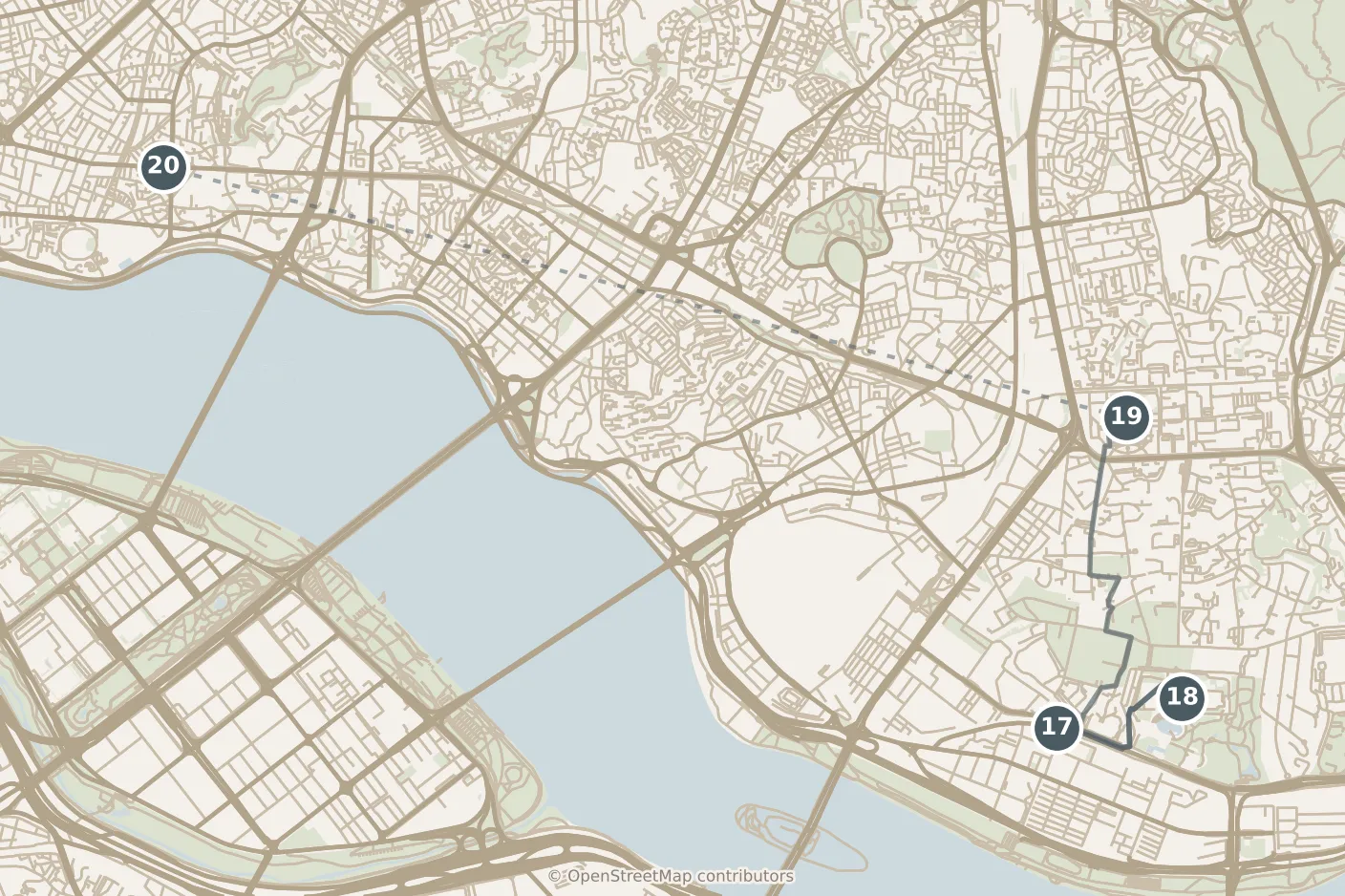
- With a third day
- 17Ichon Station
- 18National Museum of Korea
- 19War Memorial of Korea
- 20Sangsu Station
A third day is added at the end, and the reason is the shape of the evenings rather than the geography: the two days above both start at a gate that opens in the morning, while this one ends late in a student quarter and has no gate to catch at all. Added at the end it changes no numbering and moves nothing. It is also the only one of the three with neither a booking nor a light to be caught, which makes it the day that slides when a closure squeezes the other two — and if a closure does push it into the middle, nothing inside the first two days changes, because neither depends on the other. The one thing to re-check in that case is that your garden reservation is still dated to the day you are actually taking the palaces on.
It is a day south of the old wall, and it is where the country’s whole past and its worst century are each kept in a single building.
Start at Ichon Station, which is on line 4 and on the Gyeongui–Jungang line, and walk a quarter of an hour to the National Museum of Korea. It is free, it opened on this site in 2005, and by floor area it is among the largest museums in the world, which is a warning rather than a recommendation: going in without a plan is how people spend four hours and remember nothing. Take three things and let the rest go. The first is in the entrance hall and is unmissable, because it is a ten-story marble pagoda of 1348 standing indoors — carved for Gyeongcheonsa temple, taken to Japan in 1907, returned in 1918, dismantled again in 1995 and re-erected inside this building when it opened. The second is the pair of gilt-bronze pensive bodhisattvas, seventh-century, one ankle laid over the opposite knee and two fingers at the cheek, shown together in a dark sloping room built for the two of them and open since 2021; it is the quietest space in the building and people sit down in it. The third is the Goryeo celadon, which is a color rather than a shape and has to be looked at rather than described. Two and a half hours for the three, which is a fair morning, and the museum’s own restaurants are the sensible lunch, because there is very little around it.
The river is fifteen minutes south of the museum gate, down through apartment blocks, and going to look at it is a decision rather than a sight: the Han here is very wide, gray and working, with park and cycle paths along both banks, and standing on the bank tells you why the city is arranged the way it is. Go if the scale of the thing interests you.
Then the War Memorial of Korea, which is also free and which is about half an hour on foot north from the museum — or, once you have walked the quarter of an hour back to the station, two stops on line 4 from Ichon to Samgakji, which saves a good deal less than it looks as though it should. Walk it if the weather allows. It is a very large building with a courtyard of aircraft, tanks and a warship’s bridge outside it, and the part that matters is inside: the Korean War galleries, which take the war month by month rather than as a single event, and the corridors of bronze panels carrying the names of the dead, the Korean ones and then, contingent by contingent, the foreign ones. An hour and a half. It is the plainest explanation you will get of why the country you have spent two days walking around looks the way it does.
Local tip. Do these two in this order and not the other. The museum needs a fresh head and two and a half hours of standing; the memorial does not, and it is also the one of the two to cut if the day has gone short. Reversed, you arrive at the largest collection in the country tired, and you do the thing the paragraph above warns about. And if two museums in a row is one too many, cut the memorial outright, take the river slowly, and give the whole afternoon to the west of the city, which is where this day ends anyway. Samgakji is still the way there: either the two stops on line 4 from Ichon, or the same half hour north on foot, past the memorial’s door without going in.
Finish the evening in the west. From Samgakji, line 6 runs to Sangsu Station with no change and takes about a quarter of an hour, and Sangsu sits at the bottom of Hongdae, the student and music quarter around the art university. It is loud, cheap, very young, and it is the one part of Seoul on these three days that is not about the past, which after the morning is exactly the right correction. Walk north through it and Hongik University Station is at the top; the airport railway calls there and runs straight out to Incheon International Airport, which makes this the right last evening if you are flying the following day — and the other way along the same line into Seoul Station if you are leaving by train.
Practicalities
The booking. The timed tour of the Huwon, the garden behind Changdeokgung, on the palace day. It is reserved in advance on the Korea Heritage Service’s own booking site rather than through an agency — that is the service the palaces and the shrine belong to, and it publishes their hours and closing days as well. Open it as soon as you have dates: the English-language departures are the few, and how far ahead the window opens is the number this page does not know and the one you need first. A share of each day’s places is held back and sold at the palace’s own ticket office on the day, which is the fallback and not the plan. The palace ticket and the garden ticket together were in the five-to-ten-thousand-won range in 2026. The two museums on the museum day are free and everything else is sold at whichever gate you are standing at, with one thing to check for yourself: the shrine on day two admits by timed tour, and whether that tour is reserved in advance or joined at the gate is not something this page will guess at. There is also a combined ticket covering the palaces and the shrine, sold at any of their gates, and these two days pass through three of those gates plus the shrine, which is the arithmetic a one-day visit cannot make. Whatever ticket you hold, the garden is a separate reservation made before you travel.
Which day is which, and the closures. The rules below are written for the days by name — the palace day, the wall day, the museum day — because a closure can push the third one into the middle and shift the numbering.
- The palace day must miss the weekday Gyeongbokgung is shut, which in 2026 was the Tuesday. It must also miss whichever day Changdeokgung is shut, and there the check is free: the garden reservation system will not offer you a slot on a day the palace is closed, so booking the garden first settles that half of the problem without your looking anything up. One lane or another in the hill village may also be closed to visitors on the day you come; that costs you a lane and not a day.
- The wall day turns on two closures, and neither is a guess worth making from a distance. Changgyeonggung and Jongmyo each keep a weekly closing day, and the palaces here do not all shut on the same weekday — the closures are staggered deliberately so that something is always open, which is a kindness to a two-day visitor and a trap for one who assumes. Each publishes its own closing day on its own page, under the Korea Heritage Service; read those two lines in the week before you fix your order. Whichever of the two is shut, the day survives it, because both sit at the front and both are an hour and a quarter. If the shrine is the one, start at the palace and carry on as written. If the palace is the one, start at the shrine instead, reached from Jongno 3-ga Station on lines 1, 3 and 5 rather than from Hyehwa on line 4 — and note that on that version the day stops being a loop, so the bag goes to Jongno 3-ga. Either way the freed hour and a quarter goes into the wall at the end: north from the ridge to Hyehwamun and back is about an hour, and the remaining quarter of an hour is a slower lunch. The free museum beside the gate keeps a weekly closing day too, and it is the one loss on this day that changes nothing, since the wall it explains is outside its door.
- The museum day has no palace in it, so it is the one to move: put it on the day a closure has spoiled and take the other two on either side of it. Both of its buildings keep closing days of their own and both publish them, so read those when you decide where in the run it goes — which you are doing anyway, because it is the day that moves.
- The closing weekdays in this city cluster at the start of the week. A two-day trip that is the Monday and the Tuesday is therefore the arrangement to check hardest and the one most likely to need reordering; a run containing a Wednesday or a Thursday can always be arranged.
If the garden is sold out, and it does sell out, the palace day still works and the substitution is concrete rather than a gesture. Take Changdeokgung’s courts as written — a ticket at the gate, no reservation — and give the hour you would have spent in the garden to Changgyeonggung instead, which is ten minutes further east through the connecting gate, Hamyangmun, and which is otherwise the wall day’s opening stop. It wants an hour and a quarter, so the palace day runs a little longer than written and still ends in the same alleys. The wall day then loses its first hour and a quarter and begins at the shrine, reached from Jongno 3-ga Station; its count back from the light shortens from about five and three quarter hours to about four and a quarter, so on that arrangement you start later. It is a real trade and not a free one: you have swapped a garden for a glasshouse, and you have taken the twentieth-century argument out of the front of the wall day.
What to cut if you are short. On the palace day, in this order: Samcheong-dong first, which saves half an hour and costs you one of the morning’s two ticket-free streets; then the back half of Gyeongbokgung — Geoncheonggung and the dowager’s quarters — which brings the palace down to an hour and a half and saves another half hour. Do not cut the hill village: with Samcheong-dong already gone it is the only open street left before the evening, and it is what stops the morning being one walled compound after another. Never spend the margin in front of the garden tour, because a timed tour is timed. On the wall day, in this order: the wall museum first, three quarters of an hour, for the reason that day’s callout gives; then the mural slope, twenty minutes, which you walk through either way because the path up runs through it — so walk it without stopping. Do not cut the market, which is lunch. Never spend the margin in front of the light. And the half hours saved on one day are that day’s: the two days do not lend to each other.
The bag. The palace day runs from Gwanghwamun Station on line 5 to Ikseon-dong, which is ten minutes from Jongno 3-ga Station and one stop from where the day began, so a locker at the end of the day is a two-minute detour at the start of it. The wall day is a loop that begins and ends within four minutes of Hyehwa Station on line 4, which is the easiest case there is. The one place where two of the rules on this page collide is an arrival that lands on the palace day’s closed weekday: the closure wins, because a shut gate cannot be argued with and a case can be put in a locker, so you take the wall day on your arrival day — and the wall day is the one with the climb. Leave the bag at Hyehwa Station before you start, and the loop brings you back to it, which costs nothing at all.
Getting between the stops. The palace day is about four and a half kilometers between the stops and a little over an hour of actual walking, with no leg on it longer than a quarter of an hour; the longest of them is the one down off the hill village to Changdeokgung, and the climb up into that village is the only gradient that will bother you. The wall day is about six and a half kilometers and an hour and a half of walking, its longest stretch is the twenty minutes east from the market to the gate, and its last half hour is a genuine climb on stairs — so it is the wrong day for new shoes, and the wrong one to take in ice or in heavy rain, because that climb and the hour on the ridge above it are the two stretches of these three days with nothing at all to shelter under. The museum day is the only one with a ride in it: one you must take, west from Samgakji on line 6, and one you may, the two stops from Ichon to Samgakji that a half-hour walk replaces.


