Seoul in one day: a palace at opening, Gwangjang at lunch, Namsan at dusk

Last updated 4 August 2026
Overview
One day in Seoul cannot be representative and there is no point pretending otherwise. What it can be is coherent, and the way to get that is to pick one line and stay on it. This route runs west to east across the old walled city — the palace, the hanok lanes above it, the craft street, the covered market — and then turns south onto the hill that closes the city on that side, and stops there when the lights come on. It never crosses the Han. Everything on it is either a walk from the last thing or two stops on one metro line, and the whole day comes to about ten kilometers on foot, of which the last two are optional.
What that costs you is the other half of the city and most of the country. The south bank goes entirely: no Gangnam, no towers, no river crossing, and if that is what you came for then this is the wrong day and you should build a different one. The big collections go too — the national museum sits south of the center and is a half day in itself — and so does the day trip to the border, which is a whole day with a booked coach at the front of it. The night in the student quarter west of here goes as well, because the evening on this route is already spoken for. None of these are sacrifices you have to think about. A single day in a city of this size is a decision about which one hour you are willing to spend on trains, and the answer is roughly none.
The stop the day is built around is the top of Namsan, and what it wants is the last half hour of daylight and the half hour after it, when the city underneath comes on in pieces. Korea does not use daylight saving time, so the only clock that matters is the sky, and it runs across a wide band: the sun goes down here a little after five in the first week of December and just before eight at the end of June. Take your own month’s hour and count back seven, which is what everything above the hill comes to — an hour and a half in the palace, three quarters of an hour in the lanes above it, half an hour in the craft street and ten minutes in the park at the end of it, an hour over lunch, three quarters of an hour at the design plaza, and two and a half hours of walking, metro and cable car strung between them, of which the last forty minutes is getting up the hill and into the line.
In December that count puts the start of the day at ten in the morning. At midsummer it puts it at one in the afternoon, which is not a day, and the honest answer is not to start later but to know in advance where the best part of four spare hours goes. They have an obvious home: a second palace, Changdeokgung, sits ten minutes east of the hanok lanes and absorbs two hours on its own — more if you take the timed walk through its garden, the Huwon, which is booked and does sell out. The two free museums inside the first palace’s own grounds, one of royal objects and one of ordinary Korean life, will take an hour between them without leaving the walls. Neither addition moves anything else in the day.
What the seven hours count is time spent inside places and walking between them. What they do not count is the line at the bottom of the cable car, which is the one genuinely unpredictable thing on this route: the figure above allows an ordinary wait, not a clear Saturday in the hour before sunset, when several thousand other people have had the same idea and are standing in front of you. Nor does it count the ticket window at the palace on a spring weekend. Both of those come out of the front of the evening, so build the margin there rather than discovering it on the hill.
There is one hour in this article and the day is counted from it. Gyeongbokgung admitted nobody before nine in the morning in 2026, and until lunch it is the only stop on this route with a ticket desk at all — the lanes, the craft street, the park and the stream are simply streets. So nine is the earliest this day can begin: build the morning forward from that opening, and if the hour has moved, build it forward from the new one.
One last thing to settle before you pick up a bag, because this day is a loop and that is the easy case. It starts and finishes at Seoul Station, which is where the airport railway comes in and where the luggage lockers are, so leave the bag there and collect it on the way out. Everything below assumes your hands are empty. The one stretch you would regret carrying anything on is the climb up to the cable car, which is a bit over ten minutes of sidewalk going steadily uphill with nowhere to set anything down.
The day

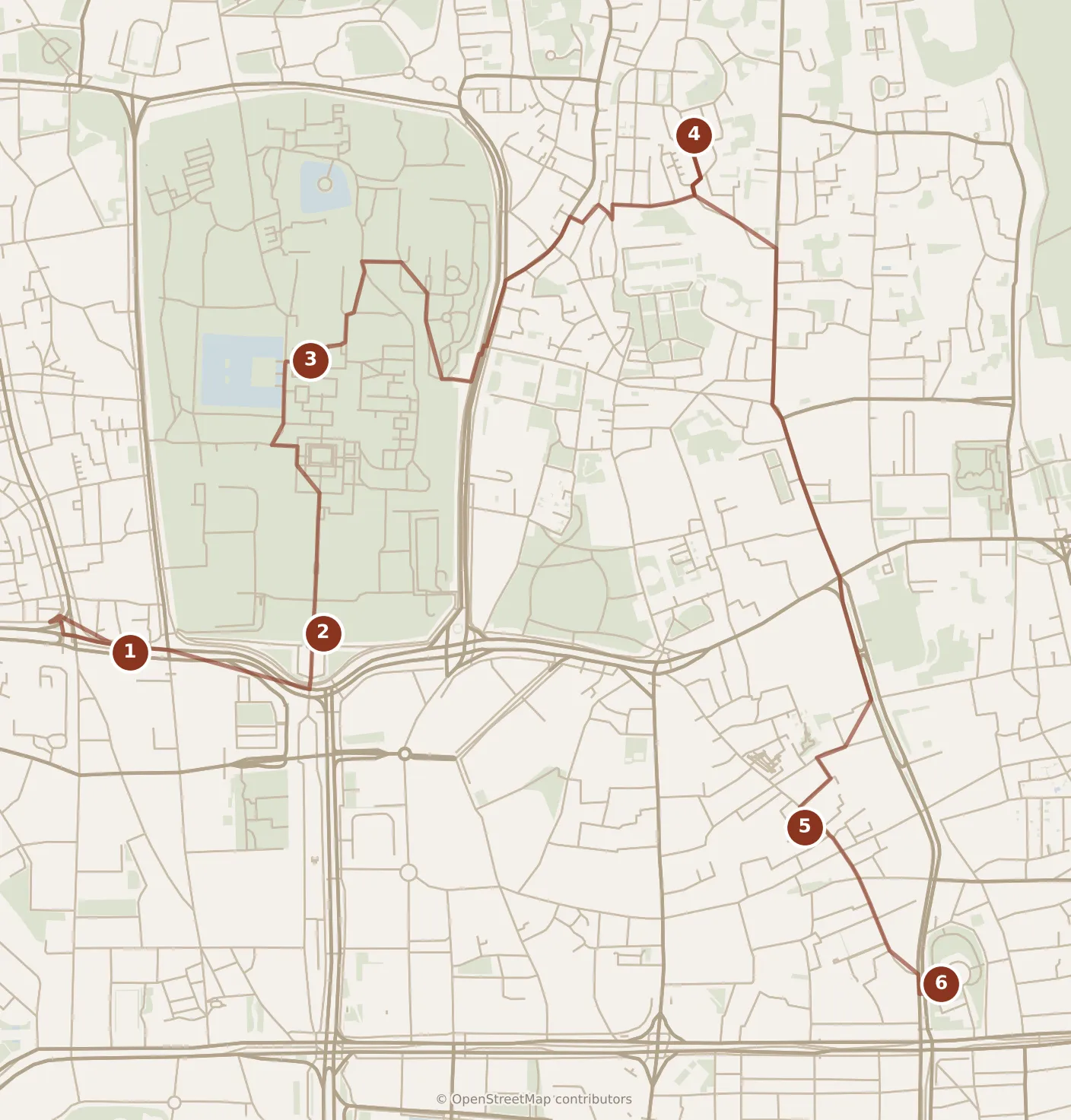
- Morning
- 1Gyeongbokgung Station
- 2Gwanghwamun
- 3Gyeongbokgung
- 4Bukchon Hanok Village
- 5Insadong-gil
- 6Tapgol Park
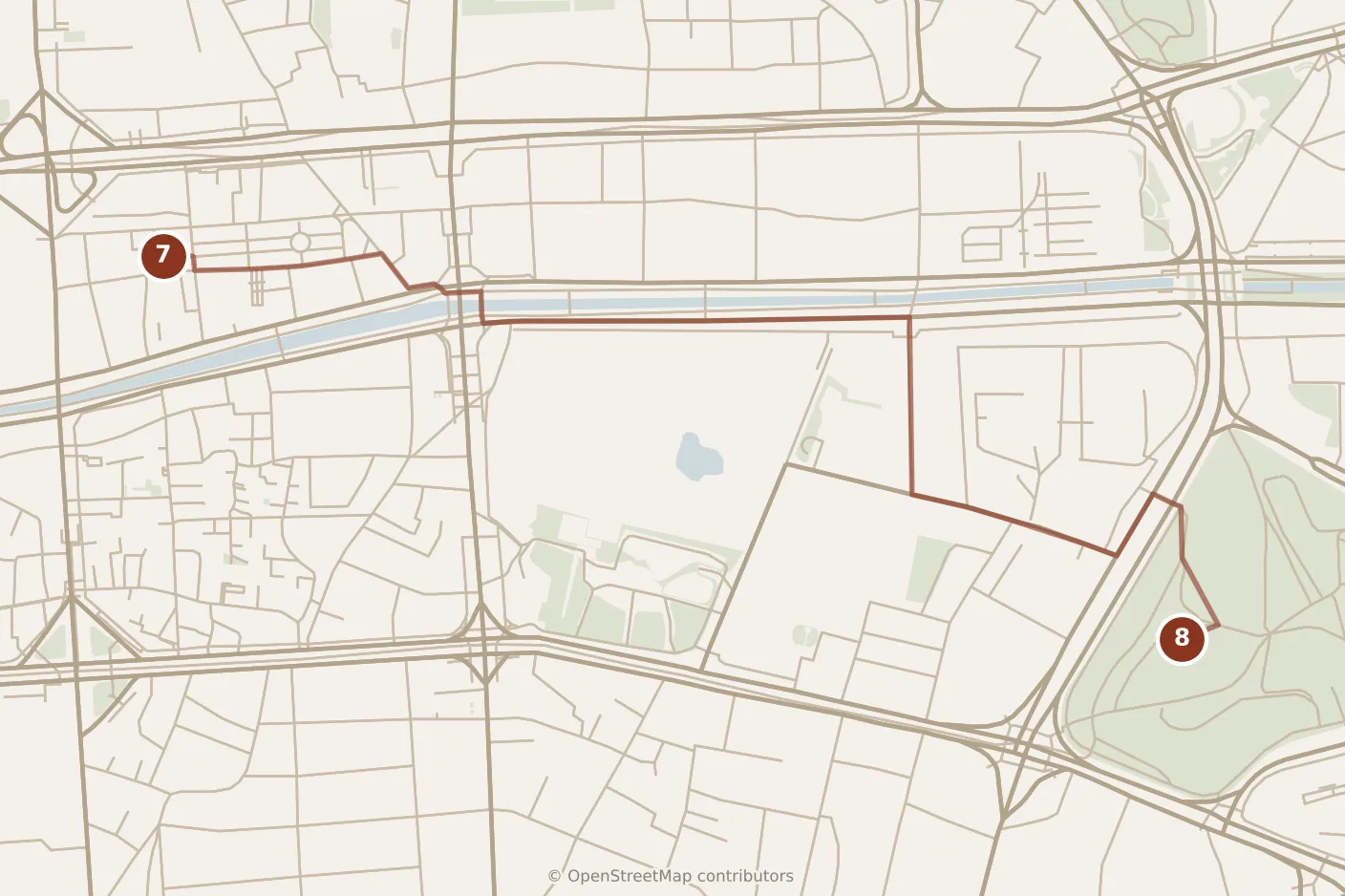
- Afternoon
- Cheonggyecheon — in the prose, not on the map
- 7Gwangjang Market
- 8Dongdaemun Design Plaza
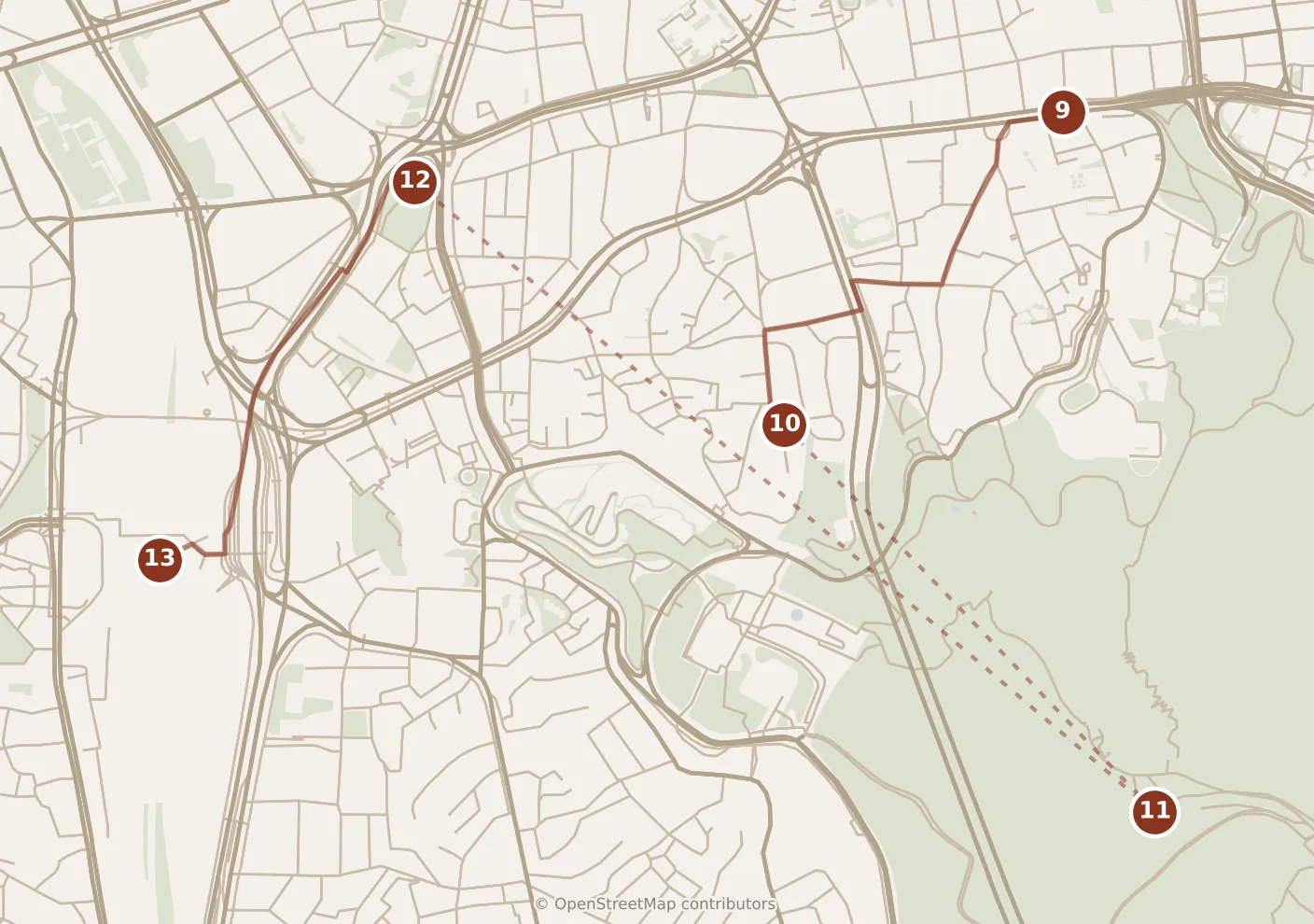
- Evening
- 9Myeongdong Station
- 10Namsan cable car
- 11Namsan Seoul Tower
- 12Sungnyemun
- 13Seoul Station
Morning
From Seoul Station take line 1 three stops to Jongno 3-ga and change there onto line 3, which is two more stops north to Gyeongbokgung Station. The station puts you out alongside the palace rather than in front of it, so walk the five minutes east to Gwanghwamun, the main gate, and go in through that instead. The gate is worth the five minutes on its own. It has been taken down, moved, burnt, rebuilt in concrete and rebuilt again in wood, and the broad stone terrace in front of it — the raised ceremonial platform the road used to run straight over — was only put back in 2023. Two stone beasts sit at the foot of it, part lion and part dog, which were there to guard against fire and did not. A changing-of-the-guard ceremony is performed in the space in front of the gate more than once during the day, in reconstructed costume with drums; it is the one thing here whose timing is worth looking up the night before, because it is twenty minutes and you either walk into it or you do not.
Then Gyeongbokgung itself, and give it an hour and a half. It was founded in 1395, burnt out during the invasions of 1592 and left as a field of stone bases for two hundred and seventy years; what stands now is the rebuilding of the 1860s, most of which was then demolished under Japanese rule, and then a restoration that has been running since 1990 and is still running. Knowing that changes what you look at, because the place is a palimpsest rather than a monument. Three things are worth your time and the rest is walking. Geunjeongjeon, the throne hall, sits alone on a double terrace in a stone-flagged court with rows of rank markers down it, and it is the one building that shows you the scale the whole thing was built at. Gyeonghoeru, the banquet pavilion, stands on forty-eight stone pillars in an artificial lake and is the most beautiful thing inside the walls. Hyangwonjeong, a small hexagonal pavilion on its own island at the back, is where the crowd thins out. Skip the rest of the halls. They are handsome, they are repetitive, and an hour spent working through them is an hour taken off the end of the day.
Leave the palace on the side nearest the hill and walk a quarter of an hour north-east into Bukchon, where the last stretch is a genuine climb. This is the district of restored hanok, the tiled single-story courtyard houses, packed onto lanes steep enough that you look down over the roofs of the row below. The useful fact about them is that they are not old in the way they look: most of this was built in the 1920s and 1930s by Korean developers subdividing aristocratic estates into small urban plots, a speculative housing boom under colonial rule rather than a surviving medieval quarter. It makes the place more interesting and not less. Give it three quarters of an hour and walk it slowly. It is also somebody’s street — several thousand people live here, there are signs asking for quiet, and since 2024 at least one of the lanes has been under restricted visiting hours with wardens enforcing them. Check what is open before you climb, and plan on the assumption that a lane may be shut, because there are plenty of others.
Come down twenty minutes south, past Anguk station, into Insadong. The main street is a pedestrian spine of paper shops, brush and ink sellers, ceramics, tea, and a good deal of souvenir tat, and half an hour is the right amount: long enough to go into two or three of the courtyards that open off it, short enough not to start shopping. Five minutes further south-east, where the street runs out onto the main road, is Tapgol Park, which is small and easy to walk past. Do not. It was Korea’s first public park in the modern sense, laid out in the 1890s on the site of a vanished temple whose ten-story marble pagoda of 1467 still stands in the middle, now inside a glass case against the acid air. And it is where the declaration of independence from Japanese rule was read aloud on 1 March 1919, which is the date the country’s calendar is still organized around. Ten minutes and a slow lap.
Afternoon
From the park drop down into Cheonggyecheon, the stream that runs east through the middle of all this a few meters below street level. It was covered over in the 1960s and an elevated highway was built along the top of it; the highway came down and the water was reopened in 2005, and the result is nearly six kilometers of walkable channel with stepping stones, willows and no traffic noise. It is honest to say the water is pumped rather than natural. It is still the best twenty minutes of walking on this route, and it happens to run exactly where you are going, so take it east rather than the street above.
Come up at Gwangjang Market for lunch and give it an hour. It has traded on this spot since 1905, which makes it the oldest permanent market in the country, and the part you want is the food alley in the middle: a cross of covered lanes with stools pulled up to the counters and almost no room to pass behind them. Three things to have. Bindaetteok are mung-bean pancakes, the beans ground wet on a stone mill you can watch turning, fried in a great deal of oil and eaten with raw onion in soy. Mayak gimbap are thumb-sized seaweed rolls with a mustard and soy dip, sold by the dozen, and the name translates as narcotic, which tells you what people think of them. Yukhoe is raw beef, seasoned and dressed with pear and egg yolk, and the stalls that do it are their own row of red-lit counters that you will find by looking rather than by asking. Sit down and eat at a counter rather than carrying something away. This is the best meal on the route and the market is the point of it as much as the food, and it will not be improved by walking.
Twenty minutes further east, most of it back down on the stream again, is Dongdaemun Design Plaza. It is a single continuous aluminum-clad shape by Zaha Hadid, opened in 2014, with no straight lines and no obvious front, clad in forty-five thousand panels of which no two are identical. Whether you like it is beside the point; it is the one piece of twenty-first-century Seoul on this route, and after a morning of Joseon carpentry it is a useful shock. Give it three quarters of an hour, and spend most of that outside rather than in the galleries: the building is made to be walked over and under and through, with ramps that take you onto the roof, and the outside of it is the exhibit. In the park beside it are the excavated foundations of the old city wall and a two-arched watergate, dug up when a stadium was demolished here in 2008 and left open.
Evening
Underneath the plaza is Dongdaemun History and Culture Park station. Take line 4 two stops south to Myeongdong Station, and from there it is a bit over ten minutes up to the lower station of the Namsan cable car, uphill the whole way and steeply at the end. The cable car has been running since 1962. It is short — three minutes over the trees — and the line for it is the reason you built margin into the afternoon.
At the top you are on Namsan, a wooded hill of two hundred and seventy meters with the city on every side of it, and the tower on top of that: a broadcast mast finished in 1971 and opened to the public in 1980, which is why the view from it is so much higher than the hill. The plaza around the base of the tower is free and open, and from it the whole of the old city you have just walked across is laid out below — the palace roofs, the line of the stream, the market, flat and legible. Stand there for the light going. It does not happen all at once: the sky holds its color for a while after the sun has gone, and the towers come on underneath in patches over about twenty minutes, and the moment worth waiting for is the one where both are true. There are five stone beacon mounds a short walk from the tower, the end of a chain of signal fires that carried news to the capital from the frontiers, and they are worth five minutes before it gets dark.
Local tip. There are two tickets on this hill and you only need one of them. The cable car is worth paying for, because the alternative on foot is a stiff walk in the dark. It is not the only alternative, though: the Namsan shuttle buses 01A and 01B board at Chungmuro on line 4 and run up to the tower for a fraction of the cable car fare. The observatory inside the tower is not, because the free plaza at the base of it is already above everything and looks at the same city — and on a hazy evening another two hundred meters of height buys you nothing but more haze.
Come down the way you went up; there is a second line after dark, made of everyone who watched the same sunset, so take your time over it rather than standing in it. From the lower station it is a quarter of an hour downhill into Myeongdong, which is where dinner goes by default. Be clear-eyed about it: the carts on the main drag are aimed squarely at visitors and you already ate better at lunch, so the thing to do is walk one block back off it, where the ordinary restaurants are, and have a bowl of hand-cut noodles or a stew. From Myeongdong Station line 4 is two stops back to Seoul Station and takes about five minutes.
If you would rather walk it, and you have the half hour, go south-west out of Myeongdong instead. Twenty minutes that way brings you past Sungnyemun, the great south gate that the city still calls Namdaemun: built in 1398, rebuilt in 1447, and the only reason it is not the oldest wooden building in Seoul is that a man set fire to it in February 2008 and the roof came down. It was rebuilt with hand-cut timber and reopened in 2013, and it stands floodlit on its own island of grass in the middle of a road, which is a good way to end a day that began at another gate two kilometers north of it. From there it is a quarter of an hour south-west to Seoul Station and the lockers. If you have a train to catch, count on half an hour from the top of the hill to the platform if you ride down and take the metro, and add the cable car line to that.
Practicalities
Nothing on this route is sold in advance and nothing needs booking, so if you are reading this on the train in you have not already lost anything. What it does need are two things you may not be holding: a way to pay small metro fares, and a mapping application that actually gives directions in this country, because the one you use at home does not. Both are the parent guide’s subject and both are worth ten minutes before you travel.
What the day costs in admissions is small, and worth knowing because it is smaller than people expect. The palace was in the low thousands of won in 2026 and the cable car’s round-trip fare in the mid teens of thousands, which makes the cable car the largest single ticket of the day and the only one worth a thought. The combined multi-palace ticket sold at the gate is good value over several days and no value at all over one, since this route reaches exactly one palace.
The closure that breaks this day is the palace, and it is a Tuesday. Check that one thing before you set out, because everything else here is a street, a market or a hill and keeps its own long hours. If your day does fall on a Tuesday, the fix is Changdeokgung instead: it is ten minutes east of the hanok lanes, it shuts on a Monday rather than a Tuesday, and it slots into the morning without moving anything after it. A Sunday is the other day to look at, more mildly — parts of the market trade lighter, and the restricted lane in Bukchon has been closed to visitors on Sundays since the rules came in, so check the lanes and take the loss if it is closed.
If you are running late, the order to cut in is fixed by the light. Everything before the cable car can be shortened, reordered or dropped; nothing after it can, because the sun is not negotiable and the line is not yours to control. Drop the design plaza first — it is the one stop the day survives losing, and it buys you three quarters of an hour and a walk. Shorten Insadong second. Do not shorten the palace, because it is the only stop on the route you cannot see any of from outside, and never spend the margin you left in front of the cable car line.
Two notes on comfort. The morning is a hill and the evening is another one, and the stretch up to the cable car is the steepest thing on the day, so this is the wrong day for new shoes. And the summer here is the specific problem the parent guide describes: in a wet July the stream path can be closed when the water is high, in which case the street above it goes the same way and costs you nothing but the willows.


.jpg)
