São Paulo in two or three days: Luz and the old center, Ibirapuera and Paulista

Last updated 4 August 2026
Overview
São Paulo has no center in the sense the word usually carries, and the first thing a second day buys you is permission to stop pretending otherwise. One day here can cross the city and look at it from outside. Two days can go indoors — and the interiors are where this city keeps most of what it has: its street life is real but scattered, almost none of it is in the center where a first visit starts, and it has almost no view.
So the shape below is not a longer walk. Day one is the old center and the quarter above it at Luz, taken slowly enough to get inside the buildings: a national picture collection, a Benedictine church where the office is still sung, a 1940s tower you can go up, an opera house you can get inside on the days its free visit runs, a market. Day two abandons the center entirely and gives the morning to a park the size of a district and the afternoon to the ridge the modern city grew along. A third day, if you have one, goes out to the museum of the country’s independence and then to the far end of a metro line.
One thing day one deliberately does not do is the founding center in the open air. Praça da Sé, the Pátio do Colégio beside it and Liberdade below them belong to the one-day route on this site, which is built outdoors where this one is built indoors — leaving them out is what buys the interiors their time. If day one runs early, and on the timings below it does, that is where the slack goes.
The unit of distance here is the metro stop, not the minute on foot. Inside each of those districts you walk and the walking is short; between them you ride, and at least once on these two days the metro simply does not go where you are going. Nothing below is a long march except by choice.
Light is not the constraint. Sunset moves about ninety minutes across the whole year — half past five at the start of June, a few minutes before seven in the first week of January — so your month barely changes your day. What does change it is the weekday, and, between November and March, the chance of heavy rain, which is why day two has a wet-weather version at the end.
Almost every museum in this city shuts on Mondays, and the one exception on this route is the Pinacoteca, which shuts on Tuesdays instead. That single asymmetry decides the order. If one of your days is a Monday, make it day one: you lose the tower and the language museum but you keep the picture collection the day is built on. If one of your days is a Tuesday, make it day two, because the museum on the avenue was free all day on Tuesdays in 2026. And do not let day one fall on a Tuesday. Whatever those arrangements are when you travel, the rule that produced them will hold: find the one institution that closes on a day of its own, and build around that one.
Getting to the start. Day one begins inside a railway station, which is convenient, because if you fly into Guarulhos you can arrive at that same station without changing trains. The jade line runs from the airport station into the city, and one service on it, the Expresso Aeroporto, runs through to Luz with no change at all, roughly hourly through the day; the ordinary trains are more frequent and want a change at Engenheiro Goulart onto the sapphire line for Brás. Between the terminals and the airport station there is a free shuttle bus; an automated people mover has been under construction there for years and may be running by the time you land.
You should not start day one off the plane, though. The museums will not take a suitcase and neither will the market, so the bag goes to your room first. Coming back costs little: Luz is the end of the yellow line, three stops from Paulista station and seven from Pinheiros, which are the two districts the city guide is most likely to have put you in.
Day one

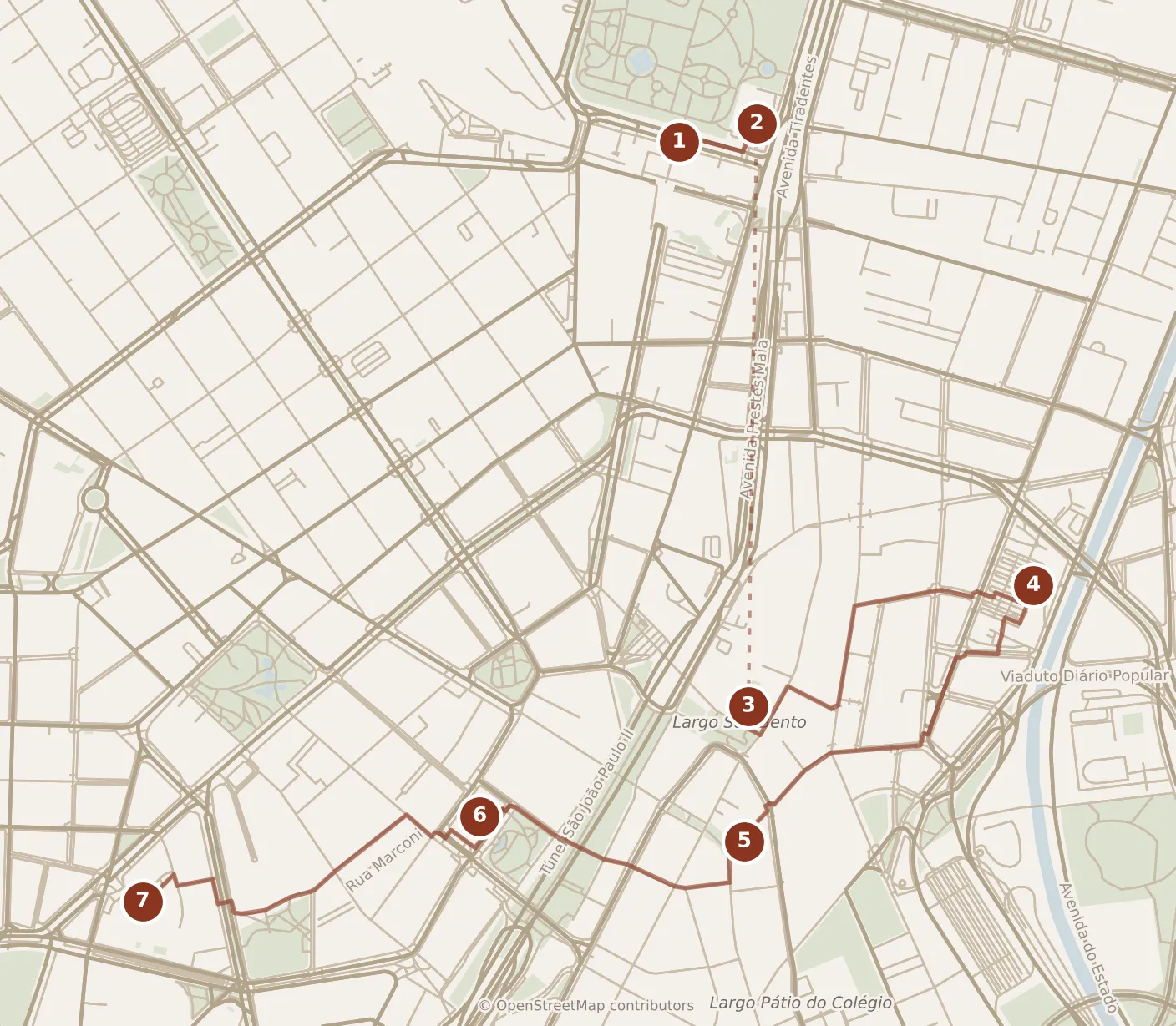
- Morning and afternoon
- 1Museu da Língua Portuguesa
- 2Pinacoteca de São Paulo
- 3Mosteiro de São Bento
- 4Mercado Municipal
- 5Edifício Altino Arantes
- 6Theatro Municipal
- 7Edifício Copan
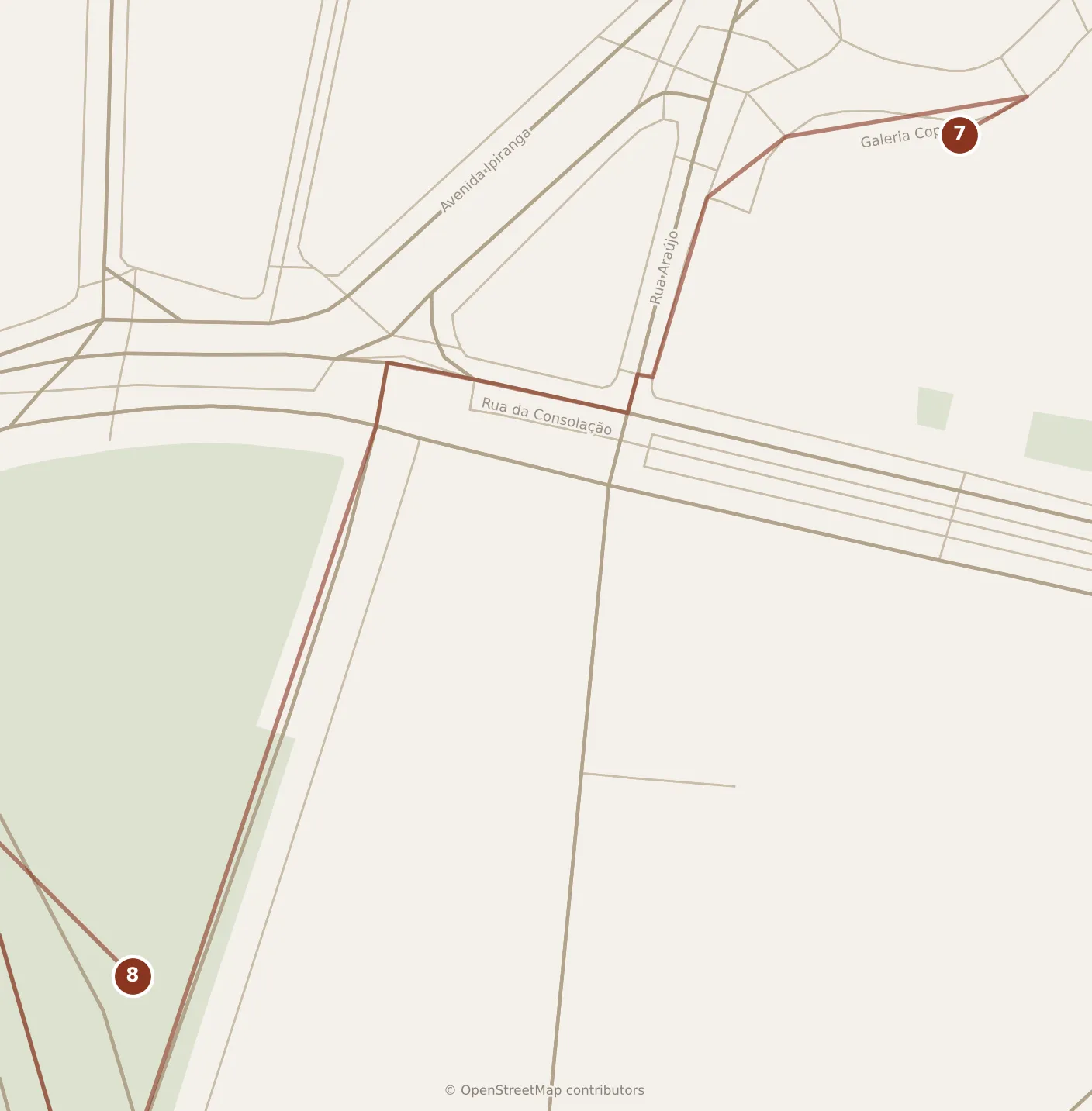
- Evening
- 8Praça Roosevelt
Everything today is in a strip about two kilometers long, running south from Luz through the old center. You cover it once, in one direction, and you are out of the center before the evening — which is deliberate, and the one structural thing to know about walking here.
The day has no deadline in it, so the constraint sits at the front rather than the end. The Pinacoteca did not open before ten in 2026 and the language museum below it opened an hour earlier, so the morning builds forward cleanly: be at the language museum when it opens, and you reach the picture collection exactly as its doors go. Whatever those two hours are when you travel, build the morning the same way — start at the earlier opener and let the later one set the pace — because the point of it is to be inside the monastery before midday, for the reason given below.
Morning
Start with the Museu da Língua Portuguesa, which occupies the upper floors of a working commuter station. It burned in 2015 and reopened in 2021, and what reopened is a museum about a language rather than a museum of objects — projections, recorded speech, etymology, the way Portuguese arrived here and what happened to it afterwards. It is the one stop on these two days whose value depends on how much of the language you have. Give it an hour if you have some, forty minutes if you have none, and do not feel short-changed either way.
Three minutes across the square is the Pinacoteca, in a raw brick building Ramos de Azevedo put up in 1900 as a crafts school. Paulo Mendes da Rocha gutted it in the 1990s and left the brick unrendered, roofed the courtyards in glass and threw steel walkways across them, so you look down into the galleries from the middle of the air. Inside is Brazilian art of the nineteenth and twentieth centuries — the landscape painters who invented what this country was supposed to look like, and a sculpture collection that is the better half. Ninety minutes.
Local tip. One ticket admits you to all three Pinacoteca buildings, which sounds like value and is mostly a way to lose a morning. The main building on the square is the collection; the other two are exhibition spaces. Spend the ninety minutes in the first one and walk past the others unless a show you actually want is in them.
This is also the point to say where you are. Luz is fine at the station, in the garden and along the avenue, and it is busy all day. Some of the streets around it are not where a visitor should be wandering, and the answer is simply not to: arrive and leave by the station, keep to the square and Avenida Tiradentes, and treat the rest as somebody else’s neighborhood.
From Luz take the blue line one stop south to São Bento — the walk is twenty minutes and not a walk worth having. The Mosteiro de São Bento is three minutes from the station exit: a German-built church of 1910 to 1922 by Richard Berndl, dim and high and heavily painted, with an organ of more than six thousand pipes installed in 1954. The reason to be inside it is not the building but the sound. The monks sing the office in Gregorian chant daily, and the sung mass on a Sunday is at ten.
Aim to be here before midday, and this is the one place on the route where the reason is not crowds. It is a monastery, not a museum: the doors follow the offices, and a church that is open all afternoon on a Wednesday may not be open all afternoon on a Saturday. The community publishes its own hours and its mass times; read them for the day you are going, and if the middle of the day is shut, let the market start the afternoon instead and come back up to the church when it reopens — ten minutes back uphill from the market — before you go on to the tower. If you go to a mass, understand what you are going into: it is a church at prayer, not a concert with an altar behind it. You take a seat, you stay for the hour, and you do not walk about with a camera while it is happening. People arrive early for somewhere to sit. If you only want the building, come on a weekday between the offices and give it half an hour.
If your day one falls on a Sunday, run the morning the other way round. Go to São Bento first for the ten o’clock mass — the monastery has its own station on the blue line and the church is three minutes from the exit — then ride one stop north to Luz and take the Pinacoteca and the language museum afterwards. What it costs is the afternoon’s slack: the market closes earlier on a Sunday and this order reaches it later, so lunch is tight and the tower is the thing that may have to go.
Afternoon
Ten minutes east and downhill is the Mercado Municipal, which is where lunch is. It is open every day of the week, which is why it can anchor a Monday. The mezzanine, built for the food counters when the market was restored, is where to eat — you sit looking down into the hall rather than fighting through it — and the two things to order are the mortadella sandwich and a pastel de bacalhau — between them more food than one person wants, so order one of each for two people. An hour and a quarter, and no more: this is a lunch stop today, not the morning it would be if you only had one day.
Thirteen minutes south-west, on Rua João Brícola, is the Edifício Altino Arantes: a state bank’s headquarters finished in 1947, modeled openly and unapologetically on the Empire State Building, and the tallest thing in São Paulo when it went up. It is run as a cultural center now and carries its sponsor bank’s name over the door, which is what the signs and the map apps will say; if the name used here does not find it, the street address does. There is a viewing floor near the top and it is shut on Mondays. What is worth knowing before you pay for it: the far distance is the same in every direction and stops meaning anything after a minute. The reward is directly below you — the grain of the old center, the viaduct, the roofs, the way the streets fall into the valley — so look down rather than out. An hour including the elevator.
Nine minutes west, over the Viaduto do Chá and the paved esplanade of Anhangabaú beneath it — rebuilt in 2021 as a flat expanse of stone, water jets and benches where a sunken garden used to be — stands the Theatro Municipal, Ramos de Azevedo again, opened in 1911 in full Italianate dress. Its claim on the day is one week in February 1922, when the Modern Art Week was staged inside it and Brazilian modernism started, to considerable booing. The interior can be seen on a free guided visit run by the theater’s own education team; it does not run every day and tickets appear on the theater’s site the day before, with a few held back for the door. Check it the day before you come — if there is one, take it and give it an hour; if there is not, the exterior and the square in front are worth twenty minutes anyway.
Twelve minutes further west, the ground stops being nineteenth-century and Edifício Copan appears: some eleven hundred apartments behind a long concrete curve that Oscar Niemeyer designed at the start of the 1950s and nobody finished until 1966. It is a residential building, so the inside is not yours. What you come for is the sweep of it from the sidewalk and the parade of small shops threaded along its base. The roof can be visited, but only on a tour booked in advance through the building’s own management, never on the day. Twenty minutes, and the day is done.
Add that up — three quarters of an hour with the language, ninety minutes in the collection, half an hour in the church, an hour and a quarter over lunch, an hour up the tower, twenty minutes at the theater and twenty at Copan, plus about fifty minutes of walking and one metro stop — and you get roughly seven hours, which from a nine o’clock start at the language museum finishes around four. That sum is the time spent inside things. It does not include the line for the tower’s elevator, which is the one on this route that can run long, nor the ticket desk at the Pinacoteca.
Evening
Praça Roosevelt is six minutes from Copan: a concrete deck of a square rebuilt in 2012, with skateboarders on it until late and four or five small theaters around its edges. From the square, Rua Augusta climbs south, and the lower stretch of it is where the center goes out — bars, small clubs, lines on a sidewalk, entirely unlike anything else on this route. It is about two kilometers from the square to Consolação station at the top, half an hour on foot if you walk it straight through, which nobody does — walk the busy stretch, keep the phone in a pocket rather than a hand, and take a rideshare when the bars thin out.
That is also the way home. Consolação on the green line and Paulista on the yellow are one interchange, so from the top of the strip you can reach any of the districts the city guide recommends. The trains stop long before the street does; after that, a rideshare.
Day two

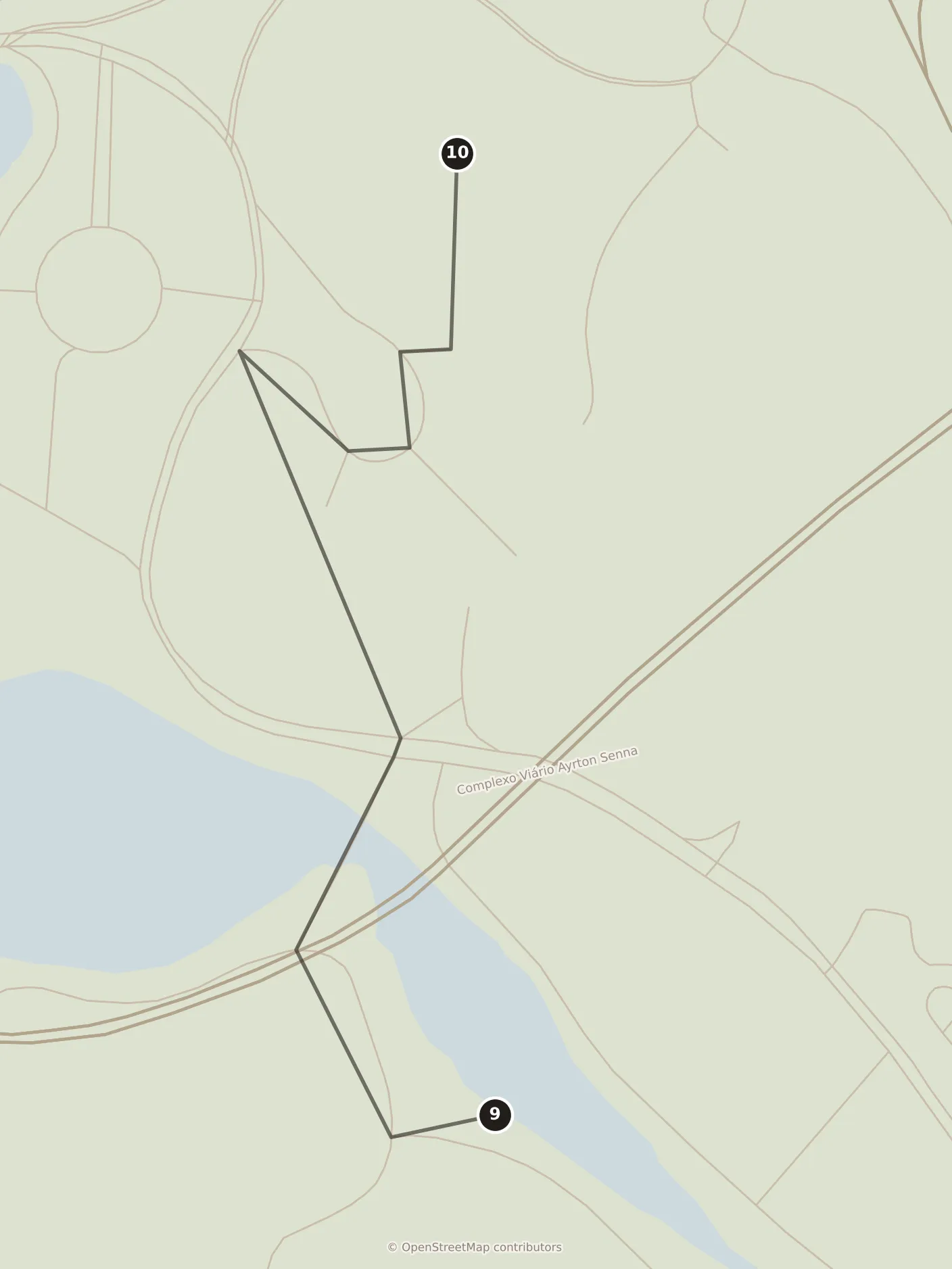
- Morning
- 9Parque Ibirapuera
- 10Museu Afro Brasil
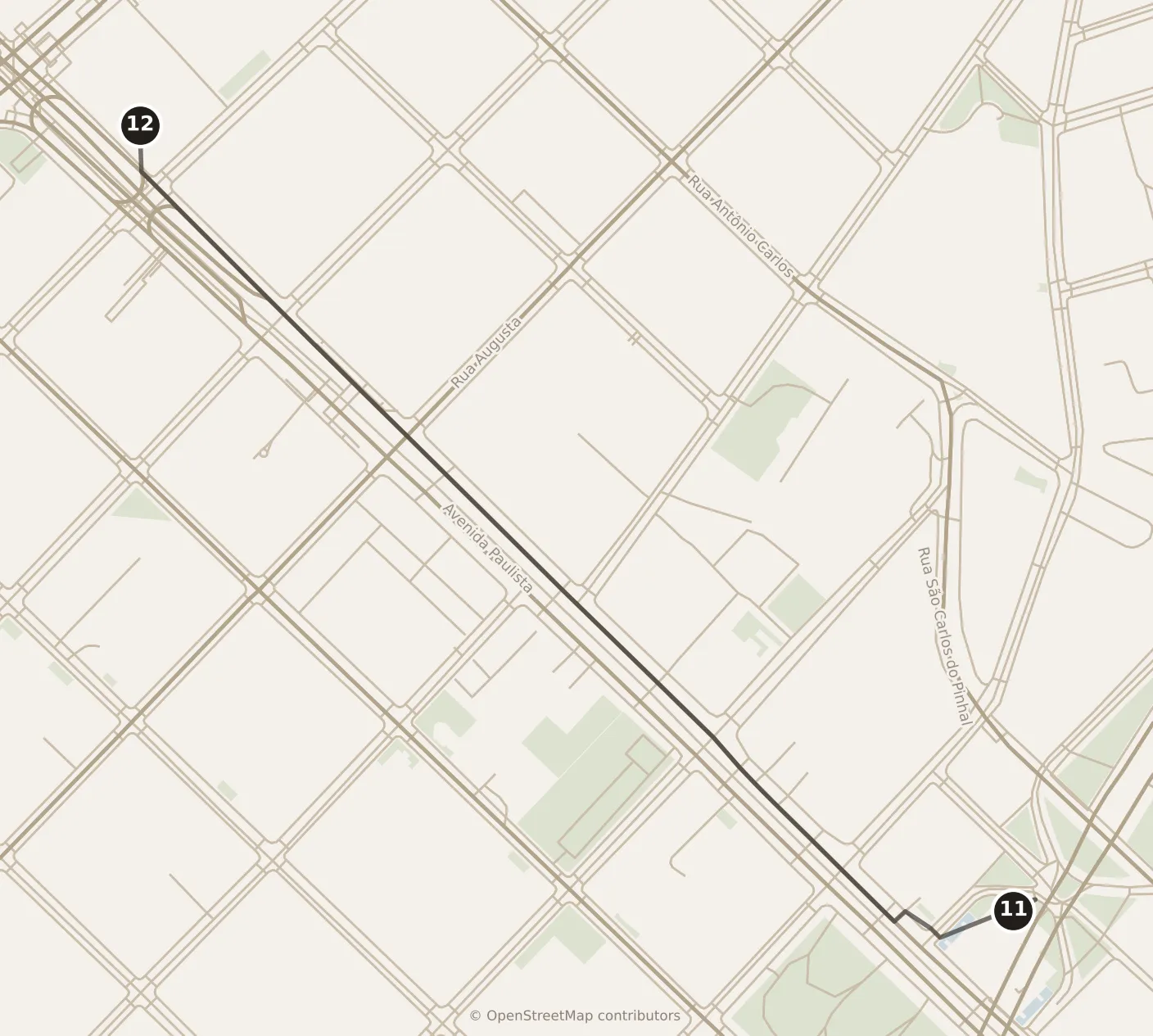
- Afternoon
- 11Museu de Arte de São Paulo
- 12Instituto Moreira Salles
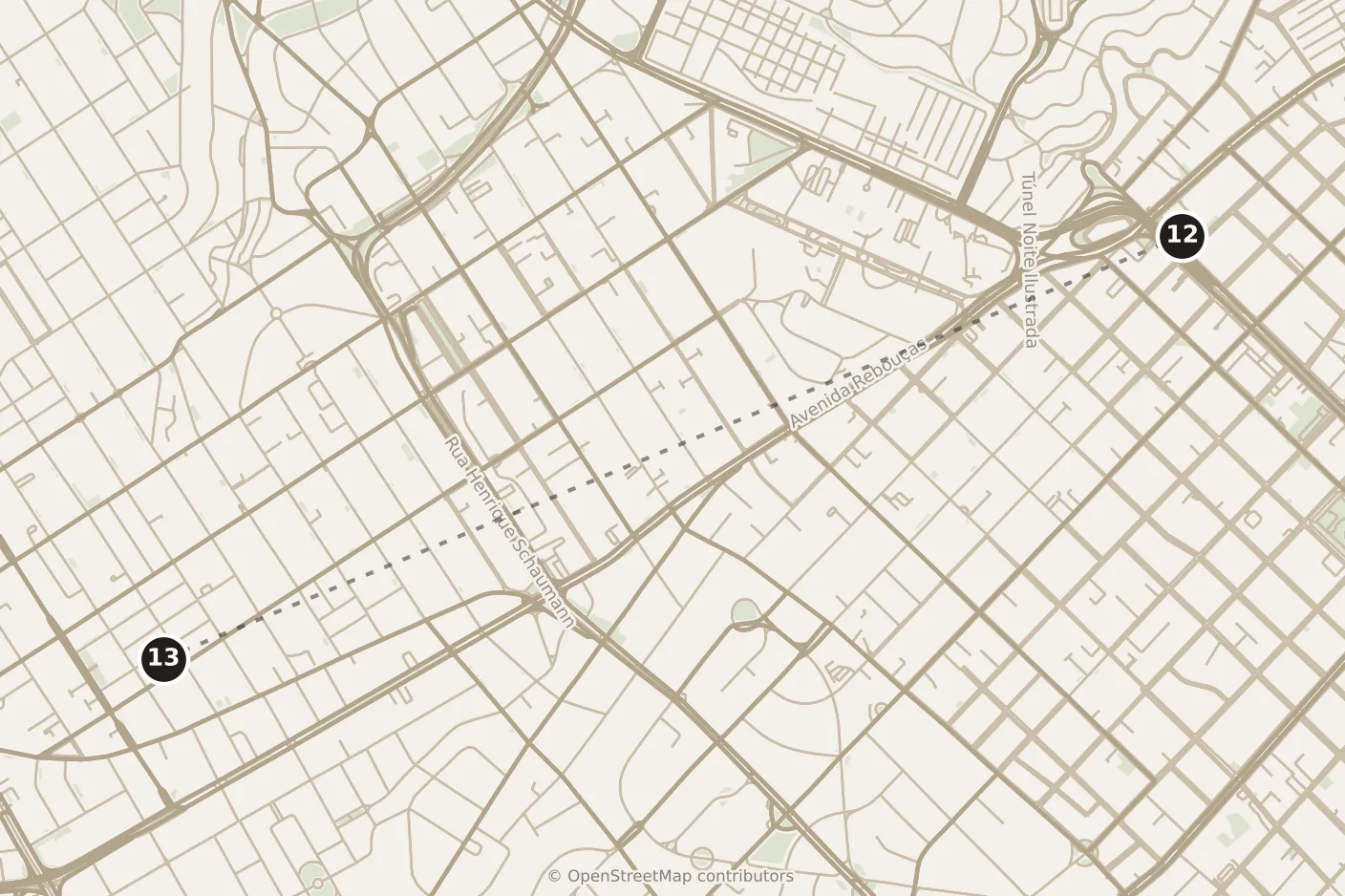
The leg out of the center: from stop 12 by metro, not on foot.
- Evening
- 13Pinheiros
Today the city stops being old, and the two halves of it are half an hour apart with nothing in between.
The order is not arbitrary. In 2026 the museum inside the park closed at five and the one on the avenue at six, later still on a Friday — so the park goes first and the avenue takes the afternoon. If those hours have moved by the time you go, the rule has not: put the earlier closer first.
Morning
Getting to Parque Ibirapuera is the parent guide’s warning about this city made concrete. There is no station at a park of this size. The nearest is AACD-Servidor on the lilac line, and from the Paulista districts that means Trianon-MASP to Chácara Klabin on the green line, four stops, then three more on the lilac; the exit is on Rua Pedro de Toledo and it is about fifteen minutes on foot from there to the park’s Portão 5. Reckon forty minutes door to gate. A rideshare does it in twenty when the traffic allows and fifty when it does not. Take the train if you want to arrive at the far corner and cross the park on foot, which is a good half hour under trees and past the lake and is genuinely the best way in. Take the car if the rain is light; if it is set in, the park goes altogether and day two runs the wet-weather version at the end instead.
The park opened in 1954 for the city’s four hundredth birthday, and its buildings are a set of Niemeyer pavilions gathered under one long free-standing canopy that wanders between them — you can walk the whole length of it out of the sun without going inside anything. The dome called the Oca sits at one end. On a weekday morning the park belongs to runners and push-chairs; on a Sunday it fills, and the walk across it stops being the quiet half hour described above.
Cross to Portão 10 on Avenida Pedro Álvares Cabral for the Museu Afro Brasil, in one of the Niemeyer pavilions and the reason to give the park a morning rather than an hour. It opened in 2004 around a collection Emanoel Araújo had spent decades assembling, and it treats African and Afro-Brazilian history as the main line of the national story rather than a chapter of it — the trade, the plantations, religion, work, and then four centuries of art hung as art. The permanent display is the whole point. Ninety minutes, and skip the temporary shows unless one of them is why you came. It is walk-up, and free on Wednesdays.
Eat before you leave the park. The afternoon on the avenue is a museum, a walk and another museum, so lunch belongs to the end of this morning rather than to the middle of the day: three quarters of an hour, at the pavilions, before you call the car.
From the park to the avenue there is no useful train. A rideshare up Avenida Brigadeiro Luís Antônio takes about twenty minutes, and it is the one stretch of these two days the metro does not cover. On a Sunday or a public holiday the avenue itself is closed to cars from mid-morning, so the drop is a block away and you walk the last minute.
Afternoon
The Museu de Arte de São Paulo is a glass box hung under a concrete beam on four red legs, Lina Bo Bardi’s, and the collection inside is not on the walls: the pictures stand on glass easels in one open room, labeled on the back, so you meet each one before anyone tells you what it is. That takes an hour on its own. What the second day gives you that a single day cannot is the rest of the museum — a fourteen-floor building opened beside it in 2025 and named for the museum’s first artistic director, Pietro Maria Bardi, which added five galleries and roughly doubled what the institution can show at once. The temporary program lives there now. Two hours covers both properly. If you have one hour, take the easels and skip the new building, not the other way round.
This is the one thing on either day you must arrange before you set out. The ticket was in the eighty-to-ninety-real range in 2026 and free all day on Tuesdays, and either way it needs a slot booked online in advance — the free day is not the walk-up day, it is the day the slots go first. It is sold on the museum’s own site and nowhere else you should trust.
Local tip. Book the slot before you leave home, not the night before, and book it even if you are going on the free day. It is the reservation that decides whether the afternoon happens, and one of only two on this route — the other is the museum at Ipiranga, if you take a third day.
Then walk the avenue, in the direction of the rising house numbers, about eighteen minutes, to the Instituto Moreira Salles at number 2424. It is free, it is seven floors, and photography is what it is for — Brazilian photographers, mostly, shown at a scale nobody else here gives them, plus a cinema and a view down the avenue from the upper floor that costs nothing. An hour. The walk between the two is the avenue itself, which is the only piece of São Paulo that behaves like a promenade; on Sundays and public holidays it is closed to cars from mid-morning until the early evening and belongs to people on foot and on bicycles.
Roughly seven and a half hours: forty minutes to reach the park, half an hour crossing it, ninety minutes in the museum, half an hour among the pavilions, three quarters of an hour over lunch, twenty minutes in the car, two hours on the avenue’s museum, eighteen minutes’ walk and an hour at the end. It counts the time inside things and it does not count the bag check at the museum door.
Evening
Paulista station is beside the photography institute, and four stops west on the yellow line is Pinheiros. This is the grown-up half of the city’s eating and drinking — proper kitchens, long dinners, design shops that were shut by the time you arrived — and it is where to sit down after a day that has been almost entirely on your feet. It is also the deliberate counterpoint to last night on Rua Augusta, and to Vila Madalena if you take a third day: the same city, three quite different ideas of an evening.
With a third day

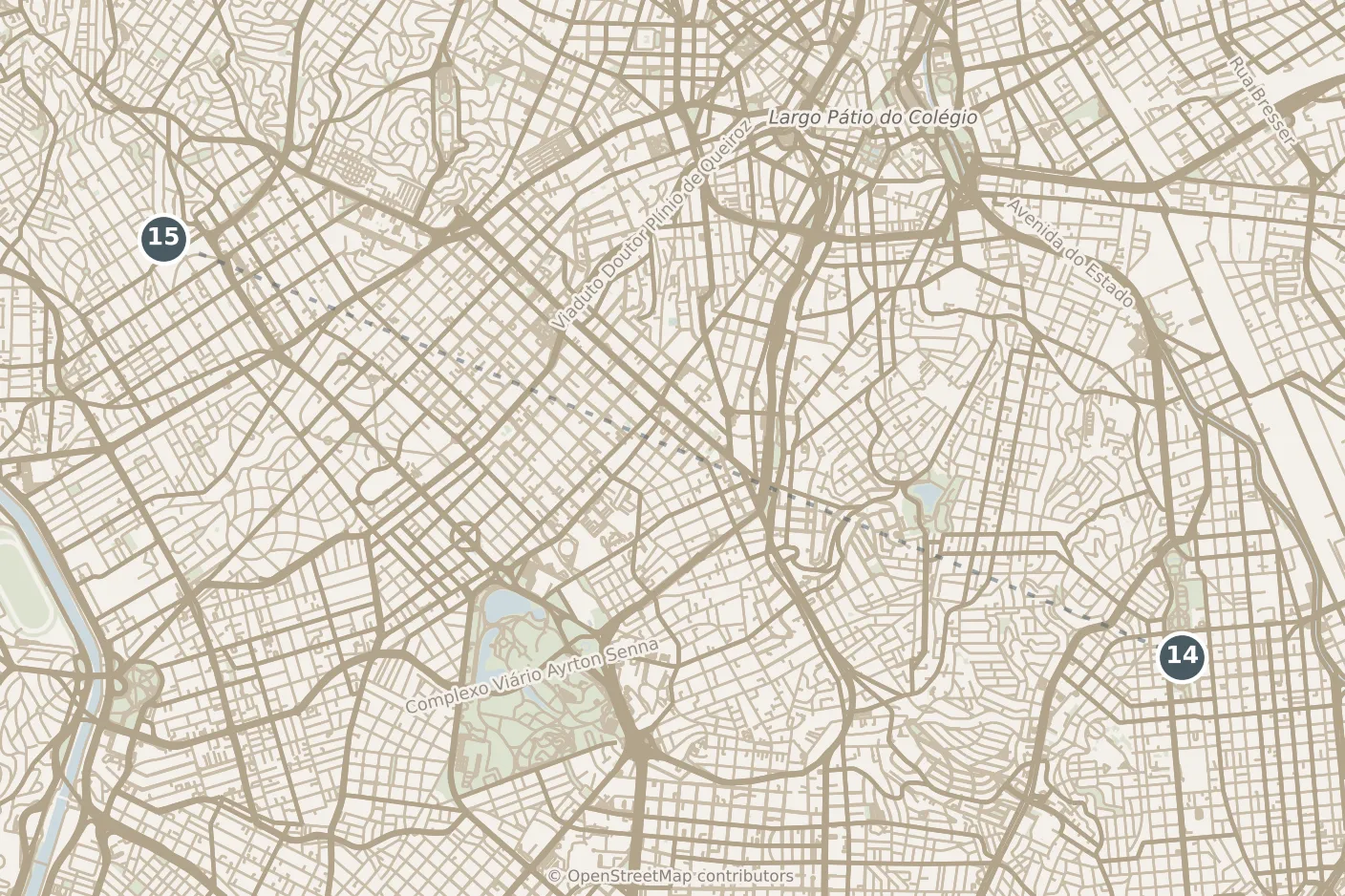
- With a third day
- 14Museu do Ipiranga
- 15Beco do Batman
- Vila Madalena — in the prose, not on the map
The third day is appended, not inserted. Nothing in it explains anything in the two days above, and its museum cannot rescue a Monday, because it closes then exactly as day two’s do. The Vila Madalena half of the day can — it is the fallback at the end of this section, and a Monday is a good day for it. So it goes on the end and the order of the other two is untouched.
There is one arrangement that moves it, and it is worth knowing because it is common. If your three days are a Sunday, a Monday and a Tuesday, put this day on the Sunday, day one on the Monday and day two on the Tuesday: the Monday is the day the collection at Luz is open while the other museums on this route are shut, and the Tuesday is when the avenue’s museum is free. If that Sunday is the first of the month the Museu do Ipiranga is free as well — but free there means no booking at all, a box-office line on the morning, and a start at the museum’s opening. Everything else about the two days above stays as written.
Give the morning to the Museu do Ipiranga. It stands at the top of a formal garden on the slope above the stream where independence was declared in 1822, a vast Italianate pile finished in 1895 and built to say so. It closed to the public in 2013 and did not reopen until September 2022, with an entire new floor excavated beneath it, so what you walk into is a nineteenth-century monument with a twenty-first-century museum inside it. In the main hall hangs Pedro Américo’s enormous painting of the declaration, the picture that fixed the scene in the national imagination, and painted in 1888 — sixty-six years after the event, which tells you most of what you need to know about how much of it its painter saw. Give the museum two and a half hours, and the Parque da Independência in front of it another twenty minutes on the way out.
Two practical things. On a paid day the ticket is sold online and effectively only online, through a third-party ticketing site the museum links to rather than through its own; the slots were in the twenty-five to thirty-five-real range in 2026 and they sell out days ahead, so this is the second and last thing on the whole route to book before you travel. On a free day — Wednesdays and the first Sunday of the month — there is nothing to book and no way to: the ticket is handed out at the box office on the day, in releases every fifteen minutes, and the line is long enough that the museum warns about it, so go at opening or not at all. And the last stretch of the journey is the awkward part: Alto do Ipiranga on the green line is the nearest station and it is still two kilometers away, uphill nearly all of it. Take a bus or a rideshare from the station rather than walking it, unless you want the hill.
Then the elegant part of the day. Go back to Alto do Ipiranga and ride the green line all the way to the other end of it — ten stops, no change, about half an hour — and get out at Vila Madalena. The station is not actually in Vila Madalena; it sits on the boundary with Perdizes, above the district rather than in it, so allow about twenty minutes downhill on foot. Beco do Batman is a knot of residential lanes where every wall, gate and garage door is painted and repainted, so what is on them is not what was photographed last year. Half an hour of walking slowly is enough for the alley, and it is the same half hour whether or not you have already stood in it — the one-day route ends here too, and what the third day adds is not the alley but everything around it. The rest of the afternoon is the district around it, which is where the third day earns its keep: the painting spills onto the ordinary streets for several blocks, there are small galleries and studios among the houses, and it is the part of this route that rewards having no plan.
Stay for the evening. If last night was in Pinheiros, this one is a few blocks uphill rather than across a boundary — Vila Madalena is a neighborhood inside the Pinheiros district, not a rival to it — and the difference is in the streets: down there the city sits down to dinner, up here, Thursday to Saturday especially, it stands up loudly enough that you will not mistake which one you are in.
If the museum’s slots are gone when you look — and they go — do not improvise a substitute for it. Give the whole third day to this end of the city instead: start at Vila Madalena station in the late morning, work down through the lanes, cross into Pinheiros in the afternoon and stay for the evening. It displaces nothing, because the museum was the only part of the day that needed a ticket.
Practicalities
Two bookings, and no others: the museum on Avenida Paulista, which needs a timed slot even on its free day, and — if you take a third day — the museum at Ipiranga, whose tickets sell out days ahead. Everything else on these days is walk-up or free, with one thing to check the night before: the theater’s free guided visit, whose tickets appear on its own site the day before. The one thing this route needs that nobody hands you is a way through the gates: on the metro lines used below the fare is paid by tapping a contactless bank card at the barrier itself; how you pay on a bus is a separate question, and the city guide has that along with everything else that is true of São Paulo rather than of these particular days.
Which day falls on which weekday. Day one must not fall on a Tuesday, when the Pinacoteca — the reason day one exists — is shut. Days two and three lose their museums on a Monday: the collection in the park, both of the ones on the avenue and the museum at Ipiranga are shut. What survives is not nothing — the park itself, the walk across it and the pavilions, the avenue, and the whole Vila Madalena half of the third day. So a Monday, if you have one, goes to day one, which costs you the tower and the language museum and nothing else; a second Monday goes to the park or to the lanes. Wednesday to Saturday will take any arrangement. A Sunday works too but reorders day one — the monastery first, for the ten o’clock sung mass, then Luz — and the market’s earlier Sunday close usually costs you the tower. A Saturday afternoon at the monastery is the one to check before you go. The trap is arriving on a Tuesday and starting at the beginning: do day two first that day, when the avenue’s museum is free — but that only works if you booked the free slot before you flew, because on the day it is gone — and pick up day one on the Wednesday.
If you are short. Two days that turn out to be a day and a half lose the tower first. It is the one whose line you cannot predict, and its view is of a city that looks the same in every direction — so an hour goes and the walk from the market runs straight on to the theater instead, twenty minutes in one go rather than thirteen and then nine. The second thing to go is the language museum, which frees the Pinacoteca to open the day at ten. Do not cut the church to save half an hour: it is the only stop on the day you cannot see a version of anywhere else.
If it rains on day two. The park is the casualty and the avenue absorbs the whole day. From wherever you are, take a rideshare up Avenida Brigadeiro Luís Antônio, about twenty minutes, and go straight to the museum on the avenue — give it the full three hours it can take with the 2025 building included, instead of the two the day allowed. Then the eighteen minutes up to the photography institute, which is free, indoors and has a cinema in it, and is the natural place to lose the end of a wet afternoon. What you lose is the park and the Afro Brasil collection, and if a third day exists, the park is what it should start with instead of Ipiranga. What you do not lose is the booking — but it does not move with the weather. It is a slot for an hour you chose before you traveled, so if the rain reaches you well before that hour, swap the two round and start at the photography institute, which is free and takes no reservation.
The two stretches with no train. The metro covers everything on these days except the run from the park up to the avenue, and the last two kilometers from the station to the museum at Ipiranga. That is the shape of the network rather than a flaw in the route. Budget for both, and do not try to walk either.


