São Paulo in one day: the old center, Avenida Paulista and Vila Madalena

Last updated 3 August 2026
Overview
São Paulo does not reward one day the way a compact old town does, and pretending otherwise is how a day here goes wrong. There is no medieval core to loop around and no skyline you can stand outside of: from any tall building the city keeps going to the edge of what you can see, and the distances that matter are counted in metro stops rather than in minutes on foot.
What a single day can honestly do is cross the city once, in one direction, and take three completely different places on the way. So this route runs west and never doubles back. It starts in the old center, where São Paulo was founded and where the market is; it moves up to the ridge of Avenida Paulista, where the art and the money are; and it ends in Vila Madalena, which is where the city goes out. Two metro rides join the three, and both are short. They are not a compromise between competing itineraries — they are simply the three things São Paulo is, and a day that visits only one of them has seen a district rather than a city.
What you give up is the parks and most of the museums. Ibirapuera is the great one and it genuinely deserves a morning, but the nearest metro belongs to a line this route never touches, it sits well south of the day’s path, and reaching it costs you either the old center or the evening. On one day, take the museum on the avenue and let the park go. The same arithmetic disposes of the rest: naming a fourth museum in a city this size is easy and useless, and the hour it would take is the hour that buys you lunch sitting down.
One structural warning, because it shapes the order below rather than decorating it. The old center is a daytime place and this route is out of it by the middle of the afternoon. Do not run the day backwards to finish there.
The day

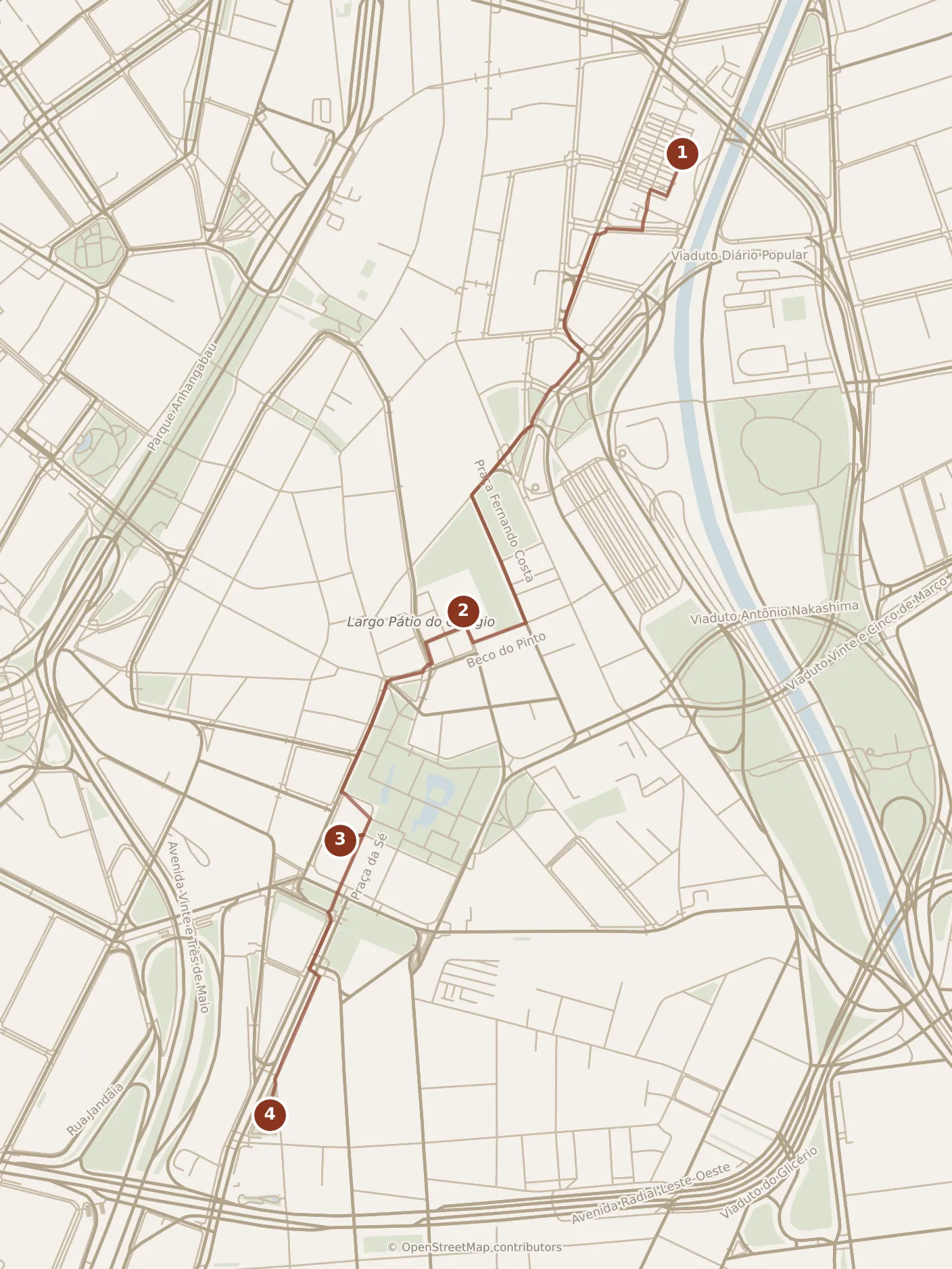
- Morning
- 1Mercado Municipal
- 2Pátio do Colégio
- 3São Paulo Cathedral
- 4Liberdade
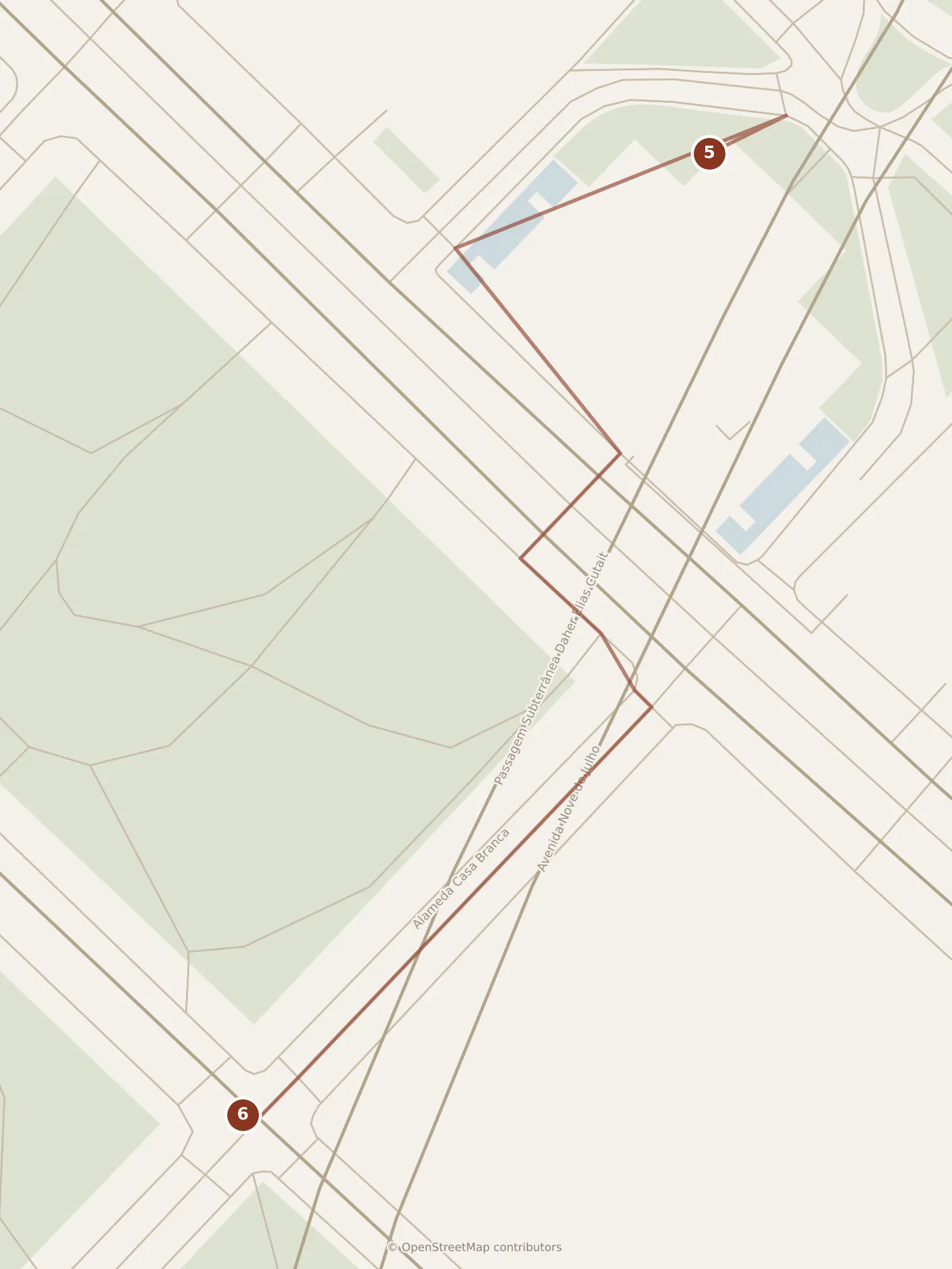
- Afternoon
- 5Museu de Arte de São Paulo
- 6Parque Trianon
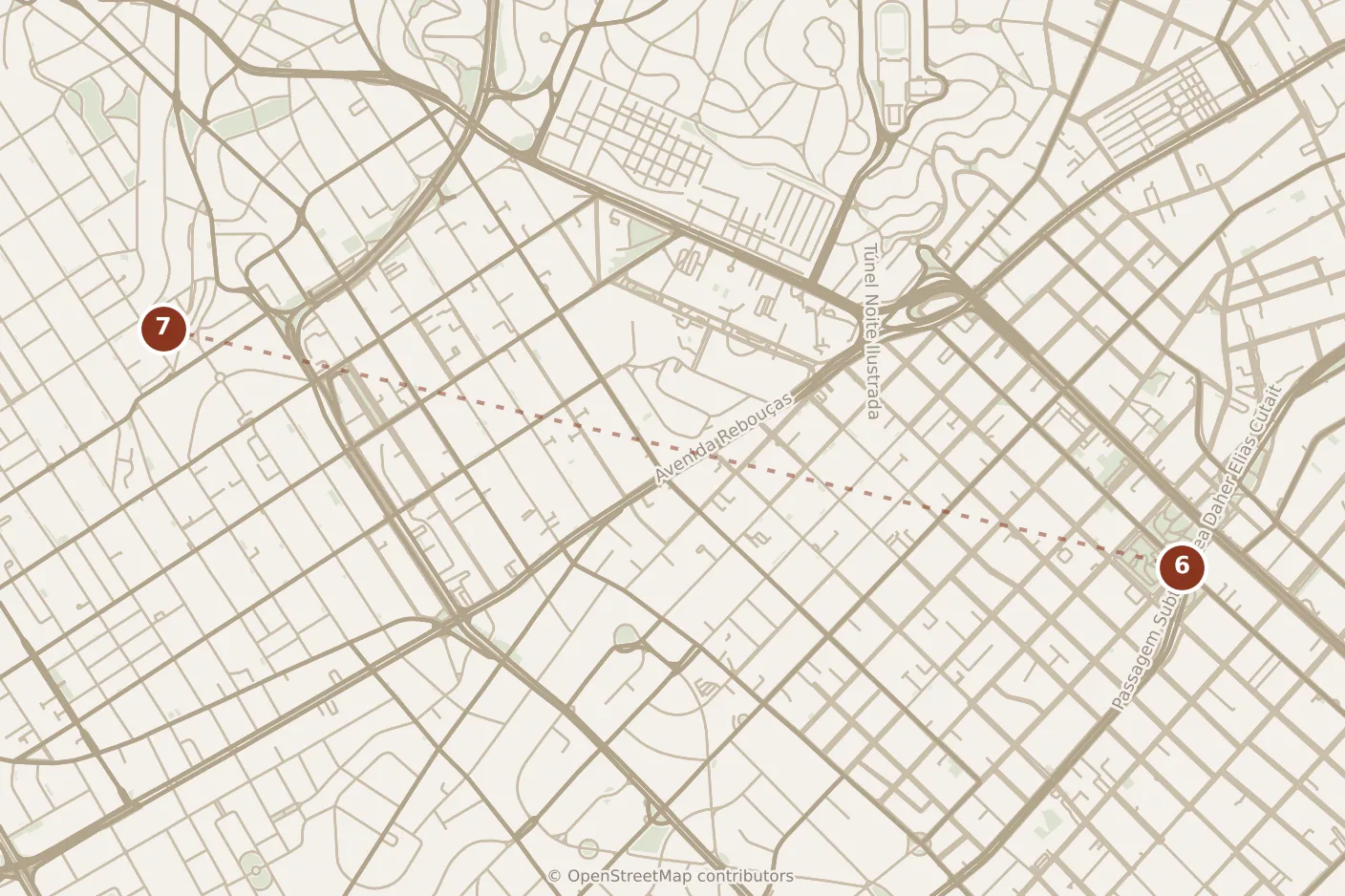
The leg out of the center: from stop 6 by metro, not on foot.
- Evening
- 7Beco do Batman
- Vila Madalena — in the prose, not on the map
Morning
Start at the Mercado Municipal, and start early, because a market is only itself in the morning. It is a brick hall with a barrel roof, and the first thing to do inside is look up: the windows are stained glass, and their subject is farming rather than saints — cattle, coffee, bananas, the things that paid for the building. Underneath them are pyramids of fruit you will not be able to name, walls of salt cod, and the counters that make the mortadella sandwich, which is what you eat here and is the size of a meal. Give the market an hour. If a slice of something is handed to you across a fruit counter, treat it as the opening of a sale rather than a gift: a bag follows the slice, and it is priced by weight.
Local tip. The sandwich at the market and lunch in Liberdade are the two good meals on this route, and they are three hours apart. Pick one and let the other be a taste. Eaten properly the sandwich ends your appetite until evening, and Liberdade becomes twenty minutes of looking instead of the sit-down hour it deserves.
From the market walk about fifteen minutes south-west into the old center proper, to Pátio do Colégio. This is where the city started, in 1554, as a Jesuit mission school on high ground between two rivers, and the building in front of you is a reconstruction: the original was demolished at the end of the nineteenth century and rebuilt in the twentieth in the shape it was believed to have had. That is as São Paulo as a fact gets — the oldest place in the city is a copy of itself. There is a small museum of the mission inside, worth twenty minutes, and a courtyard that is free to walk into.
Five minutes further south is Praça da Sé and the cathedral on it. It is neo-Gothic and it is not old: begun in 1913 and consecrated in the 1950s with its towers still unbuilt, which is a strange thing to find at the center of a city founded in the sixteenth century and a short, clear lesson in how recently São Paulo became enormous. The part most visitors miss is the crypt below, which is where the marble and the tombs are. Twenty minutes covers the church and the crypt together. The square outside is the point from which every road distance to São Paulo is measured.
Then walk fifteen minutes south into Liberdade and have lunch. Red arches stand over Rua Galvão Bueno, the street lamps are shaped like lanterns, and the shopfronts are Japanese, Korean and Chinese — groceries, stationery, candy shops, bakeries selling things that are neither Brazilian nor quite Japanese any more. Eat sitting down, and eat here rather than somewhere later: this is the best food on the route and the afternoon has nothing to match it. On weekends a street fair fills Praça da Liberdade and the sidewalks around it with food stalls, which makes the stop better and slower. Give lunch an hour and a half.
Afternoon
From Liberdade the blue line runs three stops south to Paraíso, where you change to the green line; that line runs directly beneath Avenida Paulista, and two stops on it bring you up on the avenue outside the museum. Half an hour, door to door.
The Museu de Arte de São Paulo is a glass box slung under a concrete beam on four red legs, so the whole plaza runs underneath the building rather than around it — an idea so plainly right that the space below has become a public square in its own right, with a market in it on weekends. Inside, the collection is not on the walls. The paintings stand on glass easels in the middle of one open room, so you walk between them and behind them, there is no route and no order, and the label is on the back of each — which means you meet the picture before anyone tells you what it is. Give it an hour and a half, and do not try to see the building whole: the room of easels is the reason to come, and the changing exhibitions around it are the part to skip when the day is tight.
Come out and walk a few hundred meters of the avenue itself before you go anywhere else. This is the ridge the city grew along, it is lined with towers and cultural buildings, and for most of a Sunday it is closed to cars and taken over by people on foot and on bicycles. Then cross to Parque Trianon, directly opposite the museum. It is a surviving scrap of the Atlantic forest that stood here before the avenue did: big trees, dense shade, loud birds, and the temperature drops as you walk in. It is small, half an hour is right, and it is the only quiet you will get all day.
Evening
Take the green line back the other way and ride it to the end, which is Vila Madalena — about twenty minutes. The station sits at the top of the district rather than in the middle of it, so allow another fifteen minutes on foot to where things actually happen.
Go to Beco do Batman first, while there is still light. It is a knot of narrow residential lanes in which every wall, gate and garage door is painted, and repainted: the work turns over constantly, so what is there is not what was photographed last year, and half an hour of walking slowly is enough to see it properly.
This is the stop the whole day is built around, because paint needs daylight and the lanes have none of their own. So work backwards rather than fixing a time. The alley wants the last hour of light, and everything above it — an hour in the market, the quarter of an hour walking out of it, twenty minutes at the founding site, twenty in the cathedral, the two short walks between them, an hour and a half over lunch, half an hour of metro, an hour and a half in the museum, half an hour in the park and the half-hour of train and walking out here — comes to about seven hours. Sunset lands around half past five in June and a little before seven in December; count back from it, and that is when to start.
After that, stay. The streets immediately around the lanes are where São Paulo drinks: small bars with plastic tables put out on the sidewalk, spilling into the road once it is properly dark, concentrated on a few streets of which Rua Aspicuelta and Rua Fidalga are the two you will keep crossing. Order a caipirinha, eat standing up, and understand that Thursday to Saturday this is a genuinely loud neighborhood and the rest of the week it is a pleasant one. The metro shuts before the bars do — nothing runs all night — so the way home from here late is a rideshare.
Practicalities
This route uses the metro twice and nothing else, so the one thing to have sorted before you set off is how the fare is paid. On both of this day’s lines a contactless bank card — the physical card, tapped at a turnstile marked for it — is enough; the parent city guide covers the alternatives, along with everything else that is true of São Paulo rather than of this particular day. Beyond the fare and one museum ticket, the whole route is free: a market, a courtyard, a church, a public park and a set of lanes.
Nothing here needs booking ahead. What can break the day is a closing day, and there are two candidates. The museum on the avenue closes on Mondays, as most museums here do, and it is the anchor of the afternoon; the small museum at the founding site keeps short hours of its own and shuts on Sundays and Mondays, though its courtyard does not. If your single day falls on a Monday the route still works as a walk — market, cathedral, Liberdade, avenue, park, painted lanes — but you lose both interiors, and it is worth checking rather than discovering.
A Sunday changes the day in the other direction. The avenue is closed to cars through the middle of the day and belongs to people walking, and the weekend street fair in Liberdade is on, which are the two best versions of two stops on this route. Against that, the old center is emptier on a Sunday than on a working day, so do the market and the two historic stops early and move on briskly.
Two practical points about the order. First, it is one-directional on purpose: each metro ride takes you further west and there is no leg that retraces one you have already done, so nothing is lost by running late except the last thing on the list. Second, the two longest legs are both on rails and both under half an hour, while every walk between stops is fifteen minutes or less. If you are carrying a bag, leave it in a left-luggage office where you arrive — the airport and the main bus terminal both keep one around the clock — because this is not a day to carry it: the old center in particular is a place to walk through with your hands free and your phone away.


