Santiago in two or three days: the founding grid, the twentieth century, and a third day in Valparaíso

Last updated 8 August 2026
Overview
Santiago’s old center is about a kilometer square, and one day will empty it. That is the fact a second day here has to answer, because a second day of the same thing would be a second day of walking past buildings you have already walked past. What two days buy is not more of the center. It is the rest of the argument: the colonial grid is only one of three cities stacked into this valley, and the other two — the one that remembers the dictatorship, out west on Matucana and north in Recoleta, and the one built with the copper money, east under the glass — are each a Metro ride away, and neither fits into a single day alongside the first.
So day one walks the founding grid and never uses the Metro inside itself: markets in the morning, the colonial city in the afternoon, just under six kilometers in all, and the longest single stretch is the half hour south from the market to the palace. Day two crosses the valley instead — three Metro journeys, one change in each, a little over an hour of the day underground — and it is the harder and the better of the two.
The first leg is the one nobody describes, so: day one begins in the Plaza de Armas, and the square has a station of its own name on Line 5 and Line 3, with exits into the square itself. From the airport-bus interchange at Pajaritos that is Line 1 east to Los Héroes, Line 2 one stop north to Santa Ana, then Line 5 one stop east — twenty-five to thirty minutes with the two changes. If you come overland instead, the long-distance terminals are all on Line 1 at the western end of the city and the same ride brings you in; and with a case rather than a daypack, stay on Line 1 as far as Universidad de Chile and walk the few blocks north to the square rather than make two changes underground with it. If you are sleeping anywhere along Line 1 to the east, go instead to Baquedano and take Line 5 two stops west, through Bellas Artes. This route rides the Metro often enough on day two that the rechargeable travel card is worth buying at the ticket window of the first station you use rather than at the third — it is the bip! card, and that is the word to ask for; how it works and what else it pays for is the city guide’s job, not this page’s.
One thing across these three days is worth booking before you leave home, and only one: the timed slot for Sky Costanera, the observation deck on the evening of day two, which is sold on its own site and was in the twenty-five to thirty-thousand-peso range per adult in 2026, the upper end being the late-afternoon slots. Everything else is free, or bought at a door on the day.
Now the light, because day two ends on it. The earliest sunset of the year here is around twenty to six, in the first week of June; the latest is just short of nine, at the turn of the year — a spread of more than three hours, which is why nobody can answer this once for everybody. Both of those are clock times and the clocks here move for the southern summer, so look the sunset up for the actual dates you are traveling on rather than reading between the two. Take your own month’s hour and set it against the count in day two. It matters more than usual here, because the two viewpoints this city has are not interchangeable: Cerro San Cristóbal across the river is free to walk into but the funicular that carries you up it is ticketed and stops in the early evening, and the tower in the east charges a great deal more and runs until late. From about October to March the sun is still up long after the last car up the hill, and the tower is the only one of the two that can show you the day end. In the winter half it is the other way round, and the cheaper one wins.
Finally, the day of the week decides more here than the season does. Day two is the museum day and its museum closes on Mondays; day one is squares, markets, churches and a hill, and does not care. If one of your days is a Monday, make it day one, and nothing about the trip is lost.
Valparaíso, Cerro Concepción, La Sebastiana — not on the walking map.
- With a third day
- Valparaíso — in the prose, not on the map
- Cerro Concepción — in the prose, not on the map
- La Sebastiana — in the prose, not on the map
Day one

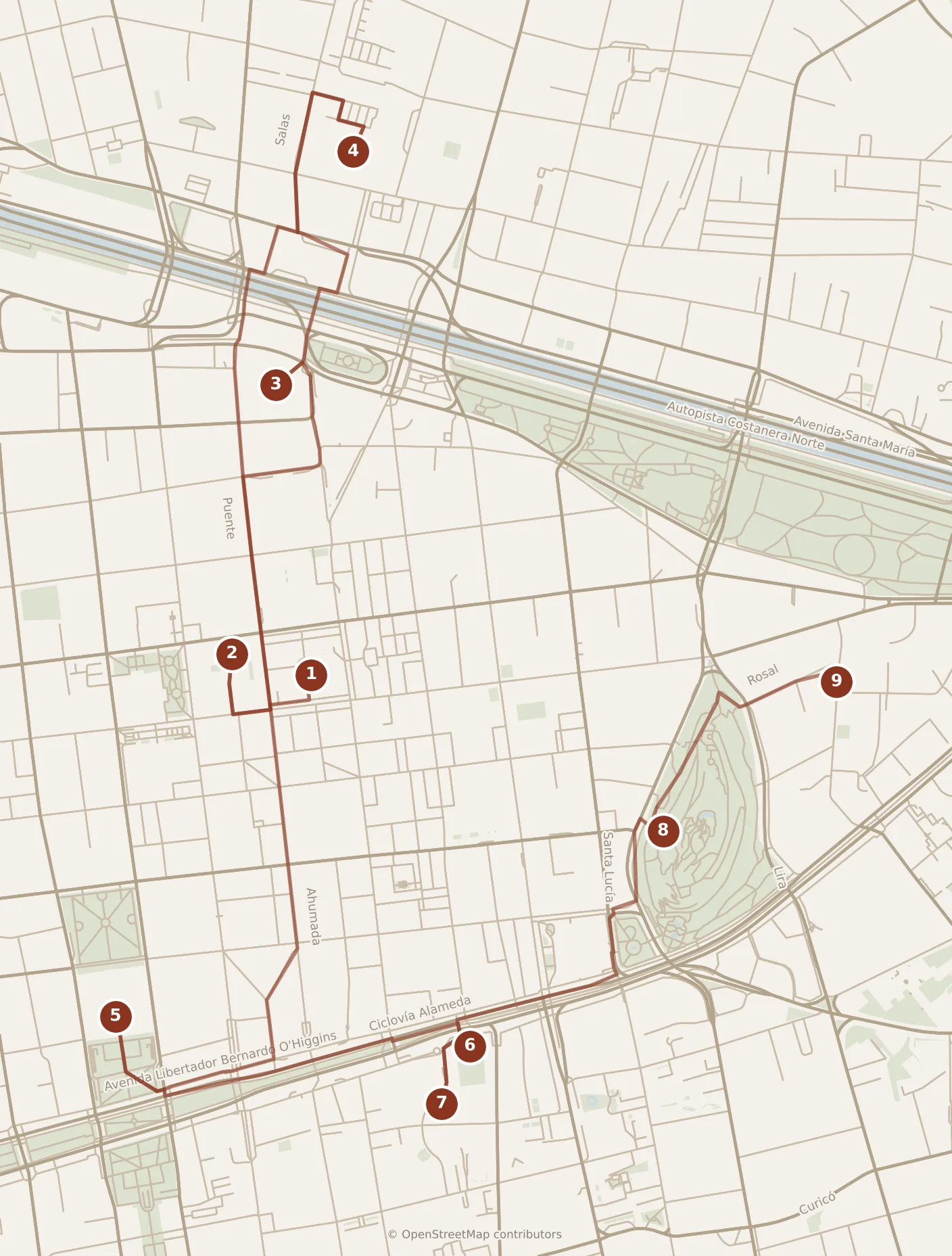
- Day one
- 1Plaza de Armas
- 2Santiago Metropolitan Cathedral
- 3Mercado Central
- 4La Vega Central
- Mercado Tirso de Molina — in the prose, not on the map
- 5Palacio de La Moneda
- 6San Francisco Church
- 7Londres 38
- 8Cerro Santa Lucía
- 9Lastarria
Everything today is on foot. The shape is a long north–south loop: the square first, because it is what the whole grid was measured from, then north over the river for the markets, then all the way south to the palace and back east to the hill. You cross your own path once, on Paseo Ahumada, and never twice.
Morning
Start in the Plaza de Armas at about nine, and give it twenty minutes before you go anywhere. This is the square laid out in 1541 from which every block of the old town was measured, and its four sides are a lesson in what happened afterwards: the cathedral down the western side, the old Real Audiencia of 1808 on the north, the central post office beside it, and a mess of commercial building filling what is left. Note one closed door while you are here, because it changes what this day can contain — the national history museum inside the Real Audiencia shut on 2 August 2026 to begin a restoration announced as a three-year job, so the one museum on this square will not be a possibility for the working life of most guidebooks. Check whether it has come back; the day below does not need it.
Fifteen minutes inside the Santiago Metropolitan Cathedral is enough, and the interesting thing about it is how much of it is a reconstruction of a reconstruction. Five churches stood here before this one; earthquakes in 1647 and 1730 wrecked their predecessors, and a fire finished the last of them in 1769. What you are standing in was begun in 1748 to a design by two Bavarian Jesuits, taken over from 1779 by Joaquín Toesca — the same architect who gave the presidential palace its front, which you see this afternoon — and then comprehensively redecorated from 1898 by Ignacio Cremonesi, who stuccoed over the stone and painted the ceilings. Walk up one aisle and down the other rather than standing at the back, and if a Mass is under way keep to the aisles, keep quiet and leave the camera in the bag: this is a cathedral in daily use rather than an exhibit. The eighteenth-century German organ and the marble canopy over the high altar are the two things to stop at.
Nine minutes north, at the river end of the center, the Mercado Central is a twenty-minute stop and not a meal. The iron roof over the middle of it went up in the 1870s and is the reason to step inside; lunch is not, because lunch is over the river and you are going there anyway. Cross the Mapocho — a shallow brown thing in a concrete channel, which looks like a drain, which is fair — and eight minutes brings you to La Vega Central. This is the produce market for the whole capital, six thousand square meters of it, and it is where this day’s timing comes from: nothing here shuts at a stated hour, but a wholesale market is a morning, and by the middle of the afternoon you are looking at a swept floor. Give it an hour, walk the aisles rather than the edges, and expect to be moved out of the way by a hand truck.
Lunch is seven minutes on, upstairs at the Mercado Tirso de Molina, the newer hall on the same bank: fruit on the ground floor, and along the upper gallery a row of plain cookshops with tables, which is where the market’s own people eat. This is the meal to have pastel de choclo at if you are here in summer, or empanadas de pino at in any month. Give it an hour, because it arrives at its own pace.
Local tip. Almost everything today is free and outdoors, and there are exactly two tickets in it. If you are only buying one, buy the cloister museum at San Francisco this afternoon — the Museo de Arte Colonial, which is the name to check its days under: Londres 38 afterwards is a memorial rather than a collection, and the part of it that will stay with you — the names set into the paving of the street — is outside, costs nothing, and keeps no hours at all.
Afternoon
Half an hour south through the shopping streets, down Paseo Ahumada or Estado, brings you to the Palacio de La Moneda. It is the longest walk of the day and there is little to see along it, so take it as a walk. What you arrive at is a low, heavy, symmetrical front, built as the colonial mint and the president’s house since 1845, with Plaza de la Constitución behind it and the long ramp of Plaza de la Ciudadanía in front. Half an hour is what it is worth. You cannot walk in off the street, and the cultural center under the front plaza is a decent gallery rather than a reason to be here; the building’s real weight arrives tomorrow, when the museum out west shows you what was done to it, and from it, after 11 September 1973.
Eleven minutes east along the Alameda is San Francisco Church, the oldest building in the city with a construction date anyone can name — walls of stone finished in 1618 — and the one interior today that is genuinely old rather than restored to look it. Look up first: the nave ceiling is coffered Spanish timber work in the Moorish-derived manner, and it is what the earthquakes did not take. Then pay for the cloister museum beside it, one of the largest colonial painting collections on the continent, whose centrepiece is a series of forty-two canvases of the life of the saint from the Cusco workshops of the late seventeenth century. Give the church fifteen minutes and the museum three-quarters of an hour. That museum keeps its own days and is the one door today that may be shut; if it is, you have lost the ticket and nothing else.
Two minutes away, on a short curving street of 1920s houses off the Alameda, is Londres 38. It was a Socialist Party office until 1973 and then, from 1974 and under the code name Yucatán, one of the secret police’s clandestine detention and torture houses: around eleven hundred people were brought through it, and ninety-four of them were killed or never seen again, most of them young. It is run now by survivors and relatives as a memorial rather than a museum, with talks rather than displays, and it publishes its own opening days — read them the week before. If it is closed, stand on the street anyway: the names are set into the paving outside, one to a stone, and that is the part of it that does the work. Half an hour, and it is a heavy half hour. Do not put anything demanding after it.
Evening
Eleven minutes north-east and you are at the foot of Cerro Santa Lucía, sixty-eight meters of landscaped rock in the middle of the grid, all of it stairs. Give it three-quarters of an hour, up whichever stairways are open — sectors of it close for repair for years at a time — and down the eastern side if that gate is open, back down the front if it is not. From the top the whole day is visible at once: the grid you walked this morning, the Andes shutting off the east, and — if the air is behaving — the tower you go up tomorrow evening, standing on its own out east above everything else.
Seven minutes from the hill’s foot is Lastarria, and that is the rest of the day. Bookshops, cinemas, a run of tables outside, and the long strip of park along the river at its northern edge to walk the stairs off. A nine o’clock start puts you here at about four in the afternoon: the stops above come to a little under six hours standing still and about an hour and a half walking, and the count models neither the market’s pace, which is the largest thing it leaves out, nor the ticket desk at the cloister. Four o’clock is early for an evening, and deliberately so — in June the light will be gone by twenty to six, and the hill wants to be climbed in it. In the summer half it hands you three or four spare hours in the pleasantest few streets of the center, and the right thing to do with them is nothing at all, followed by a late dinner, which is when this city eats anyway.
If you would rather have the city’s best museum than its markets, the Chilean Museum of Pre-Columbian Art is two blocks west of the Plaza de Armas on Bandera, and it is an hour and a half of Andean textiles and desert mummies. Take it instead of the Mercado Central and La Vega, which are an hour and three-quarters together with the walking between them, and eat in the streets around the square rather than over the river. In the winter half you cannot have both and still finish this day in daylight. In the summer half you can — the three or four spare hours the evening hands you are exactly what pays for it — so make the swap only between about April and September. Not on a Monday, though: this museum shuts on the same day of the week as day two’s, and the overview has just sent your Monday to day one, so a Monday here is a market morning whatever the season.
Day two

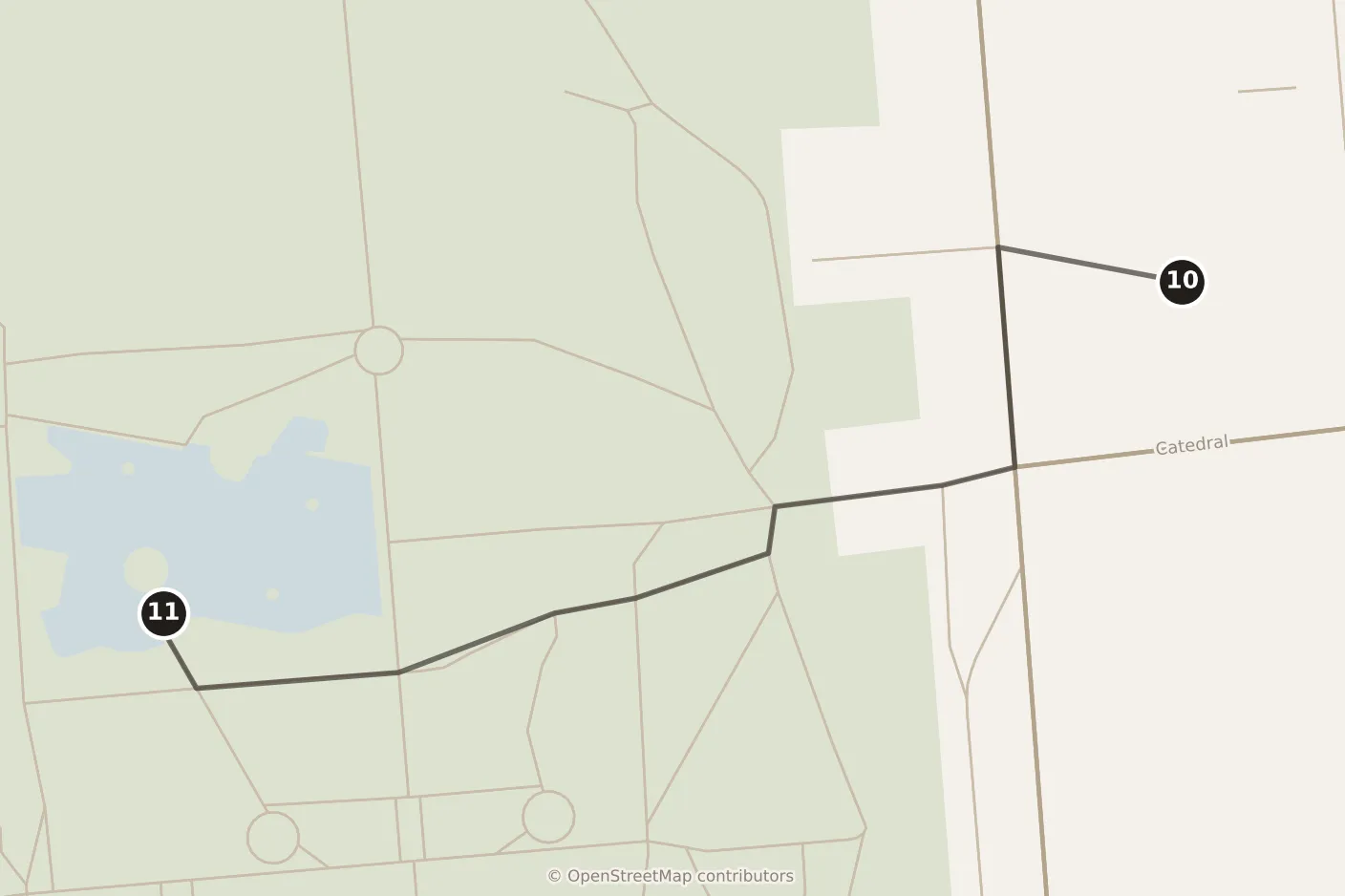
- Morning
- 10Museo de la Memoria y los Derechos Humanos
- 11Parque Quinta Normal
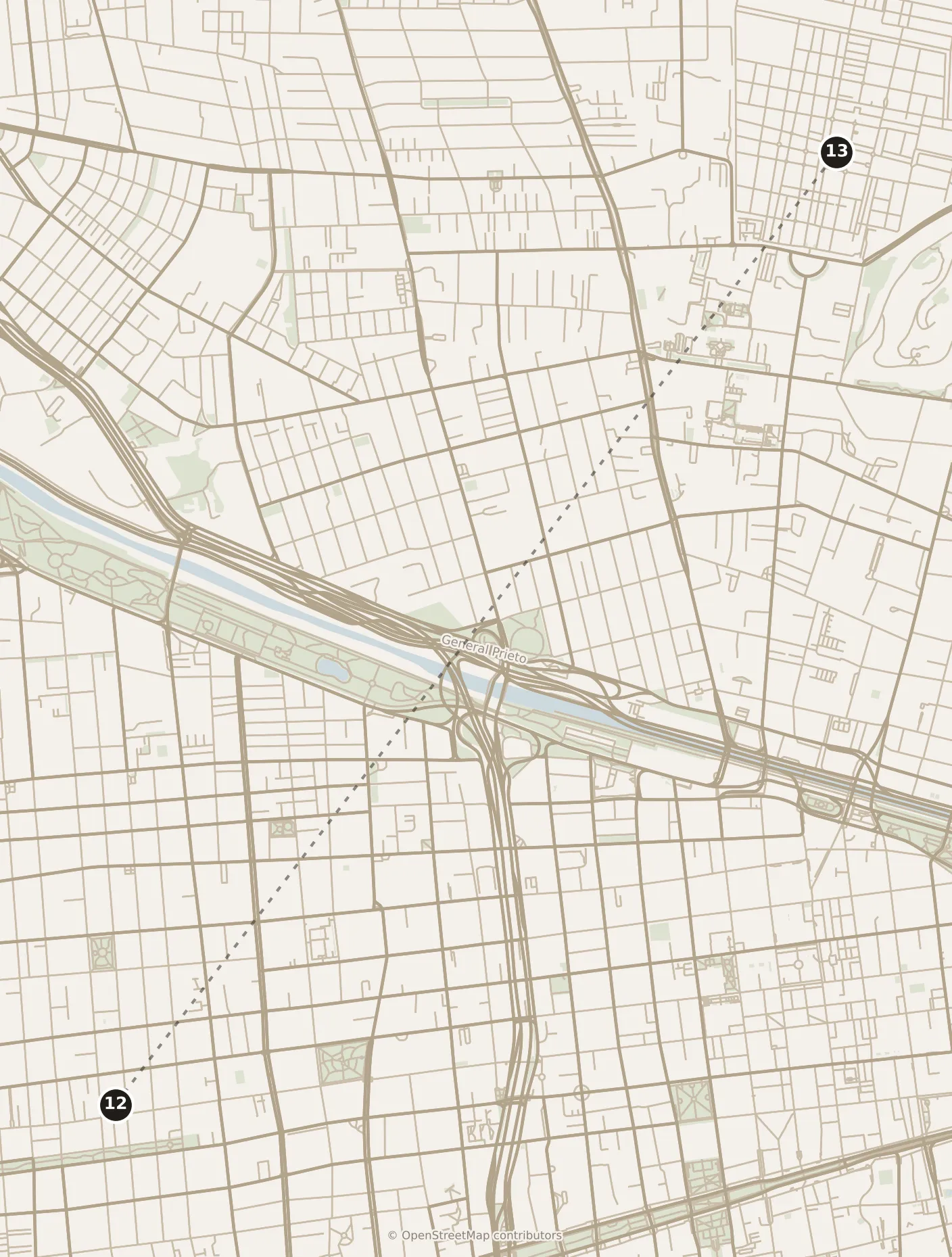
- Afternoon
- 12Barrio Yungay
- 13Cementerio General de Santiago
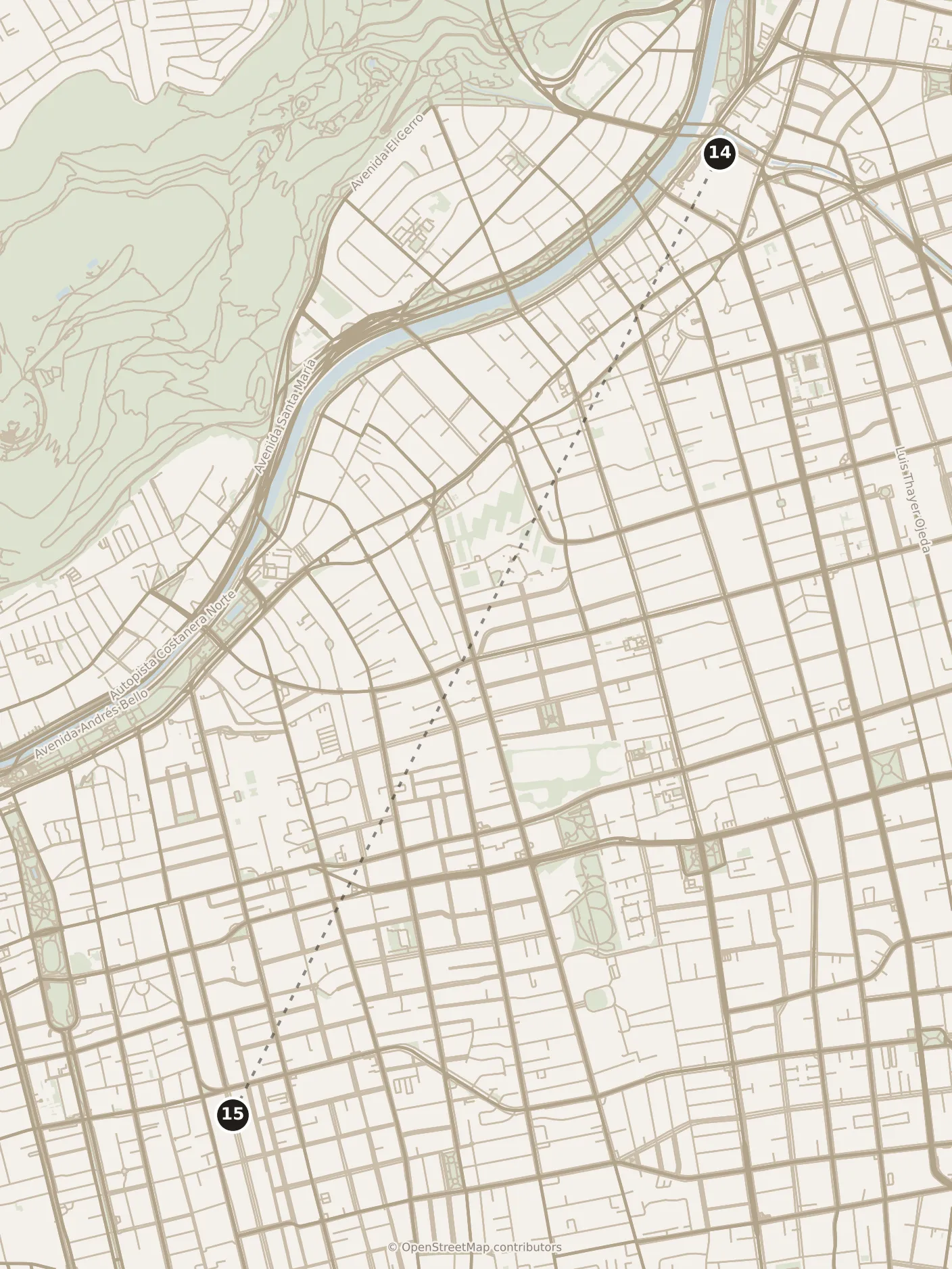
- Evening
- 14Gran Torre Costanera
- 15Barrio Italia
Today is the twentieth century, and it runs west, then north, then east, which is also the order in which this city arranges its money. Three Metro journeys, each with one change. The museum, the cemetery and the light are the day; where the hour comes from, if you are short of one, is set out in the evening below.
Morning
The Museo de la Memoria y los Derechos Humanos is the reason day two exists, and it opens at ten — it admitted nobody earlier in 2026, and stopped admitting at half past five — so ten is where the count starts. If that hour has moved, the method has not: everything below is counted forward from this museum’s door. Its entrance is on Matucana, a minute from the Quinta Normal station on Line 5, and it takes no admission.
Give it two hours. It runs chronologically, from the coup of 11 September 1973 through seventeen years of dictatorship to the plebiscite that ended it, and it is built out of evidence rather than argument: the letters prisoners got out, a door from the old public prison, the instruments, the newspapers as they were printed at the time, and a wall of photographs of the disappeared running up through the full height of the building. Víctor Jara’s last poem, written in a stadium in the days before he was killed, is on the wall at the entrance; you pass his grave this afternoon. Beneath the entrance plaza there is a separate underground chamber by a Chilean artist, five hundred lit silhouettes in the dark, admitted in small groups on its own schedule — the desk in the lobby will tell you when. This is not a building people go round quietly out of politeness. A good many of the Chileans in it are looking for one particular name.
Six minutes’ walk and you are inside Parque Quinta Normal, thirty-five hectares laid out in 1841 as an agricultural experiment station and now the plainest large park in the city, with a boating lagoon in the middle of it. Half an hour here is not a sight, it is a decompression, and after that museum you want one. The natural history museum stands in the same park: skip it unless you have children with you, and if you do have children, be clear about the price — it is an hour, and it is the same hour the evening below tells you to hand back if you want the winter light. You cannot have the dinosaurs and the sunset on the same short day.
Afternoon
Sixteen minutes east on foot, and the park becomes Barrio Yungay: laid out in 1837, named for a battle won two years later, the oldest surviving residential quarter in Santiago and the one that looks it. Single-story adobe fronts, courtyards behind them, a great deal of paint, and a square with a monument to the Roto — the anonymous Chilean working man — at its center. Lunch here, and give the whole thing an hour and a half including the wander. Then eleven minutes on foot to Cumming on Line 5, one stop to Santa Ana, and Line 2 four stops north to Cementerios: about twenty minutes with the change.
That station is named after what you have come for. The Cementerio General de Santiago was opened in 1821 by Bernardo O’Higgins, covers eighty-six hectares and holds something like two million burials, and it is laid out as a city, with avenues, numbered blocks, and mausolea in Egyptian, Gothic and Moorish dress belonging to families who wanted the argument settled after death. Give it an hour and a half, and understand that the hour and a half is walking rather than standing. Three things are worth aiming at: Salvador Allende’s tomb, the graves of Violeta Parra and Víctor Jara, and the memorial to the detained and disappeared and the politically executed, a long wall of names unveiled in 1994 at the far end of the main axis. Ask at the gate for a plan; the numbered blocks are the only way to find anything here.
It is a working cemetery and not a monument. Funerals cross the avenues all day, families are at the graves on Sundays, and there are usually people at that wall who are not visiting it. Keep the camera down near anyone who is grieving, and give a funeral party the path.
Evening
Back to Cementerios, five stops south on Line 2 to Los Héroes, then Line 1 east to Tobalaba — about forty minutes in all, and a ride worth looking up from, because it is the whole east–west gradient of the city in one go. From Tobalaba it is nine minutes on foot to the Gran Torre Costanera, three hundred meters of it, the tallest building on the continent, with the observation floors on the sixty-first and sixty-second; you go in through the ground floor of the shopping center beneath. Give it an hour including the elevator, which is the other thing the count leaves out: one shaft moves everybody, so people go up in batches rather than continuously.
From that museum’s door to this tower’s, the stops above come to about five and a half hours standing still and something under two hours moving — call it a quarter past five at the tower’s foot. Set that against your own month. In June the sun goes at twenty to six, so you have twenty-five minutes in hand and no more: if the museum has run long, drop the park and cut the Yungay lunch to an hour. That is your hour back, and it is on this day rather than borrowed from another. Around the turn of the year the sun does not go until just short of nine, which leaves you nearly four spare hours and wants a different order — see the tip below.
Then twenty minutes back west, Line 1 to Baquedano and Line 5 two stops to Santa Isabel, and ten minutes’ walk east into Barrio Italia, which is where dinner is. It grew up round Italian artisans a century ago, and the workshops became furniture restorers and then galleries and restaurants without the street being rebuilt underneath them, so you eat in converted houses on a street of converted houses. The shops keep shop hours; by dinner time it is the tables that are open.
Local tip. From about October to March this order strands you: you would be standing at the tower two to four hours before the light. Turn the evening round. Go to Barrio Italia first, while the workshops are still open, eat early by the standards of this country, and be back at the tower’s foot by half past eight. The last elevator up was at nine in 2026, and in the first days of January the sun sets three minutes before it, so there is no margin there to spend.
There is also a cheaper version of this evening, and in the winter half it is the better one. Skip the tower: take Line 2 two stops from Cementerios to Patronato instead, and walk a little over twenty minutes east along the north bank to the funicular at the foot of Cerro San Cristóbal, the hill across the river. It climbs to a summit some three hundred meters above the streets, its ticket is a small fraction of the deck’s, and the view is the better of the two because you are standing outside in it with the mountains at your back. What it cannot do is stay open late, which is the entire reason the tower is written in above. If you take the hill, the evening ends in the bars of Bellavista below it instead of in Barrio Italia, the one timed ticket of the trip goes with it — leaving nothing to arrange from home but the left luggage, if you need it — and you should read the third day’s alternative below knowing that.
With a third day

The third day goes to Valparaíso, and it goes at the end rather than in the middle. Days one and two are built to be taken in that order — the first teaches you the grid, the second explains what was done to it — and the coast is the one of the three that will sit on any date, which makes it the one to move. So nothing shifts when you append it. The only arrangement it forces is the Monday rule from the overview, unchanged: keep Mondays off day two, and if all three of your dates are fixed and one of them is a Monday, spend that Monday on day one.
It is about a hundred and twenty kilometers north-west, and the coaches run all day from Terminal Alameda, which has a direct underground connection to Universidad de Santiago on Line 1. Reckon on an hour and a half each way, and buy the ticket at the terminal that morning; there is nothing to gain by booking it ahead. Go early. A day here is a day, not an afternoon.
What Valparaíso is, and is not: a working container port with a UNESCO World Heritage quarter stuck to the hills above it, listed in 2003, and nothing whatever like Santiago — narrow, vertical, painted, poorer, and built over more than forty hills joined to the flat part by staircases and by the surviving handful of the funicular elevators that once ran up most of them. Which elevators are running changes from year to year and there is no use in my telling you; the stairs beside each one always work, and if the elevator you wanted is dark, that is your answer.
Give the middle of the day to Cerro Concepción and Cerro Alegre beside it: the tight knot of nineteenth-century German and British merchant houses, painted iron cladding, murals, and the lanes and stairways between them. It is a two-hour walk and it should be taken slowly and without a fixed route — but keep to those two hills and the stairways that join them to the flat part, which is what the listing is; the hills to either side are ordinary residential city, and not what you came up for. Then La Sebastiana, Pablo Neruda’s Valparaíso house on the hill to the west, a short taxi or a twenty-five-minute walk across: five narrow floors stacked up the slope, built around the view rather than around the rooms, and the best of the three houses he left behind. Give it an hour. It is shut on Mondays, the same day as the museum on day two, so the Monday rule from the overview covers the coast as well and there is nothing extra to arrange. Tickets are sold at the door. It is the only thing on the coast that can be shut.
Aim to be back on a coach by early evening. The last of them run late, but the road is heavy on a Sunday night, and these hills are not where you want to be finding your way down in the dark with a bag.
If you would rather not leave the city, be honest with yourself first: the third day is then a half day, and you should know that before you plan a whole one. Take the viewpoint you did not take on day two — the hill if you paid for the tower, the tower if you took the hill — and give the morning to the Chilean Museum of Pre-Columbian Art — shut on Mondays, like the house below — unless you already swapped that into day one, in which case no museum is left that is worth the morning, and the honest answer is that Santiago is a two-day city with a coast attached. Pablo Neruda kept a house here too — La Chascona, on the slope below the funicular — and it fills an hour if the afternoon needs a shape, on any day but a Monday.
Practicalities
What to book. One thing: the timed slot for Sky Costanera on the evening of day two. Nothing else across these three days needs booking in advance, the coach to the coast included — with one exception, and it is the bag paragraph below, since the left-luggage networks take their reservations online before you arrive. If you take the hill instead of the tower, the timed slot goes and the bag is the only thing left here: the funicular is ticketed, but the ticket is bought at the bottom on the day.
Which day is which. Monday is the only weekday that rewrites the trip. The museum on day two closes on Mondays, and it is two hours of the reason to be in this city, so day two must miss it. Day one — a square, a cathedral, three market halls, a palace exterior, a church, a memorial street and a hill — loses at most the cloister museum and the memorial’s talks and keeps its shape either way, which is why the Monday goes there. The cemetery opens every day and shut at six in 2026. Sunday costs you a little at both ends: the cathedral has services through the morning, the produce market is at its thinnest, and the workshops of Barrio Italia are shut, though its tables are not. Saturday is the markets at their biggest and is the best day of the week for day one. Friday closes nothing at all; it only fills the restaurants in Lastarria and Barrio Italia, which is a reason to sit down at seven rather than at nine. The third day’s closing doors are Mondays too, on the coast and in the city alike, so the rule above covers them and there is nothing separate to check.
Two fixed dates close the day-two museum outright and are not a weekday problem: 1 May, and 18 and 19 September, the Fiestas Patrias, which shut a great deal else besides. And 11 September, the anniversary of the coup, is not a date on which to run day two as written: there are marches, the center and the streets around the cemetery are not ordinary places after dark, and the memorial sites keep their own program that day rather than their normal hours. Move it if you can; if you cannot, do day one instead.
Getting between the stops. Day one needs nothing but shoes: it is walked end to end, and the longest single leg is the half hour from the market over the river down to the palace. Day two is three Metro journeys with one change apiece — Cumming to Santa Ana on Line 5, then Line 2 north to Cementerios; Cementerios back down Line 2 to Los Héroes, then Line 1 east to Tobalaba; Tobalaba to Baquedano on Line 1, then Line 5 two stops to Santa Isabel — which is a little over an hour of the day sitting on trains. There is no quicker way to do it and no reason to want one.
The bag. A reader with two or three days here has a room, so the bag is a problem exactly twice: the morning you land before you can check in, and the last day after you check out. Day one survives an arrival-day bag, since it stays inside a square kilometer until the evening, with two exceptions worth planning round — Cerro Santa Lucía is sixty-eight meters of staircase with nowhere sensible to leave anything, and the cloister museum will not want a case in it. Day two cannot be done with one at all, and the coast day least of all: Valparaíso is stairs from the moment you leave the flat part. The Metro stations here keep no left-luggage counters; what covers the center and Providencia instead are the booked networks that leave a bag with an ordinary staffed business, reserved online before you arrive, keeping their host’s hours rather than a station’s. Book the point nearest the station you leave from rather than the one nearest where you slept — on a last day those are rarely the same place, and the long-distance terminals are all at the western end of Line 1, at Universidad de Santiago and Estación Central, with Pajaritos further out for the airport buses. Ask at the terminal before you book anything: Terminal Alameda keeps a staffed left-luggage counter of its own on its lower floor, from early morning until half past ten at night, and it takes no reservation.
One thing about the air. Day one’s hill and day two’s tower are both there for a view, and between about May and August the view is the first thing this valley takes away. Nothing published will tell you a week ahead whether it will be clear. What you can do is put the viewpoint on whichever of your days looks the better one when you get up, because the hill and the deck both belong to the end of a day, and either day can end at either.


.jpg)

