Santiago in one day: the old center on foot, and San Cristóbal before the last car

Last updated 4 August 2026
Overview
Santiago is a very large city with a very small center, and one day here works only because of that. Around seven million people live in a valley that takes an hour to cross; the part laid out in 1541 is about a kilometer square, flat, and still holds the palace, the cathedral, the market and the museum that a first visit wants. This route walks a little over six kilometers in total, almost all of it between the palace and the river, and then rides a funicular up the hill on the far bank to look back down at everything it skipped.
And it skips a great deal, deliberately. Everything east of the center — the leafy avenues, the glass towers, the good restaurants, the road up into the mountains — is a genuine half-hour each way, and going out there and coming back is the most expensive thing you can do with a single day in this city. The one place worth crossing water for is the hill on the far bank, and that crossing is a bridge rather than a journey.
The hill is also where the day’s timing is decided, and it is worth understanding before you plan anything. The funicular that climbs Cerro San Cristóbal stopped running at about a quarter to seven in 2026, an hour later in high summer, and did not start until the early afternoon on Mondays. That is not a detail to look up afterwards, because it is a hard end to the day and everything below is arranged to arrive well ahead of it. If the hours have moved since, the method is unchanged: find the hour of the last car and the hour the museum opens, and count backwards from the first to the second.
Count like this. From the museum’s door to the foot of the funicular the stops below come to about six hours standing still and an hour and a quarter walking — call it seven and a quarter. Against a last car at a quarter to seven that puts the latest possible start at half past eleven, and the museum in any case admitted nobody before ten in 2026. So take the ten o’clock opening: it leaves an hour and a half in hand, which is roughly what a line for the funicular, a slow lunch and a ticket desk will take off you. The count models the time you spend inside things and nothing else. The largest thing it leaves out is the funicular itself, which is one pair of cars on a 485-meter track and therefore moves people in batches rather than continuously.
Now the light, because it decides whether the hill is a sunset stop or an afternoon one. The sun goes down in Santiago between about twenty to six in the second week of June and a few minutes before nine in the first days of January — three and a quarter hours of drift, which is a great deal more than most cities and the reason this cannot be answered once for everybody. Compare your own month’s hour with the last car. In the winter half of the year the sun is down before the funicular stops, so the summit at dusk is yours and the city lights up beneath you on the way. Around midsummer the last car leaves more than an hour before the light goes, the summit is an afternoon view of a very bright valley, and the evening happens afterwards, down among the bars on the near bank. Both are good days. Only one of them is the day you may be imagining.
One practical thing before you start, for a reader holding nothing: this route uses the Metro twice, once at each end, so the simplest thing is to buy the city’s rechargeable travel card at the ticket window of the first station you enter. The Metro also advertises paying with a bank card, but nothing published says whether a foreign contactless card is accepted at the gates, so do not arrive counting on it. How that works, and everything else about paying to move around Santiago, is in the city guide rather than here.
The day

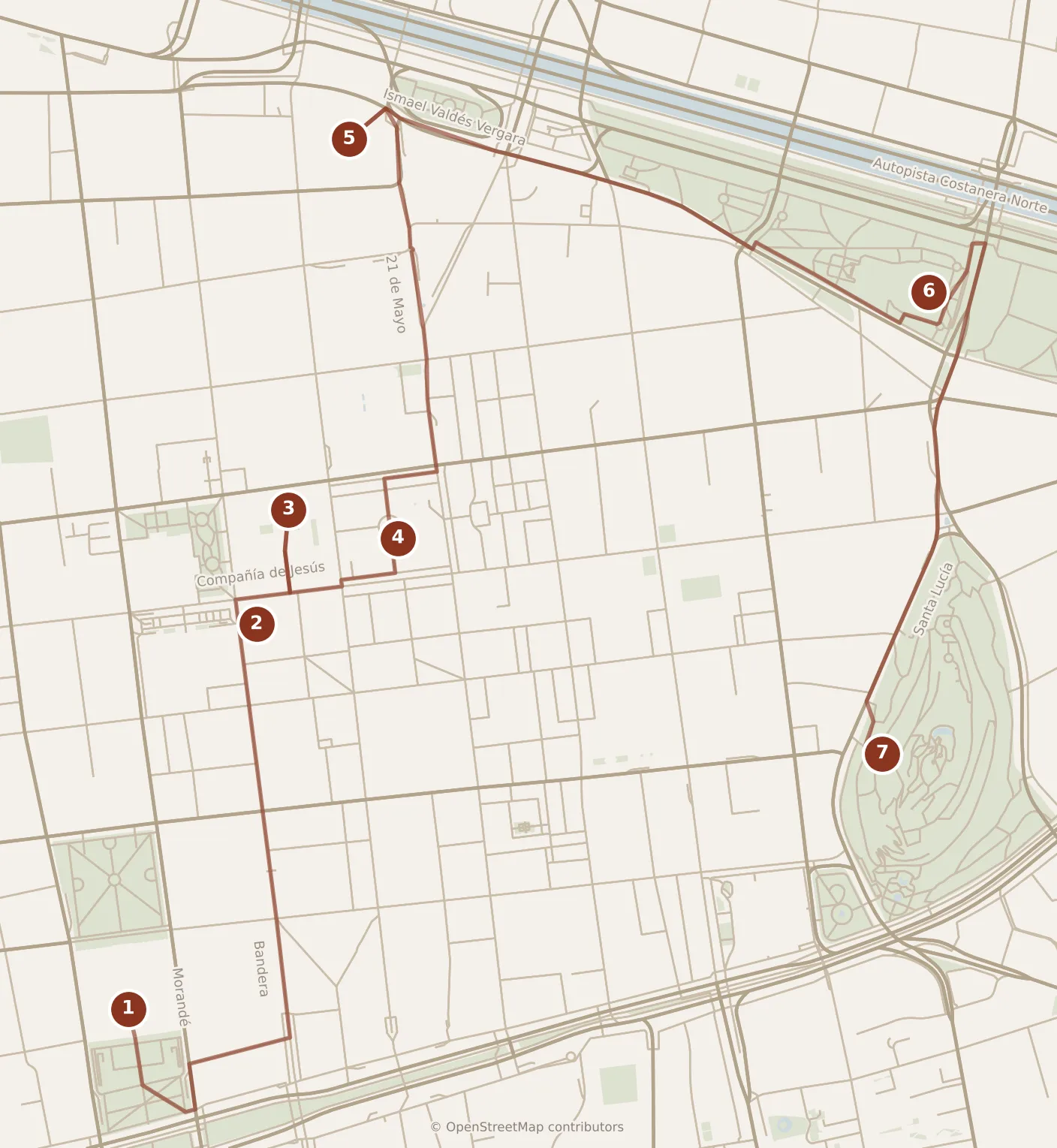
- Morning and afternoon
- 1Palacio de La Moneda
- 2Chilean Museum of Pre-Columbian Art
- 3Santiago Metropolitan Cathedral
- 4Plaza de Armas
- 5Mercado Central
- 6Chilean National Museum of Fine Arts
- 7Santa Lucía Hill
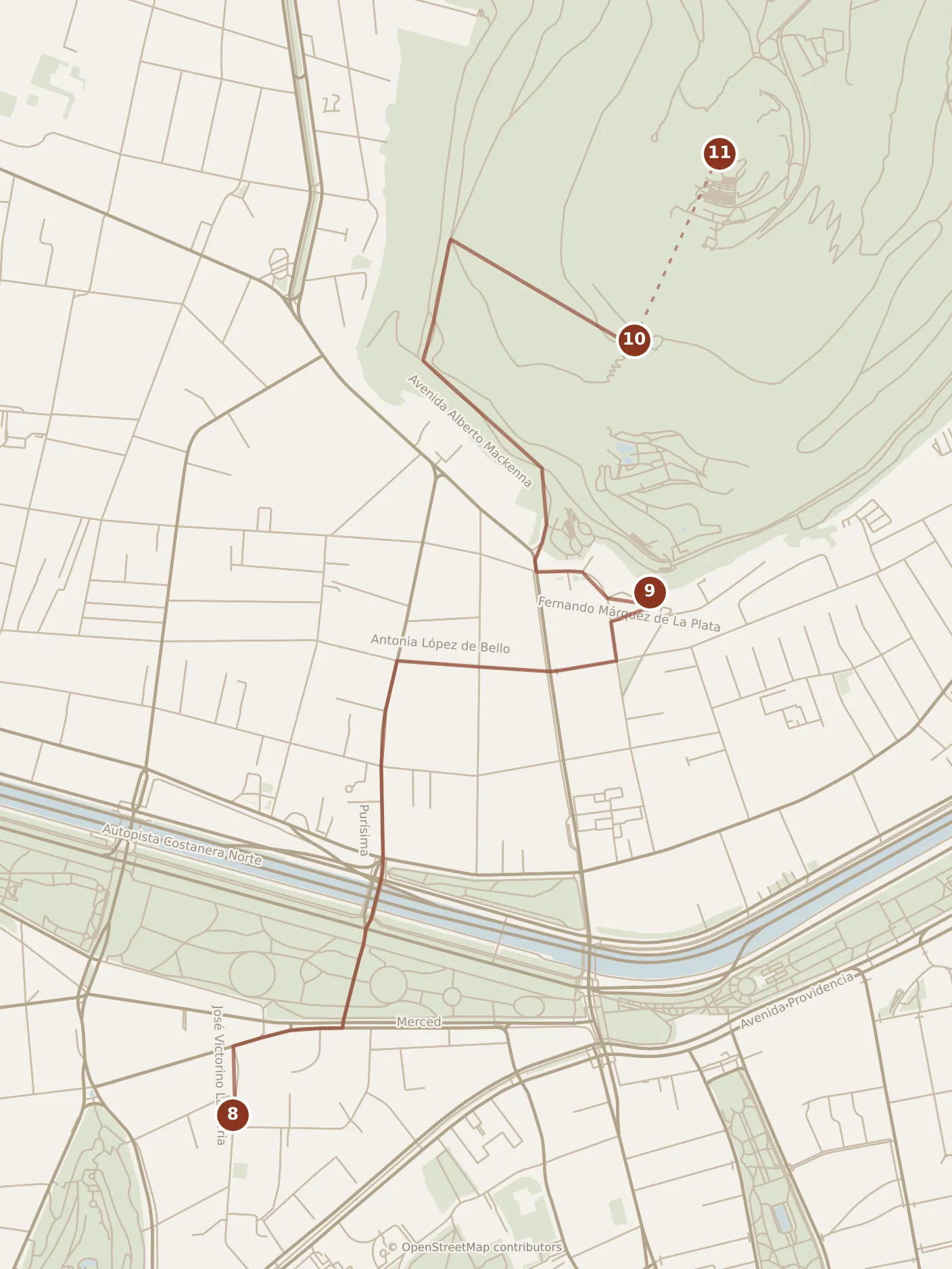
- Evening
- 8Lastarria
- 9La Chascona
- 10Funicular de Santiago
- 11Cerro San Cristóbal
Morning
Start at Palacio de La Moneda, above the Metro station of the same name on Line 1. It was built as the colonial mint — which is where the name comes from, and why a building meant to hold coins has walls like that — to a design by Joaquín Toesca, and has been the president’s seat since 1845. It is also the building the air force bombed on 11 September 1973, and the plain, heavy, rebuilt front you are looking at carries none of that on its face, which is itself worth twenty minutes. Walk round it: Plaza de la Constitución on one side, the long sloping Plaza de la Ciudadanía on the other. Both are open ground, free and always accessible, which makes this the right first stop — it keeps no hours of its own, so it absorbs whatever is left of the morning before the museum opens. It is not quite doorless — a cultural center with galleries and a film archive runs underneath the Plaza de la Ciudadanía — but that opens at the same hour as the museum, so it is not the answer to an early arrival. The guard changes here on alternate mornings, and the hour depends on the day of the week; if your date has one it is worth arriving early for, and if it does not you have lost nothing.
Ten minutes north of it, on Bandera at the corner of Compañía, is the Chilean Museum of Pre-Columbian Art, in the old royal customs house finished in 1807. Give it an hour and a half and treat it as the one museum of the day. It is not a national-history museum and does not tell you about Chile: it is about the peoples of the whole continent before Europeans arrived, and it is arranged by craft and cosmology rather than by date. Two things are why you came. The Andean textiles run back three thousand years and are the finest thing in the building — go to those first, because they are what the rest of the collection is measured against. And the Chinchorro mummies, from the northern desert coast, are the oldest deliberately mummified human remains anywhere in the world, older than Egypt’s by a couple of thousand years. A 2014 extension by Smiljan Radic enlarged the museum by about seventy per cent and is what made room for the Chilean galleries; if the ninety minutes are running out, those are the ones to walk through rather than read.
Three minutes away is Santiago Metropolitan Cathedral, whose long front takes the western side of Plaza de Armas. Fifteen minutes inside is enough. It is broad rather than tall, the interior was reworked in an Italian manner that sits oddly on a colonial shell, and the thing to do is walk up one side and down the other looking at the side chapels rather than stand at the back trying to take it in whole.
Then step out into Plaza de Armas itself and give it twenty minutes doing nothing. This is the square laid out in 1541 as the center of the grid, and every block of the old town is measured from it. It is not a beautiful square and it is not trying to be: it is the busiest public room in Chile, with chess players, preachers, shoeshine stands and portrait photographers working in front of printed backdrops. Sit on a bench in the shade. This is the one stop on the route where watching is the activity.
Afternoon
Nine minutes north, towards the river and the Puente Cal y Canto Metro station, is the Mercado Central, and lunch goes here — sitting down, at a table, not carried. The building itself is worth a minute before you eat: it opened in 1872, and the great iron roof over the middle of it was cast in Glasgow by Laidlaw and Sons and shipped out in pieces, with Fermín Vivaceta putting up the brick shell around it. What it sells is fish. Chile is four thousand kilometers of cold coast, and this is where the capital eats it. Order caldillo de congrio, the conger-eel broth that Neruda wrote an ode to in 1954 — you will meet him again in a few hours — and give the meal an hour and a quarter, because it arrives at the market’s pace rather than yours.
Local tip. If the day is running late, the stop to cut is Santa Lucía, not the hill. They are both viewpoints over the same valley and you do not need two — and of the two, the hill is the one with a funicular doing the climbing and a fixed hour you cannot move. Santa Lucía will still be there, free, on any other afternoon.
Fourteen minutes east along the river, through the long thin Parque Forestal, brings you to the front of the Chilean National Museum of Fine Arts. Stand in front of it for ten minutes and do not go in. That is a real recommendation rather than a hedge: the building was put up for the centenary of independence in 1910, modeled on the Petit Palais in Paris, with a glass-and-iron hall behind the colonnade, and the front of it is the part that will stay with you. The collection inside is a good national gallery and a bad use of the ninety minutes you have already spent on a better one.
Eleven minutes on is Santa Lucía Hill, the rocky outcrop the city was founded beside, and the climb up it is the only real exertion of the day. Sixty-eight meters above the streets, no more, but it is all stairs. Benjamín Vicuña Mackenna turned a bare rock into this between 1872 and 1874 and the result is deliberately theatrical: the Terraza Neptuno and its fountain at the bottom of the grand staircase, paths doubling back on themselves, the Castillo Hidalgo halfway up, a small Japanese garden added in 1959, and the Torre Mirador on the topmost crag. Give it forty-five minutes and go all the way up. From the top you can see the whole grid you have just walked, the Andes closing the east, and the hill you are going to next.
Evening
Seven minutes down the far side and you are in Lastarria, and this is where the day changes gear. It is a few short streets between the hill and the park — bookshops, cinemas, a run of cafés with outdoor tables, and a small street market of prints and second-hand things on the weekend. Give it forty-five minutes and sit down for a coffee. You have walked most of the old town and you are about to cross the river, and this is the last flat, easy, unhurried thing on the route.
Then the longest single stretch of the day: twenty minutes north-east, over the Mapocho, up to La Chascona. Pablo Neruda built it from 1953 for Matilde Urrutia, and named it for her hair; he lived here until his death in 1973, and it was ransacked in the days after the coup before being restored. It is not one house but three small buildings stacked up the slope, so you keep going outdoors to get from room to room, and it is full of the sea — a dining room fitted out like a ship’s cabin, portholes, figureheads, a bar. Give it an hour. It is the sort of house that explains a writer better than a biography does, and it is the last interior of the day.
Seven minutes further up Pío Nono is the foot of the Funicular de Santiago, which has been hauling people up Cerro San Cristóbal since 1925 — 485 meters of track, three stations, closed for rebuilding from late 2020 and running again since July 2022. This is the hour you have been counting towards. Buy a round-trip ticket, ride to the top, and give the summit an hour. The hill is 876 meters above sea level and about three hundred above the streets you left, which is enough for the whole valley to lay itself out flat: the grid to the west, the towers to the east, the Andes behind you. At the top there is a sanctuary to the Immaculate Conception with an open-air amphitheatre where John Paul II prayed in 1987, and above it the Virgin herself, fourteen meters of her on an eight-meter pedestal, white against the sky from a long way down the valley.
Come down the way you went up. From the foot of the funicular it is fifteen to twenty minutes south down Pío Nono and over the river to Baquedano, which is on Line 1 and Line 5 and is where the day ends. If you are not leaving yet, do not go straight there: the streets you have just walked through are the loudest part of Santiago after dark, and a completo eaten standing up on Pío Nono is the correct last thing to do. If you are leaving, Line 1 runs west from Baquedano through Universidad Católica, Santa Lucía, Universidad de Chile, La Moneda and Los Héroes, and carries on to Estación Central for the regional trains and the long-distance bus terminals, and to Pajaritos for the airport buses.
Practicalities
Nothing on this route has to be booked before you travel. The day has one substantial ticket, the Pre-Columbian museum, which was in the eight-thousand-peso range for foreign visitors in 2026 and a small fraction of that for Chileans and residents; the funicular return was a couple of thousand pesos. Neruda’s house is the one door to check ahead: the foundation that runs it publishes the hours and closing days on its own site, and nothing published says whether tickets are sold at the door — so look there before you count on walking in. Everything else — the palace squares, the cathedral, Plaza de Armas, the market, the park, Santa Lucía — is free.
Monday is the day that rewrites this itinerary, and it is the thing to check your date against before anything else. The two interiors this route pays for — the Pre-Columbian museum and Neruda’s house — each close one day a week, and for both of them that day is Monday; the funicular runs a shortened Monday too, starting in the early afternoon rather than the morning, and stops altogether on the first Monday of the month for maintenance. Confirm all three before you set out rather than trusting this paragraph: the funicular’s hours are the park authority’s to publish, and the museum and the house each publish their own. If your one day is a Monday, invert it rather than abandon it: take the hill in the middle of the afternoon, once the funicular has started, and give the morning to the square, the cathedral, the market and Santa Lucía, none of which has a weekly closing day. What a Monday costs you is the museum and the poet’s house, and that is a real loss rather than a manageable one — if you have any choice at all about which day you spend here, do not spend it on a Monday.
Sunday is a much smaller problem and worth thirty minutes of slack rather than a redesign. The cathedral has services through the morning, which can cost you the fifteen minutes inside it, and the hill is a family outing rather than a tourist one on the weekend, so the funicular takes longer to work through the people in front of you.
Getting between the stops needs nothing but shoes. The whole route is on foot apart from the funicular and the Metro at either end, and the longest single stretch is the twenty minutes from Lastarria over the river to La Chascona. There is a way to shorten it — Santa Lucía and Baquedano are two stops apart on Line 1, with Universidad Católica between them, and Baquedano leaves you about a quarter of an hour short of the house — but once you have gone down to a platform and back up again the saving is a few minutes, and it costs you Lastarria, which is the pleasantest three-quarters of an hour on the route.
The bag is the one thing to settle before the day starts, and the route itself settles it. There is no left-luggage counter inside the stations, but the storage networks that leave bags with ordinary staffed businesses — a shop, a café, a hotel back office — cover this part of the city, and their nearest points are at La Moneda station, where the day begins, and around Plaza de Armas a few blocks north. Book online before you arrive rather than turning up: each point keeps its host business’s own hours, which the booking shows you, and the one at La Moneda is the only one that takes the bag off you before the first stop rather than after it. The stop a case genuinely ruins is Santa Lucía — sixty-eight meters of staircase with nowhere sensible to leave anything — and after that the market at lunchtime, which is narrow and crowded and full of people carrying trays. The hill itself is fine with a bag, because the funicular does the work. With the bag left behind at the start, the day runs exactly as written, Santa Lucía included. If you are carrying it anyway — arriving before the shops open, or between buses with nothing booked — it is still a whole day: take the morning exactly as written, eat at the market, walk the park east to the front of the fine arts museum, cut Santa Lucía, and put its three-quarters of an hour into Lastarria and the funicular instead. One viewpoint lost, and the rest of the route unchanged.
Finally, dress for the top rather than the street. The summit is three hundred meters up, it is windier and colder than anything you will have felt all day, and you will be standing still on it while the light changes.


