San Sebastián in 2 to 3 days: the old town, the bay, and a cliff walk to Pasaia

Last updated 3 November 2026
Overview
San Sebastián is a bay with a hill at each end, and two days is the honest length for it: one for the old town and the hill that shelters it, one for the curve of the beach and the hill at the far end. Everything on those two days is on foot except a funicular ride, and nothing on them needs booking. A third day leaves the city on purpose — along the cliffs to the fishing villages of Pasaia, on a waymarked path, and back by boat and bus — and the title says so because it is a hill walk, not a stroll.
The order matters more than the list. Day one is the Parte Vieja, the old town wedged between Monte Urgull and the river mouth, and it goes first because it is where you will eat every evening and you should learn its streets in daylight. Day two walks west round La Concha to Monte Igueldo, and it is the day built around an hour: the view from the top wants the last of the light.
To use that, you need the sunset. Here the sun goes down from just after half past five in early December to just before ten at the end of June, which is a wider swing than most visitors expect this far south. Take your month’s hour, and day two tells you how far back from it to start.
One stop on day one, San Telmo Museoa, closes on Mondays, except when the Monday is a public holiday. If your first day is a Monday, swap the two days: day two is beaches, a palace garden and a funicular, and it does not care what day it is.
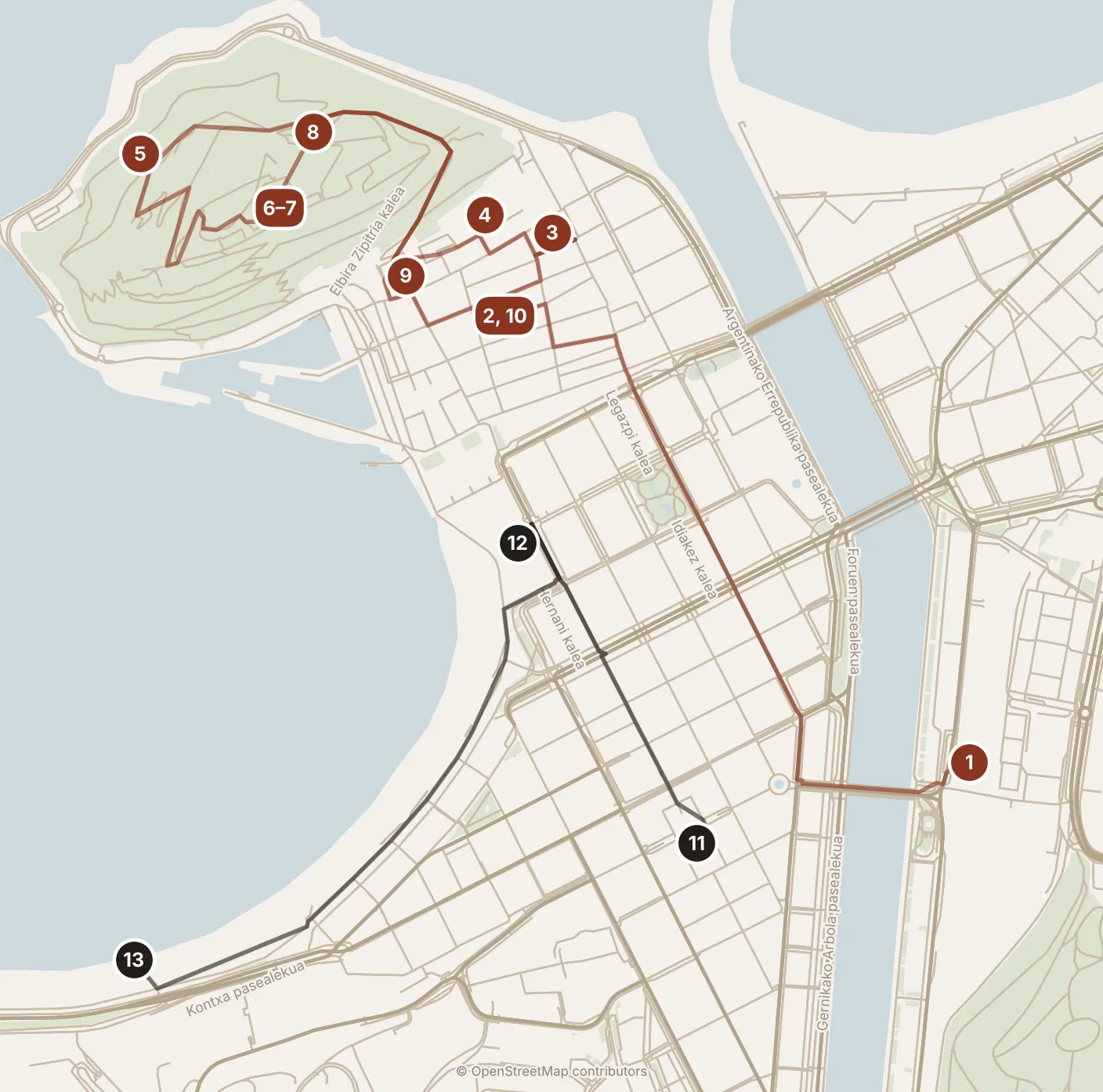
- Day one
- 1Estación del Norte
- 2Plaza de la Constitución
- 3San Vicente
- 4San Telmo Museoa
- 5Paseo Nuevo
- the fishing port — in the prose, not on the map
- 6Monte Urgull
- 7Castillo de la Mota
- 8English Cemetery
- 9Santa María del Coro
- 10Parte Vieja
- Day two
- 11Buen Pastor Cathedral
- 12Alderdi Eder
- 13La Concha
Day one

Today stays inside a few hundred meters of the old town’s main square and the hill above it. There is no hour it has to meet: the light on Monte Urgull is good all day. Anchor it to the start instead — be at San Telmo Museoa soon after it opens, because the museum is the one thing today that rewards fresh attention, and the hill is better with a lunch behind you.
Morning
Most readers arrive at the Estación del Norte, the main railway station, or at the bus station beside it on the east bank of the river. From there it is about twenty minutes on foot to the old town: cross the river on the María Cristina bridge directly in front of the station, the one with the ornate lamp-topped columns, turn right along the riverbank, and the old town is where the river meets the sea. The Euskotren trains from Bilbao and from Hendaye on the French border stop instead at Amara, on the same side of the river south of the center, about twenty minutes on foot from the old town. The line’s new tunnel under the center, with stops nearer the bay, was scheduled to open on 21 November 2026, so check Euskotren’s map for the nearest one. If your bag is still with you, drop it where you are staying first; nothing on this route is pleasant with one, and the hill is impossible.
Start in the Plaza de la Constitución. It was used as the town’s bullring before the city built one, and the balconies on every side still carry the numbers painted on them when they were sold as seats. The old town around it is younger than it looks: the allied army besieging the French garrison in 1813 burned almost all of it, and what you walk through was rebuilt afterward on a grid. Calle 31 de Agosto, named for the day of the fire, is the one street whose houses largely survived. Give the square and that street twenty minutes.
At the eastern edge of the old town, San Vicente is the oldest church in the city, a heavy sixteenth-century Gothic block in stone that looks built to survive exactly what happened in 1813. Ten minutes inside is enough to see the carved altarpiece and the scale of the nave.
San Telmo Museoa is next door, in a sixteenth-century Dominican convent pressed against the foot of the hill, with a modern extension behind it that is wrapped in a perforated green-gray skin. It is the museum of Basque society — how people here fished, farmed, worshipped and argued about who they are — and it is better than that description sounds. Give it an hour and a half. If time is short, skip the upper floors of the modern wing and go straight to the cloister and the old convent church, whose walls are covered in the huge gold-and-sepia canvases Josep Maria Sert painted of Basque history in the 1930s. That room alone is worth the ticket.
Lunch is in the old town, which is a pintxo district at midday as well as at night: stand at a counter, eat two or three things, and move on.
Afternoon
Leave San Telmo by Plaza Zuloaga, at its door, and pick up the Paseo Nuevo, the promenade that runs round the sea side of Monte Urgull from the river mouth to the port. It is the stretch of the city where the open sea hits rock directly below you, and on a rough day the spray comes over the wall; the city closes it when the sea is heavy, and that is the right call. Walked at a stroll it takes fifteen to twenty minutes, and it brings you round to the aquarium and the fishing port.
The port is small and still working: fishing boats, nets on the quay, and the view straight across the bay to the island of Santa Clara and Monte Igueldo behind it, which is tomorrow. In summer, launches to Santa Clara leave from here; a crossing with a swim is half a day, so it belongs to a third day, not this one.
From the port, paths climb Monte Urgull through woods to the Castillo de la Mota at the top, crowned by the large Sagrado Corazón statue that you can see from the whole bay. The climb is short and steady, and the reward is the bay from above: La Concha laid out below as one curve, the island in its mouth. Give the hill an hour and a half, walking slowly and stopping at the old gun emplacements on the way up.
On the seaward slope, the English Cemetery holds the graves of British soldiers who died in the sieges and wars of the nineteenth century. It is a small, quiet place among trees and worth ten minutes; if the afternoon is running short, it is the first thing to cut.
Evening
Come down on the town side of the hill and you arrive almost at the door of Santa María del Coro, the baroque basilica whose carved front faces straight down Calle Mayor to Buen Pastor Cathedral at the other end, lined up across the whole city on purpose. Look inside for ten minutes; the façade is the reason to stop.
Then stay in the Parte Vieja. The evening here is pintxos, eaten standing, a few at each counter, along Fermín Calbetón, Calle 31 de Agosto and the streets between them. The cold ones sit on the bar for you to take; the hot ones are ordered from the staff, often from a board, and you usually pay at the end for what you had. Order a gilda — anchovy, olive and a pickled green pepper on a stick — somewhere, and a glass of txakoli poured from a height. Everything is within five minutes of everything else, so there is no plan to follow: go where it is full of locals rather than of people photographing the counter.
Local tip. If rain closes the Paseo Nuevo or makes the hill miserable, keep the morning as written and give the afternoon to the aquarium at the port and a longer hour in San Telmo, then go straight to the basilica. You lose the view, which day two gives back from the other hill.
Day two

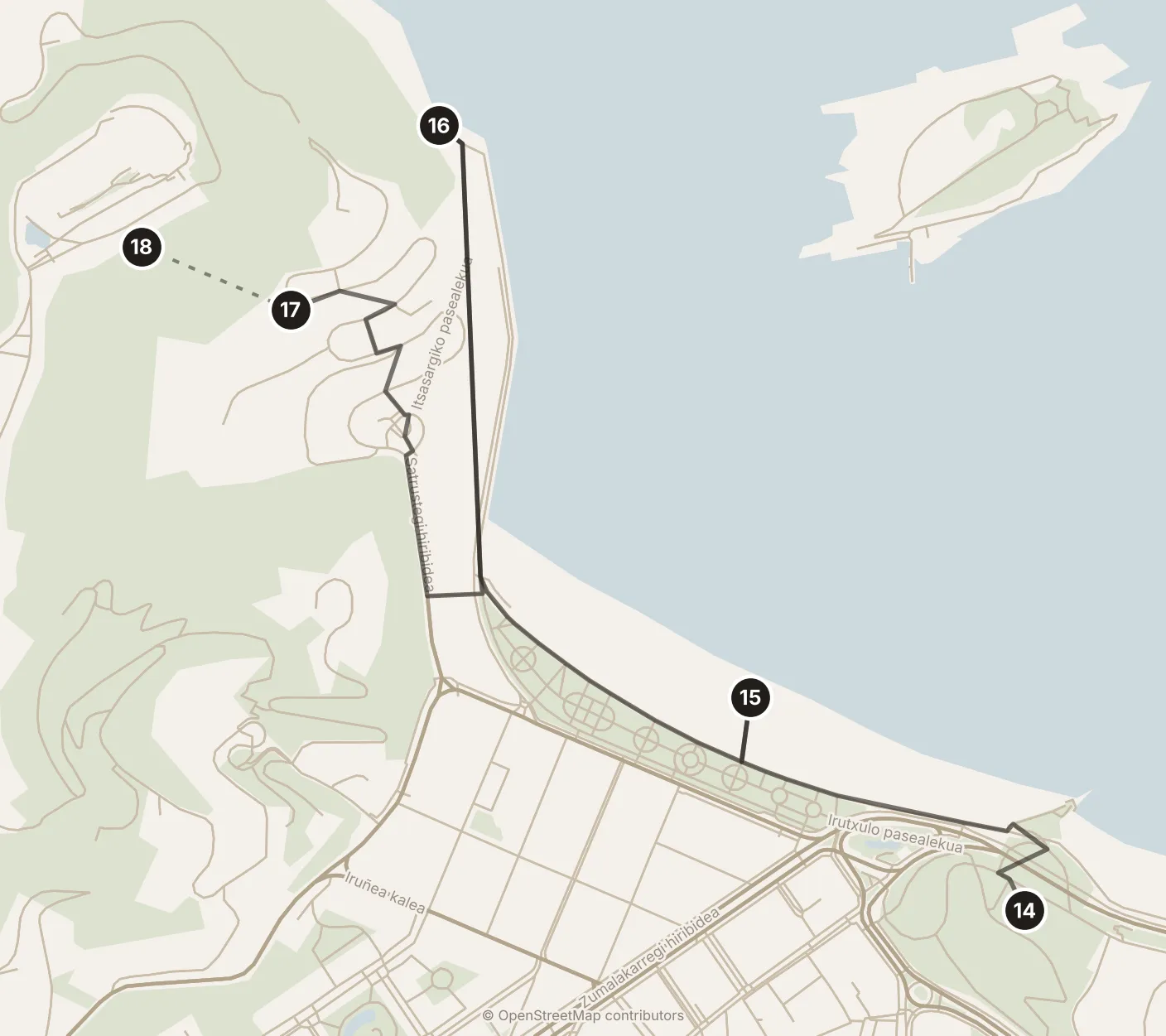
- Afternoon and evening
- 14Miramar Palace
- 15Ondarreta
- 16Peine del Viento
- 17Igueldo funicular
- 18Monte Igueldo
Today walks the whole curve of the bay from east to west and ends at the top of the hill at its far end. It is the day built around an hour, and that hour is at the very end.
Morning
Start at Buen Pastor Cathedral, in the nineteenth-century grid south of the old town — the big neo-Gothic church consecrated in 1897 whose spire is the tallest thing in the center. Ten or fifteen minutes is enough inside. Then walk north up the grid toward the sea, about twelve minutes, to Alderdi Eder, the gardens on the bay at the edge of the old town. The large white building on the gardens is the city hall, and it was built in 1887 as the casino, which tells you most of what you need to know about what this resort was for.
From here the promenade of La Concha begins: the white cast-iron railing and the lamps running the length of the beach, which is the image of the city every postcard uses. Walk it. It takes about half an hour to reach the far end, and there is no reason to hurry — the morning is for walking and, in summer, for the beach itself. The tide here has a big range, so the sand is wide at low tide and narrow at high tide; the promenade does not care either way.
Afternoon
Eat in the Antiguo, the residential neighborhood behind the west end of the bay. Then go up into the gardens of the Miramar Palace, the English-cottage summer house built in the 1890s for the queen regent on the low hill that divides La Concha from Ondarreta. The house is not the point; the lawns are, because they hold the view back along the whole bay. Give it half an hour or forty-five minutes.
Down the other side, walk the length of Ondarreta, the quieter, flatter beach, about fifteen minutes to its western end. There the promenade stops at the rocks and at the Peine del Viento — the Comb of the Wind, Eduardo Chillida’s three steel sculptures of 1977 bolted into the rocks at the end of the bay, gripping at the sea. The granite plaza in front of them has vents set into it, and when the waves come in hard, air and spray blow up through the holes. Give it half an hour; on a rough day give it longer.
Evening
This is the stop the day is built around, so work backwards. The Igueldo funicular is a five-minute walk back from the Peine del Viento, near the end of Ondarreta; it has climbed the hill since 1912, the ride itself is a few minutes, and the top is worth the last hour before dark. Everything from leaving the Miramar Palace to stepping off at the top — the beach, the sculptures, the walk to the funicular and the ride — comes to about an hour and a quarter. So leave the palace gardens about two and a quarter hours before sunset: around a quarter past three in December, and around a quarter to eight at the end of June. In midsummer that leaves a whole afternoon for the beach first; in winter it leaves almost none, so cut the Miramar gardens down rather than arrive in the dark.
That count includes nothing for a wait at the funicular’s ticket window, which is the one queue this day can have on a summer evening. Allow for it.
At the top of Monte Igueldo the view faces east over the bay and the city: the island in front, La Concha’s curve, Urgull at the far end with yesterday’s statue on top. The sun goes down behind you, over the open sea on the far side of the hill, so what the last light does is light the city rather than set in front of you. There is an old-fashioned amusement park up here as well, as old as the funicular itself; the view does not depend on it.
The funicular publishes its own season’s last run down. Read it before you go up, and if the last descent in your month comes before dark, take the sunset from the Peine del Viento instead: it faces the open sea, and the hill can be the afternoon’s view rather than the evening’s.
Coming back, the walk along the whole bay to the old town is about forty minutes, and with the railing lit it is the best walk of the day. City buses also run along the bay; they take the Mugi card, and the parent guide covers how to pay.
With a third day

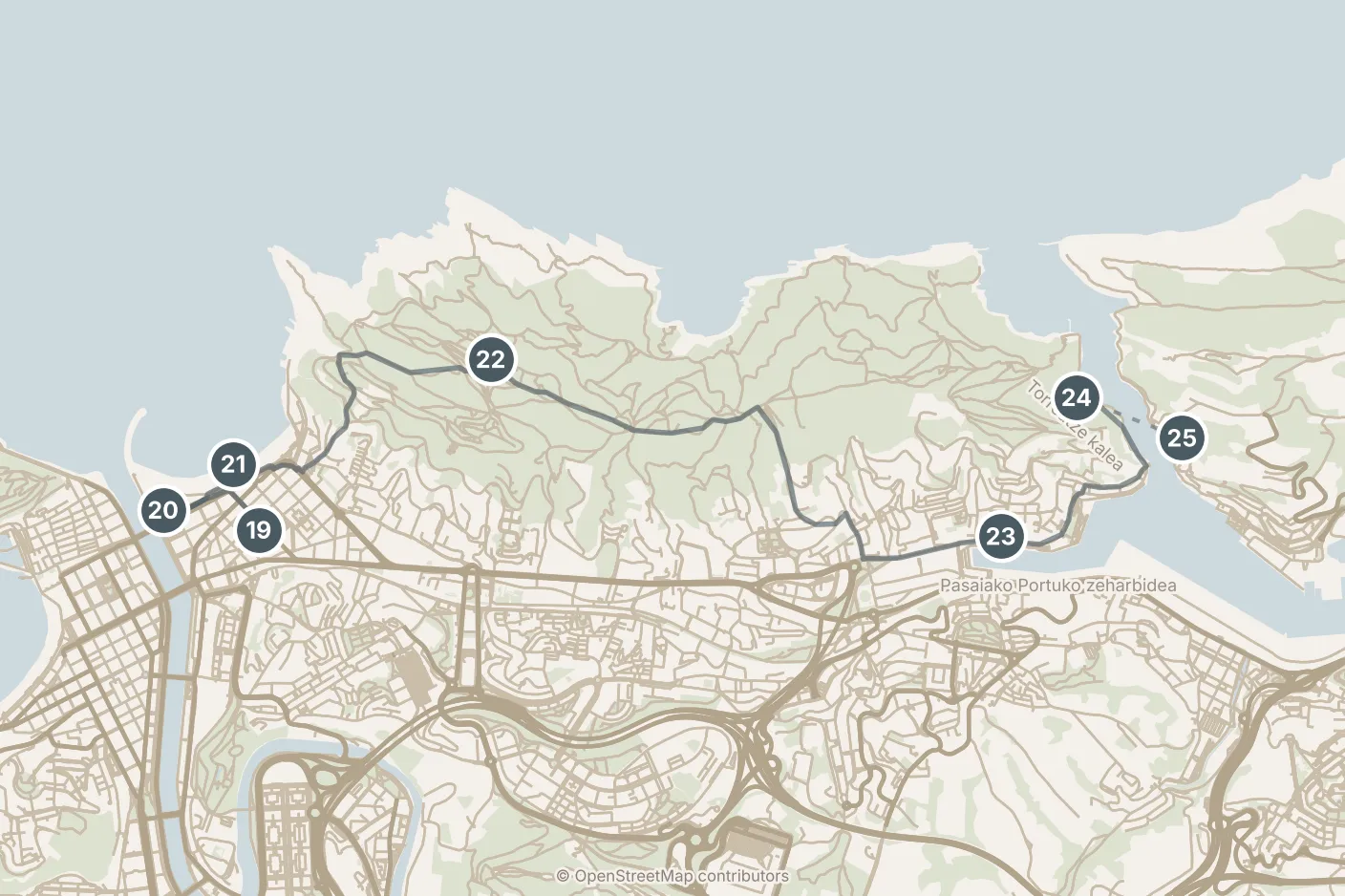
- With a third day
- 19Gros
- 20Kursaal
- 21Zurriola
- 22Monte Ulia
- 23Pasai San Pedro
- 24Albaola
- 25Pasai Donibane
The third day leaves the city on foot: a waymarked path from the beach at Zurriola over Monte Ulia and along the cliffs to Pasai San Pedro, a small boat across the harbor mouth to Pasai Donibane, and a bus back. Give the walk the whole morning, and do not underestimate it. It is a real hill path, up and down, often muddy, and on a map it is several times the straight-line distance. Wear shoes you would hike in, carry water, and take no bag beyond a small one.
Start in Gros, the neighborhood across the river from the old town, reached by the bridge at the river mouth. At the end of the bridge is the Kursaal, Rafael Moneo’s congress center of 1999: two leaning cubes of translucent glass that glow at night and look like rocks washed up at the river mouth by day. Walk past it along Zurriola, the open surf beach where the city learns to surf, all the way to its eastern end at Sagüés, where the path starts climbing.
Monte Ulia is wilder than the two hills of the bay — gorse, pine, and cliffs falling straight into the sea, with no buildings for long stretches. The path is the same one pilgrims on the coastal route to Santiago walk in the other direction, so the waymarks point back toward the city; follow the coast and you will not lose it. It drops at last into Pasai San Pedro, on one side of a long natural harbor that opens to the sea through a gap so narrow it looks like a river.
In Pasai San Pedro, Albaola is the shipyard where a replica of the San Juan, a sixteenth-century Basque whaler that sank off Labrador in 1565, was built by hand from 2014 with the tools of the period, and launched into the harbor in November 2025; the yard is now a museum of how she was made. Visits must be booked in advance, so arrange it before the day or walk past; the day loses nothing it depended on. Give it an hour if you have booked.
From the San Pedro side, small passenger launches cross the harbor mouth to Pasai Donibane in a few minutes, back and forth all day. Donibane is essentially one long, narrow street of old houses squeezed between the hill and the water, some of them built out over it, with small squares opening onto the harbor. The house where Victor Hugo stayed in 1843 is marked on that street. Eat here — this is a fishing village and lunch should be fish, grilled — and walk the street to its end and back, an hour in all.
Take the launch back across to Pasai San Pedro, where interurban buses run to the center in about twenty minutes. If your legs have finished before the cliffs have, the walk is the part to shorten, not the villages: go out by bus instead and walk only the last stretch of path down from Monte Ulia into San Pedro.
Practicalities
Nothing on the two city days needs booking before you arrive; on the third, only Albaola does. The funicular sells its tickets at the bottom station, and the launches across the harbor at Pasaia are paid on board.
Two things are worth checking the week before. San Telmo Museoa closes on Mondays that are not public holidays; if your first day is one, swap day one and day two, which works because day two has no stop that keeps a weekly closing. And the Igueldo funicular publishes its own hours by season; read its last run down for your month, because on a winter evening it decides whether the sunset is taken from the top of the hill or from the Peine del Viento.
The Paseo Nuevo closes in heavy seas, and the coastal path to Pasaia is the wrong walk in a storm. If your third day is wet, keep it in the city: the aquarium at the port, a second, slower visit to the old town, and the beach at Zurriola, which is at its most interesting in rough water.
Days one and two are walkable end to end; the longest stretch is the half hour along La Concha, and the walk back along the bay on day two’s evening is optional, since buses cover it. For the Mugi card and everything else about paying for transport, see the parent guide.
When you leave, the Estación del Norte and the bus station next to it are about twenty minutes on foot from the old town, back across the María Cristina bridge.


