San Sebastián in one day: the old town, the bay and its two hills

Last updated 3 November 2026
Overview
San Sebastián is a bay with a hill at each end, and a single day here is best spent walking from one hill to the other. The old town, the Parte Vieja, is packed into the foot of Monte Urgull on the eastern horn of the bay; La Concha and then Ondarreta curve away from it for the better part of three kilometers; and Monte Igueldo closes the western end. Taken in that order the day never doubles back. The one leg you do not walk is the return from Monte Igueldo, and the one ground you cover twice is the old town, once for its morning market and once for its evening bars.
What a single day costs you is the museum. San Telmo Museoa is the best indoor stop in the city and it is in this route, but it is also the first thing to cut if the morning runs late, because the bay and the light at the end of it cannot be moved and the museum can.
The day is built around one moment: the view from the top of Monte Igueldo in the last hour of daylight, with the whole bay, the island of Santa Clara in the middle of it and the old town under Monte Urgull on the far side. Everything recommended before it adds up to about seven hours, so the method is to take your date’s sunset, subtract an hour for the time on top, and then seven more for the day: that is when to be leaving the station. The sun sets here from just after half past five in early December to nearly ten at the end of June, which means a winter visitor has to be walking by half past nine and a midsummer one can start at lunchtime and still make it. Those seven hours count the time spent inside the places and the walks between them. They do not count the line at the funicular on a summer weekend, which can be the longest wait of the day, or a long lunch standing at a crowded bar.
Most readers of a one-day page arrive by train or bus, and both terminals sit side by side across the river from the center, so the day starts and ends at the same place.
The day

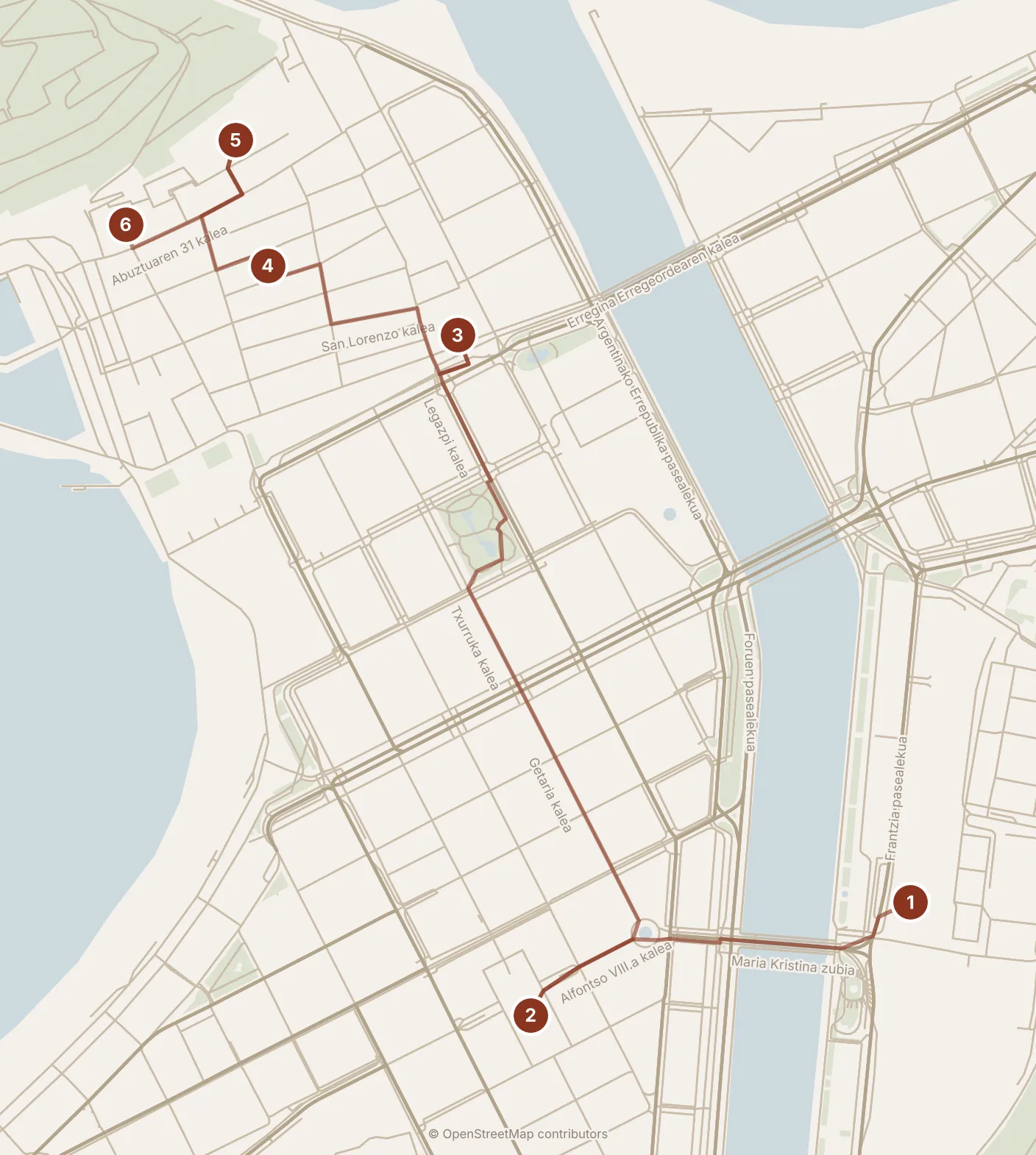
- Morning
- 1Donostia-San Sebastián station
- 2Buen Pastor Cathedral
- 3La Bretxa
- 4Plaza de la Constitución
- 5San Telmo Museoa
- 6Santa María del Coro
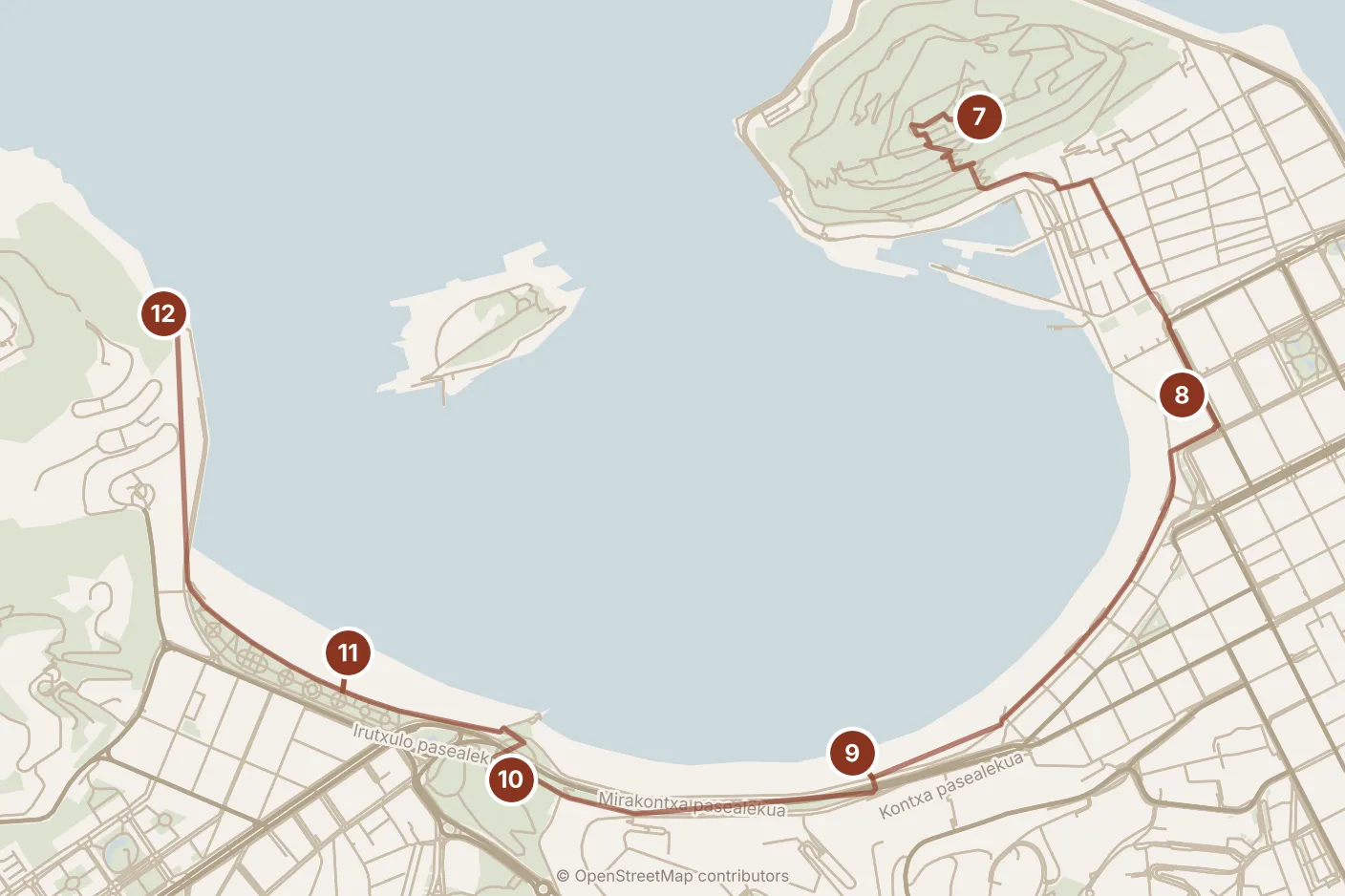
- Afternoon
- 7Monte Urgull
- 8Alderdi Eder
- 9La Concha
- 10Miramar Palace
- 11Ondarreta
- 12Peine del Viento
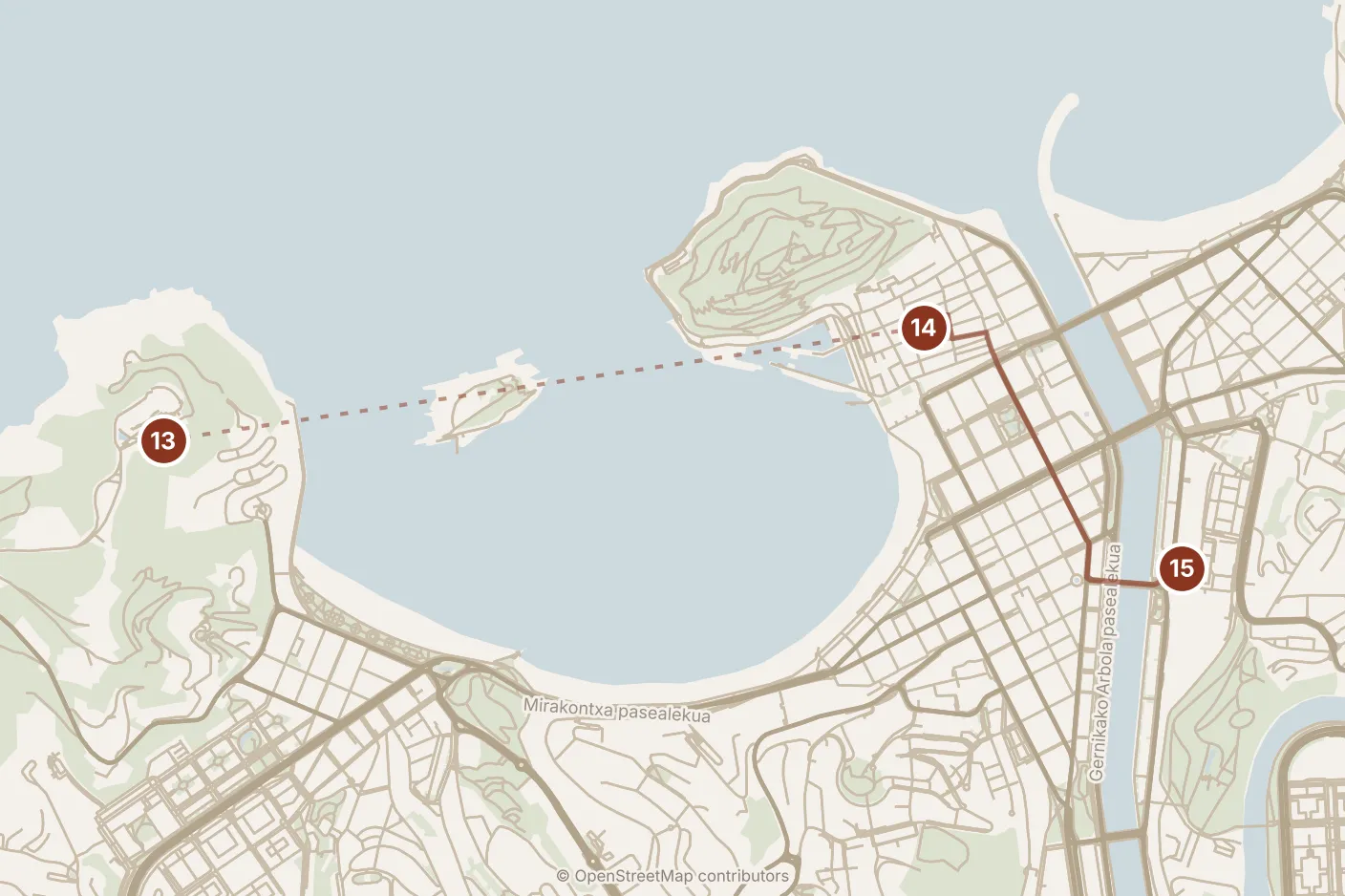
- Evening
- 13Monte Igueldo
- 14Parte Vieja
- 15Donostia-San Sebastián station
Morning
You arrive at Donostia-San Sebastián station, the Renfe station on the east bank of the Urumea; the city’s bus station is underground right beside it, so coaches land you in the same spot. If you come in from Hendaye on the Euskotren line people call the Topo, get off at Amara, a short walk south of the cathedral, and join the route there. The line’s new tunnel under the center, with stops nearer the bay, was scheduled to open on 21 November 2026, so check Euskotren’s map for the stop closest to the route.
Deal with the bag before anything else. The bus station next to the Renfe building has lockers, open around the clock, and it is worth settling before you cross the river, because this route asks you to climb two hills, walk the length of a beach and ride a funicular, and none of those is something to do with a case. The day comes back to the same station at night, so whatever you leave, you collect on the way out.
Cross the Urumea on the María Cristina bridge, the one with the four obelisks on its piers, and a seven-minute walk brings you to Buen Pastor Cathedral, the neo-Gothic church consecrated in 1897 whose spire you have been looking at since the station. Give it fifteen minutes: the interior is tall and fairly plain, and the reason to stand in front of it is the straight line of street running north from its door into the old town, where it becomes Calle Mayor. At the far end of it, about a kilometer away, is the facade of Santa María del Coro, and the two churches face each other down it. You will finish the morning at the other end.
Walk north through the grid of the center to La Bretxa, the market on the edge of the Parte Vieja, about twelve minutes. The complex is being rebuilt, and while the works run the fresh stalls trade underground, below the square. Its name means “the breach”, for the gap the besieging army made in the town walls in 1813. This is the stop that is only itself in the morning: the stalls and the fish counters are working then, and by the afternoon there is little to see. Give it twenty minutes and look rather than buy, since you have the whole day ahead of you.
Two minutes into the old town is Plaza de la Constitución, an arcaded square whose balconies are numbered from the days when it was used as a bullring and the flats were let as seats. Almost everything around you was rebuilt after the fire of 31 August 1813, when the town burned after the Anglo-Portuguese siege; Calle 31 de Agosto, a block north, carries the date, and it is the one street where some houses survived the fire. Ten minutes here is enough.
Three minutes on, at the foot of the hill, is San Telmo Museoa, the museum of Basque society, in a sixteenth-century convent with a modern wing set against the rock. Give it an hour and a half and spend most of it in two places: the cloister, and the old convent church, whose walls Josep Maria Sert covered in huge gold-and-sepia murals of Basque history. The rest of the collection is good, but if you are behind, these two are the museum and the galleries can go.
Then four minutes west along the bottom of the hill to Santa María del Coro, the baroque basilica you saw from the cathedral, its doorway squeezed into the end of Calle Mayor. Turn around on the steps and look back down the street at Buen Pastor, the whole length of the morning in one line. Fifteen minutes inside is plenty.
Lunch goes here, in the lanes around you. The Parte Vieja is where pintxos are eaten, and lunch is as good a time for them as the evening. Take an hour.
Afternoon
From behind Santa María del Coro the paths start up Monte Urgull. The summit is barely a few hundred meters away on the map, but it is about 120 meters up on winding paths and steps, so it takes longer than the distance suggests. On the way you pass the English Cemetery, the graves of British soldiers who fought here in the Carlist war of the 1830s, and at the top is the Castillo de la Mota with the large statue of the Sagrado Corazón above it. The reason to come up is the view: from here you see the whole bay you are about to walk, with Santa Clara in the middle and Monte Igueldo at the far end. Give the hill an hour, climb and descent together, and come down on the harbor side.
Local tip. If the morning ran long, this hill is the one to shorten rather than San Telmo Museoa: walk the Paseo Nuevo round the outside of it at sea level instead of climbing, and you keep the sea and lose only the summit view, which Monte Igueldo gives you again at the end of the day.
The harbor at the bottom is a working fishing port with the old town’s houses stacked behind it. Walk it to Alderdi Eder, the gardens at the start of the beach, with City Hall beside them in the building that opened as the casino in 1887. Half an hour for the harbor and the gardens.
Now La Concha, the beach the city is known for: a long, shallow curve of pale sand with the white railing along its promenade above it. Walk the promenade rather than the sand, about twenty-five minutes, to Miramar Palace, built as the royal family’s English-style summer residence, on the low rise where La Concha ends. Its gardens are open to walk through and have a good look back across the bay; fifteen minutes. In summer the sand is the city’s living room, and with time to spare this is the place to stop and swim, since the bay is sheltered.
Past the palace is Ondarreta, the quieter beach, and at its far end, twenty minutes from Miramar, the Peine del Viento, the Comb of the Wind: three rusted steel sculptures by Eduardo Chillida, set into the rocks where the open sea meets the end of the bay, with a granite platform by the architect Luis Peña Ganchegui in front of them. Vents in the paving blow air and spray up when the sea is high and heavy; at low tide on a calm day nothing happens, and if you care about that half of it, a tide table is the one thing to check that morning. Give it twenty minutes either way.
Evening
Five minutes back along the end of Ondarreta is the bottom station of the funicular that climbs Monte Igueldo, running since 1912. This is the stop the day is built around, so this is where the count from the Overview lands: you want to be at the top about an hour before dark. Up there is an old-fashioned amusement park, which you can ignore, and the view, which is the best in the city: La Concha’s full curve, the island, Monte Urgull and the old town under it, all in one frame, and the lights coming on around the bay as the sun goes. The funicular publishes its own hours, and they are shorter in the colder months. Read them for your date: if the last car down leaves before dark, ride it up earlier in the afternoon, after Ondarreta, and spend the last light at the Comb of the Wind instead, which faces the open sea.
Coming down, do not walk back. The bay walk to the old town is around three kilometers, the better part of forty-five minutes after a day of walking, so take one of the city buses that run back along the bay to the center from Ondarreta, or a taxi. The buses take the Mugi card or a contactless bank card on board; the parent guide has the rest.
End in the Parte Vieja, where the evening is what most people come for. The bars along Calle 31 de Agosto and Fermín Calbetón lay their pintxos out on the counter; you take or order a couple, have a drink, and move to the next one rather than settle in one. The anchovy-olive-pepper skewer called a gilda is the one to try at least once, and a glass of txakoli poured from a height is the drink. An hour or two, as long as you like.
If you have a train or a bus, the station is under twenty minutes on foot from the old town: cross the Urumea on the Santa Catalina bridge and walk up the far bank. The bag, if you left one at the bus station, is right there.
Practicalities
Nothing on this route has to be booked ahead. San Telmo Museoa and the funicular are paid at the door; the churches, the market, the two hills on foot and both beaches cost nothing.
San Telmo Museoa closes on Mondays, unless the Monday is a public holiday; if you are here on one, the morning simply ends earlier at Santa María del Coro, and the hour and a half goes either to a longer climb of Monte Urgull or to the beach in the afternoon, which on a warm day is the better trade anyway. The churches close around services, which on a Sunday morning can mean most of the morning; with one day, look at the two of them before fixing the order.
The funicular’s hours are the other thing to read in advance, for the reason given in the evening: on a short winter day the last car down may come before the light goes, and the day still works with the funicular moved earlier and the sunset taken at the Comb of the Wind.
If your time is shorter than a full day, cut from the middle and keep both ends. San Telmo Museoa goes first, then the climb of Monte Urgull, which you can replace with the flat Paseo Nuevo round its base. What you should not cut is the walk of the bay itself, from Alderdi Eder to the Comb of the Wind: it is the city’s whole shape, and it is free.
Everything except the return from Monte Igueldo is on foot. The longest single walk is the stretch of La Concha from Alderdi Eder to Miramar Palace, about twenty-five minutes; the bay walk back from the far end is the one to skip, which is why the bus is in the evening.


