Salvador in two or three days: the upper town, the market, and the hill of Bonfim

Last updated 8 August 2026
Overview
A single day in Salvador is a choice between the old town and the water, and it is a hard one. Two days ends the choice, and it does something better than doubling the list: it lets you go into things. The upper town is not the four photographed streets; it runs a kilometer and a half north along the top of the bluff, and the half of it beyond the Pelourinho — the Carmelite churches, the fort where capoeira is taught, the street the quarter is named after — is where the crowds stop and the city carries on. Day one walks that whole spine and pays for interiors. Day two goes down the cliff to the harbor and then north up the bay to the hill of Bonfim, five and a half kilometers north of the old town — the most visited church in the state, and still a working shrine rather than a monument.
Light is not what constrains a day here. Thirteen degrees south of the equator, the sun goes down between about a quarter past five at the end of May and about ten past six in the middle of January — fifty-four minutes of swing across the whole year, so there is no backward count to do from the sky in any month. What does change by month is rain: April to June are the wet ones by a wide margin, and the day below that suffers for it is the Bonfim day, which is an open market, a hill of steps and an unsheltered point. The rain note at the foot of this page says what to do about that. What shuts early here is doors, and on some days of the week rather more of them than on others. The notes at the end of this page say which, and the rules there are written by the day’s content, not its number, because the third day below goes in the middle.
Day one, counted from the museum door on Terreiro de Jesus, comes to about five and a half hours of standing still, an hour and a half for lunch and roughly three-quarters of an hour of walking between stops: start at nine and you are back on the ridge at Santo Antônio a little after half past four. Day two is about four and three-quarters hours inside places, plus lunch at the market, about ten minutes of walking between stops — thirty-five if you walk the one leg on it that can be walked — three car legs in the day and a long one back at the end of the afternoon. Both sums measure only the time you spend at the stops. Day one’s largest omission is the ground: this is a hill town of cobbled ramps in heat and humidity, and the walking figure is calculated at the flat, unhurried pace of somewhere cooler. Day two’s omission is the traffic on the road north, whose length is decided by the hour of day rather than by the three kilometers of each leg.
One subtraction is already made. The Igreja de São Francisco — the gold interior that every account of this city is built on, on the square adjoining Terreiro de Jesus, so you will walk past its front on day one — has been closed since 5 February 2025, when part of the ceiling came down in the middle of a visiting afternoon and killed a woman of twenty-six. The restoration has been discussed in years, not months. Check what has reopened before you travel; neither day below is built on it, and the carved and gilded interior that carries day one instead is the Carmelite one at the top of the hill.
The one thing this route needs that you may not have thought about: a working way to pay for app cars. Three of day two’s legs and two of the third day’s are neither walkable nor on the metrô, and those rides are this itinerary’s only real transport cost. How the metrô and the cars work in general is the city guide’s business, not this page’s.
Day one

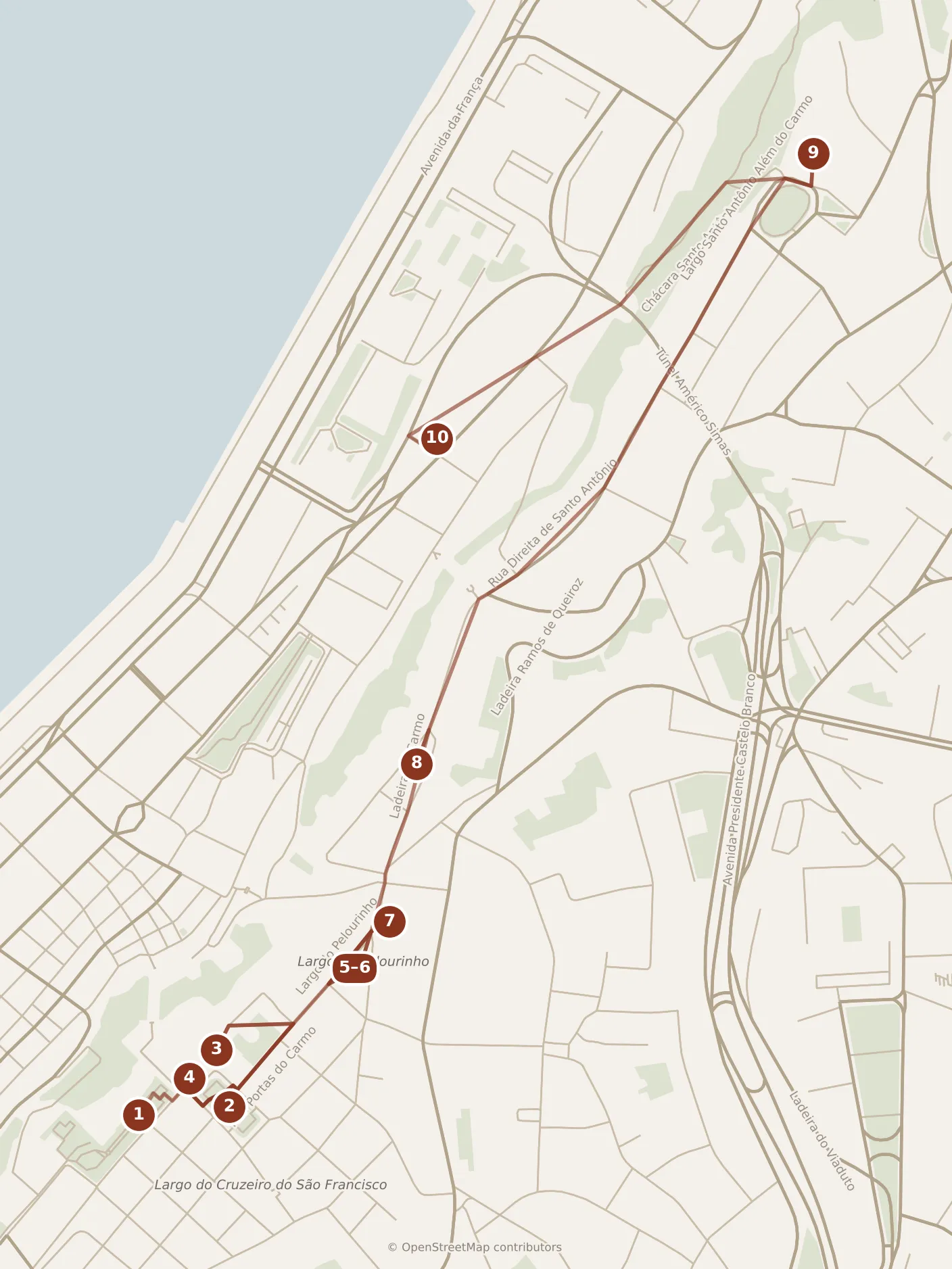
- Day one
- 1Praça da Sé
- 2Terreiro de Jesus
- 3Museu Afro-Brasileiro
- 4Catedral Basílica de Salvador
- 5Largo do Pelourinho
- 6Fundação Casa de Jorge Amado
- 7Igreja de Nossa Senhora do Rosário dos Pretos
- 8Igreja da Ordem Terceira do Carmo
- 9Forte de Santo Antônio Além do Carmo
- 10Rua Direita de Santo Antônio
Everything today is on one street, more or less, running north along the top of the bluff from the square where the first cathedral stood to the fort at the far end. Nothing is more than a quarter of an hour from the last thing, and the day gets slower and less visited as it goes.
Morning
The historic center has no metrô station. Coming in from the airport it is the free shuttle to Aeroporto, the end of Line 2, then Line 2 to Acesso Norte, then Line 1 to Campo da Pólvora — the last stop but one — and about fourteen minutes on foot north from there. The metrô itself runs from five in the morning to midnight, so a flight landing outside that window is a car into town whatever this page says. With a case that final stretch is uphill and cobbled and worth a car instead; without one it is a fine way to arrive, because you come into the old town from below rather than being dropped in the middle of it.
Give Praça da Sé the quarter of an hour before nine. It is a square with a hole in it: the primatial cathedral of Brazil stood here until 1933, when it was pulled down to run a tram line through, and the city has been arguing about it ever since. The paving marks where the walls were, and a great fallen cross stands at one side as the monument to the thing that is not there.
Two minutes east is Terreiro de Jesus, the square the Jesuits laid out, with a fountain in the middle and three church fronts looking on to it at once. Cross it now and come back to it: the ten minutes it is worth are best spent at eleven, when you come out of the museum into it and can see which building is which.
The Museu Afro-Brasileiro is on its north side, in the long building that held the first medical faculty in Brazil. Give it two hours, and here is what the second one buys. A short visit here is a visit to one room: the twenty-seven carved cedar panels by Carybé, one for each orixá of Bahian Candomblé — Oxalá, Iemanjá, Oxum, Ogum, Oxóssi, Xangô, Iansã, Nanã and the rest — cut deep and hung together so that a whole religion is in front of you at once. They are worth the visit on their own. But with two days you can do the thing the panels really reward, which is to walk the West African rooms first — the masks, the cloth, the ritual objects the museum’s collection is built from — and come to the panels last. Read in that order they stop being beautiful carvings and become a conclusion. Take it first thing rather than after lunch: in 2026 it shut its own doors for an hour in the middle of the day, and the churches around it did not.
Local tip. That midday hour is the whole reason the order of this morning is what it is. If you are running late, let the cathedral slip until after lunch and keep the museum where it is; do it the other way round and you will arrive at a shut door with nothing to do but wait for it to open again.
A minute away across the same square, the Catedral Basílica de Salvador is the church of the Jesuit college that once occupied this entire block, and has been the city’s cathedral since the old Sé came down in 1933; forty minutes is right for it. The stone is not Bahian: it was quarried and cut in Portugal and shipped here for the purpose, which is why the front looks like a building that landed rather than one that grew. Inside, the room to give real time to is the sacristy, tiled and panelled and several degrees cooler than the nave.
Five minutes north on cobbles brings you down into Largo do Pelourinho, the sloping square of pastel fronts that every photograph of this city is taken in. The photograph takes two minutes. What the extra day buys is going into the houses on it, and the one to go into is the Fundação Casa de Jorge Amado, on the upper side. Forty-five minutes: the novelist’s manuscripts, the wall of his books in every language they have been translated into, and — the thing that stays with you — the covers, which are a century of how the outside world decided this city looked. Eat afterwards, up here rather than down at the water. Sitting down, this is moqueca country, and give it an hour and a half rather than an hour: a moqueca is cooked from cold when you order it and comes to the table in its own pot, portioned for two.
Afternoon
At the foot of the square stands the Igreja de Nossa Senhora do Rosário dos Pretos, and it is the answer to the morning. The brotherhood that built it was formed in 1685 by enslaved and freed Africans who were not admitted to the churches at the top of the hill; they were given permission in 1704 to build here at the old gate, the Portas do Carmo, and it took them the better part of a century, raised in whatever time the members had of their own — the façade and towers were not begun until 1780, under the master builder Caetano José da Costa. Behind the church is the burial ground of the people who built it. Half an hour. If a service is being sung when you arrive, stand at the back or come back later; the aisles are not a walkway then. On a Tuesday the mass here is at six in the evening, accompanied by Candomblé drums — the Terça da Bênção, which has been kept for over forty years rather than being a season’s program — with music in the largo afterwards. If your old-town day is a Tuesday, come back down for it rather than staying north at Santo Antônio, and order a car from the square itself when you leave. That is an evening worth trading the one below for, and the walk out of the lower Pelourinho after dark is the part this page would not do.
Four minutes up the Ladeira do Carmo — steep, and the steepest bit of the day — brings you to Largo do Carmo and the Igreja da Ordem Terceira do Carmo. Three-quarters of an hour. The church you see was built between 1788 and 1860 after a fire destroyed its predecessor in Holy Week 1787, and the reason to come is one object: a cedar figure of the dead Christ, carved in 1730 by Francisco das Chagas, with two thousand rubies set into it for the drops of blood. It is the piece on this route people go back for a second look at, and with the gold church shut it is the carved interior that now carries the day. The Carmelite convent alongside it has been a hotel since the 1970s for want of friars, which is worth knowing so that you do not wait in line to get into it.
From here the crowd stops. Rua Direita de Santo Antônio runs north out of the Largo do Carmo and it is seventeen minutes along it to the Forte de Santo Antônio Além do Carmo at the far end, begun in November 1695 and finished in 1703. It is not a monument you tour. Restored in 2006, it has been the city’s center for capoeira ever since: six teaching rooms, a memorial to the old masters, and a yard. Forty minutes, and go for the courtyard and whoever is training in it rather than for anything in a case.
Evening
Walk back down Rua Direita — seventeen minutes again — and stay on it. This is where visitors to the old town actually sleep, and it shows: low houses, guesthouses behind shutters, a bar every fifty meters, and cross-streets on the bay side of the road that end in a low wall above the water. You will be back here a little after half past four, which is when the doors open and the tables come out, and the light goes somewhere between a quarter past five and ten past six depending on the month — so the shape of this evening is an hour or two sitting still rather than another stop. Order the car from the table when you have had enough: this end of the historic center is a long way from a station and the walk back through it after dark is one the city guide advises against.
Day two

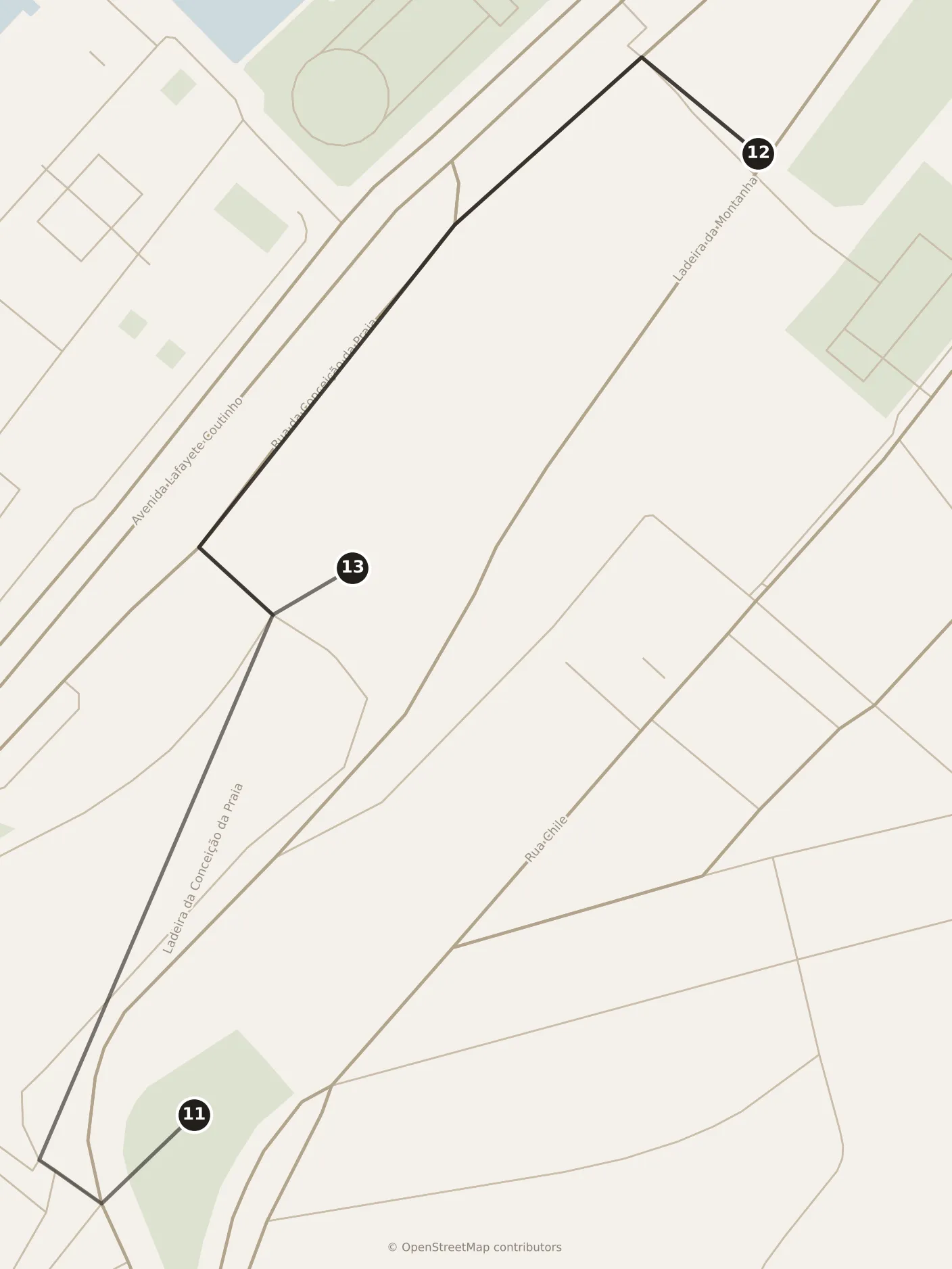
- Morning
- 11Praça Castro Alves
- 12Elevador Lacerda
- 13Basílica de Nossa Senhora da Conceição da Praia
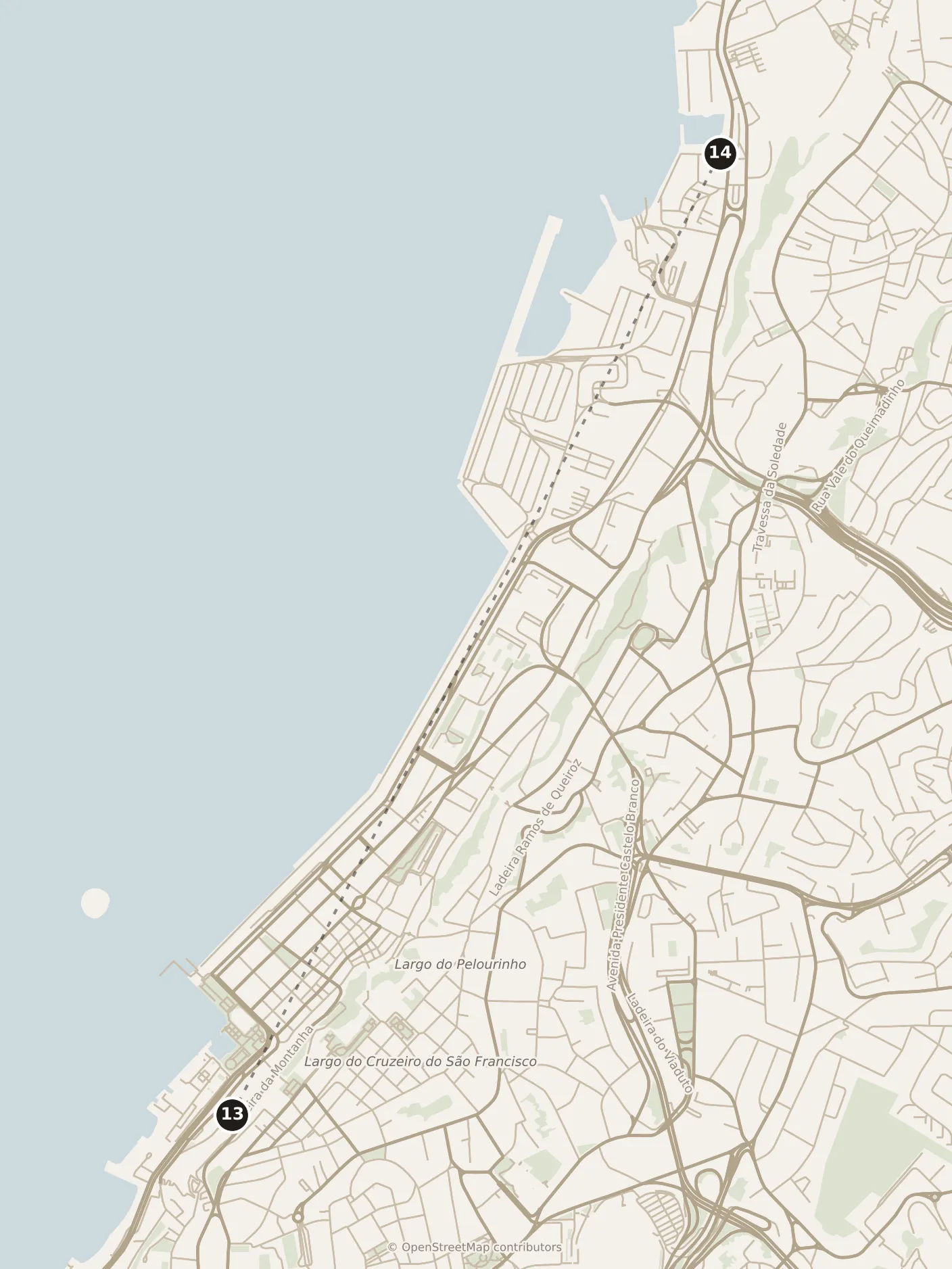
The leg out of the center: from stop 13 by taxi, not on foot.
- Morning
- 14Feira de São Joaquim
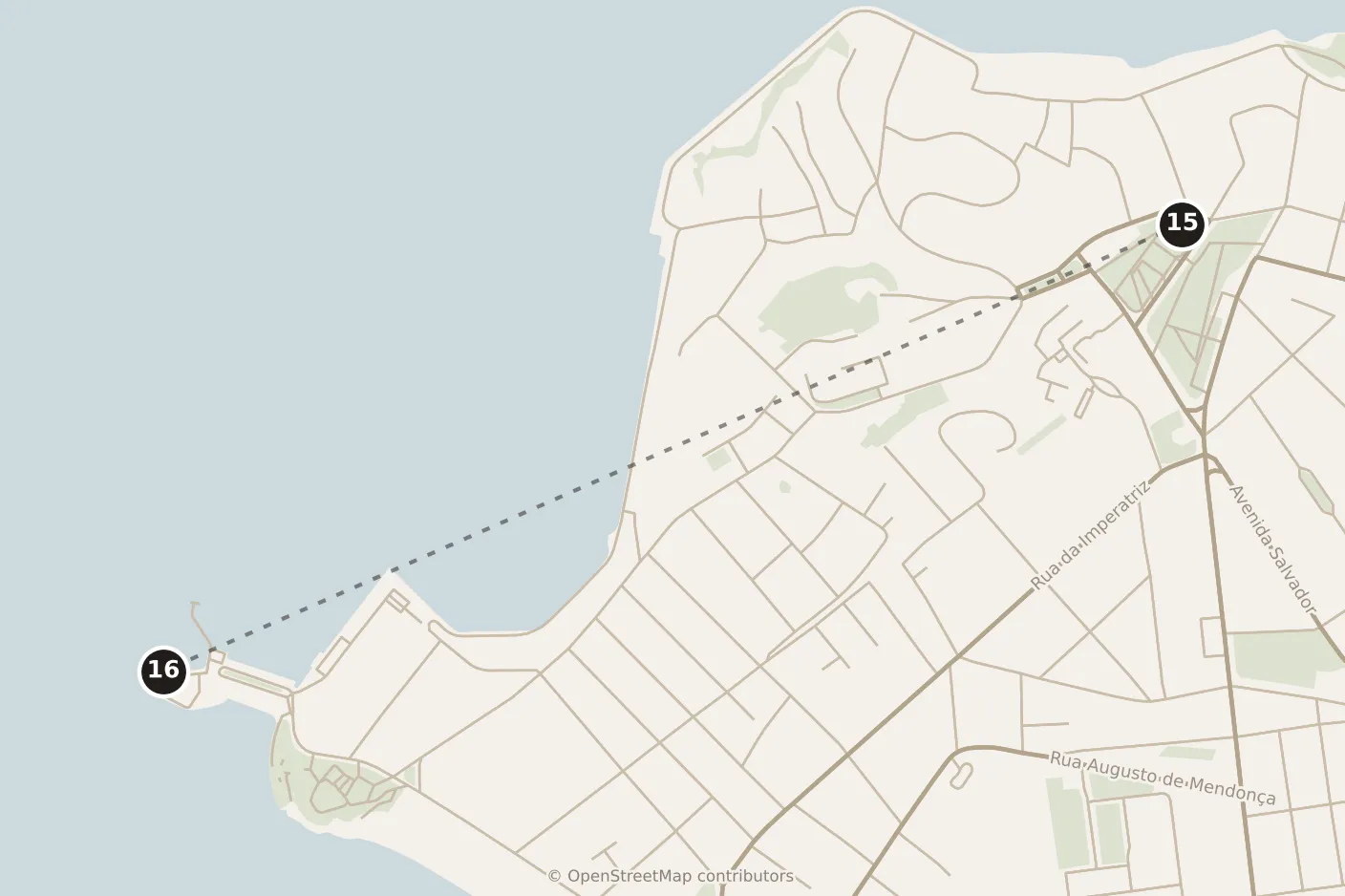
- Afternoon
- 15Igreja de Nosso Senhor do Bonfim
- Forte de Monte Serrat — in the prose, not on the map
- 16Ponta de Humaitá
Today is the other Salvador: the harbor, the market that feeds it, and the peninsula in the north where the city’s real devotion lives. It runs in one direction, south to north, and you never double back.
Morning
Start at Praça Castro Alves, the terrace at the top of Rua Chile where the Cidade Alta runs out and drops away to the port. Fifteen minutes for the view down over the roofs of the Cidade Baixa and the bay behind them — and for the fact that the carnival circuit through the center ends here, which explains the size of a square otherwise doing nothing. From Lapa, the end of Line 1, it is about a quarter of an hour on foot.
Seven minutes north, the Elevador Lacerda takes you down. Treat it as transport, because that is what it is: something like twenty-eight thousand people a day ride it between the two halves of the city, the fare is small change measured in centavos, and the trip takes thirty seconds. Ten minutes with the line.
At the bottom, four minutes along, is the Basílica de Nossa Senhora da Conceição da Praia, and it is the best thing in the lower city. Half an hour. The whole church was cut in Lioz limestone in Portugal, shipped across in numbered pieces and assembled here as a puzzle by Eugênio da Mota — begun in 1739, inaugurated in 1765, finished only in 1849. Look up: the ceiling of the nave is one enormous illusionistic painting, traditionally given to José Joaquim da Rocha, and it is the picture that taught Bahian painters to do that. The craft market in the old customs house five minutes along the quay — the Mercado Modelo — is deliberately not on this day. It is twenty minutes and a souvenir, and what follows is the market that actually supplies the city.
A car north takes ten to fifteen minutes to the Feira de São Joaquim, and this is the hinge of the day: come in the morning, not the afternoon. A market of this kind is a different place at ten and at three, and no amount of planning recovers the difference. Thirty-four thousand square meters of it, on the shore of the Baía de Todos os Santos, built after the market it replaced burned down in 1964. Clay alguidares and couscous pots stacked by the hundred, the produce of the Recôncavo brought across the water by sailing barge, whole aisles of Candomblé goods — beads, herbs, iron tools for the orixás. An hour and a half, because the aisles are the point and there are a great many of them, and lunch here afterwards; the food stalls are a genuine part of it. Two things to know before you walk in, because you will not guess them: this is a working market and not a display, so live animals are sold here and the ground is what a market floor is; and people here are at work, so photograph the goods freely and the stallholders only after asking. Carry nothing loose.
Afternoon
Another ten minutes by car north brings you to the Colina Sagrada and the Igreja de Nosso Senhor do Bonfim, begun in 1745 and finished, towers and all, by 1772. Give it an hour. Two things fill it. The first is the ribbons: the colored fitas have been made since the early nineteenth century — the tradition is credited to Manoel Antônio da Silva Servo in 1809 — and each is cut to the length of the right arm of the image inside. They are tied to the railings of the gates and the fences, three knots and a wish at each, and they are tied there and not to anything inside. You will also be offered one for your wrist at the gates: two turns and three knots, a wish at each, worn until it wears through. It is a real custom and a real trade at the same time — the ribbon is rarely the gift it is announced as, so agree what you are paying before it goes on, or say no thank you without breaking step. The second is the room of ex-votos: wax and carved wooden limbs, silver hands, photographs of the sick, left by people whose prayers were answered. That room is other people’s petitions and there are usually people praying in it, so keep your voice down and keep faces out of the camera. Understand also what you are standing in: this is a Catholic church, and for a great many of the people around you the figure on the altar is also Oxalá. Nobody will explain that to you and it is not a question to put to a stranger. One Thursday every January the steps are washed in procession — the Lavagem do Bonfim — which is a date rather than a weekly pattern, but it is not a day to arrive expecting a quiet church.
Local tip. What this day costs is car fares, and there are four of them if you take them all: two north, one at the end of the afternoon, and one short hop from the hill down to the point. Only that last one is optional — it is about twenty-five minutes on foot and downhill, and it is the single stretch of this day you would see at walking pace. Walk it if the heat allows and ride it if it does not; nothing else in the day changes either way.
The Forte de Monte Serrat sits at the tip of the peninsula: an irregular hexagon with round watchtowers at its corners, designed by the Florentine engineer Baccio da Filicaia, begun in the 1690s and not finished until 1742. Since 1993 it has held the Museu da Armaria, a small collection of guns and cannon. Beside it, on Ponta de Humaitá, is the point itself: a whitewashed church, a stretch of rock, and the whole city laid out across the water to the south — the bluff, the port, the cranes, and the towers of Barra at the far end of it. This is the one view that shows you what you have been walking on for two days. An hour and a quarter for the fort and the point together, and you will be here by about two.
Evening
You will be done here by about a quarter past three, which is early and deliberately so: this is the hottest hour of the day on an unshaded point with nothing to sit it out in, you are further from the center than at any other point in this itinerary, and this is not a district that fills up later. Order the car when you have had the view rather than waiting for the light; the drive back is half an hour. If you are eating acarajé on this trip, tonight is when to do it and Rio Vermelho is where the stalls are — but be clear that it is not on the way back from the peninsula. It is a separate leg of about half an hour in its own right, and that is the price of a day that ends where this one does.
With a third day

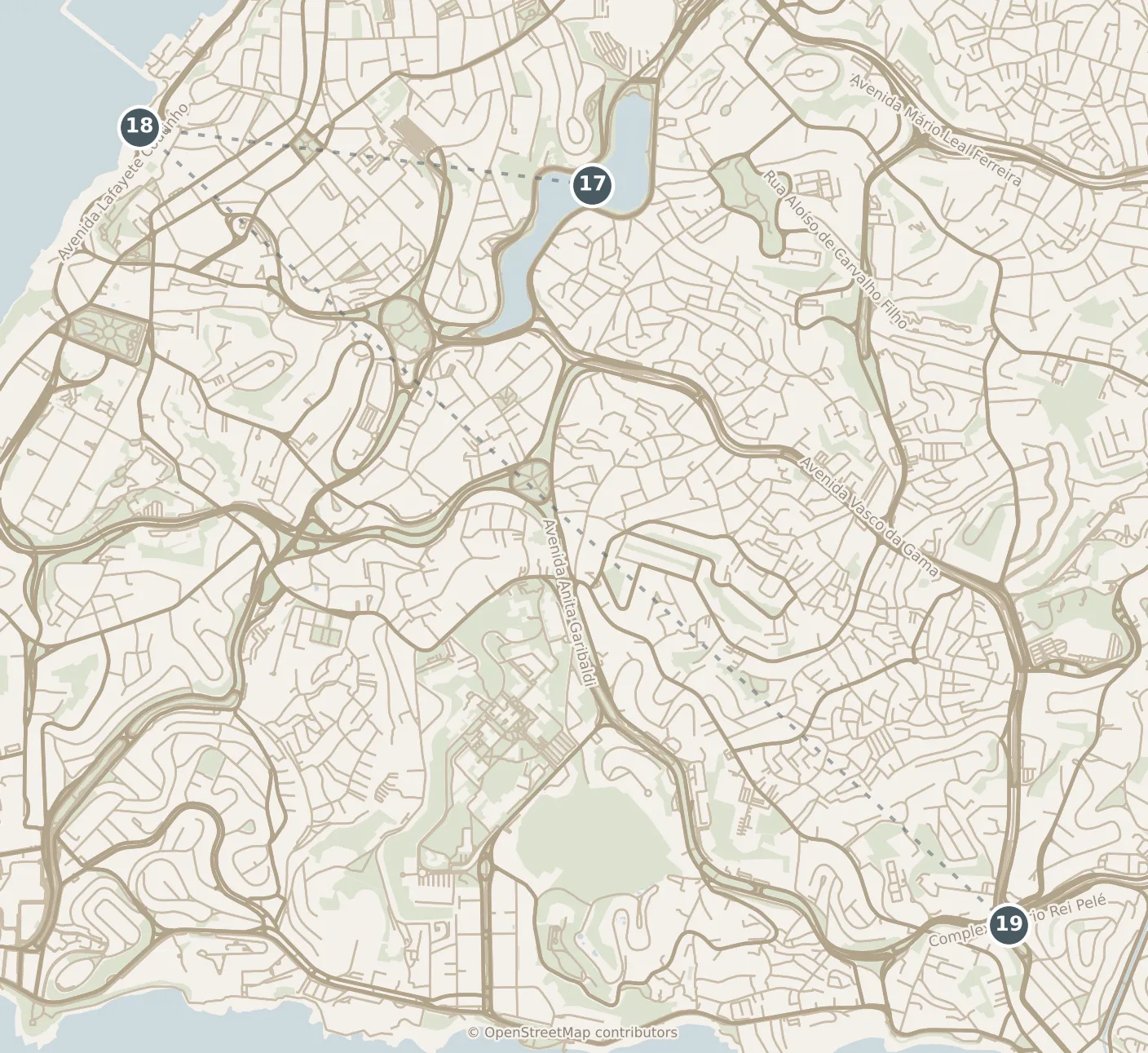
- With a third day
- 17Dique do Tororó
- 18Solar do Unhão
- 19Casa do Rio Vermelho
A third day adds the century the first two skip — the twentieth — and it goes in the middle rather than at the end. Three stops, about three and a quarter hours inside them and two car rides: it is the short day, deliberately.
The middle for one reason, and it is not variety for its own sake: the week. This is the only one of the three days that cannot take a Monday, while the Bonfim day can take anything at all, so the default order is old town, twentieth century, Bonfim — with the Bonfim day at the end, free to absorb whichever weekday is left over. It is also the shortest of the three and the least walked, which is what makes it the easiest one to move when the rules below say it has to. The rules at the foot of this page will move all three on some arrival days, and they are written by the day’s content for exactly that reason.
One thing moves when you insert it, and only one: this day also ends in Rio Vermelho. So give the acarajé evening to this day, where it costs nothing because you are already standing in the district, and let the Bonfim day end quietly near wherever you are sleeping instead of driving half an hour across the city for it. Two evenings in the same three streets is one evening wasted.
Start at the Dique do Tororó, thirteen minutes on foot from Campo da Pólvora station and the only natural water in the city. Standing in the lake in a ring are eight fibreglass figures of the orixás by Tatti Moreno, installed in 1998, each better than three meters tall on its plinth — Oxalá, Iemanjá, Oxum, Ogum, Oxóssi, Xangô, Iansã and Nanã, eight of the same company you met carved in cedar on day one, here standing in open water in the middle of a ring road with the Arena Fonte Nova behind them. Forty-five minutes. It is the most matter-of-fact statement this city makes about itself.
Ten minutes by car — it is downhill under the bluff and not a walk — is the Solar do Unhão, and it is the best hour and a half of the three days for anyone who likes buildings. Benedictine land from 1584, a great estate house by 1700, eighteenth-century Portuguese tile panels and a fountain in the yard, a chapel first recorded in 1740; and then in 1962 Lina Bo Bardi was given it and turned it into the Museu de Arte Moderna da Bahia in under a year, keeping the sugar machinery where it stood and threading a spiral staircase of wood through the old hall. The museum opened here in 1969. Outdoors, on the rocks at the water’s edge, is the sculpture park, open since 1998, where you sit at sea level with the bay in front of you and nothing sold to you.
Local tip. The writer’s house that ends this day comes last on purpose. It is a fixed hour whatever you do, while the museum on the bay you are standing in now is however long you want it to be. So any slack this day turns out to have belongs to this museum, and any shortfall comes off it — never off the writer’s house, which you cannot usefully do in half the time.
Fifteen to twenty minutes east by car is the Casa do Rio Vermelho, the house where Jorge Amado and Zélia Gattai lived until it was closed in 2003, opened to the public as a museum in 2014. An hour. It is a writer’s house rather than a shrine: the rooms as they were, the kitchen, the objects, the recorded voices; and in the garden, under a tree, the ashes of both of them. Then walk out into the district for the evening, which is what this day was for.
Practicalities
None of the stops here is booked before you travel, which for a three-day trip is worth saying straight out. Every door on these days is walk-up. The only ticket worth putting a number to is the writer’s house in Rio Vermelho, which was in the ten-to-twenty-five-real range in 2026 depending on who you are, with one free day midweek that the house publishes itself; the modern-art museum on the bay charged nothing to walk in, and the old-town interiors are the small walk-up tickets a church charges, bought at the door. Bring cash for the market and the stalls.
The one hour these days rest on is the opening of the museum on Terreiro de Jesus, because day one is counted from it: it admitted nobody before nine in 2026, and closed again for an hour in the middle of the day. If you find a different hour, build day one back from the new one and everything after it slides; the day’s shape does not depend on the number, only on the museum going first. It belongs to the federal university rather than to the city, and the university’s own museum page and account are what carry its hours — the tourist listings disagree with one another about this one stop, which is the reason to go to the source. The other opening worth checking is the modern-art museum on the bay: the listings disagree about whether it opens in the morning at all, and the third day above puts you at its door before ten. If it turns out to be an afternoon opening on your date, start that day late — the lake is the one stop on it that does not care what hour you see it — and it still ends in Rio Vermelho for the evening.
The days of the week, written as rules rather than as an answer. Name the days by what they contain, not by their number, because the third day above goes in the middle and the numbering shifts.
- The old-town day wants a weekday. Its museum keeps university hours, and it was the weekend that was the risk in 2026, not the Monday. Check that one thing the week before. If it is shut on your day the morning still stands — the square, the cathedral, the Pelourinho and the church at the foot of it — and the two hours it frees go to the rest of the spine: a longer look at the Carmelite church up the hill, which rewards one, and an evening on Rua Direita that begins two hours earlier than it otherwise would. Neither moves when the third day is inserted, so this remedy holds in either arrangement.
- The twentieth-century day cannot be a Monday — that is the third day above, the one with the lake, the house on the shore and the writer’s house, and it is called that here because it is the only one of the three that is not about the colonial city. The writer’s house in Rio Vermelho ran Tuesday to Sunday in 2026 and the modern-art museum on the bay is the same kind of institution, so a Monday costs you both of the day’s interiors and leaves you the lake and the sculpture terrace. If a Monday is unavoidable, give the Monday to the Bonfim day.
- The Bonfim day takes any day, which is what makes it the one to hand your awkward weekday to. Its one qualification is Sunday: both churches on it give their Sunday mornings to their own congregations rather than to visitors, and the market the morning ends at keeps its shortest hours then — the listings disagree about how short, which is itself the reason to check before you put the day on a Sunday. Of the two weekend days a Saturday is much the better for it.
- Which may trade places: the old-town day and the twentieth-century day swap freely, as long as the first keeps off the weekend and the second off the Monday. The Bonfim day goes wherever is left.
- Two days of the week matter without closing anything, and they belong here so that the list above is complete. Tuesday is the evening of the sung mass at the church at the foot of the Pelourinho, which is a reason to want the old-town day on a Tuesday rather than a reason to avoid one. And one Thursday every January is the washing of the steps at Bonfim — a fixed date rather than a weekly pattern, so it cannot be planned around by choosing a weekday; look up the date if your trip falls in January.
- The arrival that quietly breaks this is a Saturday. With only two days, Saturday and Sunday leave the old-town day no weekday at all, and the cost is two things rather than one: take the old town on the Saturday and plan the morning without its museum from the start rather than discovering it at the door, and that puts the Bonfim day on the Sunday, when its churches belong to their congregations in the morning and its market keeps its shortest hours.
- Three days from a Saturday force a choice rather than resolving one. Bonfim on the Saturday and the twentieth-century day on the Sunday leave only the Monday for the old town, which is the day the bag rule below tells you not to end on. So either take the old town on the Saturday and accept the weekend risk to its museum, or leave your bag somewhere before you go up the hill. There is no order that avoids both.
One week of the year overrides all of this. During Carnival, and on the weekends immediately before it, the circuit through the center ends at the square the Bonfim day starts from and a second circuit runs through the Pelourinho itself: the old-town day does not exist in the form written here, and the museums and church interiors keep holiday hours or none. Carnival moves with the calendar each year, so check the dates before you book rather than after.
If it rains. Rain barely touches the old-town day, which is interiors two hundred meters apart. It ruins the Bonfim day: an open market on an open floor, a hill of steps, and a rock point with no shelter. With three days, pull the twentieth-century day’s interiors onto the wet morning: from wherever you are staying, a car to the Solar do Unhão on the shore below the bluff gives you an hour and a half indoors, and a second car carries you on to the house in Rio Vermelho for another hour — that is that day’s interior half, brought forward whole. What it displaces is the Dique, which is its open-air part and the one thing best kept for the fine day you have just been handed. With only two days there is nothing to bring forward: take the old town on the wet day and the hill on the dry one — unless you are carrying your bag, when the order is forced anyway and the old town goes first whatever the sky is doing. If both are wet, the market and both churches are roofed — it is the steps outside and the point at the end that are not.
If you are short, here is what goes first, in order. On day one, the fort at Santo Antônio: it is a courtyard and a set of teaching rooms rather than a collection, the value at that end of the old town is the street rather than the building, and cutting it saves the forty minutes plus most of the walking, because you turn round on Rua Direita instead of going to the end of it — the best part of an hour and a quarter. On the Bonfim day, Ponta de Humaitá goes first: not because you will have seen the view already, you will not, but because the hill is why you came north and the point is a view rather than a place, so it is the hour on that day you will miss least. On the twentieth-century day, the Dique goes first — it is forty-five minutes and it is outdoors, so it is the cheapest thing on the route to lose.
The bag. There is no station left-luggage office in the historic center — the city’s are at the airport and at the bus station, and neither is anywhere near any of these three days. A handful of commercial bag-drop points do operate in and around the Pelourinho, bookable online by the day, so check one is open on your date rather than assuming it either way. If you end up carrying the bag, the consequence is about order: do not put the old-town day last. It ends at the far north end of the upper town, a long way from any station, on the cobbled ramps that are the worst surface in the city for a wheeled case. The default order above already satisfies that, and it is the one place the default is worth overriding: if your last day is also your traveling day, move the twentieth-century day to the end — unless that last day is a Monday, when it has nothing open — because it finishes in Rio Vermelho, which is on the airport side of the city rather than the wrong side of it, and leaving from there is a car ride out along the coast road. Move the acarajé evening with it — the rule was that it belongs to whichever day ends in Rio Vermelho, and that is still this one. The Bonfim day then sits in the middle, which is exactly where it is happiest, since it is the day that takes any weekday. Two days and no third leaves you nothing to move, because the order is forced and the Bonfim day ends eight kilometers north of everything: if that second day is also your traveling day, cut Ponta de Humaitá — it is the stop this article would drop first anyway — and come back from the hill at Bonfim, which is an hour saved and a slightly shorter run to the airport road. The same logic runs backwards on the first morning: arriving with a case, take the metrô to Campo da Pólvora and then a car for the last fourteen minutes uphill rather than walking them. Leaving from the old town instead, it is the arrival chain reversed — Campo da Pólvora, Line 1 to Acesso Norte, Line 2 to Aeroporto, and the shuttle at the end of it.
Moving between the stops this article names. Day one is entirely on foot once you are up in the old town, and the longest single leg on it is the seventeen minutes from the Largo do Carmo out to the fort. Day two is a walk down to the water, then two car rides of ten to fifteen minutes each, a short hop from the hill to the point that you can walk instead, and a ride of about half an hour back at the end; none of the three unavoidable ones is on the metrô and none is walkable. The third day is two car rides. The metrô touches this itinerary only at its edges — Campo da Pólvora at the start of day one and of the twentieth-century day, Lapa at the start of the Bonfim day — and that is the whole of its usefulness here.


.jpg)

.jpg)