Rio de Janeiro in two or three days: the statue, the tram up to Santa Teresa, and Sugarloaf at dusk

Last updated 8 August 2026
Overview
Rio is not a hard city to see in two days. It is an easy one to spend in a car. The four things everyone arrives wanting — the statue on the ridge, the rock at the mouth of the bay, the ocean beaches, the old commercial town behind them — sit on four different sides of a mountain range, and the roads between them squeeze through a handful of tunnels. Plan by sight and you spend the trip in traffic. Plan by slope and each day has one hill on it and runs downwards from there.
So day one is the inland ridge, top to bottom: the cog railway up to Christ the Redeemer in the morning, and then the same hillside lower down, where a tram climbs into Santa Teresa and a street of painted steps drops you at the arches in Lapa. Day two is the flat and the water: the old center on foot, the sea in the middle of the afternoon, and the cable car at dusk.
The two summits are on separate days on purpose. Corcovado and Sugarloaf are both worth nothing in cloud, and a day built to take in both means one gray morning costs you the pair of them. Split across two days you get two throws, and if the first is a write-off the second is still there.
What two days does not contain is a beach day, and that is exactly what a third buys. It goes in the middle rather than at the end, for reasons set out below.
The sun sets here between about a quarter past five at the end of May and about a quarter to seven in the first week of January. That is a band of an hour and a half across the entire year, which is almost nothing — a northern European city swings four or five — so light is not what shapes a day in Rio, and you can plan an evening in June much as you plan one in December. Heat is what shapes it, and from December to March the afternoon storm is: the rain here tends to arrive late in the day, heavy and short. Day two puts the walking in the morning, which is the sheltered half of it, and the sand and the cable car in the afternoon and the evening, which are not. Day one runs the other way — the mountain first, then the walk down off Santa Teresa through the middle of the afternoon — so neither day is safe from a storm, and what each stands to lose is different: on day one it is the descent, because two hundred and fifteen glazed tiled steps are not something to go down in heavy rain, and on day two it is the swimming and the rock. What to do about that is in Practicalities, along with what moving a day costs.
There is one thing on these days that must be bought before you travel, and it is the ticket for the railway up Corcovado. It is a dated, timed slot, it includes entry to the monument at the top, and it was in the hundred-and-twenty to hundred-and-fifty-real range in 2026. It is sold on the railway’s own site and at the station in Cosme Velho, and only one of those two involves finding out on the morning that the slot you wanted has gone. Know before you buy what the slot costs to move, because the shape of these two days depends on being able to swap them for the weather: the railway will rebook a ticket and will not refund one, and it charges a tenth of the fare to move it more than a day ahead and three tenths inside twenty-four hours or after the train you did not take. The only other thing anyone arranges in advance here is the guided visit to the inside of the Theatro Municipal on day two, which this route treats as optional. Everything else is walk-up or free, and the third day adds nothing at all. What the route does need working before you set out is a ride-hailing app with a payment method already attached: these days contain five car rides, all of them on days one and two. Three are because no metro line reaches either Cosme Velho or Urca — up into the valley, back out of it, and round the headland to the foot of Sugarloaf — and two are the ways home after dark, out of Lapa when the first evening ends and out of Urca when the second does. How you pay for the metro itself, and everything else about arriving, is the city guide’s.
Almost everyone lands at Galeão, out on its island in the bay, and rides forty minutes to an hour into the Zona Sul; Santos Dumont sits on the water beside Centro and is mostly domestic. Day one then begins at Cosme Velho, which the metro does not reach. From Ipanema or Copacabana, take Line 1 north to Largo do Machado and a car up Rua Cosme Velho from there — about ten minutes — or one car the whole way if there are three of you and the fare splits.
One thing decides the order before you read the days: day two is a weekday. The library at its heart shuts on weekends, and so, in effect, does the district around it. The full set of rules, including what to do if your two days are a Saturday and a Sunday, is in Practicalities.
Day one

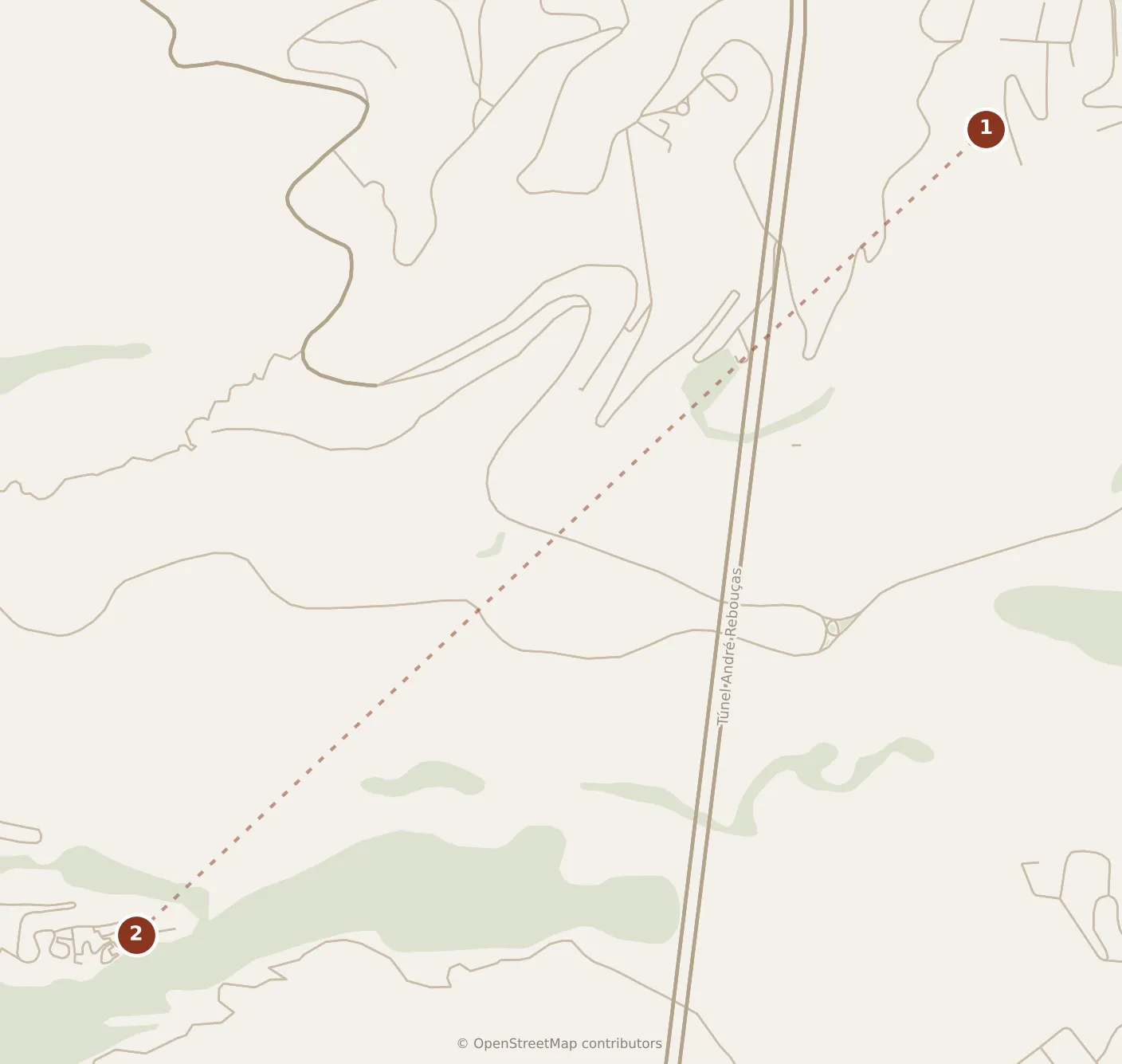
- Morning
- 1Cosme Velho
- 2Christ the Redeemer
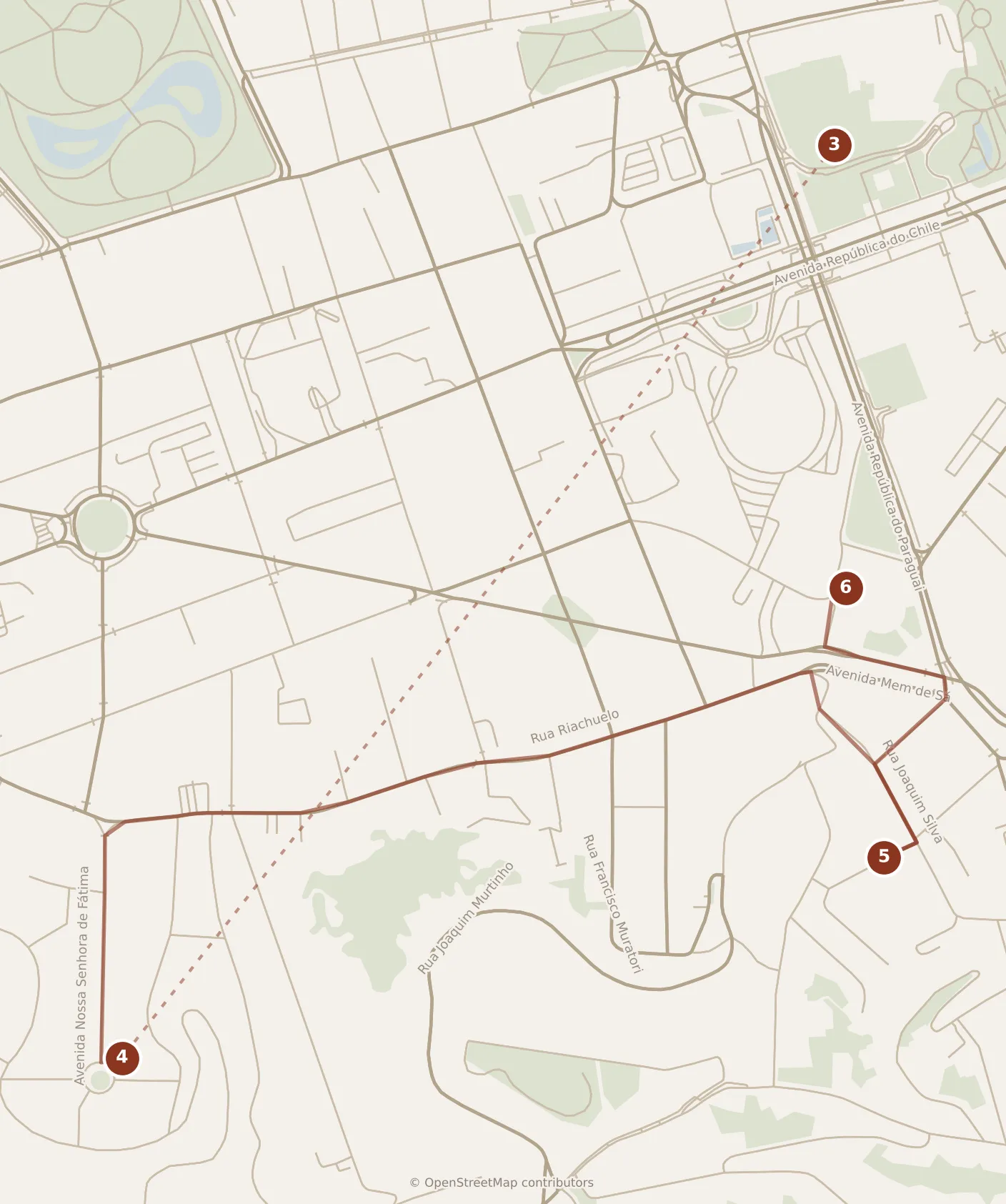
- Afternoon and evening
- 3Carioca
- 4Santa Teresa
- Parque das Ruínas — in the prose, not on the map
- 5Escadaria Selarón
- 6Arcos da Lapa
Everything today happens on one slope, and the day comes down it. You start at seven hundred meters and finish under a floodlit aqueduct at sea level, and apart from one ride out of the valley you never cross the city.
Morning
The railway leaves from Rua Cosme Velho, in a narrow green valley behind Laranjeiras that feels nothing like the rest of the Zona Sul. It is a rack railway, opened by the emperor Pedro II on 9 October 1884, three and four fifths of a kilometer long, climbing at up to thirty per cent, and electrified in 1910 — the first electrified line in Brazil. The ride takes about twenty minutes each way and runs the whole distance inside Tijuca National Park, which is rainforest rather than parkland: the carriages tilt, the light goes green, and the city disappears entirely for a quarter of an hour.
Take the earliest slot you can get, and take it for the cloud rather than for the time. The peak clears more often early than late, and a ticket is dated and timed, so this is a decision you make days in advance. You can undo it, but not for nothing: the slot can be rebooked and never refunded, at a tenth of the fare if you move it more than a day ahead and three tenths inside twenty-four hours or after the train has gone.
At the top, Christ the Redeemer is thirty meters of reinforced concrete faced in soapstone, standing on an eight-meter pedestal with its arms twenty-eight meters apart. It was built between 1922 and 1931 and dedicated on 12 October 1931; Paul Landowski modeled it in France in pieces, Gheorghe Leonida made the face, and Heitor da Silva Costa worked out how to stand it on a mountain. Escalators and elevators were installed in 2003, so the last flights of steps are optional, and you should take the machines and save your legs for the afternoon.
What you actually do up here is walk the terraces below the statue, which is a working Catholic sanctuary as well as a viewing platform and is treated as one. The view divides cleanly in two: turn one way for the ocean beaches and the lagoon, the other for the bay, its ships and the bare cone of Sugarloaf, which is where tomorrow ends. Give the top an hour and a quarter. The thing nobody tells you is that you cannot photograph the statue and the view in the same frame — they face opposite ways — and most people spend twenty minutes discovering it.
Local tip. If you can see from the street that the peak is capped in cloud, do not spend the morning hoping. These two days are interchangeable: run day two today and take the mountain on your other morning. Two things bear on the swap, and both are in Practicalities: the day of the week, which can make it impossible altogether, and the railway’s rebooking fee, which is three tenths of the fare from the evening before onwards, since the slot is a morning one. Only a forecast that reaches you more than a day ahead buys the swap at a tenth.
Afternoon
Come back down and get out of the valley by metro rather than by road. A car to Largo do Machado takes about ten minutes; from there it is four stops north on Line 1 — Catete, Glória, Cinelândia, Carioca — and the whole transfer runs to something under half an hour. Doing it in one taxi is the obvious move and the wrong one, because the traffic into Centro is precisely what this itinerary is built to stay out of.
Come up at Carioca and walk a couple of minutes to the tram terminal on Rua Lélio Gama, off Largo da Carioca. The tram — the bonde — is a genuine survivor rather than a heritage re-creation: open-sided wooden cars on an odd eleven-hundred-millimetre gauge — a width set by the eighteenth-century aqueduct they cross on the way out of Centro — before climbing into the hill in a series of switchbacks with the conductor hanging off the side. It stopped after a fatal accident in 2011 and came back on 27 July 2015.
This is the one thing on day one that has a last departure, but it is not the thing that shapes the day — daylight on the tiled steps below is, and that comes hours earlier. In 2026 the tram ran from eight in the morning until half past six on weekdays, and from nine until five at weekends, and a day that starts when the light demands boards it in the early afternoon either way. If you find a different hour, the method is unchanged: the tram goes before the walk down, never after, because everything below it is downhill and on foot and the tram is the only part that can shut.
Ride to Largo dos Guimarães, the small square that works as Santa Teresa’s center. The neighborhood is a hill of cobbled lanes and nineteenth-century houses that went bohemian when the rest of the city went to the beach, and it is where lunch is — an hour, sitting down, because you have just come off a mountain and the afternoon from here is entirely downhill.
About a quarter of an hour down the lane, Parque das Ruínas is the shell of a mansion built for Laurinda Santos Lobo between 1898 and 1902, whose salon was the room artists and politicians came to before she died in 1946 and the house fell in. It was opened as a public park in 1997 with steel stairs and walkways threaded up through the brickwork, so you climb inside a ruin with nothing between you and the sky, and the terrace at the top looks straight down onto Centro on one side and out to the bay on the other. Half an hour. It was renamed after the journalist Glória Maria in 2023 and almost nobody calls it that.
Ten minutes further down and you are at the top of the Escadaria Selarón, which runs between Santa Teresa and Lapa. Jorge Selarón, a Chilean who lived beside them, began covering the steps in tiles in 1990 and did not stop: two hundred and fifteen steps, a hundred and twenty-five meters of them, more than two thousand tiles sent from over sixty countries by people who had walked up. He was found dead on his own staircase on 10 January 2013. Coming down them is much better than going up, which is the argument for doing Santa Teresa in this direction and not the other. Twenty minutes, and do it in daylight — this is the moment of the day that will not wait.
Count it backwards from there. The hour over lunch, the quarter of an hour down to the ruin, the half hour in it, the ten minutes on from it and the twenty on the staircase come to two and a quarter hours from stepping off the tram. The morning — the ride up, the hour and a quarter at the top, the ride down — is a little under two hours from the platform at Cosme Velho back to it, and the transfer into Centro is another half. That is four and three quarter hours, and the tram ride itself is on top of it: call it five hours from the first train to the bottom of the steps. You want the steps in daylight, so six hours before sunset is the latest this day can start. The earliest slot the railway sells is at eight, a long way before that, and taking it puts you at the bottom of the steps in the early afternoon — hours before the arches are worth seeing lit. That gap is not a fault in the day, but it does need saying: it is the long lunch in Santa Teresa, and then it is the room. Cinelândia is a short walk from the arches, so Line 1 does both the going back and the coming out again for the price of two fares, and adds no fourth car ride to a day that already has three. Make that second walk while Lapa is filling rather than after it has emptied: the walk the evening below rules out is the one at the end of the night, and the third car is what replaces it. What the five hours does not model is the line at the top of the mountain, which is the one place on day one where you wait.
Evening
Five minutes from the foot of the steps, the Arcos da Lapa closes the day — but it closes it after dark, which is why the afternoon above ends in the room and not here. It is an aqueduct, begun in 1718 and finished in 1750 to carry the water of the Carioca river down into the city; forty-two arches in two tiers, two hundred and seventy meters across the valley floor, and the tram you rode this afternoon has been crossing the top of it since 1896. It is floodlit after dark and the whole of Lapa arranges itself underneath.
This is the nightlife district — samba and forró rather than anything you need a table booked for — and it is a Friday and Saturday thing above all; on a Tuesday the arches are lit and the streets are quiet. A caipirinha here is made in front of you at a sidewalk counter, which is the version worth having. One piece of local practice: when the evening ends, take a car from the arches, whichever way you are going and however short the walk looks. Not the hill you came down, and not the walk to the station either: at that hour you leave Lapa in a car, and the ride costs almost nothing.
Day two

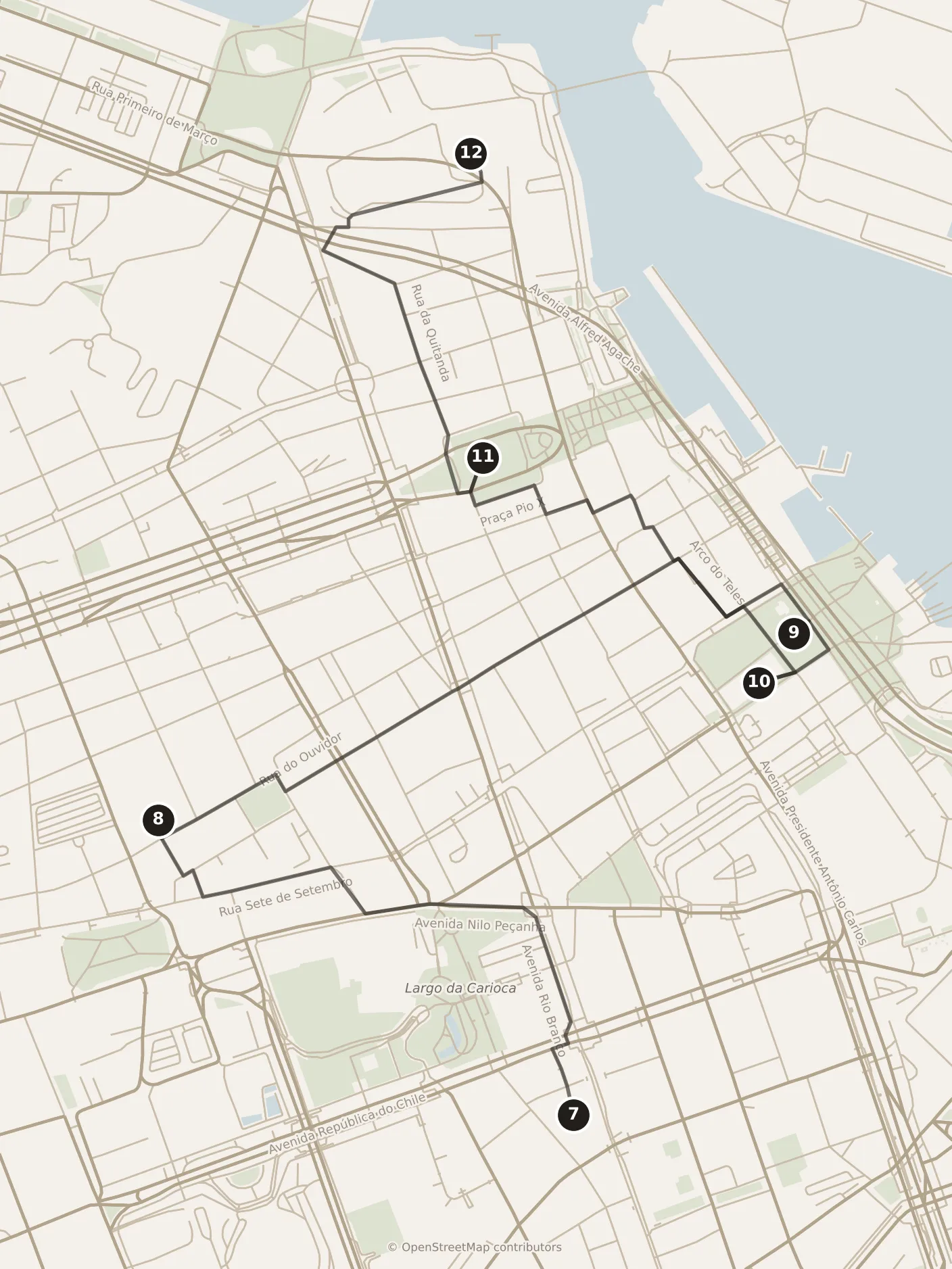
- Morning
- 7Theatro Municipal
- 8Real Gabinete Português de Leitura
- 9Praça XV de Novembro
- 10Paço Imperial
- 11Igreja da Candelária
- 12Mosteiro de São Bento
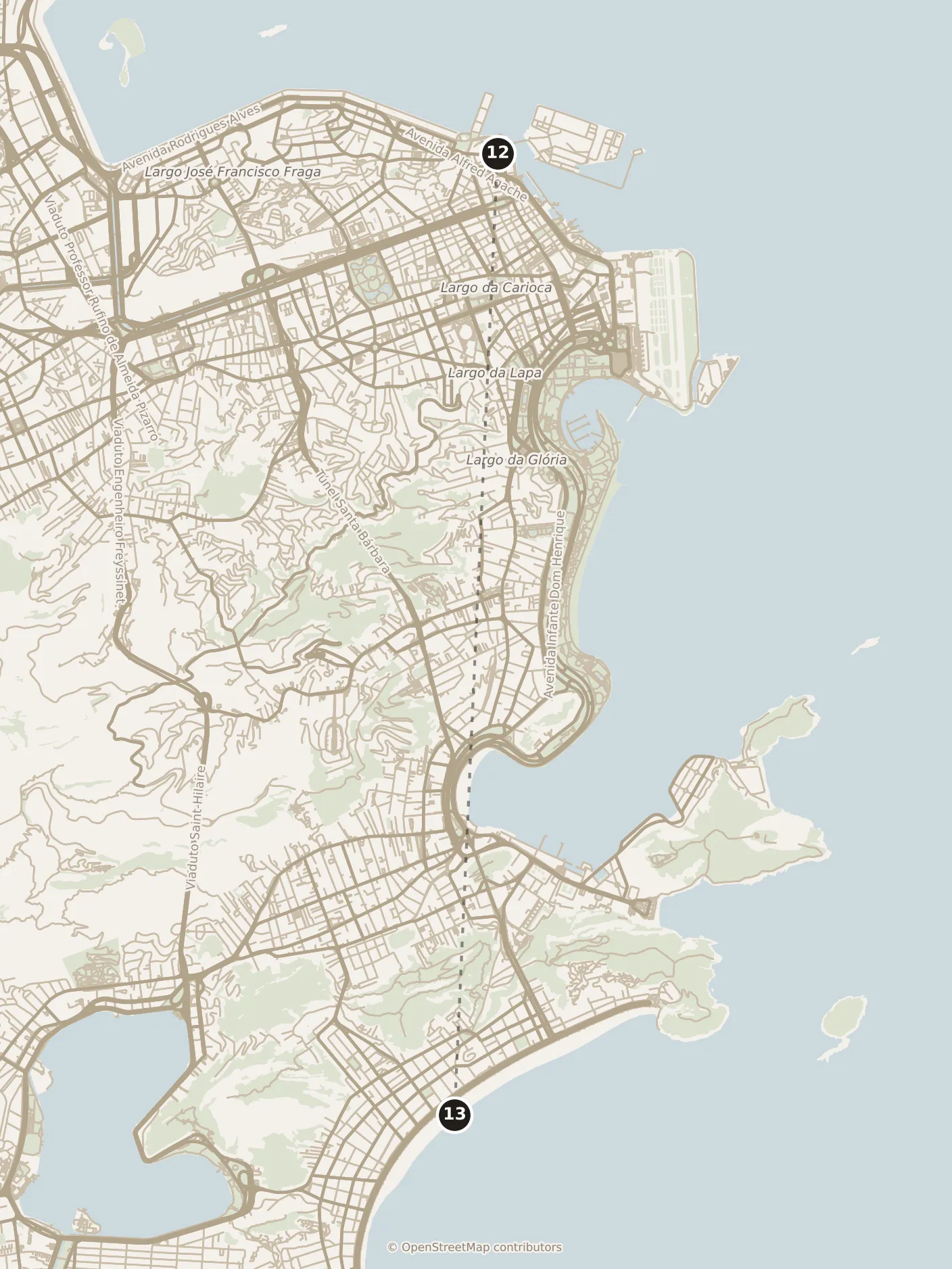
The leg out of the center: from stop 12 by metro, not on foot.
- Afternoon
- 13Copacabana Beach
- Evening
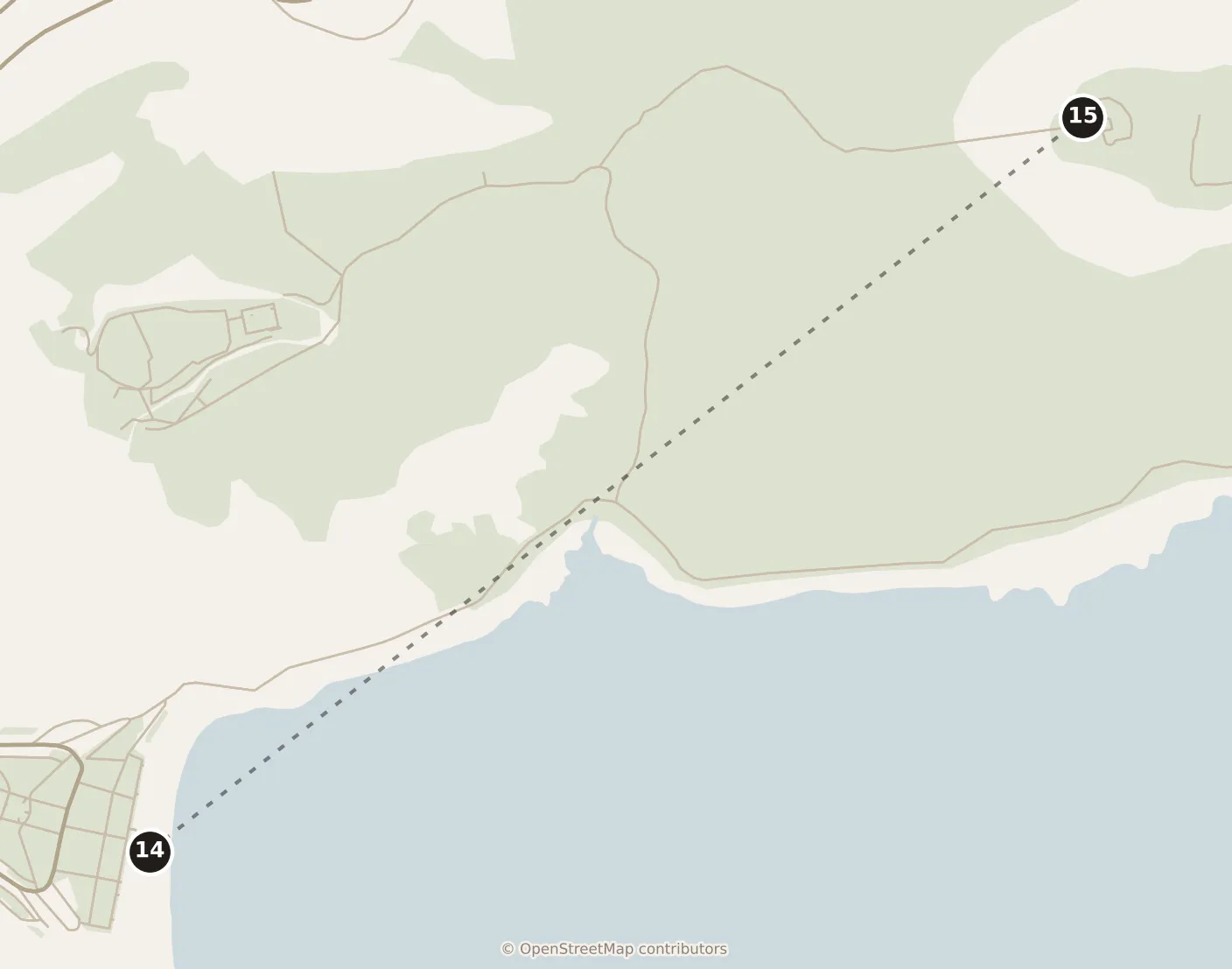
- 14Praia Vermelha
- 15Sugarloaf Mountain
Today is the day that has to be a weekday, and it is flat almost all the way. The morning walks four and three quarter kilometers north through the old commercial city, ending at a Benedictine church on a rise; the afternoon is the sea; the evening is a cable car. The only real climb is the last four hundred meters, up the side of a rock, and something else does it for you.
Morning
Line 1 to Cinelândia. You come up in Praça Floriano, an oddly Parisian square of black and white pavement with the Theatro Municipal standing on it: begun in 1905, opened on 14 July 1909 by president Nilo Peçanha, and modeled quite openly on Garnier’s opera house in Paris, down to the gilded eagles on the dome. The outside walls carry the names of European and Brazilian artists cut into the stone, which is the part worth twenty minutes and costs nothing; going inside means either a performance or the theater’s own guided visit, which the theater publishes and sells itself — the one optional booking on this trip, and worth making before you travel if the interior is why you came.
A quarter of an hour north-west, through the lanes west of Avenida Rio Branco, is the Real Gabinete Português de Leitura, and it is the reason day two is a weekday: in 2026 it opened at ten and closed at five, Monday to Friday. Build the morning from that and the rest falls into place — the theater first because it is outdoors and open whatever the hour, the library second because it is the one door on this day that shuts. Half past nine on the square puts you at the library at about five past ten, which is what a ten o’clock opening asks for. If you find a different hour, the order is unchanged: the library goes early, because everything after it is either a church or a beach. Founded in 1837 by Portuguese immigrants, the building went up between 1880 and 1887 to Rafael da Silva e Castro’s design, in a neo-Manueline style that imitates the great age of Portuguese navigation in carved limestone; Pedro II laid the first stone and his daughter Isabel opened it. Inside is one room: three galleries of dark wooden shelving rising to an iron-framed skylight, a chandelier hanging into the middle of it, and around three hundred and fifty thousand volumes, the largest collection of Portuguese works outside Portugal. It is a working library and you are a visitor in it, so half an hour is both enough and about as long as is decent.
Twenty minutes east brings you out on Praça XV de Novembro, on the water. The long low white building along one side is the Paço Imperial, put up in 1743 as the governors’ house and then occupied in turn by viceroys, by the Portuguese court when João VI moved it here, and by two Brazilian emperors. Two things happened inside it that the country dates itself by: the Dia do Fico on 9 January 1822, when the prince regent — the future first emperor — announced he was staying rather than sailing home, and the signing of the Lei Áurea on 13 May 1888, which ended slavery in Brazil — the last country in the Americas to do it. It is a cultural center now with changing exhibitions, and the honest advice is to walk through the first floor and the courtyard whatever is on, because the building is the exhibit.
Behind the square, through the Arco do Teles, the Travessa do Comércio is a single narrow eighteenth-century lane of shuttered houses and lanterns that survived the flattening of colonial Rio. It is where lunch is: an hour and a half here covers the square, the palace, the lane and the meal, and it is the only sitting-down the morning gets.
Ten minutes north-west, marooned on its own island of traffic, stands the Igreja da Candelária, and what to find here is on the sidewalk outside rather than under the dome. On 23 July 1993 eight homeless young people sleeping in front of the church were shot dead by off-duty police; six of them were children, the youngest eleven, and the massacre took the church’s name. The memorial is set into the paving, and you look for it before you go in rather than after. Inside, the church began as a chapel around 1609, put up by a Portuguese couple whose ship of that name had nearly gone down in a storm; the present building was started in 1775 to Francisco João Roscio’s design, and the dome — white Lioz stone cut in Lisbon and shipped over — was the tallest thing in Rio when it was finished in 1877. Twenty minutes inside.
Eight minutes further north and up a short rise stands the Mosteiro de São Bento, and it is the best interior in the city. The church was begun in 1633 and largely done by 1671; every surface inside is lined with gilded woodcarving, running from late-seventeenth-century baroque at one end of the room to mid-eighteenth-century rococo at the other, with the statues of São Bento and Santa Escolástica by Frei Domingos da Conceição. It is dark until your eyes adjust and then it is overwhelming. Half an hour.
This is a working Benedictine monastery and not a museum, and it enforces one thing a visitor cannot guess: proper dress to go into the church. Shorts, vests and beachwear will stop you at the door, so whatever the rest of your day holds, keep the swimming things in a bag until the monastery is behind you. The monks’ enclosure is not open at all, and the famous sung Mass with organ and Gregorian chant is on Sunday morning, which is the one day this itinerary cannot give you. That is a real collision and not an oversight: the library is Monday to Friday and the chant is Sunday, and there is no arrangement that has both on the same trip of two days. The trade is straightforward — the church itself is open every day and the carving does not change, so take the library on your weekday and hear the chant only if your trip contains a Sunday you were going to spend on the sand.
From the monastery it is about fifteen minutes on foot back to Uruguaiana, and then eight stops south on Line 1 to Cardeal Arcoverde.
Afternoon
Cardeal Arcoverde puts you at the quieter northern end of Copacabana Beach, which is the end to arrive at: the crowd thickens as you walk south and you are walking with it rather than against it. The beach is four kilometers of sand between two forts, and the numbered lifeguard posts along it work as addresses rather than as distances: the company changes every few hundred meters, and Rio reads the difference the way other cities read a postcode.
This afternoon is a swim and a lie-down and not a walk; the walk is the third day. Two things are worth knowing before you go in. The first is that this is open Atlantic and not a bay: the shore break lands hard and close in, and the water shelves quickly, so swim in front of a manned post rather than between them and take the flags flown on it at face value — the lifeguards here are the ones who close the water and they are not being cautious for the sake of it. The second is that you should carry to the sand only what you would be relaxed about losing, which in practice means a little cash and nothing else; the guide to the city covers why. Some of that cash is for a chair and an umbrella, which is how people sit on a beach here — you take them from the barraca whose patch you are on, and the same people bring you what you drink where you are sitting. There is no shade on this sand otherwise.
Give it a little under two to three and a half hours, and which end of that you get depends on the month rather than on you. The arithmetic is at the end of today, under the cable car.
Evening
A car round the back of the hill to Praia Vermelha in Urca, at the foot of the two rocks — no rail reaches it, which is equally true of the ride you will take back out of here in the dark. Praia Vermelha is a short curve of coarse sand facing back into the mouth of the bay, hemmed by granite, and the cable-car station stands at the end of it.
The cable car climbs in two hops: the first onto the broad flat top of Morro da Urca, the second out along fourteen hundred meters of span to the summit of Sugarloaf Mountain, three hundred and ninety-six meters above the water. Cars leave every twenty minutes and each hop takes about three. Most people spread out and stay on the lower rock, which has room and a bar; the upper one is smaller, more exposed and the reason you came. Notice which way you are facing when you get there: from this rock the sun goes down inland, behind the city and behind Corcovado, and not into any sea. The last car back down is a number the cable car publishes itself and the one worth looking up on the day, because it is what decides how long you may stay once it is dark.
This is the stop the day is built around, so count backwards. The morning is a shade over three hours inside places and about fifty minutes walking between them — four hours from the square to the monastery door. Getting from there to the sand is another half: fifteen minutes back to Uruguaiana and eight stops on Line 1. You want to be standing at Praia Vermelha with an hour of daylight left, and the car round from Copacabana takes about twenty minutes. Start at half past nine and the sand gets a shade under two hours at the end of May, when the sun goes at about a quarter past five, and nearly three and a half in January, when it does not go until nearly seven. The beach is the only variable; nothing above it moves. Call it six and three quarter hours in winter and eight and a quarter in high summer, from Praça Floriano to the cable-car station.
What that count measures is the time you spend inside places and walking between them. It does not measure the wait to board at Praia Vermelha, and at this hour there is one, because everyone has had the same idea about the light. Nor does it measure the tunnels between Copacabana and Urca, which on a bad afternoon are the reason to leave the sand earlier than you want to.
Local tip. Do not spend the hour up here waiting for the sun, for the reason the paragraph above gives: it sets inland from this rock. Spend it choosing which of the two stages to be on when the light goes, and choose the upper one — then stay past dark for the thing the ride is really for, which is the whole of the Zona Sul coming on while the bay stays black, and ride down through it. The third day has the other sunset, from a rock at the far end of the beaches — and that one does not go into the sea either; it drops behind the mountains at the end of Ipanema. What it has instead is the whole run of sand in front of it and the crowd on the rock, which is a different thing to be in the middle of.
With a third day

- With a third day
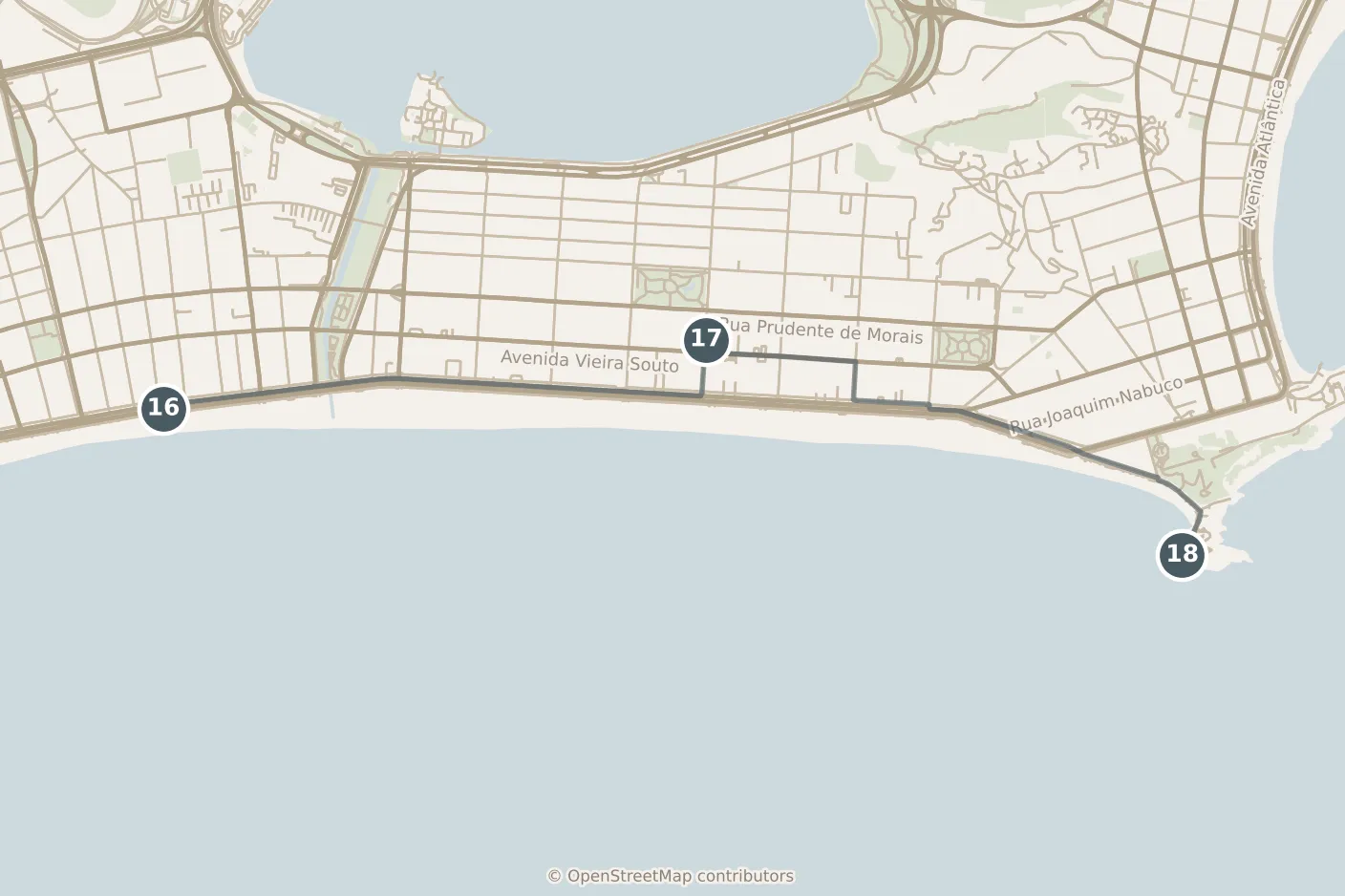
- 16Praia do Leblon
- 17Ipanema Beach
- 18Arpoador
The third day is the beach, given a whole day instead of an afternoon, and it goes in the middle — it becomes your day two, and the old day two slides to third.
There are two reasons for putting it there rather than on the end. It is the only one of the three that does not care what the sky is doing, so having it in the middle puts a day you can trade next to the two days a capped peak would waste. And a day of walking a flat beach between a day that starts on a mountain and a day that walks Centro end to end is the right shape for a body.
Two limits on that trade, and they matter more here than in the two-day version. The beach day and the mountain day swap with each other for nothing; the Centro day only ever swaps onto another weekday, and moving the mountain day at all costs the railway’s rebooking fee. And if the last of your three days falls at a weekend, the default order has to go — that is a real collision and not an oversight, because it lands the Centro day on a Saturday or a Sunday with the library shut. Run Centro on the first day instead, with the mountain and the beach on the other two in either order, and take the loss on the shape rather than on the library, which is the one room that cannot be worked around. Do the same if you are flying out early on your last day, because as written this arrangement ends the trip in Urca after dark, and the beach is the only one of the three days you can walk away from at any hour.
What moves when you insert it. One thing: the Copacabana afternoon comes out of the Centro day, because this day now covers the sand properly. In its place, take the earlier car from Uruguaiana straight round to Praia Vermelha and walk the Pista Cláudio Coutinho — a paved, level path a kilometer and a quarter long that runs from the end of the beach around the foot of the rocks, with the sea on one side and a granite wall on the other, distance marked every fifty meters and marmosets in the trees. It is free, it takes about an hour there and back at a strolling pace, and it is a daylight path, so it goes before the cable car and not after. The Centro morning, the monastery’s dress rule and the weekday requirement are all unchanged.
That afternoon is shorter than the beach one it replaces, which is a surplus and not a problem: give the lunch on the Travessa do Comércio two hours rather than ninety minutes, leave the monastery at two rather than half past one, and take the path in the last of the heat instead of the middle of it. In June, when the light goes at a quarter past five, that lands you back at the cable-car station with an hour in hand and nothing wasted.
Start at the far end of Leblon: Line 4 to Antero de Quental and about ten minutes to the sand. Praia do Leblon is the same water as Ipanema and a different beach socially — families, dogs, locals rather than visitors, and the granite of Dois Irmãos standing straight up out of the sand at the western end. An hour and a half here, early, before the sun is overhead.
Then walk east. It is half an hour along the front to the middle of Ipanema Beach, and it is one continuous stretch of sand interrupted once, by the short canal at Jardim de Alah that drains the lagoon behind and is the actual line between the two neighborhoods. Ipanema is the loud half. Posto 9 is the stretch everyone has heard of and it is the beach at its most self-aware; two hundred meters either side of it the volume drops and the average age changes. The sellers working the sand with iceboxes and trays are part of the fabric here rather than a nuisance, and buying from them is how the beach works. Two hours, lunch included, and eat a block back from the sand rather than at a beachfront counter. An açaí na tigela — frozen hard, eaten sitting down with a spoon — is what lets you stay where you are instead of going in.
Another half an hour east and the beach ends against a low dark rock. This is Arpoador, and this is the reason the third day is a whole day and not a morning. Climbing it takes two minutes. The whole run of sand you have just walked lies behind you to the west, ending in the two peaks of Dois Irmãos, and it is behind those that the sun drops. When it clears the ridge the rock applauds, out loud, which reads like something written for a brochure and is simply what happens. The two-day version of this trip spends that same hour four hundred meters up in the air on the far side of Copacabana; this is the other way to have it, and it is the better one if you are only going to have it once.
Work back from it the same way: an hour and a half at Leblon, half an hour walking, two hours at Ipanema, half an hour walking is four and a half hours, so put your feet on the sand at Leblon about five hours before sunset and you will reach the rock with time to find a place to sit. That count assumes you swim and lie down; it assumes nothing about how long you spend choosing somewhere to have lunch.
Bring nothing. There is nowhere on this day to leave anything, no lockers on any of these beaches, and a bag left on the sand while you swim is the single most reliable way to lose it in this city.
Practicalities
Throughout this section, day one and day two mean the days as written above, whatever order you end up running them in — and if you take the third day it normally slots in between them, so what is called day two here becomes your last. Normally, because the section that inserts it names the two cases where it cannot: a trip whose last day falls at a weekend, and an early flight home on the last day.
The one booking. The railway up Corcovado, and nothing else has to be dated. It is a timed slot and the morning departures go first, so buy it when you book the flights rather than the week before. The cable car at Urca is sold at its own station at Praia Vermelha and on its own site for the same day and needs no arranging; the theater’s own guided visit is the one optional extra, sold by the theater and by nobody else, and worth looking at before you travel only if the interior is why you came. The third day adds nothing at all: every stop on it is a public beach.
Which days break what, and why day two is a weekday. The load-bearing rule is one room. The library was Monday to Friday in 2026 and shut on weekends, and it is what the Centro morning is built around. Do not extend that into a claim about the district. Centro’s offices empty at the weekend, but every other stop on this walk is a building rather than a crowd and is still there on a Sunday — and on a Saturday an antiques market fills Praça XV in front of the Paço Imperial, which puts the middle of the walk at its busiest on one of the two days the library is shut. Two other things on that day keep a weekly rule I would not guess at for you. The Paço Imperial’s galleries take a day off — check which before you fix your dates, and if it falls on yours the morning survives whole, because the courtyard, the square and the lane behind it are what that stop is for. And both churches are working churches: a service can shut a nave on any day of the week, at any hour, and the answer if you arrive during one is to sit at the back rather than to come back. The monastery’s sung Mass is Sunday at ten, which is the collision described in the day-two text and cannot be resolved, only chosen between. Day one has two things worth checking and neither is fatal — the tram’s hours, below, and the gate at Parque das Ruínas, also below. The beach day has nothing to check at all.
So: day two must fall Monday to Friday. Day one and the beach day take any date, in either order. Day one is better on a Friday or a Saturday, because Lapa under the arches is a weekend place and on a Tuesday it is an aqueduct with the lights on. On a Saturday or a Sunday, note that the tram ran shorter hours in 2026 — last car up at five rather than half past six — which tightens day one’s afternoon without breaking it. The Corcovado slot has to be a morning one anyway, on every day of the week, and it is the light on the steps that forces it rather than the tram. And if your trip contains a Saturday, that is the day to put day one on and to give Santa Teresa the long version of lunch: feijoada is a meal that eats an afternoon, and day one is the day with the slack in it.
Parque das Ruínas is a municipal park with a gate and an opening hour of its own, which I will not state for you because it is the sort that moves. It is also, as it happens, the one stop on day one you can lose without noticing — so look it up if you like, and if it is shut, put its half hour into the staircase and the lanes and carry on down.
The arrival that breaks the week as written. A Saturday arrival with only two days. That gives you Saturday and Sunday, there is no weekday for day two to land on, and the room the whole morning was arranged around is locked. Do not try to run day two anyway. Run day one on the Saturday, when Lapa is at its best, and on the Sunday take the third day forward — the beach from Leblon to Arpoador — and then, instead of stopping at the rock, take a car from Arpoador round to Praia Vermelha, twenty minutes, and put the cable car on the end of it in place of the sunset. Start on the sand an hour earlier than the beach day says — six hours before sunset rather than five — because the car and the line both come out of the light. That gives you both mountains and the coast, and it costs you Centro, which is the part of this trip most worth coming back for. If your two days are a Sunday and a Monday, the Monday is your day two and everything works.
If the sky is wrong. The mountains are the only stops here that a cloudy day genuinely ruins, and they are on different days precisely so that you can move. If a forecast puts cloud or rain on one of your two days, make that day the Centro day: the theater’s façade aside, the library, the palace, the Candelária and the monastery are all indoors and the longest exposed stretch is the twenty minutes from the library to Praça XV. The mountain then goes on your other day. That swap is available on any weekday and impossible on a weekend, which is the whole reason the weekday rule is worth reading before you book. It is not free, either: the railway rebooks a Corcovado ticket and never refunds one, at a tenth of the fare more than a day ahead and three tenths inside twenty-four hours — so a swap decided two days out is cheap and one decided the night before is not, because the slot you are moving is a morning one. If cloud sits on Sugarloaf at the end of the Centro day, do not wait in line for it: ride to Morro da Urca only, which is two hundred and twenty meters up and often below the cloud base, or skip the cable car altogether and walk the Pista Cláudio Coutinho at sea level instead, then eat in Botafogo, ten minutes back up the road. In a summer downpour, which arrives late and hard and passes, the answer on the beach afternoon is a kiosk on the Copacabana promenade rather than a taxi home — but the swimming is finished for the day whatever the sky does next. The drains here run to the sea, and the advice after heavy rain is to stay out of the water for a full twenty-four hours, so what you go back to is the sand and not the surf. Day one’s exposure is a different one, because the storm’s hour is the hour that day spends coming down off Santa Teresa, and a staircase of two hundred and fifteen glazed tiled steps is not one to take in the wet: sit it out over a longer lunch, since these storms are short, and if it will not pass, ride the tram back down rather than descend them. And if you have three days and one of them is written off entirely, the beach day is the one to move: it has no booking, no closing hour and no room you have to be let into, so it is the only one of the three that can go anywhere in the week without consequence.
If you are short. Day one’s first cut is Parque das Ruínas — half an hour, and you have already had a better view of the same city from seven hundred meters before eleven that morning. Its half hour goes back into lunch or into the steps. Day two’s first cut is the inside of the Candelária: twenty minutes of interior between two better ones. The memorial on the sidewalk is not part of that arithmetic — you stop there whether or not you go in, and it is not a line in a budget. Second to go is the theater’s twenty minutes outside, and be clear about what that buys, because it is not beach time: the library opens at ten and the morning is built to reach it at five past, so cutting the theater lets you leave later, not arrive at the sand earlier. The honest figure for a shortened day two is therefore a little under twenty minutes, and in winter, when the sand already gets a shade under two hours, that is what it is worth. On the beach day there is nothing to cut, because it is one continuous thing: being short here just means starting further east, at Ipanema rather than Leblon, which costs the first ninety minutes and nothing structural. What never gets cut is the tram, the library and the monastery — those three are the reason the days are shaped the way they are.
The bag. Two or three days is the easy case: you have a room, and it will hold your case before check-in and after check-out as a matter of course, which is worth saying only for what it implies about your last morning. Nothing on any of these routes has anywhere to put a suitcase — not the railway, not the tram, not the monastery, and certainly not the sand — so whichever day is your last, plan it around going back for the bag. The awkward version is checking out on the Centro day, which ends in Urca at nightfall and nowhere near the Zona Sul; if you are flying that evening, Santos Dumont is about fifteen minutes from Praia Vermelha and Galeão nearer forty, so a late flight works and an early one does not. Note that the three-day shape hands you that version by default, since it puts the Centro day last — which is the second reason, along with the weekday rule, to run it first instead and finish on the sand. The other bag question here is the beach, and there the answer is not a locker but a decision: take a little cash and leave everything else in the room, on every one of these days that touches sand.
Getting between the stops. The pavement walking is light for a city this size and it is concentrated in one morning; the third day is the exception, and it is sand. Day two’s Centro walk is four and three quarter kilometers in seven pieces, about seventy minutes end to end counting the walk in from Cinelândia and the walk out to Uruguaiana, or fifty between the stops themselves; the longest single stretch is the twenty minutes east from the library to Praça XV, and in January start it early and carry water, because the avenue and the square are open and unshaded. Day one walks a little over two kilometers, almost all of it downhill from Largo dos Guimarães to the arches, and its longest stretch is the quarter of an hour from the square to Parque das Ruínas. The third day is four and a half kilometers in three pieces and it is the only day you should expect to feel in your legs, which reads oddly beside day two’s four and three quarters until you remember that most of it is sand, and sand is not pavement. Line 1 does most of the linking: Largo do Machado for Cosme Velho, Carioca for the tram, Cinelândia for the theater, Uruguaiana for the monastery, Cardeal Arcoverde for the north end of Copacabana and General Osório for Ipanema, with Line 4 running on to Antero de Quental at Leblon. What the metro does not reach is Cosme Velho and Urca, which is where three of the five car rides come from; the other two are the ways home after dark, out of Lapa and out of Urca, and between them they are why the app matters more here than the map; Santa Teresa the tram handles, and it is the better way up in any case.


.jpg)


