Rio de Janeiro in one day: the gardens under the mountain, the beaches, and Sugarloaf at dusk

Last updated 3 August 2026
Overview
Rio’s difficulty with a single day is not that there is too much in it. It is that the things everybody names sit on opposite sides of a mountain range, and the roads between them run through a handful of tunnels that are usually full. A day built to take in Christ the Redeemer, Sugarloaf and a beach is mostly a day spent in cars, and the parts of it you remember afterwards are the lines.
This day does not attempt that. It runs one way along the Zona Sul: from the foot of Corcovado down to the sea, then along the coast to the rock at the mouth of Guanabara Bay. End to end the whole route spans less than six kilometers of hillside and shore. Four stretches of it are walked, none of them much longer than half an hour, and it never doubles back.
What it costs you is standing under the statue. The cog train up Corcovado leaves from Cosme Velho, a valley of its own, on a timed ticket and as a return trip, and it takes the entire morning that this day spends on the ground. You do see the statue — the first stop is directly beneath it, and the view up from there is the one that gets photographed — but you do not go up to it. Sugarloaf takes the evening instead, and the reason is practical as well as geographical: it is four hundred meters high where Corcovado is over seven hundred, and the lower rock is in cloud a great deal less often.
The day gives up the old city as well — Centro, Lapa, Santa Teresa, the tram up the hill — and that is a real loss rather than an oversight. Rio’s claim on the world is its geography and not its buildings. One day buys you the geography.
The day

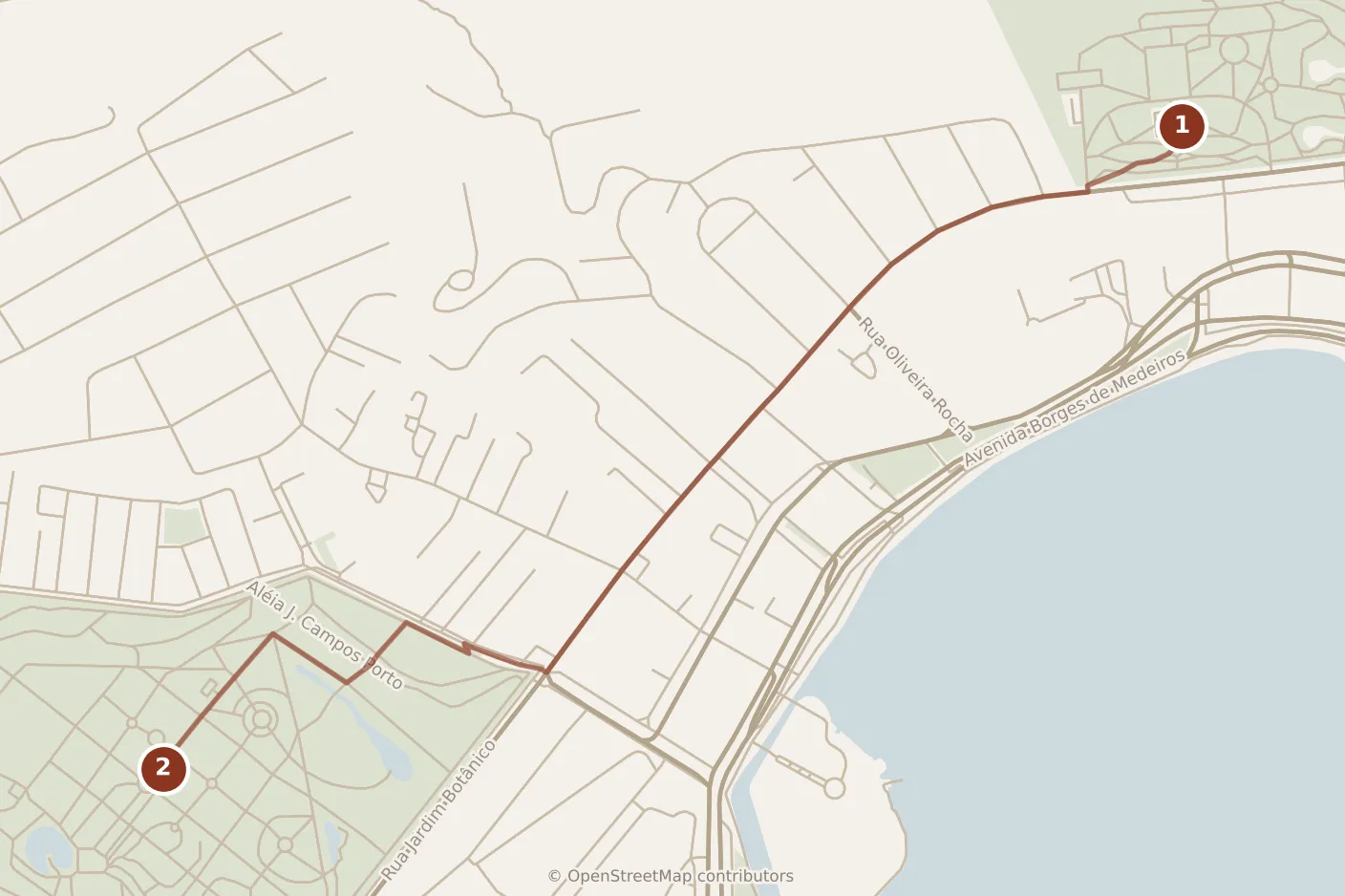
- Morning
- 1Parque Lage
- 2Jardim Botânico
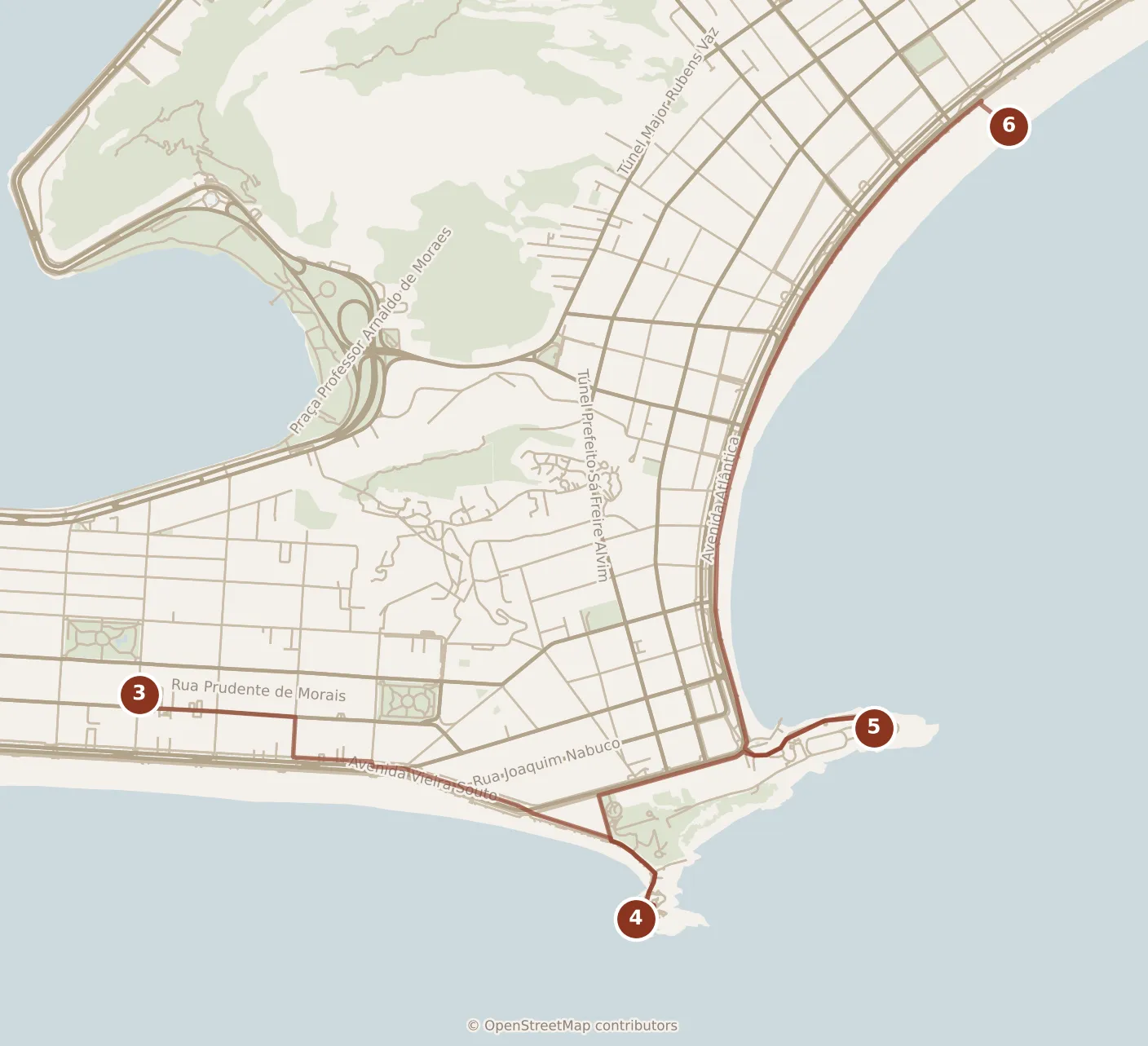
- Afternoon
- 3Ipanema Beach
- 4Arpoador
- 5Forte de Copacabana
- 6Copacabana Beach
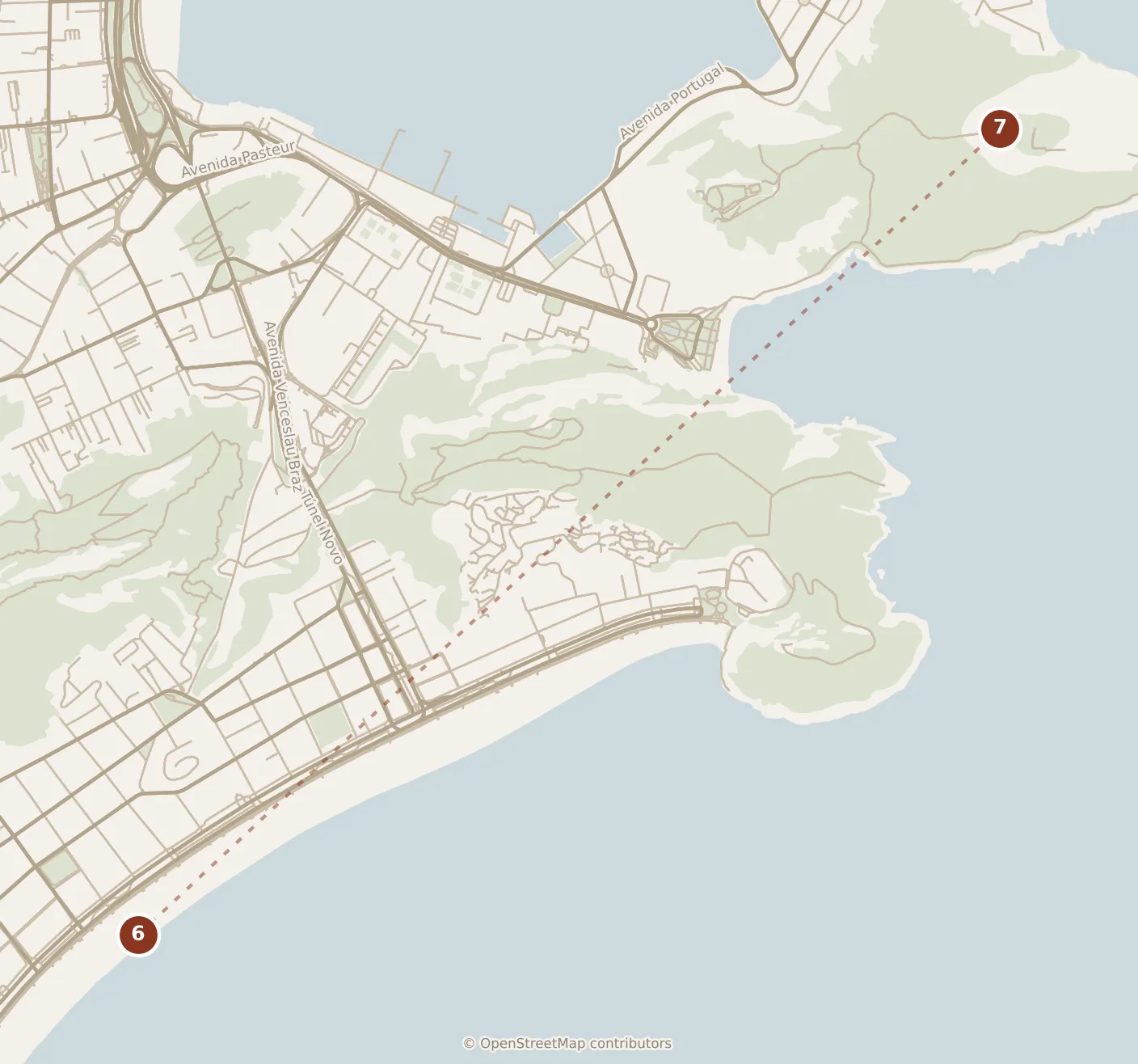
The leg out of the center: from stop 6 by taxi, not on foot.
- Evening
- 7Sugarloaf Mountain
Morning
Start at Parque Lage, and start early: it is free, it is a public park rather than a ticketed sight, and it is the stop most damaged by other people being in it.
The house at its center was rebuilt in the 1920s around an open courtyard with a pool set into the floor, and it is a visual-arts school now, so there are students working in the arcades and a counter selling coffee. What you have come for is the view straight up out of that courtyard: forest, then bare granite, then Christ the Redeemer very small on the ridge above. It is the view the statue is usually photographed from, and it costs nothing. Behind the house the paths climb into Atlantic forest past an artificial grotto with a row of aquarium tanks built into it. Give the whole park three quarters of an hour. A footpath does leave from here and go up to the statue, but it is a serious morning on foot in the heat, and it is not this day.
Parque Lage and the botanical garden stand on the same road, and it is just under half an hour along it from one gate to the other. Jardim Botânico was founded in 1808, when the Portuguese court was sitting in Rio because Napoleon had driven it out of Lisbon, and it is still a working research institution with something like six and a half thousand species in it. Fifty-four hectares are cultivated and the rest runs off into forest, which is the thing to know before you go through the gate: you cannot see it all, and trying is how the afternoon gets eaten. The avenue of royal palms is what to come for — seven hundred and fifty meters of them, a hundred and thirty-odd trees, every one descended from a single palm planted at the founding and long ago killed by lightning. The orchid house and the lake are the other two things worth the walk. Give the garden an hour and a quarter and leave the far end for a longer trip.
From the garden to the beach is about three kilometers and no metro runs between them, so this is the first of the day’s two car rides.
Afternoon
Land on Ipanema Beach in the middle of it, at Posto 9. The postos are numbered lifeguard stations and what they mark is not distance but crowds: nine is the loud, young, watched one, and it is where an outsider gets a clear view of what this beach is actually for. Give the beach and lunch two hours together. Eat in the streets a block back from the sand rather than at one of the beachfront kiosks — and if your one day falls on a Saturday, know that feijoada is a lunch that takes the whole afternoon, which this day has not got. An açaí na tigela, served frozen and thick enough to stand a spoon in, is the version of lunch that fits.
Then walk east along the front, just under half an hour, to where the beach ends against a low dark rock. This is Arpoador. Climb it, which takes a couple of minutes, and look back west along the whole length of Ipanema to the twin peaks of Dois Irmãos at the far end and the great block of Pedra da Gávea behind them. This is the rock the city gathers on at sunset to applaud the sun going down, and that is the one thing on this route you are deliberately giving up, because at that hour you will be four hundred meters in the air on the other side of Copacabana. Half an hour here is enough.
Round the point, about a quarter of an hour on foot, to Forte de Copacabana. It was finished in 1914 with a pair of 305 mm Krupp guns in an armoured turret sunk into the rock, and on 5 July 1922 its garrison mutinied; the navy shelled it from the sea the next morning, and a handful of the rebels walked out along the beach into the army’s fire — the episode the country remembers as the eighteen of the fort. The army keeps a museum inside. But what the ticket is really for is the view from the walls: the entire four-kilometer curve of Copacabana in one piece, which is the shape everyone pictures when they picture this city and is the one thing you cannot see from the beach itself. Three quarters of an hour, and skip the halls of uniforms if the light is going.
Local tip. If standing under the statue matters to you more than any of the above, the swap is the whole morning and nothing smaller: Parque Lage and the garden come out, the cog train from Cosme Velho goes in, and you rejoin this day on the sand at Ipanema in the early afternoon. What you cannot have is both, because the train is a return trip out of a different valley and this day already ends on a mountain at dusk. Cloud on the peak is the thing that decides it, and it is worth looking at before you commit the morning rather than after.
Walk north from the fort up the promenade of Copacabana Beach, a little over half an hour. The black-and-white wave underfoot is Portuguese and a good deal older than the sidewalk it is laid into; the promenade itself is Roberto Burle Marx’s, redrawn at the start of the 1970s as three parallel bands running the length of the sand. Stop wherever your legs stop, and pick up a car there.
Evening
The car takes you round to Praia Vermelha in Urca, at the foot of the two rocks. A cable car has run from here since 1912, the first in Brazil, and it climbs in two stages: a glass box up to Morro da Urca at two hundred and twenty meters, then a second one to the summit of Sugarloaf Mountain at three hundred and ninety-six. Neither stage takes more than a few minutes.
Go up with an hour of daylight still in hand, and stay past dark. From the top you can see almost the entire day you have just walked — the beaches along one side, the bay and its ships on the other, and Corcovado inland on its ridge with the statue standing on it, which is the argument for not having gone there. Then come down after the lights are on. That descent is the half of the trip nobody plans for and it is the better half.
This is the stop the day is built around and the only one with an hour it cannot move, so count backwards. The stops above come to about five and a quarter hours if you give each of them what is recommended here; the four walks add an hour and three quarters between them; the two car rides, on an ordinary afternoon, add most of another. Call it eight hours from the gate of Parque Lage to the cable-car station, and you want an hour of light left when you get there — so nine hours before sunset is when this day starts.
That count measures the time you spend inside the places and walking between them, and it measures nothing else. The largest thing it leaves out is the line for the cable car, which is the busiest single thing on this route; the second is the traffic in the tunnels the two car rides use. And do not carry a sunset hour around in your head. Rio’s sunset hour swings less than a European one, but less still means the better part of an hour and a half between June and January, so look up the hour for your own date and count back from that one.
Practicalities
The only thing here worth buying before you arrive is the cable car, and only in high season or at a weekend; the garden and the fort sell their tickets at the gate, and Parque Lage costs nothing. What this route does need, and needs working before you start rather than halfway through, is a ride-hailing app with a payment method already attached to it: there are two car rides in the day, and no metro line reaches either the botanical garden or the cable car. Everything else about arriving in Rio and moving around it is in the city guide.
The fort is a working army museum as well as a fort, and it is the one stop on this route that takes a day off in the week. Check which day before you fix the order, and if it lands on yours, Arpoador and the promenade north absorb the time and nothing else in the day has to move. The garden never closes but for two days at the turn of the year, though one morning a week it opens late — currently Wednesday, and late enough to cost this day its start — so check that alongside the fort’s closing day. Parque Lage is a public park, open every day, and is the one stop that never breaks this plan.
The last car down from Sugarloaf is the one fixed hour this article will not give you, because it is exactly the sort of number that changes. Look it up on the day you go: it decides how long you may stay up there once it is dark, and coming down is not optional.
On foot the day is easy. Everything from Ipanema to the north end of Copacabana is flat, paved and about five kilometers in total. The longest single stretch is the promenade north from the fort, a little over half an hour. Two others come close to it — the walk east to Arpoador and the road from Parque Lage to the garden, both just under — and the second of those is the only one of the four walks that is not beside the sea.


