Riga in two or three days: the market and the medieval town, the boom-time streets, and a day across the river

Last updated 14 August 2026
Overview
Riga is one of the few cities where the second day is not more of the first. The medieval town and the streets built around 1900 sit half an hour’s walk apart and belong to two different fortunes of the same port — six hundred years of German, Swedish and Russian trade behind a wall, and then a boom that threw up a whole apartment city in twenty years once the wall came down. A single day makes you choose between them and choose badly. Two days does not, and that is the only argument for the extra night that is worth anything.
So day one below takes the south end: the market, the warehouse quarter behind it where the ghetto was, and the oldest half of Vecrīga. Day two begins where the wall ends and walks north out of it, through the ring of parks that replaced the moat and into the apartment grid beyond. Neither day crosses the other, and nothing is visited twice. Both are entirely on foot: not counting however you got in from the airport, they contain no ride at all between them, and the third day contains exactly one, outward, with the walk back over the river as the point of it.
The light here is not a background condition, it is a constraint you plan around. The sun goes down as early as a quarter to four on the shortest December afternoons and as late as twenty past ten at the June solstice — a swing of six and a half hours between the two ends of the year, which is more than most visitors expect and enough to decide the order of both afternoons below. Each day has exactly one stop that wants daylight and cannot be moved to the other end of it, and each says which.
Day one comes to about seven and a half hours from the station to the last museum, lunch included; day two to about seven and a quarter; the third day to about four and a half, and it has no lunch hour in it because you eat in the first market on it. Those counts are the time spent inside the places and on the sidewalk between them, and they model nothing else. In particular they do not include the line for the elevator at St Peter’s: it is one small elevator, and that is the only stop on the whole route where half an hour can vanish while you stand still. Two and a half kilometers of walking on day one, a little over two on day two, and close to six on the third — which is what the third day is for. The longest single stretch across the first two days is about a quarter of an hour: the walk out of the ghetto quarter into Vecrīga on day one, and, if you invert day two’s afternoon for the winter light, the walk up to Alberta iela.
Nothing on any of these days has to be booked. What does have to be settled before you read any further is which day is which: day one must miss Saturday and Monday, day two must miss Monday and Tuesday, and the arrangement that survives whatever day you land on is worked out at the foot of this page. Fix the calendar there first. The two days below assume it is fixed. One price is worth knowing before you travel, because it settles a choice this article makes for you: the ticket at St Peter’s covers the church and the gallery in its tower together, and was in the eight-to-ten-euro range in 2026, so going up is not a second decision. You have already paid for it.
You need a fare card once. It is called an e-talons, it is rechargeable, and it is sold at kiosks and ticket machines rather than on board; the alternative is the Rīgas satiksme app, which sells a code ticket you scan as you get on. One tram ride in three days is all the route itself asks of either; the airport bus is a fare of its own. Everything else about fares, passes and the airport belongs to the city guide — if you have not read it, that is where it is.
The bag, if day one is also your arrival day. Day one starts at Riga Central Station, and the luggage room is at the coach station immediately beside it — the Autoosta terminal, first floor, entered from the waiting halls, and self-service round the clock — so the bag goes in and comes back out at an hour of your choosing rather than the building’s, which matters here more than it usually does. Nine minutes from the first stop, in the right direction. Leave it there rather than dragging it round: the market’s aisles are not a place for a wheeled case, and the elevator up St Peter’s is a box. What matters more is the other end, because none of these three days finishes at the station. Day one ends in the Old Town, under twenty minutes from it. Day two ends on Alberta iela, a little over half an hour away on foot. The third ends back in the Old Town after a forty-minute walk over the river, so another quarter of an hour to the platforms. If your train or coach goes on the last evening, that walk back is real and it is not on the way to anything, so decide before breakfast which day you want to end near the trains.
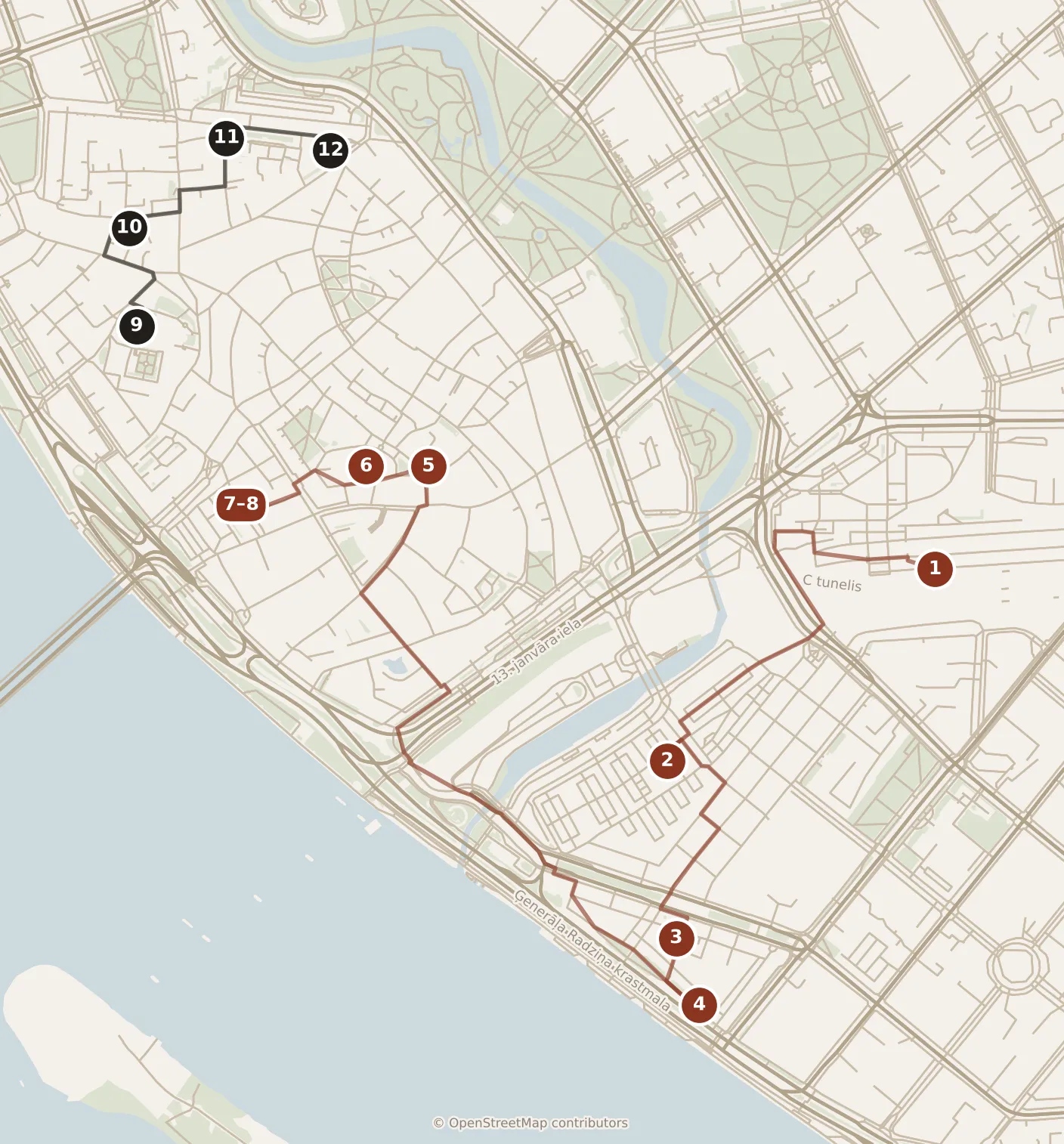
- Day one
- 1Riga Central Station
- 2Central Market
- 3Spīķeri
- 4Museum of the Riga Ghetto
- 5St John's Church
- 6St Peter's Church
- 7House of the Blackheads
- 8Museum of the Occupation of Latvia
- Day two
- 9Riga Cathedral
- 10Three Brothers
- 11Swedish Gate
- 12Powder Tower
Day one

Today runs from the river back into the lanes and never doubles back. It is also the day that does not exist in a single visit: the market and the medieval core will always fit into one day somehow, but the quarter between them will not, and it is the one that changes what the rest of the city means.
Morning
Start at Riga Central Station. If you have come in from the airport, bus 22 does the run in about half an hour, and the stop to want is the one by the station rather than the one across from the Old Town, because that is where the bag goes.
The Central Market is nine minutes away, on the far side of the coach terminal. Give it an hour and use the hour on two pavilions rather than one. There are five — meat, dairy, fish, vegetables and a gastronomy hall — and the mistake is to walk all of them at the same pace and remember none. The fish hall is the one that is unlike anywhere else, ranks of smoked, salted and pickled river and sea fish under the vaults; the dairy hall is where you see what a Latvian household actually buys, and it takes ten minutes. Outside, the open rows change with the season in a way the halls do not, and in autumn they are mostly mushrooms and berries. The pavilions themselves are old airship hangar frames re-erected over new halls and trading since 1930, which is worth knowing and takes four seconds to see once you look up.
Five minutes south, along the canal side, the brick warehouses of Spīķeri are the surviving block of the nineteenth-century port — thirteen of them, tall, plain and gabled, now studios, galleries and a concert hall. Twenty minutes walking through the lanes between them is enough, and it is the approach that matters, because it puts you at the edge of the quarter the ghetto was put in. Most people still call it Maskavas forštate; the city calls it Latgale, the name it had before the war and took back when it renamed the street the old name came from, in 2024. Several thousand people live there, and it is a working, largely Russian-speaking neighborhood rather than a memorial district.
Next door is the Museum of the Riga Ghetto, which signs itself the Riga Ghetto and Latvian Holocaust Museum — worth knowing, because that is the name its own site is under and the shorter one turns up the history rather than the institution. The ghetto was set up in this quarter in 1941, and most of the Latvian Jews held in it were killed in the Rumbula forest outside the city that November and December. The museum is built around that: a reconstructed ghetto house you walk into, a deportation wagon standing in the yard, and the thing that makes the visit different from reading about it — stands carrying the names of more than seventy thousand Latvian Jews, out in the open, which you walk between rather than look at. Give it an hour. It closes on Saturdays and on Jewish holidays, which move each year and are published on its own site; that is not an inconvenience to work round, it is the institution keeping Shabbat, and it is the one thing about this day a visitor cannot guess.
Then sixteen minutes north-west into Vecrīga, which is the longest walk of the first two days, and lunch in the lanes when you get there.
Afternoon
Skārņu iela holds two churches back to back. St John’s is the quieter — a Dominican chapel from 1234 that reached its present shape around 1500, with a steep Gothic gable and a warm brick front worth two minutes on the sidewalk. Unlike the two ticketed churches on these days there is no desk and no visiting schedule: it is open to visitors only when someone is there to open it, so treat the outside as the stop and the inside as a bonus. Look along the outside wall for the cross-shaped opening in the brickwork: two fifteenth-century friars are said to have had themselves walled up alive here in pursuit of canonisation and fed through that gap, and it is the memorial to an ambition the pope then refused. Twenty minutes.
Two minutes on is St Peter’s, and this is the stop the day is built around. The ticket covers the church and the gallery at seventy-two meters together, so take both: the interior is a huge scoured brick hall that reads in fifteen minutes, and the gallery is where you finally see the shape of what you have been walking through — the red roofs below, the river and its bridges, the Stalinist spire of the Latvian Academy of Sciences standing over the quarter you spent the morning in. An hour and a quarter, and most of the variance is the elevator. Everything above this point — the market, the warehouses, the museum, the walk in, lunch and the first church — comes to about four and a quarter hours, and you want an hour of light left when you get up there, so in December that means walking out of the station at ten. In June it means nothing at all.
Local tip. The only ordering decision on this afternoon is the gallery against the church, and the answer is procedural: if the light is going, go up first and come down to the nave; if it is not, do the church first and let the elevator line clear. Either way it is one ticket and one visit, so there is nothing to decide twice.
Three minutes west, on the town hall square, the House of the Blackheads is worth going inside, which is the difference two days makes. The 1334 merchants’ hall was shelled to rubble in June 1941, cleared by the Soviet authorities in 1948 and rebuilt between 1996 and 1999; the facade you photograph is a reconstruction, and the visit is the restored halls, the cellars beneath them and one of the larger silver collections in the region. Forty minutes. If the day is running short, this is the stop that gives — twenty minutes on the square outside is a fair version of it, and those twenty minutes are the twenty the elevator line took off you earlier.
One minute behind the square, in a rebuilt block reopened in 2022, is the Museum of the Occupation of Latvia, covering 1940 to 1991, and it wants an hour and a quarter. It is the necessary second half of the morning: the ghetto museum is one occupation and this is all three of them, and taken in this order the country’s twentieth century stops being a list of dates.
Evening
Dinner in the Old Town lanes, which is the one evening of the three where being in the middle of the tourist quarter is the right answer, because you are already standing in it and everything you have seen today is within four hundred meters. The rule that earns its keep is to eat in the lanes and not on the squares: a table with photographs of the food outside it, or someone standing beside it inviting you to sit down, is charging you for the square it stands on, and the same money two streets in buys a better plate. Afterwards is the hour for Black Balsam — black, bitter, herbal, and the only one of the three tastes on these three days that is actually from this city rather than from somewhere else in the country. Neat in a small glass, or in coffee, or long with blackcurrant if neat is too much.
Between May and August this day ends about five hours before the sun does, and that gap is a gift rather than a hole. The lanes are at their best in the late evening, and if you want a second view the deck on the Latvian Academy of Sciences is called Panorama Riga, it is open every day, it keeps the longest hours of anything on this route, and it costs about what the tower does. It is under twenty minutes east of the Old Town, past the market you started at. In December the gap does not exist: the day ends in the dark, both of its last two stops are indoors, and that is exactly why they are last.
Day two

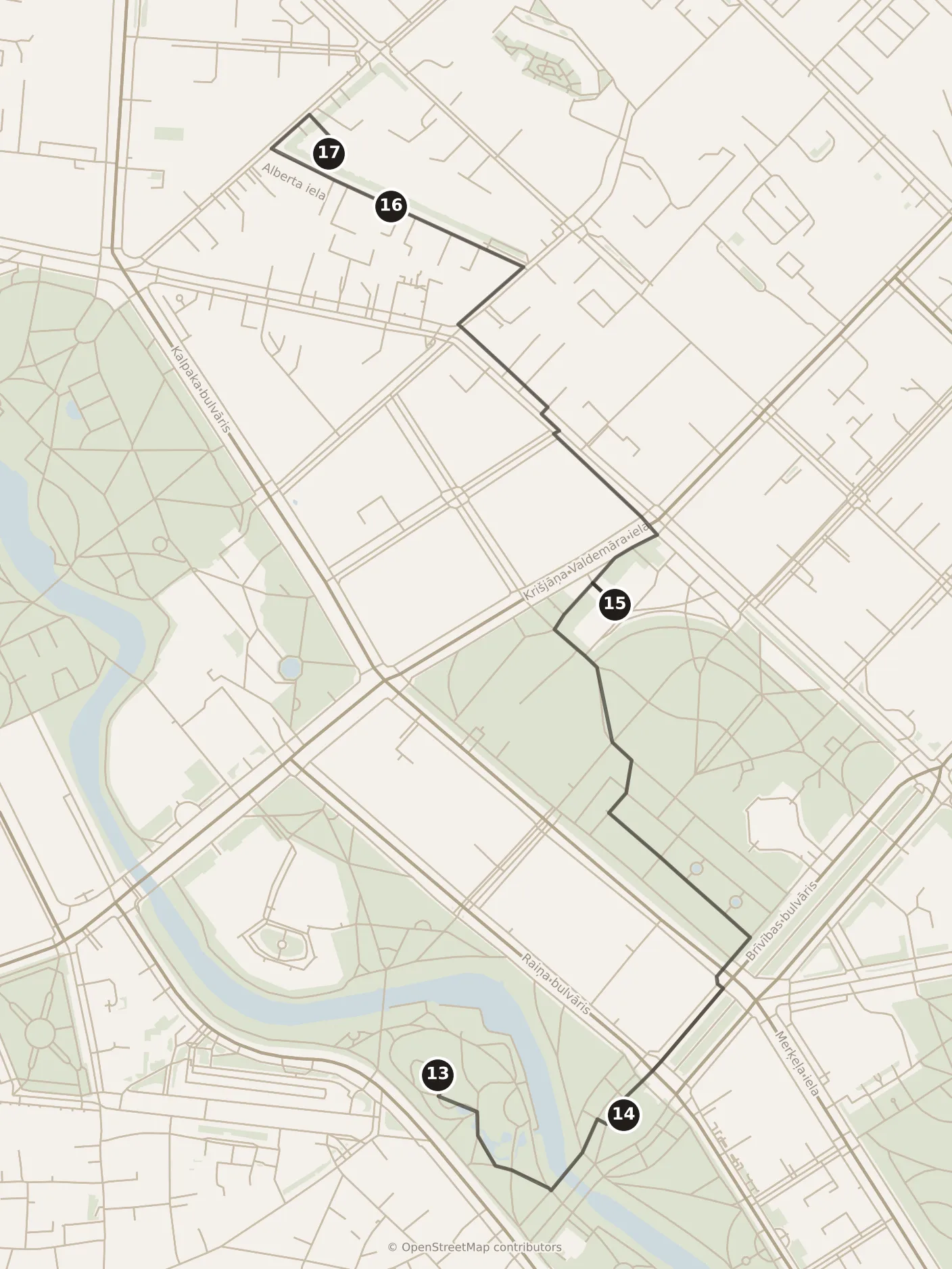
- Afternoon
- 13Bastejkalns Park
- 14Freedom Monument
- 15Latvian National Museum of Art
- 16Alberta iela
- 17Riga Art Nouveau Museum
Today starts where the wall ends. The whole point of it is a single walk north across four hundred years — the last of the medieval town, then the moat the city filled in and planted, then the apartment streets built on the ground the fortifications had been standing on.
Morning
Riga Cathedral opens the day, on Dome Square. It was begun in 1211 under Bishop Albert and is the largest medieval church in the Baltic states, and you step down into it, because eight centuries have raised the ground outside. The organ is the famous thing and it is not what to give your time to here; the cloister is. It is thirteenth-century, early Gothic, cross-vaulted, and one of very few left in this part of Europe — carved capitals of leaves, birds, animals and human heads running the length of it, and the walk now lined with the stone the city has taken down over the centuries: tombstones, coats of arms, carved doorways, cannon. Forty-five minutes for the two together, and give the cloister more of it than feels natural. On a Sunday morning this is a working congregation rather than a monument, so start at the Three Brothers instead and come back at midday.
Three minutes north are the Three Brothers, numbers 17, 19 and 21, the oldest houses in the city standing shoulder to shoulder and getting later as they go — a late fifteenth-century one with a stepped gable, a mid-seventeenth-century one, and a narrow Baroque one at the end. Fifteen minutes on the sidewalk in front of them is the whole stop, and what to read is the windows: the oldest house has the smallest openings, because glass was expensive when it was built, and they get larger and more confident as the houses get later.
Three minutes on, the Swedish Gate is a vaulted passage driven through a row of houses in the last years of Swedish rule, and the only city gate still standing. You walk through it, not at it; five minutes.
Three minutes east, along the surviving run of town wall, the Powder Tower is twenty-five meters high with an outer wall three meters thick, rebuilt in 1650 on a base the Swedes had destroyed, with cannonballs set into the brick long afterwards. Inside it and in the block behind is the Latvian War Museum, which charges nothing and gives you the twentieth century from the military side — the riflemen of the First World War, two independence wars, and the long argument about what Latvians were conscripted into and by whom. An hour and a quarter. Its week runs Wednesday to Sunday, which is the single fact that decides which of your days this one is. Then lunch — gray peas with bacon if it is on the board, though it is a winter dish here, closest to a Christmas one, and a heavy plate to set in front of an afternoon spent walking.
Afternoon
Three minutes on, the wall runs out into Bastejkalns Park. This is the hinge of the whole city plan: the bastion was leveled in 1856, the moat was kept as a canal and the earth was planted, and the green ring you are now standing in is the exact footprint of the defenses. Walk the canal path rather than the road beside it. Low stones are set into the grass, marking where people were killed here in January 1991, when Soviet troops moved on the government buildings and the city threw up barricades across its own streets. Independence was restored seven months after that, in the August, and the distance between those two dates is most of what the stones are for. They are easy to walk past, and slowing down for them is the point of the twenty minutes.
Three minutes east, where the canal meets the main avenue, the Freedom Monument stands in the gap the walls left. Ten minutes. It is a working national memorial rather than a backdrop — flowers are laid at the foot of it most days and the two soldiers on duty are on duty — so it is one place in this city where the weekend behavior of the Old Town is conspicuously out of place.
Nine minutes north through the Esplanade brings you to the Latvian National Museum of Art, in a palace built for it and opened in 1905 at the top of the park. This is the national collection and it is the only place on these three days that explains the country to itself: Latvian painting from the eighteenth century to the present, most of it unknown outside the Baltic states and much of it very good. An hour and a half is right. It closes on Mondays.
Eight minutes further north is Alberta iela, and it is the stop this afternoon is aimed at. The street was laid out and built in one burst from 1901 on ground freed when the fortifications went, and the argument along it is between two generations who disagreed about what a facade was for. Mikhail Eisenstein’s houses are the loud ones, plaster masks and sphinxes and open-mouthed faces stacked up the front with no restraint at all. Numbers 11 and 12 are by Konstantīns Pēkšēns with Eižens Laube, in the plainer national-romantic manner that came a few years later, and standing in the road between the two is the entire stop. Forty minutes, with your head back.
Number 12 was Pēkšēns’ own apartment and is now the Riga Art Nouveau Museum: a well-off apartment of the period, furnished, with a painted spiral stair in the entrance hall. Forty-five minutes. It closes on Mondays too, like the art museum you have just walked up from.
Local tip. In the dark half of the year the end of this afternoon inverts: take Alberta iela and the apartment at number 12 first, and walk the six hundred meters back down to the art museum afterwards. It costs about ten minutes of extra walking and it is the only ten minutes on this page worth spending twice, because the facades are the one thing here that is nothing after dark and the art museum is the one thing that does not care.
Evening
Two rules on this day cannot both hold in December, and it is better to say so than to pretend the arithmetic works. In the inverted order everything above Alberta iela comes to about four and a third hours, the street itself wants forty minutes of daylight, and a quarter to four is when the light goes — so a ten o’clock start puts you on Alberta iela with the light still on it and delivers you to the art museum at the wrong end of its own day. On the days it shuts earliest that is an hour rather than the ninety minutes it deserves, and there is no arrangement that gives you both. Take the street: it is free, it is the reason people come to this quarter, and an hour in the museum, taken as the nineteenth-century rooms alone, is a real hour rather than a consolation.
Dinner belongs in these blocks rather than back in the Old Town, for the plain reason that you are standing in them and going back is a kilometer each way. Do not read that as a local’s price bracket, though: this is the Quiet Centre, and the tables nearest Alberta iela are aimed at the same visitors the facades bring. Between May and August, do not go in early — the street still has light on it at nine, and walking it twice is not a repetition.
With a third day

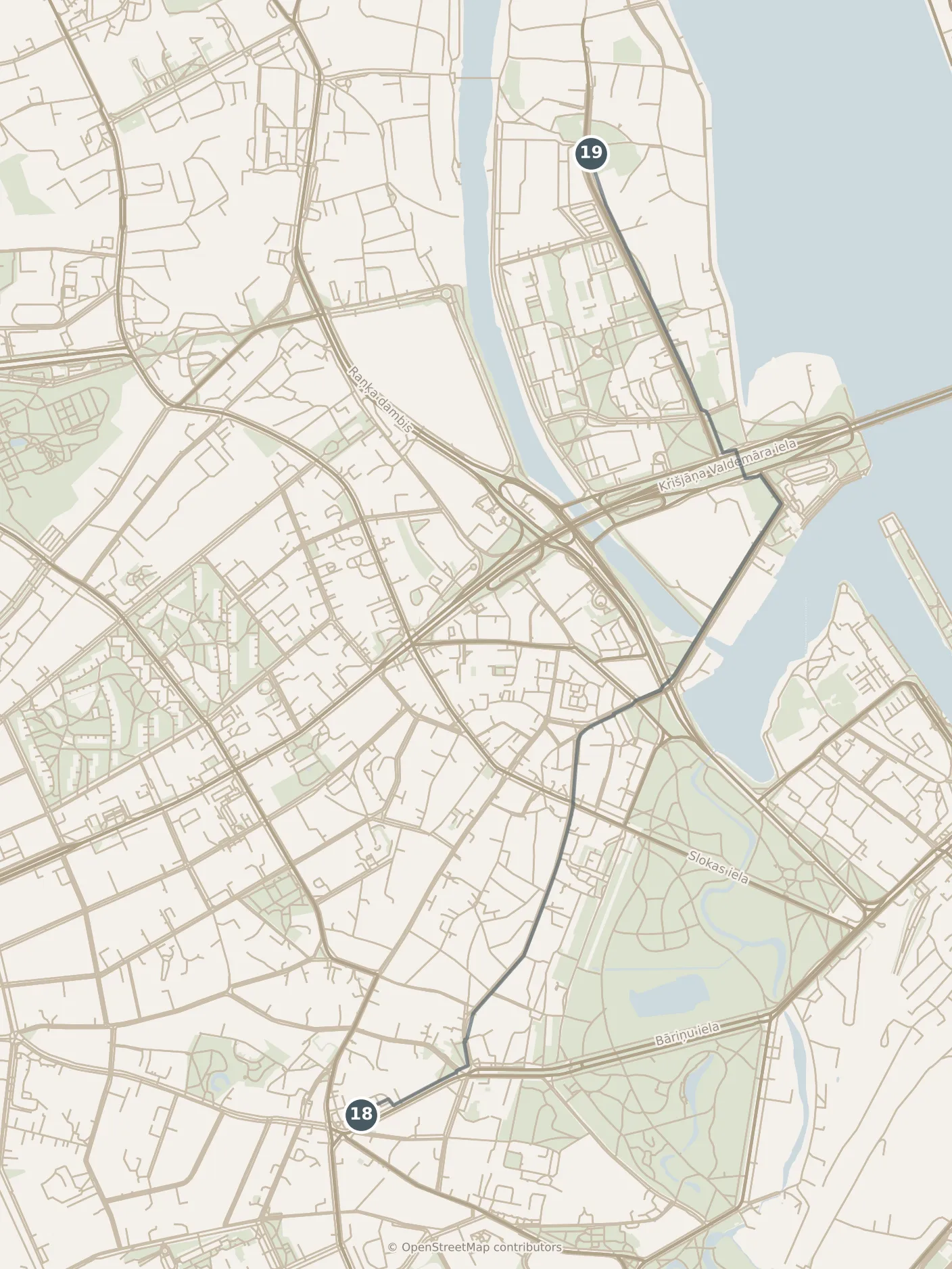
- With a third day
- 18Āgenskalns Market
- Kalnciema kvartāls — in the prose, not on the map
- 19Ķīpsala
The third day crosses the Daugava, which the first two only look at, and it is the day this city is least likely to sell you. It goes on a Saturday if a Saturday falls inside your stay, because that is the day the wooden quarter holds its market and the day the whole thing has a point beyond architecture. Otherwise it is appended at the end and loses about an hour.
It inserts cleanly, and that is the useful property: the two things that care what day it is care about opposite days. The museum in the ghetto quarter on day one shuts on Saturdays; the wooden quarter’s market only happens on one. They cannot collide. So if your Saturday is the middle day of three, this becomes the middle day, and days one and two simply take the days on either side — subject to the closure rules at the foot of this page, which is where the arrangement is worked out.
Take tram 2 from Stacijas laukums, in front of the railway station, and get off at Āgenskalna tirgus. The whole line runs a little over half an hour end to end and you are off well before halfway.
Āgenskalns Market is a red-brick hall by Reinholds Šmēlings, the city architect, begun in 1911, stopped by the war and finished in the 1920s, shut for four years of restoration and reopened in 2022. It is the neighborhood market the Central Market is not: smaller, slower, with a terrace and a courtyard, and it is the right place to eat sklandrausis, the rye tart of carrot and potato that comes from Kurzeme rather than from here. Forty-five minutes.
Seventeen minutes north-west along Kalnciema iela is Kalnciema kvartāls, a block of restored nineteenth-century wooden buildings — the ordinary architecture of this whole bank of the river, which burned or rotted almost everywhere else. The market here ran on Saturdays from ten until four in 2026. Everything above it — the tram, the brick hall, the walk — comes to about an hour and twenty minutes, so eighty minutes back from the closing hour is the last tram you can take at all, and taking one before noon puts you in the quarter by one with three hours of market in front of you and no need to use them. If the hour has moved by the time you read this, count the same eighty minutes back from the new one. In December there is a second reason to take the ten o’clock tram rather than the last possible one: it puts you on the island at the end of the day with two hours of light still on the water. On any other day the quarter is still there and still worth twenty minutes, but it is a courtyard rather than an occasion, and that is the hour the third day loses.
Then the walk that is the day: a little over half an hour north-east through Āgenskalns and along the water to Ķīpsala. This is the part with no monument in it — timber houses with carved porches, gardens, boatyards, the occasional new glass block dropped in among them. Ķīpsala is an island and was a fishing village, and Balasta dambis, its best street, is literally built on the ballast that ships dumped here from the eighteenth century onwards. Forty-five minutes along it, and at the end of it the city you have spent two days inside is laid out across the water in one piece, spires and all, which is a thing you cannot see from within it.
From there it is about forty minutes back into the Old Town over the Vanšu Bridge, on a walkway opened in 1981 and slung under cables the whole way across. The day ends in the middle of the afternoon on purpose, and it has no evening in it. That is not the page running out: by the third day you know which of the two quarters you would rather eat in, and being told again is worth less than the hour it would take to read.
Practicalities
Nothing here needs booking, in advance or at all. Two of the interiors on the first two days cost nothing: the war museum in the Powder Tower is free, and the museum in the ghetto quarter asks for a donation rather than a fee. The rest sell at the door on the day and none of them takes an advance booking. The third day has no ticket on it anywhere. Every interior that does charge sat between three and ten euros a head in 2026, which is the whole answer to what a day of this costs: there is nothing on these three days expensive enough to plan around, and nothing worth pricing in advance. The only fare on the route is the one tram ride, and the card and the app that pay for it are named in the Overview.
Which day is which is decided by a handful of closures and nothing else, and it is the rules that are worth having rather than the answer, because you will arrive on the day your flight or your train does.
Day two must miss Monday and Tuesday. The war museum’s week runs Wednesday to Sunday, and both the art museum on the Esplanade and the Art Nouveau Museum at Alberta iela 12 close on Mondays. So of this day’s four interiors, three are shut on a Monday and one of those on a Tuesday as well; the cathedral is the only one that is never shut, though a Sunday reorders the morning around it.
Day one must miss Saturday and Monday. The ghetto museum keeps Shabbat, and St Peter’s is shut one day a week which in 2026 was the Monday — that one I would check on the church’s own page before I relied on it, because it is the sort of thing that moves and the whole afternoon hangs off it.
The third day wants a Saturday and is indifferent otherwise. A Sunday is fine for day two provided you take the cathedral at midday rather than first, as that day says. Nothing else on any of the three days cares what day it is: a market, a wall, a park, a monument, a street of facades and an island are indifferent to all of them, and the two city days may be taken in either order.
That leaves one trap and it is a common arrival. Three days beginning on a Saturday puts a Monday in the set, and the Monday can hold neither day as written. The arrangement that survives is: the third day on the Saturday, day two on the Sunday, and day one on the Monday, where what you lose for certain is St Peter’s and the substitute is in the next paragraph. Two days beginning on a Monday is the same problem twice — in that case take day two’s route on the Monday without any of its three museums, which leaves the cathedral, the wall, the canal ring and Alberta iela from the sidewalk, and is a perfectly good day, and take day one whole on the Tuesday.
If St Peter’s is shut, or the line for the elevator is worse than you are willing to stand in, the substitute is not another church. It is the open deck on the seventeenth floor of the Latvian Academy of Sciences — Panorama Riga, at sixty-five meters up the tower the city calls Stalin’s birthday cake, eight minutes east of the ghetto museum and therefore already on day one’s morning. It is open every day and it keeps the longest hours of anything on this route: it is still selling tickets in the evening, hours after every museum here has shut. It costs about what the tower does. Give it forty minutes and slot it between the ghetto museum and the walk into Vecrīga — eight minutes out, and the sixteen back into the old town are the sixteen you were going to walk anyway. The morning gains those forty minutes, the afternoon loses St Peter’s hour and a quarter, and the day comes in about half an hour shorter overall, which is the one afternoon on this page with slack in it.
If your three days hold no Saturday, the third day is an hour shorter and the honest question is whether to fill it. The one alternative worth the name is the coast: trains run from Riga Central Station to Majori, in the middle of Jūrmala, in about half an hour and roughly every half hour, and what is there is a long beach, pine forest and a street of wooden villas. That is a summer plan and only a summer plan. In November it is a wind tunnel with the shutters up, and the left-bank day, market or no market, is better in every month that is not June to August.
Closing days aside, the two things to look up the week before are St Peter’s and the art museum on the Esplanade, both of which publish their own hours on their own sites, and both of which are load-bearing in the sense that no other stop on the route does their job. Everything else on these three days is a street, and streets keep no hours.


_02.jpg)
.jpg)

