Riga in one day: the market, the medieval core, and the Art Nouveau streets before dark

Last updated 4 August 2026
Overview
Riga is the largest city in Latvia, and the useful consequence for a single day is that almost everything worth seeing is stacked in a strip about two kilometers long, running north from the railway station. The medieval town sits at the bottom of it, the old moat and the Freedom Monument in the middle, and the Art Nouveau streets at the top. This route walks that strip once, from the bottom upwards, and comes back down only at the end of the evening. Six kilometers of walking in all, an hour and a half of it, and the longest single stretch is the twenty minutes back to the station at the finish.
What one day costs you here is the museums and the river. Riga has a national art museum, a national history collection and an open-air museum of wooden farm buildings at the edge of town, and all of them are the first things to give up: an hour indoors is the hour that would have bought you the market, the wall and the facades, which are what this city is actually made of. The Daugava you will look at from the top of a tower rather than walk beside, and in one day that is the right trade — the far bank is residential, and the bridges are long.
Two stops have to be taken at the right end of the day and the rest do not care. The Central Market is a market, and a market is only itself in the morning. Alberta iela, which the whole second half is aimed at, is read by standing in the road and looking up, and that needs daylight — which is worth doing arithmetic over this far north, because daylight here is not a constant.
The sun goes down over Riga at a quarter to four in the afternoon in the second week of December and not until twenty past ten at night in the third week of June — six and a half hours of difference between the two ends of the year, and around midwinter the whole day holds barely six hours of usable light. Everything above Alberta iela on this route comes to about five hours, lunch included. So take your own month’s sunset hour, count those five hours back from it, and that is when to walk out of the station. In December that means leaving at about eleven, and if you have arrived later than that, the last paragraph of Practicalities is written for you. In June the light will not force anything at the far end of the day — but do not start much earlier than the middle of the morning either. The market is the one stop here that opens early; everything after it keeps church and museum hours, so a very early start buys nothing but a longer stay at the fish counters and then a wait on a cold step.
Reckon on about six and a half hours from the platforms to walking back out of the apartment on Alberta iela, lunch and all the walking inside that, and another two for dinner and the way back — call it eight and a half in all. That count is the time you spend in the places and on the sidewalk between them and it models nothing else. In particular it does not include the line for the elevator up St Peter’s: there is one elevator, it is small, and that is the single stop on this route where half an hour can disappear while you stand still. Note also where the slack in the day sits. Everything before Alberta iela is pinned by the light and cannot stretch; dinner is the part that can. Start at nine on a June morning and you will be looking for somewhere to eat at four, and the answer to that is to take the second indoor hour the day offers rather than to walk faster.
The bag, if you are between trains: luggage storage is at the coach station, which sits immediately beside the railway station and directly on your way to the first stop. It is self-service rather than a counter — on the second floor, reached from the waiting hall or the ticket hall — and it takes and returns bags at any hour, so nothing at either end of this day has to be timed around it. Aim for that rather than for the railway building itself, which the Rail Baltica works have had in pieces for years — the rebuilt station was projected for 2027 when this was written — so what is where inside it moves. Everything below assumes empty hands, and that matters more here than it sounds: Vecrīga is cobbled end to end, the market is no place to be pulling a case through, and the tower elevator is a box.
The day

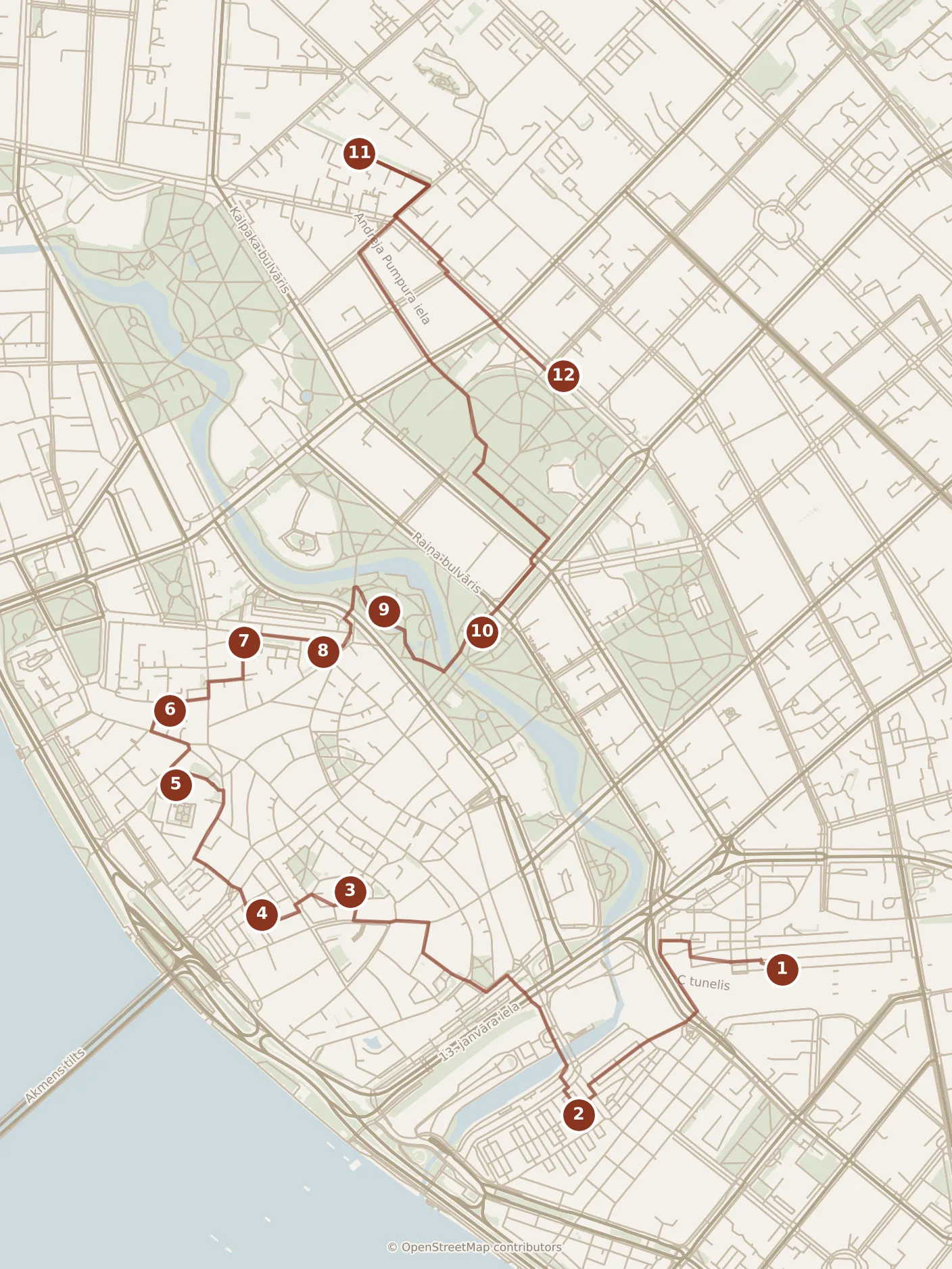
- The day
- 1Riga Central Station
- 2Central Market
- 3St Peter's Church
- 4House of the Blackheads
- 5Riga Cathedral
- 6Three Brothers
- 7Swedish Gate
- 8Powder Tower
- 9Bastejkalns Park
- 10Freedom Monument
- 11Alberta iela
- 12Elizabetes iela
Morning
Start at Riga Central Station and walk south-west out of it rather than north. Under ten minutes, past the coach terminal, brings you to the Central Market, and reaching it before the Old Town rather than after it is the whole reason this day works.
The market is five long pavilions with a field of outdoor stalls around them. The bones of the pavilions are German airship hangars, dismantled at the Vaiņode base after the First World War, their upper frames re-erected here over new halls of stone and reinforced concrete, trading from 1930. It is one of the largest markets in Europe and it is not a heritage exercise: this is where the city buys its food.
Do not try to walk all five. Take the fish hall end to end — ranks of smoked, salted and pickled fish, and the tinned sprats people carry home by the bagful — then put your head into one of the others and leave it at that. Eat here rather than saving your appetite: dark rye bread, and sklandrausis, the open tart of carrot and potato on a rye crust that comes from Kurzeme rather than from Riga and has held protected traditional-speciality status since 2013. Give the market three quarters of an hour.
Ten minutes north-west, across the wide road at the edge of the Old Town, is St Peter’s. It is brick Gothic with a spire a hundred and twenty meters high, and the spire is a reconstruction: artillery fire gutted the church on 29 June 1941 and the tower went up again in steel, the restoration running from the 1950s into the 1980s. The gilded cockerel on top was placed in 1970, is the seventh the church has had, and weighs a hundred and fifty-eight kilograms. What you are here for is the elevator, which climbs to a gallery at seventy-two meters — the only place on this route that shows you the shape of the city: the red roofs of Vecrīga immediately below, the Daugava and its bridges to the west, and away to the north the grid of the Art Nouveau center the afternoon walks into. Give the gallery half an hour and the church beneath it fifteen minutes; it is a large, scoured, plain interior and the tower is the point.
Three minutes west is the House of the Blackheads, on the town hall square. It went up in 1334 as a merchants’ warehouse and hall, and took its name from the brotherhood of unmarried merchants and shipowners who ran it. It was shelled to a ruin on the same June day in 1941 that gutted St Peter’s, the remains were cleared by the Soviet authorities in 1948, and the building was put back between 1996 and 1999 from drawings and photographs, partly paid for by five thousand people buying bricks. Ten minutes in front of it reads the facade, which is the half worth having; the interior is a reconstruction of a reconstruction and on a single day it is the right thing to skip. Behind the square is the museum of Latvia’s occupation years, 1940 to 1991, in a Soviet-era block reopened in 2022 after rebuilding. If you are going to give an hour to a museum today, that is one of the two places to spend it; the other comes after lunch.
Five minutes north-west, Dome Square opens out, and Riga Cathedral stands on it: begun in 1211 under Bishop Albert and the largest medieval church in the Baltic states. You step down into it, because the ground outside has risen around the building over eight centuries. The organ is what to come in for — built by Walcker of Ludwigsburg and inaugurated in January 1884, with a hundred and twenty-four stops and six thousand seven hundred and eighteen pipes, among the largest instruments in the world when it was new. The recitals are not a matter of luck: in 2026 the cathedral ran a twenty-minute organ recital at midday almost every day, with longer concerts on Friday evenings, and it publishes that program on its own concerts page months ahead. Read it before you travel, and if one falls while you are here, take it and let the rest of the morning move around it. Otherwise half an hour covers the church and the cloister.
Lunch goes in the lanes between Dome Square and Mazā Pils iela, sitting down, and it should be gray peas with bacon — a bowl of dried peas, onion and fat pork that is the closest thing this country has to a national dish and costs almost nothing. Give it an hour. You are about to spend four hours outdoors.
Afternoon
Two or three minutes north, on Mazā Pils iela, are the Three Brothers: numbers 17, 19 and 21, the oldest group of dwelling houses in the city, standing shoulder to shoulder and getting younger as they go. Number 17 is late fifteenth-century, with a stepped gable and a Gothic doorway; 19 carries 1646 on its front and a stone portal added a century after that; 21 is a narrow Baroque one from the end of the seventeenth century. The state architecture museum is inside them. On one day, ten minutes on the sidewalk in front of the three is the whole of it — this is a stop you look at, not one you enter.
Three minutes north-east is the Swedish Gate, a vaulted passage cut straight through a row of houses in the last years of Swedish rule and the only one of the city’s gates still standing. It takes a minute, and you walk through it rather than at it.
Three minutes east, along the surviving stretch of the town wall, is the Powder Tower: twenty-five meters high and fourteen across, its outward wall three meters thick, rebuilt in 1650 on the base of a tower the Swedes had destroyed in 1621. Cannonballs are set into the brickwork, put there long afterwards in memory of the Second Northern War. Inside the tower and the block behind it is the Latvian War Museum, which charges nothing to enter and whose week runs Wednesday to Sunday. Five minutes outside for the wall and the cannonballs; the museum is an hour, and it is the second of the day’s two indoor candidates.
Local tip. This day has room for exactly one indoor hour beyond the tower elevator and the apartment on Alberta iela, and the two candidates are the war museum in the Powder Tower, which is free and shut on Mondays and Tuesdays, and the museum of the occupation years behind the town hall square, which charges and opens every day. What the hour costs you is time rather than money, and at the start of the week the choice is made for you. Take one, not both. They fall on either side of lunch, so decide before you sit down — going back for the other one is the only thing this route does not survive.
Two minutes north the wall runs out into Bastejkalns Park: the last bastion, leveled in 1856 when the fortifications came down, with the moat left behind as the city canal and a dolomite waterfall of 1898 built into the slope. Low stones are set into the grass here, marking where people were killed in January 1991, in the last violent weeks of Soviet rule; some of them were filming at the time. They are very easy to walk past. Fifteen minutes, and take the canal path rather than the street beside it.
Three minutes east, where the canal crosses the main avenue, is the Freedom Monument: forty-two meters of travertine and copper by Kārlis Zāle, unveiled in 1935, a figure at the top holding up three gilded stars for Vidzeme, Latgale and Kurzeme, and Tēvzemei un Brīvībai — for fatherland and freedom — cut into the base. That it stood through fifty years of Soviet rule is the fact to carry away from it. Two soldiers keep guard at the foot and are relieved on the hour, but only through the middle part of the day, and not at all in bad weather or in deep cold — below about minus ten, which is an ordinary December here. Worth a few minutes if the changing is about to happen, and worth building nothing around. Ten minutes.
Then a little under twenty minutes north, up through a quiet grid of embassies and apartment houses, to Alberta iela. Go by Elizabetes iela rather than the main avenue: two thirds of the way up it you pass numbers 10a and 10b, which are Mikhail Eisenstein’s, and if you were only ever going to look at two of his facades those are the two. They are also a fair warning of what the next street does. There is no ride worth taking instead of this walk — it is part of the stop.
Alberta iela was laid out and built in a single burst from 1901, on ground freed when the fortifications went. Eisenstein — a city engineer by profession, and the father of Sergei Eisenstein — designed numbers 2a, 4, 6, 8 and 13 here, and those are the loud ones: masks, sphinxes, and faces open-mouthed along the parapets, laid on with no restraint whatever. Numbers 11 and 12 are by Konstantīns Pēkšēns with Eižens Laube, in the plainer national-romantic manner that followed a few years later, and the argument between the two sides of the street is the thing to stand in the road and look at. Half an hour, spent almost entirely with your head back.
Number 12 was Pēkšēns’ own apartment and is now the Riga Art Nouveau Museum: furnished as a well-off apartment of the period, with a painted spiral stair in the entrance hall that is worth the ticket on its own. Forty-five minutes.
In 2026 that museum closed its doors at six in the evening, with the ticket desk shutting a quarter of an hour before them, and it is the one hour this whole day rests on. Not because six is early, but because for the dark half of the year it is later than the light: from November to February the facades have gone by the time you reach them and the apartment is all that is left of the stop. So build the end of the day back from that door — and if the hour has moved by the time you read this, build it back from the new one. Between May and August the light outlasts everything and the question does not arise.
Evening
Ten minutes: back down Alberta iela and east along Elizabetes iela, past 10a and 10b again, which is no hardship, and on into the blocks beyond them.
Dinner goes in this quarter rather than back in the Old Town, and that is a recommendation and not merely geography. The Old Town’s central lanes are where the weekend drinking crowds land, the blocks around Elizabetes iela are where people who live in Riga eat, and going back would be a kilometer west followed by the same kilometer east. If you want the one drink the city is known for, it belongs here rather than at lunch: Riga Black Balsam, which is taken neat as a shot, or arrives stirred into a hot berry drink, or into coffee, or over ice with cola.
From here Riga Central Station is about twenty minutes on foot, south-east past the Esplanade and the monument. It is the longest single walk of the day, and outside high summer it is the one you will certainly do after dark. The coach station and its luggage store are two or three minutes further, on the market side of the platforms, so add that if the bag is there. The store itself never closes, so the only clock in this paragraph is the one on your train.
Practicalities
Nothing on this route has to be booked before you travel, and that is the useful thing to know rather than a shrug. Four doors on this day take money — the elevator up St Peter’s, the cathedral, the apartment at Alberta iela 12, and the museum of the occupation years. The first three sell at the door on the day; the occupation museum sells through an online booking service as well, and its own site is the place to look before you rely on the desk. The war museum in the Powder Tower, the other candidate for the indoor hour, charges nothing at all. The rest is streets, a wall, a park, a monument and a market, and none of it charges anything. The whole itinerary is walked, with no tram, trolleybus or bus in it at any point, so the fare system, the airport bus and the passes are the city guide’s business and not this page’s; if you have not read it, that is where they are.
Free is not the same as open, and the closures are what to check rather than to trust a page for. The museum on Alberta iela is one of them: the city’s tourism office and every listing put it at Tuesday to Sunday, while its own site prints one time range across the week without marking a closing day, so read the museum’s page rather than assuming either. The two things worth checking before you set out are St Peter’s, whose interior and lift are the one stop here nothing else replaces, and the war museum, which is the one stop here that keeps closing days. If the apartment on Alberta iela is shut anyway, the street outside it is free and is the greater part of that stop. If St Peter’s is shut, the day loses its one view and nothing else; there is a public platform on the tower of the academy of sciences, under ten minutes east of the market, which is the only substitute on this side of the river — but confirm it is open before walking out to it, because nothing else on this route goes that way. Nothing else here cares what day it is: a market, a wall, a park, a monument and a street of facades are indifferent to all of them, and what a Monday or a Tuesday costs you is only the war museum, which leaves the occupation museum as the indoor hour on those two days.
The cathedral is a different case rather than a third one. It is a working church with a concert program, so its visiting hours are set around services and rehearsals instead of being a fixed schedule. The concert program is the plannable half and the cathedral publishes it on its own site months ahead; the visiting hours are not, so if the door is closed to visitors when you get there, carry on to the Three Brothers, which are two minutes further, and come back to it before lunch — the lanes you eat in are between the two.
Finally, the late arrival, which is the case the sunset arithmetic above cannot save. If you land after midday between November and February, do not compress the day — reverse it. Walk the thirty-five minutes straight north from the station up to Alberta iela, take the street and the apartment while there is still light on the facades, then come back down through the canal park, the wall and the Old Town in the dark, all of which is lit and loses nothing by it, and finish with dinner in the Old Town instead. Two things go in that version, and it is worth being plain about both: the market, because by late afternoon it is a shop rather than a market, and the view, since a gallery at seventy-two meters after dark shows you lights rather than the shape of the city. What you keep is the facades, and in deep winter with a late start those are the right thing to keep.


