Reykjavík in two or three days: one day indoors, one on the water, and a third out to the island

Last updated 15 August 2026
Overview
One day in Reykjavík is a day in the old town on foot. Two days is a different thing, and what the second one buys is not more sights — it is the right to let the sky decide the order. The two days below are a matched pair. Day one is mostly under a roof — three collections, a public building, a lake and a pool — and nothing on it is ruined by rain. Day two is out in it from beginning to end: a tower, a street, a working harbor, a quay at the far end of the docks and two kilometers of open shore road with nothing over it. Look at the forecast the night before and put the outdoor day on the better of your two mornings. That instruction is the whole argument for a second night here, and it is the one thing a single day cannot give you.
The light is the other half of the same argument, and it is more extreme here than anywhere else this site writes about. In the third week of December the sun comes up at about a quarter past eleven and is gone again by half past three — four hours in total, and it never gets high in any of them. In the week of the June solstice it does not set until four minutes after midnight, and for two weeks either side there is no real darkness at all. Day two below is written for the long half of the year, roughly March to October. From November to February it does not survive as written, and a paragraph at the end of it says exactly what changes. Day one is indifferent: nothing on it depends on the sky.
There is no railway in this country and no metro or tram in this city, so there are no lines or platforms to give you, and none of these three days needs one. The two city days are walked end to end — about four and a half kilometers on day one, six and a bit on day two, which is what the harbor and the shore cost. The one long leg of the two city days is on day one, from the museum on Suðurgata across to Laugavegur, and it is a little over twenty minutes. If you use a bus at all it will be on the third day, and the fare system is called Klappið: an app you download, or a refillable Klapp card, or a contactless bank card tapped on board, and in 2026 it stopped charging after three rides in one day. The city guide has the rest.
Reckon on about nine hours for day one, from the first door at ten to walking out of the pool, of which a little over an hour is the walking; and about seven hours for day two, an hour and a half of it on foot. Those totals model the time you spend inside the places and on the sidewalk between them, and nothing else. Two omissions are large enough to name. One is standing about in weather: rain here arrives sideways and leaves within the hour, and somewhere in each of these days you will give twenty minutes to a doorway that no count knows about. The other is on day two, where the guided visit aboard the ship at the end of the docks starts at fixed times — the seven hours assumes you walk into one of them, and if you arrive just after one has gone you wait, which can be most of an hour. Build one gap into each day and both still stand.
Nothing on days one and two has to be reserved, which is worth saying plainly to somebody who has landed holding nothing: every stop on both days is bought at its own door on the day, or is free. The one thing in this article worth buying before you are standing in front of it is on day three — the ferry out to Viðey, and only in high summer, when a fine Saturday fills the boats. It was in the two-to-three thousand-krónur range for an adult return in 2026, sold on the operator’s own site, Elding; the rest of the year it is bought at the Skarfabakki pier on the day. Money, arrival and the airport coach are all the city guide’s.
The bag. This format’s reader is not the one a single day is written for. You have a room, and that changes the answer rather than removing the question. There is no railway station in this country, so the usual solution does not exist; BSÍ is a coach terminal that publishes nothing about holding luggage; and no stop on these three days passes a locker bank. So the bag goes where you are sleeping and stays there, and the shape that matters is that both city days begin and end inside the same square kilometer of old town, so you never have to break a day to go back for it. The case that bites is an early landing with the room not ready. If the bag has nowhere to go for a few hours, start with day one and not day two: day one opens with three indoor buildings that have somewhere to put a coat, while day two opens in a line for a tower elevator and ends on an open quay in the wind, which are the two worst places in this article to be holding a suitcase.
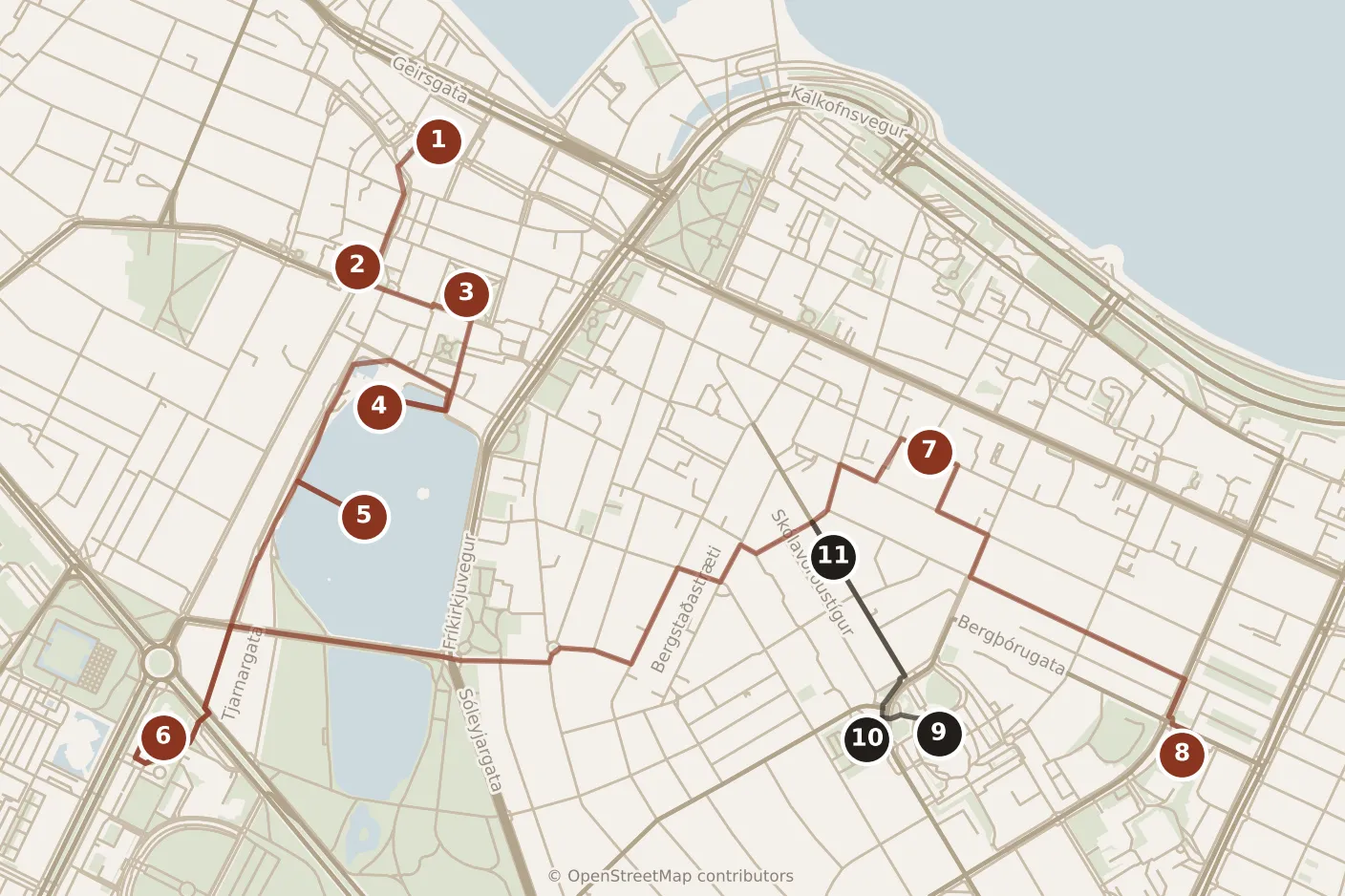
- Day one
- 1Hafnarhús
- 2The Settlement Exhibition
- 3Austurvöllur
- 4Ráðhús Reykjavíkur
- 5Tjörnin
- 6National Museum of Iceland
- 7Laugavegur
- 8Sundhöll Reykjavíkur
- Day two
- 9Hallgrímskirkja
- 10Einar Jónsson Museum
- 11Skólavörðustígur
Day one

The indoor day, and the day to give to the worse forecast. It runs in one sweep from the harbor end down to the university — old warehouse, old street, parliament square, city hall, lake, museum — and never doubles back on itself. Nothing on it is decided by the light, which is unusual enough to say out loud: day one has no hinge, and that is precisely why it is the arrival day. Instead it is counted forward from a door. In 2026 the first house on this route opened at ten in the morning, and ten is when to be outside it; if that hour has moved by the time you read this, build the morning forward from the new one and everything below falls where it falls.
Morning
Start at Hafnarhús, the art museum in the old port warehouse on Tryggvagata — a long low concrete building that stored fish and still reads as a shed inside, which is most of its charm. The reason to come is the Erró collection: the pop painter gave the city several thousand of his works, and rooms of them are on show here at all times. Dense, loud, comic-strip panels crushed together into wall-sized brawls, and nothing else in Reykjavík looks remotely like it. Give it an hour and give most of that hour to Erró rather than to whatever the temporary shows are — if you like the temporary work you will find it by yourself, and if you do not, you will at least have spent the hour on the thing that is always here. In 2026 it stayed open into the evening on a Thursday, which matters below.
Four minutes south is The Settlement Exhibition, and the two-day version of this stop is not the one-day version. It is two addresses on Aðalstræti under one ticket. The first is underground, built around the excavated oval wall of a hall lived in from the tenth century. The second is a small timber house a few doors up the same street, the oldest surviving building in the city, and it carries the part of the story the basement cannot: what happened on this one street between a turf farm and a capital, a gap of eight hundred years that nothing else in town fills. Give the pair three quarters of an hour and spend the time upstairs rather than reading every panel below; the upper house is the half almost everyone misses.
Three minutes east the lanes open into Austurvöllur, a small grassed square with the parliament along one side and the pale stone Dómkirkjan beside it, a cathedral the size of a village church. The square’s name means the east field, and it is traditionally said to be the hayfield of the very farm whose floor you have just been standing over — which is why it belongs immediately after the longhouse rather than on another day. Fifteen minutes, standing still, is the whole of it — and what makes them legible is knowing what the square is for. This is where the country shouts at its government: in the crash of 2008 the crowds stood here banging kitchenware every Saturday until the government fell. Alþingishúsið is a low dark building you could walk past without looking up; the Alþingi it houses is the oldest surviving parliamentary institution in the world.
Afternoon
Lunch goes in the lanes immediately off Austurvöllur, which is where the offices around the parliament eat and where the prices are ordinary rather than harbor-front. An hour. Then four minutes south-west to Ráðhús Reykjavíkur, the city hall, which is a public building rather than a sight: you walk in, nobody asks you anything, and the thing to walk in for is the relief of the whole country modeled in three dimensions on the floor of one of its halls. Twenty minutes, and use them for something specific — find the ring road, find the ice caps, and work out for yourself how far away the places you were half intending to book actually are. The building is open every day of the week, so no date takes it away from you; what does, and without warning, is the hall being let for a private event, in which case the model is behind a closed door and the day loses twenty minutes.
Local tip. Do the relief model on the indoor day, before you commit to anything on the third day, not after. Whether the country trip you half-intend is a comfortable morning or most of a day in a coach seat is a question that answers itself in ninety seconds on that floor, and there is nowhere else in town where it answers as fast.
You step out of the far side of the building directly onto Tjörnin, since one wall of the city hall stands in the water. Walk twenty minutes down the western shore, past the timber and corrugated-iron houses that face the lake, to the park at the southern end. In a hard winter the lake freezes hard enough to be walked and skated on, and if an area has been marked out, that is the one to use — go by the marking, not by your own reading of the ice. If nothing is marked, the shore path is the walk this day wants anyway.
Eight minutes further, on Suðurgata beside the university, is the National Museum of Iceland, and this is the stop a single day gives up. Two floors run from the settlement to the present across some two thousand objects, and the honest advice is to stop reading the labels. Give it two hours and spend them on three things: the carved Valþjófsstaður door, a thirteenth-century church door with a knight and a lion cut into a circle of wood, which is the finest object in the country; the cases of small silver and bronze out of the Viking graves; and then the upper floor taken briskly, because the nineteenth and twentieth centuries are where this stops being a saga and becomes the story of a poor Danish colony that turned into the city outside. Skip the photographic archive and the temporary galleries without guilt.
Evening
From the museum it is a little over twenty minutes across town to Laugavegur — the longest single leg of the two city days, and better known about before you start it than halfway along. The shops here shut earlier than a visitor expects and the street changes character completely when they do, from a shopping street into a drinking one with almost nothing in between. Give it an hour and a half with dinner inside it. The cheap and entirely correct dinner is a pylsa from a stand — but not from this street. The stand with the two-in-the-morning weekend line, the one that is not a visitors’ novelty, is down on Tryggvagata by the old harbor, fifteen minutes west and the same street this day started on at ten in the morning. Going for it and then back uphill to the pool adds about twenty minutes to the evening. If you would rather not spend them, eat here and take the pylsa on the outdoor day instead, which walks past that corner twice.
Finish ten minutes uphill at Sundhöll Reykjavíkur, the city pool of 1937, and finish there on purpose: a hot pot outdoors after dark, in the rain if it is raining, is the most Icelandic hour available here and it is wasted on a morning. Give it an hour. In 2026 it stayed open until ten at night and an adult ticket was in the fifteen-hundred-krónur range, so the hour after dinner sits comfortably inside the evening rather than against a closing door; that closing time is the number this end of the day leans on, so read it off their page if the rest of the day has run late. The etiquette is enforced and you will be stopped if you get it wrong. Shoes come off at the entrance to the changing room and stay in the rack there. You then shower naked, without a costume, with soap, in the open showers, before you go anywhere near the water. There are attendants, there are diagrams on the wall, and nobody here treats any of it as a formality. Do it properly and no one looks at you twice. The one thing to have carried since the morning is a costume and a towel — that is what this decides, and it is decided at ten in the morning rather than at eight at night, on both this day and the third.
Day two

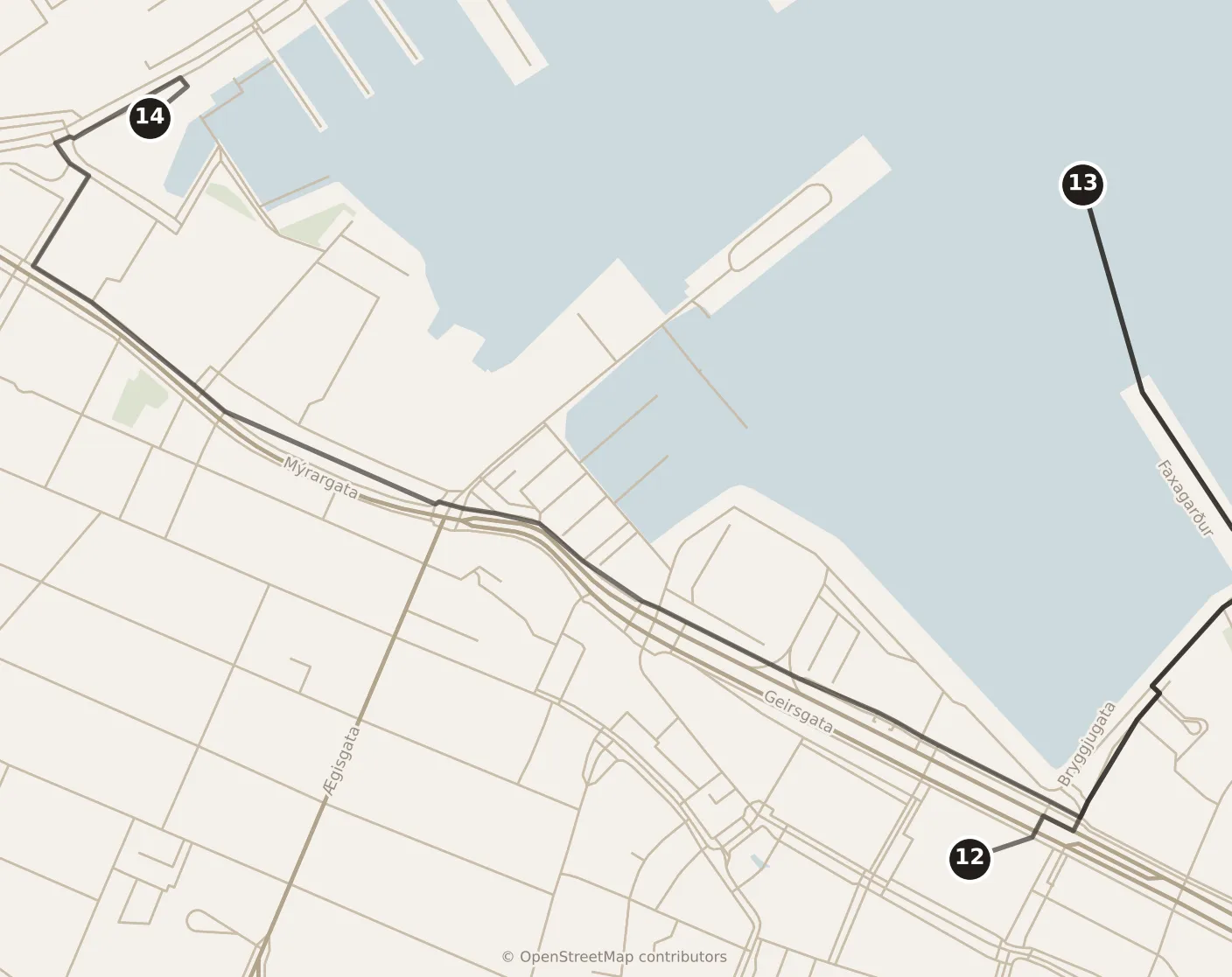
- Afternoon
- 12Kolaportið
- 13Reykjavík harbor
- 14Reykjavík Maritime Museum
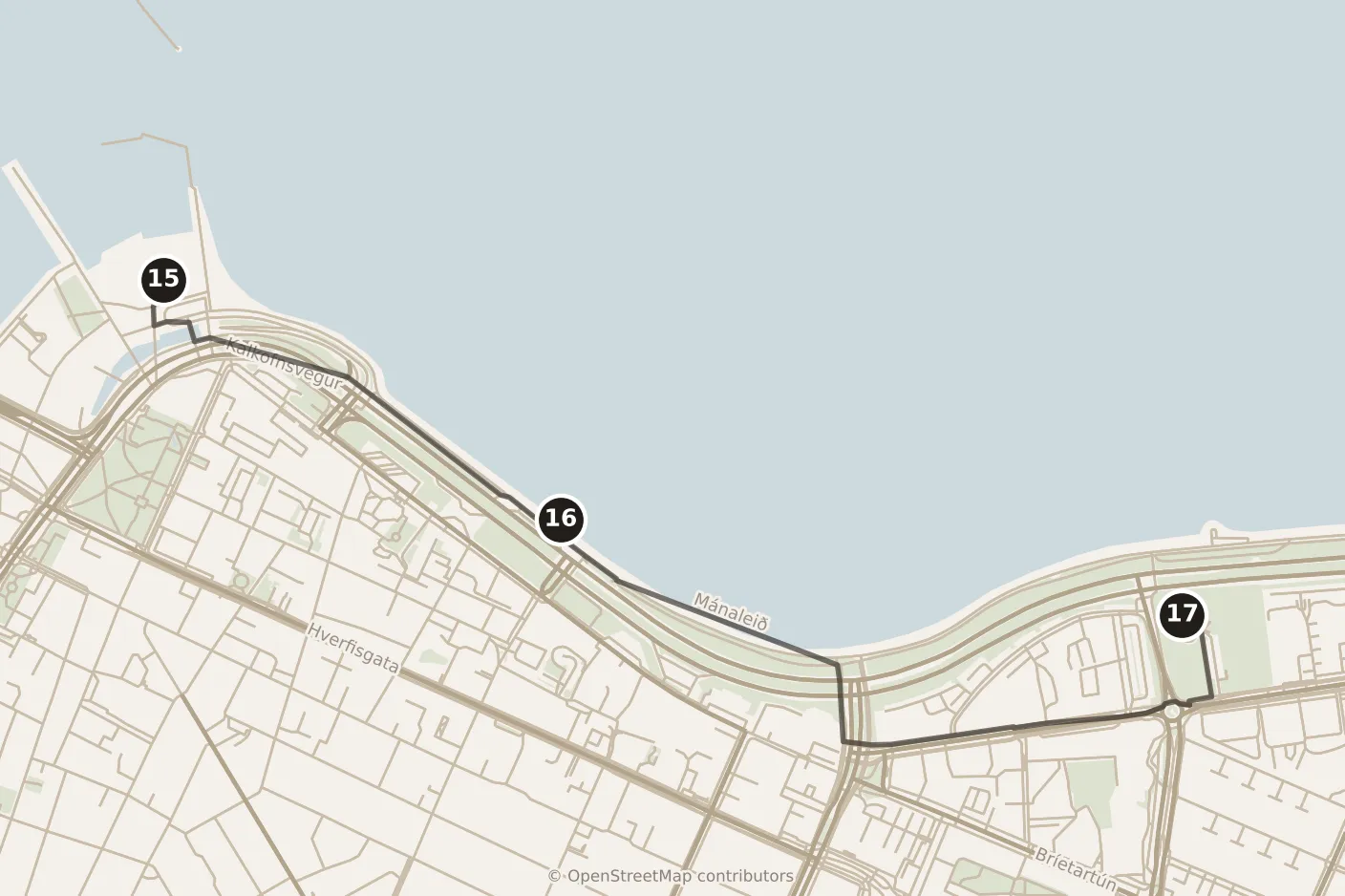
- Evening
- 15Harpa
- 16The Sun Voyager
- 17Höfði
The outdoor day. It is written for the long half of the year, roughly March to October; the last paragraph of this section rearranges it for the dark months, because as written it does not survive them. It goes uphill first, then down to the water, out to the end of the docks and back east along the shore, so you cross the harbor once and never return to a street you have finished with.
The hour it rests on is at the far end of it. In 2026 the guided visits aboard the old coastguard vessel moored at the maritime museum ran at one, two and three in the afternoon, daily from the first of March to the end of October, and it is the last of the three that this afternoon is built backwards from. Be at the church door at about ten and you walk into it. The chain, if you would rather check it than take it: the tour itself, three quarters of an hour in the museum before it, twelve minutes of quay, an hour and a quarter at the harbor with lunch inside it, eight minutes, half an hour in the market, thirteen minutes of hill. If the tour times have moved, count back from the new last one in exactly the same way.
Morning
Hallgrímskirkja first, and the tower rather than the church, which is a bare white room and takes five minutes. You go up by elevator rather than on foot, so the three quarters of an hour this stop takes is a line and a viewing deck rather than a climb, and on a summer late morning the line is most of it. What the tower is for is the shape of the place: from up there you can see that this is a town of small houses under colored metal, that it stops abruptly at the water on three sides, and that the long flat ridge of Esja on the far shore is what everybody here means by the weather. Go up before you look at anything below. One thing can take this stop away from you, and the whole afternoon hangs off it: this is a working parish church, and its own pages say access is limited while services, ceremonies and concerts are on. A Sunday morning is the date to check before you give the outdoor day to it — and to check again in the dark months, when this day starts at eleven.
Two minutes across the top of Skólavörðuholt is the Einar Jónsson Museum, a windowless concrete block the sculptor designed for himself and lived in. Jónsson worked almost entirely in plaster and gave up naturalism altogether after Rome, so what is inside is a hall of white symbolic figures — wave-riders, wrestling angels, allegories whose titles explain nothing — and it is either the strangest half-hour in Reykjavík or half an hour you did not need. You will know which within five minutes. Behind the house is a garden where those plasters have been cast in bronze and set out among the paths, and that is the half of the stop that does not depend on whether the door is open. Thirty minutes for both.
Then walk down Skólavörðustígur, which drops in a straight line from the church to the main street below, and treat it as a stop rather than a corridor: twenty-five minutes, because the makers’ shops along it — knitwear, ceramics, print, silver — are what the street is for, and the top block of it is painted end to end in rainbow stripes.
Afternoon
Thirteen minutes down and west is Kolaportið, in the old customs building by the water, and it exists only on the weekend — Saturday and Sunday, eleven to five, on Tryggvagata. Half an hour. It is the country’s best-known flea market, and the one thing genuinely worth buying there is a second-hand lopapeysa: the same knitted wool sweater the shops on Skólavörðustígur sell new, on a trestle table, at a fraction of the price. If your outdoor day falls on a weekday the market is simply not there — the day does not get shorter, the half hour goes into the harbor instead.
Eight minutes on is Reykjavík harbor, and lunch happens here, at about ten to one by the count-back above, because this is where the fish is landed. Take plokkfiskur if it is on — poached haddock and potato mashed together with butter and onion, with dark rye alongside — and take it standing at a counter rather than sitting at a table. An hour and a quarter with the meal inside it.
Twelve minutes west along the quay, past the slipway and the trawlers, is the Reykjavík Maritime Museum on Grandi, in a former fish-freezing plant, and it is the reason the second day goes this far. The permanent exhibition is a century and a half of the fishing industry, which sounds narrow and is in fact the whole economic history of the country in one room. Moored outside it is the coastguard vessel Óðinn, and the guided visit aboard her is the thing to be here for: she is one of the ships that cut British trawl warps in the Cod Wars, and the tour is told as that story, by people who take it personally. Three quarters of an hour in the building, then the tour, which is as long as they make it — reckon on another three quarters and adjust.
Evening
Seventeen minutes back east along the water — the longest leg of this day — is Harpa, the concert hall. Go in and go up the stairs; it is free, and twenty minutes is genuinely the whole of it, because the point is standing inside the glass rather than looking at it from the road. It is a working building and not a monument: the Iceland Symphony Orchestra plays here, and the name is both the word for a harp and the old Norse month that opens the summer.
Eleven minutes further east along Sæbraut, on the water side of the road, is The Sun Voyager. On a one-day route this is the climax of the whole thing; on a two-day route it is a pivot, and ten minutes is honestly all it needs. Stand so that the bay and Esja are behind the steel and the traffic is not.
Then fifteen minutes east again to Höfði, a small white timber house of 1909 standing alone on a lawn above the shore, where Ronald Reagan and Mikhail Gorbachev met over two days in October 1986. The summit failed, and it is generally reckoned to be the moment the Cold War began to end; the United States and Soviet Union flags hang crossed inside for it. You cannot go in — the city owns it and uses it for official receptions — so this is ten minutes outside a locked house, and it earns them only because the twenty-five minutes of shore road that brought you here is the best walk in Reykjavík. If the day is running short this is the first stop to go, and it goes ahead of everything else: dropping it saves the ten minutes standing there and about a quarter of an hour of the walking, because from the sculpture you cut inland instead. From Höfði it is ten minutes inland to Hlemmur, the bus interchange at the eastern end of Laugavegur, and dinner is anywhere down that street from there.
From November to February this day does not work as written, and the reason is arithmetic rather than taste: there are about four hours of light and the tower and the shore road both want them. Start at the church at eleven instead of ten, so that the sun comes up while you are in line or already on the deck, and then run the day in exactly the order above. Lunch at the harbor lands in the last of the light, the maritime museum is indoors and does not care, and Harpa and the sculpture happen after dark — which costs the sculpture something and costs Harpa nothing, since its glass is lit from the inside. Drop Höfði outright: it is a white house on an unlit lawn and there is nothing there to look at. The tours aboard the ship do not run in those months either, so the day loses its hinge and gains three quarters of an hour.
Local tip. In the dark half of the year the tower and the shore road are competing for the same four hours and you cannot give them to both. Give them to the tower. It is the only stop on this day whose whole value is being able to see across the bay, and the shore road is a walk that still works in the dark.
With a third day

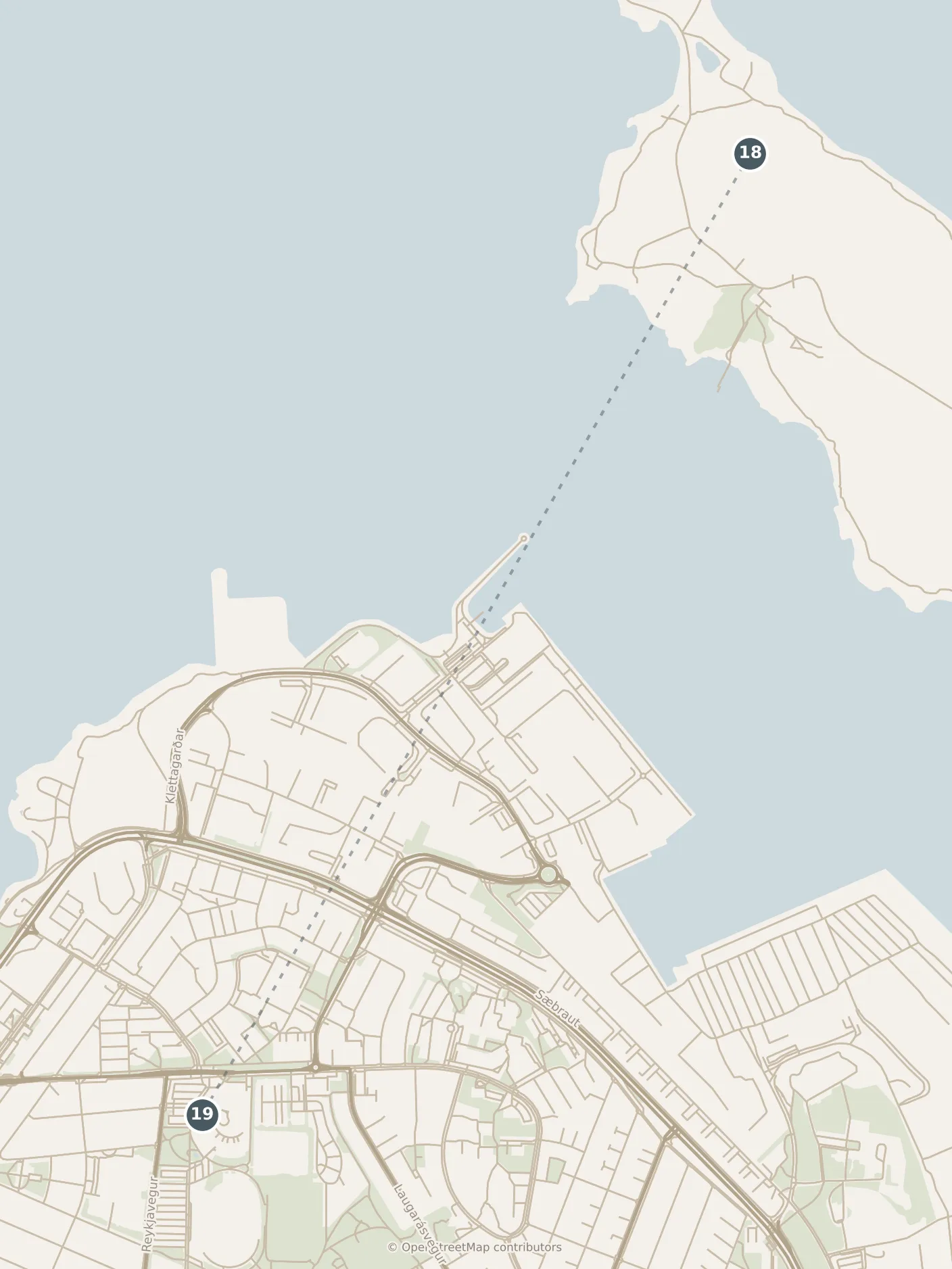
- With a third day
- Skarfabakki — in the prose, not on the map
- 18Viðey
- 19Laugardalslaug
Give the third day to Viðey, the island lying just off the eastern shore, and put it in the middle — as your second day, with the outdoor day moving to the third. The reason is not preference. It is the only one of the three days that something outside your control can cancel, because a small boat crossing an open sound does not sail in every wind, and a day in the middle has a spare day on either side to move to while a day at the end has none. Everything below still calls the two city days the indoor day and the outdoor day, whatever dates they land on.
What moves when you insert it: nothing inside the two city days. Their order was already free — the entire design is that you swap them by the forecast — and pushing the outdoor day back twenty-four hours changes nothing within it. What it can move is the calendar underneath, and that is worth working out on paper before you book. From the first of September to the middle of May the ferry runs only at weekends. The flea market on the outdoor day is also weekend-only. So a three-day trip in that half of the year with exactly one Saturday or Sunday in it cannot have both, and inserting the island day is what forces the choice. Give the weekend to the boat. The market is half an hour on a route that passes its door anyway; the island cannot be had on any other day, and losing it leaves the third day with nothing in it at all.
And when the weekend day is not your middle day — you land on a Thursday and the Sunday is your last, or on a Sunday and it is your first — the schedule wins and the buffer goes. Take the island on the day the boat actually sails, and accept that a canceled crossing then costs you the island rather than moving it, because there is no second sailing day to move it to. The middle slot is a preference; the sailing days are not.
The crossing from Skarfabakki takes five minutes. Skarfabakki is out by the container port, about forty-five minutes on foot east along the shore from The Sun Voyager, or a short ride on a Strætó bus paid with Klappið. From the first of June to the end of August there is a second boat from the old harbor in the middle of town, which takes twenty minutes and saves you the walk out. In the summer of 2026 the boats from Skarfabakki ran hourly from a quarter past ten in the morning until a quarter past five — and the winter weekend, which is the only weekend the boat sails at all, is a different day entirely: from the first of September to the middle of May the same schedule put the first sailing out at a quarter past one and the last one back at half past four. The crossing is five minutes, so that is a little over three hours ashore at the outside, and no morning on the island at all. The last one back is the deadline this whole day is built on, it is published on the operator’s own schedule, and you should read it before you sail and count the island backwards from it rather than forwards from the crossing out.
The island is 1.7 square kilometers of grass, low cliff and gravel track, and a full circuit is two to three hours unhurried — a summer figure, and one the winter boats do not allow: sailing at a quarter past one and landing five minutes later, with the last one back at half past four, leaves a little over three hours at the outside, and from November to January the light is gone by half past three, so a perimeter of low cliff and gravel finishes in the dark. The honest winter version is the near end of the island — the stone house, the church and the Peace Tower — and not the circuit. What is on it: Viðeyjarstofa, a squat stone house built in the 1750s to a design by the Danish court architect Nicolai Eigtved and usually called the oldest stone building in the country, with Viðeyjarkirkja beside it; Áfangar, nine pairs of basalt columns that Richard Serra set around the island’s perimeter in 1990, so that walking the edge is the work rather than standing in front of it; and the Imagine Peace Tower, Yoko Ono’s memorial to John Lennon, which is a beam of light thrown out of a stone well. One thing to know before you build the day around it: the beam is lit between the ninth of October and the eighth of December each year and on a small number of other dates, so on any ordinary day you are looking at a wishing well with words cut into it, and it takes four minutes. The stone house is the only building on the island you can go inside, and it keeps its own seasonal hours, so do not plan lunch around it — take something to eat, and wear the coat you brought for the shore road.
Come back and give the afternoon to Laugardalslaug, the largest pool in the city, twenty-five minutes’ walk south of Skarfabakki or one stop on the bus. Fifty meters, outdoors, heated, with a bank of hot pots and a steam room beside it, and it is the pool people from Laugardalur use. An hour and a half, and the shower rules from the indoor day apply here exactly as they do there. The whole third day comes to about five and a half hours from leaving the center to leaving the pool, with both crossings and the walk out to the pier inside that. On a winter weekend the shape inverts rather than shortens: the island becomes the short half, out at a quarter past one and back at half past four, and the pool afterwards is what fills the day.
If what you actually want is the country, take it instead — but take it honestly. The Golden Circle — Þingvellir, the geyser field where Strokkur goes off every few minutes beside the older vent at Geysir that gave its name to the word, and the falls at Gullfoss — is a coach loop that fills a whole day, sold by several operators, picked up at BSÍ and at the numbered coach stops in the center, and booked online before you fly rather than at a desk when you land. What it costs is not vague: most of the day is spent sitting down, and you give up the island, the big pool and any third day in the city at all. It is the right answer if you are not coming back to Iceland. It is the wrong one if you are.
The other thing weighed against a day in the city is the big geothermal lagoon out by the airport, and it is not a third day at all. It sits between Keflavík and the town rather than in either, it is sold as a booked timed slot rather than a door you walk up to, and the volcanic peninsula it stands on has closed it at short notice more than once since 2023 — so check it is open before you build anything on it. All of which makes it an arrival or a departure afternoon, taken on the way past, rather than one of these three days. And if what you want from it is hot water outdoors in bad weather, that is exactly what days one and three already give you, at a city pool’s price and with the etiquette you will by then have learned.
Practicalities
Booking. The ferry, and only in high summer, when a fine Saturday fills the boats; the rest of the year it is bought at the Skarfabakki pier on the day. Nothing on either city day takes a reservation of any kind — the tower ticket, the five museums and the pool are sold at their own doors, and the squares, the lake, the city hall, the harbor, Harpa, the sculpture and Höfði are free. The country day instead of the island is the exception: that one does want booking ahead in June, July and August.
Which day falls on which date. This is not a city whose week governs it. Its month does, and the two facts that actually move things are seasonal rather than weekly: the ferry runs daily only from the middle of May to the end of August and at weekends the rest of the year, and the visits aboard the ship at the maritime museum run only from March to the end of October. Against those, the weekday rules are short and worth stating exactly. The island day is the only one of the three that is pinned: from September to mid-May it has to be a Saturday or a Sunday. The indoor day and the outdoor day take any date and may trade places freely, with two things to look up — that permission is the point of them, and you should expect to use it. The first is the church: the tower the outdoor day opens on closes to visitors while services, ceremonies and concerts are on, so a Sunday morning is the one date worth confirming before you give that day to it. The second is whether any of the five museums keeps a weekly closing day in winter, which is a weekday matter like this one and is dealt with in the hours paragraph below. Two weekday details then ride along and neither is worth reordering a trip for: the flea market exists only on the weekend, which costs half an hour, and in 2026 the art museum in the warehouse was open into the evening on a Thursday, which is a lever rather than a constraint. The trap is a Monday-to-Wednesday trip outside the summer, which contains no weekend day at all: there is then no island day, and the third day is either the country or a second, slower pass at whatever you cut.
The dates that shut this city hardest are not weekdays, and there are more of them than most visitors expect. Five are fixed: the first of January, the first of May, the seventeenth of June — the national day, which also fills the square day one gives fifteen minutes to — and the twenty-fifth and twenty-sixth of December. One is a fixed weekday: the first Monday of August, which is the country’s largest domestic travel weekend. The rest move with Easter — Good Friday, Easter Sunday and Easter Monday, with Ascension and Whit Monday later the same spring. And two are half-days rather than days, the twenty-fourth and the thirty-first of December, when everything shuts at one in the afternoon: those do not cancel day one so much as halve it, since its shape is ten in the morning to seven at night. Check whether any of them falls inside your three days, and if one does, do not assume either day survives it: on those dates almost everything with a door shuts, and what is left on both is the squares, the lake, the harbor, the shore road and whatever daylight there is. Between the two, the dates that move with Easter and the twenty-fifth and twenty-sixth of December are the worse ones to give to the outdoor day, because the church it opens on is a working parish church holding services on exactly those dates, and the sculptor’s house, the market and the ship tour are shut behind it. The two half-days are the other way round: a one-o’clock shutdown still leaves day one three of its nine hours, while in the months when the outdoor day does not start until eleven it would keep about two.
Hours, and where to read them. The three collections on the indoor day and the two on the outdoor one publish their own hours; the settlement site and the maritime museum are both run by the Reykjavík City Museum, so they sit on one organization’s pages rather than four. The thing to look up rather than gamble on is whether any of them keeps a weekly closing day in winter, because that is exactly what changes here from season to season, and it is a five-minute check the night before. Start with the sculptor’s house on the outdoor day: it is the smallest of them, and the one whose opening days are least safe to assume. Most of these closures cost only their own time, on either day: an hour or two off the indoor day’s nine, or the sculptor’s half hour off the outdoor morning — and there the garden of bronzes behind the house is outside the door anyway, so half the stop survives the closure. The one that costs more than itself is the maritime museum, because the ship tour is the hour the outdoor afternoon counts back from; if that is the one shut on your date, run the afternoon forward from lunch instead and give the extra hour to the shore road.
What to cut, and in what order. The indoor day is the long one at about nine hours, and the first thing out of it is Hafnarhús. Cutting it brings the day to just under eight and costs you the painting rather than the country — the national museum is the stop that explains why any of this is here, and the art house is the pleasure. If you would rather not lose it, the Thursday evening opening is the lever: leave it out of the morning, start instead at the settlement houses, and walk fifteen minutes west from Laugavegur after dinner to finish there. That moves the pool to the end of the outdoor day, which finishes seven minutes from its door at Hlemmur; both days then come to about eight hours instead of nine and seven. On the outdoor day the first cut is Höfði, as the section says, and the second is the Einar Jónsson Museum, thirty minutes and the most easily missed thing in this article.
Weather, and the swap. The pair of city days is built to be reordered and you should expect to reorder it. If both mornings look equally poor, run the indoor day first anyway and accept that the other will be wet: its indoor spine is the maritime museum and the harbor lunch, two and a half hours that do not care about rain, and what you actually sacrifice is the tower, which is worth nothing in cloud. The Icelandic Meteorological Office publishes the forecast and the wind warnings on its own pages, and the aurora forecast beside them. That is the honest place for the northern lights in an article like this one: they are a forecast rather than a stop, nothing in these three days can be arranged around them, and from inside a lit city the move is to read that page each evening and walk out of the street lighting when it is good. Three winter nights is a lottery ticket, which is worth knowing before you book them for that reason. The shore road east of Harpa is the stretch to make the weather decision about, because it is the only part of these three days with no shelter on it at all, and there is no published wind speed at which it stops being walkable, so the call is yours.
Arriving and leaving. The airport coach from Keflavík sets you down at BSÍ, which is the closest thing this city has to a terminus. From BSÍ it is twelve minutes on foot into the middle of Laugavegur and a little over twenty to the harbor end where the indoor day starts. The same twelve minutes is what you need at the other end: whichever day is your last, it finishes inside the old town, and BSÍ is just south of it rather than across it.


.jpg)


,_Reykjavik,_Iceland.jpg)