Reykjavík in one day: the pool before the town opens, the tower, and the harbor while the light lasts

Last updated 4 August 2026
Overview
Reykjavík is the rare capital where one day is not a compromise about the city. It is a compromise about the country. Everything below is on foot and there is no transport in this day at all — no bus, no ticket, nothing to work out — because the whole visitor city fits inside a twenty-minute walk and the route comes to about six and a half kilometers across a dozen stops. The longest single stretch in it is the ten minutes at the very end, walking back out to the coach terminal.
What a single day costs you here is Iceland. The waterfalls, the geysers and the lagoon out on the airport road are day trips, and each of them takes the whole day and gives you a coach seat for a good part of it. Spend your one day that way and you will have seen the country and not the capital: a legitimate choice, and not this article. The second thing it costs you is the museums. The national collections are good, and they are the first thing to give up, because an hour indoors is the hour that would otherwise have bought you the harbor.
The light is the only thing here that genuinely has to be planned around, and it is not a detail you can carry over from anywhere else you have been. The sun goes down over Reykjavík as early as half past three in the afternoon in the days before Christmas, and at the other end of the year so late that for two weeks around midsummer it does not go down until after midnight — the sunset falls on the following day’s date, which is a fair warning that this is not a city where you plan around a sunset hour. In the third week of December the whole of the usable light comes to about four hours, which is enough for this route only if you spend it on the right half of it. So from November to February the day below wants turning inside out, and the rule is one line: give the light to the water and to the tower, and the dark to everything with a roof. Start at the pool as written. On a weekday the two indoor stops go in the dark before the sun is up: in 2026 the city hall opened at eight, and in the third week of December the sun does not clear the horizon until a quarter past eleven, so the hall and the longhouse both fit before it, and the light when it comes goes to the harbor and the shore road. On the weekend that is not possible — the hall opened at ten on a Saturday and at noon on a Sunday — so on those two days take the water first, harbor and shore road and sculpture, and put the city hall into the dark that follows, since it stays open until six; the longhouse goes wherever its own hours allow, which is the thing to look up before you fix the order. Either way the tower goes last, and you leave the sculpture an hour before your month’s sunset or an hour before the tower closes, whichever comes first: in the winter of 2026 the tower shut at five, and by the end of February sunset is not until a quarter to seven, so it is the closing that binds and not the sun. That hour is the walk up plus the three quarters of an hour the tower is worth. The roofs are still colored in that hour and the lamps are coming on, and it ends better too: from the church door the terminal is seven minutes downhill instead of ten. From April to September nothing forces any of it and the order below stands as written.
Reckon on about seven hours from leaving the terminal to standing at the sculpture, walking included, and about half an hour less on a weekday, when the flea market is shut. That number models the time you spend inside the places and on the sidewalk between them and it models nothing else — in particular it does not model the weather, which here is a scheduling problem rather than a mood. Wind-driven rain arrives and clears in the same hour in any season, and the twenty minutes you spend waiting it out under an awning is time this count knows nothing about. Build in one such gap and the day still works.
There is no railway station in Iceland, so the familiar answer to the bag — the lockers at the station you arrived in — does not exist here. The airport coaches run to and from the BSÍ terminal, ten minutes south of the center on foot, and whether it will hold a bag is the one thing to establish before you commit to this route, because two stops turn on it. The first is the pool: a changing-room locker takes a rucksack and a swimming costume, not a suitcase, and the pool is both the first stop and the most Icelandic hour of the day. The second is the harbor, where the last few hundred meters are open quay with the wind coming straight off the bay, which is no place to be towing anything. Nothing published settles whether the terminal will hold one, so ask rather than assume: its own address forwards to the coach operator’s site, and that site says nothing about left luggage, so it goes to the operator you book the airport transfer with, and the moment to ask is when you book it. If the bag has nowhere to go, there is still a whole day here and this is it: start at the church, seven minutes uphill from the terminal, and take the tower, Skólavörðustígur, Austurvöllur, the city hall, the lake, the longhouse and the market in the order below; then the harbor, where you eat at the near end and skip the walk out along the open quay; then Harpa, the sculpture and Laugavegur exactly as written. That is about six hours instead of seven, it ends in the same place, and what it costs you is the best hour of the day and nothing else.
The day

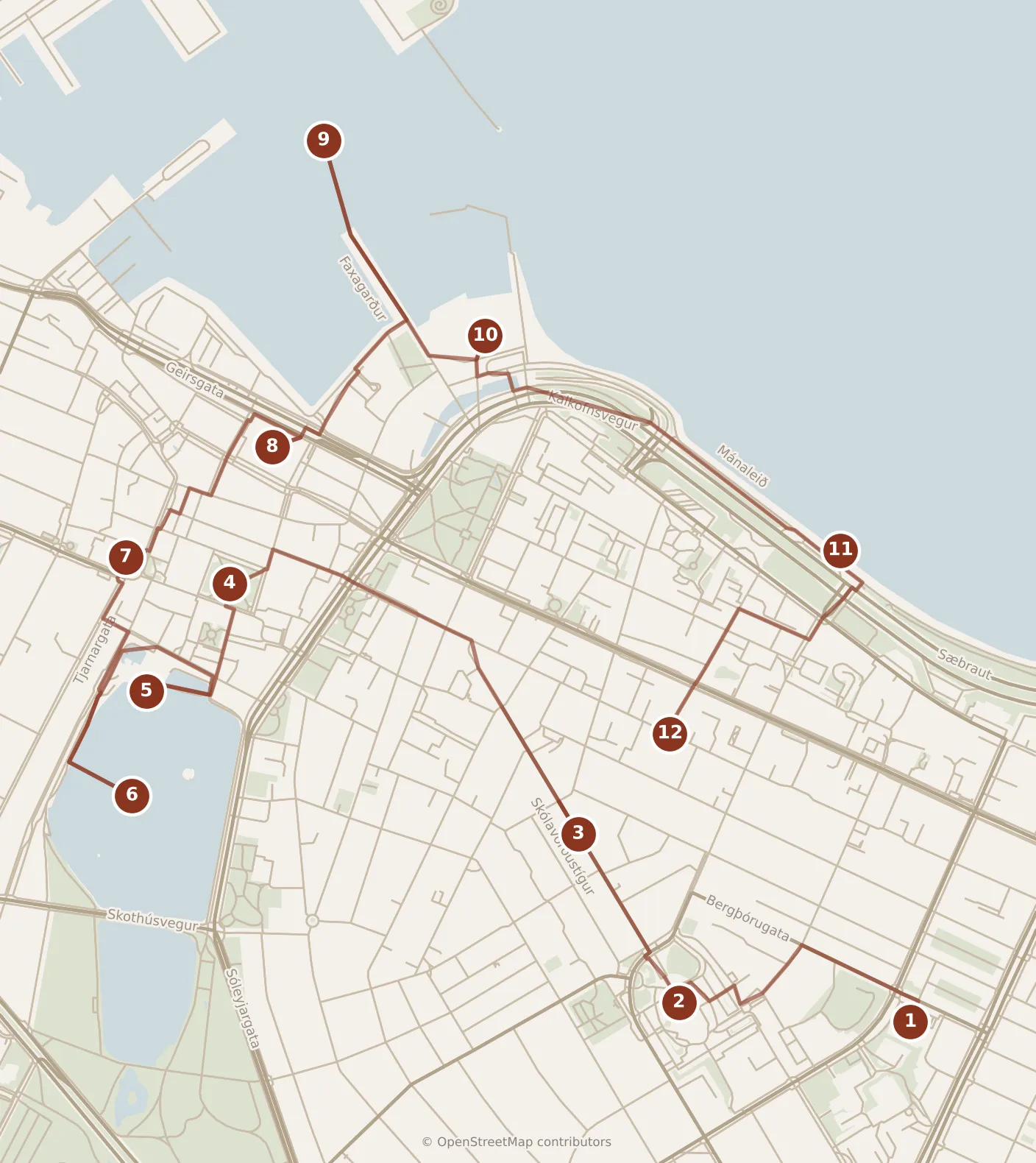
- The day
- BSÍ Bus Terminal — in the prose, not on the map
- 1Sundhöll Reykjavíkur
- 2Hallgrímskirkja
- 3Skólavörðustígur
- 4Austurvöllur
- 5Ráðhús Reykjavíkur
- 6Tjörnin
- 7The Settlement Exhibition
- 8Kolaportið
- 9Reykjavík harbor
- 10Harpa
- 11The Sun Voyager
- 12Laugavegur
Morning
Two doors decide this morning, and in 2026 they stood three and a half hours apart on a weekday and two on the weekend. Sundhöll Reykjavíkur, the old city pool, opened at half past six on weekdays and at eight at the weekend; Hallgrímskirkja, seven minutes uphill from it, opened at ten through the winter months and an hour earlier at the height of summer. That gap is the whole reason the pool goes first. It is not an ornament at the start of the day — it is what there is to do with the hours before the town opens. Build the morning forward from the pool’s door and the rest of the day forward from the church’s, and if either hour has moved by the time you read this, build it the same way from the new ones.
The pool is eleven minutes’ walk from the terminal, and it is the one stop on this route that is not a sight. It opened in 1937, designed by the architect who also drew the church you are about to climb, and it is still a working neighborhood pool: a twenty-five-meter indoor hall under high windows, and outside it a second pool, hot pots, a cold tub and a sauna added in a 2017 extension. Icelanders use the hot pots the way other cities use a café — in them nobody is doing lengths, everyone is sitting in water hot enough to stay in for half an hour, talking. Give it an hour, which is enough for the shower, twenty minutes outside and a slow change. The etiquette that goes with it is strict, and it is in the city guide.
Seven minutes uphill is Hallgrímskirkja, which is not a cathedral and not old — a parish church finished in 1986 after four decades of building, its front elevation stepped in concrete columns after the basalt formations that fold out of the ground all over this country. Guðjón Samúelsson designed it; the statue of Leifur Eiríksson standing in front of it is older than the church behind it, a gift from the United States in 1930 for the thousandth anniversary of the Alþingi at Þingvellir. Inside there is almost nothing, which is the point, and the reason to be here is the tower. From the top the whole low-rise city lies out below in red, green and blue metal roofs, the harbor beyond it and the flat-topped Esja across the water to the north. Give the church and the tower together three quarters of an hour, most of it up top.
Then walk down Skólavörðustígur, the straight street that runs from the church door to the main shopping street below. This is a stop rather than a corridor: it is the one street in the city where the shopping is worth your time — knitwear, ceramics, printmakers and jewellers, much of it made by the person at the counter — and the block below the church is painted across in rainbow stripes, which began as a temporary thing for the city’s pride march and stayed. Twenty minutes, not five.
At the bottom the street runs into Bankastræti; follow it downhill and west for about nine minutes into Austurvöllur, a small grassed square with a statue of Jón Sigurðsson in the middle of it. Along one side stands Alþingishúsið: the parliament house, put up in a single year and opened in 1881, built of hewn Icelandic dolerite, dark, low and no grander than a provincial bank. That is the fact worth standing there for. The Alþingi was founded at Þingvellir in 930 and is the oldest parliamentary institution in the world, and it governs a country of fewer people than a mid-sized European town from a building you could walk past without looking up. In 2009 the square in front of it filled with people banging saucepans until the government resigned. Fifteen minutes.
Afternoon
Four minutes south-west is Ráðhús Reykjavíkur, the city hall, finished in 1992 and built out over the water on concrete piers so that one wall of it stands in the lake. Walk in — it is a public building, free, warm, and the reason to enter is the enormous three-dimensional relief model of Iceland laid out inside, big enough to walk around, on which every fjord, ice cap and interior track you might have been arguing about becomes obvious in ninety seconds. Fifteen minutes here is worth more than an hour with a map.
Step out onto the lake side of the building and walk a few minutes along Tjörnin before turning back. The lake is small, ringed by wooden houses and the older villas, and it is thick with birds all year because a corner of it is kept from freezing. Ten minutes, and the point of it is the view back at the city hall from along the water.
Seven minutes north brings you to Aðalstræti and The Settlement Exhibition, which is the stop that explains why there is a city here at all. It is built underground around the oval wall of a Viking-age longhouse, dug out in 2001 and left exactly where it was found. The hall was lived in from about 930; beside it is a fragment of turf wall older still, built before the layer of volcanic ash of 871 settled over it, and that ash layer is the line Icelandic archaeology counts everything from. What you get is the actual footprint of the first farm on this ground, at the size it really was, with the long fire pit down the middle. Give it three quarters of an hour and take the room slowly rather than reading every panel.
Five minutes on, in an old customs building by the water, is Kolaportið, the city’s flea market. Half an hour is plenty: it is trestle tables of second-hand wool, books, vinyl and old tools, and at the food end the traditional counters where the fermented shark is sold to be dared rather than eaten. It is the one stop on this route that exists only on the weekend: Saturday and Sunday, from eleven in the morning in 2026, at Tryggvagata 19 — which matters for the winter order, where the route reaches this part of town before the doors open. If your day is a weekday you lose nothing but half an hour, which goes into the harbor instead.
Another five minutes and you are on the Old Harbour, which is still a working one: trawlers, ice, gulls, whale-watching boats at the near end and the coastguard vessels beyond. Lunch goes here and it lands late on this route, which is deliberate — this is where you want to be eating fish, and if plokkfiskur is on, take it: the mash of poached haddock, potato, onion and butter that every household makes differently, with dark rye beside it. Give the harbor an hour and a quarter with the meal inside it, and spend the spare twenty minutes walking out along the quay rather than sitting.
Local tip. The pool and the tower are the two paid stops of the morning and they answer to opposite weather, so if the sky has already decided your day, let it choose between them. The tower is worth its ticket only when you can see across the bay to the Esja. The pool is the better answer in horizontal rain, for the obvious reason that you are already in the water.
Evening
Eight minutes east along the water is Harpa, the concert hall: a steel frame filled with faceted glass cells whose geometry comes from the same basalt columns the church front is quoting, designed with Ólafur Elíasson and opened in May 2011. The story is in the date. Building started in 2007, the banks went down in 2008 with the shell half up, and the government decided to fund the rest of it anyway — for several years it was the only construction site in the country. You can walk in and up the stairs for nothing. Twenty minutes, and the glass is better from the inside looking out.
Then twelve minutes east along Sæbraut, the shore road, keeping to the sea side of it, to The Sun Voyager. It is a polished steel skeleton of a boat on a low plinth at the water’s edge, and almost everyone is told it is a Viking ship. It is not: Jón Gunnar Árnason called it Sólfar, a dream vessel and an ode to the sun, and he did not live to see it unveiled in 1990. Ten minutes is the whole of it, and they are better spent standing so that the bay and the Esja are behind the steel rather than the road — and this is the last thing on the day that wants daylight.
From there it is seven minutes inland and uphill to Laugavegur, the long shopping street, and this is where the evening goes. Dinner here will cost more than you expect; the cheap and entirely respectable alternative is a pylsa from a stand: the hot dog is mostly lamb, with pork and beef in it, and taken with everything it arrives under fried onion, raw onion, ketchup, sweet brown mustard and remoulade, eaten standing up. Skyr is what you buy from a supermarket or a convenience store on the way for the coach. If you are catching one, BSÍ is about ten minutes south on foot from the middle of Laugavegur, and that walk is the longest uninterrupted stretch of this day — nearer a quarter of an hour if you have come from the far eastern end at Hlemmur, and more if you are going back for a bag.
Practicalities
Nothing on this route has to be booked, in any season, and that is worth saying plainly to a reader holding nothing: the pool, the tower, the longhouse and the flea market are all walk-up, and the squares, the lake, the city hall, the harbor, the concert hall and the sculpture are free. The one thing this day asks you to have with you is a swimming costume and a towel, and the shower etiquette that goes with them — which is not a formality here — is in the city guide, along with the airport coach and how the fares work. The only ticket worth pricing is the pool: a single adult admission at a city pool was in the fifteen-hundred-krónur range in 2026, which is the cheapest hour on this itinerary by a distance and the one most worth its money.
Four stops keep hours of their own, and they fail in different ways. The flea market is the easiest to plan for because it is not a closure but an existence: it is a weekend market, so on a weekday it simply is not there, and the half hour goes into the harbor. The city hall is the second, and the calendar is not what fails there: it is open every day of the week, later on the weekend than on a weekday, so a Saturday costs you nothing. What fails is the room. The relief model stands in the western half of Tjarnarsalur, and Tjarnarsalur is let out for events, which puts the model behind a closed door on a day the building itself is open. If it is out of reach you lose the relief map and keep the lake, which is the better half of that stop in daylight anyway.
The church is the third and the one to check before you fix the order. It is a working parish church, so services come first and Sunday morning belongs to the congregation, and the tower has both its own ticket and its own hours. The ticket is sold at the door and there is no timed or online entry to buy in advance; the hours are the church’s own and it publishes them itself, which is where to read them, because they move with the season and shorten sharply in winter. If the tower is shut when you arrive, the day survives it: go in, look at the front from the bottom of Skólavörðustígur, which is where it is best seen anyway, and put the three quarters of an hour into the harbor, where the Esja fills the view from the quay and costs nothing. The longhouse is the fourth, and it is the one to look up rather than gamble on: it is a museum, so it keeps museum hours and may keep a weekly closing day, and it is the only stop here that cannot be half-seen from the sidewalk outside it. Its hours belong to the city museum that runs it and are published on that museum’s own pages rather than posted anywhere you will walk past, so read them the night before instead of finding out at the door. If it is shut there is no substitute for it and none is worth inventing — the time goes to the harbor, which is where the rest of this day already wants to be.
Everything on this route is walked, so what you wear decides more than what you book. There is no shelter on the quay and none on the shore road, the wind off the North Atlantic is a category of its own, and the two exposed stretches of the day are the shore road out to the sculpture and the walk back out to the terminal — at about seven hundred meters each, the two longest legs of it as well; the walk into Austurvöllur is shorter than either and has buildings on both sides. Read the national met office’s forecast before you commit to the shore road: nobody publishes a wind speed at which it stops being walkable, so that call stays yours. Waterproofs and shoes you can stand in for six hours, in July as much as in January. Nothing else about this day needs planning: it is a dozen stops inside about a kilometer and a half of city, and once you have started it you will not need a map again.


