Quito in two or three days: the old town, the cable car and the equator

Last updated 14 October 2026
Overview
Quito is a long, narrow city laid along a valley at about 2,850 meters, with the volcano Pichincha standing over its western side. That shape decides the trip. The colonial old town, one of the first places put on UNESCO’s World Heritage list in 1978, is compact enough to walk in a day; almost everything else worth your time is spread along the valley or up the slopes, and is reached by taxi. So day one is on foot in the old town, day two goes up the mountain and across to the north-east of the city, and a third day leaves the valley for the equator.
The order is not only geography. It is altitude. Day one is deliberately the gentle one: you are walking at the city’s own height, and most visitors feel it on stairs and slopes for the first day or two — short of breath, a headache, a slower pace than at home. Day two takes you up the cable car to close to 4,000 meters, which is the wrong thing to do on the day you land. Do not swap them.
Daylight is easy to plan around here, because the city sits almost on the equator and the evening barely moves through the year: the sun sets from just after six in late October to just after half past six in early February. Both days below count backwards from that, and from the other fact a local takes for granted — the mornings are the clearer half of the day, and the cloud tends to build over the mountain as the afternoon goes on.
A reader arriving by air lands well outside the city; the drive in from the airport is an hour or more by taxi, longer in the evening traffic, and the parent guide covers the alternatives. If you are sleeping in the new town, the one useful thing to know before day one is that the metro stops at La Alameda, about ten minutes’ walk uphill to the basilica where the day starts, and at San Francisco, under the old town’s great church square.
Day one

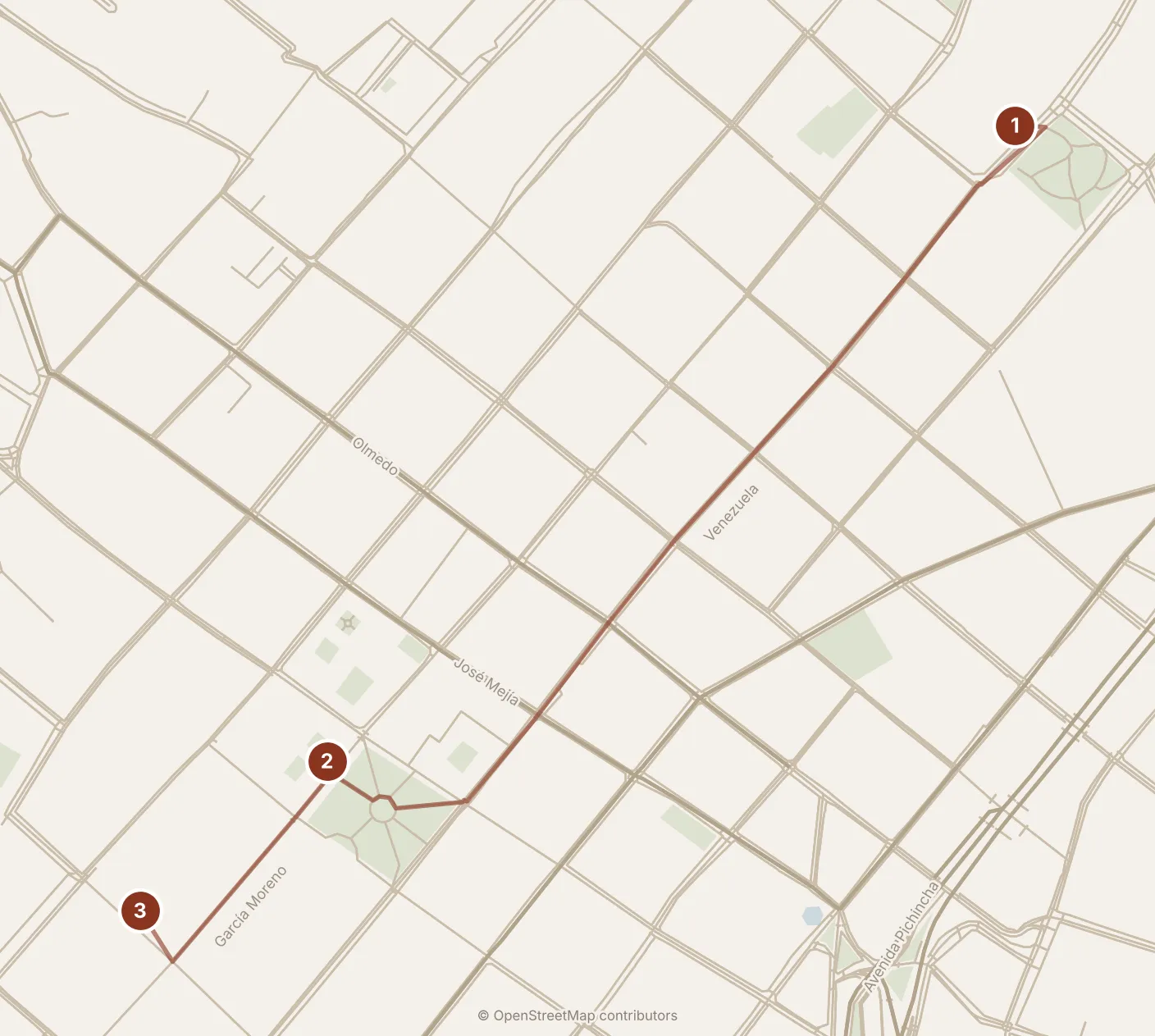
- Morning
- 1Basílica del Voto Nacional
- 2Plaza Grande
- 3La Compañía
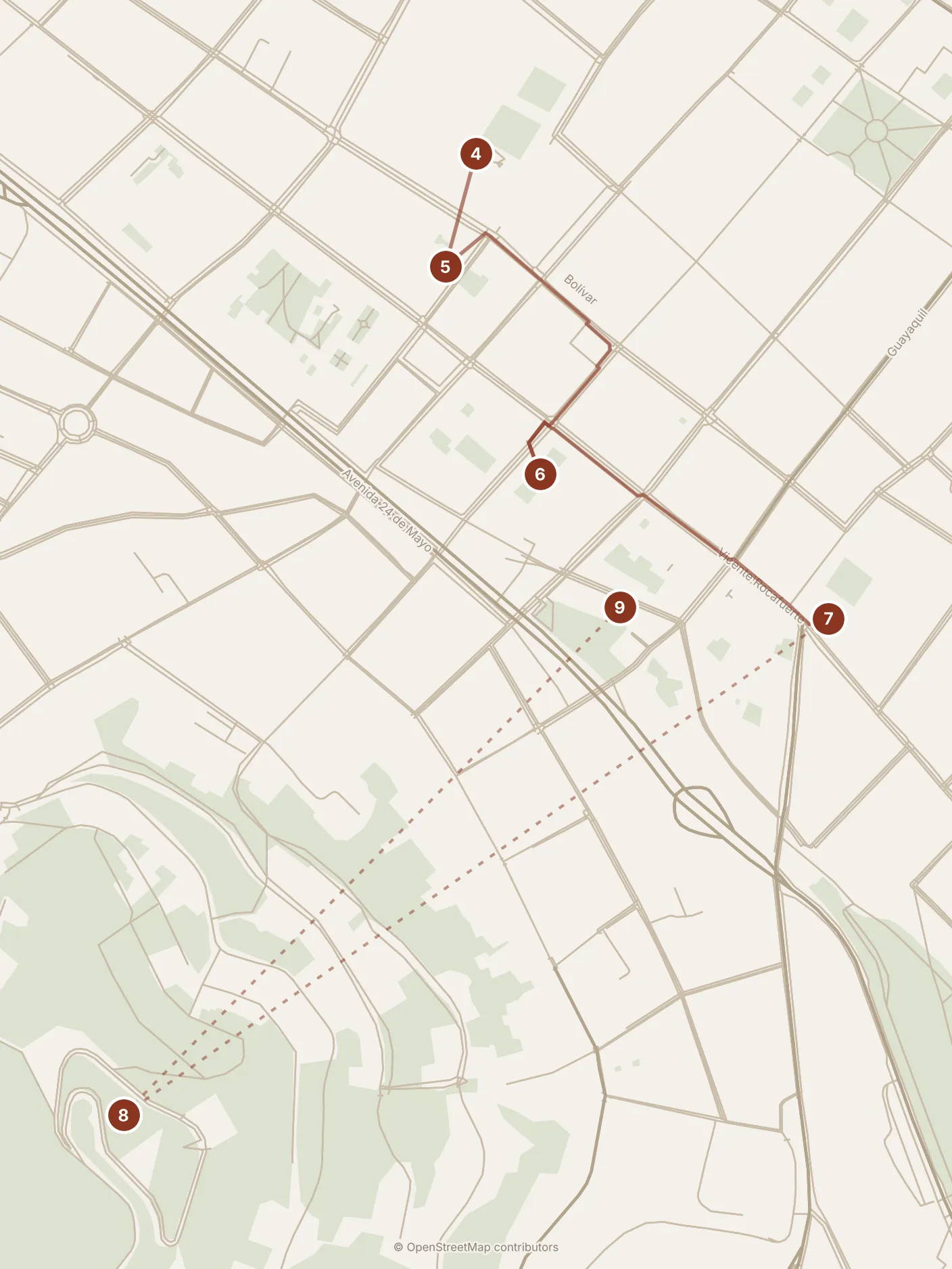
- Afternoon and evening
- 4San Francisco
- 5Casa del Alabado
- 6Museo de la Ciudad
- 7Santo Domingo
- 8El Panecillo
- 9La Ronda
Everything today is in the old town, and everything until mid-afternoon is within a few minutes’ walk of the next thing. It is a day of churches, two museums and a lookout, and the one stop it is built around is the last one, the hill of El Panecillo, which wants daylight and which you should be off before dark.
Work backwards from that. The stops below come to about seven hours, counting lunch and the hill itself, and you want to leave the hill around an hour before sunset — so start at the basilica by about half past nine, earlier if you like slack. The sum does not include the one thing that will stretch it: the altitude. On a first day, every staircase and every uphill block costs more than it looks, and the old town is full of both.
Morning
Start at the Basílica del Voto Nacional, at the north-eastern edge of the old town, a neo-Gothic church begun in the 1890s and consecrated nearly a century later. Look up before you go in: the gargoyles are not demons but Ecuadorian animals — tortoises, iguanas, armadillos, condors. The reason to come first, though, is the climb. You go up inside the towers by stairs and then by steep iron ladders, and part of the way runs along a narrow walkway above the vault of the nave. The view from the top is the whole old town laid out south of you, with El Panecillo and its statue at the far end — the route you are about to walk, seen in one look. Give it an hour, towers included. The ladders are genuinely steep, they are hard with a bag, and on a first day at altitude the right pace is slow; if heights trouble you, the nave and the gargoyles alone are worth the visit.
From the basilica, walk south-west to the Plaza Grande, about a quarter of an hour. This is the square the city was laid out from: the presidential palace, the Carondelet, on one side, the archbishop’s palace opposite, and the cathedral along the south. The cathedral holds the tomb of Sucre, the general who won the battle on the slopes of Pichincha in 1822 that ended Spanish rule here. Give the square and the cathedral three quarters of an hour; the square itself, with its benches, shoeshines and pensioners, is as much the point as the interior.
Then La Compañía, four minutes south-west along García Moreno. The front is carved volcanic stone; the inside, built by the Jesuits over more than a century and a half from 1605, is covered almost entirely in gold leaf, walls, vault and altars together. It is the reason many people come to Quito, and it is not a long visit: half an hour is enough to stand in it properly. The church has asked visitors not to photograph the interior; read the sign at the door rather than finding out from an attendant.
Afternoon
Eat lunch in the blocks around you — this is the part of the city for a bowl of locro de papa, the potato soup served with cheese and avocado, or a plate of hornado, slow-roasted pork. Give it an hour.
Then San Francisco, four minutes on from La Compañía, across the broad cobbled square of the same name. The Franciscans began building here in the 1530s, within a year or two of the Spanish founding of the city, and the result is one of the largest colonial religious complexes in the Americas: the church, and behind it the convent, its cloisters and its museum of the Quito school of colonial painting and sculpture. Give it an hour; if you have to cut, keep the church and one cloister and skip the upstairs rooms. The metro station named after the square opens onto it.
Two minutes away, just off the square, the Casa del Alabado is a restored colonial house holding pre-Columbian pieces — pottery, stone, gold — arranged by theme rather than by culture, so you read the room as a set of ideas about the dead, the shaman and the body rather than as a timeline. It is the old town’s counterweight for anyone who has only seen colonial Quito so far. Give it an hour.
Six minutes south, the Museo de la Ciudad occupies a hospital founded in the sixteenth century and still treating patients until the 1970s; it tells the city’s history through its building as much as its rooms. It is the optional stop of the day — take it only if the morning has run to time.
Five minutes east is Santo Domingo, the church and square at the southern end of the old town. Look at the square, step into the church for its painted ceiling and gilded side chapels, and then get a taxi for the hill.
El Panecillo is the rounded hill that closes the old town to the south, crowned by a winged Virgin made of aluminum plates and raised in the 1970s, copying a small eighteenth-century carving by Bernardo de Legarda. From the top the city runs away north up the valley under Pichincha, and you see how thin and long it really is. Give it three quarters of an hour. Go up and come down by taxi, and ask your driver to wait or come back: the staircases that climb the hill from the old town are the one walk in this article not to make, and the standard advice given to visitors.
Local tip. If the day has run long, drop the Museo de la Ciudad before anything else, then the upstairs of the San Francisco convent. The hill is the one stop that cannot move to later, because later is dark.
Evening
The taxi down from El Panecillo can drop you at La Ronda, the narrow colonial street just below the hill on the south side of the old town, a few minutes from Santo Domingo. Its houses have wooden balconies over the cobbles, and in the evening it is where people come for empanadas and for canelazo, the hot cinnamon drink taken with or without a measure of cane spirit. It is at its busiest at the end of the week and can be close to empty early in it. If you are sleeping in the new town, take a taxi back rather than walking it — the distance alone is the reason.
Day two

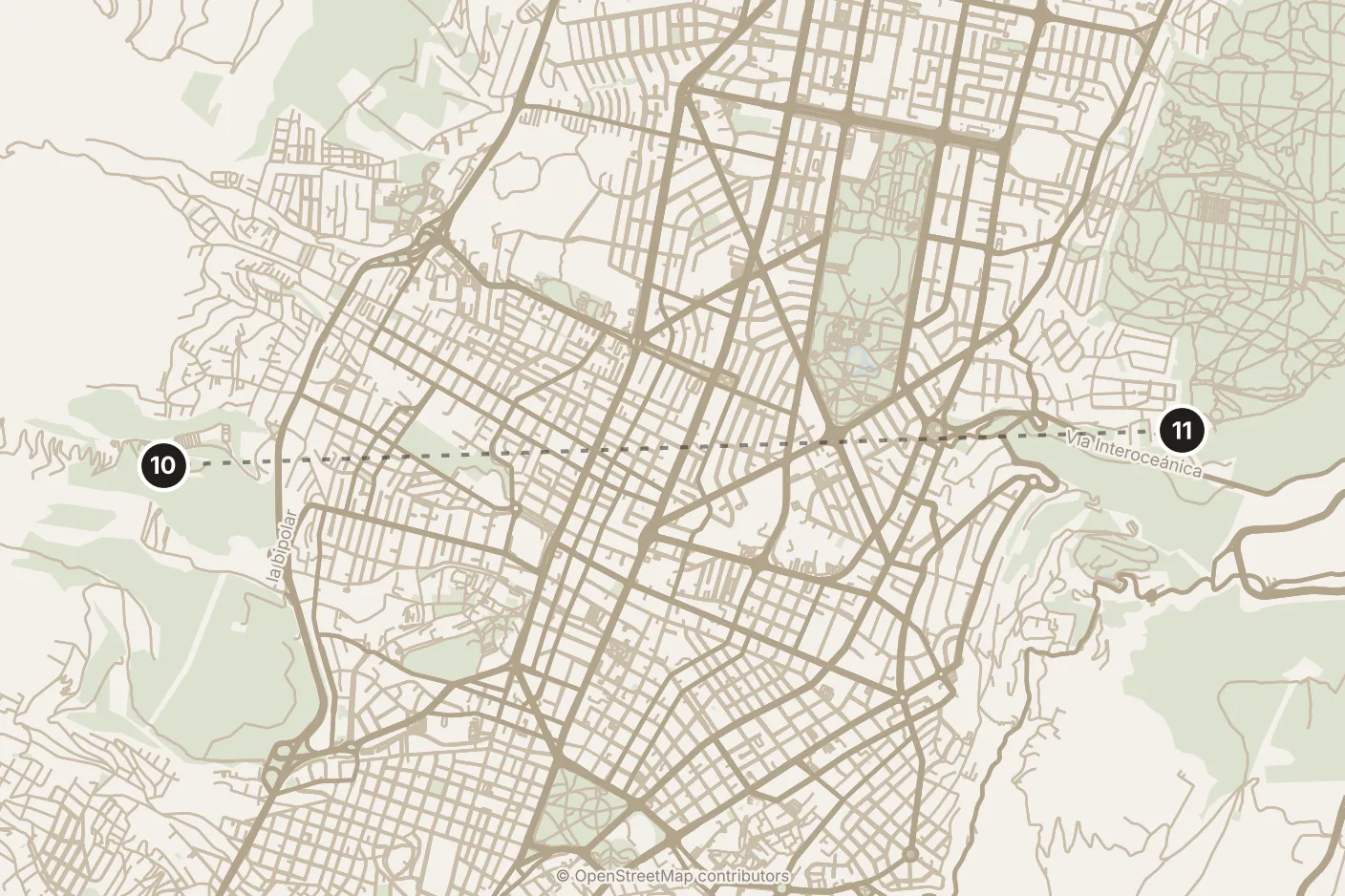
The ride on to stop 11, by taxi, not on foot.
- Morning
- 10TelefériQo
- Cruz Loma — in the prose, not on the map
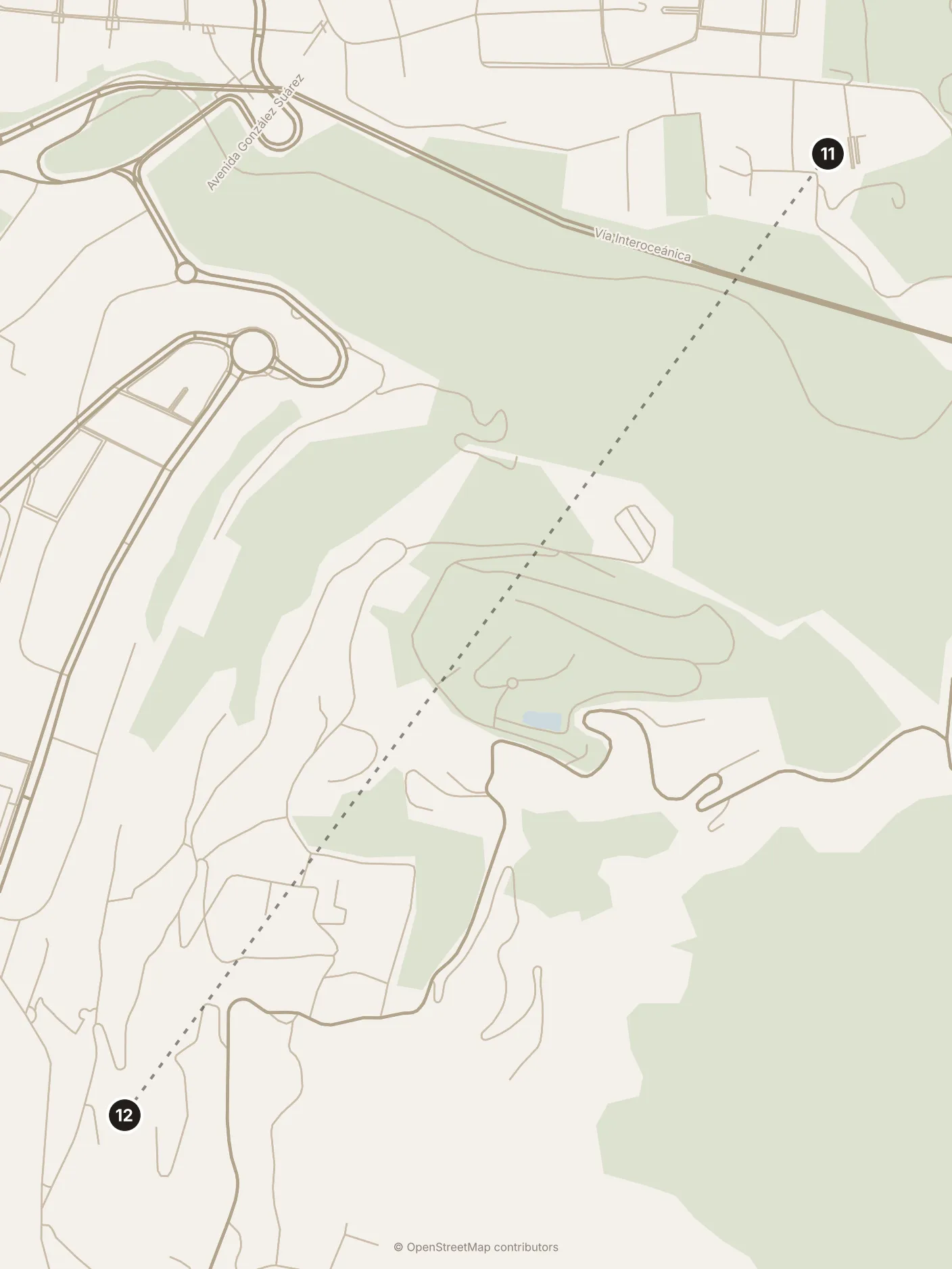
- Afternoon
- 11Capilla del Hombre
- 12Guápulo
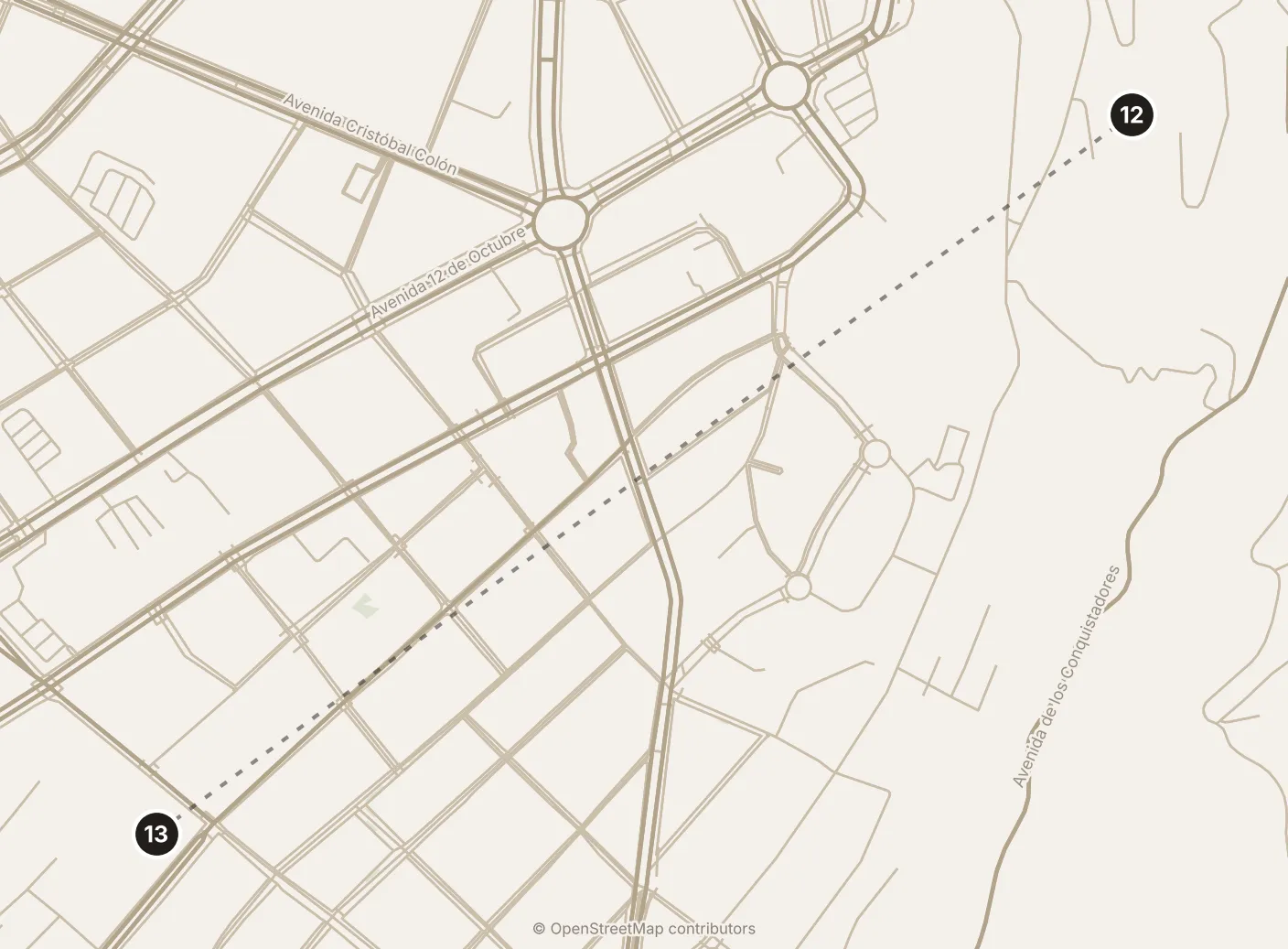
The leg out of the center: from stop 12 by taxi, not on foot.
- Evening
- 13La Floresta
Today is the mountain in the morning and the city’s great painter in the afternoon, and almost every leg of it is a taxi: the stops are spread across the valley, and nothing would be gained by walking between them. The one moment that does not wait is the first. The cable car is only as good as the sky, and the sky is clearest early, so go as close to the opening as you can — the TelefériQo publishes its hours itself; read them the day before and build the morning forward from whatever they say.
Morning
Take a taxi to the TelefériQo, the cable car on the city’s western slope, above the new town. The cabins climb the side of Pichincha from a base station already well above the city to Cruz Loma, the upper station at close to 4,000 meters. The ride itself is the first reward: the city drops away below you and you see it whole, a strip of roofs from one end of the valley to the other, with the other volcanoes of the Andean line beyond it on a clear morning.
At Cruz Loma there are paths along the ridge, a small chapel, and the open moorland of the high Andes — grass, wind, the first sight of what the country is above the cities. Give the top an hour and a half including the rides, and walk slowly. You are some 1,100 meters above where you slept, and that is where a first-day visitor gets into trouble; a short walk along the ridge is the right amount. The trail on towards the summit of Rucu Pichincha is a serious high-altitude hike of several hours, not an extension of this morning, and nothing in this itinerary asks you to make it. Bring a warm layer whatever the weather below: the top is cold and the sun is strong at once.
If the mountain is in cloud when you wake, do not go up into it. Swap the morning instead: take a taxi to the Casa de la Cultura by Parque El Arbolito, close to the El Ejido metro station, where the national museum holds the country’s archaeology — the Valdivia figurines from the coast, among the oldest pottery in the Americas, a room of pre-Columbian gold — and its colonial painting. Give it two hours, and the afternoon below runs exactly as written. The cable car moves to the next clear morning, including the morning of a third day.
Afternoon
Have lunch in the new town on the way across — the taxi down from the cable car passes through it — and give it an hour.
Then a taxi across to Bellavista, the hill on the north-eastern side of the city, for the Capilla del Hombre. Oswaldo Guayasamín, the country’s best-known painter, designed it as a chapel to the people of Latin America and did not live to see it: it opened in 2002, three years after his death. Inside, under a single dome, are the large canvases of his later work — the conquest, forced labor, grief, mothers holding children — painted in the hard, angular style that made his name, at a scale that makes the room feel like a church in more than its shape. His house stands on the same grounds and is part of the visit. Give the chapel and the house two hours together, and do not rush the chapel for the house: if one has to be short, it is the house.
From Bellavista a short taxi ride takes you to the lookout above Guápulo, a village-like neighborhood that falls steeply down the side of the valley to a white seventeenth-century church at the bottom. The view from the top, across the valley to the east, is the reason to come; the descent is a set of stairs and steep lanes, short on the way down and much harder on the way back up at this height. Go down to the church if your legs allow and take a taxi back up from the bottom if they do not. Give it an hour. If the afternoon has run short, Guápulo is the stop to drop — the day is the cable car and the chapel, and this is only the view between them.
Evening
La Floresta, the residential neighborhood on the ridge above Guápulo, is where to end the day: quiet streets, small places to eat and drink, a crowd that lives in the city rather than visits it. It is a short taxi from the bottom of Guápulo, or a steep climb from the top of it. Take a taxi home at the end of the evening.
With a third day

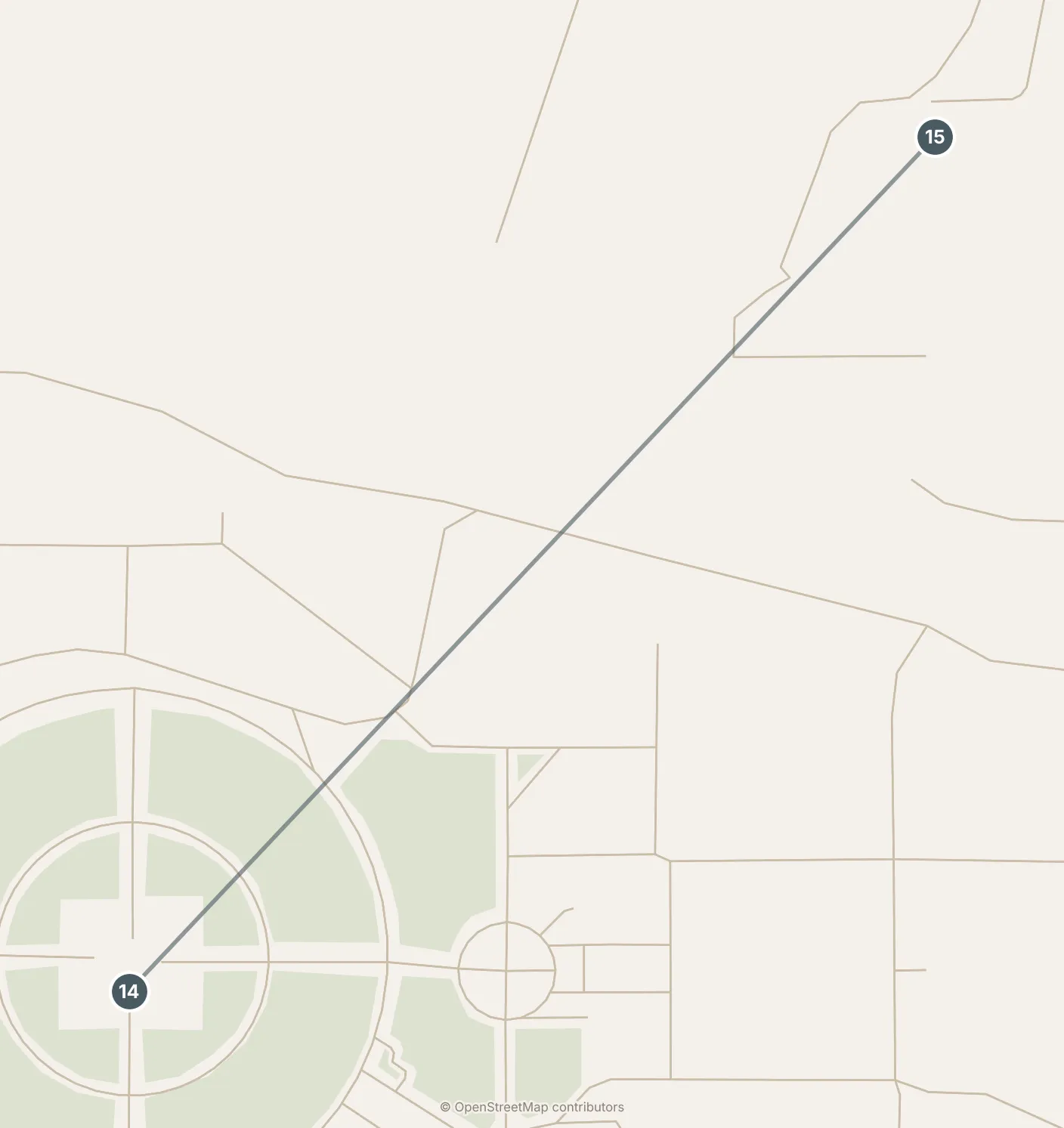
Pululahua — a day trip off the walking map.
- With a third day
- 14Mitad del Mundo
- 15Intiñan
Give the third day to the equator, and leave the city in the morning, because the stop worth the most is the one that clouds over first.
The monument at Mitad del Mundo is a little over twenty kilometers north of the center, in the dry country where the valley opens out. A taxi takes the better part of an hour, depending on traffic; the public route is a city bus to the northern terminal at La Ofelia and a change there onto a bus marked for Mitad del Mundo, which is cheap and costs much of the morning. Either way, go first a few kilometers past the monument to Pululahua, a volcanic crater whose floor is farmland: from the lookout on its rim you see fields and a scatter of houses inside a volcano, a crater that people farm and live in. It fills with cloud as the day goes on, which is why it comes first. Give it half an hour at the rim; the walk down into the crater and back up is a hike of its own and not part of this day.
Then the monument itself: a stone tower about thirty meters high, topped by a globe, standing on a line painted across the plaza to mark the equator as the French geodesic expedition measured it in the eighteenth century. Everyone photographs themselves astride the line. The honest footnote is part of the pleasure: satellite positioning puts the equator a few hundred meters north of it, which takes nothing from what that expedition did with the instruments it had. Inside the tower is an ethnographic museum of the country’s peoples, with a lookout at the top. Give the monument and its grounds an hour and a half.
A few minutes’ walk away, the Intiñan is a small open-air museum that claims the line it stands on as the true one, and shows visitors balancing eggs on nails and water draining in opposite directions on either side of it. Enjoy the showmanship and do not take the physics home: the Coriolis effect is far too weak to turn a basin of water, and the demonstration works by the hand that pours it. Give it three quarters of an hour, or skip it if the monument was enough.
You are back in the city by early afternoon. Leave the rest of it alone. Three days of altitude, stairs and taxis add up, and the best use of the hours left is an unhurried walk back through whichever part of the old town day one rushed. If clouds kept you off Pichincha on day two, this is not the afternoon to try again; take the cable car on this morning instead, and let the equator be the thing a third day does not reach.
The sum of the morning is about three hours at the stops plus two hours of driving, out and back. It does not include the traffic on the way out of the city, which is the part of the day nobody can predict, and it is why the morning should start early.
Practicalities
Nothing on these days needs booking before you arrive. The cable car, the churches, the museums and the monument are all paid for at the door, and the one stop where the hour shapes the day — the cable car, first thing — publishes its hours itself.
The fixed point is that day one comes first. It is the gentle day at the city’s own altitude, and day two takes you some 1,100 meters higher; a reader who lands and goes straight up the cable car is the one reader this order exists to protect. Day two and the third day may change places freely, and either can take any date.
The old-town museums and the Capilla del Hombre each keep a closing day of their own, and on a short trip the reader is likely to meet one. Read them the week before. If one falls on its day here, do not reshuffle the trip: on day one, drop the closed museum and keep the churches and the hill; on day two, if the chapel is shut, move it to the third afternoon and give day two’s afternoon to the national museum at the Casa de la Cultura.
Day one is walked between every stop except the hill, which is a taxi each way. Day two and the third day are taxis between the stops. If you are sleeping in the new town, the metro is the quickest way into the old town in the morning: La Alameda is the station for the basilica, and the parent guide covers how the fare is paid.


