Quito in one day: the old town, walked downhill from the Basílica to La Ronda

Last updated 14 October 2026
Overview
One day in Quito is one day in the old town, and that is the right decision rather than a compromise. The colonial center is compact, it holds most of what the city is known for, and it sits on a slope, so the shape of this day is simple: start at the top, at the Basílica del Voto Nacional, and walk down through it. Nothing on foot below is more than a quarter of an hour from the last thing, and the one stop that is not walkable, the Panecillo hill, is done by taxi both ways.
What a single day costs you is everything outside the center: the cable car up the slopes of Pichincha, the modern north of the city, and the equator monuments well beyond its edge. Each of those is half a day on its own, and none of them is the old town.
Two things shape the plan. The first is altitude: Quito sits at around 2,850 meters, and if you arrived today from the coast or from sea level, the uphill blocks will feel steeper than they look. That is the reason this route runs downhill. The second is the light. The day’s one hinge is the view from the Panecillo, which wants daylight, and here near the equator the sun sets within a narrow band all year: from just after six in late October to just after half past six in early February. Take your month’s hour and count back from it, as the day below does.
The day

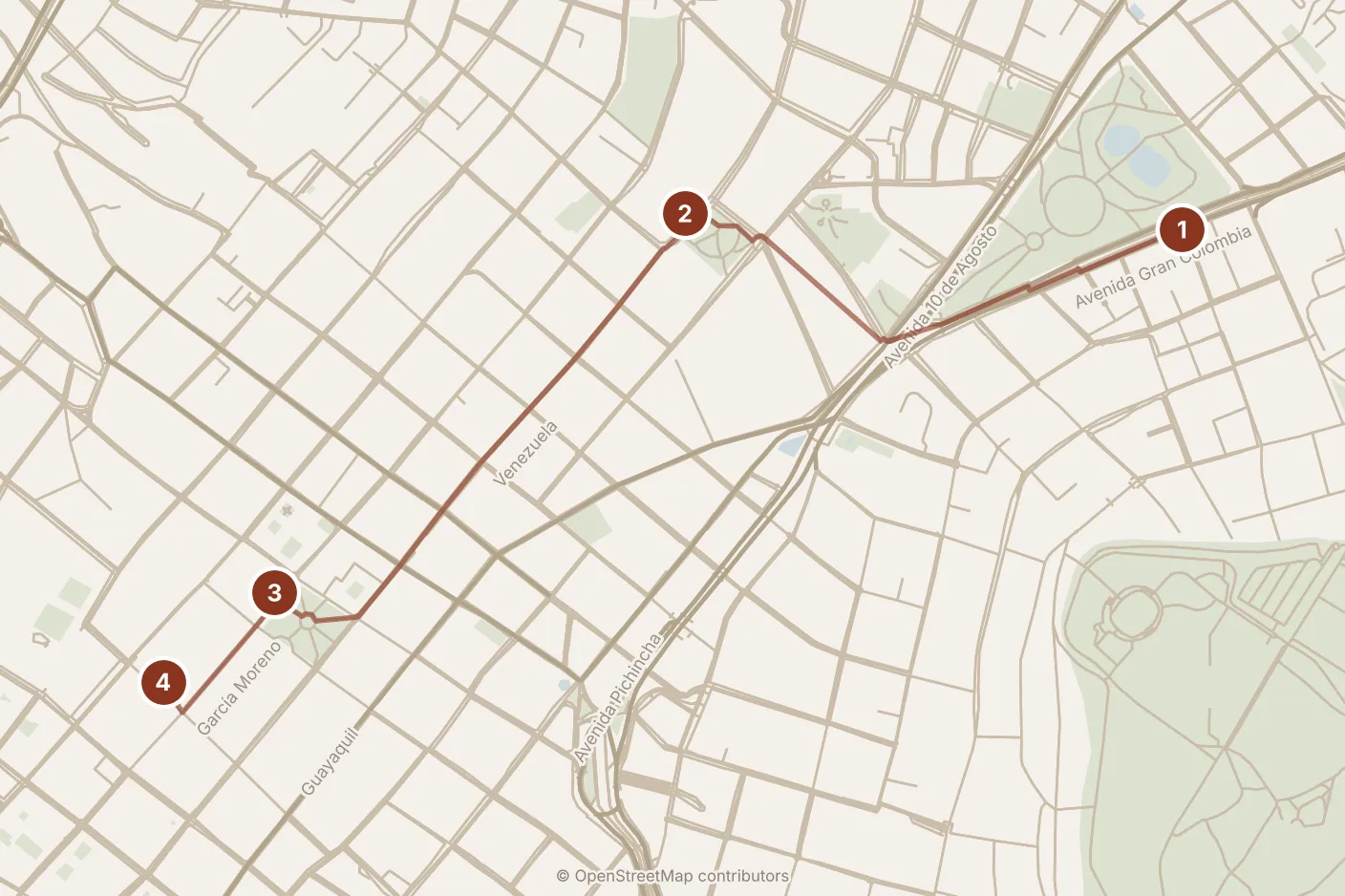
- Morning
- 1La Alameda
- 2Basílica del Voto Nacional
- 3Plaza Grande
- 4La Compañía de Jesús
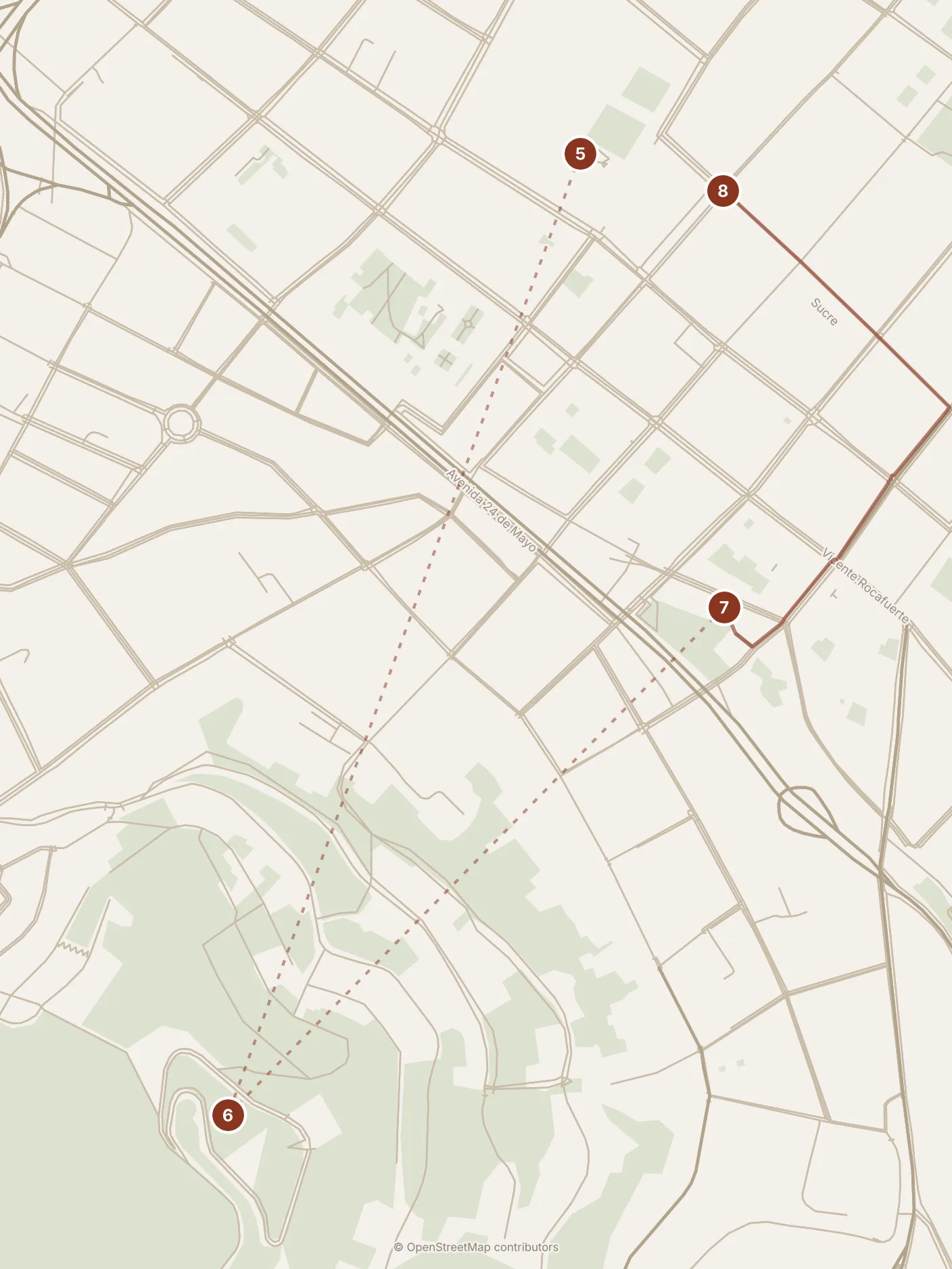
- Afternoon and evening
- 5San Francisco
- 6El Panecillo
- 7La Ronda
- 8San Francisco station
Morning
Arriving by intercity bus from the south, you come in at Quitumbe, which is the southern end of the metro’s Line 1. Ride it north to La Alameda station, about a quarter of an hour and roughly half the line; it passes through San Francisco station on the way, which is where you will board again tonight. Arriving from Mariscal Sucre, there is no rail link: take a taxi from the official rank in arrivals and allow an hour or more by road, and ask for the Basílica directly. From the northern bus terminal at Carcelén the metro does not reach it, and a taxi is the simplest move.
From La Alameda station the Basílica del Voto Nacional is about ten minutes uphill on foot, and you will see it before you reach it. It is neo-Gothic, begun in 1892, and officially still unfinished; it is often described as the largest neo-Gothic church in the Americas. Look up at the gargoyles before you go in: instead of monsters they are Ecuadorian animals, Galápagos tortoises, iguanas, armadillos and condors. The reason to come, though, is the climb. A paid entry at the door takes you up the towers by stairs and then steep ladders, and across a wooden walkway over the roof of the nave, to look down on the whole old town with the Panecillo and its statue at the far end of it. Give the towers and the nave together an hour. Anyone with vertigo should keep to the nave and the lower viewpoints; the last ladders are exposed and narrow.
Then walk south down Calle Venezuela to Plaza Grande, about a quarter of an hour and downhill the whole way. This is the civic heart of the city: the cathedral, the Carondelet palace that is the seat of the presidency, and in the middle a monument to the uprising of 10 August 1809, the first cry for independence from Spanish rule. Sit for ten minutes; the square is where Quito actually spends its day. Then go into the cathedral, where Antonio José de Sucre, the general who won the decisive battle of that independence on the slopes above the city, is buried. Give the square and the cathedral three quarters of an hour between them.
One block south along Calle García Moreno, three minutes, is La Compañía de Jesús, built by the Jesuits between 1605 and 1765. The facade is carved volcanic stone with twisted columns; the inside is covered almost entirely in gold leaf, walls, vaults and altars, and it is the single most striking interior in the city. Look also for the large painting of hell near the entrance, a catalogue of sins and their punishments. Photography inside has long been forbidden, and the staff enforce it, so put the phone away at the door. Give it half an hour; it is one room, and that is enough.
Afternoon
Lunch goes here, in the streets around La Compañía and Plaza Grande, where there are plenty of places serving set lunches at midday. Sit down for it, and give it an hour: after a morning of climbing at this altitude, the rest is part of the plan. If you want the city’s own dish, a bowl of locro de papa, the potato soup with cheese and avocado, is the one to ask for.
From La Compañía it is one block west, about three minutes, to Plaza San Francisco, a wide paved square with the church and convent of San Francisco across its top. It was begun within a few years of the Spanish founding of the city in 1534 and is the oldest of the great colonial churches here. Inside, over the main altar, is the winged Virgin of Quito carved by Bernardo de Legarda in the eighteenth century: remember her, because you will meet her again in aluminum, some thirty meters tall, on the hill this afternoon. The convent’s museum, the Museo Fray Pedro Gocial, holds the sculpture and painting of the Quito School, and the cloister alone is worth the entry. Give the church half an hour and the museum three quarters. The legend you will hear on the steps is about Cantuña, the builder who supposedly struck a bargain with the devil to finish the atrium and escaped by leaving one stone out.
Now the one moment that does not wait. From Plaza San Francisco, take a taxi up the Panecillo: allow a quarter of an hour for the ride and agree with the driver either to wait at the top or to come back, which is what most visitors do. Do not walk up. The stairs and lanes climbing its flanks from the old town have for many years been the standard advice to avoid, and the taxi is the plan, not the luxury. On top stands the aluminum statue of the Virgin of Quito, the copy of the carving you just saw, and from her base you have the old town laid out on one side, the long south of the city on the other, and on a clear day the cone of Cotopaxi far to the south. You can go up inside the base for a higher platform. Give it three quarters of an hour.
This is the stop the day is built around, so work backwards. Everything from the Basílica to the end of San Francisco comes to just under five hours, and the ride a quarter of an hour more. To be on top with a clear hour of light before sunset, start at the Basílica by eleven at the latest, which puts you on the hill around four with two hours of daylight in hand. Earlier is better, because the Basílica’s towers are the other view of the day, and cloud often builds over the slopes of Pichincha as the day goes on. What the count leaves out is the altitude: it times the places, not your breathing on the climbs, and a reader fresh from sea level should add slack to every uphill leg.
Evening
Take the taxi back down, but get out at La Ronda rather than the plaza: it lies at the foot of the hill, a short ride. La Ronda is Calle Juan de Dios Morales, a narrow colonial lane of balconies and flowerpots, restored and pedestrian, and it is at its liveliest after dark, when the small bars and kitchens along it fill, most of all at the end of the week; early in the week it can be quiet. This is where to drink a canelazo, the hot cinnamon-and-cane drink that suits an evening at this altitude, and to eat empanadas de viento, fried and dusted with sugar. Give it an hour, or as long as you have.
To leave, walk back up to Plaza San Francisco, under ten minutes, and San Francisco station is underneath the square. Line 1 south takes you straight back to Quitumbe for a bus heading south. For a bus north from Carcelén, or for the airport, take a taxi from the old town instead, and for the airport allow the same hour or more you allowed coming in. After dark, keep to the lit main streets between La Ronda and the square.
Local tip. If cloud has settled on the hill by the afternoon, do not pay the taxi to stand in it. Give the hour to the San Francisco museum instead and go to La Ronda earlier; the Basílica’s towers in the morning are the view this day can still keep.
Practicalities
Nothing on this route has to be booked in advance. The towers of the Basílica, the cathedral, La Compañía, the San Francisco museum and the inside of the Panecillo statue each take a modest entry at the door. The one thing to have in hand is a way to ride the metro: buy your ride at the machines or the ticket window inside the station at Quitumbe or San Francisco, and the Quito guide covers how the network is paid for.
The bag decides more of this day than anything else. This article cannot point you to a left-luggage office it can vouch for, and none sits on this route. That changes the day: the Basílica’s ladders are impossible with a case, and the steep cobbled blocks of Calle Venezuela are miserable with one. A reader between buses holding a bag should come in by taxi straight to Plaza Grande, skip the Basílica, take the morning from the square down to San Francisco and the afternoon as written, and keep the bag in the taxi’s trunk only with the driver waiting and in sight on the Panecillo. Then finish in La Ronda and take a taxi straight from the old town to the terminal or the airport rather than carrying a case to the metro.
Hours are the thing most likely to break the plan. The churches and the museum keep daytime hours, shorter on a Sunday, when masses also take parts of the morning in the cathedral and San Francisco; La Compañía and the museum are the stops most likely to have a closing day. Each publishes its own hours, so read them the week before. If one is shut on your day, the other fills its time: a closed La Compañía gives San Francisco the extra half hour, and a closed museum leaves the church and the cloister.
If you are short of time, cut in this order: the San Francisco museum first, keeping the church and the Legarda Virgin; then the cathedral’s interior, keeping the square. The Basílica’s towers and the Panecillo are the two views the day is made of, and they go last. In the churches, dress as you would for a working place of worship, with shoulders covered, and keep quiet during a service. The longest walk on the whole itinerary is the quarter of an hour down Calle Venezuela from the Basílica to Plaza Grande; everything else on foot is ten minutes or less.


