Prague in 2–3 days: inside Josefov, the whole castle ridge, and a third day at Vyšehrad

Last updated 4 August 2026
Overview
A single day in Prague is a walk past closed doors. The famous things stand in a line — a castle on a ridge, a bridge, a square — and one day is exactly enough to walk that line and photograph it. Two days is the trip where you go inside, and the two interiors that decide whether you have seen this city or only its outside are both things a day has to skip: the synagogues and burial ground of Josefov, which need a morning and give nothing at all from the sidewalk, and the ticketed half of the castle, which needs the other kind of morning.
So the two days split by bank and by weather. Day one is the flat east side and is almost entirely under a roof: Josefov, then the cellars and the tower of the old town hall, then an art nouveau concert house, then the long boulevard the twentieth century happened on. Day two is the west side and is outdoors end to end — over the river at first light, up to the castle, then along the ridge the castle sits on, which most visitors never walk at all, to a pilgrimage church, a monastery library and a hill with a tower on it. Both days are on foot inside about three kilometers of river frontage.
Two things fix the shape before you read them. Day one cannot be a Saturday: the museum that holds Josefov’s synagogues and the cemetery closes on Saturdays and on Jewish holidays, and from the street the quarter gives you a gable, a wall and some handsome apartment blocks. Day two is open every day of the year, so a Saturday goes to it. Put the rain on day one for the same reason in reverse — day one has a roof over almost all of it, and day two is a ridge walk whose payoff is a view.
Only one of the two days is timed by the light, and it is day two, which is built around the tower on Petřín at dusk. The sun sets here between just after four in the second week of December and a little after nine at midsummer, so take your own month’s hour: the arithmetic for reaching the tower in time is at the end of day two, and everything before it can drift. Day one has no deadline in the sky at all, but it does have two fixed times in its afternoon — the Municipal House tour, which you book, and the town hall’s interior circuit, which runs at announced times you take as they come — and fitting the afternoon around the pair of them is the whole of its planning.
Day one

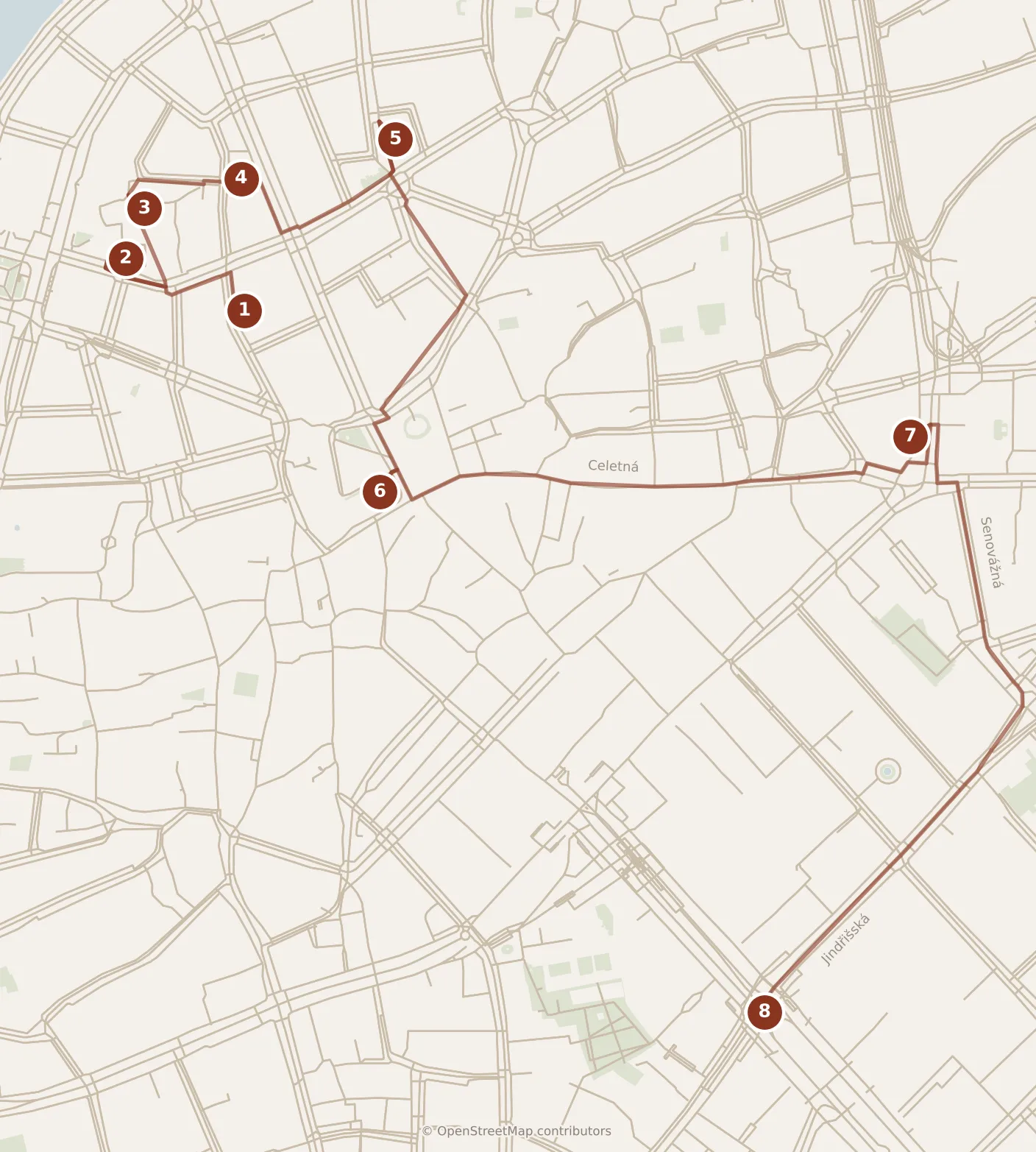
- Morning and afternoon
- 1Maisel Synagogue
- 2Pinkas Synagogue
- 3Old Jewish Cemetery
- 4Old New Synagogue
- 5Spanish Synagogue
- 6Old Town Hall
- 7Municipal House
- 8Wenceslas Square
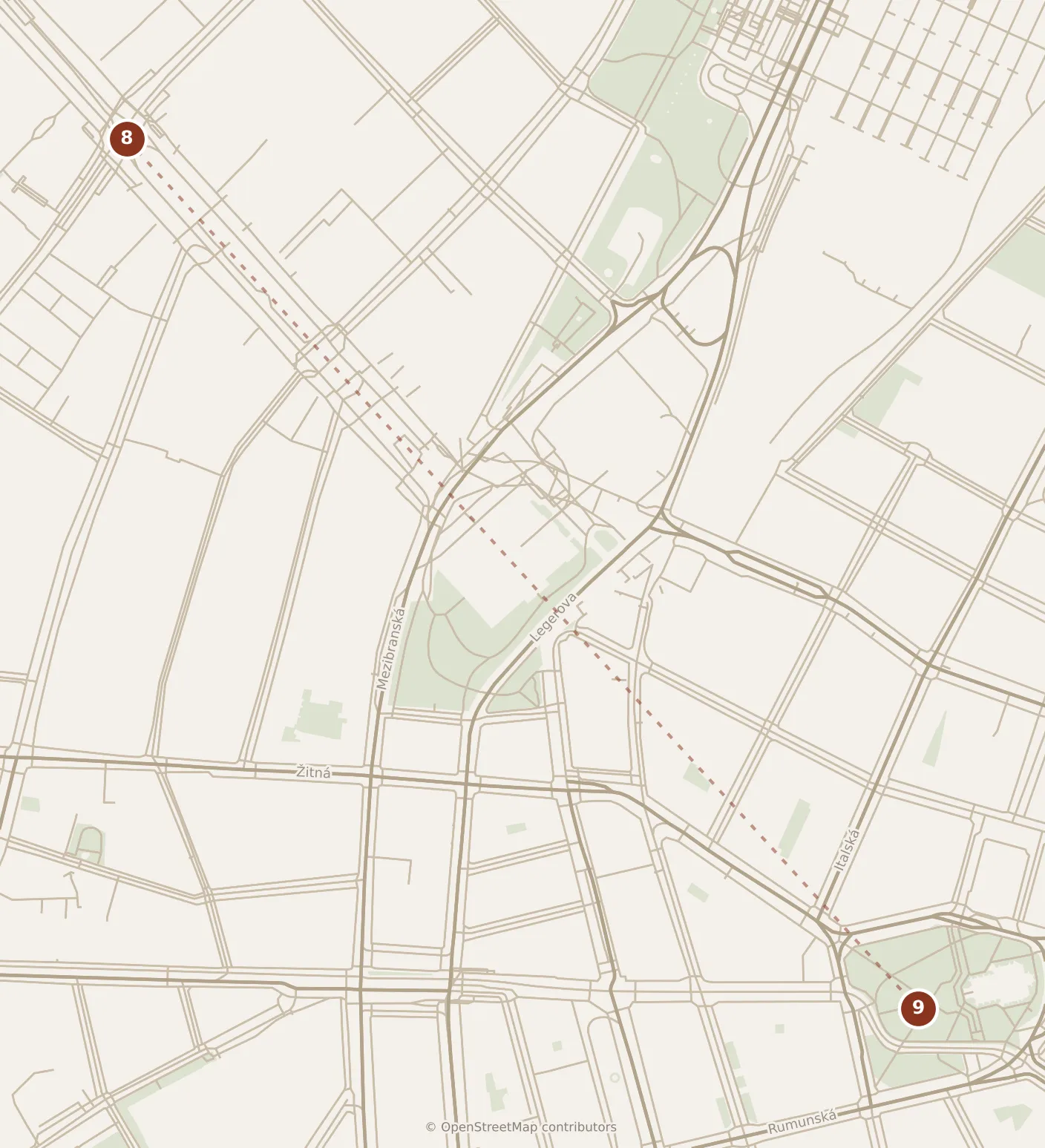
The leg out of the center: from stop 8 by metro, not on foot.
- Evening
- 9Náměstí Míru
Everything today is on the flat, and the whole day runs west to east across the Old Town and then south into the New Town, so you never walk a street twice.
Morning
Day one begins at Staroměstská, the green-line metro stop on the edge of Josefov, three minutes’ walk from the first ticket office. From Praha hlavní nádraží that is one stop on the red line to Muzeum and two more on the green, about ten minutes with the change, or half an hour on foot across the New Town. From the airport it is trolleybus 59 to Nádraží Veleslavín and then the green line the whole way in without changing. The city guide covers how the ticket is bought, and it is the same ticket for all of it.
Three things about Josefov that nobody tells you at the door, and all three change the morning. Every site screens visitors with a metal detector. Shoulders must be covered to go in. And bags over thirty liters are refused, with no left luggage anywhere on the premises — so if this is also your arrival day, the case goes to the station before you come, not with you.
One ticket covers the whole quarter, and it is valid for three opening days rather than one. The museum’s own advice is to avoid the middle of the day, which is the other reason Josefov goes first. Start at the Maisel Synagogue, which is not a working synagogue but the museum’s account of a thousand years of Jews in the Czech lands up to the eighteenth century: give it forty minutes and read the first two rooms properly, because everything after them assumes you did.
Then Pinkas Synagogue, three minutes on, and clear an hour for what is behind it. The walls of the hall carry the hand-painted names of the Czech Jewish victims of the Holocaust, name after name after name, and the doorway at the back opens into the Old Jewish Cemetery. The community was allowed no other burial ground for three hundred years, so the dead were laid one layer above another until the ground rose above the street, and the twelve thousand stones that remain lean into each other like a crowd pushing forward. Nothing is explained in there and nothing needs to be.
Two minutes north is the Old New Synagogue, finished around 1270 and the main synagogue of Prague’s Jewish community for more than seven hundred years, which makes it the oldest active synagogue in Europe. Inside it is one low hall with vaults of five ribs where every other building of its age has four or six, and the explanations offered for the fifth are all guesses; a wrought-iron cage stands round the reading platform. The loft above is the one part nobody is admitted to, which is why the Golem was said to have been left up there. Twenty minutes.
Finish at the Spanish Synagogue, three minutes further and the opposite of everything you have just seen: an 1868 hall in a dense moorish manner, every surface gilded, patterned and repeated, with an upstairs exhibition carrying the story on to the present. Forty minutes.
Local tip. The ticket is good for three opening days, not one. If three hours of this in a single morning is more than you want — and for many people it is — take the cemetery and the two older synagogues today and keep the Spanish one for the start of the third day. It costs nothing extra and it is the only thing in these two days that can be split. What it cannot do is ride on the front of day two: the quarter opens at nine and day two starts on the bridge at first light. And the day you carry it over to can never be the Saturday, when Josefov is shut like everything else in it.
Eat before you leave the quarter, but do not expect quarter prices: the street running north through it is the country’s luxury one, flagship shop after flagship shop. Lunch is the substantial meal of the Czech day, and the set lunch is where the value is.
Afternoon
Seven minutes south brings you to the Old Town Hall, and the point of going in is that almost nobody does: the crowd outside is watching the astronomical clock on the wall and the building behind it is half empty. Three parts are worth going in for, and they are not one ticket. The tower has an elevator as well as a stair, and from the gallery the square below resolves into a plan — you can see that the twin-spired church across it stands behind a terrace of houses that hides it completely from the ground. The chapel puts you behind the clock, where the apostles wait in the dark to be turned out through the windows. And the cellars are the old town at its original level, three meters down, before the whole quarter was raised against the river. The tower is the part you walk into; the chapel and the cellars are a separate guided circuit that runs at announced times, so ask at the counter for the next one and take the tower while you wait. Give the building an hour and a half. Note as you leave that a wing of it is simply missing: it burned in the last days of the war in May 1945 and was never rebuilt, which is why the square has a lawn on one side where a building should be.
Ten minutes east along the lanes and you come out at the Powder Tower, a black gothic gate of 1475 left standing when the walls came down, and against it the Municipal House. This is the best art nouveau building in the country and its inside is the whole of it: a concert hall, a series of lounges and, at the top, a circular room designed down to the door handles by Alfons Mucha. The country’s independence was declared here in October 1918. The interiors can only be seen on a guided tour of about an hour, sold at its box office on the ground floor and online — book the slot before you come. That hour and the town hall’s circuit are the two fixed times on day one, and they have to be arranged around each other; everything else today you walk into when you arrive.
Then twelve minutes down Na Příkopě to Wenceslas Square, which is not a square: it is a boulevard three quarters of a kilometer long and sixty meters wide, laid out as a horse market in 1348 and the place the modern country was argued about. The crowds of November 1989 filled it, and a plain bronze cross set in the sidewalk below the museum steps marks the spot where Jan Palach fell in January 1969; it commemorates him together with Jan Zajíc, who did the same thing a month later. Walk its length uphill, twelve minutes, to the National Museum. Do not go in — the day has no room and the building is a morning of its own — but give two minutes to the front of it: the paler patches across the stone are the repairs to the damage from Soviet gunfire in August 1968, deliberately made in a stone that does not match.
Evening
Get out of the center for dinner. Náměstí Míru is one stop on the green line from Muzeum, or twelve minutes on foot, and it is where Vinohrady begins: a brick church with two spires, a theater beside it, and streets of tall apartment blocks with a dense run of honest, fairly priced eating. Order svíčková if you have not had it yet.
Day two

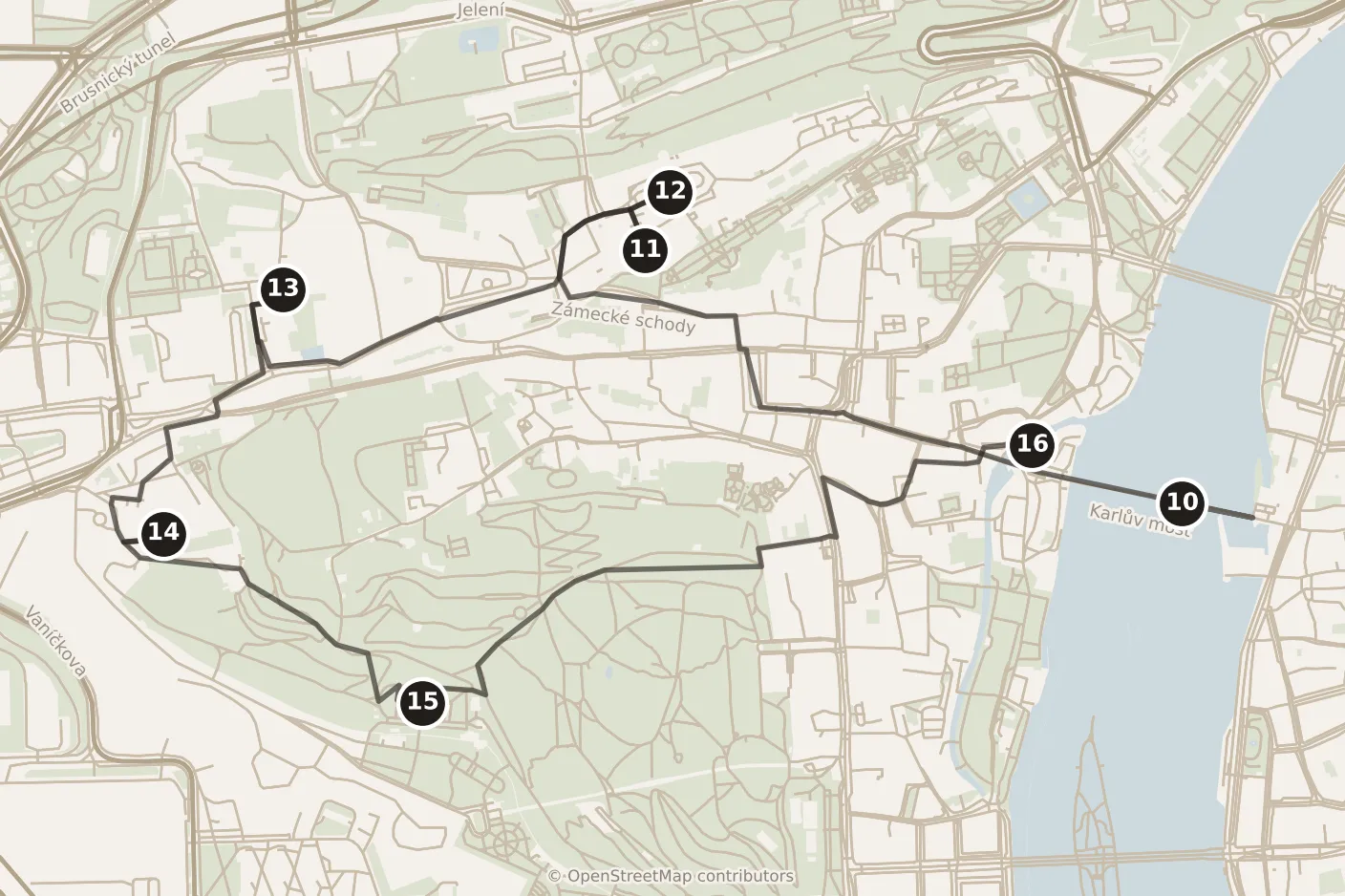
- Day two
- 10Charles Bridge
- 11Prague Castle
- 12St Vitus Cathedral
- 13Loreta
- 14Strahov Monastery
- 15Petřín Lookout Tower
- 16Kampa Island
Today goes up. It crosses the river once, climbs the ridge, walks the length of the ridge westward to the monastery at its end, then turns back east along the crest to the tower and comes down at the eastern foot — one hill, and never a meter repeated.
Morning
Start on the Charles Bridge before the day does. It is five hundred meters of stone with thirty statues on it, and from mid-morning until dusk it is a slow press of people; at seven it is empty but for the fishermen underneath and a few photographers. This is the first thing a second day buys and it is worth arriving for: a trip with one day has to spend its morning up at the castle and cross here in the middle of the afternoon, at its worst. The walk takes ten minutes and you should give it thirty.
From the far towers, seven minutes north to Malostranská and up the Old Castle Steps, which is a proper staircase and the reason to do it now rather than after lunch. Twenty minutes from bridge to gate, and you arrive at the eastern end of the complex rather than the front — the right end, since the day carries on out of the western one.
Visitors may be stopped for a random security check on the way in, courtyards included; it is not the fixed toll at the gate that it used to be. In 2026 the ticketed buildings opened at nine every day and shut at five between April and October, at four the rest of the year. If the hours have moved, keep the method rather than the number: the castle is the only stop today with a door that closes earliest, so it goes first and the ridge behind it goes second, because everything on the ridge stays open later than it does.
The standard circuit covers the Old Royal Palace, St George’s Basilica, St Vitus Cathedral and Golden Lane, and two hours does it without hurrying. Give the cathedral the largest share of that, and outside it look for the mosaic of the Last Judgment over the old ceremonial doorway: a million pieces of Venetian glass set in 1371, and there is nothing else of its kind north of the Alps. The cathedral is a working church and admits no visitors during a service, which on a Sunday morning is most of the morning — if day two lands on a Sunday, take the palace and Golden Lane first and the nave when it opens.
Two things are sold separately, and one of them is the whole argument for a second day. The Great South Tower is a few hundred steps of stone spiral with no elevator, and it puts you above every roof in the city; hanging in it is Zikmund, cast in 1549, the largest bell in the country and still swung by hand by a team of ringers on the days that matter. Half an hour, and it is the stop a compressed day never has room for. The other is the Story of Prague Castle, the permanent exhibition in the gothic cellars beneath the palace, where the archaeology of the hill is laid out — an hour, and the better of the two if the weather has turned and you would rather not be outside at height.
Afternoon
Out through the western gate into Hradčanské náměstí, where the whole city lies below you for nothing, and then eight minutes west to Loreta. This pilgrimage complex was begun in 1626 and it is the strangest thing on either day: a cloister built around a small brick house, the Santa Casa, a replica of the house the Virgin was said to have lived in, carried to Italy by angels and copied across catholic Europe. The tower above it carries twenty-seven bells that play a hymn to the Virgin on the hour, and the treasury holds a monstrance set with several thousand diamonds. An hour, including getting there, half of it in the cloister rather than the rooms.
Eight minutes on is Strahov Monastery, founded in 1143 and still a working abbey, and you come for the library. Two halls — the Theological Hall of the 1670s under barrel vaults of white stucco, and the Philosophical Hall of the 1780s with a ceiling fresco running its whole length — with a corridor of cabinet curiosities between them, including a narwhal tusk and a dried thing labeled as a dragon. You do not walk into either hall. The ordinary ticket takes you along the corridor and holds you at the doorway of each, because humidity and dust are what destroy books, and going inside is a separate, limited tour the abbey sells itself. Forty-five minutes. The terrace outside the gate is free and gives you the city from the highest point you have yet reached.
Local tip. If the day is running short, Strahov’s library is the stop to drop, and it is the only one today that can go without breaking anything. You are paying to look through two doorways; the terrace outside costs nothing and the path onward to Petřín starts at the same gate.
Evening
From Strahov a path runs east along the ridge, following the Hunger Wall — a fortification of the 1360s said to have been built to give work to the poor in a famine — for ten minutes to the Petřín Lookout Tower. It went up in 1891 for a jubilee exhibition, in open ironwork copied from the tower in Paris at a fifth of its height; because the hill does the work, the platform at the top stands higher above sea level than the top of the original. There is an elevator and a stair of just under three hundred steps. Give it half an hour. Everything is below you and in order: the castle you spent the morning in now under your eye, the river with its bridges laid out along it, the east bank flat to the horizon.
In 2026 the tower closed at ten at night between April and September and at six the rest of the year, which is later than sunset in every month and is what makes the count below work at all — check it against your own month before you plan around it, and if the two ever cross, go up an hour earlier and take the light on the way down.
Here is the count, and it is arithmetic over the recommendations above rather than a prediction. An hour less ten for the bridge and the climb, three hours for the castle, an hour for lunch, an hour for Loreta with the walk, an hour less five for Strahov with the walk, three quarters for the ridge path and the tower: about seven and a half hours. Count that back from your month’s sunset and you have the latest hour you can be standing on the bridge — in every month it falls after the seven o’clock the morning recommends, and the difference is slack. Spend it on the bridge rather than at the castle, whose ticketed buildings do not open until nine. What the sum leaves out is the line at the castle’s ticket counters, which can add half an hour in high summer and is the omission most likely to cost you the light; buying that ticket online before you come is what removes it.
In December, when the sun is down soon after four, the count puts you on the bridge at about half past eight and inside the castle just after its ticketed buildings open: the day fits as written, with nothing dropped and no slack in it at all. In June it puts the latest start in the middle of the afternoon, which wastes the best part of the day — start early anyway, and reverse the evening instead: come down off the hill after Strahov, eat in Malá Strana, and walk back up from Újezd, twenty minutes uphill, for the last of the light.
The funicular that climbs from Újezd closed in September 2024, when landslide risk after heavy rain took it out of service, and it has been in full rebuild since; it was due back in the summer of 2026, so check whether it is running before you count on it. The day as written does not need it — it reaches the tower along the ridge, on the level — but the reversed June evening three lines above does: the twenty minutes uphill from Újezd is exactly the leg the funicular covers, and without it you walk them.
Either way, come down through the orchards to Újezd and finish on Kampa Island, fifteen minutes north along the bank. It is not really an island but a strip cut off by the Čertovka, an old millstream with a working wheel on it, and the flood marks on the walls are from 2002. From beneath, the bridge you crossed at dawn is arches and nothing else. Malostranská is eight minutes on if you are crossing back tonight.
With a third day

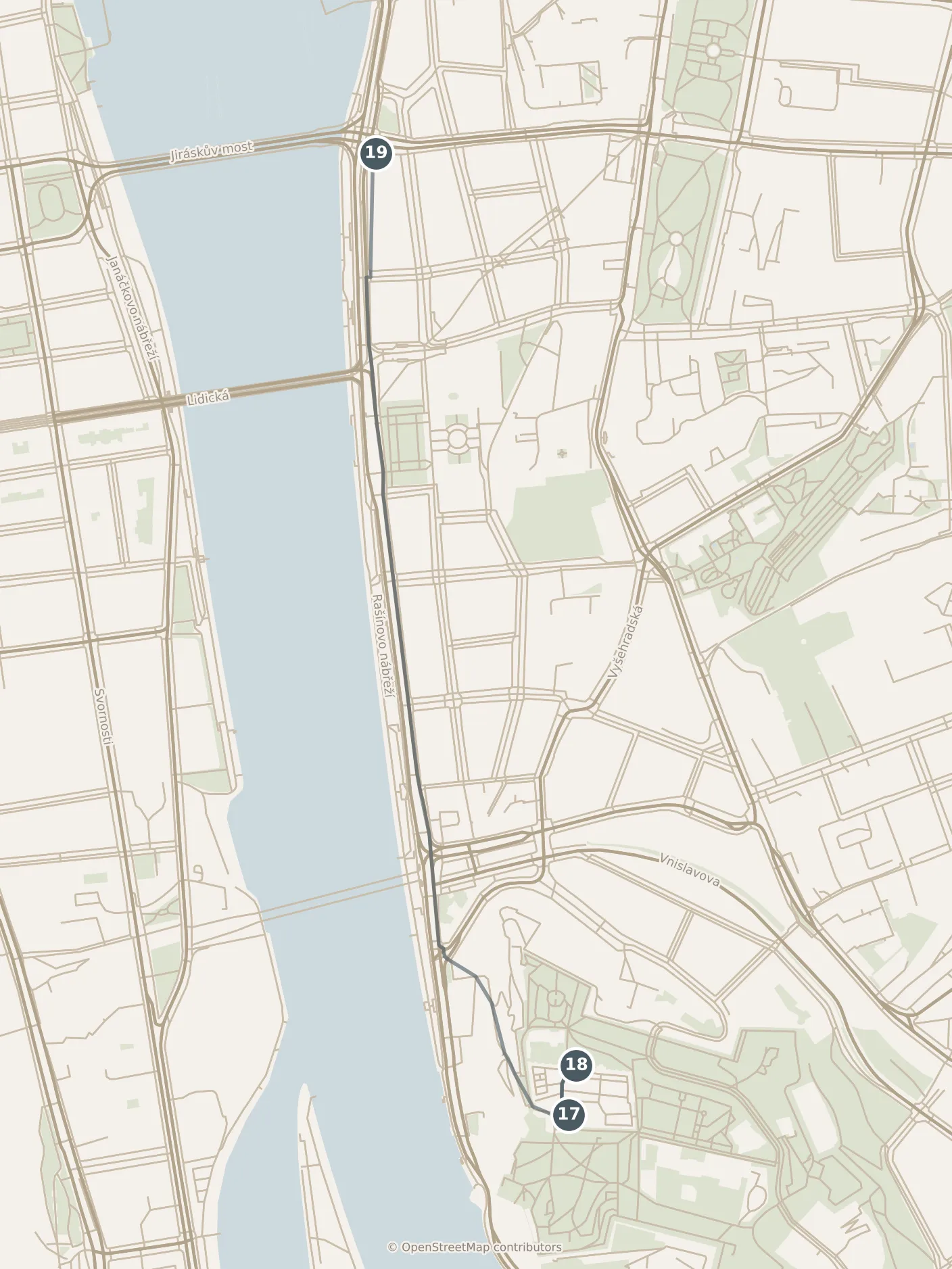
- With a third day
- 17Vyšehrad
- 18Vyšehrad cemetery
- Náplavka — in the prose, not on the map
- 19Dancing House
The third day is appended, not inserted: days one and two are the two banks and this is the third hill, so it works as day three and does nothing useful in the middle. A Saturday does not change that. The only day that cannot take one is day one, because Josefov is shut; day two and this one take any date, so if the Saturday falls on the first of your three, run the days in the order two, one, three and leave this one at the end where it belongs.
Vyšehrad is the rock two kilometers upstream, and it is where the story says the city was before the city was here. Metro to Vyšehrad on the red line, then a short walk across the plateau to the Tábor Gate. The grounds, the ramparts and the cemetery are free and open, the paths are wide, and after two days of cobbles and staircases that is not a small thing.
Head for the ramparts first and walk the edge above the water. This is the view that shows you the river as a river — a broad bend below, the whole city downstream of it, and the castle small and pale on the far ridge, which after two days spent inside it is a useful correction of scale. Half an hour, and there are benches.
Inside the walls, the Rotunda of St Martin is a plain round stone drum from the second half of the eleventh century, the oldest building on the rock and one of the oldest in the city; you look at it rather than into it, and it takes two minutes and rewards them. Beside it the Basilica of St Peter and St Paul carries two black neo-gothic spires put up in the 1880s over a much older church, and it is worth going in for the interior, painted floor to vault in art nouveau pattern; the church charges where the grounds, the ramparts and the cemetery do not, a couple of hundred koruna in 2026. Twenty minutes.
The Vyšehrad cemetery is next to it and is the reason many people come. It is small, walled, arcaded, and it holds most of the Czech nineteenth and twentieth century: Antonín Dvořák and Bedřich Smetana, Karel Čapek, Alfons Mucha. At its end stands Slavín, a common tomb of the nation’s dead, with a list of names on it that is a syllabus. Give it forty-five minutes and do not hunt for particular graves — a plan is posted at the gate and the pleasure is in the wandering.
The casemates are the one thing here you cannot simply walk into: a kilometer of vaulted tunnel through the ramparts, opening into Gorlice, a hall where several of the original baroque statues from the Charles Bridge are kept out of the weather. It is a guided visit rather than a wander, and Vyšehrad’s own information center sells the ticket and publishes the times.
Local tip. Do the rock before the river, not after. The walk down off Vyšehrad is steep and short and the walk back up is neither, so an embankment stroll that turns into a climb at the end of the day is the version of this to avoid.
Come down through the ramparts to the river and turn north along Náplavka, the low quay below the embankment wall, which is the liveliest stretch of riverside in the center: the vaults in the wall are bars and galleries, and on Saturdays a farmers’ market runs along the quay until two, so if this day is your Saturday, come down off the rock earlier rather than later. Twenty-five minutes downstream brings you to the Dancing House, finished in 1996 on a corner plot that had stood empty since an American air raid in February 1945 destroyed the apartment building there. It is two towers leaning into each other and it is better in life than in photographs. Karlovo náměstí, on the yellow line, is five minutes inland from it, and that is where this day stops.
Practicalities
Three tickets are worth buying before you set out, and three things here run to a schedule rather than a door you walk through: the Municipal House tour, which is both, the Old Town Hall’s chapel and cellars, and Vyšehrad’s casemates. The Josefov ticket covers all five synagogues and the cemetery on one admission, valid for three opening days; it was in the five-to-six-hundred koruna range in 2026, and it is sold online, at the synagogues’ own ticket offices, and at the museum’s visitor center on Maiselova. The castle’s standard circuit was in the four-to-five-hundred range in the same year, with the tower and the cellar exhibition each a separate ticket on top, about two hundred and about three hundred; all of it is sold online in advance as well as at the castle’s own counters, and the counters are where the line is.
The closures decide your start day, and what you need is the method rather than the answer. Day one is the only load-bearing day: it must miss Saturday, and it must miss the Jewish holidays, which move each year and are published by the museum itself — read that calendar instead of guessing, because some of them run to two days. Day two and the third day take any date, though the third day belongs at the end rather than in the middle. So the trap is arriving on a Friday evening for a trip that is Saturday and Sunday: that puts day one on the Saturday and leaves you Josefov from the outside. The fix is simply to run the days in the order two, one.
Where the plan breaks, this is what replaces what. If Josefov is shut on the only morning you have, do not walk its streets and call it done: bring the town hall and the Municipal House forward into the morning, which they take without trouble, and give the freed afternoon to the National Museum at the top of Wenceslas Square — the one large collection these days deliberately leave out. If the weather closes in on day two, there is no indoor substitute for a view, so swap the days; and if you cannot swap, take tram 22 from Pohořelec, the stop outside Strahov’s gate, down off the hill and over the river to Národní divadlo, then fifteen minutes on foot to the old town hall, and take day one’s afternoon out of order, moving the rest of the ridge to the next day. On foot that whole descent is about forty minutes, all of it downhill.
If you are short rather than unlucky, cut in this order. The Municipal House tour goes first — an hour at a fixed time, and the booking the rest of the afternoon has to bend around. Strahov’s library goes second, for the reason given on the day. What does not go is Josefov’s morning: it is the half-day nobody could have guessed at from outside, and with a day and a half in Prague it is the half to keep.
On the bag: there is nowhere to leave one on this route, and the Josefov sites turn away anything over thirty liters at the door. Left luggage in Prague is at Praha hlavní nádraží and the railway publishes where in the building it is — read that before you arrive rather than on the concourse. If your last day is the third one, note that Vyšehrad is a rock with a staircase off it and the worst place here to be dragging a case: take the ramparts and the cemetery in the morning, come down to the embankment, and go back for the bag from Karlovo náměstí, which is one change from the main station.
Underfoot, all three days are cobbles, and day two is cobbles on a slope; wet ones here are genuinely slippery, and the descent from Petřín is gravel path rather than sidewalk. Day one is about three kilometers of walking and flat throughout; day two is about four, with a staircase and a hill in it; the third is about three and a half, almost all of it level once you are on top of the rock.


