Prague in one day: down from the castle, across the bridge, and up to Letná at dusk

Last updated 3 August 2026
Overview
Prague in one day is a downhill walk, and it stops being a good day the moment it is planned as a list of sights. The old city is two halves divided by a river and by a hill steep enough that you only want to climb it once: the castle stands on the ridge on the west bank, and everything else lies flat on the east. The single decision that makes or breaks one day here is which end of that slope you start at. Start at the top. The route below comes down through the whole of it on foot, crosses the water once, and finishes with one short climb on the other side for the view back over everything you have walked.
Two things are given up, and both are worth saying plainly. The first is museums. Prague has good ones and this day enters none of them, because an hour indoors is the hour that would otherwise have bought the walk down the hill, a lunch sitting down, and the light at the end.
The second is the real editorial choice in a Prague day. Josefov, the old Jewish quarter, keeps a museum spread across several synagogues and a cemetery, and it is the most affecting thing in the Old Town. It is worth ninety minutes of anyone’s attention — and ninety indoor minutes is precisely what a morning already spent inside the castle has not got left. So the route below walks Josefov’s streets and looks at its buildings from outside. If Josefov is the reason you came to Prague, go in, and pay for it by taking only the free half of the castle. Swap; do not add.
The order is also a defense. The castle and the bridge are the two places where the crowd is worst, and they fill at different hours: the castle as the coach parties reach the top of the hill in mid-morning, the bridge from mid-morning until the evening thins it. You cannot have both of them quiet in one day, so this route takes the castle first, when it can still be had quietly, and crosses the bridge in the middle of the afternoon at its very worst. That is a knowing trade rather than an oversight: the day gives the bridge back at the end, from above, with the whole river in the frame.
One last thing fixes the shape before anything else is planned. Exactly one stop on this route depends on the hour, and it is the last one — the bluff on the far bank does at dusk what it cannot do at two in the afternoon. Everything else can move. That cannot, and the arithmetic for arriving there in time is at the end of the day below.
The day

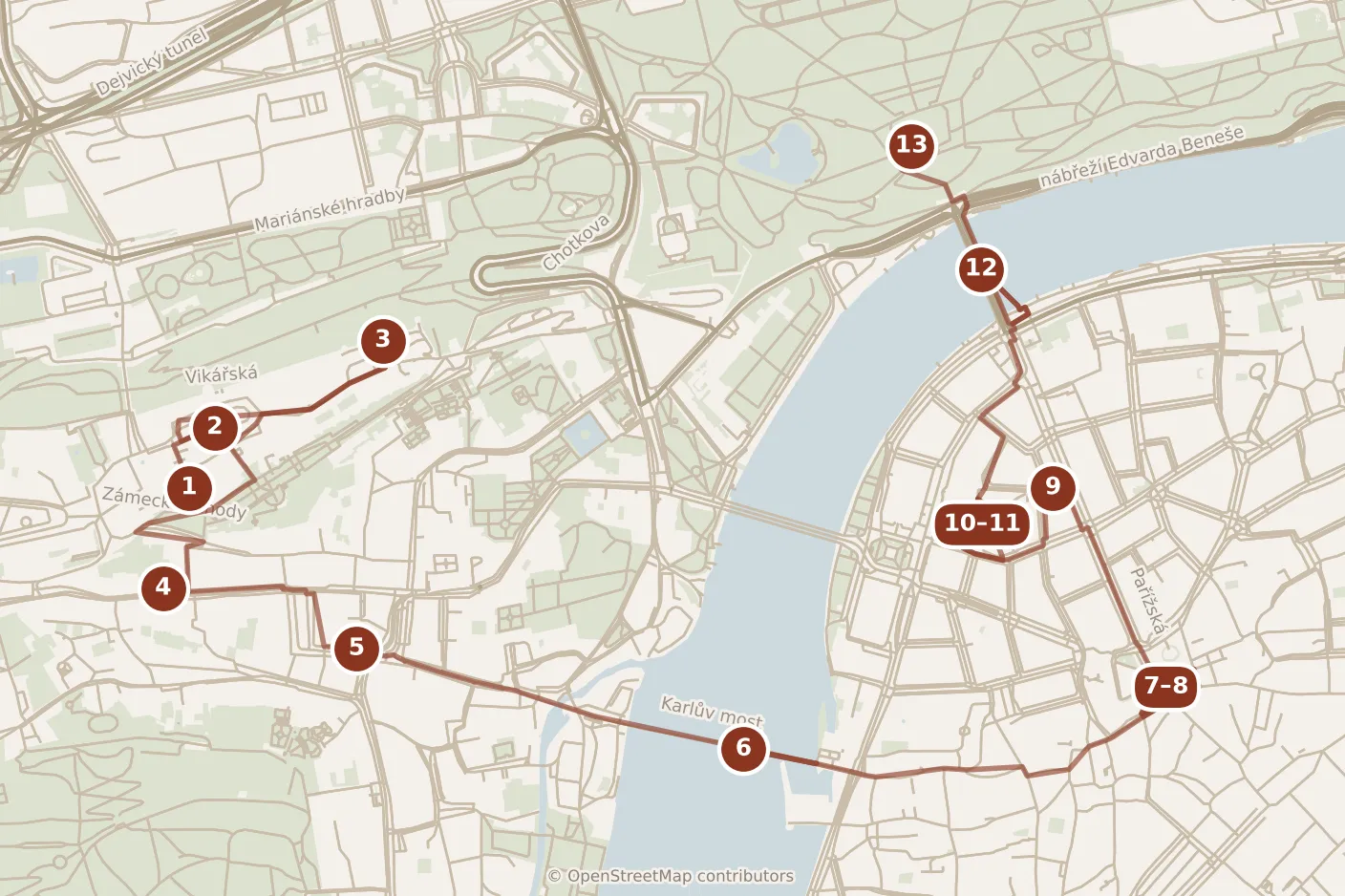
- The day
- 1Prague Castle
- 2St Vitus Cathedral
- 3Golden Lane
- 4Nerudova
- 5St Nicholas Church
- 6Charles Bridge
- 7Old Town Square
- 8Prague Astronomical Clock
- 9Old New Synagogue
- 10Pinkas Synagogue
- 11Old Jewish Cemetery
- 12Svatopluk Čech Bridge
- 13Prague Metronome
Morning
Take tram 22 up and get off at Pražský hrad, which puts you level with the castle instead of at the bottom of a staircase — the tram can be picked up at Malostranská, at the foot of the hill, and it is two stops from there. Keep your bag in front of you on board: the castle line is the pickpockets’ line too, and the recorded warnings on the trams are in Czech only. At the gates everyone passes a security check, free courtyards included; it is short at opening and twenty minutes long by mid-morning, which is one more argument for arriving early. What you walk into is not a castle in the single-building sense; it is a walled quarter with three courtyards, a cathedral, a palace and a lane of houses inside it, and by area it is the largest ancient castle complex in the world — a fact you feel as fatigue rather than as awe. The courtyards cost nothing to walk through, and so do the gardens in the months they are open; the interiors are the ticketed half.
Local tip. Because the free half and the paid half are separable here, the choice at the gate is not which building to enter but whether to enter at all. The courtyards, the gardens and the walk out to the square in front are a good forty-five minutes on their own. If you have already decided that Josefov is what this day is for, take the free half here and keep the morning.
Give St Vitus Cathedral forty minutes. It was begun in 1344 and finished in 1929, and the seam is visible from inside: the part you walk in through is twentieth-century work and the far end is fourteenth-century, and the glass tells you which is which long before the stone does. The window that stops people is not medieval at all — an art nouveau design by Alfons Mucha from 1931, in the newer half, and unmistakable beside everything around it. Then find the Wenceslas Chapel, whose walls are set with hundreds of polished semi-precious stones over painted panels, and which holds the tomb of the country’s patron saint. You look into it from the doorway rather than walking in; that is how it is meant to be seen.
Twenty-five minutes for the Old Royal Palace next door, almost all of it for one room. Vladislav Hall is a vast late-gothic space whose vaulting ribs curl overhead like rope, built wide enough to hold tournaments indoors and reached by a ramp of shallow steps that horses could be ridden up. Off it is the window of the defenestration of 1618, where two imperial governors were thrown out and survived the fall, and which set off the Thirty Years’ War.
Ten minutes for St George’s Basilica, the oldest surviving church in the complex: a plain, pale romanesque hall behind a red baroque front, and the collision between the two is the whole point of stopping. Then Golden Lane, a row of doll-sized houses jammed against the castle’s outer wall, built for the castle’s marksmen in the sixteenth century and later lived in by the poor; Franz Kafka’s sister rented one and he worked in it for a winter. It is the most crowded few meters inside the walls and it is a quarter of an hour. Take it or leave it without regret.
Come back west through the courtyards and out of the main gate onto the square in front, where the whole city lies below you for nothing, then down the cobbled ramp into Nerudova. This is the best street in the city and it is free. Before houses had numbers they were identified by a carved or painted sign over the door — a violin, three fiddles, two suns, a golden key, a red eagle — and the signs are still there. Reading them down the hill is the walk: fifteen minutes if you do not stop, half an hour if you do.
At the bottom, on the square it stands in, St Nicholas Church is the great baroque church of the Lesser Town: a green copper dome, a bell tower, and inside a ceiling fresco painted so that the architecture in the picture continues the architecture underneath it. Twenty minutes. The bell tower beside it is a separate building with its own entrance, and in the communist years the secret police kept an observation room in the gallery at the top of it, watching the embassies in the streets below.
Eat before you cross the river. The blocks immediately at either end of the bridge are the worst value in the city and the streets three minutes back from them are not, so walk inland or uphill a little and sit down. Lunch is the substantial meal of the Czech day and this is the one to make it — svíčková, or vepřo knedlo zelo — and give it an hour. It will slow the afternoon down, which is the correct speed for the afternoon.
Afternoon
The Charles Bridge was begun in 1357 to replace one the river had taken, and it has sixteen arches and thirty statues, every one of which is a copy; the originals were moved indoors out of the weather. One statue’s base carries a bronze panel rubbed bright by hands — the priest it commemorates was thrown off this bridge — and touching it is a habit with no agreed meaning, so do it or do not. The crossing is ten minutes of walking and will take you thirty. Do not wait in line for the towers at either end: you are buying a view this evening, from higher up, for nothing.
Give Old Town Square half an hour and walk its edges rather than standing in the middle of it. Three things are worth finding. The twin spires of the Týn church rise behind a terrace of houses that stands directly in front of it, so you never see its facade from across the square — the building is hidden by the street it belongs to. The Jan Hus memorial in the center went up in 1915, on the five-hundredth anniversary of his burning. And set into the sidewalk near the town hall are twenty-seven white crosses, one for each of the men executed on that spot in 1621.
The Prague Astronomical Clock is on the town hall’s tower and has been running since 1410, which makes it the oldest astronomical clock still in operation. Most people photograph it without reading it, and it is worth ten minutes of reading: the upper dial tracks the sun and the moon against the zodiac, the outer ring counts the hours in the old Czech manner, and the lower dial is a farming calendar of the months. On the hour the apostles pass two windows and a skeleton pulls a bell rope. It is over in about a minute, the crowd assembles for a quarter of an hour beforehand, and knowing that ratio in advance is the most useful thing this paragraph can tell you. Watch it if the hour happens to be near; do not build the afternoon around it.
Four or five minutes north is Josefov, and the streets themselves are the first surprise: this is the one part of the old city that is not medieval. The ghetto was cleared at the turn of the twentieth century and rebuilt as broad avenues of tall art nouveau apartment houses, with the synagogues and the cemetery left standing and everything between them swept away.
Stand in front of the Old New Synagogue: a steep brick gable over a low gothic hall, finished around 1270 and in continuous use since, which makes it the oldest synagogue in Europe still holding services. A few steps on, Pinkas Synagogue is the doorway to the Old Jewish Cemetery. Its interior walls carry the hand-painted names of nearly eighty thousand Czech Jewish people murdered in the Holocaust, one after another after another. The cemetery behind it was the only burial ground the community was permitted for three centuries, so the dead were laid in layers and the stones now lean into one another in a crowd.
Both are inside the museum ticket and behind a wall, and this is where the choice made at the top of this article lands. From the street you get the gable, the doorways and the tops of the cemetery trees, and that is three quarters of an hour well spent. Going in is ninety minutes more — and if you go in, the day ends here and you should end it deliberately rather than discovering it at dusk.
Evening
From the cemetery wall it is ten minutes north to the water and over the Svatopluk Čech Bridge, a short, heavily decorated crossing of 1908 with gilt figures on its columns. On the far bank a staircase climbs the bluff, and at the top of it stands the Prague Metronome: a twenty-three-meter steel arm swinging over the city since 1991, mounted on the plinth where a granite monument to Stalin stood until it was blown up in 1962.
This is what the whole direction of the day was for. The Vltava lies below with its bridges laid out in order, the Old Town roofs face you across the water, and on the skyline stands the castle you were standing in this morning. Letná is a working park rather than a viewpoint — in the warm months a beer garden under the trees, skateboarders on the plinth, people sitting along the wall with the view behind them — and an hour here costs nothing at all. Getting back is the reverse of the arrival: ten minutes down and over the bridge again puts you at Staroměstská, the metro stop beside Josefov, two minutes from anywhere you need to be.
Which makes the timing the last thing to get right, and it is arithmetic rather than guesswork. Work backwards through the recommendations above: two hours for the castle, forty-five minutes for Nerudova and the church, an hour for lunch, half an hour on the bridge, an hour for the square and the clock, three quarters for Josefov’s streets, and twenty-five minutes for the walk and the climb up here. That is about six and a half hours, so count six and a half back from sunset and you have the hour the tram should be carrying you up the hill. In late June, when the light holds past nine, that means starting in the early afternoon with half a day spare — put it into one of the museums this route gave up. In late December the sun is down soon after four, the sum leaves no slack whatever, and you want to be at the castle gate when the interiors open and to linger nowhere.
Practicalities
One ticket matters on this route and it is the castle’s, bought at the castle on the day itself. Nothing here sells out in advance and nothing needs a slot reserved from home — but the counter line inside can take half an hour at the height of summer, which is the second argument for being at the gate when it opens. What you do need before you start is a transport ticket for the tram up the hill — that ride is the only one in the day — and the city guide covers how tickets are bought and validated.
Two closures can break the day as written. The synagogues and the cemetery in Josefov shut on Saturdays and on Jewish holidays: that costs you nothing if you are only walking the streets, and it costs you everything if you have decided to go in, so check the day before you plan the swap. And both churches on the route close to visitors during services, which on a Sunday morning is most of the morning — if your one day falls on a Sunday, expect to be turned away from the cathedral early on and to take the palace, the basilica and Golden Lane first.
The route otherwise survives a Monday, which is worth knowing if your single day lands on one: it is a castle, two churches, a bridge, two squares and a park, and the museums that close on Mondays are the ones this day has already given up.
Winter shortens the day twice over. The castle interiors keep shorter hours in the cold months than in summer, and the light goes early, so the six-and-a-half-hour sum above stops being generous and becomes the exact length of the available day.
This is not a day for carrying luggage — five kilometers of cobbles punishes a wheeled bag — so leave it at the station rather than bringing it. Underfoot, this is a route of cobbles throughout, and the descent from the castle is a steep cobbled ramp followed by a steep cobbled street. Wet cobbles here are genuinely slippery and shoes are the difference between a good afternoon and a careful one. There is a metro station at the foot of the castle hill, Malostranská on the green line, and another beside Josefov, Staroměstská on the same one, so from mid-morning onwards you can stop the day in two minutes rather than walking back to where you began.
The whole thing is about five kilometers of walking, nearly all of it downhill or flat, with one flight of steps at the end. The longest single stretch is the ten minutes from Josefov across to the far bank, and by then you are almost finished.


