Philadelphia in two or three days: the founding quarter, the Parkway museums, and South Philadelphia

Last updated 8 August 2026
Overview
Two days here is not one day twice. Philadelphia’s two great concentrations sit at opposite ends of the same street and each fills a day on its own: the founding quarter east of 6th Street, four blocks square and walked end to end in ten minutes, and the diagonal boulevard running north-west out of City Hall with three serious collections strung along it. One day can cross that line once and take the top off both. What the second day buys is not more sights — it is doors. You go into the Second Bank’s portrait gallery, into the room where the First Continental Congress sat, into the Revolution museum, into the Barnes, instead of past all four.
The days below are almost entirely on foot. One ride shapes the first day, the second needs none at all if you are sleeping anywhere in the center, and the third needs two. Two things on the two-day route are worth buying before you travel and the third day adds a third; a fourth appears only if you cannot make nine o’clock on the first morning, and the whole of day one is arranged so that you can.
That nine o’clock is the first of the two hours everything rests on. In 2026 Independence Hall ran a free open house from nine until ten minutes to ten and went over to booked timed tours for the rest of the day, and Congress Hall beside it needs no ticket at any hour. So the free window is worth more to a two-day reader than to anyone else: you can spend it on the Hall and still walk into the second building without a reservation. If the hour has moved, build the morning back from whatever you find, because the shape holds either way — the ticketless rooms first, the ones that keep the same hours all day afterwards.
The second hour is a closing time, and it decides the order of day two rather than its start. In 2026 the Barnes Foundation and the Philadelphia Museum of Art both kept a Thursday-to-Monday week and both shut their galleries at five, with the art museum alone running on into the evening on Fridays. Two large collections that close at the same moment cannot both have an afternoon, and the day below is honest about that: it gives the afternoon to one of them and tells you which reader should choose which. Move that hour and the arithmetic changes; the rule that the collection comes before the view, never after, does not.
The view is the terrace at the head of the art museum steps, and it is the one thing on these three days that no institution controls: an open plaza with no door and no closing time, looking a mile back down the Parkway to the lit tower of City Hall. It wants the half hour after the lamps come on. The earliest sunset of the year here falls a few minutes before twenty to five, in the first week of December, and the latest a few minutes after half past eight, in the last week of June — so take your own month’s hour. Day two adds up to about seven and a half hours from breakfast, which puts you on that terrace a little after four. In December that lands almost exactly; in June it lands four and a half hours early, and the answer to that is at the end of day two.
Those totals count the time you spend inside the places and the time you spend walking between them, and nothing else. On day one the largest thing they leave out is the security screening: entering Independence Square and entering the Liberty Bell Center each mean a scanner, you and your bag both, and on a fine weekend morning that is the longest wait of the day. Count it as its own line. Day two has no equivalent, provided you arrive at the Barnes holding a slot rather than hoping for one, which is the reason to book it.
Last, the bag, which for a two- or three-night stay is only a problem on one day — the day you check out and still have hours to spend. That is the day the shape below matters, because the third day ends in South Philadelphia, a good two miles from 30th Street Station, and there is nowhere down there to leave a case. If your last day is the South Philadelphia one, take it before you check out or not at all; if you must do both, the Broad Street Line runs back to 15th Street/City Hall — one station now, with the Broad Street and Market–Frankford platforms joined under the building by a concourse rather than a street — and one stop west from there puts you at 30th Street Station, where the staffed baggage room is the only one on any of these routes. Whether you may use it turns on holding a ticket for a train that day, so settle that at the counter before you plan around it, not after. The arrival day is not the second problem it looks like, because it is the same room read the other way round: day one starts at that station anyway, so a morning train means the case goes in there on the way past, rather than across the city to a hotel that will not check you in until the afternoon.
Day one

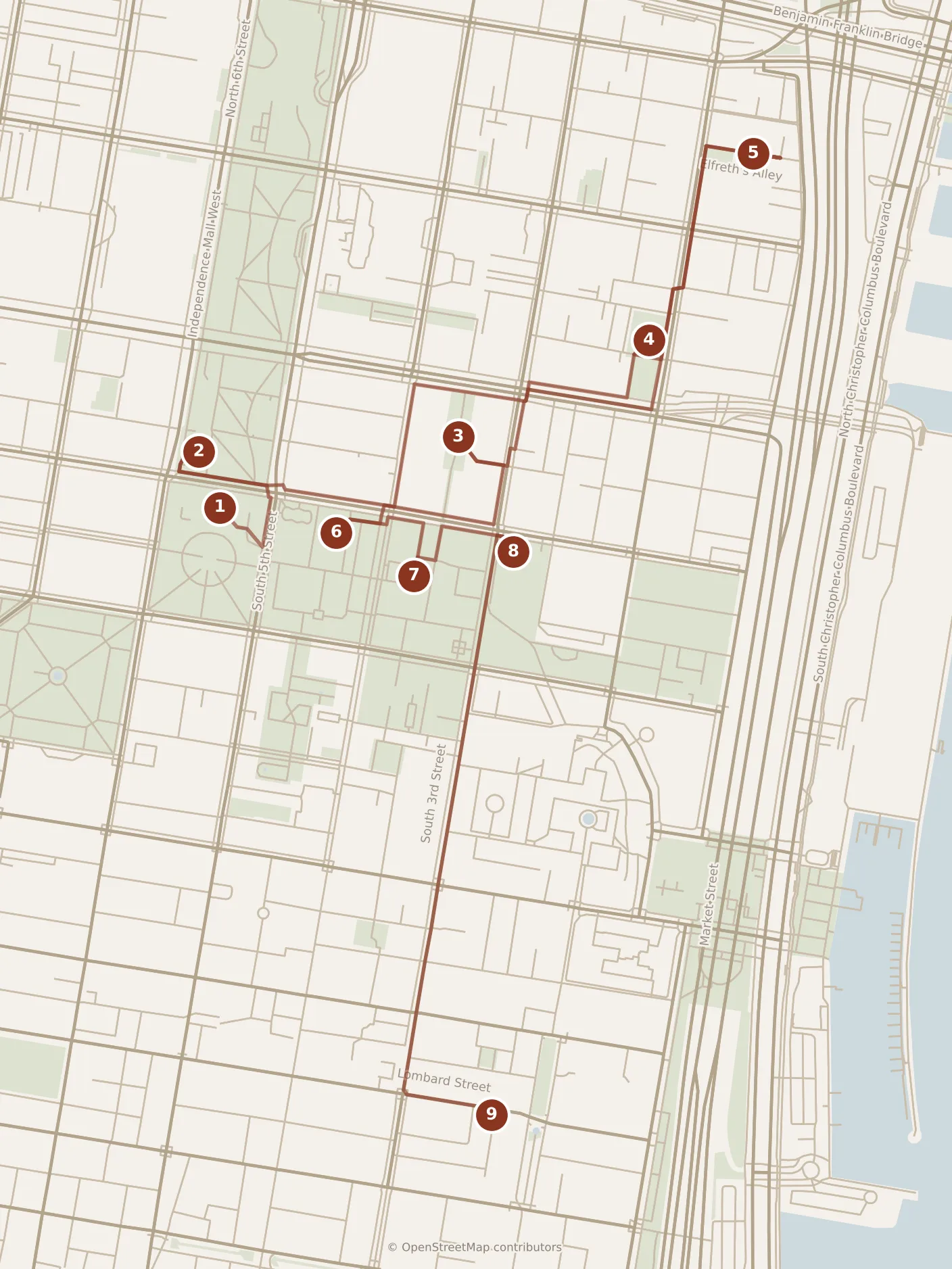
- Day one
- 1Independence Hall
- 2Liberty Bell Center
- 3Franklin Court
- 4Christ Church
- 5Elfreth's Alley
- 6Second Bank of the United States
- 7Carpenters' Hall
- 8Museum of the American Revolution
- 9Head House Square
Everything today sits between 2nd Street and 6th Street, and the day is built as one loop north and then back south, so the only stretch you walk twice is the ten minutes back west from lunch. Nothing here rests on the light. It rests on a door, and the door is at nine.
Morning
Almost everyone arrives at 30th Street Station, on the far bank of the Schuylkill, and the first thing to do is leave. The Market–Frankford Line, which every local calls the El, runs from the platforms beneath the station along Market Street to 5th Street/Independence Hall; the ride is about ten minutes and the walk down to Independence Square four. Look for the letter and not the name: SEPTA letters its subway lines now, so the signs, the maps and the platform screens call this one line L, and the Broad Street Line you want on the third day is line B. Doing the same journey on foot takes the better part of an hour, and this morning has no hour to give. If you have flown in instead, the SEPTA Airport Line runs from the terminals through 30th Street Station to Suburban Station and Jefferson Station, and from Jefferson it is six blocks east on Market Street.
Everyone entering Independence Square goes through a screening tent at its 5th Street corner. Be at it for nine. Independence Hall is a provincial Georgian state house with a white steeple, built for the colony of Pennsylvania and never meant to hold what it now holds, and the open house lets you walk the ground floor at your own pace rather than in a group on a clock. Give the building forty minutes with the line in it. Most visitors give all of that to the Assembly Room and walk straight past the room opposite — the chamber of Pennsylvania’s own supreme court, with its royal arms and its prisoner’s dock, which is what the building was for the other three hundred and sixty days of the year and which explains the modesty of the rest.
Twenty-five minutes next door in Congress Hall is the stop that separates a two-day visit from a one-day one, and it costs nothing at all. This was the United States Capitol from December 1790 to May 1800, built as a county courthouse and pressed into service: the House of Representatives on the ground floor, the Senate above it. The Bill of Rights was ratified while Congress sat here, three states were admitted, and two presidents were inaugurated in the building — Washington for his second term in 1793 and Adams in 1797, which was the first time in the country’s history that the office changed hands and nothing happened.
A minute north, at 6th and Market, the President’s House site stands on the open sidewalk outside the screening: low brick walls raised on the footprint of the house where Washington and then Adams governed for the whole decade the capital was here, with the real foundations left open below. Washington kept nine enslaved people in that household and moved them in and out of the state so that none of them completed the six months’ residence that would have freed them under Pennsylvania’s abolition law. It is outdoors, free and takes five minutes to walk through, and it is the one place in the founding quarter where the argument the Revolution museum makes indoors this afternoon is made on the ground the day is already standing on.
The Liberty Bell Center entrance is on the same corner, and takes half an hour and the second scanner. The approach is a long ramp of interpretive panels and the bell is at the far end of it; walk the panels at whatever speed suits you, but do not skip out before the last room, because the object is genuinely small and quiet and deserves the two minutes it takes to look at properly rather than the twenty seconds most people give it.
Six minutes east is Franklin Court, and fifty minutes there is well spent. Franklin’s house was pulled down in 1812 and no drawing of it survives, so what stands in the courtyard is a white steel outline at the exact size and position of the vanished building, with glazed hoods in the paving to look down into the real foundations. Underneath is a museum arranged by character rather than by chronology. In the buildings around the court there is a working printing office and a post office that still hand-cancels mail with Franklin’s own signature as postmaster — a franking mark you can watch being applied, which is a better souvenir than anything sold in the shop.
If you want the man himself, he is buried a block off the route at 5th and Arch, which lies between the Liberty Bell and this courtyard: the Christ Church Burial Ground charges a small fee to walk in, but the grave lies against the perimeter wall and bronze rails were cut into the brick in 1858 so that it could be read from the sidewalk, which costs two minutes and nothing else.
Five minutes on, Christ Church is Georgian, galleried and startlingly bright after the brick. The thing to find is the font, brought over from a London parish in 1697, in which William Penn was baptized — it predates the building around it by decades. This is a working parish and not a monument, so services take precedence over visitors and what is open moves with them; put your head in rather than planning around it, and fifteen minutes is the right ask.
Five minutes more and you are in Elfreth’s Alley, a lane of thirty-odd brick houses that has never been widened and is lived in almost throughout. It is a street, so it is free and it is never shut — and it is also thirty-two front doors with people behind them, which is worth holding in mind before you sit on a step or photograph through a window. Two of the houses are kept as a small museum by the alley’s own residents’ association and they keep short hours of their own, so treat that as a bonus rather than a plan. Fifteen minutes, and then back down towards Market Street for lunch in Old City, which is worth three quarters of an hour rather than a sandwich on the move — the afternoon is three interiors in a row and you will not sit down again until the evening.
Afternoon
Three doors sit within two hundred meters of each other on Chestnut Street, and the afternoon is simply walking east through them. From the lunch blocks it is about ten minutes back west to the first.
The Second Bank of the United States is William Strickland’s Greek Revival temple of 1824, built for the bank whose charter Andrew Jackson later refused to renew, and it now holds a portrait gallery: room after room of the founding generation, many of them painted by Charles Willson Peale from life, while the men were in the city arguing. Forty minutes. It is the least famous stop on this day and the one that most changes what the other stops feel like, because after it the names on the plaques have faces. Two things about its week, and both matter more than they sound: in 2026 it did not open before noon, which is why it comes after lunch and not before, and it kept the same Thursday-to-Monday week as the big museums on day two, so on a Tuesday or a Wednesday this is the one door of the three that will be shut.
Two minutes east and set back in its own garden court is Carpenters’ Hall, still owned by the eighteenth-century guild that built it and free to walk into. The First Continental Congress met in this one room from September to October 1774 and signed the Continental Association here — the first thing the colonies ever did jointly, and it was a trade boycott. Twenty minutes, and it is the smallest, plainest and most surprising room of the three. It shuts on Mondays, and on Tuesdays as well in January and February.
Local tip. These three doors keep three different weeks. Carpenters’ Hall shuts on Mondays; the Second Bank’s gallery kept the same Thursday-to-Monday week as the big museums in 2026; the Revolution museum below keeps neither. If only two of the three are open on your date, that is the afternoon deciding itself, and the right move is to let it rather than to reshuffle the day around a forty-minute room.
Two minutes further, at 3rd and Chestnut, the Museum of the American Revolution opened in 2017 and wants two hours. Its one irreplaceable object is Washington’s headquarters tent — the canvas he worked and slept in for most of the war, shown in a small theater of its own on the upper floor, and it is the last thing you should see rather than the first. Below it the galleries do the harder job of putting the loyalists, the enslaved, the Oneida and the ordinary soldiers back into a story usually told with five men in a room. If the day is running short, take the tent and the galleries feeding into it and skip the reconstructed privateer ship you can climb about in; it is the part that entertains children and the part that costs you the most time per idea.
Evening
Come out and walk south. Society Hill starts one block down: brick, shutters, marble steps, and streets like Delancey that are barely wider than a cart, with the Powel House among them. It is quiet the way a lived-in district is quiet — one street north of South Street and a short walk from the waterfront road — so it is a lull rather than a silence. Give it a quarter of an hour of aimless walking rather than a list.
Nine minutes on you reach Head House Square, an open market shambles running down the middle of 2nd Street between Pine and Lombard with a squat brick fire house of 1804 at its head. It is a piece of ordinary eighteenth-century civic plumbing that survived by accident while grander things came down, and it is the last thing on this day that is not about the Revolution. Expect it empty, though: traders are under that roof on Sunday mornings only and are gone by the early afternoon, so at this hour, on every day of the week including that one, it is a run of brick pillars and a firehouse rather than a market. Ten minutes is enough for the structure. What is worth the walk south is the streets around it — Queen Village below, the 2nd Street blocks above — which are where dinner is, without the weekend noise Old City gets.
Everything above comes to a bit over eight hours from the nine o’clock door, so you are at Head House Square by about a quarter past five. From November to the end of January that last hour happens after dark, which suits the Society Hill streets and does nothing for the market shed; if your day one falls in midwinter, take Society Hill before the light goes and eat earlier. To get back, 2nd Street station on the El is about twenty minutes north up 2nd Street, which is the price of ending the day this far south — although the walk is back through the blocks you spent the morning in, at the hour they are best. If the day is running long, the cut is the Franklin Court museum below ground: the steel frame and the paving hoods in the courtyard are outdoors, free and take ten minutes, so dropping the rest buys you forty. Cutting the Revolution museum buys two hours and ends the day at Head House Square just after three, which is a different and smaller day.
Day two

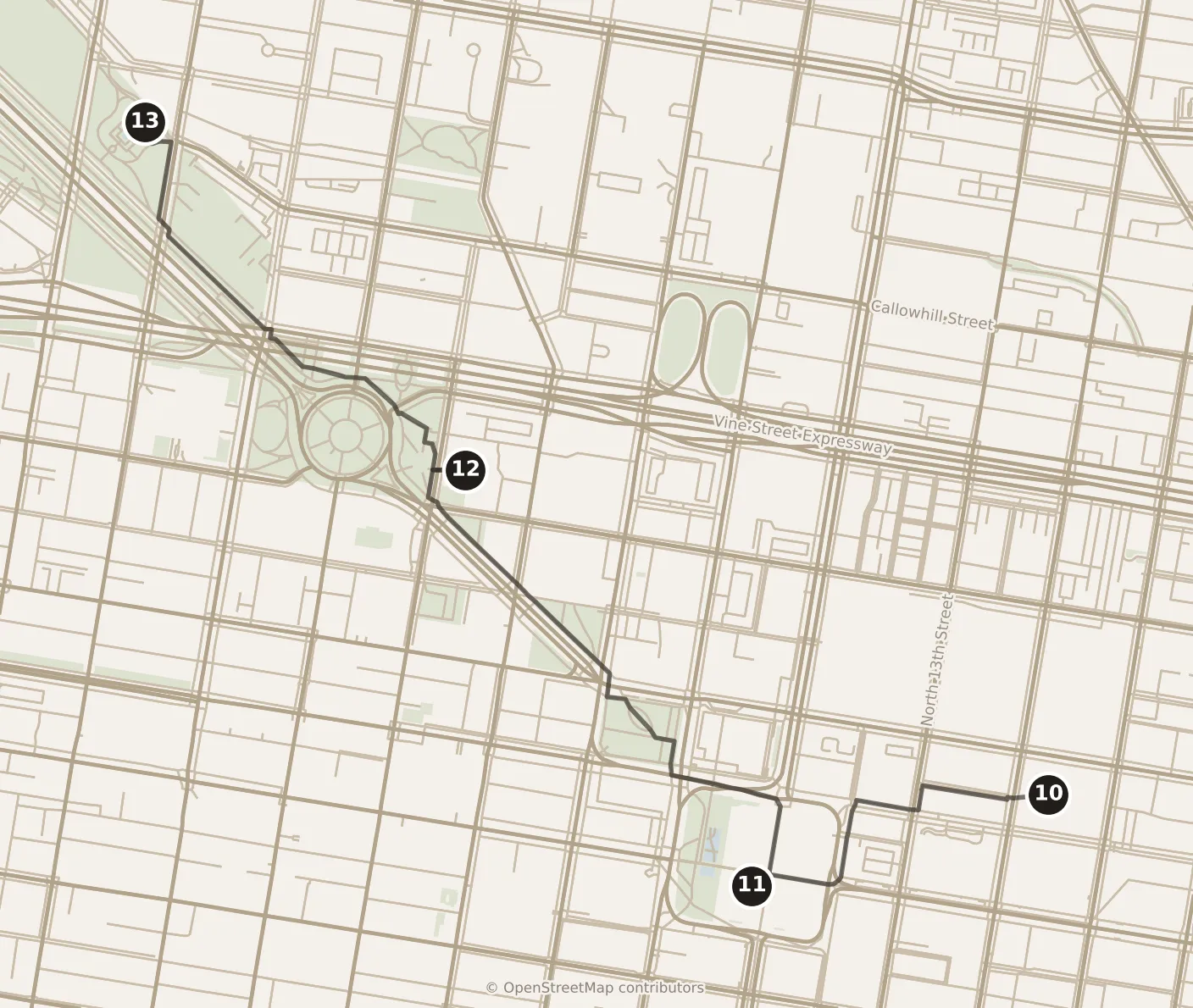
- Morning
- 10Reading Terminal Market
- 11Philadelphia City Hall
- 12Cathedral Basilica of Saints Peter and Paul
- 13Rodin Museum
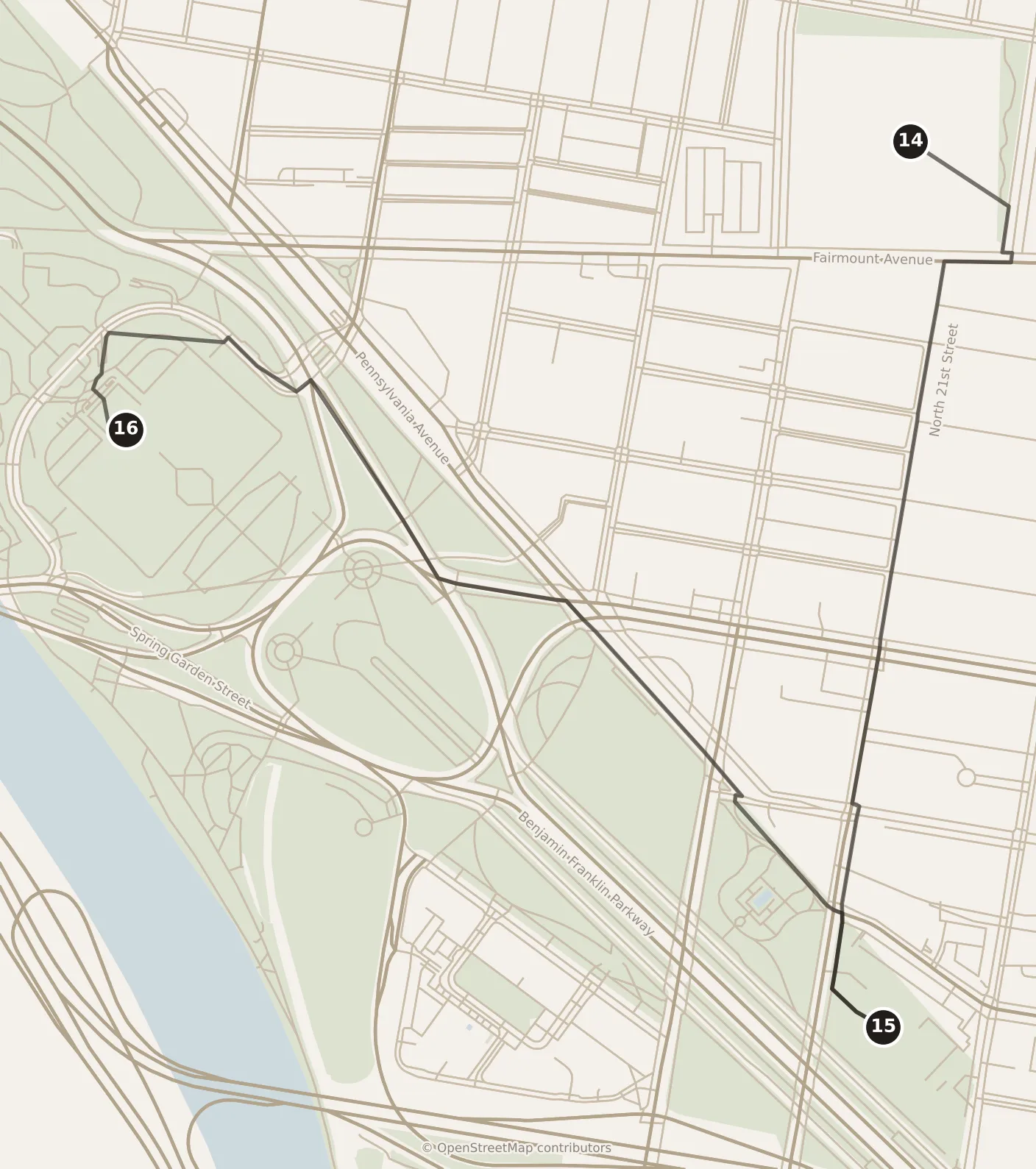
- Afternoon and evening
- 14Eastern State Penitentiary
- 15Barnes Foundation
- 16Philadelphia Museum of Art
Today is one straight line north-west, from a market breakfast to a terrace at dusk, and you do not turn round once. The afternoon starts early — the prison is the reason — and the five o’clock closing is what shapes everything after lunch.
Morning
Start at Reading Terminal Market with breakfast, and start early, because at half past eight it is a working market and by one it is a lunch room with a line at every counter. Forty-five minutes. Scrapple is the thing to order here and this is the meal to order it at: a loaf of pork scraps and cornmeal, sliced and fried hard, which is a breakfast food and makes no sense at any other hour. The market itself opens at eight every day of the week, so the half-past-eight breakfast holds whatever day you are on. What does not is the counter: the Pennsylvania Dutch stalls, which are the ones that cook this, do not trade on Sundays. A Sunday day two therefore keeps the market and loses the scrapple, and the answer is to order something else rather than to move the day. One other thing worth knowing while you are standing in this hall: a counter here does the roast pork sandwich — pork, sharp provolone, garlicky broccoli rabe — which is the order most people who live in this city will tell you beats the cheesesteak you are going to wait in line for on the third day. It is a lunch sandwich and this is a breakfast, so that is a collision rather than a plan: it means coming back at midday, or taking it on your way out of the city, and the day as written does neither.
Nine minutes west and you walk into City Hall rather than at it: four archways open into a courtyard that is a public right of way, and you can stand under a hundred and sixty-seven meters of tower for as long as you like. Fifteen minutes, looking up. It is load-bearing masonry the whole way — granite, brick and marble, with walls over six meters thick at the bottom and no steel frame taking any of the weight, only an iron cap at the very top carrying the clocks and the statue — which is why it took thirty years to build and why the tower is as fat as it is. You can also go up, and it is worth saying so rather than letting you discover it on the day: there is an observation deck directly beneath the statue, reached by an elevator that takes four visitors and an operator at a time. It is a separate timed ticket, it runs on weekdays only and not before ten, and at four people a quarter of an hour it books up — which is why it is not built into the morning below, since this day is in the courtyard before it opens, and the courtyard is the part that costs nothing and cannot be full. Leave by the archway that puts the Parkway in front of you and the rest of the day is in view.
The Benjamin Franklin Parkway was cut diagonally through the grid in the 1920s to a plan by Jacques Gréber, which is why nothing about it looks American. Five minutes up it is LOVE Park; ten minutes there is plenty. Nine minutes further, at 18th Street, the Cathedral Basilica of Saints Peter and Paul is worth twenty. It is the largest brownstone building in the city and, by seating, the largest Catholic church in the state, and the thing to notice is what is missing at eye level: there are no windows in the lower walls at all. The story the parish tells is that the bishop, building in the decade after the anti-Catholic riots of 1844, had a man throw a stone at the wall and put the glass above the mark. Inside, the dome carries Constantino Brumidi’s Assumption, painted in 1868 by the man who painted the inside of the Capitol dome in Washington. This is a working cathedral with a daily schedule of services and a bishop’s seat in it, not a monument with a nave: a Mass may well be running when you walk in, and if it is, come in at the back, keep the camera down and let it have precedence over your twenty minutes.
Thirteen minutes on, past Logan Circle and the Swann Memorial Fountain, the Rodin Museum sits back off the road behind a formal garden. Thirty-five minutes, and go in rather than admiring the bronzes at the gate from the sidewalk, which is what a shorter visit is reduced to. It holds the largest gathering of Auguste Rodin’s work outside Paris, assembled in the 1920s by a cinema owner, Jules Mastbaum, who died before it opened; the building is by Gréber again, which is why the museum, its garden and the road it stands on read as one thought.
Afternoon
Fourteen minutes north-east, at 22nd Street and Fairmount Avenue, Eastern State Penitentiary is the strangest hour and twenty minutes on these three days. John Haviland’s Gothic Revival prison opened in 1829 as the most expensive public building in the country and closed in 1971, and it has been held since as a stabilized ruin rather than restored: peeling cellblocks under barrel vaults, radiating like spokes from a central hub so that one man standing in the middle could see down every corridor at once. The plan was copied by three hundred prisons around the world. What it was built to test was total separation — every prisoner alone, hooded when moved, with a skylight in each cell instead of company — and Charles Dickens came in 1842 specifically to see it and left convinced that it was a slow and secret cruelty worse than any physical punishment. The audio tour is included and its main loop is about forty minutes; the rest is yours to wander. Capone’s cell is furnished as a set piece and is the least interesting thing here.
Lunch is five minutes back down Fairmount Avenue, which is a neighborhood high street rather than a museum strip and priced accordingly. Forty-five minutes.
Then the choice this day is built around. Fourteen minutes south is the Barnes Foundation, and eighteen minutes beyond it is the Philadelphia Museum of Art; each wants two hours and both shut at five, so you get one of them. Take the Barnes if you have ever found a big museum exhausting: it is one collector’s house rebuilt as a gallery in 2012, and Albert Barnes’s will fixes every wall exactly as he hung it — pictures in dense symmetrical ensembles with ironwork, chests and pewter between them, no chronology, no schools, no labels beside the frames. There are a hundred and eighty-one Renoirs in it, sixty-nine Cézannes, fifty-nine Matisses and forty-six Picassos, and you will see more Impressionist painting in two hours than most national galleries hold. Take the art museum instead if you want the encyclopaedic thing — it is one of the few museums that collects rooms as well as pictures, with whole interiors reassembled inside it — and if you want the collection and the terrace in one stop rather than two.
Evening
Either way you finish on the terrace at the top of the art museum steps, and everything above comes to about seven and a half hours from breakfast, which puts you there a little after four. The Parkway runs away dead straight in front of you for a mile with lamps down both sides and City Hall closing the end of it. There is nothing to pay and nothing to shut. There is also nothing quiet about it: these are the seventy-two steps Rocky runs up, and people are still running up them to be photographed at the top for as long as there is light to do it in. That is not a reason to go elsewhere — it is the busiest free ground in the city at this hour because the view earns it — but arrive expecting company rather than a terrace of your own.
In December and the first weeks of January the arithmetic lands almost exactly: you come out, and you are on the terrace something like half an hour before the light goes. From April to August it does not land at all, and there is no pretending otherwise — the galleries shut at five and the light has hours left in it, and those two rules cannot both be satisfied by one visit. So do not pad the museum to close the gap. Walk fifteen minutes back east to Fairmount Avenue, eat there, and walk the same fifteen minutes back up when the lamps come on. You are staying the night, which is the one thing this day has that a day trip does not, and this is the place to spend it. A Friday removes the problem outright, because the art museum alone ran on into the evening on Fridays in 2026.
Local tip. The terrace has no door and no hours, and it is the only thing on this day that the clock cannot take away from you. That is why the collection always comes before the view and never after, and it is why the summer answer is to leave and come back rather than to wait on the steps.
If you want both collections rather than one and your day two is not a Friday, the thing to cut is the prison. Dropping Eastern State takes an hour and twenty minutes out of the middle of the day and most of the detour north with it — call it an hour and a half, on this day and no other. That hour and a half is precisely the difference between the fifty-odd minutes the day as written leaves before the galleries close and a proper two hours inside the second one. On any day but a Friday it is the only version of this day that fits three ticketed interiors, and it is a real trade rather than a saving: you give up the strangest building on the Parkway to see a second collection of paintings. A Friday needs none of it: the art museum ran on into the evening, so the eighteen-minute walk from the Barnes at ten to four buys a second full collection with the prison still in the day.
With a third day

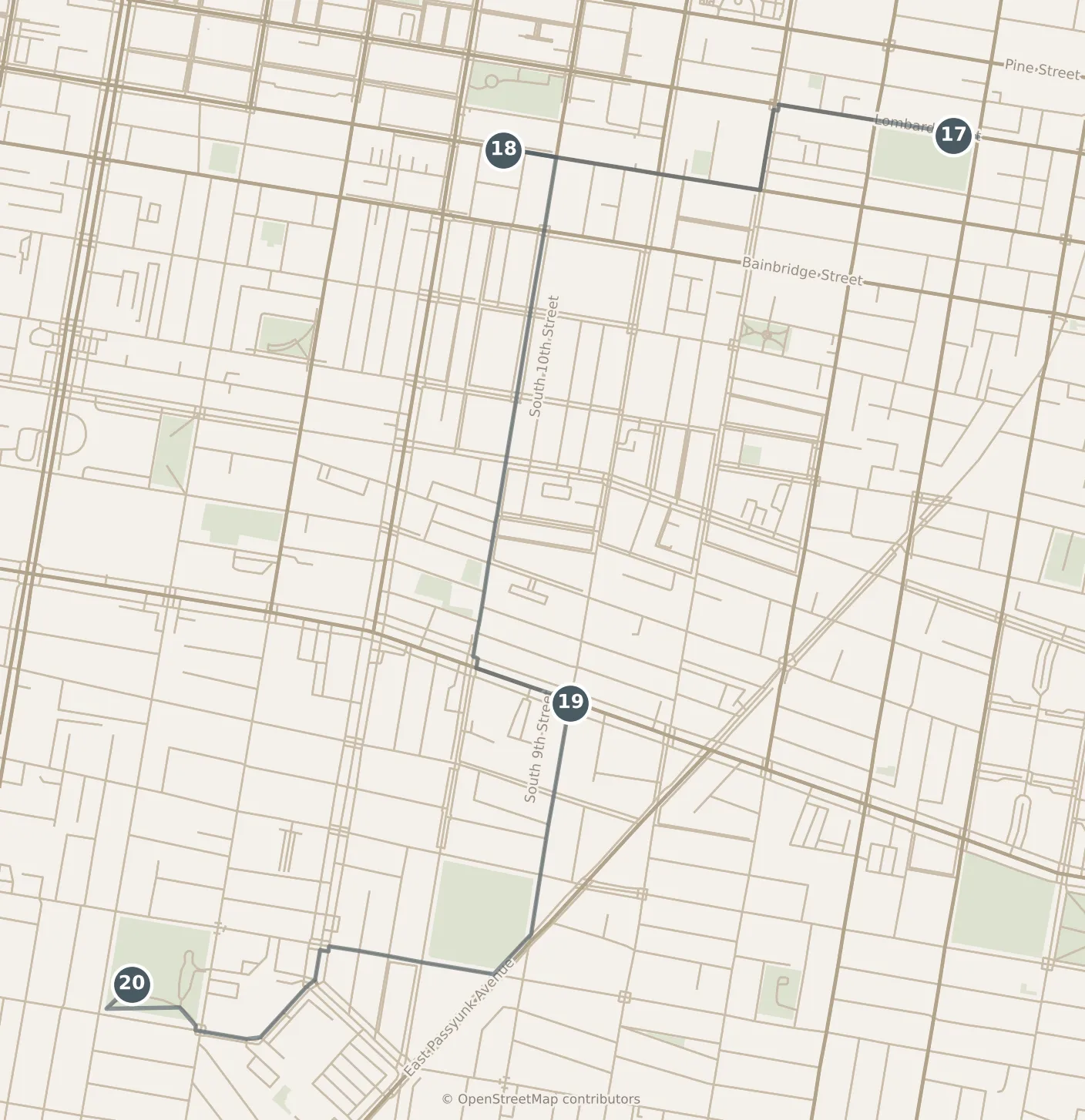
- With a third day
- 17Mother Bethel A.M.E. Church
- 18Philadelphia's Magic Gardens
- 19Italian Market
- 20Passyunk Square
A third day goes to South Philadelphia, and it is not an appendix — it is the half of the city the first two days never enter. Everything above is public history and pictures. This is where people actually live, and it is where the food the city is known for comes from.
It is appended, not inserted, in every arrangement but one. Day two is the only one of the three with a fixed week, so the method is to keep the printed order and shift it only when that would put day two on a Tuesday or a Wednesday. Arrive on a Thursday, Friday or Saturday and nothing moves at all: day one, day two, this day. Arrive on a Sunday and the order still holds, but this day then lands on the Tuesday and gives up the Magic Gardens — what you lose is the labyrinth and the ticket, not the street, because Zagar’s walls along South Street are outdoors and free. Arrive on a Monday and day two comes forward to the front: the museums on the Monday, the founding quarter on the Tuesday without its portrait gallery, this day still third on the Wednesday. The single arrangement in which this day is genuinely inserted is a Tuesday arrival — day one on the Tuesday, this day second on the Wednesday, and the Parkway day pushed to the Thursday, which costs day one its portrait gallery like any other Tuesday. When day two moves, everything it rests on moves with it — the five o’clock closing, the choice between the two collections, the seven and a half hours to the terrace and the sunset hour you count them against. Day one is the one that will take any weekday, because the nine o’clock open house is there every day of the week and the doors on it that do keep a week cost it an hour at the very worst.
Take the Broad Street Line south from 15th Street/City Hall to Lombard–South and walk east along South Street. It is a little over twenty minutes to 6th Street and you pass the Magic Gardens at 10th on the way, which is deliberate rather than careless: they do not open until eleven, and this stretch of sidewalk is itself one of the things you came for. At 6th, Mother Bethel A.M.E. Church stands on ground that has been continuously owned by a Black congregation since 1791 — the oldest such parcel in the country. Richard Allen, who walked out of a segregated white church and founded this one with the Free African Society, is buried with his wife Sarah in a crypt beneath the present 1890 building, alongside a small museum. It is a working congregation before it is anything else, so a Sunday morning here is a service and not a visit; on any other day check what they are opening before you come, and if the answer is nothing, the exterior and the historical marker are on the sidewalk and the twenty minutes go to the walk instead.
Then turn round and go back west twelve minutes to 10th Street, which sounds like a mistake and is not: this stretch of South Street is hung with Isaiah Zagar’s mosaics, hundreds of them, on gable ends and alley walls, and walking it twice in opposite directions is the only way to see both sides. Philadelphia’s Magic Gardens is where they concentrate — three lots that Zagar bought and spent fourteen years covering, inside and out, in mirror shards, bicycle wheels, bottles and broken china, with an outdoor labyrinth you walk through rather than look at. Forty-five minutes. It opened at eleven in 2026 and shuts on Tuesdays; tickets are timed, sold on its own site, and they genuinely go on weekends, so book before you travel. It was in the mid-teens of dollars for an adult in 2026 — worth stating, because it is the only ticket on this whole day, and the number is what settles whether the day costs anything at all.
Fourteen minutes south down 9th Street brings you into the Italian Market, which is a street rather than a hall: awnings, curb carts and shopfronts running from Fitzwater Street down to Federal Street, with the old heart between Christian Street and Washington Avenue. Italians arrived here in the 1880s and the district was formally chartered in 1915; a century later half the produce carts and a good share of the kitchens are Mexican, which is the market being what it has always been rather than the market changing. Give it an hour and a quarter and eat while you walk. Individual shops keep their own weeks and their own hours and there is no list of them, so the way to handle it is to arrive late in the morning rather than early and to accept that some shutters will be down. At 9th and Passyunk the two rival cheesesteak counters face each other across the intersection, open absurdly late, and the sandwich is worth having once in the neighborhood that produced it. Order it the way the sign at the window tells you to, and in one breath: the cheese first — Whiz, provolone or American — then wit or wit-out, which means onions. Hesitating at the front of that line is a public event with an audience behind you. Have cash on you before you join it.
Thirteen minutes west and south, Passyunk Square and the avenue that runs through it are where the afternoon ends: a diagonal high street of small restaurants and old corner bars cutting across the grid, at the scale of a village. There is nothing to see there in the sense the first two days meant it, which is the point of coming. Tasker–Morris on the Broad Street Line is eight minutes on and puts you back under City Hall in ten. If this day is short — a train to catch, a late start — the thing to cut is the Magic Gardens, with its booking and its three quarters of an hour, and give the time to the market and the avenue instead. That is the reverse of what the day’s one ticket would suggest, and it is the right way round.
Practicalities
Three things want buying before you travel, and only two of them are bookings. The Barnes sells its own timed slots and is the one that fills; book it the week before at least. The Magic Gardens, on the third day, is the same shape at a smaller scale. Eastern State Penitentiary needs no timed slot for the self-guided visit but is worth buying online anyway, because it was a couple of dollars cheaper bought online than handed over at the gatehouse in 2026, in a band of low twenties of dollars either way. A fourth appears only if you cannot reach Independence Square by nine on day one: the timed tour is booked on Recreation.gov, the federal reservation site the National Park Service uses, entry itself is free and the reservation carries a handling fee of a dollar a ticket in 2026, and you should take the earliest slot offered, because everything else on day one is stacked behind that hour and a late one pushes the Revolution museum against its own closing time.
The weekday rules are worth reading rather than reducing to a start day, because getting them wrong costs a whole day rather than a stop. Day two must miss Tuesday and Wednesday: in 2026 the Barnes and the art museum both kept a Thursday-to-Monday week, and there is no version of that day without at least one of them. Day one takes any weekday and loses at most an hour: Carpenters’ Hall shuts on Mondays and also on Tuesdays in January and February, and the Second Bank’s gallery keeps day two’s week, so a Monday costs you twenty minutes, a Tuesday or a Wednesday forty, and a Tuesday in January or February both — annoying, not structural. The third day loses one stop on a Tuesday, when the Magic Gardens is shut, and part of another on a Sunday, when Mother Bethel’s morning belongs to its congregation; everything else on it is street. Day two on a Sunday is fine and the market opens at eight as it does on every other day; what a Sunday costs is the scrapple, because the Pennsylvania Dutch counters are the ones that shut. Day one and the third day may therefore trade places freely, and day two may not move onto a Tuesday or a Wednesday at all. The shorthand is to arrive on a Thursday, Friday or Saturday and stop thinking about it.
The arrival that quietly breaks a two-day trip is a Monday or a Tuesday, and the two break differently. Arriving Monday, your only legal arrangement is day two first and day one second — the museums on the Monday, the founding quarter on the Tuesday minus the Second Bank. Arriving Tuesday, there is no legal arrangement at all: Tuesday and Wednesday between them close both big collections, and the honest answer is that this is a trip without museums. It is not a lost trip. Day one runs on the Tuesday minus the Second Bank; the South Philadelphia day runs whole on the Wednesday, because the Magic Gardens shuts only on the Tuesday; and Eastern State Penitentiary opens every day of the week, so the prison and the walk up the Parkway can be folded into either afternoon. What you come back for is the Barnes.
For moving between these stops: day one needs a single ride, on the Market–Frankford Line — line L on the signs — from 30th Street Station to 5th Street/Independence Hall, and after that it is walking, with 2nd Street at the end of the evening if you want it. Day two needs nothing at all — it is a continuous walk of about six kilometers from Reading Terminal Market to the art museum steps, all of it flat, with 15th Street/City Hall under the start of it if you would rather begin further up the Parkway. The third day needs two rides, both on the Broad Street Line — line B — down to Lombard–South and back from Tasker–Morris. The reloadable card is called the SEPTA Key and a contactless bank card taps at the same gate; day one needs one ride and the third day two, which is too few to be worth buying and loading a card for, so tap the bank card you already carry.
Two things about weather, since a good half of day one and most of the third day are outdoors. Rain suits day two, which is nearly all interiors, so swap it forward if the forecast is bad and the weekday rules allow — that permission is the whole reason for spelling them out above. Heat does not suit the Parkway, which is a mile of open sidewalk with very little shade; in July and August walk it early, which is what day two already does, and let the air-conditioned hours be the middle of the afternoon rather than the end of it. The third day has no shelter on it either, and the Italian Market in August is a genuinely hard hour. The day as written cannot reach it much before noon, because the Magic Gardens do not open until eleven and want three quarters of an hour, so August is a straight trade: start early and cut them — the day’s own short-day cut — or keep them and take the heat. Going earlier has a cost of its own in any case, because the shops raise their shutters late and an early market is a half-shut one.


