Philadelphia in one day: Independence Hall at nine, Old City on foot, the Parkway at dusk

Last updated 4 August 2026
Overview
Philadelphia is a grid laid between two rivers, and one day works here because the two halves worth having sit at opposite ends of a single straight line. The founding-era quarter is in the east by the Delaware and is roughly four blocks square. The museums are in the north-west, strung along one boulevard. Market Street runs between them and the subway runs beneath it, so the day below rides east once, then walks west all afternoon and never turns round. About eight kilometers on foot, two hours of actual walking, and one fare.
What a single day costs you is South Philadelphia, and it costs you the whole of it: the Italian Market, the two rival cheesesteak counters facing each other at their own corner at the foot of 9th Street, and the row-house streets that are what Philadelphians mean when they talk about their own city. It costs you Fishtown, and University City beyond the station, on the same terms. None of these is a detour — each is a ride and then a neighborhood, and a day that goes to fetch one comes back with the afternoon gone. Give them up now rather than at three in the afternoon, when it will feel like a defeat rather than a plan.
One hour decides everything else on this page. In 2026 Independence Hall ran an open house from nine until ten minutes to ten with no ticket needed, and went over to booked timed tours for the rest of the day. That is why the day starts at nine and why it starts here: turn up on the hour and you walk into the room where the Declaration of Independence was adopted having reserved nothing and paid nothing. Nine is also when this end of the city wakes up generally, the Bell included, so there is nothing to gain by being earlier. If the hour has moved, build the morning back from the new one; if you cannot make it at all, the alternative is in Practicalities and it costs a dollar and a booking made in advance.
The other fixed point is the light, and nobody revises the sky. The last thing on this route is the terrace at the top of the art museum’s steps, which looks straight back down the Parkway to the lit tower of City Hall: a mile of boulevard, flagpoles and fountains in one frame, and it only exists in the half hour when the lamps have come on and the sky has not yet gone black. The sun sets here from a little after half past four in the first week of December to about half past eight at midsummer, so take your own month’s hour and work back from it. From a nine o’clock start everything above the terrace comes to about eight hours, which puts you on it at around five.
That eight hours counts the time you spend inside places and the time you spend walking between them, and it counts nothing else. The largest thing it leaves out on this particular route has a name: security screening. Independence Square and the Liberty Bell Center each have a scanner at the door, you are in one of those lines twice inside the first hour, and on a fine Saturday morning it is the longest single wait of the day. Put it in the plan as its own line rather than folding it into the total.
Last, the bag, because a reader with one day is carrying one. The shape is good: the day starts at 30th Street Station and ends a little over twenty minutes’ walk from it, so you never haul a case across town and never double back for it after dark. What nobody can promise you is somewhere to leave it — the station’s baggage service turns on holding a ticket for a train that day, and that is the thing to settle before you ride east rather than after. If the answer is no, do not spend the morning dragging a case through two scanners: give up the interiors rather than the walking, and what is left is still a day rather than a consolation. Ride east as written and take the open half of Old City — the steel frame and the sunk foundations at Franklin Court, then Christ Church, then Elfreth’s Alley, which is a street and so is free and never shut, and then Franklin’s grave read through the opening in the Arch Street wall. Call it two hours and nothing screened. Lunch at the market as below. Then the whole afternoon unchanged, because all of it is outdoors anyway: the City Hall courtyard, the fountain at Logan Circle, the two Rodin bronzes at the gate, the steps and the terrace at dusk, and the river path back to the station. What you give up is the Assembly Room, the Bell and the museum, and what you accept is carrying the case the whole way. That is the reverse of the usual advice and it is the right way round here.
The day

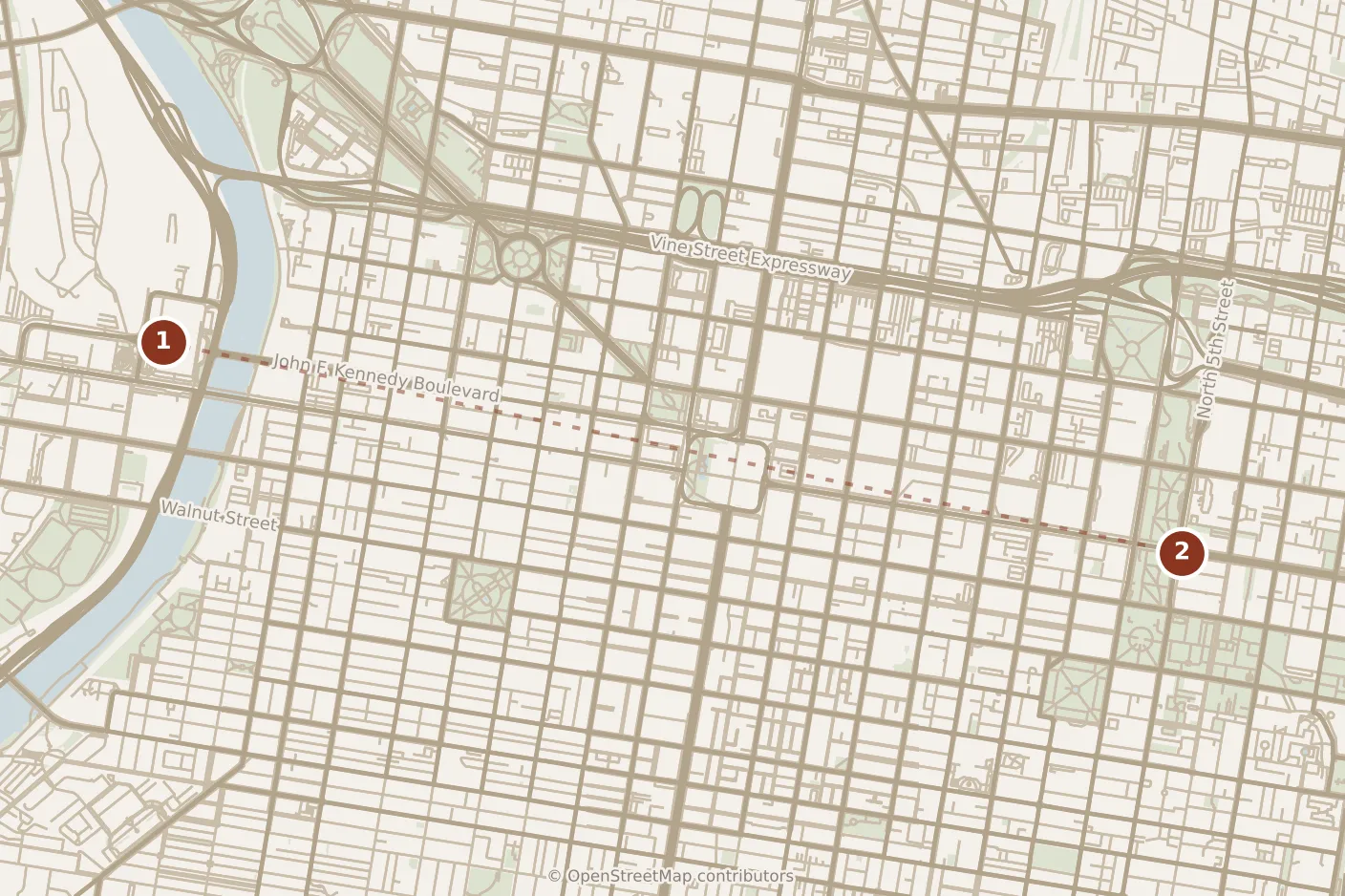
The ride on to stop 2, by metro, not on foot.
- Morning
- 130th Street Station
- Morning
- 25th Street station
- 3Independence Hall
- 4Liberty Bell Center
- 5Franklin Court
- 6Christ Church
- 7Elfreth's Alley
- 8Christ Church Burial Ground
- Afternoon
- 9Reading Terminal Market
- 10Philadelphia City Hall
- 11Swann Memorial Fountain
- 12Rodin Museum
- 13Philadelphia Museum of Art
- Evening
- 14Boathouse Row
Morning
Nearly everyone arrives at 30th Street Station, on the far bank of the Schuylkill, and the first move is to leave it again. The Market–Frankford Line — the El — runs under Market Street from the platforms beneath the station to 5th Street, which comes up a couple of blocks north of Independence Square; the way onto the square is the security entrance on 5th Street itself, between Chestnut and Walnut. The ride is about ten minutes and the walk at the end of it four. The same journey entirely on foot is closer to an hour, and the first hour of this day is already spoken for.
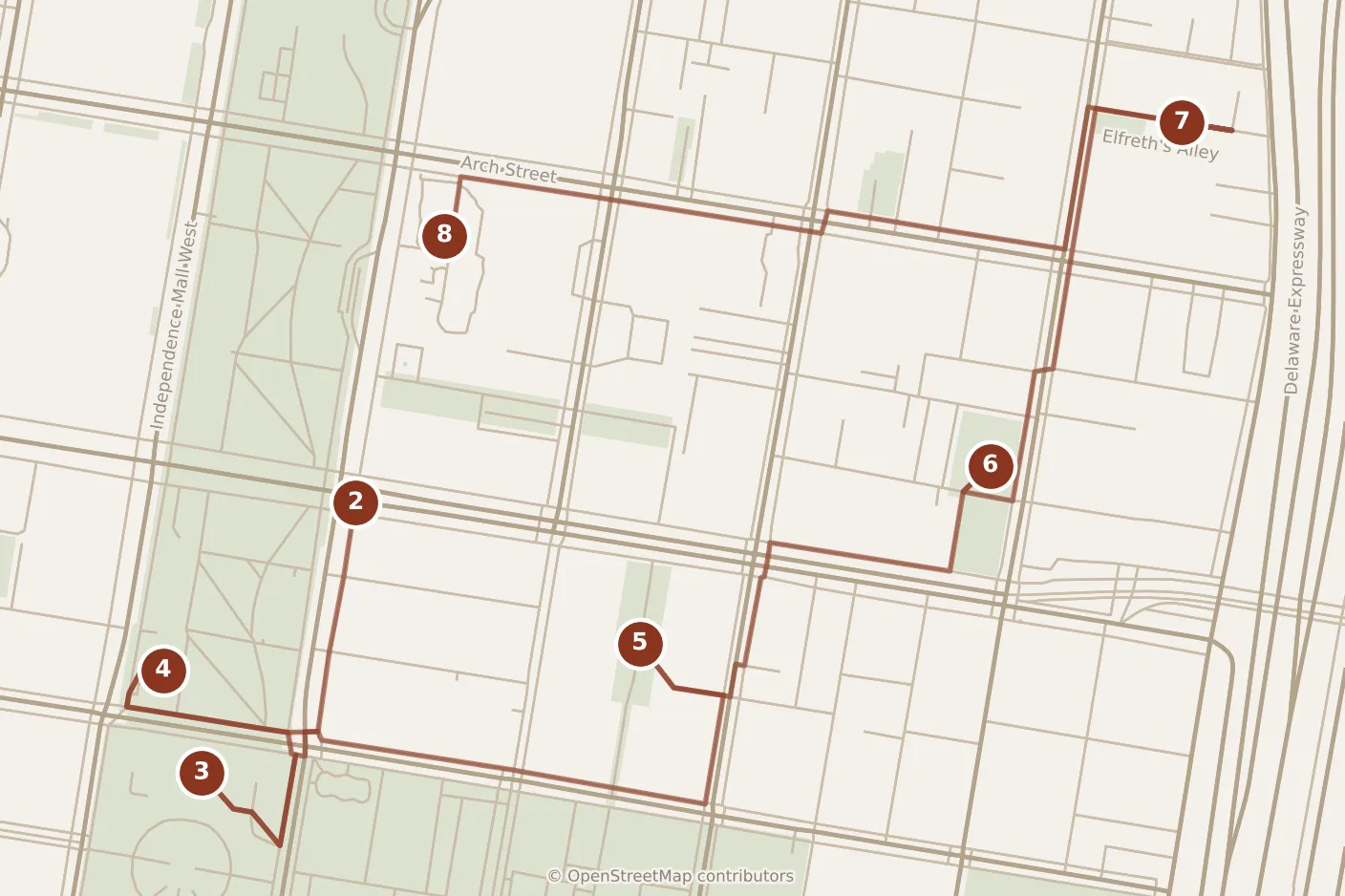
Independence Hall is a modest brick state house with a white steeple, and the modesty is most of the point: a provincial Georgian building begun in the 1730s, in which two documents were written that the rest of the world then argued about for two centuries. The room to be in is the Assembly Room on the first floor, restored to how it stood in 1776 — plain tables under green cloth, rows of wooden chairs, and at the front the high-backed chair George Washington sat in through the summer of 1787, when the Constitution was drafted in the same room eleven years after the Declaration. A half-sun is carved into its crest, and Franklin’s remark about not being able to tell a rising sun from a setting one is the single best-known thing anyone ever said in an American room. Give the building forty minutes with the scanner line included, and take in Congress Hall next door on the same square if the line was kind.
Local tip. Most people join the line for the Bell first, because it is the famous one, and it is the wrong order. The Bell keeps the same hours all day and has no free window to miss; the Hall’s ticketless hour ends at ten and does not come back. Do the Hall, then walk the minute across to the Bell.
The Liberty Bell Center is that minute away, and half an hour is enough. The bell is smaller than photographs suggest and the crack is not the interesting thing about it: it hung in the state house steeple, cracked early, was recast twice by local founders who got it wrong both times, and spent its first eighty years as an ordinary bell nobody wrote about. It became the Liberty Bell in the 1830s, when abolitionists took up the verse cast around its shoulder — proclaim liberty throughout all the land unto all the inhabitants thereof — and gave it the name and the meaning it now has. Walk to the end of the hall for the last exhibit, where a glass wall puts the bell and Independence Hall in the same view.
Six minutes east is Franklin Court, and it is the stop people skip and shouldn’t. Franklin’s house was demolished in 1812 and no drawing of it survives, so in 1976 Robert Venturi put up a white steel frame at the size and in the position of the vanished house — an outline of a building standing in an open court, with hoods in the paving you look down through onto the real foundations and the privy pits. Underneath is a museum of four low rooms organized by character trait rather than by chronology, with a glass armonica of the kind he invented, and the record of his break with his own son, who stayed loyal to the crown and whom he never forgave. Forty minutes.
Five minutes on is Christ Church, Georgian, galleried, and startlingly light inside after the brick streets. Its steeple was finished in 1754 and made it the tallest structure in the American colonies, which it stayed for more than half a century. The pews used by Washington and Franklin are marked. Fifteen minutes is the right amount: it is a working parish church, so what is open and when moves with the services, and it is worth putting your head in rather than planning around.
Five minutes more brings you into Elfreth’s Alley, thirty-two houses built between the 1700s and the 1830s down a cobbled lane one cart wide, and the street’s own claim is that it is the oldest continuously inhabited residential street in the country. People live in nearly all of them, which is what makes it worth the detour and also what limits it: you look, and mostly you do not go in. The exceptions are numbers 124 and 126, kept as a small museum by the alley’s own residents’ association and open on Friday, Saturday and Sunday afternoons for a few dollars paid at the door — which on the day as written is after this morning has gone past, so fifteen minutes is still generous. It is a street, so it is free and it is never shut, which will matter later.
Then ten minutes west along Arch Street to Christ Church Burial Ground, where Franklin is buried under a flat slab with his wife, alongside four other signers of the Declaration. It charges five dollars for a self-guided visit, keeps the church’s own calendar rather than the park’s, and shuts for January and February altogether, so it is the one stop of the morning that may simply be closed on the day you turn up — and if it is, the grave sits against the wall on Arch Street and can be seen from the sidewalk through an opening in the brickwork, which is how most of the coins on it got there.
Afternoon
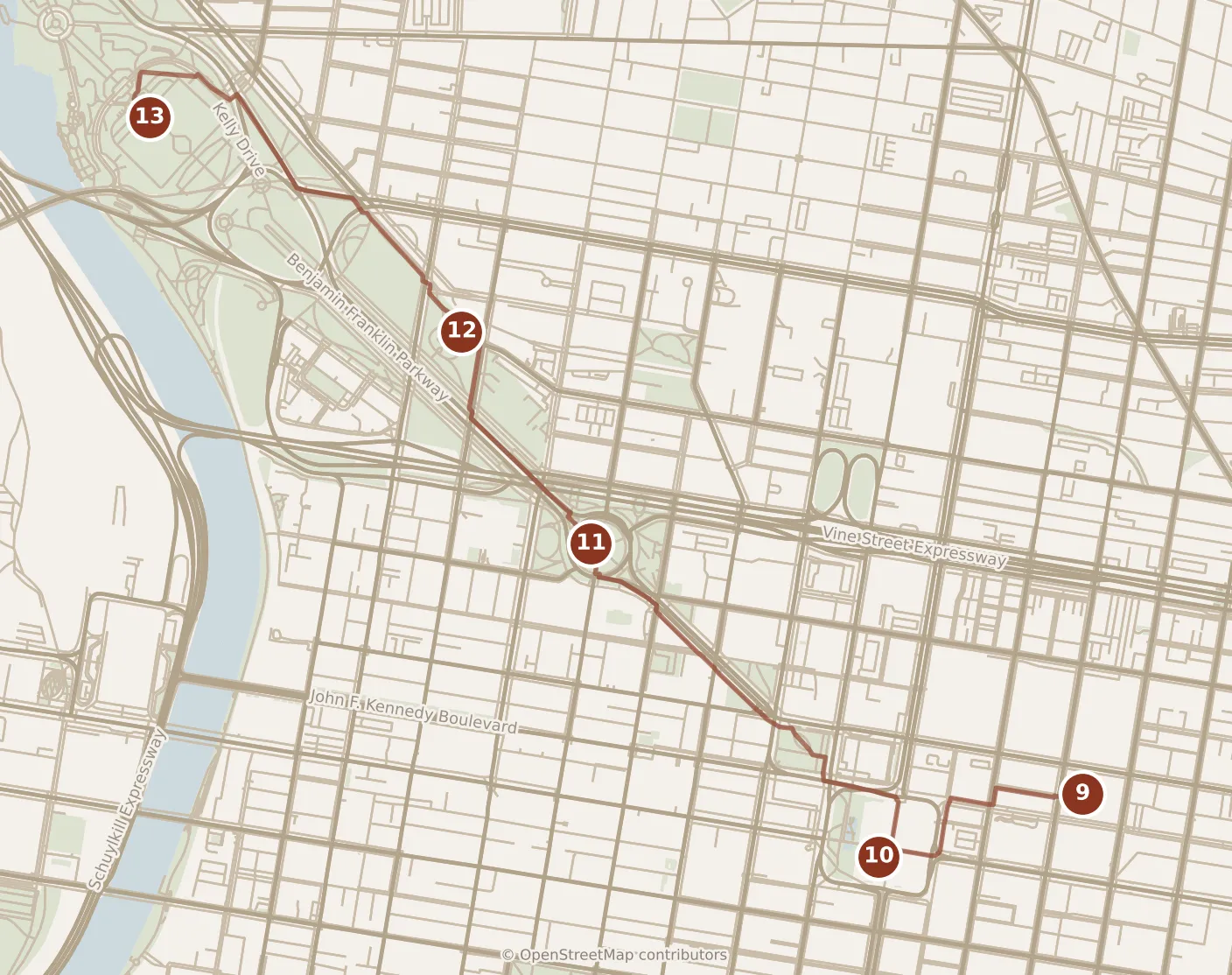
Just under twenty minutes further west, still on Arch Street, is Reading Terminal Market: a covered block of stalls opened in 1893 in the undercroft of the Reading Railroad’s train shed, and the one indoor place in this city that everybody uses. Lunch goes here and it should take an hour. The seating is a single communal block of tables in the middle of the hall, unallocated and at its fullest in exactly the hour this day arrives, so a table is luck rather than a plan and eating standing costs you nothing but the sitting down. Order the roast pork sandwich rather than the cheesesteak — long-roasted pork, sharp provolone and bitter greens on a long roll, the sandwich Philadelphians argue for against the more famous one. One thing decides itself if your day falls on a Sunday: the Pennsylvania Dutch counters, which are a named part of what this market is, are shut every Sunday.
Under ten minutes west and you walk into City Hall, which on this day is a stop you go through rather than one you go into: four archways open into a courtyard that is a public thoroughfare, and you can stand in the middle of it under 167 meters of tower. It went up between 1871 and 1901 and it has no steel frame at all — load-bearing granite, brick and marble the whole way, with walls up to six meters thick at the base, which makes it the tallest load-bearing masonry building in the world and explains why it took thirty years. William Penn stands on the top in bronze, by Alexander Milne Calder. Twenty minutes in the courtyard, looking up. If you want the view from the other end of that tower, there is a glazed observation deck near the top of it, reached only on a guided tour and only four people at a time in a hundred-year-old elevator; the tickets are sold by the city’s visitor center rather than at the building, so it is a thing to settle before the day rather than in the courtyard.
Seventeen minutes up the Benjamin Franklin Parkway — a diagonal cut straight through the grid in the 1920s on the model of a Paris boulevard, which is why nothing about it looks American — brings you to Logan Circle and the Swann Memorial Fountain. Three reclining bronze figures pour water at each other across the basin, and they stand for the region’s three rivers: the Delaware, the Schuylkill and the Wissahickon. It is by Alexander Stirling Calder, son of the man who made the Penn on City Hall behind you, and the third Calder in that line has work in the museum ahead of you. Three generations of one family along a single mile of road is a peculiar thing to be able to walk, and it takes ten minutes to do it.
Ten minutes on, the Rodin Museum sits back off the Parkway behind a formal garden. The Thinker is at the gate and The Gates of Hell at the door, both outside and both free to stand in front of, and inside is the largest gathering of Auguste Rodin’s work anywhere outside Paris. If the day is behind, look at the two bronzes from the sidewalk and keep walking; that is a real half of the stop rather than a consolation.
A quarter of an hour further and the Parkway ends at the Philadelphia Museum of Art, which you should reach at about three. Two hours, and the reason to be firm about that is the second hour that shapes this day: in 2026 the museum shut at five on every day it opened, and ran on to a quarter to nine on Fridays only. The terrace outside has no doors and no hours; the collection does. So the museum always comes before the view, never after — and if that hour has moved, the order still holds and only the arithmetic changes.
Two hours buys about a fifth of the building, so choose before you go in rather than in the third gallery. Take the European rooms for Vincent van Gogh’s Sunflowers and the run of Impressionists around it, then the Marcel Duchamp holdings, which are the largest anywhere, and then the arms and armor, which is a genuinely strange collection of complete jousting harness. Skip the special exhibition, whatever it is: it will have a line and it is not what this building is for. Come up the main staircase rather than the elevator, once, for the gilded Diana by Augustus Saint-Gaudens standing at the top of it.
Evening
You come out of the doors onto the terrace at the head of the steps, and this is what the day has been walking towards. The Parkway runs away in front of you dead straight for a mile, lamps down both sides, and City Hall closes the far end with Penn lit on top of it. There is nothing to pay and nothing to shut; the terrace is a public plaza and you can stand on it at any hour. The bronze Rocky is at the bottom of the steps, not the top, and the line for a photograph beside it is longer than the line for anything upstairs.
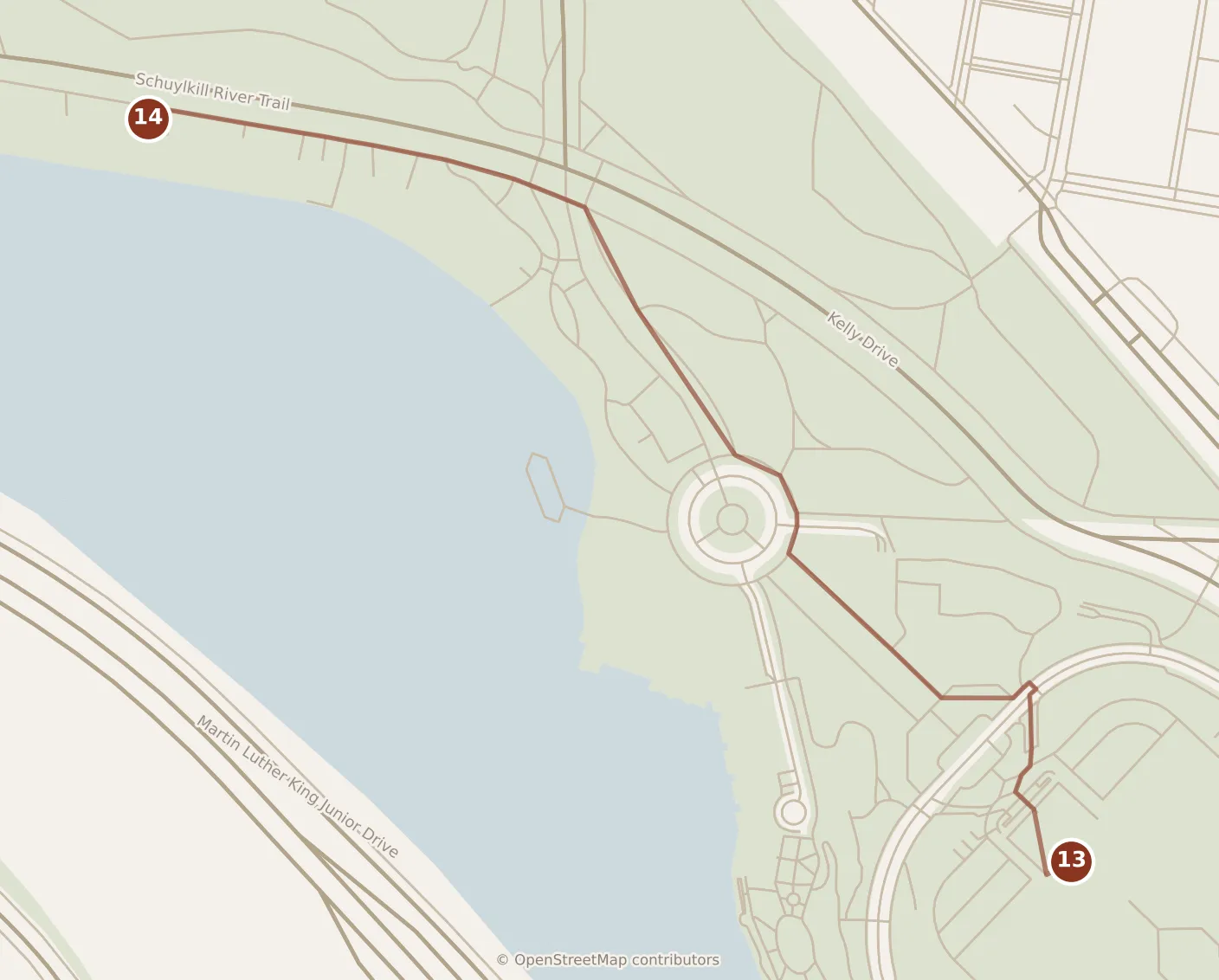
From late autumn to early spring the arithmetic lands almost exactly: the museum closes and the light goes within the same hour, and you walk out into it. In summer it does not, and there is no point pretending — at midsummer you are on the terrace three and a half hours before dusk. Do not pad the museum to close that gap. Walk a quarter of an hour up the river path instead to Boathouse Row, a line of nineteenth-century rowing clubs along the Schuylkill that have been outlined in lights after dark since 1979, and come up for the terrace afterwards. Do not count on eating on the way: the path runs through parkland, and nobody publishes what is trading at the boathouses from one year to the next, so keep dinner for the streets. A Friday in summer solves the problem by itself, because the museum runs late.
Then the last leg, which is also the longest unbroken walk of the day: a little over twenty minutes down the river path from the museum to 30th Street Station, with the water on your right the whole way. From late autumn to early spring that walk happens after dark, and nobody who manages the trail publishes whether the stretch is lit or how late it is used, so if you come to it in the dark with a case on you, take the streets down instead and keep the river for a long evening. From Boathouse Row it is half an hour rather than twenty minutes, so add that in if you went. The station is the one you started at and the departure boards are on the concourse you walked out of in the morning, and that symmetry is the whole reason the day runs east to west rather than the other way about.
Practicalities
One thing here can be booked ahead and only one: the timed tour of Independence Hall, if you cannot be there for the ticketless hour at nine. It is reserved in advance through the federal booking site the National Park Service uses; admission is free and the reservation fee was a dollar a head in 2026. How far ahead the slots open is published there and nowhere else, so look rather than assume you have a month. Book it if your train gets in late, and take the earliest slot you can, because the whole shape of this day depends on being finished in Old City by noon. Nothing else on the route needs arranging in advance.
The closure to check is the art museum, and it is a serious one: in 2026 it was shut on both Tuesday and Wednesday, which is two days in seven and is unusual enough that people arrive not expecting it. Check that before you fix your date rather than after, because it is the single thing most likely to break this day as written. If it falls badly, the shape survives — the Parkway, the fountain, the Rodin forecourt and the terrace are all outdoors and none of them close — and the two hours go somewhere else. The best somewhere else is Eastern State Penitentiary, a quarter of an hour off the Parkway from the Rodin Museum: a ruined prison of vaulted stone corridors radiating from a hub, abandoned in 1971 and deliberately left to decay. It opens every day, so the only thing that would shut it is one of its own special events. Failing both, put the hours back into the morning and take a proper look at Congress Hall.
For the route itself you need one fare in your hand and very nearly that is all: the single ride east on the El at the start. There is one place you might want a second, and it is the twenty-minute walk west along Arch Street after Elfreth’s Alley — the El runs the same way underneath, from 2nd Street to 11th Street, a couple of blocks from the market, and taking it costs you the burial ground. Everything else on this page is free or paid at the door, and the walk home at the end is a walk. One exception if you arrive by air: the airport train runs through 30th Street and on to Jefferson station at 11th and Market, a couple of blocks from that same market, so you can stay aboard, walk the six blocks east to the square and pay for no El ride at all. The city guide covers how the fare works and what to tap, and this page assumes you have not read it and does not repeat it.
Two things about the weather, because half of this day is outdoors and no amount of planning changes that. Rain inverts the afternoon cleanly: give the museum three hours instead of two, walk less of the Parkway, and the day still works. Heat does not — the Parkway is a mile of open pavement with very little shade on it, and in July and August the stretch between City Hall and the fountain is the part people give up on. If your one day falls in high summer, do the Parkway early and give the museum the hottest hours rather than the coolest, which is what a large air-conditioned building is for; the terrace at the end is the same terrace either way. The El will not help with this one: it runs under Market Street and no further north. But it is not the only thing running — the SEPTA 38 bus takes the Parkway itself, past the museum and back down into the grid, and through the summer the Philly PHLASH visitor loop covers the same stretch daily on a flat day pass, free if you already hold a SEPTA fare card. Either one turns the hottest mile into a sit-down, which is the answer the El cannot give.


