Nuremberg in two to three days: the walled old town, the rally grounds and the courtroom

Last updated 18 October 2026
Overview
Nuremberg holds two cities, and two days is what it takes to see both without letting one swallow the other. The first is the walled old town: a medieval imperial city rebuilt after the Second World War on its own street plan, small enough to cross from the main station to the castle in under half an hour, with the river Pegnitz running through the middle of it. The second is the twentieth century, which in Nuremberg is not a footnote: the rally grounds on the southeast edge of the city, and the courtroom in the west where the International Military Tribunal sat. Day one is the old town. Day two is the national museum in the morning and the rally grounds in the afternoon. A third day takes you to the courtroom, then back under the old town into the rock-cut cellars beneath it.
Everything inside the walls is walked. The only rides in the whole trip are tram 8 out to the rally grounds and the U1 line, both from the Hauptbahnhof, and both are named where you need them. The local network is VGN; a VGN TagesTicket Solo from the machines at the stops covers a day of trams and U-Bahn, a Deutschlandticket is valid on it too, and the parent guide covers buying and validating.
Day two is the one with a deadline. The rally grounds are open air and unlit, and the walk across them is worth doing only in daylight. The sun sets here from just after four in December (16:17 at the earliest) to nearly half past nine at the end of June (21:27 at the latest), so take your month’s hour and count back the afternoon set out under day two. In December that leaves you very little margin, and the day as written tells you what to cut.
One closure decides the order. The Germanisches Nationalmuseum, the heart of day two, is closed on Mondays. If day two would land on a Monday, swap the two days. Day one survives a Monday except for Dürer’s House, which is shut on Mondays outside July to September and the Christmas market, and is already the stop the day can lose. In Advent the Hauptmarkt becomes the Christkindlesmarkt, and the morning of day one takes longer through the crowd; nothing else in the route changes.
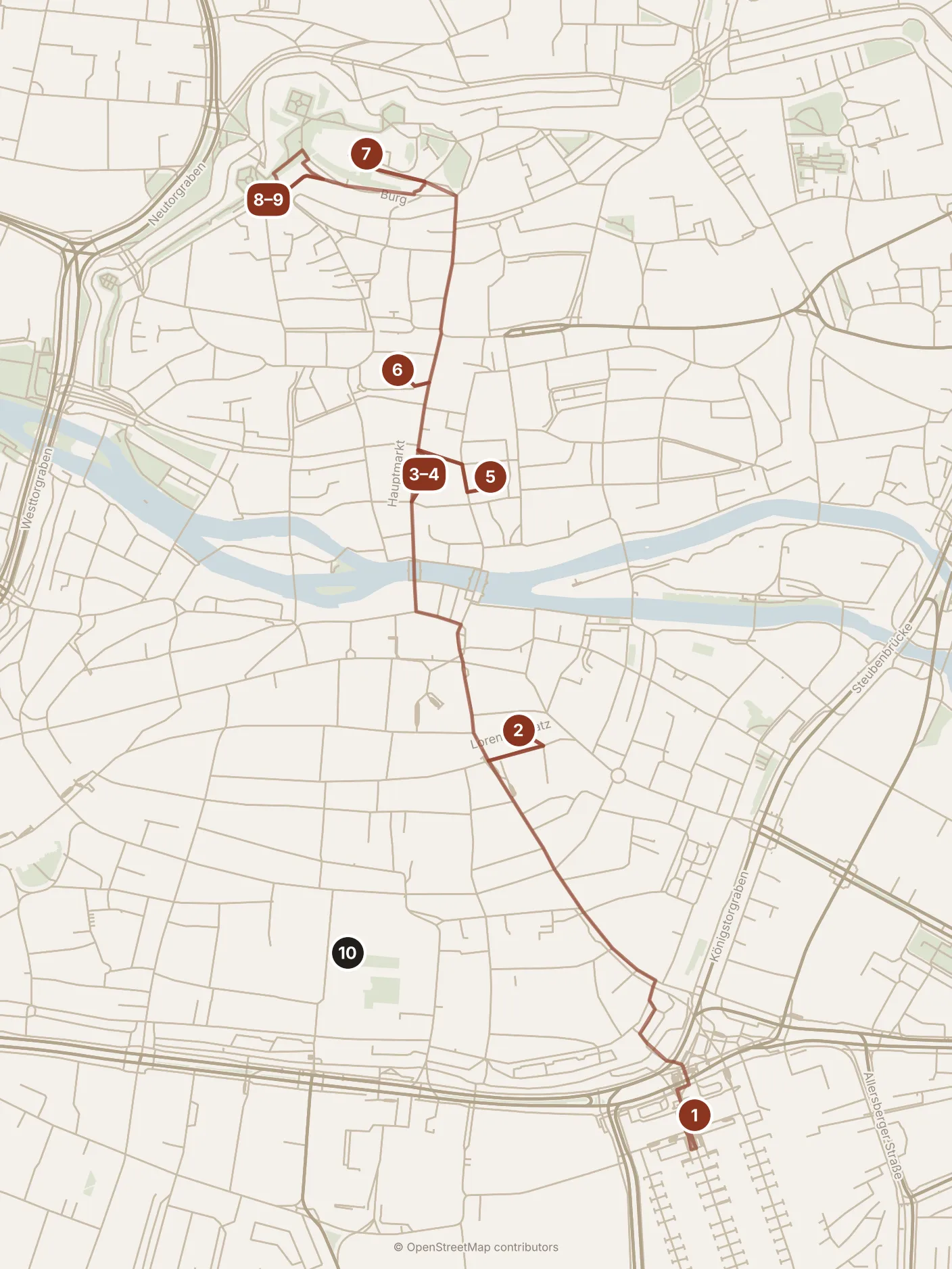
- Day one
- 1Hauptbahnhof
- 2St. Lorenz
- 3Hauptmarkt
- 4Schöner Brunnen
- 5Frauenkirche
- 6St. Sebald
- 7Imperial Castle
- 8Albrecht Dürer's House
- 9Tiergärtnertorplatz
- Day two
- 10Germanisches Nationalmuseum
Day one

Today runs south to north in a single line, from the station to the castle, and never turns back on itself. The one moment that does not wait is noon at the Frauenkirche, so the morning is built backwards from it.
Morning
You arrive at the Hauptbahnhof, on the south side of the walls. If you are carrying a bag, the left-luggage lockers are in the station itself, and today’s route ends a twenty-minute walk away from it, which is worth knowing before you choose between leaving the bag and checking in first. Cross the ring road through the underpass in front of the station and come up at the gate tower on the other side; that is the start of Königstraße, the main street of the southern half of the old town, and you follow it north for a little over ten minutes.
It ends at St. Lorenz, the larger of the two great Gothic parish churches, with its twin towers and a rose window over the door. Inside, two things justify the stop, and both are found by looking up. Hanging free in the air above the choir is the Angelic Salutation by Veit Stoss: a wooden ring of carved roses around the Virgin and the angel, suspended from the vault. To one side of the choir, the sacrament house by Adam Kraft climbs in pale stone almost to the ceiling, a thin Gothic spire narrowing as it goes, and at its base the sculptor carved himself, kneeling and holding the whole thing up. Give the church forty-five minutes. It is a working parish church, and on a Sunday morning it is in use for services; on that day take the morning in a different order and come back to it after lunch.
Keep going north across the river on the Museumsbrücke. Stop in the middle: to your right, the Heilig-Geist-Spital sits on arches over the water, a hospital built across the river in the fourteenth century, and the view from the bridge is the one that is on every postcard of the city. Two more minutes bring you into the Hauptmarkt, the market square, about seven minutes from St. Lorenz in all.
At its corner stands the Schöner Brunnen, a stone fountain shaped like a Gothic spire, painted and gilded, with forty figures climbing it. Set into the iron grille around it is a brass ring that people turn for luck; you will see where it is from the polish.
Across the square is the Frauenkirche, and this is the stop the morning is built around. At noon every day, the mechanical clock on its front sets off the Männleinlaufen: seven small figures of the electors file out and circle the figure of the Emperor Charles IV, in memory of the Golden Bull he issued in 1356, the decree that fixed how emperors were chosen. It lasts a few minutes and it happens once a day. So work backwards: St. Lorenz wants forty-five minutes, the walk from the station takes a little over ten, and the walk from the church to the square seven, which puts the departure from the station at about half past ten if you want to be standing in the square at a quarter to twelve. The count includes nothing for queuing, because nothing here has a queue; it does not include the slow walk through the Christmas market in Advent, which can double the last stretch.
Lunch is on the square or just off it, and it is Nuremberg Bratwurst: small, thin and grilled, served six or more to a plate, or three in a bread roll from a stall.
Afternoon
Walk north out of the top of the square, four minutes uphill, to St. Sebald, the older of the two parish churches and the one closer to the castle. Its center is the shrine of Sebaldus, the city’s patron saint: a silver coffin inside a bronze cage by Peter Vischer, on a frame of snails and dolphins, with apostles standing round it and the sculptor’s own portrait among the figures at the base, in working clothes. Give the church half an hour, and spend most of it at the shrine.
From the church it is a steady climb, about six minutes up the hill, to the Imperial Castle, the Kaiserburg, on the sandstone ridge that is the reason the city is here at all. The courtyards are open to walk into; the parts with a ticket are the residential palace, the Double Chapel, the Sinwell Tower and the Deep Well. The Double Chapel is two chapels stacked one above the other, with an opening between them so that the emperor in the upper one could follow the service below. The tower is a climb up a narrow stair to the best view over the rooftops of the old town. The well is cut deep into the rock and is shown in short demonstrations, at intervals, in which a guide lowers light into it so you can see how far down it goes. Give the castle two hours. If you want only one of the paid parts, take the tower: it is the one that turns the morning’s walk into a map.
Local tip. The courtyards and the terrace outside the castle walls cost nothing and give you most of the view; the ticket buys the tower, the well and the rooms. If the afternoon is short, the free half is the one to keep and the tower is the one paid part worth adding.
The well demonstrations are the one gap in the count: the wait for the next one is not included in the two hours, and on a busy day it can be most of an hour.
Come down the west side of the hill, four minutes, to Albrecht Dürer’s House, below the Tiergärtnertor gate. This is the tall half-timbered house where the painter lived and worked from 1509 until his death in 1528, the only artist’s house of its age in northern Europe to survive in this condition. It is not a gallery of his work, which is spread across the world’s museums; it is the rooms, the kitchen and a reconstruction of a workshop where his printing is demonstrated. Give it an hour. If the castle has run long, this is the stop that goes, because the next two days do not depend on it.
Evening
Stay where you are. The square in front of the house, Tiergärtnertorplatz, is the square in the north of the old town where the evening happens, with the gate tower above it and the half-timbered houses round it. On a warm evening people sit outside along its edges until late. Eat in the streets around it or a few minutes back down the hill: the dish to look for is Schäufele, roast pork shoulder with a crackling crust and a potato dumpling, the Franconian Sunday dish served all week here. From here the station is twenty minutes on foot, straight back down through the Hauptmarkt and Königstraße, the way you came.
Day two

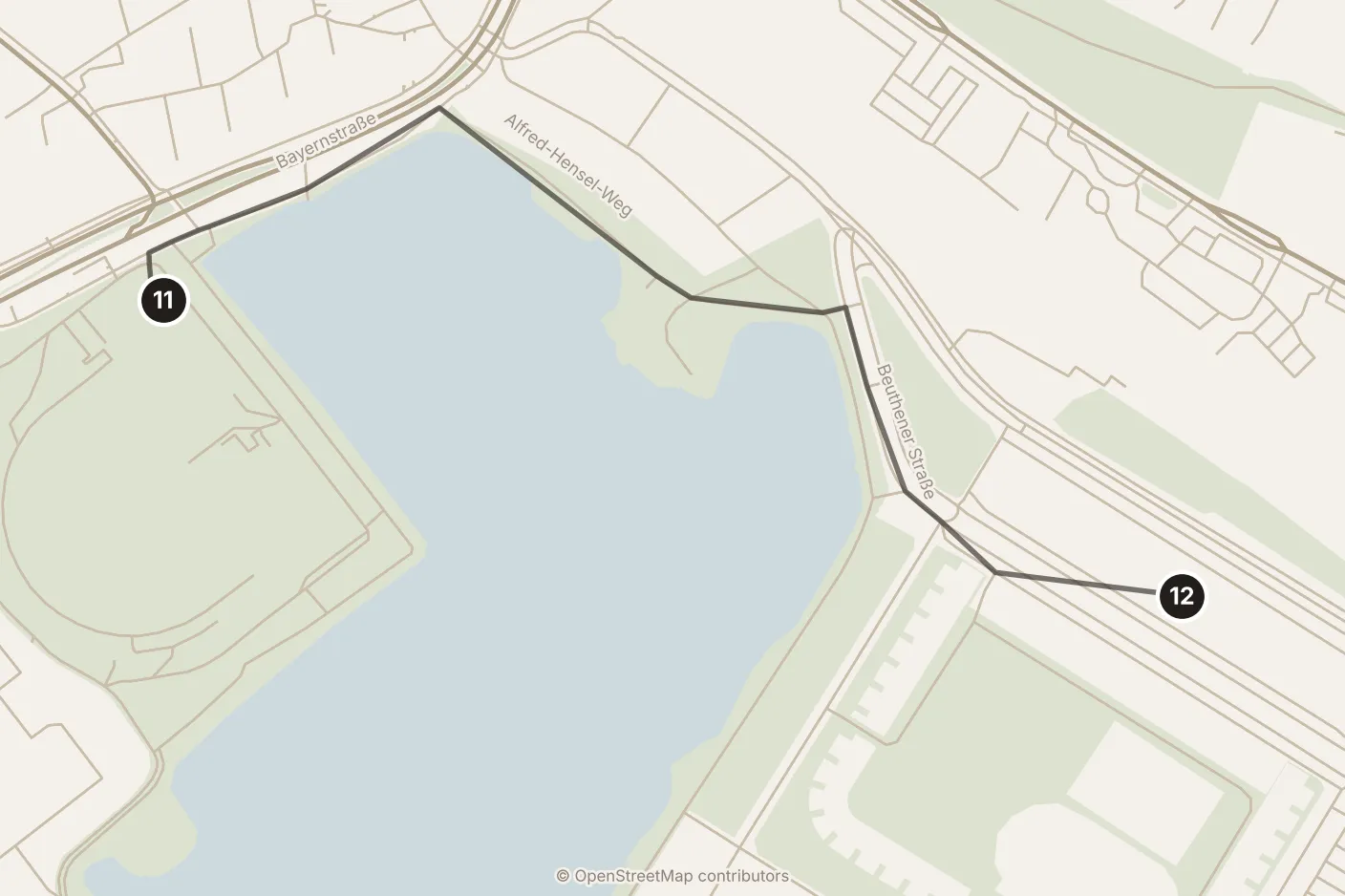
- Afternoon
- 11Documentation Center Nazi Party Rally Grounds
- 12Zeppelin Field
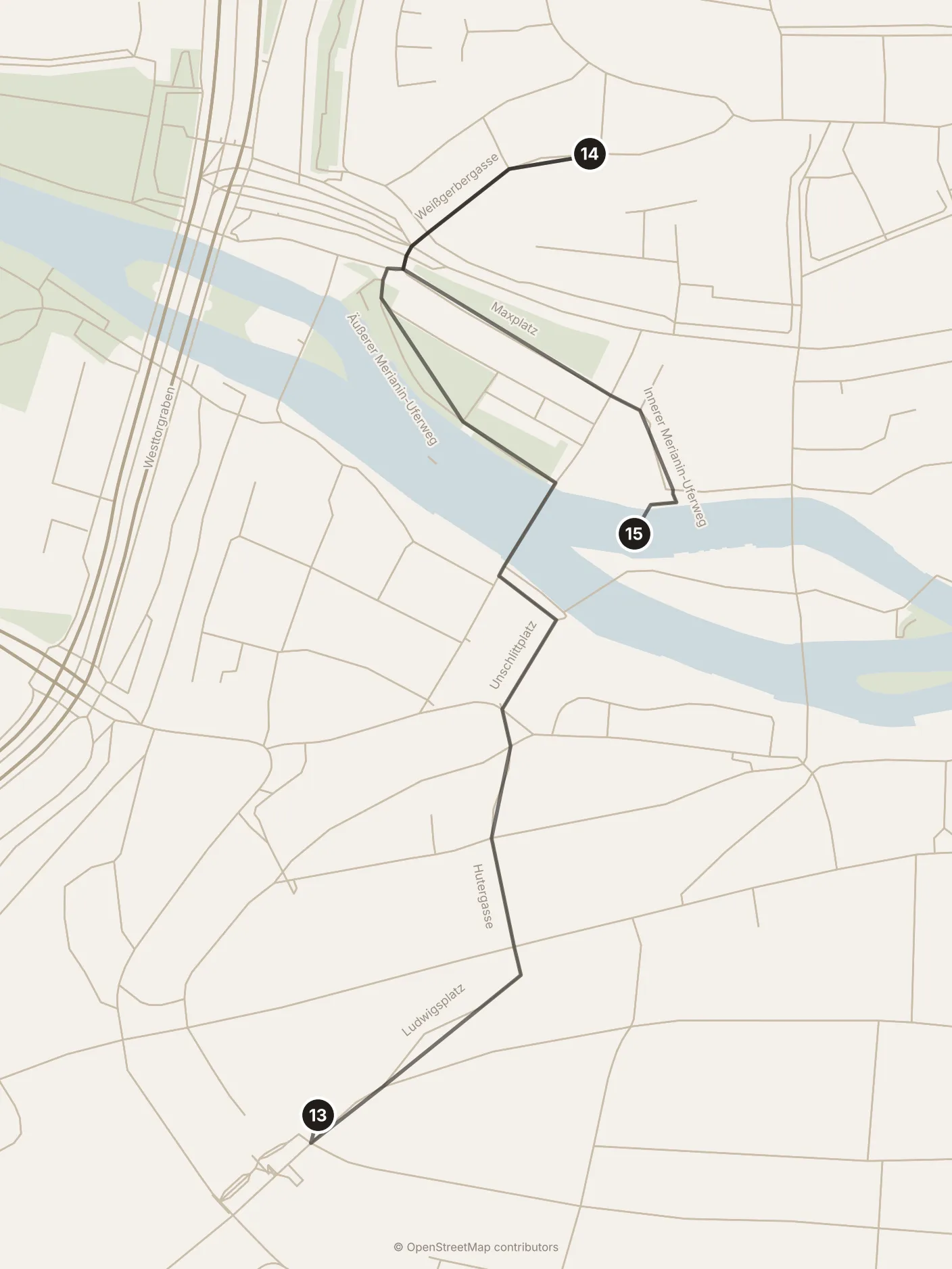
- Evening
- 13Ehekarussell
- 14Weißgerbergasse
- 15Henkersteg
Today starts beside the station and goes out of the center by tram, and its hinge is the light: the rally grounds are open, unlit and very large, so the afternoon has to end before dark. The museum in the morning is the part to trim if the season is short.
Morning
The Germanisches Nationalmuseum is ten minutes on foot from the Hauptbahnhof, along the inside of the walls to Kartäusergasse. It is the largest museum of cultural history in the German-speaking world, built around a former monastery and its church, and it is far too big to see whole. Decide before you go in that you will not try.
What to see, in the order that wastes least walking: the Behaim globe, made for Martin Behaim in Nuremberg around 1492, the oldest surviving globe of the Earth, which shows a world with no Americas in it; the paintings of Albrecht Dürer, the city’s own; and the sculpture of the late Gothic period, which is where you meet Veit Stoss again after yesterday’s church. If you have more, the musical instruments and the historic dollhouses are the collections people remember. What to skip: the long run of prehistory and early medieval rooms near the start, unless that is your subject, and anything that is labeled as a temporary exhibition if your time is short.
Give it three hours, and two and a half if the light is short. On the street outside the main entrance stands the Way of Human Rights by Dani Karavan: a row of white columns, each carved with one article of the Universal Declaration in German and in another language. It takes five minutes, it is free, and it is the right thing to walk through on a day that goes where this one goes next.
Afternoon
Walk back to the Hauptbahnhof, ten minutes, and take tram 8 from the stop in front of the station to Doku-Zentrum, the stop named after where you are going.
The Documentation Center Nazi Party Rally Grounds is inside the Kongresshalle, the congress hall begun in the 1930s for the party’s rallies and never finished: a horseshoe of brick and granite meant to hold fifty thousand people, left with no roof over its inner court. The documentation center was built into one wing in 2001 and reopened in full in 2026, for the first time since 2020, with a new permanent exhibition, Nuremberg and the Nazi Party Rallies, which explains what the rallies were, why Nuremberg was chosen and how the grounds were used to stage the regime’s image of itself. Then go out to the inner court and look at the size of the unfinished shell. Give the center an hour and a half.
From there, walk along the shore of the Dutzendteich lake to the Zeppelin Field, under twenty minutes on foot. This is the parade field where the rallies were held, and the long stone tribune from which Hitler spoke is still standing along one side of it, its colonnade gone and its stone weathering. The city has chosen to keep it as it is, neither restored nor demolished, and there is no museum at the field itself, only information boards. Walk out onto the field and look back at the tribune: the point of this stop is the view of it from where the crowd stood. Give it forty-five minutes. It is a long walk round the grounds with nowhere to sit and nothing to leave a bag with; come from the hotel, not the station.
This is the deadline the day is built around. Count backwards: the field wants daylight, it takes forty-five minutes, the walk from the documentation center under twenty, the center an hour and a half, and the tram ride and the walk to it from the museum about half an hour. That is a little over three hours before dark. In June you can leave the museum in the late afternoon; in December, with the sun down just after four, you have to be on the tram by a quarter to one, which means taking the museum at its shortest and eating lunch near the grounds or late. The count does not include lunch, and it does not include the time it takes to cross the grounds back to transport after the field.
From the field, walk back to the Doku-Zentrum tram stop and ride tram 8 to the Hauptbahnhof.
Evening
At the Hauptbahnhof go down to the U-Bahn and take the U1 two stops, past Lorenzkirche, to Weißer Turm. You come up beside the tower that gives the station its name, and beside it is the Ehekarussell, a bronze fountain of the 1980s based on a poem by Hans Sachs about the joys and miseries of marriage, with a couple shown at every stage from courtship to the skeletal end. It is grotesque and very funny and takes ten minutes.
Walk north for five minutes to Weißgerbergasse, a short street of half-timbered houses that once belonged to the tanners, the best-preserved row of its kind in the old town. It is a street to walk down slowly rather than a sight with an entrance. At its bottom, six minutes on, is the river again, and the Henkersteg: the covered wooden bridge where the city executioner lived, set apart from the rest of the town, with the long timbered Weinstadel beside it and the Trödelmarkt island just downstream. In the late evening, with the lights on the water, this is the quietest corner of the center. Eat anywhere in the streets between here and the Hauptmarkt; Lebkuchen, the city’s spiced gingerbread, is the thing to buy on the way back if you have not yet.
With a third day

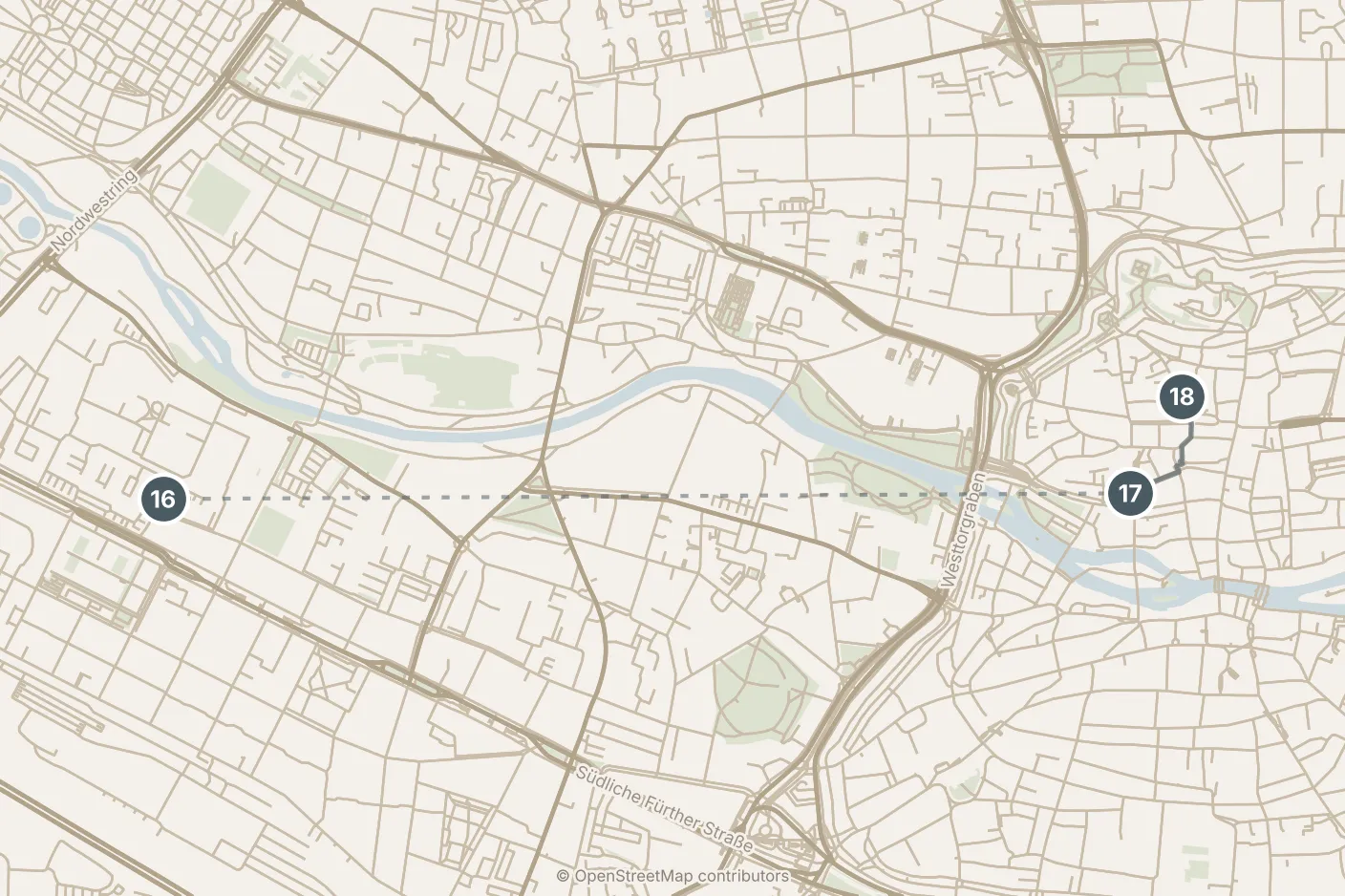
- With a third day
- 16Memorium Nuremberg Trials
- 17Toy Museum
- 18Felsengänge
Give the third day to the trials, and then go back under the old town.
Morning
From the Lorenzkirche or Weißer Turm stop, take the U1 west toward Fürth to Bärenschanze. From the station it is a few minutes’ walk along Fürther Straße to the Palace of Justice, where the Memorium Nuremberg Trials occupies the top floor above Courtroom 600, the room in which the International Military Tribunal tried the leading figures of the regime in 1945 and 1946. The exhibition explains how the Allied powers built the court, who was tried and what the trials set in motion for international law afterwards; the room itself is what you came for. Give it an hour and a half, and come in the morning: the building is quieter, and the day after the rally grounds is the right day for this.
Ride the U1 back to Weißer Turm, which puts you inside the walls again.
Afternoon
Walk north through the Sebald side of the old town, about ten minutes, to Karlstraße and the Toy Museum. Nuremberg has been a toy-making city for centuries, and the museum’s floors move from wooden dolls and tin figures to model railways and the plastic toys of the late twentieth century. It is better than its name suggests, for adults as much as for children, and an hour is enough.
From there it is about five minutes up to Bergstraße, below the castle, where the tours of the Felsengänge begin. These are the rock-cut cellars beneath the northern old town: passages cut into the sandstone over centuries to store and cool beer, and used during the Second World War as air-raid shelters for the people above. They can be seen only on a guided tour, at set times, and the tour takes about an hour. The tours start in front of the brewery shop at Bergstraße 19. This is the one thing on the three days that is worth booking: the tours run at fixed times, so the afternoon is built round whichever slot you hold. It is cool down there in every season, and steps lead down into it; leave anything heavy behind.
That leaves an evening, and the honest advice is to spend it in the square where day one ended, or anywhere on the river, rather than looking for a fourth museum. If you have only the morning of a third day, keep the Memorium and drop the Toy Museum: the cellars wait for their slot, the courtroom is the thing you came for.
Practicalities
Book one thing before you arrive: a tour of the Felsengänge, if you are taking the third day. They are guided only and run at set times, and the slot decides the afternoon. Everything else in the three days is walk-up.
The Germanisches Nationalmuseum is closed on Mondays, and it is day two’s anchor, so day two must miss a Monday; swap it with day one if it does not. Day one will take any day, except that Dürer’s House is shut on Mondays outside July to September and the Christmas market; on a Sunday morning St. Lorenz and St. Sebald hold services, so move St. Lorenz after lunch. The third day has its own weekday to watch: the Memorium is closed on Tuesdays and the Toy Museum on Mondays. If your third day is a Tuesday, the courtroom is shut: make it your first morning instead, or take only the Toy Museum and the cellars; if it is a Monday, drop the Toy Museum.
Moving between the stops: day one is entirely on foot, and the longest single stretch is the twenty minutes back from Tiergärtnertorplatz to the station. Day two uses tram 8 from the Hauptbahnhof to Doku-Zentrum and back, and the U1 from the Hauptbahnhof to Weißer Turm. The third day uses the U1 to Bärenschanze and back. A VGN TagesTicket Solo covers either day’s rides; the parent guide covers the rest.


