Nuremberg in one day: the walled old town, the castle and the rally grounds

Last updated 18 October 2026
Overview
Nuremberg holds two cities that a single day has to take in order. The first is the walled old town on both banks of the Pegnitz: two great Gothic churches, a market square, and the castle on its sandstone ridge at the top, all inside walls you can cross on foot in about twenty minutes. It was largely destroyed by Allied bombing in January 1945 and rebuilt, mostly on its old plan, which is why it reads as medieval at street level and is in large part postwar. The second is the Nazi Party Rally Grounds, three kilometers south-east of the center, where the regime staged its annual rallies on a scale meant to be seen from a distance. One tram line connects them.
The order of this day is fixed by the light. The old town is just as good at dusk, but the rally grounds are an outdoor site whose whole point is size — a tribune, a parade road, an unfinished hall the size of a stadium — and size needs daylight. So the old town goes first, walked north from the station to the castle and back down along the river, and the grounds take the last two hours before dark. The sun sets here from just after four in early December (16:17 at its earliest) to nearly half past nine in late June (21:27), so take your month’s hour and count back: everything below adds up to about eight and a half hours from the station to the end of the grounds, which in June means you can start at lunchtime and in December means the day does not fit as written. The flip for the short months is in Practicalities.
What a single day gives up is the museums. The Germanisches Nationalmuseum is one of the great collections of the German-speaking world and it is the first thing to cut, because an afternoon inside it is the afternoon that would have bought the grounds.
The day starts and ends at Nuremberg Hauptbahnhof, which is the easy case for a bag: leave it in the lockers, signposted inside the station as Schließfächer, and come back for it at the end. You will want empty hands. The castle is a steep climb on cobbles, and the rally grounds are a long walk with very little shelter.
The day

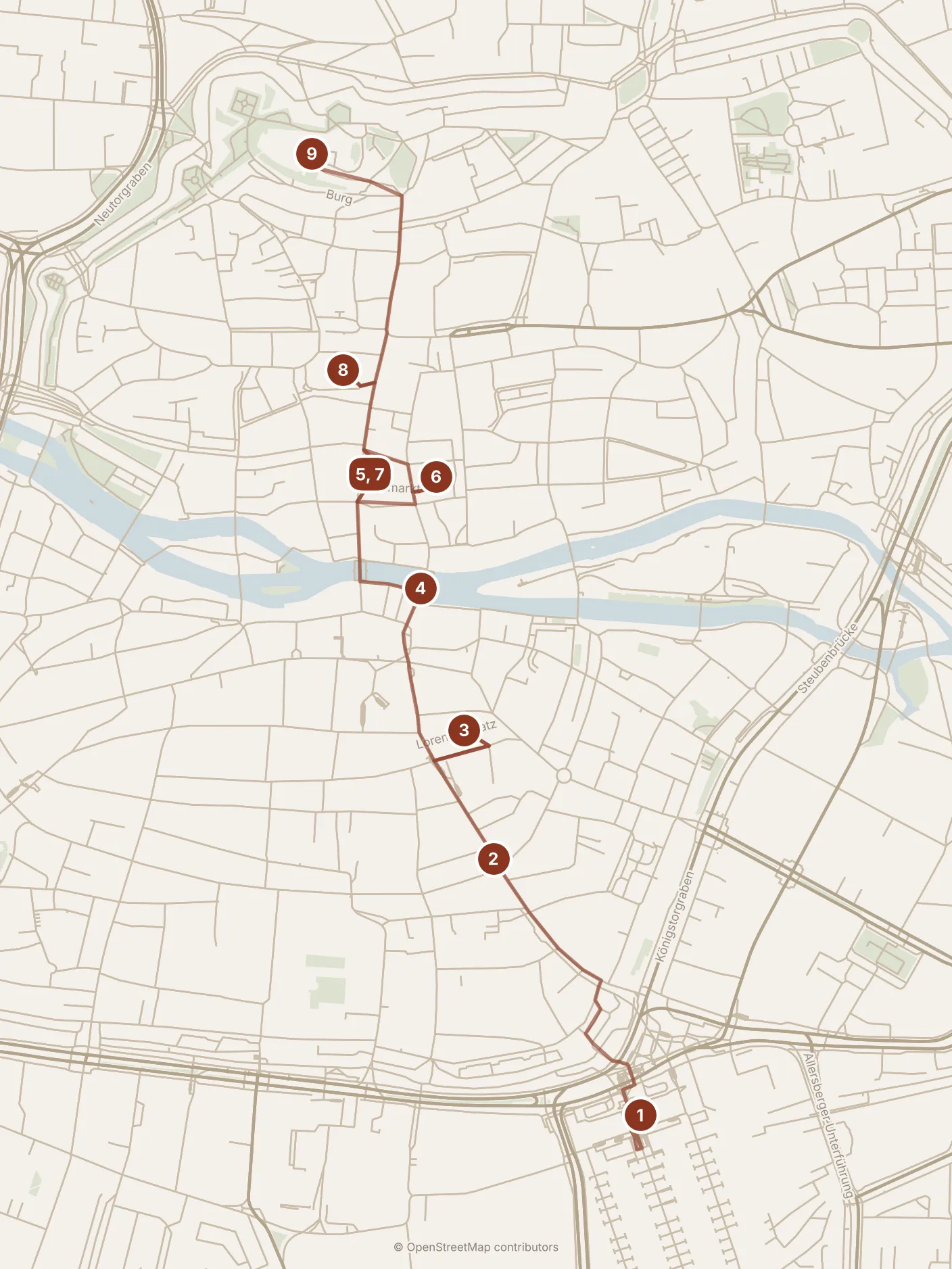
- Morning
- 1Nuremberg Hauptbahnhof
- 2Königstraße
- 3St. Lorenz
- 4Museum Bridge
- 5Hauptmarkt
- 6Frauenkirche
- 7Schöner Brunnen
- 8St. Sebald
- 9Imperial Castle
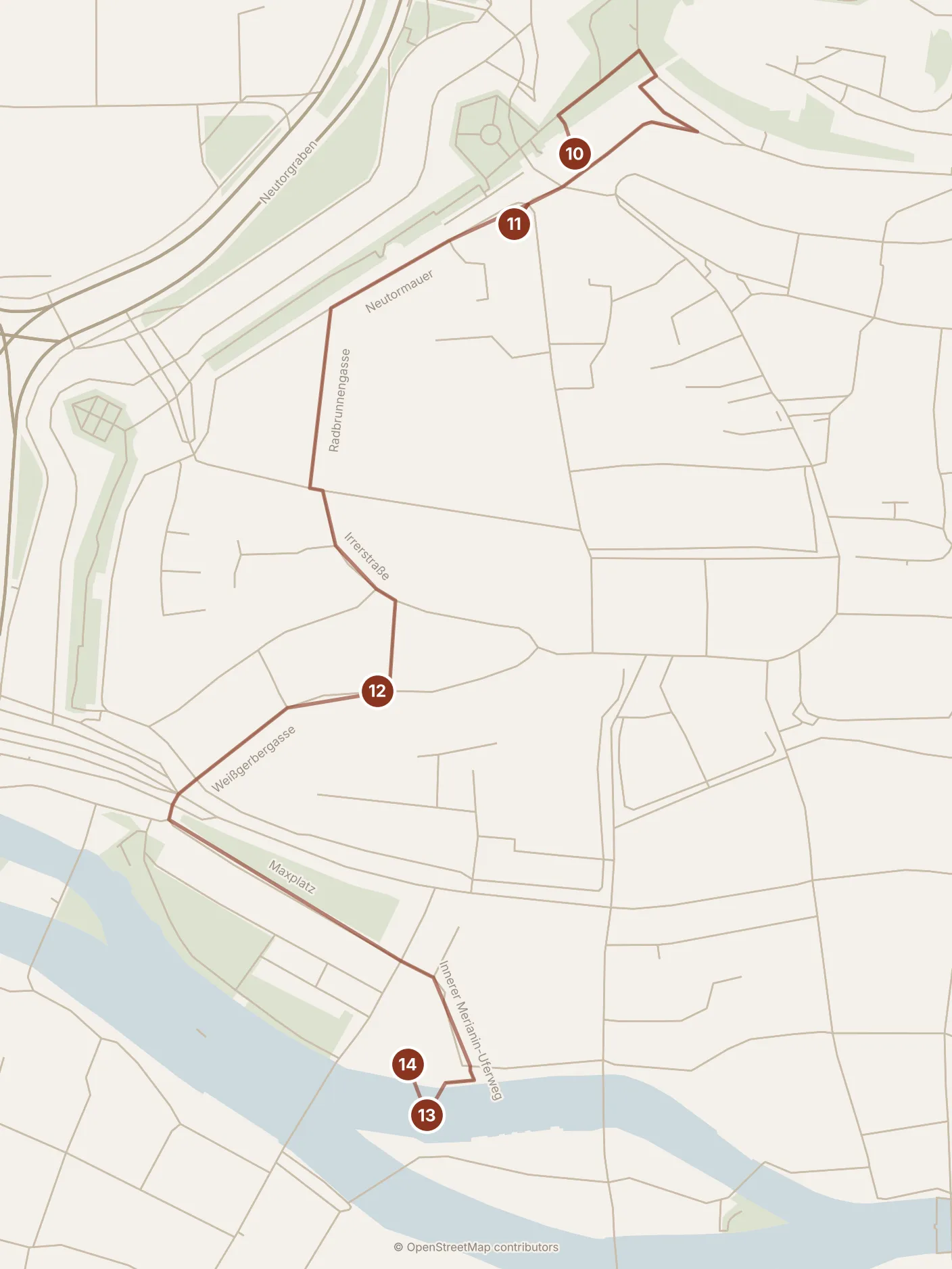
- Afternoon
- 10Tiergärtnertor
- 11Albrecht Dürer's House
- Tiergärtnertorplatz — in the prose, not on the map
- 12Weißgerbergasse
- 13Henkersteg
- 14Weinstadel
- Trödelmarkt — in the prose, not on the map
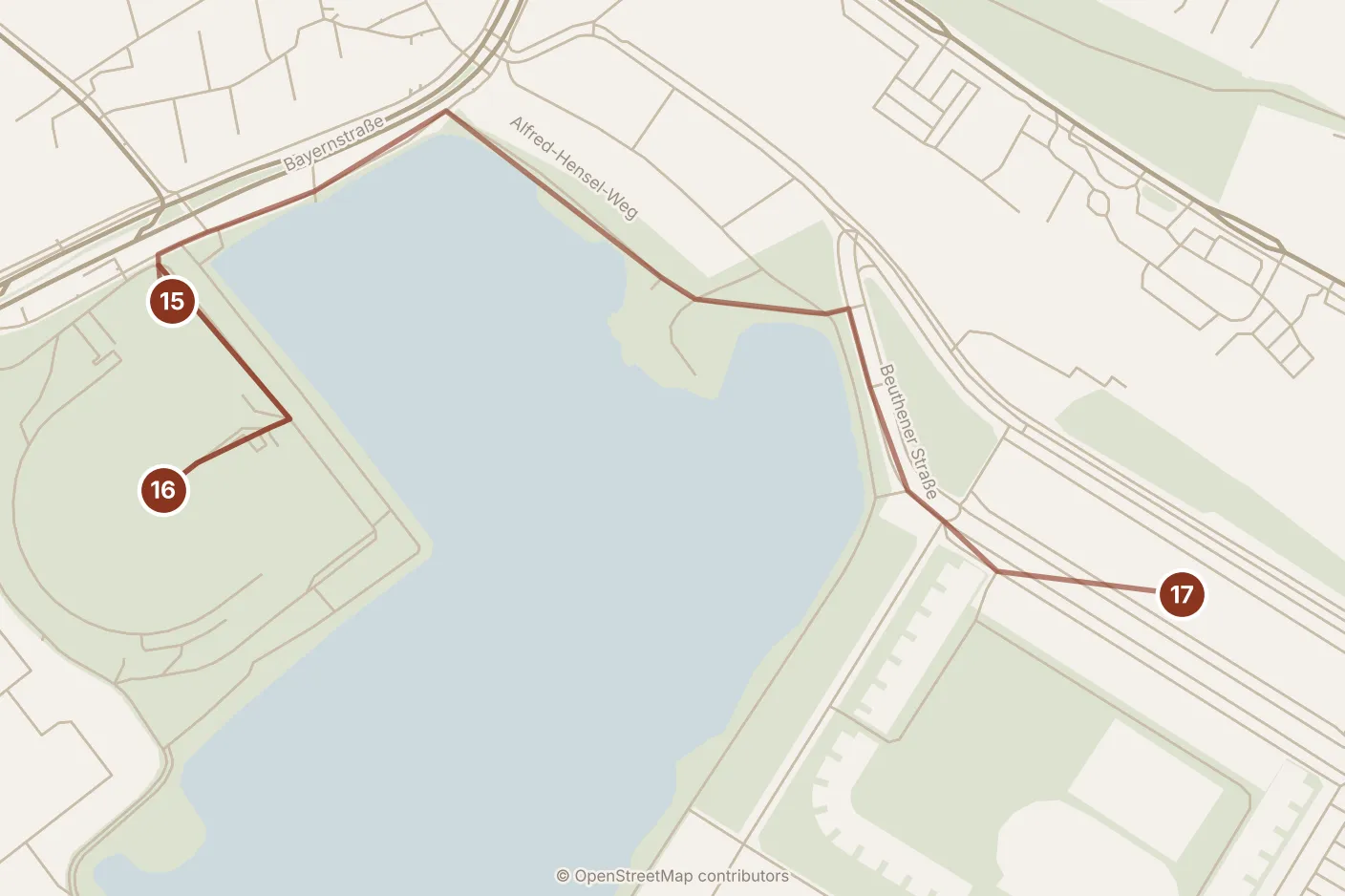
- Afternoon
- 15Documentation Center Nazi Party Rally Grounds
- 16Congress Hall
- 17Zeppelin Tribune
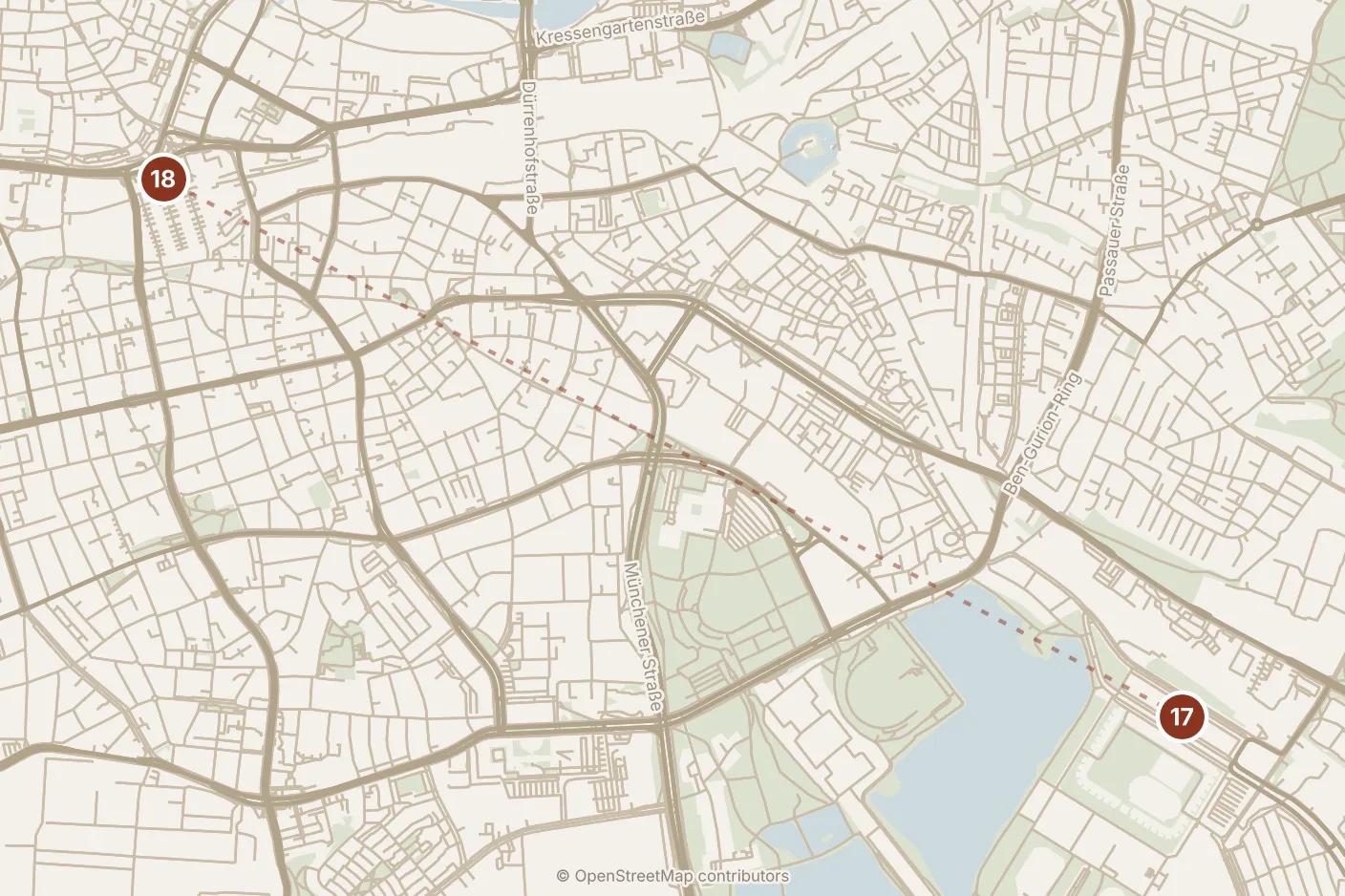
The leg out of the center: from stop 17 by tram, not on foot.
- Evening
- 18Nuremberg Hauptbahnhof
Morning
The first leg is short. Come out of Nuremberg Hauptbahnhof on the old-town side, cross the road at the round tower of the Königstor, and you are inside the walls. The walled courtyard of craft stalls just inside the gate is the Handwerkerhof; it is built for visitors and you can walk past it. Königstraße runs straight on from the gate as a pedestrian street, and St. Lorenz is at the end of it, about twelve minutes from the station on foot.
St. Lorenz is the bigger of the two parish churches, with twin towers and a large rose window on its facade. Two things inside are the reason to go in. Hanging high in the choir, beyond the nave, is Veit Stoss’s Annunciation, a ring of carved and painted limewood with the angel and the Virgin inside it, suspended in the air rather than set on an altar. And climbing nearly to the vault is Adam Kraft’s stone sacrament house, a tabernacle carved so finely that it looks like lace; at its base three kneeling figures hold the whole thing up, and one of them is Kraft himself, with his tools. Give the church half an hour. It is a working Lutheran church, so during a service it is for worshippers, not for walking round.
From the church walk north over the Pegnitz on the Museum Bridge. Look upstream as you cross: the long building standing on arches over the water is the medieval hospital, and it is the view of the river most people photograph. A few minutes on and you are in the Hauptmarkt, about seven minutes from St. Lorenz in all.
The Hauptmarkt is the market square, and two things in it matter. The Frauenkirche, the small gabled church on the square, was built by the emperor Charles IV in the 1350s on the site of the synagogue, after the Jewish quarter was destroyed in the pogrom of 1349. On its gable is a mechanical clock whose figures of the seven electors process around the emperor every day at noon, in memory of the Golden Bull of 1356; if your morning puts you in the square at twelve, it is worth the five minutes, and if it does not, do not bend the day for it. Then the Schöner Brunnen, the tall gilded fountain shaped like a church spire, with a brass ring set into its railing that visitors turn for luck. Twenty minutes covers the square and the church.
St. Sebald, the older of the two parish churches, is three minutes north. Inside is the shrine of the city’s patron saint, a bronze tomb cast by Peter Vischer and his sons in the early sixteenth century: a canopy of Gothic arches crowded with small figures, standing on snails, with Vischer among them in his work apron. Twenty minutes.
From St. Sebald the street climbs steeply to the Imperial Castle, about seven minutes uphill on cobbles — the Kaiserburg, as it is signed. The emperors of the Holy Roman Empire stayed here, and the Golden Bull required each new king to hold his first imperial diet in this city, which is why a castle this size stands on a provincial ridge. The courtyards and the open terrace just inside the outer gate are free, and the terrace is the view of the day: the old town’s roofs laid out below you, with the two churches you have just walked through standing out of them. The ticket covers the palace, with its Double Chapel where the emperor heard mass from the upper level, the Deep Well, which is shown to visitors in small groups, and the climb up the Sinwell Tower. Give the castle an hour and a half, and if you have to choose, the well and the tower are the half worth the ticket.
Local tip. The view over the roofs from the castle terrace is free and needs no ticket; the paid palace, well and tower are the part to drop if the morning has run long. If you are short of time, take the terrace and go.
Afternoon
Leave the castle by the western side and walk down, about four minutes, to the Tiergärtnertor, a gate tower in the wall, and the small square in front of it, Tiergärtnertorplatz, ringed by half-timbered houses. Albrecht Dürer’s House is on the square. Dürer lived and worked here from 1509 until his death in 1528, and the house is a museum of how he lived rather than a gallery: his famous paintings are elsewhere. Give it forty-five minutes if Dürer is why you came, and otherwise look at the house from the square and move on — it is the first stop to cut.
Lunch belongs in this corner of the old town, in the lanes between the square and St. Sebald. Rostbratwurst is what the city is known for, the small grilled sausages served by the half-dozen or more on a plate, or three in a roll — drei im Weggla. The Franconian alternative is Schäufele, roast pork shoulder with its crackling. Give lunch an hour, sitting down.
Then walk downhill, about seven minutes, to Weißgerbergasse, the street of the old tanners: a continuous row of half-timbered craftsmen’s houses, and the one street in the old town where the rebuilt city gives way to something that looks almost untouched. Walk its length; it takes ten minutes and it is the point. Three minutes further south it brings you down to the Pegnitz at the Henkersteg, the covered wooden footbridge beside the tower where the city’s executioner lived, and the long half-timbered Weinstadel on the bank beside it, once a store and now a student residence. Cross by the bridges onto the Trödelmarkt, the little island in the river, and that is the old town finished. Give the river forty-five minutes in all.
From the Trödelmarkt it is about twenty minutes on foot back to Nuremberg Hauptbahnhof, the last part down Königstraße the way you came in. The stop for tram 8 is in front of the station. Ride it to its stop named Doku-Zentrum, at the rally grounds.
This is the stop the day is built around, so work backwards from it: it wants the last two hours before dark. Everything above it — St. Lorenz half an hour, the square and St. Sebald forty minutes, the castle an hour and a half, Dürer’s House forty-five minutes, lunch an hour, the river forty-five minutes, about an hour of walking between them and the tram out — comes to about six and a half hours, which is when to leave the station before you need to be at the grounds. The count covers the time inside the places and the walks between them. It does not cover the ticket line at the castle on a summer weekend or the wait for the next group at the Deep Well, and those are the two places the morning loses time.
The Documentation Center Nazi Party Rally Grounds is in the north wing of the Congress Hall, the horseshoe-shaped hall the regime began and never finished, the largest surviving building of the period. It reopened in full in 2026, for the first time since 2020, with a new permanent exhibition, Nuremberg and the Nazi Party Rallies; but plan so that the exhibition is a bonus rather than the point, because the grounds themselves are outdoors and free. Look into the hall’s unroofed inner courtyard, which shows the scale better than any exhibit.
Then walk the grounds. The path follows the Dutzendteich lake, past the Great Road, the broad granite parade road laid across the site, to the Zeppelin Tribune, about a quarter of an hour on foot and more if you follow the shore. Where it is not fenced you can climb the tribune toward the spot where Hitler stood to address the rallies on the field below; the Americans blew the swastika off its top in April 1945. Parts of it are fenced while the city conserves it, but the view from the field is the point and is always open. Give the grounds two hours from the tram stop, and do not try them after dark: what you came to see is distance, and it disappears with the light.
Evening
Walk back from the tribune to the Doku-Zentrum stop the way you came, a quarter of an hour, and take tram 8 back to Nuremberg Hauptbahnhof, where the bag is. If you have a train to catch, that is the whole of the logistics: the tram ends the day at the station you started from. If you have an evening left, the old town is twelve minutes back up Königstraße, and the lanes around St. Lorenz are where to eat.
Practicalities
Nothing on this route has to be booked in advance. The castle sells its ticket at the castle, and the documentation center’s exhibition is walk-up. The one thing the route needs is a transport ticket for the two tram rides: the city’s network is VGN, and its machines at the tram stop and the station, and its app, sell a TagesTicket Solo, a day ticket for one person; a Deutschlandticket also covers it. The city guide covers buying and validating tickets.
The two museums on this route, Dürer’s House and the documentation center, are city institutions and each publishes its own opening days; read them the week before. If Dürer’s House is shut on your day, the route loses nothing it could not afford to lose. If the documentation center is shut, the grounds are still open, and the afternoon works as written. The churches are working churches — St. Lorenz and St. Sebald Lutheran, the Frauenkirche Catholic — and on a Sunday morning services take most of the morning, so on a Sunday walk the order the other way round: up to the castle first, then down through the churches after noon.
From late November to Christmas the Hauptmarkt is the Christkindlesmarkt, and the square is a crowd rather than a square; allow the morning more time, and expect the old town to be slower to walk.
In the short months the day does not fit as written. If your month’s sunset, minus eight and a half hours, lands before nine in the morning, flip it: take tram 8 from the station first thing and do the rally grounds in the morning light, ride back to the station, and walk the old town in the afternoon from St. Lorenz up to the castle and down to the river, ending with the twenty-minute walk back to the lockers. The castle terrace at dusk is no loss.
If it rains, the grounds are the stop that suffers, and they are the one to replace. From the Trödelmarkt, walk about twelve minutes south to the Germanisches Nationalmuseum instead of going back to the station; it sits beside the Way of Human Rights, a row of columns by Dani Karavan carved with the articles of the declaration. Inside, skip the early collections and go to the medieval and Renaissance rooms, where the globe made for Martin Behaim in 1492, the oldest surviving globe of the earth, and paintings by Dürer are what close the day. It is a twelve-minute walk back to the station afterwards. The museum is closed on Mondays; on a Monday the Memorium is the replacement. If the trials, not the rallies, are your reason for coming, the Memorium Nuremberg Trials is the other replacement: Courtroom 600 in the courthouse on Fürther Straße, where the main trial of 1945 and 1946 was held, reached on the U1 from Nuremberg Hauptbahnhof to Bärenschanze. It is a city museum too, closed on Tuesdays.
If you are short of time, cut in this order: Dürer’s House first, then the paid half of the castle, then the river walk. The rally grounds are whole or not at all — under about five hours in the city, drop them rather than rush them, and give the time to the old town instead.


