Nice in one day: the market, the old town, Castle Hill and the sea

Last updated 5 October 2026
Overview
Nice in a single day is a walk from a market to the sea by way of a hill, and the order matters more than the list. The old town, the hill above it, the old port behind the hill and the start of the seafront all sit inside a couple of square kilometers, so the whole route below is on foot except for two short tram rides, one at each end, between the station and the center.
What one day costs you is the museums, and Nice has unusually good ones — the Matisse and Chagall collections are the reason some people come at all. Both are on the Cimiez side, north of the station and away from everything else on this route, and a museum hour here is the hour that would have bought you the climb and the port. Give them up, unless it rains; what to do then is under Practicalities.
The day has one hinge, and it is at the start. Cours Saleya is a market only in the morning: by lunch the produce stalls are packing up, and although the flower stalls stay into the afternoon on most days, the market at its fullest is a morning one. So this is a day with no deadline at the end and one at the beginning — be on the tram from the station by about ten at the latest. Count the recommendations below and they come to roughly six hours: a quarter of an hour in Place Masséna, three-quarters at the market, an hour in the old town and the cathedral, an hour for lunch, an hour on the hill including the climb, half an hour at the port, and the last hour and a half walking the seafront and sitting by it. Add about half an hour for the walks between them and you are near seven. The largest thing it leaves out is the old town itself: its lanes are a tangle that is easy to lose twenty minutes in, and you will.
Most readers of a one-day itinerary arrive by train with a bag, at Nice-Ville. Do not count on a left-luggage office inside the station; storage in the streets around it is private, changes hands, and is worth finding before you arrive rather than after. If you are carrying the bag anyway, read the note under the afternoon before you set out, because one stop is bad with it.
The day

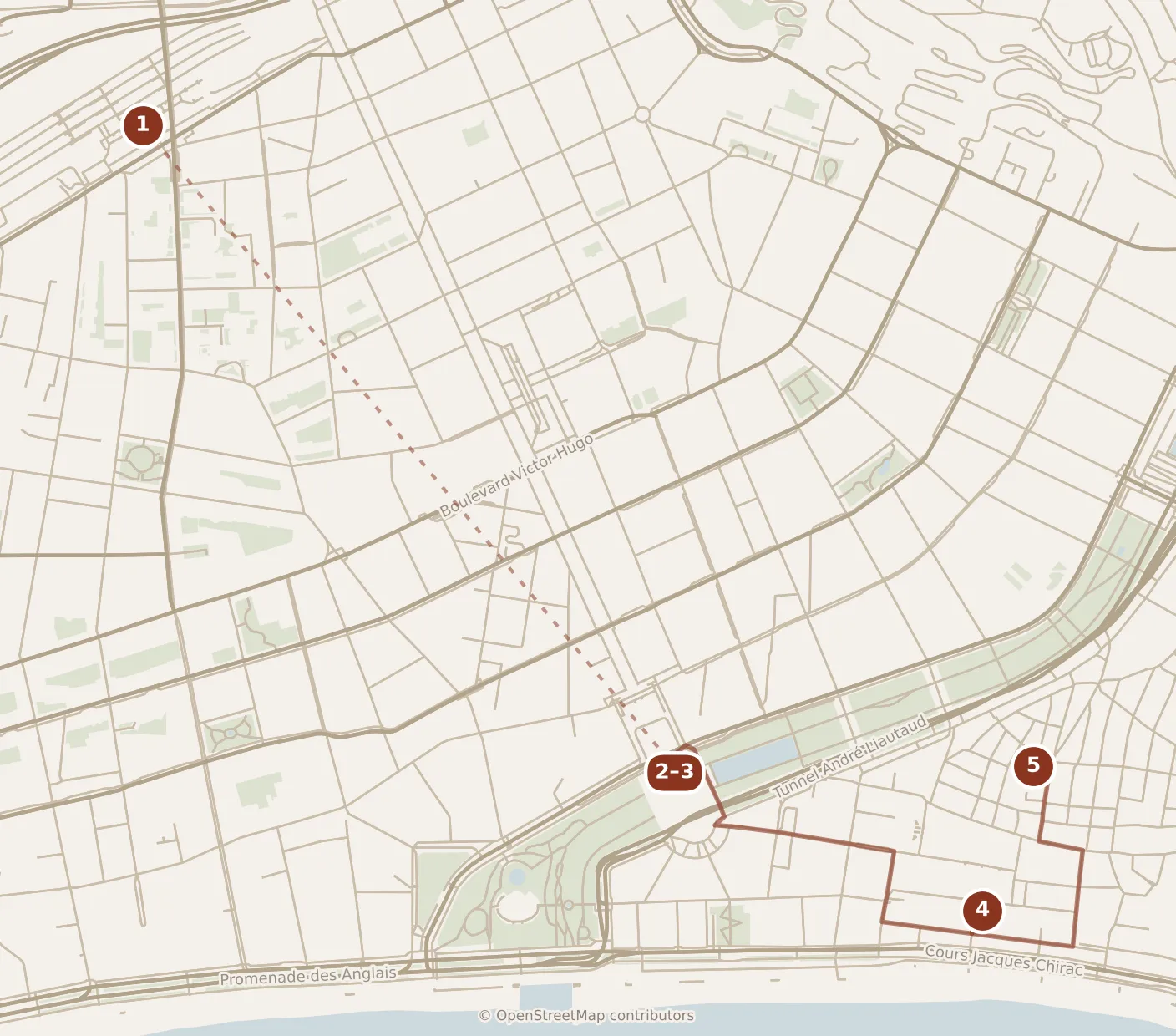
- Morning
- 1Nice-Ville
- 2Place Masséna
- 3Promenade du Paillon
- 4Cours Saleya
- 5Cathédrale Sainte-Réparate
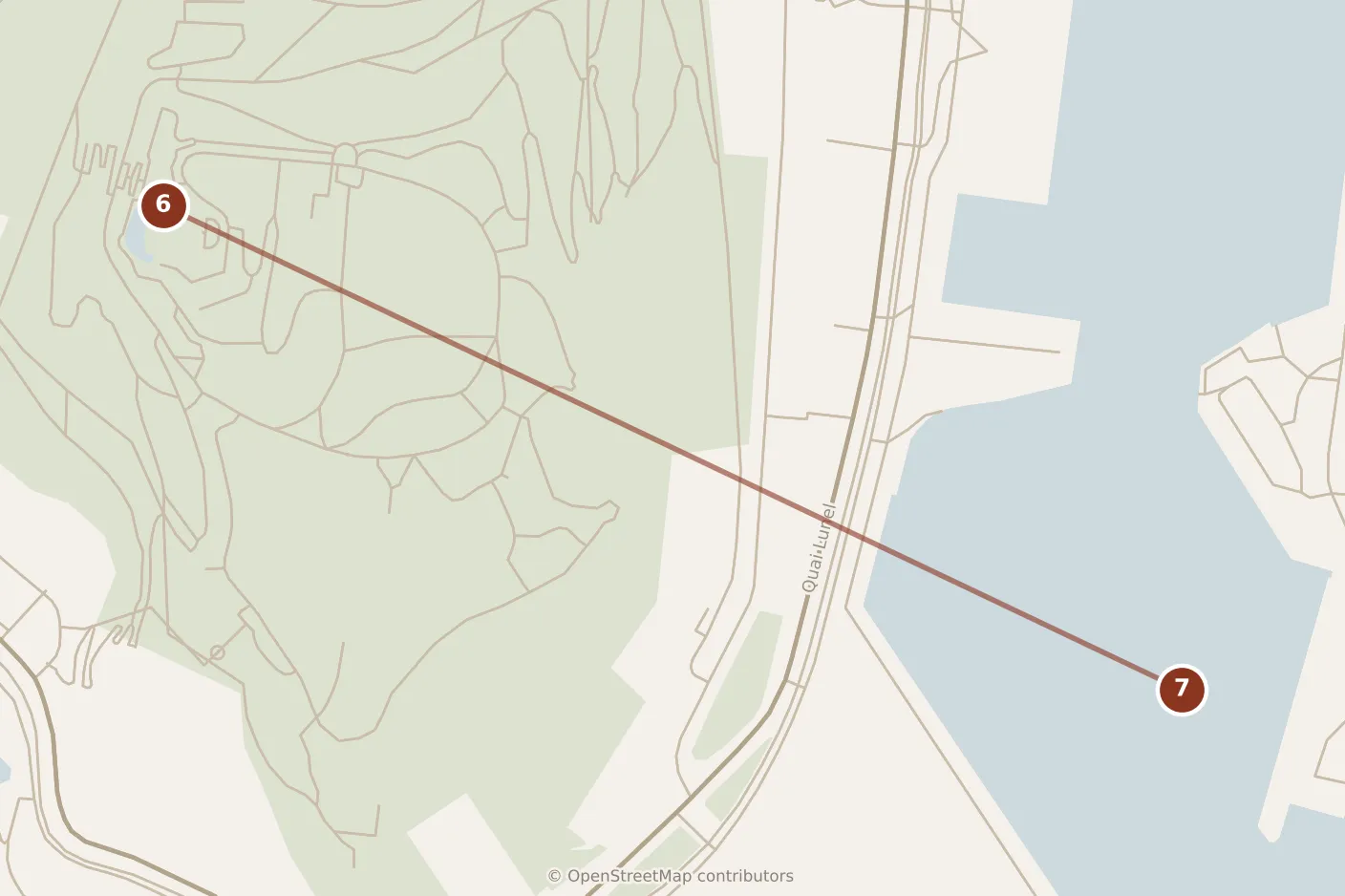
- Afternoon
- 6Castle Hill
- 7Port Lympia
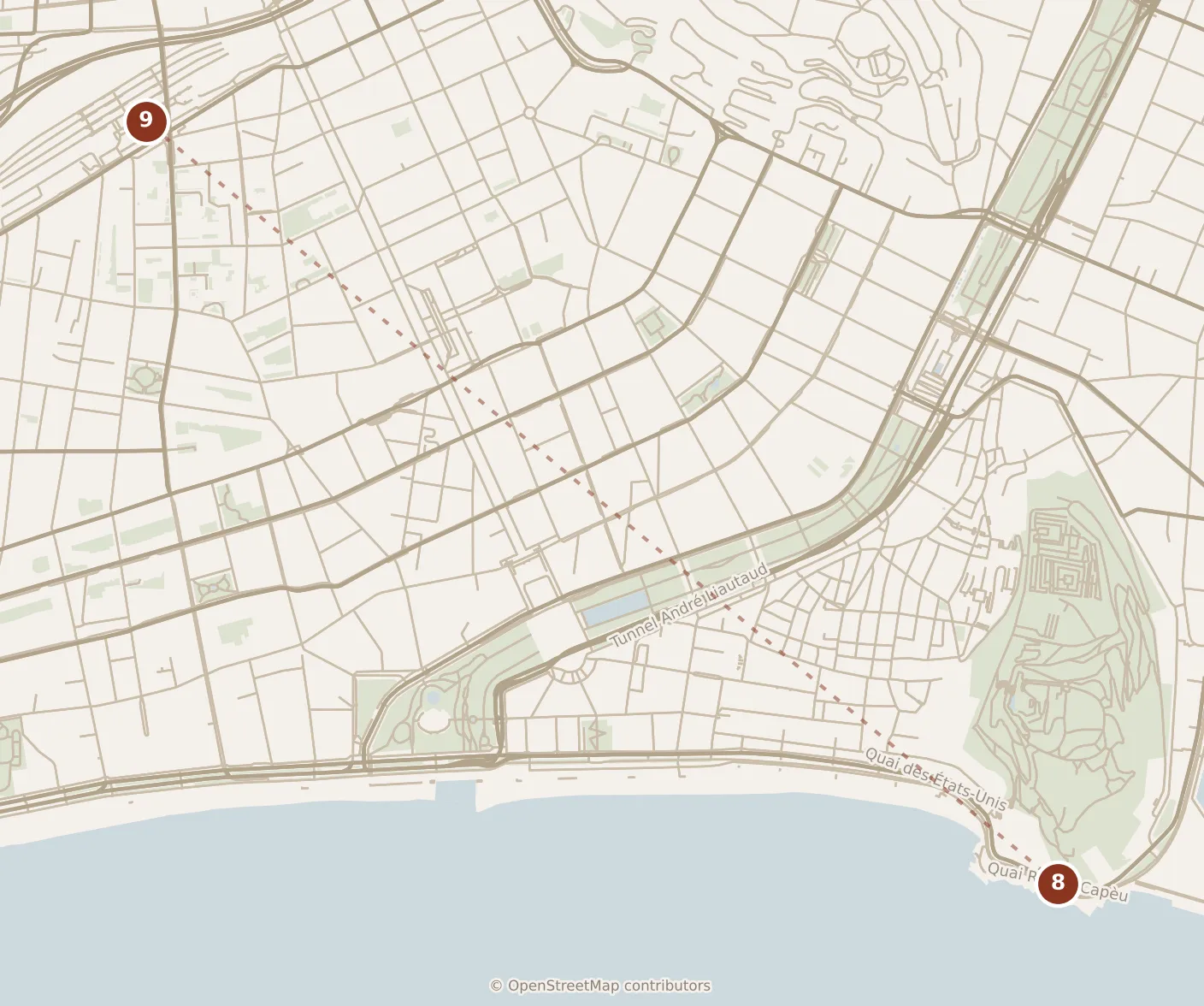
- Evening
- 8Rauba Capeu
- Promenade des Anglais — in the prose, not on the map
- 9Nice-Ville
Morning
From Nice-Ville, the start is two stops on tram line 1. Walk out of the station’s front, turn left along the street in front of it, and the Gare Thiers stop is on Avenue Jean Médecin a few minutes away; buy a single Lignes d’Azur ticket at the machine on the platform and validate it on board. Ride southbound two stops, past Jean Médecin, and get off at Masséna. On foot the same journey is about twenty minutes, straight down the avenue, and it is a perfectly good walk if the bag is light.
Place Masséna is the hinge between the newer town and the old one: a big open square of red-ochre arcaded buildings, a black-and-white checkered sidewalk, and at its southern edge the Fontaine du Soleil, a marble Apollo ringed by bronze planets. Look up at the figures sitting on tall poles above the square — they are lit in changing colors at night, which you will not see on this day, so see them now. Give the square a quarter of an hour at most; it is a place to cross, not to stay.
Cross it eastwards into the Promenade du Paillon, the long park laid over the covered river, and walk through the water mirror — a wide, flat paved area that fills with a sheet of water and jets of mist and drains again. It is ten minutes from the middle of the square to Cours Saleya, with the park as the first half of that walk; turn right off it into the old town and keep going towards the sea until the street opens into a long market.
Cours Saleya is the reason the morning cannot wait. Down the middle runs the market, flowers at one end and fruit, vegetables and local produce at the other, under striped awnings, between rows of ochre and yellow buildings; Matisse lived for years in the tall building that closes its far end. On a Monday the stalls are an antiques and bric-a-brac market instead, which is good in its own way and not what this paragraph describes. Give it three-quarters of an hour, walk it end to end once, and if a stall is baking socca, buy it — a thin pancake of chickpea flour, peppered and torn into pieces, eaten hot with your fingers. It is the right thing to eat here at mid-morning.
From the market go north into Vieux Nice, five minutes up the lanes to Place Rossetti and the Cathédrale Sainte-Réparate, a Baroque church with a dome of glazed colored tiles that you will see again from the hill. Inside it is all gilt, marble and chapels; give it fifteen minutes. It is a working cathedral: go in quietly, and not during a service. Then spend the rest of the hour wandering the lanes around it, which is where the old town actually is — tall narrow houses, washing between them, stairs where you expect a street.
Local tip. If the morning has run late, cut the old town lanes rather than the market. The lanes are still there at two in the afternoon; the produce market is not.
Afternoon
Lunch goes in the old town, somewhere on the lanes between the cathedral and the foot of the hill, and it takes an hour if you sit down for it. This is the place for the Niçois dishes that the rest of France does not make the same way: pissaladière, the onion tart with anchovies and black olives; pan bagnat, the round bread soaked in olive oil around what is more or less a salade niçoise; and more socca if you missed it.
Then Castle Hill, the Colline du Château, the rock that rises straight out of the eastern end of the old town. There is no castle on it: it was demolished in 1706 on the orders of Louis XIV, after a siege, and what is up there now is a park — terraces, pine shade, the ruins of a cathedral’s foundations, and an artificial waterfall built in the nineteenth century to give the view a foreground. The view is the point: the whole curve of the Baie des Anges one way, the old port the other, and the tiled dome of Sainte-Réparate below you. The top is about ten minutes’ walk from the cathedral, most of it steps; give the hill an hour, including the climb, and do not try to see every terrace.
The bag. Castle Hill is the one stop on this route that is genuinely bad with a case: the direct way up is a long flight of steps. There is an elevator that takes you most of the way, at the seafront end of the hill near Rauba Capeu, so with a bag go round to it rather than up the steps from the old town — and if the bag is large, take the elevator up, the elevator down, and skip the port below rather than carry it down the far side and back.
Without a bag, leave the hill by the far side, downhill to Port Lympia, about ten minutes from the top. This is the old harbor, a long rectangle of water lined with Italianate buildings in ochre and red, with small traditional fishing boats near the quays, larger yachts further in, and the ferries to Corsica at the end. At the top of the basin is the church of Notre-Dame-du-Port, with a columned front that looks more like a public building than a church. Give the port half an hour: walk one quay and sit for a while. It is the quietest part of the day.
Evening
From the port, walk back round the foot of the hill on the seafront road to Rauba Capeu, the corner where the rock meets the sea, about twelve minutes. The name is Niçois for “steals hats”, for the wind that comes round this corner. Carved into the cliff here is the war memorial, a huge white monument set into the rock face; you pass it on your right.
Rauba Capeu is where the seafront begins. From here walk west along the Quai des États-Unis, which becomes the Promenade des Anglais — named after the English winter residents who paid for the first path along this shore in the 1820s. The beach below is pebbles, not sand: lovely to sit on, hard on bare feet, and not a place to stand with a suitcase. Walk for about eighteen minutes, as far as the gardens just west of the old town, then take one of the blue chairs along the railing and stay. This is the end of the day, and it has no deadline of its own: the sea is the sight, and it does not close. Give it an hour, or whatever is left before your train.
To leave, cut north from the gardens to Place Masséna, five minutes, and take tram line 1 two stops north from Masséna to Gare Thiers, then the few minutes’ walk back to Nice-Ville. On foot the whole way it is about twenty minutes, straight up Avenue Jean Médecin. Either way, leave yourself half an hour from the seafront to the platform, and more if you have a bag to collect somewhere first.
Practicalities
There is nothing on this route that has to be booked. The one thing it asks you to buy is a tram ticket on the Lignes d’Azur network, twice: at the start, from Gare Thiers to Masséna, and at the end, back. The ticket machines are at the tram stops; how tickets and passes work in general is in the city guide. The market, the cathedral, Castle Hill, the elevator, the port and the seafront are all free.
The day of the week matters once. On a Monday, Cours Saleya holds its antiques market instead of the flowers and produce, so the morning loses its market but not its walk: keep the order as written. The park on Castle Hill keeps hours that change with the season, published by the city; check them the day before, and if the hill shuts earlier than the afternoon you have planned, swap the halves and climb it before lunch, straight after the cathedral.
If it rains, the afternoon is the part that does not work: the hill is exposed and the steps are slippery. Keep the morning as written, then take tram line 1 north from Cathédrale-Vieille Ville, on the edge of the old town, to Gare Thiers, and walk up the hill north of the station for about fifteen minutes to the Musée national Marc Chagall — a museum built for one great cycle of Chagall’s biblical paintings, which needs an hour and a half and no more. It replaces Castle Hill, the port and the seafront, and it ends within a quarter of an hour of Nice-Ville, which suits a train. It closes on Tuesdays and for a break at lunchtime; if it is a Tuesday, the old town lanes and the cathedral will hold a wet afternoon instead.
If you have less than a day, cut in this order. The port goes first: come down Castle Hill by the elevator and go straight to Rauba Capeu, which saves about half an hour. Then the hill itself, if you must: walk from the old town to the seafront directly, five minutes south of the market. The market and the seafront are the two things not to cut — one is the city’s morning and the other is the reason it exists.


