Naples in two or three days: the old town and what lies under it, the hill, and a third day at Herculaneum

Last updated 8 August 2026
Overview
One day in Naples is a day of choosing. Two days is the length the city actually asks for, and the difference is not that you see more things — it is that you go inside them. A single day never reaches the east end of the old town at all, and it walks past the royal palace and past the hole in the ground under the decumani, because each of those is an hour and one day does not have the hours. Two days buys them. Day one gives the old town a whole day instead of treating it as a corridor to the sea, and the east end is what that buys: the cathedral, its baptistery, and the Caravaggio across the street. Day two goes deeper into the museum than a single day can — five collections out of it instead of three, the wall paintings and the bronzes from the buried villa among them — and adds the hill that explains why the city sits where it does.
The shape is worth knowing before you read the days. Day one never leaves a nine-hundred-meter stretch of the ancient street grid and never doubles back: it starts at the cathedral, the east end, and drifts west along the decumani, stop by stop, to a square where the evening is. Day two climbs once and then falls all the way to the water — the museum, a funicular up to the ridge, the monastery and the fort on top of it, a second funicular down the other side, and the last hour on the sea wall. Nothing on either day needs a taxi.
One weekday decides more here than anywhere else on this site. Tuesday closes the archaeological museum, the Cappella Sansevero and the Certosa di San Martino — day one’s one fixed appointment and two of day two’s four interiors, gone together. Swapping the two days does not help, because it is not one day that is hit. Wednesday costs a single stop, and Sunday reorders day one rather than breaking it; the rules are at the end of this article and they are worth two minutes before you book anything.
Booking is one thing for the two days, and one more only if the third day goes to Pompeii. The Cappella Sansevero takes a compulsory timed slot, released about two months ahead, and the full ticket sat between ten and fifteen euros in 2026. Everything else on days one and two is bought at the door. A third day at Herculaneum adds no booking; a third day at Pompeii issues its ticket in the visitor’s name against a daily cap, and you should treat that as a second. How the metro, the funiculars and the buses are paid for is the city guide’s subject rather than this article’s — but the railway out to the excavations on the third day is a separate company with its own fare, and that is the one piece of ticketing this route adds.
These days rest on the light only once, at the very end of day two, and the count is written into that day. What you need for it here: the sun sets in Naples from about twenty-five to five in early December to about twenty to nine at midsummer. Take your month’s hour and use it where day two tells you to.
Last, the bag. Left luggage at Napoli Centrale is on the platform level, in the atrium beside platform five, and it matters at two moments rather than throughout. Day one begins about twenty minutes’ walk from that office, so a morning arrival can start the trip without checking in anywhere first. And the third day, which is the likeliest departure day, goes out from platforms directly underneath it — worth arranging deliberately, because the excavations are the one stop on all three days you genuinely cannot do holding a case: two and a half hours on uneven ancient paving, no shade, and nowhere to put anything down.
Day one

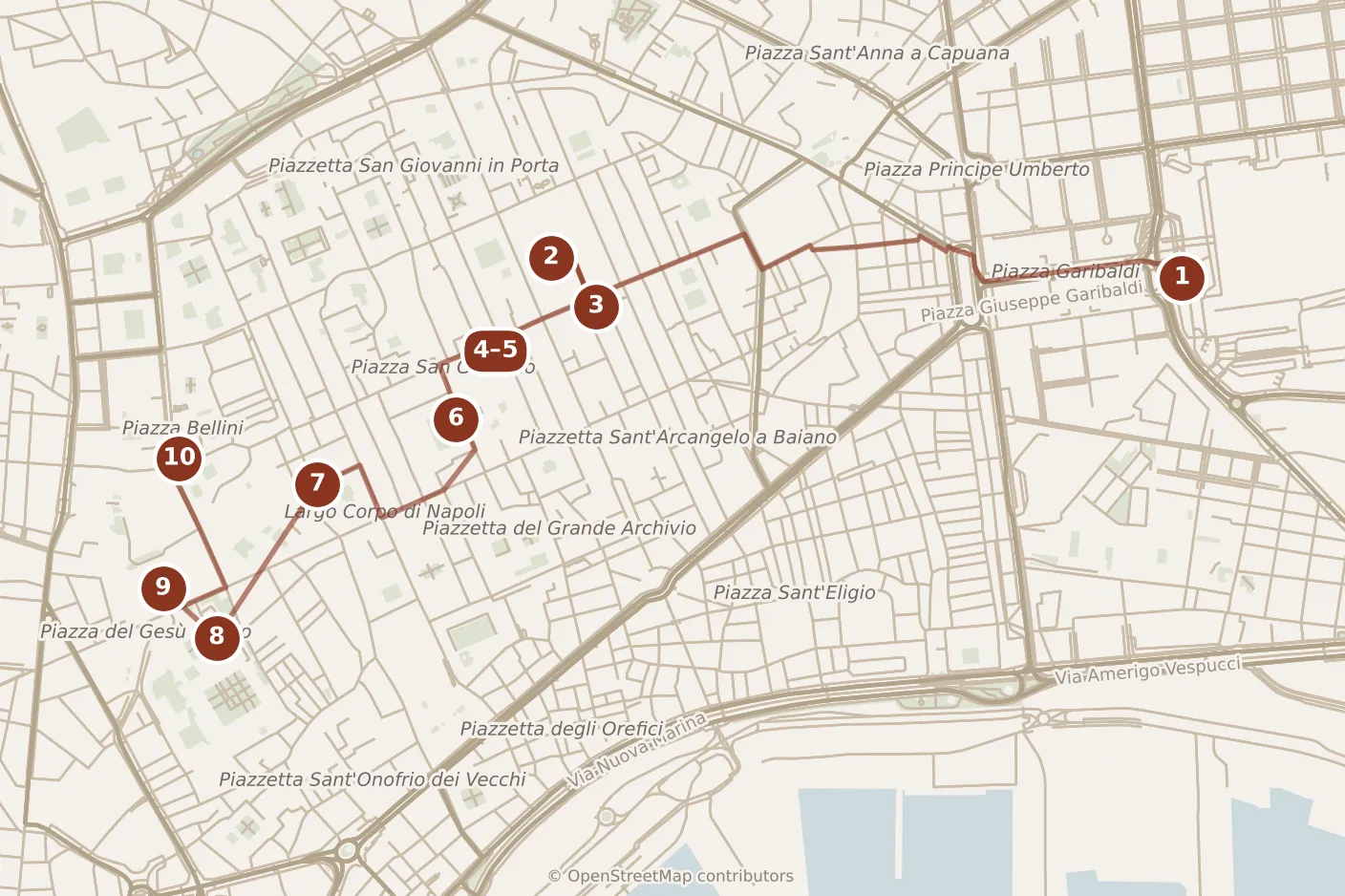
- Day one
- 1Napoli Centrale
- 2Duomo di Napoli
- 3Pio Monte della Misericordia
- 4Via dei Tribunali
- 5San Lorenzo Maggiore
- 6San Gregorio Armeno
- 7Cappella Sansevero
- 8Santa Chiara
- 9Gesù Nuovo
- 10Piazza Bellini
Everything today sits inside nine hundred meters of the Greek street grid, and the day runs one way through it, east to west, so no stop is ever behind you.
Morning
The first move is from the trains to the east end of the old town. From Napoli Centrale it is about twenty minutes on foot — west along Corso Umberto, then right and uphill into Via Duomo — or two stops on Line 1 from Garibaldi to Università and about eleven minutes up the same street; one station short of that, Duomo comes up on Via Duomo itself, nearer the cathedral. Do it with your hands empty; the left-luggage office by platform five is on the way out.
The Duomo is three churches wearing one facade, and the nave is the least of them. It is Angevin Gothic under a gilded seventeenth-century ceiling, wide and dim, and you can take it in as you walk. The two things to stop for are at opposite ends of it. The first is the Cappella del Tesoro di San Gennaro, which has its own gate off the nave and is unmistakable — a domed room the size of a church, all silver and fresco, built by the city after the plague of 1526 and paid for by public subscription, which is why it is still run by a lay board and not by the archdiocese. The vials of the saint’s dried blood are kept behind its altar. The second is the Battistero di San Giovanni in Fonte, reached through the older basilica of Santa Restituta that opens off one of the aisles: a small square room of the late fourth or early fifth century with mosaics in its vault, and the oldest surviving baptistery in the western world. Fifty minutes covers all three.
Three days a year the cathedral is not somewhere to sightsee. On 19 September, on the Saturday before the first Sunday of May, and on 16 December the city fills the nave for the liquefaction of the saint’s blood, and it belongs to the people who came for it. Do not try to work around the crowd: on one of those days take the Caravaggio across the street first and treat the cathedral as a maybe. Nothing else on day one turns on it, so the day survives either way.
Straight across Via Duomo, two minutes, is the Pio Monte della Misericordia — a charity founded in 1602 by seven young noblemen who met on Fridays to perform the seven works of mercy, and a working charity still. Above the altar of its octagonal church hangs Caravaggio’s Seven Works of Mercy, painted for this room in 1607 and never moved out of it, which almost nothing of that scale can say. All seven works happen at once in one dark street: a corpse carried out by torchlight, a man drinking from a jawbone, a woman feeding a prisoner through the bars. Upstairs, a gallery of seventeenth-century Neapolitan painting opens onto a balcony that looks down on the picture from above — go up, it is what makes the ticket worth more than ten minutes. Forty-five minutes.
This is the door the morning is counted from. In 2026 the Caravaggio room opened at ten on weekdays, and at nine with a half past two closing on Sundays; the cathedral opposite opened earlier and shut later than either. So the first hour of the day belongs to the cathedral and the second to the painting. If those hours have moved, the method has not: whichever of the two opens first goes first, and the other is two minutes away.
Then west, into Via dei Tribunali. This is the Decumano Maggiore, the middle of three dead-straight streets the Greeks laid out and the Romans kept, and it is still the spine of the quarter — a canyon of blocked-up palace fronts, shrines set into the walls, workshops at street level, a scooter every fifteen seconds. It is only about four minutes’ walk from the Caravaggio to Piazza San Gaetano, and that is the point of saying so: give the stretch twenty-five minutes anyway, because the street is the sight and the walking is not what takes the time. Then eat, at the far end of it. Lunch is pizza here and the oven takes about a minute, so a sit-down lunch is a fast one; an hour is generous. The fried counters along the same street sell crocchè and cones of fried things if you would rather graze standing up.
Afternoon
Piazza San Gaetano is the forum of the Greek and then the Roman city, which is why two completely different undergrounds start within fifty meters of each other, and why they are not interchangeable.
Take San Lorenzo Maggiore. Above ground it is a bare, tall Gothic church with an Angevin apse of radiating chapels, unusual this far south, and worth a quarter of an hour. What you came for is underneath: a stretch of the Roman market — the macellum — excavated beneath the cloister and walked at its own level, a paved street under a barrel-vaulted arcade with the shells of a bakery, a dyer’s and a treasury off it, and the drain still cut down the middle. You go down a staircase and along it in low light, and what lands is not the ruins but the depth: the modern street is one story above your head. An hour for the excavations, an hour and a quarter for both levels together. It has no weekly closing day, which is going to matter when you read the closures below.
Local tip. The other descent leaves from the same square and is a guided ninety minutes into the Greek cisterns and the aqueduct forty meters down, ending in a wartime shelter. Take one or the other, never both. The Roman market is yours to walk at your own pace and fits any hour; the cisterns run on fixed departures, and the flexibility they cost is what the four stops after this one need. If you want tunnels more than you want a Roman street, swap them — same square, and about the same hour and a half once you have waited for a departure.
Two minutes on, San Gregorio Armeno drops downhill off the decumanus: the lane of the crib-makers, workshops turning out figures for the Christmas presepe all year round — shepherds, butchers, bakers, footballers, and whichever politician is having a bad year. It knows exactly what it is, and it is still worth twenty minutes, because the trade is genuinely made in these rooms rather than imported into them. It also sets up tomorrow: the greatest survival of that whole industry sits in the old kitchens of the monastery on the hill, and day two walks into it in the afternoon.
Five minutes west is the Cappella Sansevero, the day’s one fixed appointment. It is a single room and the whole of it is one commission: Raimondo di Sangro, an eighteenth-century prince, inventor and alchemist, built it as a continuous allegory and then found sculptors capable of executing the joke. In the middle lies Giuseppe Sanmartino’s Veiled Christ of 1753, cut from one block, the shroud thin enough to read the wounds through. Around the walls the same trick is played in other keys — the Disinganno is a man fighting his way out of a net, and the net is stone. Then go down to the crypt, which is what the second day pays for: two anatomical machines, skeletons with the entire circulatory system modeled around them in wire and wax, by a method nobody has satisfactorily explained. Forty-five minutes, and the crypt is half of it.
Two things about that room before you are standing in it. Photography and video are prohibited throughout, and it is enforced rather than merely posted — you will be stopped, and being stopped in a room that size is the harm. And the timed slot is why the afternoon is arranged around this stop rather than the other way round: everything else today is walk-up, so put the chapel in the middle of the afternoon and let the morning run long if the Caravaggio is holding you.
Six minutes further west, Santa Chiara is two buildings on two schedules, and knowing which is which decides your order. The cloister is what you pay for and what you come for: in 1742 Domenico Antonio Vaccaro lined the walks of the Clarisses’ garden with octagonal pillars and long benches faced in painted majolica — vines, lemons, landscapes, picnic parties — so the enclosure is a tiled garden inside a real one. It is the quietest place on this route and it arrives exactly when you need one. An hour. The basilica beside it is free, vast, pale and startlingly empty, rebuilt by 1953 after wartime bombing to what was taken to be its original Gothic form, with the Angevin royal tombs at the far end. In 2026 the cloister stayed open straight through the afternoon on any day but Sunday, while the basilica shut from a quarter to one until half past four — so this order puts you in the cloister during the gap, which is the right way round. If the church is open when you come out, ten minutes covers it; if it is not, it is five minutes from where you will spend the evening and it stays open late. Should those hours move, the principle does not: cloister first, church second.
Two minutes on, Gesù Nuovo is worth twenty-five minutes for two unrelated reasons. The front is a wall of pyramidal stone spikes — the surviving facade of the fifteenth-century palace the church was built inside, which is why it looks like a fortification. Inside, past a Baroque interior of the usual richness, a suite of rooms commemorates Giuseppe Moscati, a physician who died in 1927 and was canonised in 1987; the walls are covered floor to ceiling in small silver ex-votos, thousands of them, each one a body part somebody believes he mended. It is the most purely Neapolitan room on this day and nothing prepares you for it. Like most churches here it shuts for the middle of the day and opens again in the afternoon, at an hour it does not publish: check it against your own arrival rather than assume this order lands on it, and check it separately for the Moscati rooms, which need not keep the church’s schedule.
Evening
Four minutes north is Piazza Bellini, where the city is oldest and youngest at once. In the middle of the square, railed off and lit below sidewalk level, runs a stretch of the Greek city wall in squared tufa blocks, laid long before the Romans arrived — the actual edge of the first city, with bar tables set out around the hole. This is the university’s square: cheap, loud, and busy from early evening until very late.
Counting the stops and the walks between them, the day comes to about seven hours from the cathedral door to this square — which from a nine o’clock start puts you here at about four, early for the square and late for anything else. That total counts the time inside the places and the walking between them and nothing else: not the ticket desks, and not a lunch that runs past the hour it is given. Spend the gap in the second-hand bookshops under the arch at Port’Alba, two minutes west, which is where Naples has sold used books for generations. When you have finished, Line 1 runs from Dante, four minutes away, and from Museo, nine.
Day two

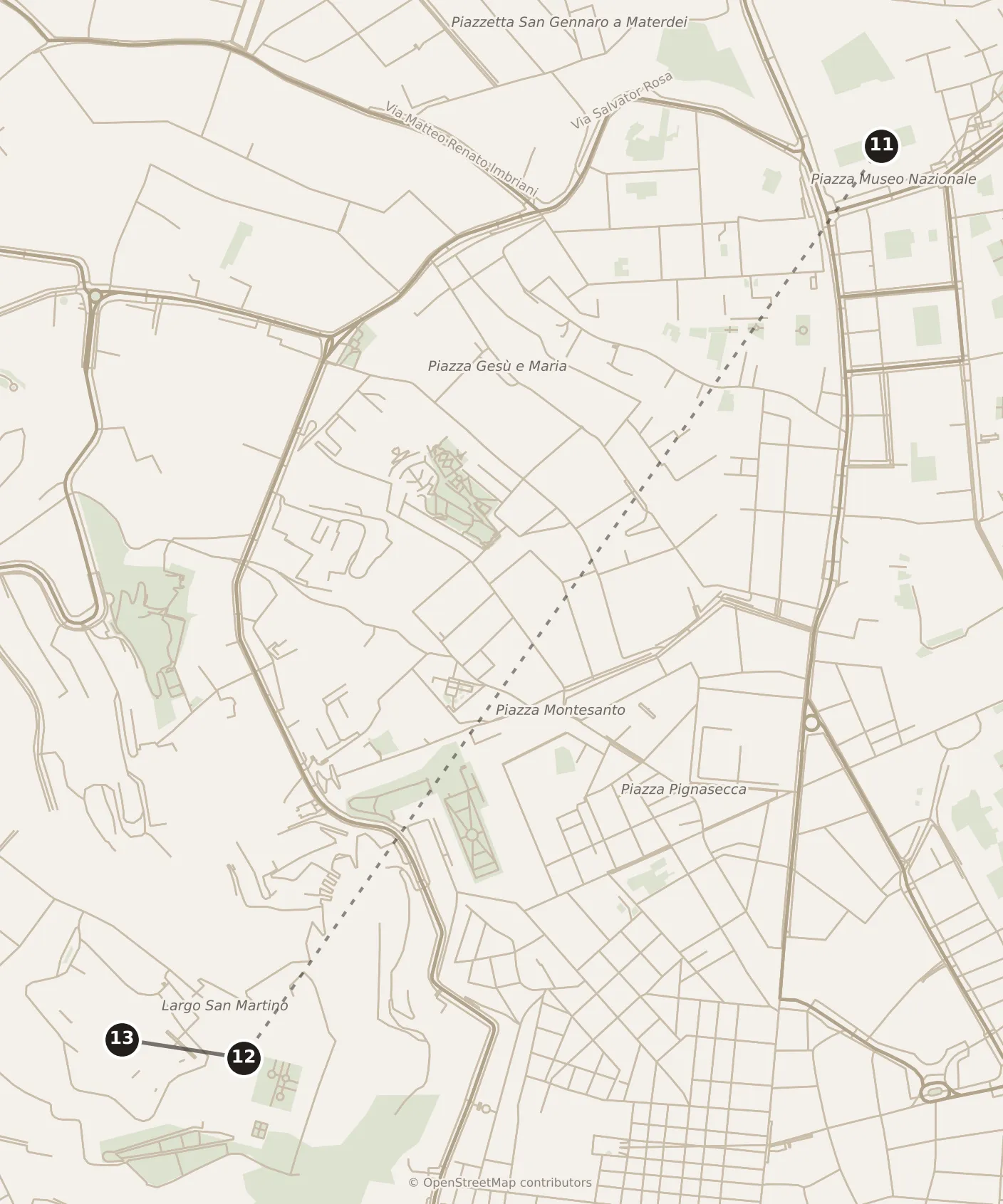
- Morning and afternoon
- 11Museo Archeologico Nazionale di Napoli
- La Pignasecca — in the prose, not on the map
- 12Certosa di San Martino
- 13Castel Sant'Elmo
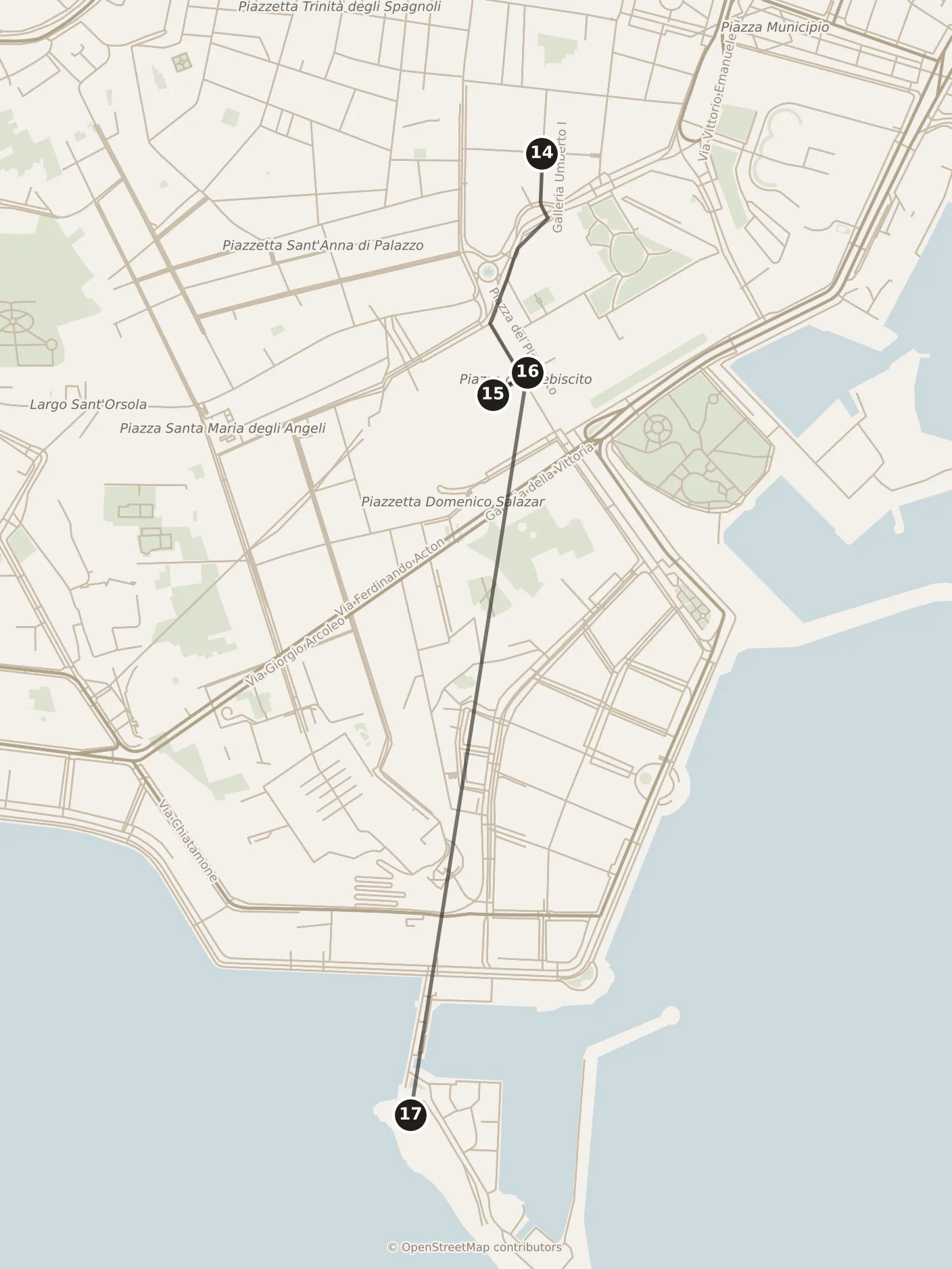
- Evening
- 14Galleria Umberto I
- 15Piazza del Plebiscito
- 16Palazzo Reale
- 17Castel dell'Ovo
Today climbs once and then comes down for the rest of the day, ending at the water. It is the long day of the trip, and what to cut if you cannot give it the whole time is at the end of the article rather than at the end of this section.
Morning
Start at the archaeological museum, at Museo on Line 1, and start at opening — nine in 2026. Everything excavated from the buried towns around the bay was brought here, which is why those sites can feel bare and this building cannot, and a single day in the city can only take three things out of it. Two days can take five, and here they are. The Farnese marbles first: colossal Roman copies after Greek bronzes, the Hercules leaning exhausted on his club, and the Farnese Bull, an entire mythological scene of two men, a woman, a bull and a crag carved out of one block. Then the mosaic rooms, where the floors of real houses hang on walls, including the Alexander mosaic lifted from the House of the Faun, which has spent years under restoration inside the building — check what is back in the room rather than plan around it. Then the wall paintings, which are the collection’s real depth and the part a short visit always loses. Then the bronzes from the Villa dei Papiri at Herculaneum, one private library’s worth of sculpture out of a single house, and the direct link to the third day if you take it. Last the Gabinetto Segreto, the room of erotic objects the Bourbon kings kept locked and which is now simply a room. Give the museum two and a half hours, and let the epigraphic basement and the coin cabinet go without regret — they are for specialists and they will eat the hill.
From the museum door it is a little over ten minutes downhill on foot, past Piazza Dante and on south-west, to La Pignasecca; or Line 1 one stop from Museo to Dante and five minutes on foot if the legs have had enough already. This is the market that fills the streets above Montesanto station, and it is a food market rather than a souvenir one: fish on ice, mozzarella cut to order, whole tuna broken down on a board, fried counters and bakeries between the stalls. Eat here, standing up, for an hour. It is the cheapest meal of the three days and the least arranged.
Afternoon
The Montesanto funicular leaves from the station at the bottom of the market and climbs to Morghen, the top of its three stations, in about five minutes. From Morghen it is five minutes on foot to the gate of the Certosa di San Martino, and the whole transition — market to monastery — costs about twenty minutes including the wait.
The Certosa is a Carthusian monastery on the lip of the ridge, and it is a museum, a church and a viewpoint at once. The church first: Cosimo Fanzago’s inlaid marble runs over every surface until the material stops reading as stone at all, under a vault frescoed in the 1630s. Then the Quarto del Priore, the prior’s own apartment, a long run of rooms with landscapes by Micco Spadaro and a private garden hanging over the city — the one part of a silent order’s house that was allowed to be comfortable. Then the two cloisters: in the larger one, the Chiostro Grande, look for the low balustrade fencing off one corner, which is the monks’ burial ground, and which is topped with marble skulls. Then the crib section, in the old kitchens, where yesterday’s lane on San Gregorio Armeno arrives — the Presepe Cuciniello is an entire eighteenth-century nativity built into an artificial grotto, hundreds of figures deep, with a lighting rig that runs from dawn through full day to sunset and night. Finally the belvedere, and the whole bay. Give the Certosa an hour and three quarters, and skip the naval section and the nineteenth-century picture rooms.
Three minutes along the ridge is Castel Sant’Elmo, a six-pointed star cut into the tufa in 1538 and rebuilt as an artillery fort, which is why it has no windows worth the name and one enormous empty parade ground on its roof. You go up for the roof. It is the widest view in the city: the whole crescent of the bay, Vesuvius, the islands on a clear day, and directly below you the grid of the old town you spent yesterday inside, which from up here is legible as a Greek plan for the first time. Forty-five minutes. It is the only thing on this hill that opens seven days a week, which is going to matter when you read the closures below.
Evening
From the Certosa gate it is about a quarter of an hour across the top of Vomero on the flat — Via Morghen, Piazza Vanvitelli, Via Scarlatti — to Piazza Fuga, where the Centrale funicular runs down through four stations to Augusteo in six and a half minutes and puts you out on Via Toledo, a hundred meters from the Galleria Umberto I. Two different funiculars, up one flank of the hill and down the other, and no ground covered twice.
You come out beside the Galleria: an iron-and-glass arcade of 1890, four arms under a dome, with the signs of the zodiac laid into the marble at the crossing. Ten minutes and a look upwards. Six minutes further south the ground opens into Piazza del Plebiscito, which after two days of lanes reads as a shock — a curved colonnade reaching out like a pair of arms on one side, the long red flank of the royal palace on the other, two bronze horsemen out in the emptiness. Twenty minutes.
Then the palace itself, which is a large part of what a second day is for. The historic apartment runs about thirty rooms off a monumental staircase: the throne room, a set of state rooms still being furnished when the monarchy ended, and the small court theater built inside the building in 1768. An hour and a quarter. In 2026 it closed at eight with last admission at seven, which is why it can be the day’s last interior rather than something you hurry at three — and if that hour has moved, the rule it stands for has not: the palace goes as late as its door allows, because everything else here closes earlier.
The stop the day is built around is not the palace: it is the water. From the palace it is seventeen minutes on foot down to Castel dell’Ovo, and the point of being there is the bay going gold and then dark, with the ridge you were standing on earlier the same afternoon stacked with lights behind you. The fortress itself has been shut for restoration since January 2023 — check what has reopened, and plan the evening so the answer does not matter, because the causeway, the little harbor under the walls and the view were never inside the ticket.
Everything above the sea comes to about eight hours from the museum door, walks and both funicular rides included; the palace adds an hour and a quarter on top of that. The total counts the time inside the places and the moving between them, and nothing else — not the ticket desk at the archaeological museum, which is the one real line on these two days, and not a lunch in the market that runs past its hour.
Set that against your own month and the arithmetic does the rest. Eight hours from a nine o’clock opening puts you at the water at five, and the palace pushes that to a quarter past six: so the sea is in daylight in any month whose sunset falls after five, and the palace fits in front of it only where sunset falls later still. Around the solstice neither holds — the same day lands you on the sea wall just after the light has gone, and with the palace in it, closer to two hours after. Do not try to hurry that. In the short months take the light where you will already be standing in it — the belvedere at the Certosa and the roof of Castel Sant’Elmo, in the early afternoon, which is the best light a winter day here gives you — and take the water afterwards, lit. The seafront is at its fullest after dark and it is built for exactly that walk.
Walk west along the front for as long as you like; the harbor under the castle walls is where the boats are moored and where the terraces charge for the view. To leave, it is about twenty-five minutes on foot back east along the seafront to Piazza del Municipio, and Line 1 runs from there three stops to Garibaldi and Napoli Centrale.
With a third day

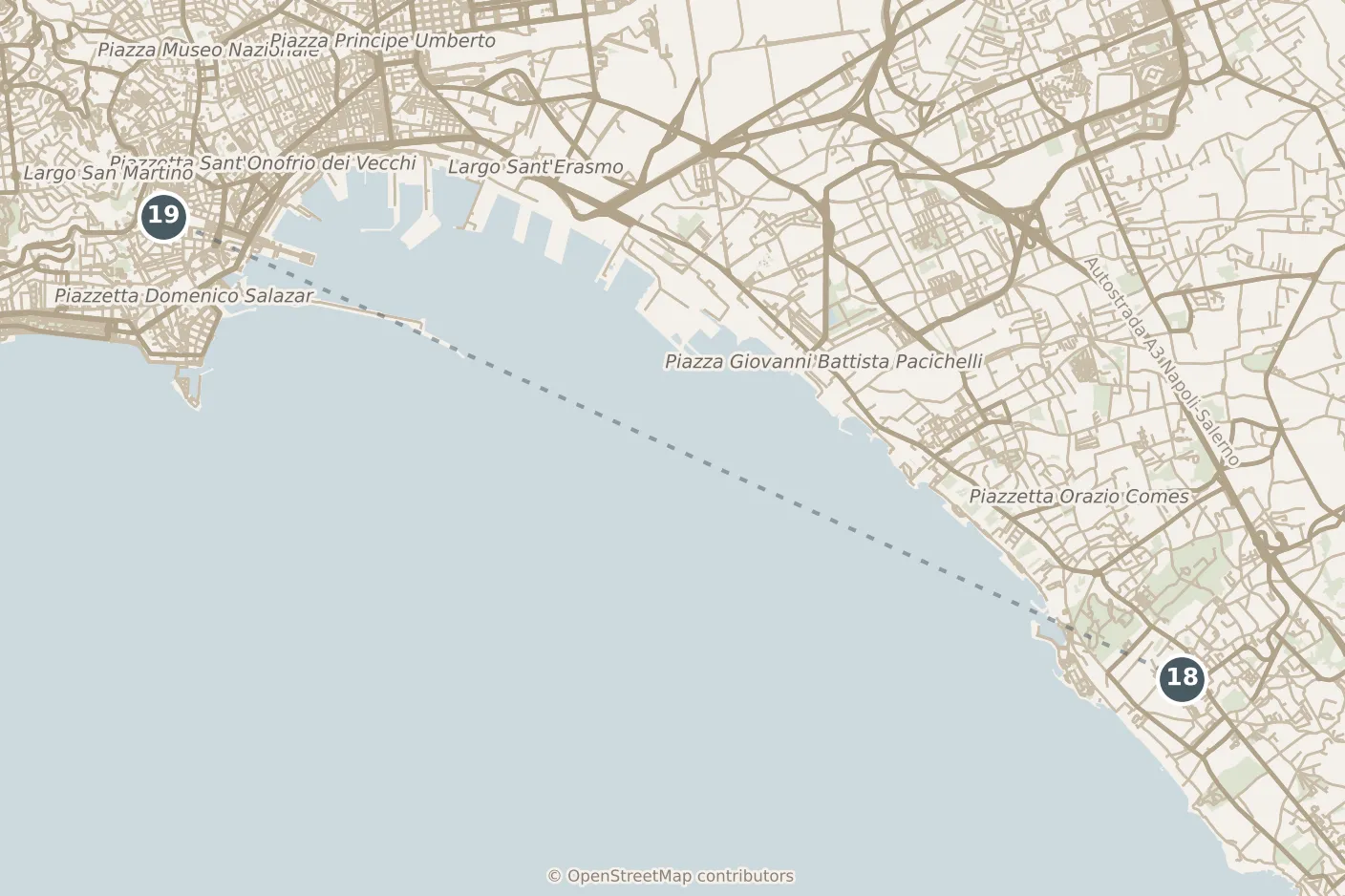
- With a third day
- Napoli Garibaldi — in the prose, not on the map
- 18Herculaneum
- Via Toledo — in the prose, not on the map
- 19Quartieri Spagnoli
The third day is appended, not inserted, and it leaves the city. Days one and two stay exactly as written, in the same order. The one thing that moves it is a Tuesday, and the weekday rules at the end of the article have that.
It goes out to Herculaneum, and the order is the argument. The frescoes, mosaics and bronzes that came out of these houses are in the archaeological museum you spent yesterday morning in; the site is what is left once they have been taken away. In that order the empty rooms are legible and the museum turns into a set of objects with addresses. In the other order the museum is a warehouse of things you have already met and the town is a puzzle.
Go from Napoli Garibaldi, the Circumvesuviana platforms underneath Napoli Centrale, reached from the main concourse. The Sorrento line takes about twenty minutes to Ercolano Scavi, and from that station the site gate is five hundred meters downhill. Herculaneum is small — a few blocks of a seaside town rather than a city — and that is exactly why it is the one to take on a half day. It was buried under about twenty meters of volcanic mud that carbonised rather than burned, so what never survives elsewhere survives here: wooden doors and window frames, roof beams, a folding bed, a bread oven, upper stories still standing over the street. In the arched boat sheds along the buried shoreline lie the remains of some three hundred people who came down to the water to wait for a rescue that did not arrive. Look for the Neptune and Amphitrite mosaic, still in its household courtyard and still the color it was made. The Villa dei Papiri, which produced yesterday’s bronzes, sits at the edge of the excavated area and is not usually part of an ordinary visit — check before you count on it. Give the site two and a half hours. There is no shade and the paving is the original.
Go out on a nine o’clock train and you are back at Garibaldi a little after one, which is where this day’s meal goes: eat in the city, before the climb. The rest of the day belongs to the slope that days one and two only pass the foot of. Take Line 1 to Toledo — the station is a destination in its own right, sunk deep under a blue mosaic light shaft over the escalators — and come up onto Via Toledo, the long pedestrian shopping street, walking north up it rather than south as day two did. Then turn uphill into the Quartieri Spagnoli, a grid of narrow streets laid out in the 1530s to barrack Spanish troops and never rebuilt since: parallel lanes climbing the slope, laundry on every frontage, shrines and murals at the corners, and the loudest street life in the city. It is a lived-in quarter rather than a sight, but it is not closed to you: the churches inside the grid are the way in — Santa Maria Francesca delle Cinque Piaghe and the Santissima Trinità degli Spagnoli among them — and they turn a walk-through into a visit. Walk up one lane, along, and down another, in the couple of hours before dinner, when the quarter is at its busiest. Come back down to Toledo or Montesanto for the metro.
If Pompeii is the reason you came, take it instead — but take it as a different plan, not a longer one. Same station and the same line: the Sorrento train from Napoli Garibaldi, about half an hour to Pompei Scavi – Villa dei Misteri, with the entrance across the road from the platform. It is roughly ten times the excavated area of Herculaneum and it is a whole day rather than a morning, so it replaces the afternoon above as well as the morning: Via Toledo and the Quartieri Spagnoli go, and that day has no evening in the city left in it. Tickets are issued in the visitor’s name against a daily cap, so book before you travel; the full ticket sat between fifteen and twenty euros in 2026. Both parks open every day of the year except Christmas and 1 January, which is the fact that decides where the third day goes if one of your days is a Tuesday.
Practicalities
What to book. One thing, and only one, for the two days: the timed slot at the Cappella Sansevero, where reservation is compulsory, slots are released about two months ahead, and the full ticket sat between ten and fifteen euros in 2026. A day or two of notice is often enough out of season and is not enough in spring or autumn. Everything else on days one and two is sold at the door — the archaeological museum, the Certosa, Castel Sant’Elmo, the royal palace, San Lorenzo Maggiore and Santa Chiara’s cloister all have their own counters, and none of them needs booking for one or two people. A third day at Pompeii adds a second booking, as above; a third day at Herculaneum adds none.
Which weekday breaks what. Three rules, and one of them is serious.
Tuesday breaks both days at once. The archaeological museum closes on a Tuesday — moving to the Wednesday in a week when a public holiday falls on the Tuesday — the Cappella Sansevero closes on a Tuesday, and the Certosa di San Martino now does too. That last one is the change to re-check before you plan anything around it: the Certosa closed on Wednesdays for years and moved its day only recently. Between them, that is day one’s one booked stop and two of day two’s four interiors. Swapping the days does not help, because both are hit. If you have three days, arrange them so the Tuesday falls last: the excavations open every day of the year except Christmas and 1 January, so a Tuesday at the end takes the third day exactly as it is written, museum before site. If the Tuesday cannot fall last, the excursion takes whichever day it does fall on — first or middle — and is inserted rather than appended, you see the site before the museum, and the third-day section’s ‘yesterday’ becomes ‘tomorrow’. That is a real collision and not an oversight — the empty rooms genuinely are harder to read in that order — and it is still the better trade than spending the Tuesday in the city and losing the museum, the Veiled Christ and the Certosa at once.
If you have only two, do not take the Tuesday as one long day of both days’ survivors: those stops come to more than ten hours together by the times given above, which is longer than either day as written. Split by ground instead. Give the Tuesday day two’s half of the city with the monastery taken out of it — the Pignasecca for lunch, the Montesanto funicular up to Morghen, Castel Sant’Elmo for the view the Certosa would have given you, the walk across Vomero, the Centrale funicular down, and then the Galleria, the square, the palace and the sea. That is about five hours. Give the other day the old town as day one is written, with the archaeological museum taken first at opening and the walk down to the cathedral after it, and book the Cappella Sansevero slot for that day: it comes to a little under ten hours, so the day one cut list below is for it. What a Tuesday costs outright is the Certosa; the rest of the cost is the trimming that long day needs.
Wednesday costs exactly one stop, and it is the one named below as the first to cut: the royal palace. Nothing else on either day closes on a Wednesday, with the single exception given above — the archaeological museum, in a week where a public holiday lands on the Tuesday. So a normal Wednesday needs no rearranging at all.
Sunday reorders day one and breaks nothing. Two of its stops shut in the early afternoon on a Sunday — the Caravaggio room and Santa Chiara’s cloister — and the order as written reaches the second of them at about three, which is too late. Three changes fix it and the first is free. The Caravaggio room opens at nine on a Sunday rather than ten, so it takes the first hour and the cathedral takes the second, which is the better way round anyway: on a Sunday morning the cathedral has a congregation in it. Then go west to the cloister before lunch instead of after it — about a quarter of an hour from the Caravaggio, and it opens half an hour later on a Sunday than on other days, so you will not be early — with Gesù Nuovo next door taken at the same time if it is open, which at midday it may well not be. Then you rejoin the day at the Cappella Sansevero — this order reaches it at about half past one, so book the slot for then rather than for the middle of the afternoon — and work back east through San Gregorio Armeno to the Roman market under San Lorenzo, which has no early closing. The evening belongs to Via dei Tribunali rather than to Piazza Bellini. Same ground, opposite direction, about ten minutes of extra walking.
Beyond those three, days one and two will trade places on any weekday. The trap is assuming a swap saves a Tuesday. Those are the weekdays; the dates are in the days themselves — the cathedral’s three liquefaction days in day one, and Christmas and 1 January, the only two days both excavation sites shut, in the third.
What to cut when time is short. On day two, in this order: the royal palace goes first — it is an hour and a quarter, it is the least particular thing on the day, and losing it is what stops the short-month day ending nearly two hours after dark. Castel Sant’Elmo goes second, at forty-five minutes, because the Certosa’s own belvedere fifty meters away shows you most of the same bay — and cutting that one as well is what puts you at the water in daylight in December, at about a quarter past four. Cutting both turns a nine-and-a-quarter-hour day into about seven, and nothing that is left is spoiled. On day one, cut Gesù Nuovo first and San Gregorio Armeno second; if you need a real hour rather than three quarters of one, the other hour on the day is Santa Chiara’s cloister — but the excavations under San Lorenzo Maggiore are the best thing on it, so cut the two small stops first, and mean it.
Getting between the stops. Everything inside each day is on foot except three rides, and they are the three named above: Line 1 to Museo at the start of day two, the Montesanto funicular from Montesanto up to Morghen, and the Centrale funicular from Piazza Fuga down to Augusteo. Day one contains no ride at all once you have reached the cathedral. The longest single walk of the two days is the twenty-five minutes back along the seafront from Castel dell’Ovo to Piazza del Municipio at the very end; then the twenty minutes from Napoli Centrale to the cathedral at the very start; then the seventeen minutes down from the square to the water; then the quarter of an hour across the top of Vomero between the two funiculars. Everything else is under a quarter of an hour, and most of it is under five minutes.
Local tip. If day two is running late and you have to choose between the palace and the sea, take the sea. The palace keeps the longest hours of anything on these two days and can be reached on another evening from almost anywhere in the center; the light on the bay cannot be moved, and inside a two-day trip there is no second chance at it.


.jpg)


