Naples in one day: the archaeological museum, the old town on foot, and the bay at sunset

Last updated 3 August 2026
Overview
One day in Naples begins with a refusal, and it is a large one: you do not leave the city. Pompeii, Herculaneum, Vesuvius and the islands are all a short ride from the central station — the Circumvesuviana goes to the excavations, the boats to Capri leave from the port all morning — and that proximity is exactly the trap. Any one of them takes the day and hands it back as a tired half-day of Naples. If the excavations are the reason you are coming, take them and treat this article as your evening. The city guide is right that they deserve a half-day each. This day is the other choice, and it is a real one, because Naples is a city people pass through on the way to its surroundings and it is better than its surroundings.
What else goes is easier to give up. Vomero has the widest view over the bay and costs a ride up and a ride back — Line 1 runs there from the museum, and the funiculars climb from lower down. The underground city is seen on guided tours of a fixed length, and a fixed length is the thing a single day cannot absorb. Of the museums, one stays and the rest go.
What is left is a single line running downhill and south — a little over six kilometers of walking in total — from the archaeological museum above the old town, through the Greek street grid at its center, down the long shopping street to the royal quarter, and out onto the water. It never doubles back: every stop is between the last one and the sea, and the only walk that goes back north is the last one, to the train.
One thing on it must be bought before you travel: a timed slot at the Cappella Sansevero, where the reservation is compulsory and the full ticket was in the ten-to-fifteen-euro range in 2026. Everything else here is walk-up, free or a metro fare, and how the metro is paid for belongs to the city guide, which is worth ten minutes before you come.
The day is anchored at its far end by the light. The last stop is the causeway out to Castel dell’Ovo, and the point of it is the bay going gold and then dark, so this is the one thing here that will not wait. The sun sets in Naples from just after half past four in early December to about twenty to nine at midsummer: take your month’s hour and count back. From the museum door to the water the route below comes to roughly six and a half hours, including every walk between stops. That total counts the time you spend inside places and nothing else — not the ticket desks, not the slack you want around a timed slot, and not the fact that the archaeological museum is the size of a palace and crossing it is part of its two hours. In December, then, this is a day that starts at the museum’s opening and has no slack in it; in June you will reach the sea with hours to spare, which is the pleasant version of the same arithmetic.
One more thing about shape. This day starts and ends at Napoli Centrale, which is the easy case: leave the bag at the station’s left-luggage office before you start, because everything below assumes your hands are empty, and the route brings you back to within three metro stops of it. Do not carry a bag through the old-town lanes or out along the sea wall. The lanes are narrow enough that scooters pass close, and the last stretch of the evening is a walk with nowhere useful to put anything down.
The day

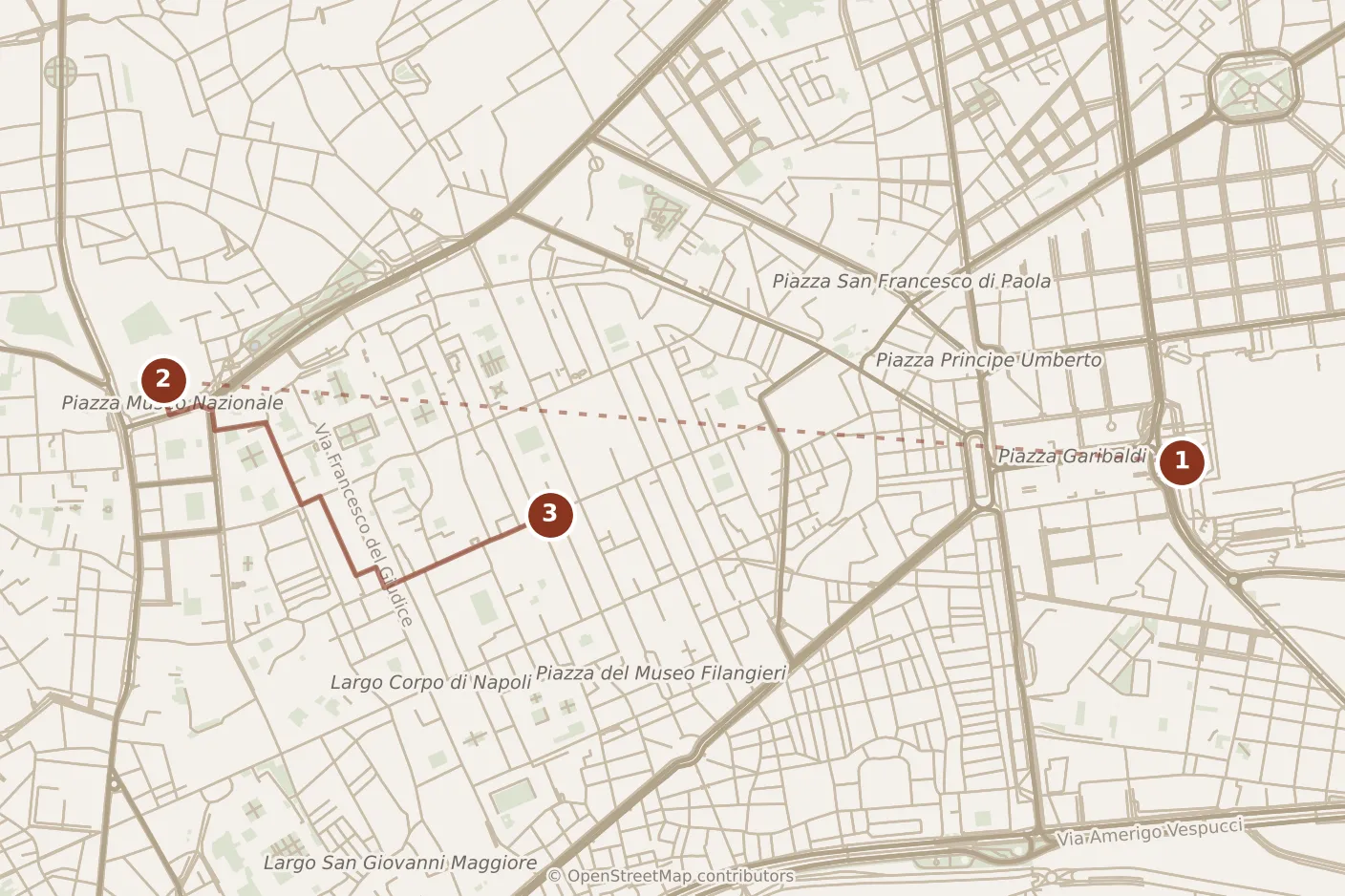
- Morning
- 1Napoli Centrale
- 2Museo Archeologico Nazionale di Napoli
- 3Via dei Tribunali
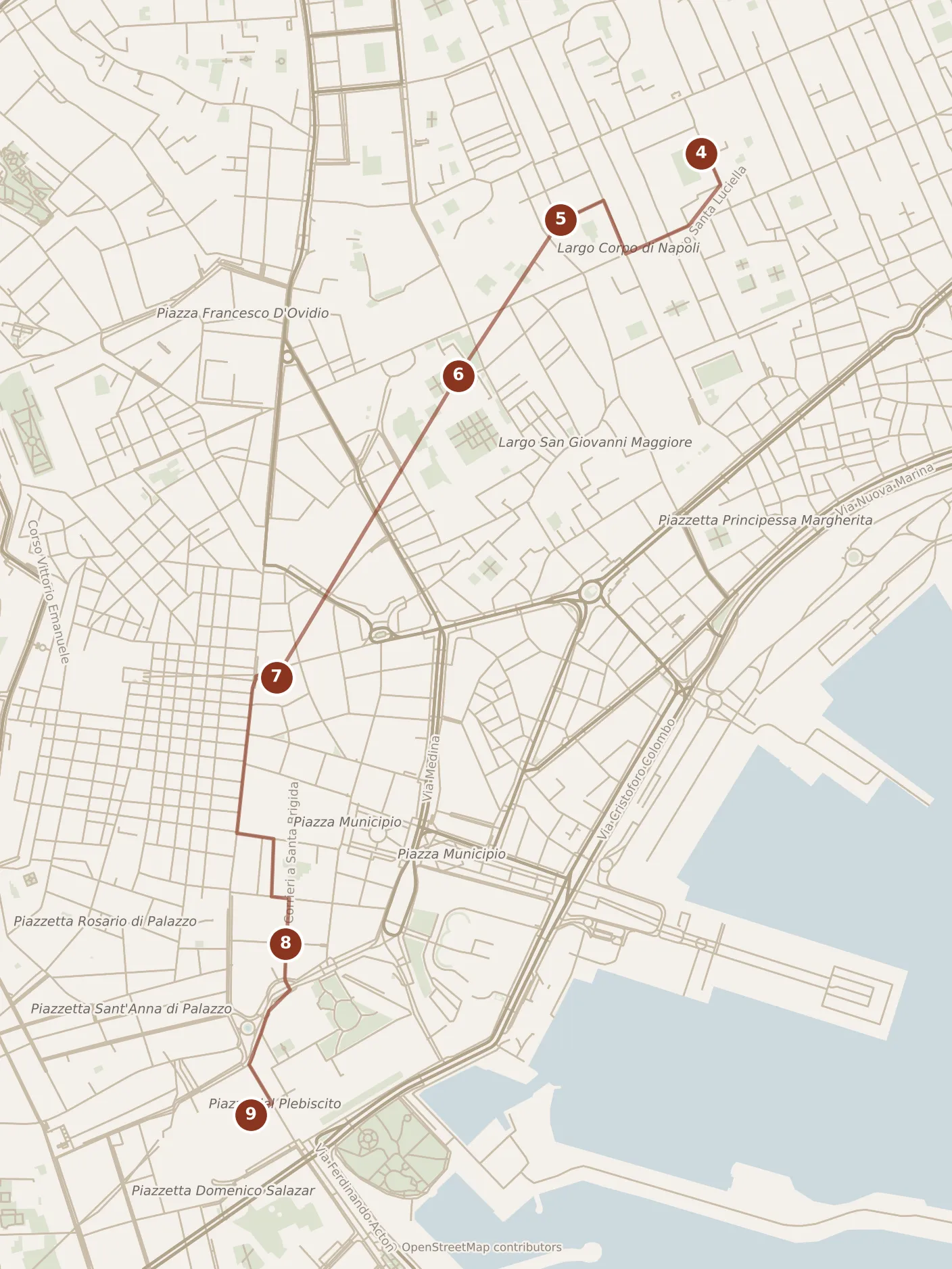
- Afternoon
- 4San Gregorio Armeno
- 5Cappella Sansevero
- 6Santa Chiara
- 7Toledo
- 8Galleria Umberto I
- 9Piazza del Plebiscito
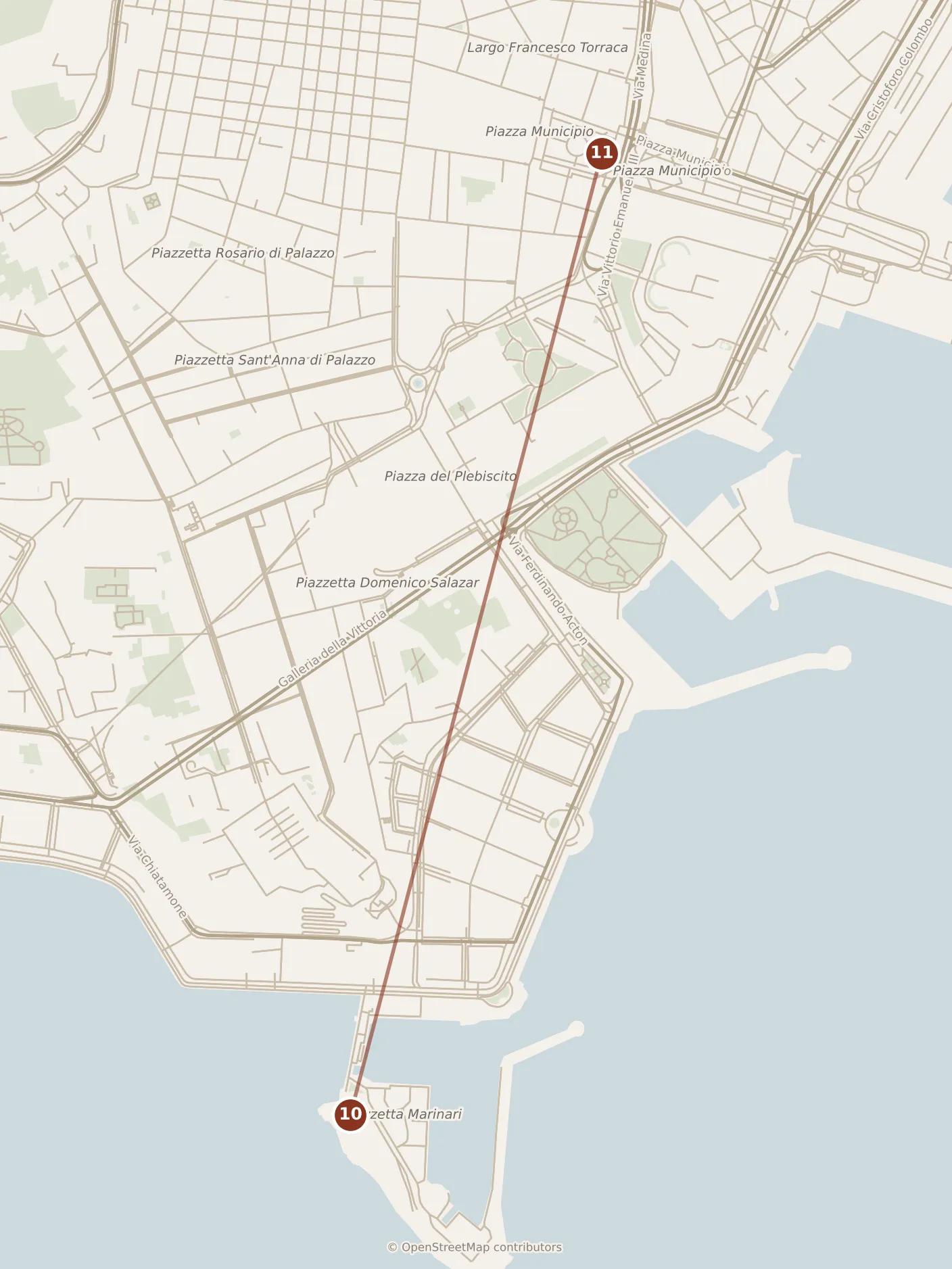
- Evening
- 10Castel dell'Ovo
- 11Piazza del Municipio
Morning
Start under Napoli Centrale, at Garibaldi, and take Line 1 six stops to Museo. The archaeological museum is a couple of minutes from the station exit, and it wants the opening of the day rather than the middle of it: this is the one indoor stop the day cannot do without, and it is the only stop that gets worse as it fills up. Eat a sfogliatella before you go in and you have had breakfast in the local manner.
Give the museum two hours and choose three things, because it holds enough for a week and is signposted by collection, which makes choosing easy. The Farnese marbles are the first choice: colossal Roman copies of Greek bronzes, including the Hercules leaning exhausted on his club and the Farnese Bull, an entire mythological scene of men, a woman, a bull and a rock carved out of one block of marble. The second is the material lifted out of Pompeii and Herculaneum — the mosaics and wall paintings that were cut off the walls of the buried houses and brought here, which is why those sites can feel oddly bare and this building oddly full. The great mosaic of Alexander from the House of the Faun has been under restoration inside the museum since 2020 and spent years visible only as work in progress, so check what is back in the mosaic rooms rather than build the visit around it. The third is the Gabinetto Segreto, the room of erotic objects and frescoes that the Bourbon kings kept locked and that is now simply a room. Let the Egyptian and epigraphic collections go. Two hours and out.
From the museum it is about a quarter of an hour on foot, downhill and south-east, into the old town and onto Via dei Tribunali. This is the Decumano Maggiore, the middle of the three dead-straight streets the Greeks laid out and the Romans kept, and it is still the axis the quarter is built on: a canyon of tall blocked-up palaces, shrines set into the walls, workshops at street level and a scooter every fifteen seconds. Walk it east for a while before you eat, because the street is the sight.
Lunch is here, and it is pizza. The oven does the work in about a minute, so a sit-down lunch in Naples is a quick lunch — give it an hour and take a table. The two orders that tell you what a place can do are the marinara, which has no cheese at all, and the margherita; a portafoglio, folded in four and eaten walking, is the cheaper move and not a lesser one. If you would rather graze, the fried counters along this street sell crocchè and paper cones of fried things, which is the other honest Neapolitan lunch.
Afternoon
Three minutes south, San Gregorio Armeno drops downhill off the decumanus and is the lane of the crib-makers: workshops making figures for the Christmas presepe all year round, shepherds and butchers and bakers alongside footballers, singers and whichever politician is having a bad year. It is a tourist lane and it knows it, and it is still the twenty minutes to give the afternoon, because the workshops are working workshops and the trade is genuinely made here. The church it is named for is behind a door on the same lane and has a gilded Baroque interior worth five minutes if you find it open; take the lane as the point and the church as the bonus. One thing about December: on the weekends before Christmas the city runs the lane one-way for pedestrians, and the permitted direction is set by date — in the stretch closest to Christmas it reverses, so you enter from Spaccanapoli below rather than from Via dei Tribunali above. Check the ordinance for your dates, and be willing to leave the lane out of the day.
Five minutes west is the Cappella Sansevero, and this is the fixed appointment of the day. It is one small room, and in the middle of it lies the Veiled Christ, carved by Giuseppe Sanmartino in 1753 out of a single block, with a marble shroud so thin you can read the wounds through it. Around the walls the same trick is played in other keys — the Disinganno is a man struggling out of a net, and the net is stone. The prince who built the room, Raimondo di Sangro, was an inventor and an alchemist with a reputation that has never quite settled, and down in the crypt stand his two anatomical machines: skeletons with the entire circulatory system modeled around them, made in a way nobody has fully explained. Half an hour, and it is a half-hour that people remember for years.
Local tip. Book the chapel slot for the early afternoon rather than the morning. It is the only fixed point in the whole day and everything else here is walk-up, so putting it in the middle lets the museum run long if it is holding you and lets the walk to the water stay unhurried if it is not. A morning slot squeezes the museum into an hour; a late one leaves you in the old town at the moment you should be heading for the sea.
Six minutes west along Spaccanapoli, Santa Chiara is two buildings and you want the second one. The basilica was gutted by fire after Allied bombing in 1943 and rebuilt by 1953 to what was believed to be its original Gothic form, so it is enormous, pale, bare and startlingly empty, with the tombs of the Angevin kings at the far end; ten minutes covers it, and it needs no ticket. The cloister behind it does, and it is the thing to pay for: in 1742 Domenico Antonio Vaccaro had the walks of the Clarisses’ garden lined with octagonal pillars and long benches faced in painted majolica — vines, lemons, landscapes, picnics — so the whole enclosure is a tiled garden inside a real one. Give it three quarters of an hour. It is the quietest place on this route and it comes exactly when you need one.
Then down to Via Toledo and south. Ten minutes on, Toledo is the one metro station on this route that is a destination rather than a means: Oscar Tusquets built it deep, kept the stretch of the Aragonese city wall the excavation turned up, and lined the escalator shaft in blue mosaic under a light well, so the descent reads as going under water. William Kentridge’s mosaic frieze of a Neapolitan crowd on the move runs along one of the passages. Part of the station is beyond the ticket barriers, so seeing all of it costs a single fare you were not otherwise going to buy — worth it, and ten minutes either way.
Nine minutes further south, the Galleria Umberto I is the iron-and-glass arcade of 1890 that the city built when it was tearing the old slums down: four arms under a glass dome, marble floors, and the signs of the zodiac laid into the paving at the crossing, relaid in 1952 after the war damaged the original. Ten minutes and a look upwards.
Six minutes on is Piazza del Plebiscito, an expanse of open paving that reads as a shock after three hours of lanes. On one side the colonnade of San Francesco di Paola curves out like a pair of arms around a domed church; on the other the long red flank of the Palazzo Reale, with two bronze horsemen out in the middle. It was a parking lot from 1963 until the city cleared it in 1994, which is worth knowing when you see people using it as a soccer field. Twenty minutes.
Evening
From the square it is about a quarter of an hour down to the sea, and the last stop is Castel dell’Ovo — a fortress on the islet of Megaride, where the Greeks put their first settlement here, joined to the shore by a short causeway. Walk out along it. The view is the whole geography of the city in one turn of the head: the hills stacked with buildings behind you, Vesuvius away to the east, and the water opening west towards the Posillipo headland, which is where the sun goes down. Underneath the walls, Borgo Marinari is a small harbor of moored boats and restaurant terraces, and it is where the evening ends if you want to eat with the water in front of you and pay for the privilege; the old town does it better and cheaper, and you are three metro stops from it.
The castle itself has been closed to the public since January 2023 for a restoration whose last phase was scheduled through 2026, so check what has reopened and plan the evening so that the answer does not matter — the causeway, the harbor and the view were never inside the ticket. Give the water three quarters of an hour and do not hurry it. This is what the counting backwards was for.
Then the return, which is the longest single walk of the day: about twenty-five minutes back along the seafront and up to Piazza del Municipio, past the dry moat, the dark stone towers and the white marble arch of the old royal castle standing in the middle of it. From Municipio, Line 1 runs three stops to Garibaldi, which puts you under Napoli Centrale and beside the left-luggage office you started at. Allow three quarters of an hour from the water to the platform, and more if you mean to eat first.
Practicalities
One thing has to be booked before you travel and it is the only one: the timed slot at the Cappella Sansevero. Reservation is compulsory, the room is small, and slots are released a couple of months ahead, so a day or two of notice is often enough out of season and is not enough in spring or autumn. The full ticket was in the ten-to-fifteen-euro range in 2026. Santa Chiara’s cloister takes a small ticket at the door and the archaeological museum sells its own; neither needs booking for one person.
Tuesday is the day this route breaks, and it breaks it twice. Both the archaeological museum and the Cappella Sansevero close one day a week and that day is Tuesday for both of them — the museum shifting to the Wednesday when a public holiday falls on the Tuesday. That is the morning and the fixed point of the afternoon gone together, which is more than half the indoor content of the day. Check both before you set out, and if your one day is a Tuesday, either move it or accept a different day altogether: the streets, the cloister, the station, the arcade, the square and the sea are all still there, and it becomes a walking day with one paid stop instead of three.
The churches on this route are the other thing likeliest to catch you out. Churches here commonly shut for a couple of hours in the middle of the day and open again later, and on Sunday mornings they belong to their congregations rather than to visitors — which is one reason lunch on Via dei Tribunali sits where it does in the day, and a reason to look at the opening times of Santa Chiara before you fix the order of the afternoon. The cloister there is the one thing that can break the afternoon outright: on Sunday in 2026 it shut at two in the afternoon, and this route reaches it well after that. So on a Sunday the cloister has to be taken in the late morning, ahead of the old town, or given up — and if the Sunday hour has moved, set it against the mid-afternoon this route gets you there and reorder the same way if it still closes first.
Moving between the stops is walking, all of it, apart from the two ends. Line 1 takes you six stops from Garibaldi to Museo at the start and three stops from Municipio back to Garibaldi at the finish; in between there is no leg where transport would save you anything, because nothing is more than a quarter of an hour from the last thing. The one exception is the evening walk from Castel dell’Ovo back to Piazza del Municipio, which is twenty-five minutes and the longest stretch of the day — worth knowing if you are watching a train. If you need to leave earlier than that, the day cuts cleanly at Piazza del Plebiscito: Toledo is about a quarter of an hour back up Via Toledo from the square, and Line 1 runs from there to Garibaldi in four stops.
Local tip. With a train to catch, cut the end of the day rather than the beginning of it. Dropping the seafront removes the two longest walks on the route in one decision and leaves the museum and the chapel — the two things here you cannot see anywhere else — whole. Taking twenty minutes off each of the first three stops instead spoils all of them a little, which is the worse trade.


_01.jpg)