Nairobi in two or three days: the city, the park, and a forest morning

Last updated 15 August 2026
Overview
One day in Nairobi makes you choose, and the choice is a bad one. The animals are out to the south-west past Langata; the collections, the archives and the one grid in this city you walk rather than ride are back to the north-east; and the fifteen kilometers between them is the least predictable hour on any page about this place. A single day takes one side and loses the other. So the second day does not really add sights — it deletes a compromise, and that is the whole argument for staying. The third adds the one thing the first two have no room for, which is a morning with nothing scheduled in it at all.
The light will not help you plan any of this, and it is better to know that now than to work it out on the second evening. Nairobi lies about a degree and a half south of the equator, so the days here do not lengthen and shorten: the sun goes down between roughly twenty past six, at its earliest in the second half of October, and roughly ten to seven, at its latest at the end of January. Half an hour of drift, across the entire year. Any advice that leans on a long summer evening or a short winter afternoon was written for somewhere else. What moves instead is the rain — the long rains from about March to May, the short ones around November — and in those two seasons the pattern is a hard afternoon downpour rather than a gray day. In a wet month that lands on the city day, and it lands on the walking. That day has its museum in the morning and its loop on foot in the afternoon — an open locomotive yard, a memorial square, an hour of crowded sidewalk and a roof with no glass on it — and it will not turn round: the museum wants you fresh and the roof wants the late hour, when the haze has gone. So in the long or short rains the downpour comes down on the most exposed stretch of these three days, and on the roads at the same time, and what follows is a trade rather than a scheduling trick. Take rain gear rather than an umbrella you would be holding for an hour. Treat the market hall and the gallery as the two stops with a roof on them, and sit a squall out in one of them. And if something has to give, give up the Railway Museum, exactly as the tip below says, because most of its hour is that open yard. The margin hour at the end of the city day cannot be spent twice: the roads take their share of it before the walking does. The middle of the year is not that weather at all. From June to September this is a cold, gray city rather than a stormy one — overcast and drizzly for weeks at a time, daily highs of around twenty-three or twenty-four degrees, mornings down towards single figures. Nairobi stands at about eighteen hundred meters, and that is the altitude speaking rather than the latitude: a six o’clock start at a park gate in July or August wants a warm layer far more than it wants a raincoat, and wants sun cover for afterwards, because at this height the sun is hard the moment the cloud breaks.
The weekly closure does not govern the calendar here either, which is unusual enough to say out loud rather than leave as silence. The national museum and the gallery open every day of the year, public holidays included; so does the house out in Karen; the elephant nursery runs every day except Christmas Day; the forest opens at six. There is no Monday to dodge among the ticketed places. City Market and the lanes that feed you beside it are a different kind of thing — a working market keeps its own trading week, and nobody publishes it — so a city day that has to fall on a Sunday is worth checking locally rather than assuming. Three other things do govern the trip. The nursery’s booked hour, which pins the wildlife day to a date before anything else gets decided. The middle of Friday, when the mosque on the city day is at the fullest prayer of its week and is not an hour for visitors. And the weekday rush, morning and evening, which is why the wildlife day starts before six and why the forest morning does not start at eight.
The durations below are what to give each place, and they add up. The city day comes to about seven and a half hours of standing still and a little over an hour on foot between the stops; with one fifteen-minute taxi in the middle, that has you off the roof at the end of it a little after five, from a start at half past eight, with an hour of light still in hand — and that hour is the margin, not spare time. The wildlife day comes to about eight and a quarter hours from a six o’clock start and finishes out in Karen before four. Both totals model the time you spend inside the places and nothing else. They do not contain the ticket desks and they do not contain the crossings of the city, and in Nairobi a crossing is not a rounding error: budget it on its own or it will eat the end of a day rather than the middle.
The bag is not the usual problem on a trip with a room in it, but it has one bad day, and the bad day is the city one. Do not walk that afternoon with a case: it is an hour of crowded sidewalk, several street crossings and a covered market, and it is the one stretch of these three days where you want both hands free and no reason to be looked at twice. The wildlife day is the opposite — it is spent in a single vehicle from before dawn, the trunk follows you everywhere, and nothing is ever left standing unattended at a gate. So if you fly out on the last evening, make the wildlife day the last day and check out straight into the car. If the nursery has given you a different date, leave the bag where you slept and go back for it, and put an hour of crossing the city into the plan rather than into the taxi. Coming in, the first leg is short and worth getting right: Jomo Kenyatta International Airport is south-east of the city, and the Nairobi Expressway — the elevated toll road above Mombasa Road — is what turns that run from two hours into well under one. It passes within a kilometer of Museum Hill, where the first morning starts. The toll on it is levied on the vehicle at the toll station rather than through your app, so ask for the Expressway when you book the car and agree with the driver how the toll is being settled before you set off.
Karura Forest — not on the walking map; you get there by taxi.
- With a third day
- 13Karura Forest
Day one

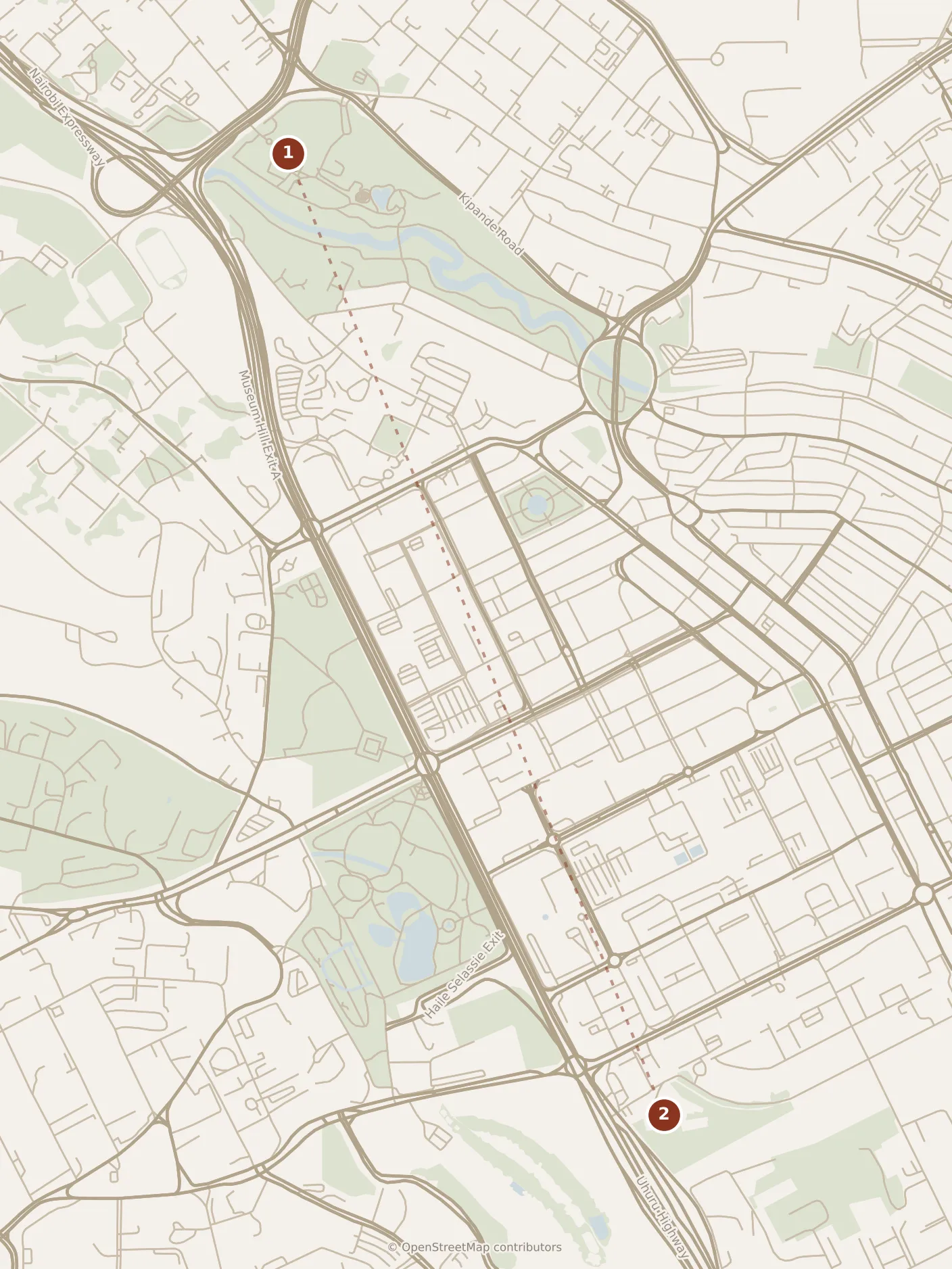
The ride on to stop 2, by taxi, not on foot.
- Morning
- 1Nairobi National Museum
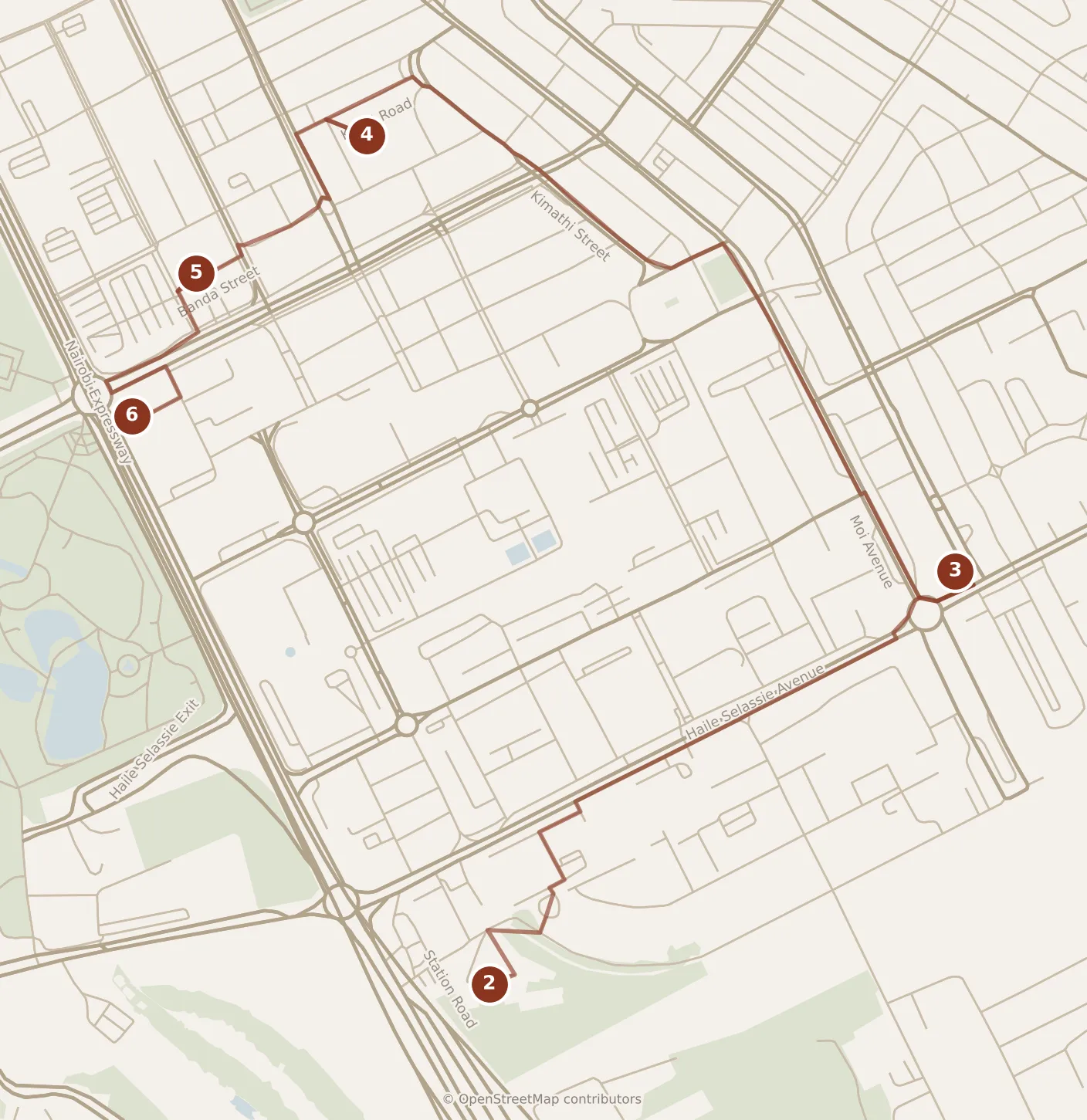
- Afternoon
- 2Nairobi Railway Museum
- 3August 7th Memorial Park
- 4Jamia Mosque
- City Market — in the prose, not on the map
- 5Kipande House
- 6Nairobi Gallery
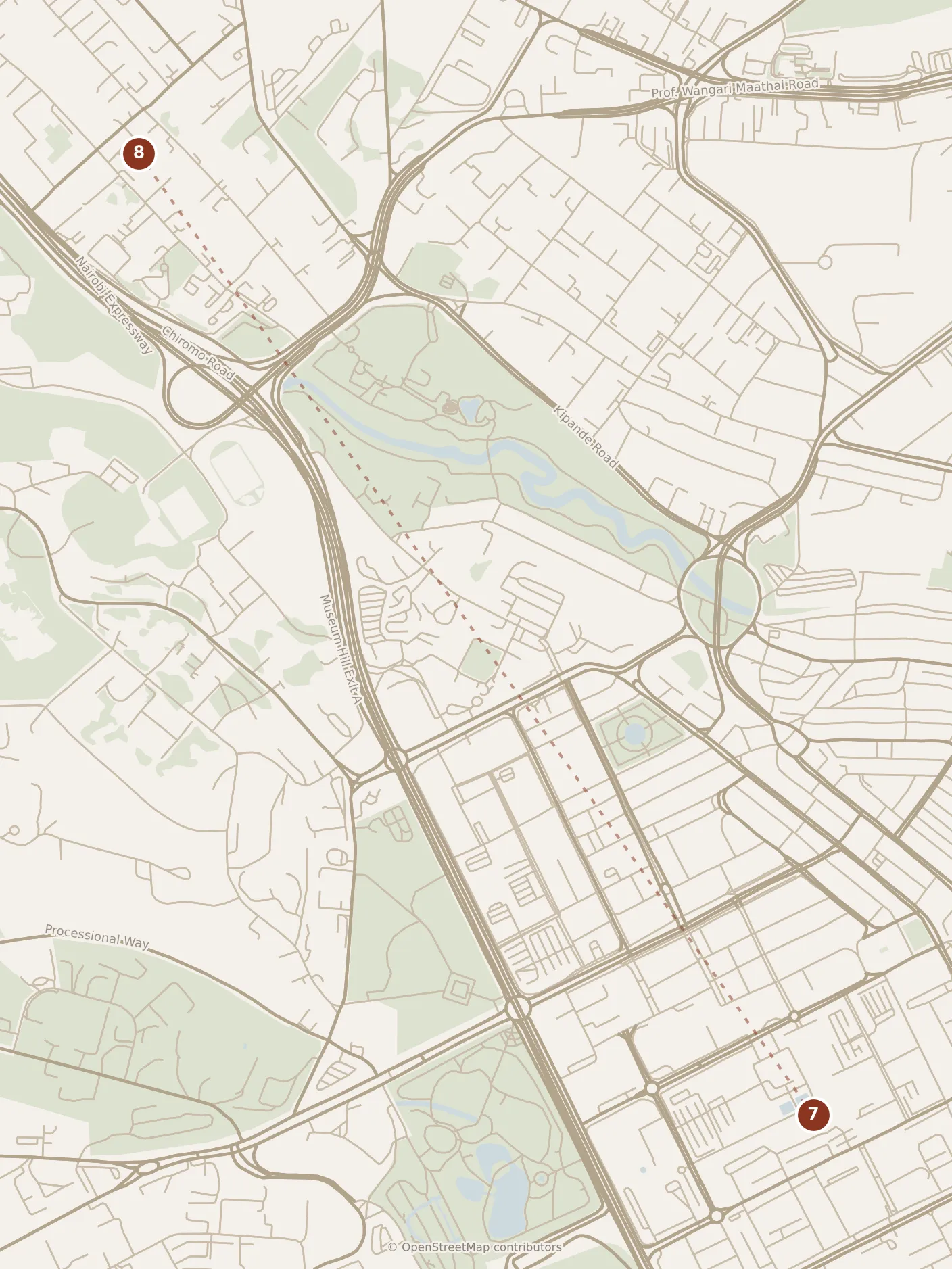
- Evening
- 7Kenyatta International Convention Centre
- 8Westlands
Two halves and two car journeys, and nothing else in between. The morning is one building on a hill north of the center. The afternoon is a loop on foot through the old business grid, which is genuinely walkable in daylight and is not a place to be walking after it.
Morning
The Nairobi National Museum admitted visitors from half past eight in 2026, every day of the year, and half past eight is the hour to be at the door — not because it fills, but because everything below is counted forward from that moment. If the hour has moved, count forward from the new one; the order of the day does not change.
It began in 1910 as a natural history society’s cabinet and moved onto this hill in 1930, and what it holds now is the national collection of a country whose national collection happens to include the beginnings of the species. Give it two and a half hours, and spend them unevenly. Start with the hominin fossils while you are fresh: the National Museums of Kenya keep one of the largest collections of early human remains anywhere, most of it dug out of the Turkana basin, and no other room in the city is doing anything comparable. Then the Joy Adamson portraits — some seven hundred paintings of Kenyan peoples in dress that in many cases no longer exists, commissioned in the 1940s and 50s and now an ethnographic record nobody could make again. Then the birds, a long wall of glass cases holding several hundred East African species, which is twenty minutes or an hour depending entirely on the person. Skip the temporary galleries without guilt; they are not what the morning is for. Out in the courtyard stands a life-size model of Ahmed, the Marsabit bull whose tusks reached the ground and who was given round-the-clock guards by presidential order in the 1970s — the only elephant in this country ever protected by name. The Snake Park sits on the same site across the courtyard, takes twenty minutes, and is included in the two and a half hours: live snakes of the region, pit by pit, arranged to teach people which ones matter.
Then a taxi down into the grid, a quarter of an hour without traffic and anything with it, and ask to be set down on Station Road.
Afternoon
The Nairobi Railway Museum stands beside the working railway station on Station Road, and it is the reason there is a city here at all: Nairobi in 1899 was a swamp with a rail depot on it, chosen because it was the last flat ground before the Rift. Inside are the drawings, the china, the clocks and the models of the Uganda Railway, the line its critics in London called the Lunatic Line. Outside, in an open yard you walk around freely, are the locomotives — including the articulated Garratt engines built to drag trains up out of the valley, which are the largest and strangest things here — and one that was used in the 1985 film of the memoir about the farm you reach on the wildlife day. Give it an hour and give most of the hour to the yard. It is an outdoor museum with an indoor room attached, not the other way round.
From the gate it is about a quarter of an hour on foot north-east, to the corner of Moi Avenue and Haile Selassie Avenue. August 7th Memorial Park is the small green square on the ground where the American embassy stood until the morning of 7 August 1998, when a truck bomb detonated outside it at about half past ten in the morning. It gutted the embassy and brought down the neighboring Ufundi House, where a secretarial college was housed and where most of the dead were. More than two hundred people were killed in this street, the overwhelming majority of them Kenyans. There is a wall carrying the names, a sculpture assembled out of the wreckage, and a documentation room that is worth the ten minutes of the half-hour you give the place. It is a memorial and, for some of the people named on it, the nearest thing to a grave; it is not a park to eat lunch in.
Twenty minutes north, on crowded sidewalk the whole way, three silver domes and a pair of minarets stand over Banda Street. Jamia Mosque is the principal mosque of the city and a working one, which sets the terms of the visit: shoes come off at the door, women cover their heads, everyone covers shoulders and knees, and you do not go in at prayer times. The middle of Friday is the congregational prayer and the busiest hour of the week — if your city day falls on a Friday, do the market first and the mosque afterwards, which costs the loop about six minutes and nothing else. Twenty minutes inside is plenty. What is interesting is that it is a building in use rather than a monument, and the difference is obvious the moment you are in it.
Under ten minutes west is City Market, the covered hall on Muindi Mbingu Street: flowers by the entrance, fish and meat at the back, and a gallery of curio stalls above where the selling is direct, continuous and entirely good-humoured about a firm no. Half an hour. Lunch is here or in the lanes immediately around it, sitting down, and the plate to order is ugali with a stew and greens. Give it an hour; you have been going since half past eight and the afternoon has four more stops in it.
Six minutes south, on Kenyatta Avenue, Kipande House is a stone building with a clock tower put up in 1913, and it is named for what happened in the line outside it rather than for anything inside. The kipande was the identity pass every African man was required to carry, in a metal case on a cord around his neck, and this is where it was issued. It is a bank branch now, so you look at it from the sidewalk and move on: ten minutes, and they are ten minutes that change how the next stop reads.
Four minutes further, where Kenyatta Avenue meets Uhuru Highway, the Nairobi Gallery occupies a colonial office building of 1913 — put up for the Ministry of Native Affairs, and used for decades to register births, marriages and deaths, which is the joke Kipande House has just set up. It became the provincial commissioner’s office after independence and a gallery in 2005. Inside is the Murumbi African Heritage Collection: what Joseph Murumbi, this country’s second vice-president, and Sheila Murumbi gathered over a lifetime — textiles, jewelry, stamps, furniture and books from across the continent, assembled privately on a scale no institution here was attempting at the time. He resigned the vice-presidency after a year and did this instead. Forty-five minutes. It is small, it is silent after the market, and nothing else in the center of Nairobi holds a private collection of that range.
Evening
The Kenyatta International Convention Centre is twelve minutes back east, and it is the one deliberate backtrack of the day; it is made on purpose, because the view is the thing you want last. The tower went up in 1973 — twenty-eight floors of cylinder with a low conical amphitheatre at its foot, designed by Karl Henrik Nøstvik with David Mutiso — and the helipad on the roof is open to visitors, with no glass between you and any of it. Rooftop access is a ticketed service and the booking now runs through the government’s eCitizen billing portal rather than dependably over a counter — the same platform the wildlife day’s park ticket is bought on. So if you have already made that account you have what you need here; and if you have decided to skip the park, you still have to make it, which is a job for weeks before you travel and not for the walk over. Settle it before the trip rather than before the backtrack, and expect to be asked for identification in the building. What you get is the grid you have spent the afternoon inside, laid out and legible for the first time: the green edge of Uhuru Park, the parliament, the roofs running east until they stop being individual, and the Ngong Hills along the south-western horizon. Three quarters of an hour. Late afternoon is the hour for it, partly because the haze has lifted by then and partly because this is a daytime roof rather than a sunset deck.
Local tip. If the afternoon is running late, the Railway Museum is the stop that goes, not the rooftop. It is the furthest south, it is the only stop on the loop whose absence moves nothing else, and dropping it hands back the hour inside plus the quarter of an hour walking out of it — an hour and a quarter, on the day you need it. Have the taxi from the museum set you down at Moi Avenue instead of Station Road and the rest of the loop is unchanged.
Then go, and go while there is still light: sunset is between twenty past six and ten to seven whatever the month, and the grid empties quickly once it has gone. It is not somewhere to be walking after dark with a phone in your hand — the whole afternoon above is a daylight route, and there is no version of it that works at night. Westlands is fifteen minutes north-west by car on an empty road, and the road will not be empty: this crossing is made at the top of the evening rush, so budget three or four times that, or come off the roof earlier and arrive in daylight. It is a different city when you get there — the eating and the drinking sit within a few streets of each other, which is what makes it an evening rather than a restaurant — and it is why the evening happens there and not here. What to eat, if the sitting-down part is done or too late to start, is mutura: off a sidewalk grill, cut from the coil by the piece, a hundred shillings’ worth being a snack. It is an evening food and only an evening food, so this is the night for it.
Day two

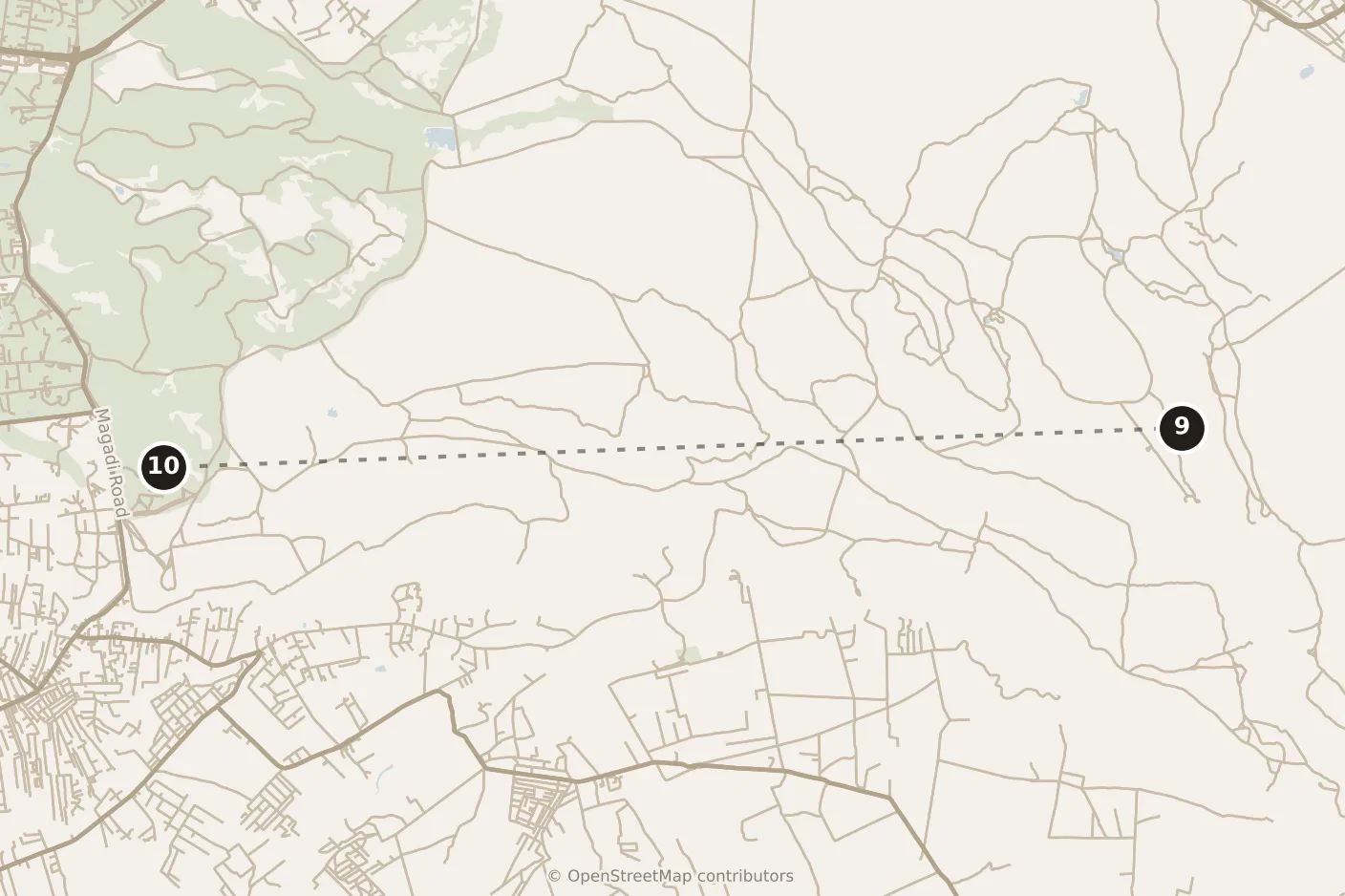
- Morning
- 9Nairobi National Park
- 10Sheldrick Wildlife Trust Nursery
- Afternoon
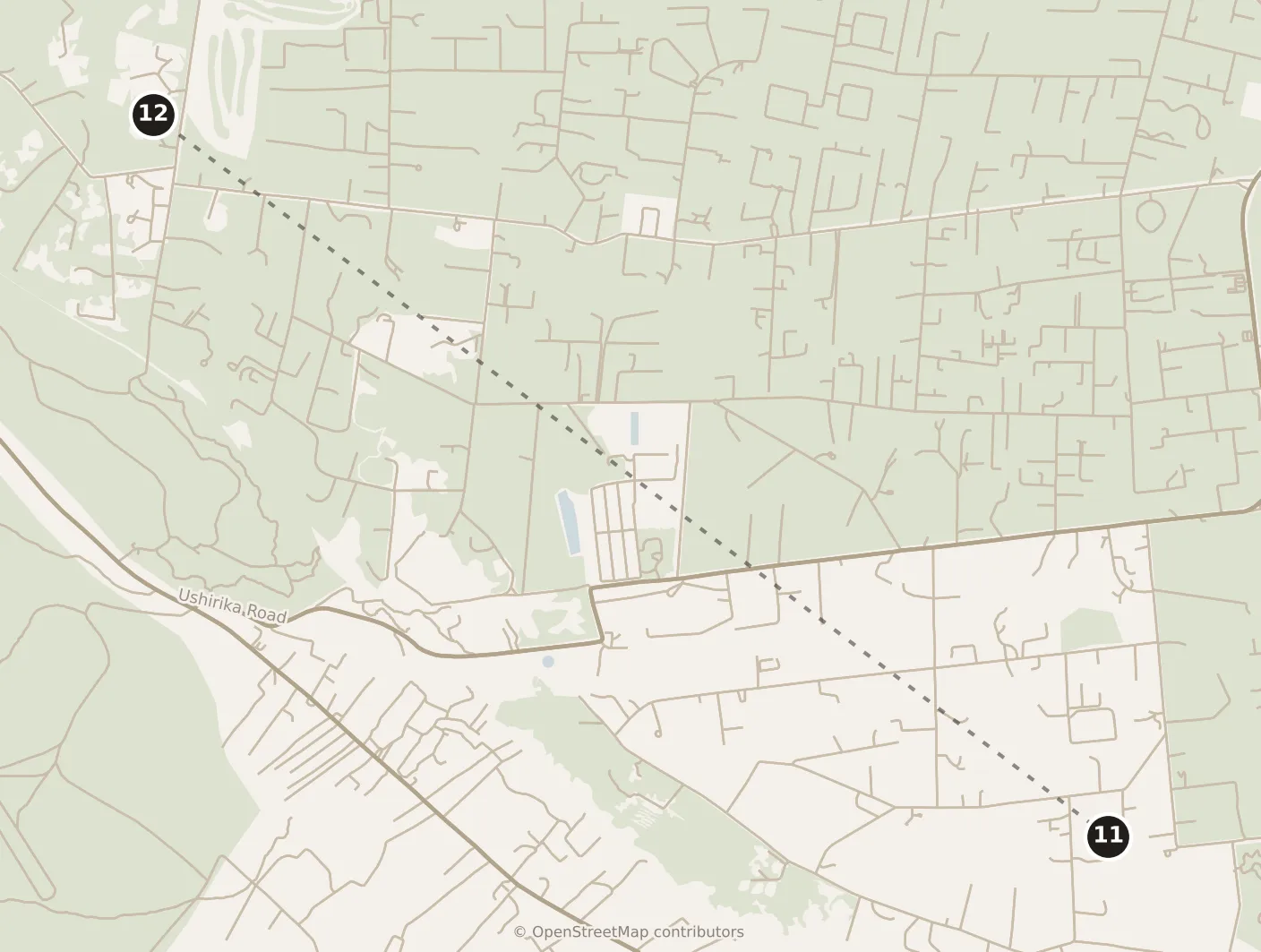
- 11Giraffe Centre
- 12Karen Blixen Museum
A vehicle from before dawn, with one immovable hour in the middle and everything else arranged around it.
Morning
The park gates opened at six in 2026, and six is when to be at them. If that has moved, the shape has not: you want to be inside for first light, and out of the drive with time in hand. Between June and September that hour at the gate is genuinely cold, whatever the equator suggests — this is the morning the warm layer is for.
Nairobi National Park is a hundred and seventeen square kilometers of open plain and flat-topped acacia beginning where the southern suburbs stop, gazetted in 1946 as the first national park in this country. It is fenced on three sides and open on the fourth, where the Mbagathi runs along the southern boundary, so the animals in front of you are a population that comes and goes rather than a collection that is kept. Four of the big five live here; the missing one is the elephant, which is a joke the morning resolves at eleven. It is also one of the more productive black rhino sanctuaries in the country and carries something over four hundred species of bird.
Give the drive four hours, and understand that those four hours are exactly what the second day buys. With one day the drive is three hours run against a clock; with two it is four hours you can afford to spend badly on purpose — sitting still at a waterhole for twenty minutes, taking a track that goes nowhere. Spend them on the open plain to the east and south rather than in the dry highland forest by the main gate, which is handsome and in which you will see almost nothing. Ask for two things by name. The ivory site, where twelve tonnes of confiscated tusks were burned in 1989 and a hundred and five tonnes went the same way on the same ground in 2016, and where the monument marks the burnings together rather than either one. And the Hippo Pools down on the Mbagathi, which is one of the very few places in this park where you may leave the vehicle, and then only with a ranger — everywhere else you stay inside it, and that is a rule rather than a courtesy.
At ten o’clock, stop, whatever is in front of you. The Sheldrick Wildlife Trust Nursery stands inside the park, but the Trust brings its visitors in through the Kenya Wildlife Service gate on Magadi Road rather than the main gate on Langata Road, so allow half an hour to get round to it and be there before the hour opens. That is the arithmetic of the morning: four hours of driving, half an hour of crossing, from a six o’clock start, leaves thirty minutes of slack against an eleven o’clock. If the drive is running long, shorten the drive. It is the elastic part of this day and the hour at the end of it is not.
The public hour ran from eleven to noon in 2026, and the reason to treat it as immovable is not strictness but biology: it is built around the orphans’ midday feed, so it begins when they are hungry and ends when they are not, and nothing is added at the far end for anyone who arrives late. What happens is that the calves come out of the forest in groups, take bottles, get into a mud pit with precisely as much dignity as that implies, and a keeper works along the rope naming each animal and saying where it was found. The word nursery is meant literally: this is the first stage only, and the orphans move on to reintegration units down in Tsavo once they are old enough to be walked back into a wild herd. Plan nothing into the back of the hour.
Afternoon
A quarter of an hour west by road is the Giraffe Centre, which began in 1979 as a breeding program for the Rothschild’s giraffe on a private property in Langata and opened to visitors four years later; its offspring have been going out to national parks ever since. What you do is climb a raised wooden platform that puts your head level with theirs and hold out pellets, with warthogs shouldering about underneath. Three quarters of an hour is the whole of it, and the way to spend it is to stand still on the platform and let a giraffe decide to come to you, rather than walking the rail looking for one.
Karen is another quarter of an hour on, and lunch belongs there and belongs sitting down: you have been out since before first light and there is one more thing in the day. Give it an hour.
Five minutes from lunch, the Karen Blixen Museum is the house the suburb is generally said to be named after — a low bungalow with a verandah and a tiled roof, built in 1912, bought in 1917 by a Danish writer and her Swedish husband, who meant to grow coffee on it, run alone by her after they separated and given up in 1931. The garden and the strip of indigenous forest behind it look out towards the Ngong Hills, and the suburb you are standing in is the farm, cut into plots after it failed. Take a guide, which costs nothing extra and is the entire point: what is interesting here happened in these rooms rather than being displayed in them, and without a guide you are looking at furniture. An hour and a half including the garden.
Evening
Stay on this side of the city. This is the real dividend of the second day, and it is invisible until you have it: a one-day visitor has to drive fifteen kilometers back into Westlands at the worst hour there is, because that is their only evening. You have already had that evening. So do not cross. Karen and Langata have the nyama choma places, and nyama choma is not a meal you order but a transaction and then a wait — you choose the meat at the counter, it is weighed in front of you, and it comes back on a board about forty minutes later. Which is exactly what the shape of this day wants: it ends before four, the sun is not down until twenty past six at the earliest, and the gap between those two is not dead time but the correct way to eat this.
Then close the loop, because it closes badly if nobody has thought about it. From Karen the airport is on the far side of the city and the run is not the Expressway’s easy one; allow two hours for it in the afternoon and take your driver’s view of the road over any map. That is the reason the wildlife day is the one to put last if you are flying out — the car is already yours, the bag is already in it, and nobody has to come back across town for anything.
With a third day

The third day goes to Karura Forest, it takes the morning, and by default it is appended rather than slotted in. There is exactly one reason to move it, and it is in the tip below.
Karura is a thousand hectares of forest inside the city boundary, between Limuru Road and Kiambu Road, wedged among Muthaiga, Gigiri and Runda and about seven kilometers from the center. What makes it worth a day rather than an hour is not the trees. Through 1998 and 1999 the forest was being carved up and allocated for housing, and Wangari Maathai and the Green Belt Movement went in and planted on the allocated plots; on 8 January 1999 the demonstrators were attacked at the forest edge and Maathai was injured, in front of cameras, and the allocations stopped. She had the Nobel Peace Prize five years later. The forest is managed now by the Kenya Forest Service jointly with a community association, Friends of Karura Forest, formed in 2009 — which is also when the first trail opened. So this is the one place in Nairobi where the thing you are standing on is the city’s own recent history, and it is worth knowing before you walk in rather than reading it on a board.
Come in at Gate A on Limuru Road, which is the main entrance and the one with parking, and pay at the barrier — card or phone, not cash. There are more than fifty kilometers of track inside, all of it red murram, which is dust in a dry month and something quite different in a wet one; in the rains keep to the wide main tracks and leave the narrow ones alone. Give it four hours and walk to two things — take the trail map at the gate and fix the route before you set off, because fifty kilometers of track will not resolve itself under you. The waterfall, in the middle of the forest, which is modest by any standard anywhere and is nevertheless a waterfall inside a capital city, and which runs orange in the rainy season because of what the river is carrying. And the caves, used as hideouts by Mau Mau fighters in the 1950s, which are shallow, unlit and unmarked in any way that would tell you what happened in them — the guides at the gate are worth the money for that half of the walk. If you are walking alone, keep one for the whole of it: the narrow trails at the far end are a long way from anybody, and a weekday morning early enough to beat the traffic is also the emptiest the forest gets.
There is no hour this day rests on, and rather than invent one it is worth saying that plainly: nothing here is booked, nothing shuts a door on you, and the only timing that matters is at the beginning. Go early enough that the drive out along Limuru Road happens before the morning rush thickens instead of inside it, and early enough that the forest is still cool. That is the whole of the constraint.
Four hours of walking and an hour of lunch leaves you an afternoon, and the honest advice is not to fill it with a fourth museum. Two things suit it. One is the Maasai Market, the craft market with no fixed address: it moves around the city by day of the week, setting up in a different parking lot or plaza on each, so the question is never where it is but which day you are here — establish the day’s location before you set out rather than after — and ask where you are staying rather than a search engine, because the location moves with the day and nobody publishes it authoritatively. The other is simply Westlands or Gigiri, both within a quarter of an hour of the forest gate, which is a better use of a slow afternoon than anything you would cross town for. And if the rain has taken the forest away from you altogether, the indoor replacement is already on this page: the Railway Museum, if the city day ran short and you dropped it. If you did not drop it, the answer is the half of the national museum you skipped — the temporary galleries, the birds you gave twenty minutes — which is the kind of second look only a third day allows.
Local tip. Append this day unless the Trust has given you a nursery slot on your last date. Then it becomes day two, the wildlife day becomes day three, and no stop and no hour changes anywhere, because the forest day is the only one of the three with nothing booked in it. That order is also the better one if you fly out on the last evening, for the bag reason above. What does move is everything dated to the wildlife day, and there are two of those rather than one. The park ticket, bought for a named date through a government portal rather than at a counter, which is not a thing you change at the gate. And the driver, who is booked before you travel for that whole day, and for the airport run on the end of it if this swap has just made it your last. Move both with the day, or the swap has left them behind on a date you are no longer using.
Practicalities
Three days, and from here on they are the city day, the wildlife day and the forest day — by default in that order, but the third day can change it, so the names are more useful than the numbers.
One day on this route has to be booked before you travel, and it is the wildlife day — but the account that pays for it is needed on the city day as well, so the account comes before either of them. The nursery hour is booked with the Sheldrick Wildlife Trust directly, and only the confirmation the Trust itself sends is checked at the gate — a booking made through a third-party experiences platform is not a booking, whatever the platform says. They take dates months ahead, do not do same-day, and want a couple of working days to answer, so leave rather more room than that. With it comes the park ticket, which is bought through KWSPay, the Kenya Wildlife Service’s portal on the government’s eCitizen platform, before you travel. The obstacle there is the account rather than the money: KWSPay opens on an eCitizen login, so a non-resident has to register against a passport before anything can be bought, and a foreign number or card is not guaranteed to go through at the first attempt. Start that weeks ahead, not the night before — and start it even if you decide to skip the park altogether, because the rooftop at the end of the city day is billed through the same platform, and a reader who turns up without an account loses that stop too. The park gate takes no cash at all, so there is no version of this where you buy the ticket on arrival, and turning up without it is what costs you the eleven o’clock. Carry the passport the ticket was bought against, because that is what is checked against it.
The one price worth having in advance is that ticket, because it decides whether the drive is worth doing at all: the non-resident adult park fee was in the eighty-dollar range in 2026, and the wildlife service publishes non-resident fees in dollars rather than shillings, so that is their figure and not a conversion. The nursery’s own entry donation is separate and was in the twenty-dollar range per adult in 2026 — and, alone on these three days, it is not pre-paid: the Trust states on its own booking page that it is payable in cash on arrival, so that is money to have in your hand before you leave for the gate. Every nursery visitor pays park entry whether or not they drive in the park, and the fee is charged per person per day — which is precisely why the drive and the nursery belong on one date. Split them across two and you pay it twice. The museums, by contrast, are walk-up: the National Museums of Kenya sell at the entrance and on eCitizen, and they have stopped taking cash.
No museum or attraction on these three days closes one day a week, which is the opposite of most cities on this site and is worth stating rather than leaving to be discovered. The national museum, the gallery and the house in Karen open every day of the year including public holidays. What that does not cover is City Market and the places that feed you around it, which keep a market’s trading week and not a museum’s, so the Sunday question is one to put to somebody local. Two dated exceptions, and neither of them is a weekly one. The nursery does not run on Christmas Day, and on that one date the wildlife day has no anchor and nothing to put in its place, so the answer is a different date rather than a different route. And the mosque’s calendar is larger than Friday: during Ramadan and on the two Eids its rhythm and its terms for visitors are not the ordinary ones and are published nowhere, so ask before you build the loop around it, and expect the daytime eating around City Market to be different in that month as well. The single hour to verify before you leave is the nursery’s, which the Trust publishes itself; if it has moved, the morning is rebuilt backwards from the new one exactly as it is built from the old.
There is no metro here and no fare card to buy — nothing on these three days is reached on a public transport ticket, so do not go looking for one. Between stops you use a ride-hailing app, and the ones that work in this city are Bolt, Uber and Little, the last being the Kenyan one; the parent guide explains why you use them rather than flagging a car in the street, and why the matatus, cheap and ubiquitous as they are, are not the tool for this particular itinerary. Almost everything else is paid off the phone with M-Pesa; the nursery donation above is the exception, and it is the one thing on these three days you have to be carrying as cash. The single departure from the app rule is the wildlife day: take one driver for the whole of it rather than summoning a new car at each stop, because you cannot be dropped at a park gate and collected later, and the transfers are the part of that day that goes wrong. Arrange that car before you travel, through where you are staying or a tour operator, and agree the whole route in advance — gate, drive, nursery, Karen, and the airport on the end of it if this is the day you fly out, because that last leg is the two-hour one and the largest thing you are asking of the driver, not something to raise in Karen at four o’clock. An app prices one trip at a time and will not wait four hours at a park gate.
Two names, because the logistics of the city day need them. Nairobi railway station is on Station Road, beside the Railway Museum — it is the old station and it handles the commuter trains, and it is not where the coast train goes. The Madaraka Express runs from a separate terminus at Syokimau, twenty kilometers out to the south-east, so a reader arriving on it is arriving a long way from the first stop and should plan for a car rather than a walk — and twenty kilometers across this city is a number of minutes nobody can promise, so treat the arrival day as an arrival day rather than as the first half of the city loop. From the airport it is the Nairobi Expressway, which passes within a kilometer of Museum Hill.
If a day has to shrink, take it from a known place rather than guessing. On the city day the Railway Museum goes first, for the reasons in the tip above, and it returns an hour and a quarter on that same afternoon. On the wildlife day the Giraffe Centre goes first: three quarters of an hour back, and almost no driving saved, because Karen is past it either way — so cut it only for the time and not for the distance. If a full hour and a half is needed after that, the house goes too and the day ends with lunch in Karen. On the forest day, the caves go and the waterfall stays.
And the bag, once more, because it is the thing that decides the order: the city day is the one that cannot be walked with a case, and the wildlife day is the one that can absorb it. If the nursery booking lets you, put the wildlife day last.


