Nairobi in one day: the park at dawn and the elephant orphans at eleven

Last updated 4 August 2026
Overview
One day in Nairobi is decided by a single hour, and it is not the hour you would guess. The orphaned elephant nursery inside the national park admits the public for sixty minutes a day — eleven to noon in 2026, by advance booking only — and it is not held open for anyone who arrives late. Everything else on this route is elastic. That one hour is not, and whatever hour the Trust is keeping when you go, the day is built forwards from the park gates at dawn to be standing at the nursery before it opens.
The light plans nothing for you here, which is unusual enough to say out loud. Nairobi sits barely more than a degree south of the equator, and the sun goes down between about twenty past six and ten to seven — that is not one month’s figure, it is the entire year’s variation, half an hour of drift from end to end. There is no short winter day to work around and no long summer evening to exploit. The rain is what moves instead: April and November are the wettest months of the year, and the dry stretch from June to October is the one the park is usually recommended for. What you plan the day itself around is the eleven o’clock, and after that the traffic.
What a single day costs you is the city. Everything below sits on the south-western side, between the park gates and Karen, and the museums, the galleries and the old business grid are fifteen kilometers back the other way — a distance that means nothing in most cities and is the better part of an afternoon in this one. The Nairobi National Museum is the real casualty, and it is a good museum. Take it on a second day, or take it instead of this day, but do not try to hang it on the end of this one.
This is a day spent in a car, and that is a rule rather than a preference: inside the park you must stay in your vehicle except at the designated picnic sites, so the vehicle is part of the ticket rather than a way of avoiding a walk. Take one driver for the whole day instead of summoning a new car at each stop — you cannot be dropped at a park gate and collected later, and the transfers are the part of this day that goes wrong. It also settles the bag, which in most cities is a problem and here is not: there is no left-luggage counter anywhere on this route and no need of one, because the trunk of the car you are already in follows you all day. Two consequences all the same. Do not leave a bag visible in a car standing at a gate or a parking lot. And the day does not end where it began — it finishes fifteen kilometers from its first stop and a long way from either airport, so if you are flying out, fix the airport run with your driver in the morning, while everyone is fresh.
The durations recommended below come to about eight hours of standing still, which from a six o’clock start has you finished in Karen in the middle of the afternoon. That total is the time spent inside the places and it is the whole of what it models. It does not contain the driving, and in Nairobi the driving is not a rounding error: the fifteen kilometers back into town at the end of the day is the least predictable hour on this page, and the move from wherever the morning’s drive has wandered to the nursery gate is the one you cannot afford to misjudge.
The day

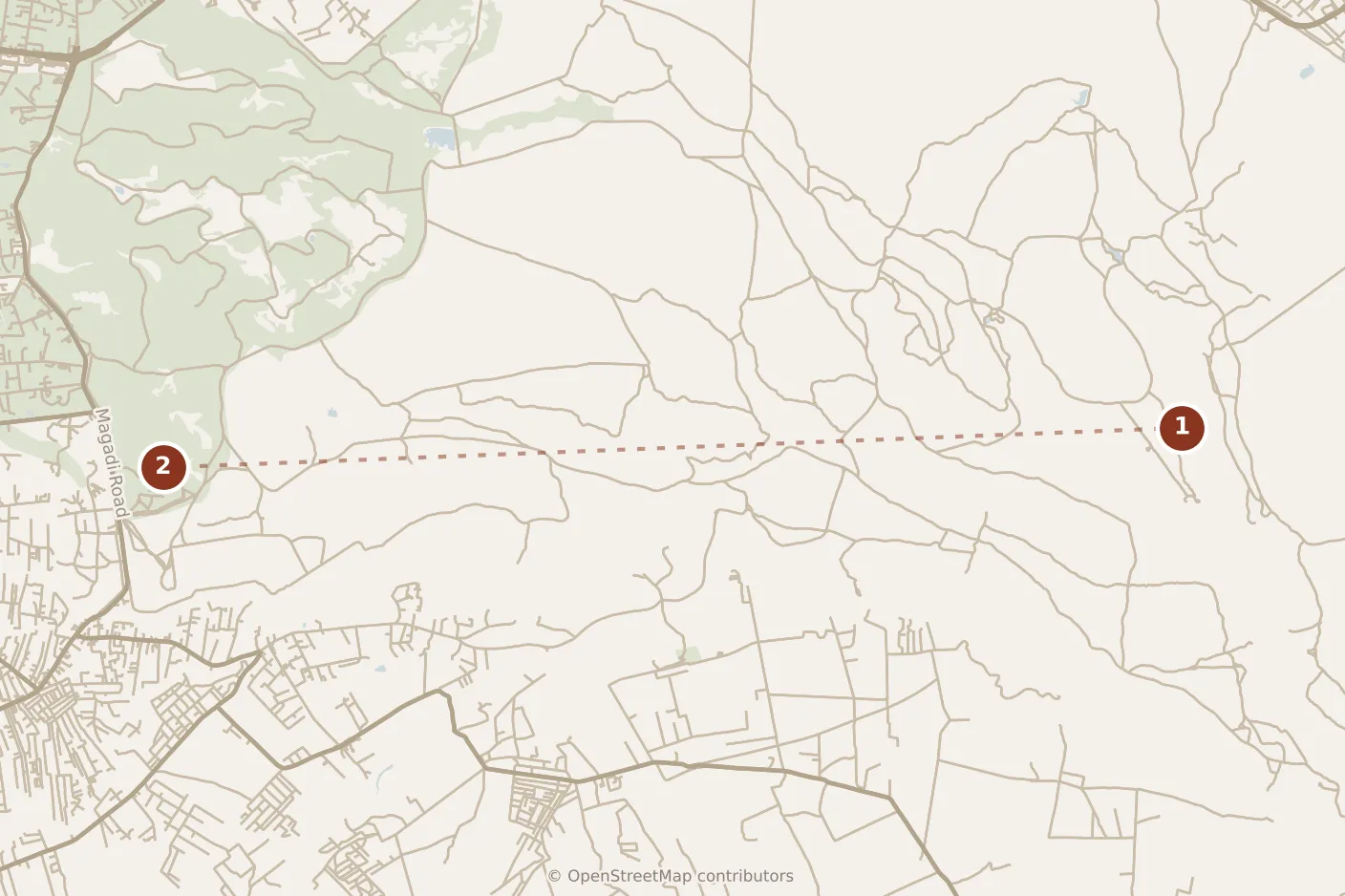
- Morning
- 1Nairobi National Park
- 2Sheldrick Wildlife Trust Nursery
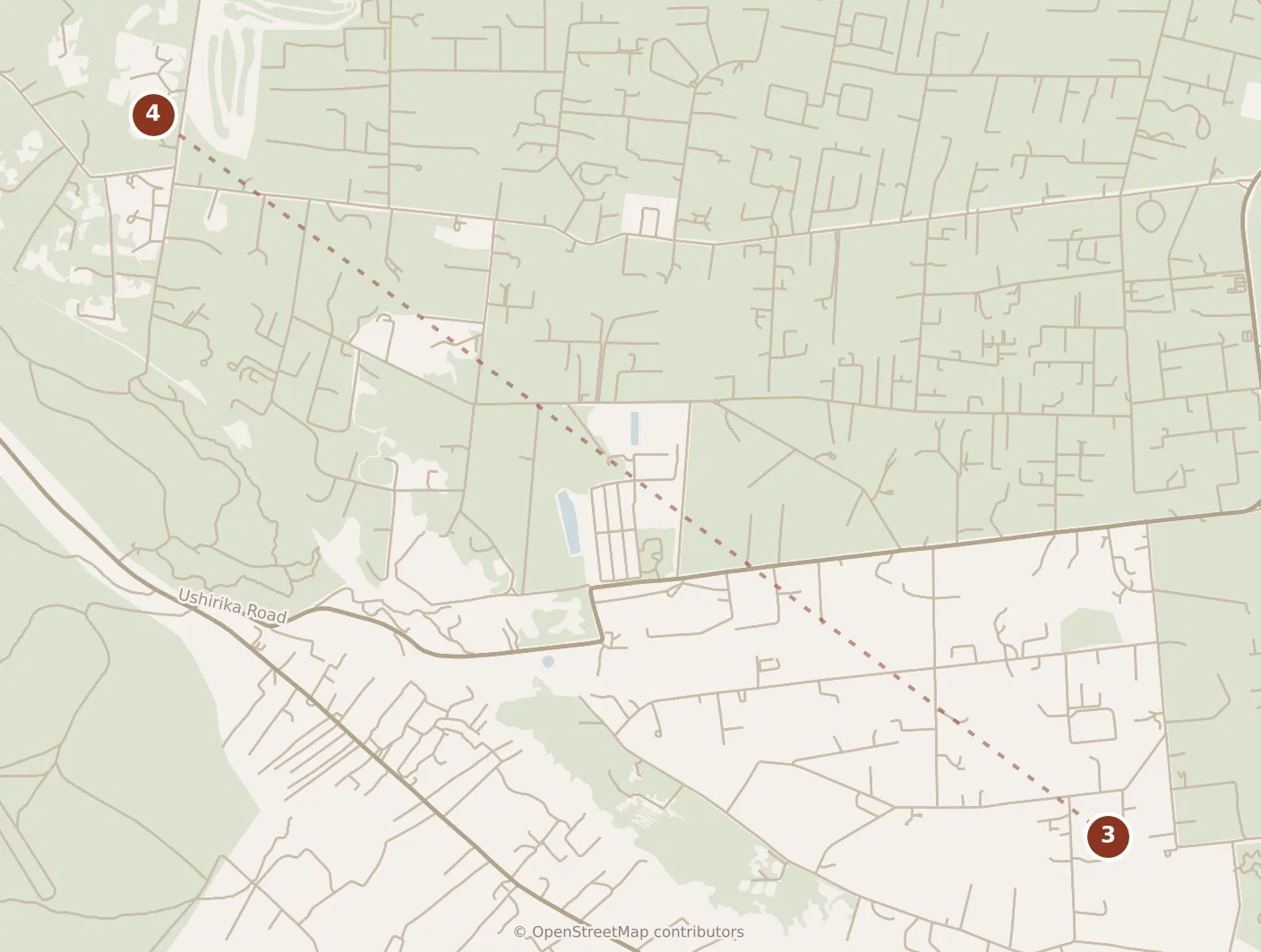
- Afternoon
- 3Giraffe Centre
- 4Karen Blixen Museum
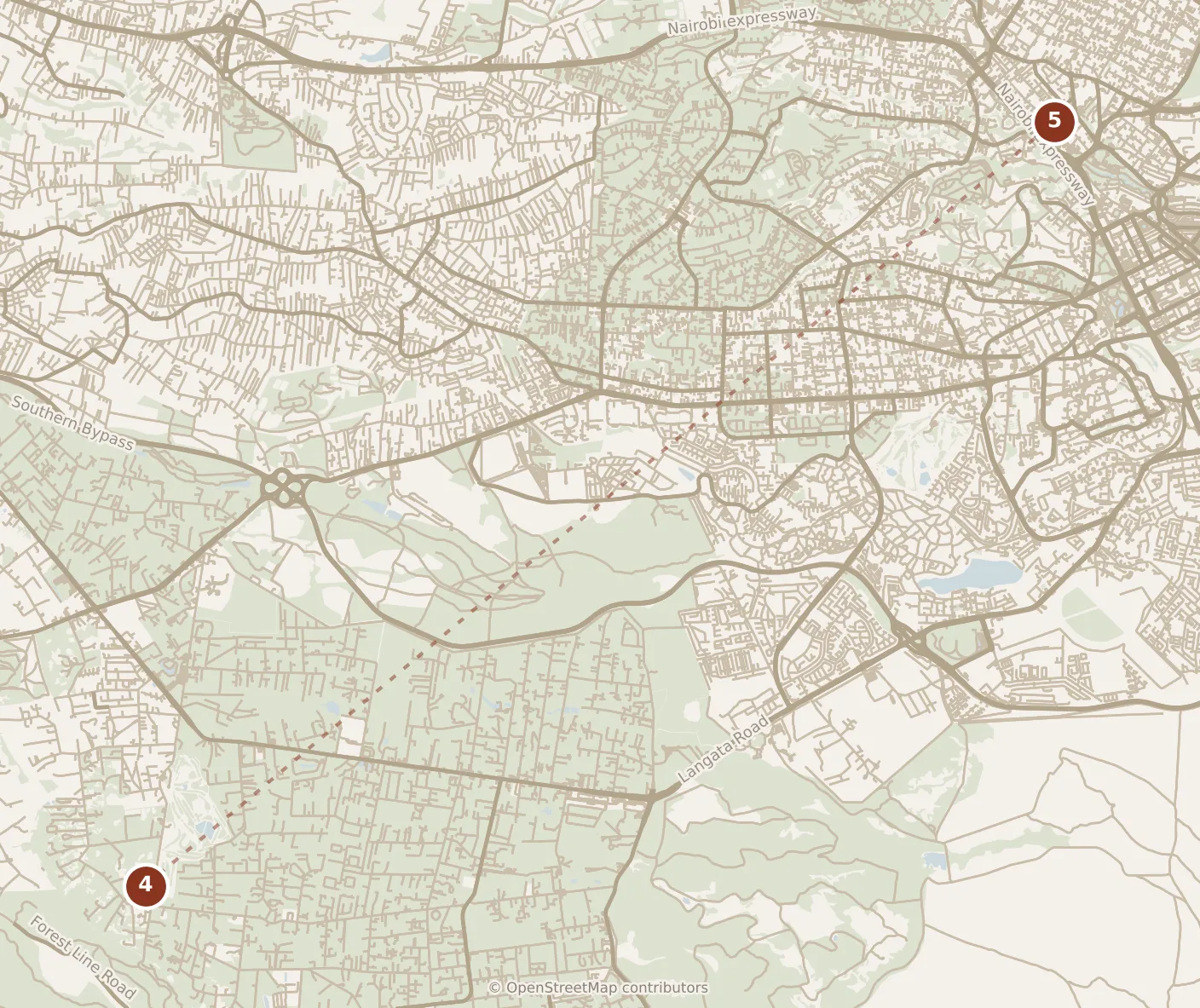
The leg out of the center: from stop 4 by taxi, not on foot.
- Evening
- 5Westlands
Morning
The park gates opened at six in 2026, and six is when to be at them. If the hour has moved, the shape of the morning has not: you want to be inside at first light, and out of the drive with time in hand for eleven.
Nairobi National Park was gazetted in 1946, the first national park in Kenya, and it is a hundred and seventeen square kilometers of open plain and flat-topped acacia beginning a few kilometers from office towers you can see from inside it. It is fenced along its northern, eastern and western sides; the southern boundary is the Mbagathi river and is not fenced at all, so animals move on and off the Athi-Kapiti plains and the Kitengela land beyond it. That is the fact that makes the early start worth it — what you are driving through is a population that comes and goes, not a collection that is kept.
Four of the big five live here, the exception being the elephant, which is a tidy joke given how the morning ends. Lion, buffalo, leopard and black rhino, this being one of the country’s more successful rhino sanctuaries, and something over four hundred species of bird. Give the drive three hours and keep a fourth in reserve. Give most of those three to the open plain rather than to the dry highland forest at the western end near the gates: the forest is handsome and you will see very little in it. Ask for the ivory site while you are in there — in 1989 the president of the day burned twelve tons of confiscated ivory on a spot inside this park, and in 2016 a hundred and five tonnes went the same way on the same ground. The monument marks the burnings together rather than any one of them, it is a ten-minute detour, and it is one of the designated sites where you are allowed out of the car.
Then the elephants. The nursery is run by the Sheldrick Wildlife Trust and stands inside the park, but the Trust brings visitors in through the Kenya Wildlife Service gate on Magadi Road rather than the main gate on Langata Road — which is the one piece of the morning to settle in advance. Which gate you enter at, and whether the ticket you bought at dawn carries you through to the elephants, is a question for the Trust when you book and for your driver the night before. Get a straight answer to it and the rest of the day is simple.
The public hour ran from eleven to noon in 2026, every day of the year except Christmas Day, and it is timed around the orphans’ midday milk feed and mud bath. Be through the gate half an hour before it starts, because the Trust does not delay the beginning for latecomers and does not extend the other end. What happens is that the calves come out of the forest in groups to be fed from bottles, wallow in a mud pit with exactly as much dignity as that suggests, and a senior keeper works the crowd naming each animal and saying where it was found. The bottles are the point of the place. The Trust was founded in 1977 by Daphne Sheldrick after her husband David died, and she was the first person to work out a milk an orphaned calf could actually survive on, having found that coconut oil came nearest to the fat in elephant milk. Everything the Trust has done since rests on that one piece of kitchen chemistry. It is an hour and it is only an hour: plan nothing into the back of it.
Afternoon
Three and a half kilometers west, the Giraffe Centre. It began in 1979 as a breeding program for the Rothschild’s giraffe, which is found only in the grasslands of East Africa, on a private property in Langata; it opened to visitors in 1983, and its offspring have gone out to national parks across the country since. What you do here is climb a raised wooden platform that puts you at giraffe head height and hand over pellets, with warthogs getting underfoot below. Forty-five minutes is the whole of it, and the way to spend them is to stand on the platform and let a giraffe decide to come to you, rather than walking the perimeter looking for one.
Karen is four kilometers north-west of that and lunch belongs there, sitting down. You have been out since before first light and there is one more thing in the afternoon; buying something to carry and pressing on is the wrong economy on a day whose entire middle is a car seat.
The Karen Blixen Museum is the house the suburb is generally said to be named after: a low bungalow with a verandah and a tiled roof, built in 1912 and bought in 1917 by the Danish writer and her husband, who intended to grow coffee on it. She ran the farm alone after they separated and went home to Denmark in 1931 having lost it; the book that made the place famous came six years later. Denmark gave the house to Kenya in 1964 as an independence gift, and it opened as a museum in 1986.
Two things are worth knowing before you walk in. Some of the furniture is the furniture — pieces she sold when she left, tracked down afterwards and bought back. And the 1985 film was not shot here: the production used the earlier farmhouse she had lived in nearby, so if you have come looking for the house on the screen, this is not it, and it is the better house. Guides work continuously and in several languages, and you should take one, because what is interesting here is what happened in the rooms rather than what is in them. An hour with a guide, twenty minutes without, and then the garden and the strip of indigenous forest behind it, looking out towards the Ngong Hills. The suburb you are standing in is the coffee farm: it was cut into plots after she gave up on it.
Local tip. If the gate and ticket question cannot be settled cleanly before you travel, invert the morning rather than drop anything from it: take the elephants at eleven and the game drive afterwards, which is what the Trust itself suggests to visitors. That costs you the house, not the elephants, and a midday drive is a worse drive than a dawn one — but a worse drive is not a wasted morning, and a missed booking is a wasted day.
Evening
Westlands is fifteen kilometers north-east of Karen, and getting there is the one long drive of the day, taken at the hour it is worst. Do it anyway. The center is not where a Nairobi evening happens — the city guide explains why — and Westlands is the district where the eating and the drinking sit within a few streets of each other. Keep the hops between them short and ask your driver which ones, rather than taking the walk as given: travel advice for Kenya is blunt about street crime in the big cities, and the end of the night is a car.
What to eat is nyama choma, roast goat or beef eaten with the hands, which is the meal this day has earned. A start before first light and ten hours out of doors is the correct preparation for it.
Then close the loop, and it closes badly if nobody has thought about it. This day finishes a long way from both airports. Jomo Kenyatta International Airport is on the far side of the city from Westlands, and the Nairobi Expressway is the road that makes that crossing survivable at the end of an evening; the city guide covers it, and your driver will know it better than either of us. Wilson Airport is the happier case. The light aircraft to the game parks leave from there, it is about twelve kilometers from the Karen Blixen Museum and it sits on the same side of town as everything above — so a reader with an afternoon flight out of it can take this day as far as the giraffes and reach the airfield without crossing the city at all.
Practicalities
Two things on this route must be arranged before you travel: the nursery visit, and the park ticket, which is bought online and not at the gate. The nursery bookings are made by email with the Trust’s Nairobi office, for dates up to three months ahead; same-day booking is not possible, and they ask for two working days to reply, so leave rather more room than that. One trap deserves naming: the Trust does not honor bookings made through the large third-party experience platforms, whatever those platforms advertise, and only its own confirmation email admits you. If an operator or a driver books on your behalf, ask them to forward you that email, and bring it. Everything else about moving around this city — the ride-hailing apps, the expressway, why you ride between districts instead of walking them — is in the city guide, and this day changes none of it.
There are two payments and they are separate. Since 2023 the wildlife service has required every nursery visitor to pay the national park entry fee whether or not they go on into the park, which is the fact that turns the dawn game drive from an indulgence into good value: you are buying that ticket regardless. The non-resident adult rate was in the eighty-dollar range in 2026 — the park service publishes non-resident fees in dollars rather than shillings, so do not go looking for a shilling price — and the vehicle is charged on top of the people in it. Since November 2025 the wildlife service has sold this ticket through KWSPay, a portal on the government’s eCitizen platform. Buy it there before you travel, and carry the passport that matches the rate you paid, because that is what is checked against the ticket at the gate. The gate does not take cash at all, so buying it on arrival is not the slower option but no option, and turning up without a ticket is what would cost you the eleven o’clock. The nursery’s own entry donation was in the twenty-dollar range per adult in 2026, is separate from the park fee, and in 2026 was collected in cash on the day rather than paid in advance.
Closures barely bite on this route, which is one of its virtues, but there are two to check. The nursery runs every day of the year except Christmas Day, so on the twenty-fifth of December this day has no anchor and nothing to put in its place; the honest move is a different date, not a different route. The Karen Blixen Museum, by contrast, opens every day of the year, public holidays included, so what is worth checking there is not the day but the hour it shuts: two different closing times circulate for it, and this day reaches Karen with most of the afternoon already spent. Take the museum service page as the one that counts, not a listing site. If the house falls through anyway, the drive into town and the Nairobi National Museum instead — open every day of the year as well — is the one swap this geography allows, and it is worth knowing that it exists rather than discovering it at a locked gate in Karen.
Moving between the stops is one vehicle and one driver from the gate at dawn to wherever the evening ends, for the reason given in the Overview: the park requires a car, so you may as well keep it. The distances are small until they are not — three and a half kilometers from the nursery to the giraffes, four from the giraffes to the house — and then fifteen back into town, which is the only leg on this itinerary worth building an evening around.


.jpg)
